maintenance CADILLAC CT5 2023 User Guide
[x] Cancel search | Manufacturer: CADILLAC, Model Year: 2023, Model line: CT5, Model: CADILLAC CT5 2023Pages: 526, PDF Size: 6.85 MB
Page 243 of 526
Cadillac CT5 Owner Manual (GMNA-Localizing-U.S./Canada-16500419) -
2023 - CRC - 5/10/22
242 Driving and Operating
.Keep vehicle tires properly
inflated.
.Combine several trips into a
single trip.
.Replace the vehicle's tires
with the same TPC Spec
number molded into the
tire's sidewall near the size.
.Follow recommended
scheduled maintenance.
Distracted Driving
Distraction comes in many
forms and can take your focus
from the task of driving.
Exercise good judgment and
do not let other activities
divert your attention away
from the road. Many local
governments have enacted
laws regarding driver
distraction. Become familiar
with the local laws in
your area.
To avoid distracted driving,
keep your eyes on the road,
keep your hands on the
steering wheel, and focus your
attention on driving.
.Do not use a phone in
demanding driving situations.
Use a hands-free method to
place or receive necessary
phone calls.
.Watch the road. Do not read,
take notes, or look up
information on phones or
other electronic devices.
.Designate a front seat
passenger to handle
potential distractions.
.Become familiar with vehicle
features before driving, such
as programming favorite
radio stations and adjusting
climate control and seat
settings. Program all trip
information into any
navigation device prior to
driving.
.Wait until the vehicle is
parked to retrieve items that
have fallen to the floor.
.Stop or park the vehicle to
tend to children.
.Keep pets in an appropriate
carrier or restraint.
.Avoid stressful
conversations while driving,
whether with a passenger or
on a cell phone.
{Warning
Taking your eyes off the
road too long or too often
could cause a crash
resulting in injury or death.
Focus your attention on
driving.
Refer to the infotainment
section for more information
on using that system and the
navigation system, if equipped,
including pairing and using a
cell phone.
Defensive Driving
Defensive driving means
“always expect the
unexpected.” The first step in
driving defensively is to wear
the seat belt. See Seat Belts
0 55.
Page 245 of 526

Cadillac CT5 Owner Manual (GMNA-Localizing-U.S./Canada-16500419) -
2023 - CRC - 5/10/22
244 Driving and Operating
Steering
Caution
To avoid damage to the
steering system, do not
drive over curbs, parking
barriers, or similar objects at
speeds greater than 3 km/h
(1 mph). Use care when
driving over other objects
such as lane dividers and
speed bumps. Damage
caused by misuse of the
vehicle is not covered by the
vehicle warranty.
Variable Effort Steering
The vehicle has a steering
system that varies the amount
of effort required to steer the
vehicle in relation to the speed
of the vehicle.
The amount of steering effort
required is less at slower
speeds to make the vehicle
more maneuverable and easier
to park. At faster speeds, the
steering effort increases to
provide a sport-like feel to the
steering. This provides
maximum control and stability.
Electric Power Steering
The vehicle is equipped with
an electric power steering
system, which reduces the
amount of effort needed to
steer the vehicle. It does not
have power steering fluid.
Regular maintenance is not
required.
If the vehicle experiences a
system malfunction and loses
power steering, greater
steering effort may berequired. Power steering
assist also may be reduced if
you turn the steering wheel as
far as it can turn and hold it
there with force for an
extended period of time.
See your dealer if there is a
problem.
Curve Tips
.Take curves at a reasonable
speed.
.Reduce speed before
entering a curve.
.Maintain a reasonable
steady speed through the
curve.
.Wait until the vehicle is out
of the curve before
accelerating gently into the
straightaway.
Steering in Emergencies
.There are some situations
when steering around a
problem may be more
effective than braking.
Page 303 of 526

Cadillac CT5 Owner Manual (GMNA-Localizing-U.S./Canada-16500419) -
2023 - CRC - 5/10/22
302 Driving and Operating
Launch Control will initially
limit engine speed as you
rapidly apply the accelerator
pedal to wide open throttle.
Allow the engine rpm to
stabilize. A smooth, quick
release of the brake pedal,
while maintaining the fully
pressed accelerator pedal, will
manage wheel slip.
After the vehicle is launched,
the system continues in
Competitive Driving Mode
or PTM.
Competitive Driving Mode,
PTM, and Launch Control are
systems designed for a closed
course race track and not
intended for public roads. The
systems are not intended to
compensate for lack of driver
experience or familiarity with
the race track.Limited-Slip
Differential
If equipped, the Electronic
Limited-Slip Differential (eLSD)
is automatically activated.
eLSD actively monitors vehicle
sensors and driver inputs to
determine the amount of
change for the conditions.
With eLSD, the vehicle has:
.Enhanced high-speed
control.
.Improved traction through
corners, allowing more
acceleration.
.More precise steering.
.Increased vehicle agility.
.Integration with StabiliTrak/
Electronic Stability
Control (ESC).
For vehicles with eLSD, driven
under severe conditions, the
rear axle fluid should be
changed. See Competitive
Driving Mode 0299 and
Maintenance Schedule 0471.
Cruise Control
{
Warning
Cruise control can be
dangerous where you
cannot drive safely at a
steady speed. Do not use
cruise control on winding
roads or in heavy traffic.
Cruise control can be
dangerous on slippery roads.
On such roads, fast changes
in tire traction can cause
excessive wheel slip, and
you could lose control. Do
not use cruise control on
slippery roads.
With cruise control, a speed of
about 40 km/h (25 mph) or
more can be maintained
without keeping your foot on
the accelerator. Cruise control
does not work at speeds
below about 40 km/h (25 mph).
If equipped with a manual
transmission, the cruise
control will remain active when
Page 362 of 526

Cadillac CT5 Owner Manual (GMNA-Localizing-U.S./Canada-16500419) -
2023 - CRC - 5/10/22
Driving and Operating 361
in reduced performance and
driveability. If heavy knocking
is heard when using gasoline
rated at 91 or greater, the
engine needs service.
Do not use any fuel labeled
E85 or FlexFuel. Do not use
gasoline with ethanol levels
greater than 15% by volume.
Recommended Fuel
(LGY 3.0L V6 and
LT4 6.2L V8 Engines)
Premium unleaded gasoline
meeting ASTM specification
D4814 with a posted octane
rating (R+M)/2 of 91 or greater
is required. The use of the
correct fuel is an important
part of the proper
maintenance of the vehicle
and a condition of the vehiclewarranty. If heavy knocking is
heard when using gasoline
rated at 91 or greater, the
engine needs service.
Do not use any fuel labeled
E85 or FlexFuel. Do not use
gasoline with ethanol levels
greater than 15% by volume.
Prohibited Fuels
Caution
Do not use fuels with any of
the following conditions;
doing so may damage the
vehicle and void its
warranty:
.For vehicles that are not
FlexFuel, fuel labeled
greater than 15% ethanol
by volume, such as
mid-level ethanol blends
(16–50% ethanol), E85,
or FlexFuel.
.Fuel with any amount of
methanol, methylal,
ferrocene, and aniline.
These fuels can corrode
(Continued)
Caution (Continued)
metal fuel system parts or
damage plastic and rubber
parts.
.Fuel containing metals
such as
methylcyclopentadienyl
manganese tricarbonyl
(MMT), which can damage
the emissions control
system and spark plugs.
.Fuel with a posted octane
rating of less than the
recommended fuel. Using
this fuel will lower fuel
economy and
performance, and may
decrease the life of the
emissions catalyst.
Fuels in Foreign
Countries
The U.S., Canada, and Mexico
post fuel octane ratings in
anti-knock index (AKI). For fuel
not to use in a foreign country,
see Prohibited Fuels 0361.
Page 369 of 526
Cadillac CT5 Owner Manual (GMNA-Localizing-U.S./Canada-16500419) -
2023 - CRC - 5/10/22
368 Driving and Operating
transmission in P (Park) for a
few minutes before turning
the engine off. If the overheat
warning comes on, see Engine
Overheating0398.
Parking on Hills
{Warning
To prevent serious injury or
death, always park your
vehicle and trailer on a level
surface when possible.
When parking your vehicle and
your trailer on a hill: 1. Press the brake pedal, but do not shift into P (Park)
yet. Turn the wheels into
the curb if facing downhill
or into traffic if facing
uphill.
2. Have someone place chocks under the trailer
wheels. 3. When the wheel chocks
are in place, gradually
release the brake pedal to
allow the chocks to absorb
the load of the trailer.
4. Reapply the brake pedal. Then apply the parking
brake and shift into
P (Park).
5. Release the brake pedal.
Leaving After Parking on
a Hill
1. Apply and hold the brake pedal.
.Start the engine.
.Shift into the
desired gear.
.Release the parking
brake.
2. Let up on the brake pedal.
3. Drive slowly until the trailer is clear of the chocks.
4. Stop and have someone pick up and store the
chocks.
Maintenance when Trailer
Towing
The vehicle needs service
more often when used to tow
trailers. See Maintenance
Schedule 0471. It is especially
important to check the
automatic transmission fluid,
engine oil, axle lubricant, belts,
cooling system, and brake
system before and during
each trip.
Check periodically that all nuts
and bolts on the trailer hitch
are tight.
Engine Cooling when
Trailer Towing
The cooling system may
temporarily overheat during
severe operating conditions.
See Engine Overheating
0 398.
Page 373 of 526

Cadillac CT5 Owner Manual (GMNA-Localizing-U.S./Canada-16500419) -
2023 - CRC - 5/10/22
372 Driving and Operating
and the trailer brakes may not
function, which could result in
a crash.
Turn Signals When
Towing a Trailer
When properly connected, the
trailer turn signals will
illuminate to indicate the
vehicle is turning, changing
lanes, or stopping. When
towing a trailer, the arrows on
the instrument cluster will
illuminate even if the trailer is
not properly connected or the
bulbs are burned out.
Conversions and
Add-Ons
Add-On Electrical
Equipment
{Warning
The Data Link Connector
(DLC) is used for vehicle
service and Emission
Inspection/Maintenance
testing. See Malfunction
Indicator Lamp (Check
Engine Light)0125. A device
connected to the DLC —
such as an aftermarket fleet
or driver-behavior tracking
device —may interfere with
vehicle systems. This could
affect vehicle operation and
cause a crash. Such devices
may also access information
stored in the vehicle’s
systems.
Caution
Some electrical equipment
can damage the vehicle or
cause components to not
work and would not be
covered by the vehicle
warranty. Always check with
your dealer before adding
electrical equipment.
Add-on equipment can drain
the vehicle's 12-volt battery,
even if the vehicle is not
operating.
The vehicle has an airbag
system. Before attempting to
add anything electrical to the
vehicle, see Servicing the
Airbag-Equipped Vehicle 077
and
Adding Equipment to the
Airbag-Equipped Vehicle 077.
Page 376 of 526
Cadillac CT5 Owner Manual (GMNA-Localizing-U.S./Canada-16500419) -
2023 - CRC - 5/6/22
Vehicle Care 375
traction control, and stability
control. These accessories or
modifications could even
cause malfunction or damage
not covered by the vehicle
warranty.
Damage to suspension
components caused by
modifying vehicle height
outside of factory settings will
not be covered by the vehicle
warranty.
Damage to vehicle
components resulting from
modifications or the
installation or use of non-GM
certified parts, including
control module or software
modifications, is not covered
under the terms of the vehicle
warranty and may affect
remaining warranty coverage
for affected parts.
GM Accessories are designed
to complement and function
with other systems on the
vehicle. See your dealer to
accessorize the vehicle usinggenuine GM Accessories
installed by a dealer
technician.
Also, see Adding Equipment to
the Airbag-Equipped Vehicle
0
77.
Vehicle Checks
Doing Your Own
Service Work
{Warning
It can be dangerous to work
on your vehicle if you do not
have the proper knowledge,
service manual, tools,
or parts. Always follow
owner’s manual procedures
and consult the service
manual for your vehicle
before doing any
service work. If doing some of your own
service work, use the proper
service manual. It tells you
much more about how to
service the vehicle than this
manual can. To order the
proper service manual, see
Publication Ordering
Information
0496.
This vehicle has an airbag
system. Before attempting to
do your own service work, see
Servicing the Airbag-Equipped
Vehicle 077.
If equipped with remote
vehicle start, open the hood
before performing any service
work to prevent remote
starting the vehicle
accidentally. See Remote
Vehicle Start 016.
Keep a record with all parts
receipts and list the mileage
and the date of any service
work performed. See
Maintenance Records 0479.
Page 389 of 526
Cadillac CT5 Owner Manual (GMNA-Localizing-U.S./Canada-16500419) -
2023 - CRC - 5/6/22
388 Vehicle Care
Automatic
Transmission Fluid
How to Check Automatic
Transmission Fluid
It is not necessary to check
the transmission fluid level.
A transmission fluid leak is the
only reason for fluid loss. If a
leak occurs, take the vehicle to
your dealer and have it
repaired as soon as possible.
The vehicle is not equipped
with a transmission fluid level
dipstick. There is a special
procedure for checking and
changing the transmission
fluid. Because this procedure
is difficult, this should be done
at the dealer. Contact your
dealer for additional
information.
Caution
Use of the incorrect
automatic transmission fluid
may damage the vehicle, and(Continued)
Caution (Continued)
the damage may not be
covered by the vehicle
warranty. Always use the
correct automatic
transmission fluid. See
Recommended Fluids and
Lubricants0476.
Change the fluid and filter at
the intervals listed in
Maintenance Schedule 0471,
and be sure to use the fluid
listed in Recommended Fluids
and Lubricants 0476.
Manual Transmission
Fluid
It is not necessary to check
the manual transmission fluid
level. A transmission fluid leak
is the only reason for fluid
loss. If a leak occurs, take the
vehicle to your dealer and
have it repaired as soon as
possible. See Recommended
Fluids and Lubricants 0476
for the proper fluid to use.
Hydraulic Clutch
For vehicles with a manual
transmission, it is not
necessary to regularly check
brake/clutch fluid unless there
is a leak suspected. Adding
fluid will not correct a leak.
A fluid loss in this system
could indicate a problem. Have
the system inspected and
repaired.
When to Check and What
to Use
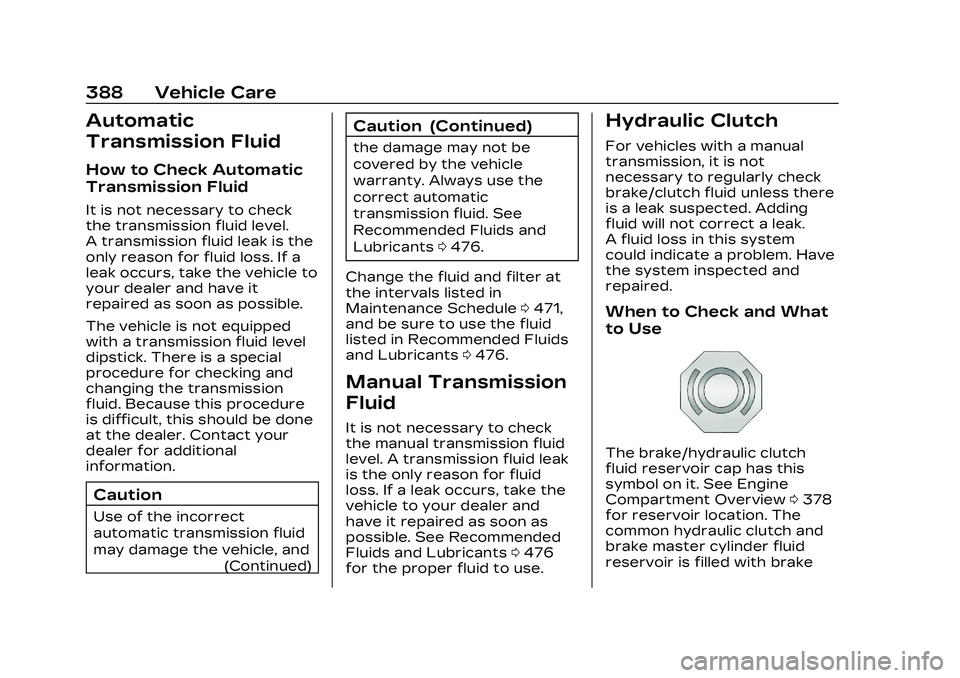
The brake/hydraulic clutch
fluid reservoir cap has this
symbol on it. See Engine
Compartment Overview 0378
for reservoir location. The
common hydraulic clutch and
brake master cylinder fluid
reservoir is filled with brake
Page 391 of 526

Cadillac CT5 Owner Manual (GMNA-Localizing-U.S./Canada-16500419) -
2023 - CRC - 5/6/22
390 Vehicle Care
compartment for the 3.0L
V6 engine. See Engine
Compartment Overview0378.
When to Inspect the
Engine Air Cleaner/Filter
.For intervals on changing
and inspecting the engine air
filter, see Maintenance
Schedule 0471.
.If equipped with Engine Air
Filter Life System, see
Engine Air Filter Life System
0389.
.If driving in very dusty areas,
follow the engine air filter
inspecting and changing
intervals, see Maintenance
Schedule 0471.
How to Inspect/Replace
the Engine Air Cleaner/
Filter
Do not start the engine or
have the engine running with
the engine air cleaner/filter
housing open. Before
removing the engine air
cleaner/filter, make sure that
the engine air cleaner/filter housing and nearby
components are free of dirt
and debris. Do not clean the
engine air cleaner/filter or
components with water or
compressed air.
{Warning
Operating the engine with
the air cleaner/filter off can
cause you or others to be
burned. Use caution when
working on the engine. Do
not start the engine or drive
the vehicle with the air
cleaner/filter off, as flames
may be present if the engine
backfires.
Caution
If the air cleaner/filter is off,
dirt can easily get into the
engine, which could damage
it. Always have the air
cleaner/filter in place when
driving.
To inspect or replace the air
cleaner/filter:
2.0L L4 Engine
1. Remove the five screws on top of the air cleaner/filter
cover.
2. Lift the air/cleaner/filter cover away from the air
cleaner/filter housing.
3. Pull out the air cleaner/ filter.
Page 395 of 526

Cadillac CT5 Owner Manual (GMNA-Localizing-U.S./Canada-16500419) -
2023 - CRC - 5/6/22
394 Vehicle Care
Engine Coolant
The cooling system in the
vehicle is filled with
DEX-COOL engine coolant.
See Maintenance Schedule
0471 and
Recommended Fluids and
Lubricants 0476.
The following explains the
cooling system and how to
check and add coolant when it
is low. If there is a problem
with engine overheating, see
Engine Overheating 0398.
What to Use
{Warning
Do not touch heater or
radiator hoses, or other
engine parts. They can be
very hot and can burn you.
Do not run the engine if
there is a leak; all coolant
could leak out. That could
cause an engine fire and can
burn you. Fix any leak before
driving the vehicle. Use a 50/50 mixture of clean
drinkable water and
DEX-COOL coolant. This
mixture:
.Gives freezing protection
down to
−37 °C (−34 °F),
outside temperature.
.Gives boiling protection up
to 129 °C (265 °F), engine
temperature.
.Protects against rust and
corrosion.
.Will not damage aluminum
parts.
.Helps keep the proper
engine temperature.
Caution
Do not use anything other
than a mix of DEX-COOL
coolant that meets GM
Standard GMW3420 and
clean, drinkable water.
Anything else can cause
damage to the engine
cooling system and the
(Continued)
Caution (Continued)
vehicle, which would not be
covered by the vehicle
warranty.
Never dispose of engine
coolant by putting it in the
trash, pouring it on the
ground, or into sewers,
streams, or bodies of water.
Have the coolant changed by
an authorized service center,
familiar with legal
requirements regarding used
coolant disposal. This will help
protect the environment and
your health.
Checking Coolant
The vehicle must be on a level
surface when checking the
coolant level.
It is normal to see coolant
moving in the upper coolant
hose return line when the
engine is running. It is also
normal to see bubbles
entering the surge tank
through the small hose.