weight CADILLAC CT5 2023 User Guide
[x] Cancel search | Manufacturer: CADILLAC, Model Year: 2023, Model line: CT5, Model: CADILLAC CT5 2023Pages: 526, PDF Size: 6.85 MB
Page 265 of 526

Cadillac CT5 Owner Manual (GMNA-Localizing-U.S./Canada-16500419) -
2023 - CRC - 5/10/22
264 Driving and Operating
Example 2
1.Vehicle Capacity
Weight for Example 2
= 453 kg (1,000 lbs).
2.Subtract Occupant
Weight @ 68 kg
(150 lbs) × 5 = 340 kg
(750 lbs).
3.Available Cargo
Weight = 113 kg
(250 lbs).
Example 3
1.Vehicle Capacity
Weight for Example 3
= 453 kg (1,000 lbs).
2.Subtract Occupant
Weight @ 91 kg
(200 lbs) × 5 = 453 kg
(1,000 lbs).
3.Available Cargo
Weight = 0 kg (0 lbs).
Refer to the vehicle's Tire
and Loading Information
label for specific
information about the
vehicle's capacity weight and seating positions. The
combined weight of the
driver, passengers, and
cargo should never exceed
the vehicle's capacity
weight.
Certification Label
Label Example
A vehicle-specific
Certification label is
attached to the vehicle's
center pillar (B-pillar). The
label may show the gross
weight capacity of the
vehicle, called the Gross
Page 266 of 526

Cadillac CT5 Owner Manual (GMNA-Localizing-U.S./Canada-16500419) -
2023 - CRC - 5/10/22
Driving and Operating 265
Vehicle Weight Rating
(GVWR). The GVWR
includes the weight of the
vehicle, all occupants, fuel,
and cargo.
{Warning
Things inside the vehicle
can strike and injure
people in a sudden stop
or turn, or in a crash.
.Put things in the cargo
area of the vehicle. In
the cargo area, put
them as far forward as
possible. Try to spread
the weight evenly.
.Never stack heavier
things, like suitcases,
inside the vehicle so
that some of them are
above the tops of the
seats.
(Continued)
Warning (Continued)
.Do not leave an
unsecured child
restraint in the vehicle.
.Secure loose items in
the vehicle.
.Do not leave a seat
folded down unless
needed.
Starting and
Operating
New Vehicle Break-In
Caution
Follow these recommended
guidelines during the first
2 414 km (1,500 mi) of driving
this vehicle. Parts have a
break-in period and
performance will be better in
the long run.
.Avoid full throttle starts
and abrupt stops. (Continued)
Caution (Continued)
.Do not exceed 4000
engine rpm.
.Avoid driving at any one
constant speed, fast
or slow.
.Do not drive above
129 km/h (80 mph).
.Avoid downshifting to
brake or slow the vehicle
when the engine speed
will exceed 4000 rpm.
.Do not let the engine
labor. Never lug the engine
in high gear at low speeds.
With a manual
transmission, shift to the
next lower gear. This rule
applies at all times, not
just during the break-in
period.
.Do not participate in
racing events, sport
driving schools, or similar
activities during this
break-in period.
(Continued)
Page 370 of 526

Cadillac CT5 Owner Manual (GMNA-Localizing-U.S./Canada-16500419) -
2023 - CRC - 5/10/22
Driving and Operating 369
Trailer Towing (LSY
2.0L L4 and LGY 3.0L
V6 Engines Only)
Caution
Towing a trailer improperly
can damage the vehicle and
result in costly repairs not
covered by the vehicle
warranty. To tow a trailer
correctly, follow the
directions in this section and
see your dealer for
important information about
towing a trailer with the
vehicle.
Never tow a trailer with a
V-Series or V-Series
Blackwing. These models are
not designed or intended to
tow a trailer.
Trailer Weight
{Warning
Never exceed the towing
capacity for your vehicle.
Safe trailering requires
monitoring the weight, speed,
altitude, road grades, outside
temperature, dimensions of
the front of the trailer, and
how frequently the vehicle is
used to tow a trailer.
Before towing a trailer, always
separately weigh:
.the total weight on the
vehicle's tires.
.the trailer.
.the trailer tongue.
{Warning
You and others could be
seriously injured or killed if
the trailer is too heavy or
the trailer brakes are
inadequate for the load. The
vehicle may be damaged, (Continued)
Warning (Continued)
and the repairs would not be
covered by the vehicle
warranty.
Only tow a trailer if all the
steps in this section have
been followed. Ask your
dealer for advice and
information about towing a
trailer.
Gross Vehicle Weight
Rating (GVWR)
For information about the
vehicle's maximum load
capacity, see Vehicle Load
Limits0261. When calculating
the GVWR with a trailer
attached, the trailer tongue
weight must be included as
part of the weight the vehicle
is carrying.
Page 371 of 526

Cadillac CT5 Owner Manual (GMNA-Localizing-U.S./Canada-16500419) -
2023 - CRC - 5/10/22
370 Driving and Operating
Maximum Trailer Weight
The trailer should never weigh
more than 454 kg (1,000 lb).
The maximum allowable
weight of the trailer may be
lower based on the weight of
the passengers and cargo in
your trailer.
The maximum trailer weight
rating is calculated assuming
only the driver is in the tow
vehicle and it has all the
required trailering equipment.
The weight of additional
optional equipment,
passengers, and cargo in the
tow vehicle must be
subtracted from the maximum
trailer weight.
Trailer Load Balance
The correct trailer load
balance must be maintained to
ensure trailer stability.
Incorrect load balance is a
leading cause of trailer sway.
The trailer tongue weight (1)
should be 10–15% of the
loaded trailer weight (2). Some
specific trailer types, such as
boat trailers, fall outside of
this range. Always refer to the
trailer owner’s manual for the
recommended trailer tongue
weight for each trailer. Never
exceed the maximum loads for
your vehicle, hitch, and trailer.
After loading the trailer,
separately weigh the trailer
and then the trailer tongue
and calculate the trailer load
balance percentage to see if
the weights and distributionare appropriate for your
vehicle. If the trailer weight is
too high, it may be possible to
transfer some of the cargo
into your vehicle. If the trailer
tongue weight is too high or
too low, it may be possible to
rearrange some of the cargo
inside of the trailer.
Do not exceed the maximum
allowable tongue weight for
your vehicle. Use the shortest
hitch extension available to
position the hitch ball closer to
your vehicle. This will help
reduce the effect of the trailer
tongue weight on the trailer
hitch and the rear axle.
If a cargo carrier is used in the
trailer hitch receiver, choose a
carrier that positions the load
as close to the vehicle as
possible. Make sure the total
weight, including the carrier, is
no more than half of the
maximum allowable tongue
weight for the vehicle or
227 kg (500 lb), whichever
is less.
Page 372 of 526

Cadillac CT5 Owner Manual (GMNA-Localizing-U.S./Canada-16500419) -
2023 - CRC - 5/10/22
Driving and Operating 371
Ask your dealer for trailering
information or assistance.
Towing Equipment
Hitches
Always use the correct hitch
equipment for your vehicle.
Crosswinds, large trucks going
by, and rough roads can affect
the trailer and the hitch.
Never attach rental hitches or
other bumper-type hitches.
Only use frame-mounted
hitches that do not attach to
the bumper.
Always seal any holes in your
vehicle if the trailer hitch
removed. If not sealed, dirt,
water, and carbon monoxide
(CO) from the exhaust may
enter your vehicle. See Engine
Exhaust0276.
Consider using mechanical
sway controls with any trailer.
Ask a trailering professional
about sway controls or refer to the trailer manufacturer's
recommendations and
instructions.
Tires
.Do not tow a trailer while
using a compact spare tire
on the vehicle.
.Tires must be properly
inflated to support loads
while towing a trailer. See
Tires
0418 for instructions
on proper tire inflation.
Safety Chains
Always attach chains between
the vehicle and the trailer, and
attach the chains to the holes
on the trailer hitch platform.
Instructions about safety
chains may be provided by the
hitch manufacturer or by the
trailer manufacturer.
Cross the safety chains under
the tongue of the trailer to
help prevent the tongue from
contacting the road if it
becomes separated from the
hitch. Always leave just
enough slack so the combination can turn. Never
allow safety chains to drag on
the ground.
Trailer Brakes
Loaded trailers over 450 kg
(1,000 lb) must be equipped
with brake systems and with
brakes for each axle. Trailer
braking equipment conforming
to Canadian Standards
Association (CSA) requirement
CAN3-D313, or its equivalent,
is recommended.
State or local regulations may
require trailers to have their
own braking system if the
loaded weight of the trailer
exceeds certain minimums
that can vary from state to
state. Read and follow the
instructions for the trailer
brakes so they are installed,
adjusted, and maintained
properly. Never attempt to tap
into your vehicle's hydraulic
brake system. If you do, both
the vehicle anti-lock brakes
Page 403 of 526

Cadillac CT5 Owner Manual (GMNA-Localizing-U.S./Canada-16500419) -
2023 - CRC - 5/6/22
402 Vehicle Care
Brake Rotor Wear
(V-Series Blackwing With
J57 Carbon Ceramic
Rotors)
The V-Series Blackwing with
J57 has carbon ceramic brake
rotors. The rotors should be
visually inspected whenever
the brake pads are replaced.
Carbon ceramic brake rotors
also need to be weighed
before brake pads are
replaced to confirm that the
rotor mass is greater than the
wear-out mass printed on the
rotor. The rotor can be reused
if the weight of the rotor is
above the mass limit. Carbon
ceramic brake rotors
inspection and weighing
methods can be found in the
service manual.
V-Series Blackwing Brake
Burnish Procedure for
Corrosion Cleanup
Corrosion spotting and
grooving on the brake rotor
surface may appear after the
vehicle sits for an extended
period of time, especially in
high humidity. This corrosion
may result in brake pulsation
and noise. To help restore
optimal braking performance
and reduce noise, complete
the following procedure:
Caution
Performing the brake
burnish procedure on a base
brake system can result in
brake damage.
Perform this procedure only
on dry pavement, in a safe
manner, and in compliance
with all local and state
ordinances/laws regarding
motor vehicle operation.
Caution
The new vehicle break-in
period should be completed
before performing the brake
burnishing procedure or
damage may occur to the
powertrain/engine. See New
Vehicle Break-In 0265.
Caution
Brake fade can occur during
this burnish procedure and
can cause brake pedal travel
and force to increase. This
could extend stopping
distance until the brakes are
fully burnished.
Completing the following
procedure as instructed will
not damage the brakes. The
brake pads may smoke and
produce an odor. The braking
force and pedal travel may
increase. After the procedure,
the brake pads may appear
white at the rotor contact.
Page 426 of 526
Cadillac CT5 Owner Manual (GMNA-Localizing-U.S./Canada-16500419) -
2023 - CRC - 5/6/22
Vehicle Care 425
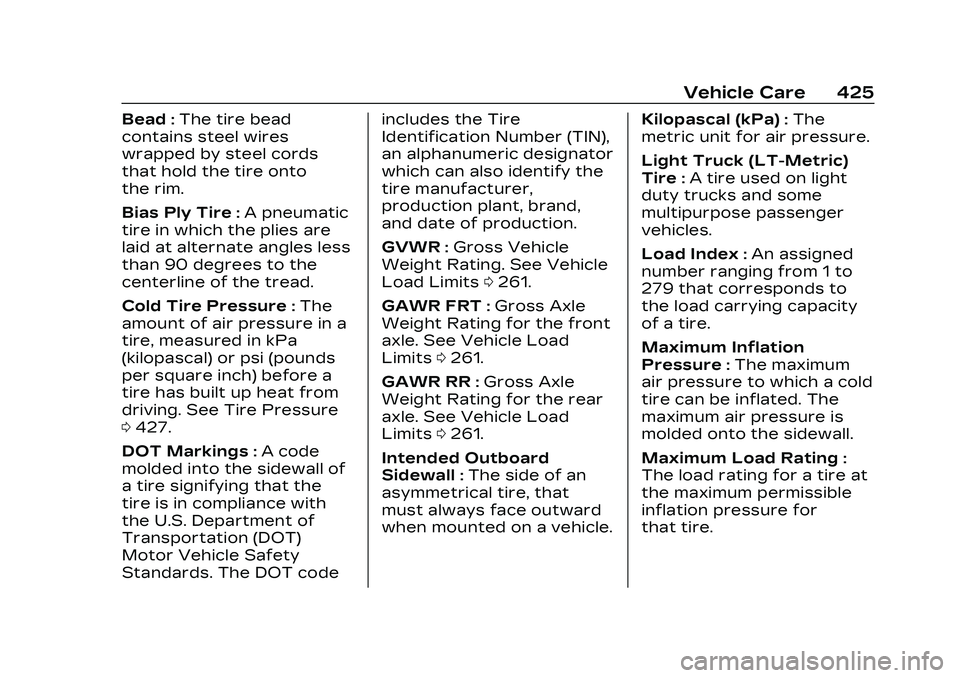
Bead:The tire bead
contains steel wires
wrapped by steel cords
that hold the tire onto
the rim.
Bias Ply Tire
:A pneumatic
tire in which the plies are
laid at alternate angles less
than 90 degrees to the
centerline of the tread.
Cold Tire Pressure
:The
amount of air pressure in a
tire, measured in kPa
(kilopascal) or psi (pounds
per square inch) before a
tire has built up heat from
driving. See Tire Pressure
0 427.
DOT Markings
:A code
molded into the sidewall of
a tire signifying that the
tire is in compliance with
the U.S. Department of
Transportation (DOT)
Motor Vehicle Safety
Standards. The DOT code includes the Tire
Identification Number (TIN),
an alphanumeric designator
which can also identify the
tire manufacturer,
production plant, brand,
and date of production.
GVWR
:Gross Vehicle
Weight Rating. See Vehicle
Load Limits 0261.
GAWR FRT
:Gross Axle
Weight Rating for the front
axle. See Vehicle Load
Limits 0261.
GAWR RR
:Gross Axle
Weight Rating for the rear
axle. See Vehicle Load
Limits 0261.
Intended Outboard
Sidewall
:The side of an
asymmetrical tire, that
must always face outward
when mounted on a vehicle. Kilopascal (kPa)
:The
metric unit for air pressure.
Light Truck (LT-Metric)
Tire
:A tire used on light
duty trucks and some
multipurpose passenger
vehicles.
Load Index
:An assigned
number ranging from 1 to
279 that corresponds to
the load carrying capacity
of a tire.
Maximum Inflation
Pressure
:The maximum
air pressure to which a cold
tire can be inflated. The
maximum air pressure is
molded onto the sidewall.
Maximum Load Rating
:
The load rating for a tire at
the maximum permissible
inflation pressure for
that tire.
Page 428 of 526

Cadillac CT5 Owner Manual (GMNA-Localizing-U.S./Canada-16500419) -
2023 - CRC - 5/6/22
Vehicle Care 427
UTQGS (Uniform Tire
Quality Grading
Standards)
:A tire
information system that
provides consumers with
ratings for a tire's traction,
temperature, and
treadwear. Ratings are
determined by tire
manufacturers using
government testing
procedures. The ratings
are molded into the
sidewall of the tire. See
Uniform Tire Quality
Grading 0439.
Vehicle Capacity Weight
:
The number of designated
seating positions multiplied
by 68 kg (150 lbs) plus the
rated cargo load. See
Vehicle Load Limits 0261. Vehicle Maximum Load on
the Tire
:Load on an
individual tire due to curb
weight, accessory weight,
occupant weight, and cargo
weight.
Vehicle Placard
:A label
permanently attached to a
vehicle showing the
vehicle's capacity weight
and the original equipment
tire size and recommended
inflation pressure. See “Tire
and Loading Information
Label” under Vehicle Load
Limits 0261.
Tire Pressure
Tires need the correct
amount of air pressure to
operate effectively.
{Warning
Neither tire underinflation
nor overinflation is good.
Underinflated tires,
or tires that do not have
enough air, can result in:
.Tire overloading and
overheating, which
could lead to a blowout
.Premature or
irregular wear
.Poor handling
.Reduced fuel economy
for internal combustion
engine vehicles
.Reduced range for
electric vehicles
(Continued)
Page 429 of 526

Cadillac CT5 Owner Manual (GMNA-Localizing-U.S./Canada-16500419) -
2023 - CRC - 5/6/22
428 Vehicle Care
Warning (Continued)
Overinflated tires, or tires
that have too much air,
can result in:
.Unusual wear
.Poor handling
.Rough ride
.Needless damage from
road hazards
The Tire and Loading
Information label on the
vehicle indicates the
original equipment tires
and the correct cold tire
inflation pressures. The
recommended pressure is
the minimum air pressure
needed to support the
vehicle's maximum load
carrying capacity. See
Vehicle Load Limits 0261. How the vehicle is loaded
affects vehicle handling
and ride comfort. Never
load the vehicle with more
weight than it was
designed to carry.
When to Check
Check the pressure of the
tires once a month or more.
How to Check
Use a good quality
pocket-type gauge to
check tire pressure. Proper
tire inflation cannot be
determined by looking at
the tire. Check the tire
inflation pressure when the
tires are cold, meaning the
vehicle has not been driven
for at least three hours or
no more than 1.6 km (1 mi).
Remove the valve cap from
the tire valve stem. Press
the tire gauge firmly onto
the valve to get a pressure measurement. If the cold
tire inflation pressure
matches the recommended
pressure on the Tire and
Loading Information label,
no further adjustment is
necessary. If the inflation
pressure is low, add air
until the recommended
pressure is reached. If the
inflation pressure is high,
press on the metal stem in
the center of the tire valve
to release air.
Recheck the tire pressure
with the tire gauge.
Put the valve caps back on
the valve stems to keep out
dirt and moisture. Use only
valve caps designed for the
vehicle by GM. TPMS
sensors could be damaged
and would not be covered
by the vehicle warranty.
Page 438 of 526

Cadillac CT5 Owner Manual (GMNA-Localizing-U.S./Canada-16500419) -
2023 - CRC - 5/6/22
Vehicle Care 437
When It Is Time for
New Tires
Factors, such as maintenance,
temperatures, driving speeds,
vehicle loading, and road
conditions affect the wear
rate of the tires.
Treadwear indicators are one
way to tell when it is time for
new tires. Treadwear
indicators appear when the
tires have only 1.6 mm (1/16 in)
or less of tread remaining. See
Tire Inspection0435 and
Tire Rotation 0435. The rubber in tires ages over
time. This also applies to the
spare tire, if the vehicle has
one, even if it is never used.
Multiple factors including
temperatures, loading
conditions, and inflation
pressure maintenance affect
how fast aging takes place.
GM recommends that tires,
including the spare if
equipped, be replaced after six
years, regardless of tread
wear. To identify the age of a
tire, use the tire manufacture
date, which is the last four
digits of the DOT Tire
Identification Number (TIN)
molded into one side of the
tire sidewall. The last four
digits of the TIN indicate the
tire manufactured date. The
first two digits represent the
week and the last two digits,
the year. For example, the
third week of the year 2020
would have a 4-digit DOT date
of 0320. Week 01 is the first
full week (Sunday through
Saturday) of each year.
Vehicle Storage
Tires age when stored
normally mounted on a parked
vehicle. Park a vehicle that will
be stored for at least a month
in a cool, dry, clean area away
from direct sunlight to slow
aging. This area should be free
of grease, gasoline, or other
substances that can
deteriorate rubber.
Parking for an extended
period can cause flat spots on
the tires that may result in
vibrations while driving. When
storing a vehicle for at least a
month, remove the tires or
raise the vehicle to reduce the
weight from the tires.
Buying New Tires
GM has developed and
matched specific tires for
the vehicle. The original
equipment tires installed
were designed to meet
General Motors Tire
Performance Criteria