ABS CADILLAC CT6 2018 1.G User Guide
[x] Cancel search | Manufacturer: CADILLAC, Model Year: 2018, Model line: CT6, Model: CADILLAC CT6 2018 1.GPages: 445, PDF Size: 7.7 MB
Page 238 of 445

Cadillac CT6 Owner Manual (GMNA-Localizing-U.S./Canada-11292458) -
2018 - crc - 2/14/17
DRIVING AND OPERATING 237
automatically disengage when the
brake pedal is released or brake pedal
pressure is quickly decreased.
Hill Start Assist (HSA)
Hill Start Assist (HSA) may
automatically activate when the
vehicle is stopped on a hill and
Automatic Vehicle Hold (AVH) is not
enabled. This feature is designed to
prevent the vehicle from rolling, either
forward or rearward, during vehicle
drive off. During the transition from
releasing the brake pedal to
accelerating to drive off on a hill, HSA
holds the braking pressure to prevent
rolling. HSA will not activate if the
vehicle is in a drive gear and facing
downhill or if the vehicle is facing
uphill and in R (Reverse).
Automatic Vehicle
Hold (AVH)
Automatic Vehicle Hold (AVH),
if equipped, can be turned on by
pressing AUTO HOLD with the driver
seat belt fastened, the driver door
closed, and the engine running. The
AVH indicator will come on.
This feature will activate when the
vehicle is stopped to prevent it from
moving. After the brake pedal has
been released and before the
accelerator pedal has been pressed,
AVH uses braking pressure to hold the
vehicle stationary. In addition, theABS pump motor may activate to
build brake pressure to maintain the
vehicle at a standstill if necessary.
If AVH is holding the vehicle, the AVH
indicator will change to green. Once
AVH is active it will hold the vehicle
for a defined time period then engage
the parking brake. While AVH is
holding the vehicle, the parking brake
will engage if the driver door is
opened or the driver seat belt is
unfastened. See
Automatic Vehicle Hold
(AVH) Light 0147.
Regenerative Braking
(PLUG-IN Only)
Regenerative braking takes some of
the energy from the moving vehicle
and turns it back into electrical
energy. This energy is then stored
back into the high voltage battery
system, contributing to increased
energy efficiency.
The hydraulic disc brakes work with
the regenerative braking to ensure
effective braking, such as when a high
braking demand is requested.
Page 293 of 445
Cadillac CT6 Owner Manual (GMNA-Localizing-U.S./Canada-11292458) -
2018 - crc - 2/14/17
292 DRIVING AND OPERATING
Backing Up
Hold the bottom of the steering wheel
with one hand. To move the trailer to
the left, move that hand to the left. To
move the trailer to the right, move
your hand to the right. Always back
up slowly and, if possible, have
someone guide you.
Making TurnsCaution
Making very sharp turns while
trailering could cause the trailer to
come in contact with the vehicle.
The vehicle could be damaged.
Avoid making very sharp turns
while trailering.
When turning with a trailer, make
wider turns than normal. Do this so
the trailer will not strike soft
shoulders, curbs, road signs, trees,
or other objects. Avoid jerky or sudden
maneuvers. Signal well in advance. If the trailer turn signal bulbs burn
out, the arrows on the instrument
cluster will still flash for turns. It is
important to check occasionally to be
sure the trailer bulbs are still working.
Driving on Grades
Reduce speed and shift to a lower gear
before
starting down a long or steep
downgrade. If the transmission is not
shifted down, the brakes might get hot
and no longer work well.
Vehicles can tow in D (Drive). Shift
the transmission to a lower gear if the
transmission shifts too often under
heavy loads and/or hilly conditions.
When towing at high altitude on steep
uphill grades, consider the following:
Engine coolant will boil at a lower
temperature than at normal altitudes.
If the engine is turned off immediately
after towing at high altitude on steep
uphill grades, the vehicle may show
signs similar to engine overheating. To
avoid this, let the engine run while
parked, preferably on level ground,
with the automatic transmission in
P (Park) for a few minutes before turning the engine off. If the overheat
warning comes on, see
Engine
Overheating 0321.
Parking on Hills
{Warning
Parking the vehicle on a hill with
the trailer attached can be
dangerous. If something goes
wrong, the rig could start to move.
People can be injured, and both the
vehicle and the trailer can be
damaged. When possible, always
park the rig on a flat surface.
If parking the rig on a hill: 1. Press the brake pedal, but do not shift into P (Park) yet. Turn the
wheels into the curb if facing
downhill or into traffic if facing
uphill.
2. Have someone place chocks under the trailer wheels.
3. When the wheel chocks are in place, release the regular brakes
until the chocks absorb the load.
Page 325 of 445
Cadillac CT6 Owner Manual (GMNA-Localizing-U.S./Canada-11292458) -
2018 - crc - 2/15/17
324 VEHICLE CARE
.A fluid leak in the brake hydraulic
system. Have the brake hydraulic
system fixed. With a leak, the
brakes will not work well.
Always clean the brake fluid reservoir
cap and the area around the cap
before removing it.
Do not top off the brake fluid. Adding
fluid does not correct a leak. If fluid is
added when the linings are worn,
there will be too much fluid when
new brake linings are installed. Add or
remove fluid, as necessary, only when
work is done on the brake hydraulic
system.
{Warning
If too much brake fluid is added, it
can spill on the engine and burn,
if the engine is hot enough. You or
others could be burned, and the
vehicle could be damaged. Add
brake fluid only when work is done
on the brake hydraulic system. When the brake fluid falls to a low
level, the brake warning light comes
on. See
Brake System Warning Light
0 145.
Brake fluid absorbs water over time
which degrades the effectiveness of
the brake fluid. Replace brake fluid at
the specified intervals to prevent
increased stopping distance. See
Maintenance Schedule 0390.
What to Add
Use only GM approved DOT 3 (for
gasoline only vehicles) or DOT 4 (for
PLUG-IN vehicles) brake fluid from a
clean, sealed container. See
Recommended Fluids and Lubricants
0 399.{Warning
The wrong or contaminated brake
fluid could result in damage to the
brake system. This could result in
the loss of braking leading to a
possible injury. Always use the
proper GM approved brake fluid.
Caution
If brake fluid is spilled on the
vehicle's painted surfaces, the paint
finish can be damaged. Immediately
wash off any painted surface.
Battery - North America
The original equipment battery is
maintenance free. Do not remove the
cap and do not add fluid.
Refer to the replacement number
shown on the original battery label
when a new 12-volt battery is needed.
The battery is in the trunk under the
spare tire. The vehicle has an
Absorbed Glass Mat (AGM) 12-volt
battery. Installation of a standard
12-volt battery will result in reduced
12-volt battery life.
When using a 12-volt battery charger
on the 12-volt AGM battery, some
chargers have an AGM battery setting
on the charger. If available, use the
AGM setting on the charger, to limit
charge voltage to 14.8 volts.
Page 336 of 445
Cadillac CT6 Owner Manual (GMNA-Localizing-U.S./Canada-11292458) -
2018 - crc - 2/15/17
VEHICLE CARE 335
FusesUsage
68 Rear seat entertainment
display
69 Rechargeable energy storage system
coolant pump
70 –
71 Anitlock brake system valve
72 –
73 –Instrument Panel Fuse
Block
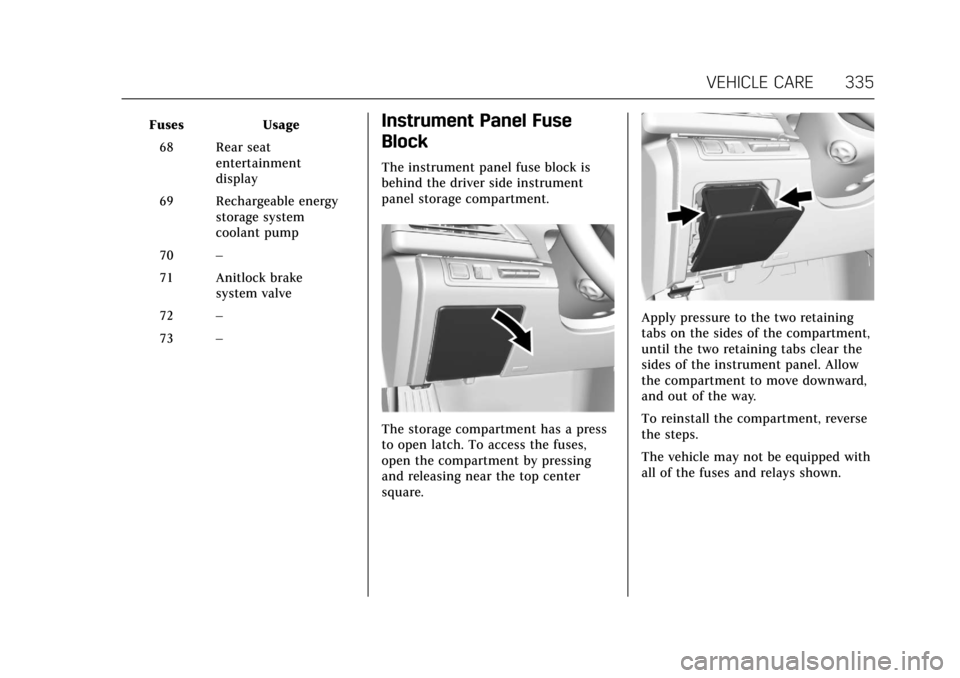
The instrument panel fuse block is
behind the driver side instrument
panel storage compartment.
The storage compartment has a press
to open latch. To access the fuses,
open the compartment by pressing
and releasing near the top center
square.
Apply pressure to the two retaining
tabs on the sides of the compartment,
until the two retaining tabs clear the
sides of the instrument panel. Allow
the compartment to move downward,
and out of the way.
To reinstall the compartment, reverse
the steps.
The vehicle may not be equipped with
all of the fuses and relays shown.
Page 374 of 445
Cadillac CT6 Owner Manual (GMNA-Localizing-U.S./Canada-11292458) -
2018 - crc - 2/15/17
VEHICLE CARE 373
Compact Spare Tire
{Warning
Driving with more than one
compact spare tire at a time could
result in loss of braking and
handling. This could lead to a crash
and you or others could be injured.
Use only one compact spare tire at
a time.
If this vehicle has a compact spare
tire, it was fully inflated when new;
however, it can lose air over time.
Check the inflation pressure regularly.
It should be 420 kPa (60 psi).
Stop as soon as possible and check
that the spare tire is correctly inflated
after being installed on the vehicle.
The compact spare tire is designed for
temporary use only. The vehicle will
perform differently with the spare tire
installed and it is recommended that
the vehicle speed be limited to
80 km/h (50 mph). To conserve the
tread of the spare tire, have the standard tire repaired or replaced as
soon as convenient and return the
spare tire to the storage area.
When using a compact spare tire, the
AWD (if equipped), ABS, and Traction
Control systems may engage until the
spare tire is recognized by the vehicle,
especially on slippery roads. Adjust
driving to reduce possible wheel slip.
Caution
When the compact spare is
installed, do not take the vehicle
through an automatic car wash
with guide rails. The compact spare
can get caught on the rails which
can damage the tire, wheel, and
other parts of the vehicle.
Do not use the compact spare on
other vehicles.
Do not mix the compact spare tire or
wheel with other wheels or tires. They
will not fit. Keep the spare tire and its
wheel together.
Caution
Tire chains will not fit the compact
spare. Using them can damage the
vehicle and the chains. Do not use
tire chains on the compact spare.
Page 381 of 445
Cadillac CT6 Owner Manual (GMNA-Localizing-U.S./Canada-11292458) -
2018 - crc - 2/15/17
380 VEHICLE CARE
Appearance Care
Exterior Care
Locks
Locks are lubricated at the factory.
Use a de-icing agent only when
absolutely necessary, and have the
locks greased after using. See
Recommended Fluids and Lubricants
0399.
Washing the Vehicle
To preserve the vehicle's finish, wash
it often and out of direct sunlight.
Caution
Do not use petroleum-based, acidic,
or abrasive cleaning agents as they
can damage the vehicle's paint,
metal, or plastic parts. If damage
occurs, it would not be covered by
the vehicle warranty. Approved
cleaning products can be obtained
from your dealer. Follow all
manufacturer directions regarding
(Continued)
Caution (Continued)
correct product usage, necessary
safety precautions, and appropriate
disposal of any vehicle care
product.
Caution
Avoid using high-pressure washes
closer than 30 cm (12 in) to the
surface of the vehicle. Use of power
washers exceeding 8,274 kPa
(1,200 psi) can result in damage or
removal of paint and decals.
Caution
Do not power wash any component
under the hood that has this
e
symbol.
This could cause damage that
would not be covered by the vehicle
warranty. If using an automatic car wash, follow
the car wash instructions. The
windshield wiper and rear window
wiper, if equipped, must be off.
Remove any accessories that may be
damaged or interfere with the car
wash equipment.
Rinse the vehicle well, before washing
and after, to remove all cleaning
agents completely. If they are allowed
to dry on the surface, they could stain.
Dry the finish with a soft, clean
chamois or an all-cotton towel to
avoid surface scratches and water
spotting.
Finish Care
Application of aftermarket clearcoat
sealant/wax materials is not
recommended. If painted surfaces are
damaged, see your dealer to have the
damage assessed and repaired. Foreign
materials such as calcium chloride
and other salts, ice melting agents,
road oil and tar, tree sap, bird
droppings, chemicals from industrial
chimneys, etc., can damage the
vehicle's finish if they remain on
painted surfaces. Wash the vehicle as
soon as possible. If necessary, use
Page 433 of 445

Cadillac CT6 Owner Manual (GMNA-Localizing-U.S./Canada-11292458) -
2018 - crc - 2/14/17
432 INDEX
IndexA
Accessories and Modifications . . . . . 298
Accessory Power . . . . . . . . . . . . . . . . . . . . 224
Adaptive Cruise Control . . . . . . . . . . . . 245
Add-On Electrical Equipment . . . . . . 295
Additional InformationOnStar . . . . . . . . . . . . . . . . . . . . . . . . . . . . . 426
Additional Maintenance and Care . . . . . . . . . . . . . . . . . . . . . . . . . . . 396
Adjustments
Lumbar, Front Seats . . . . . . . . . . . . . . . . 67
Lumbar, Rear Seats . . . . . . . . . . . . . . . . . 76
Thigh Support . . . . . . . . . . . . . . . . . . . . . . 68
Air Cleaner/Filter, Engine . . . . . . . . . . 311
Air Conditioning . . . . . . . . . . . . . . .191, 197
Air Filter, Passenger
Compartment . . . . . . . . . . . . . . . . . . . . . 204
Air Vents . . . . . . . . . . . . . . . . . . . . . . . . . . . . 203
Airbag System Check . . . . . . . . . . . . . . . . . . . . . . . . . . . . . . . . 96
How Does an Airbag Restrain? . . . . . 89
Passenger Sensing System . . . . . . . . . 91
What Makes an Airbag Inflate? . . . . 89
What Will You See after anAirbag Inflates? . . . . . . . . . . . . . . . . . . . 89
When Should an Airbag Inflate? . . . . . . . . . . . . . . . . . . . . . . . . . . . . . 88
Where Are the Airbags? . . . . . . . . . . . . 86 Airbags
Adding Equipment to the
Vehicle . . . . . . . . . . . . . . . . . . . . . . . . . . . . . 95
Passenger Status Indicator . . . . . . . 141
Readiness Light . . . . . . . . . . . . . . . . . . . 141
Servicing Airbag-Equipped Vehicles . . . . . . . . . . . . . . . . . . . . . . . . . . . . 95
System Check . . . . . . . . . . . . . . . . . . . . . . . 85
Alarm Vehicle Security . . . . . . . . . . . . . . . . . . . . . 51
Alert
Lane Change . . . . . . . . . . . . . . . . . . . . . . 269
Side Blind Zone (SBZA) . . . . . . . . . . 268
All-Season Tires . . . . . . . . . . . . . . . . . . . . . 341
All-Wheel Drive . . . . . . . . . . . . . . . .234, 326
Antilock Brake System (ABS) . . . . . . 234 Warning Light . . . . . . . . . . . . . . . . . . . . 146
Appearance Care Exterior . . . . . . . . . . . . . . . . . . . . . . . . . . . . 380
Interior . . . . . . . . . . . . . . . . . . . . . . . . . . . . 384
Armrest Storage . . . . . . . . . . . . . . . . . . . . . 116
Ashtrays . . . . . . . . . . . . . . . . . . . . . . . . . . . . . 126
Assistance Systems for Driving . . . . 260
Assistance Systems for Parking and Backing . . . . . . . . . . . . . . . . . . . . . . . 254
Auto Stop Mode . . . . . . . . . . . . . . . . . . . . 150
Automatic Climate Control System . . . . . 191, 197
Page 438 of 445

Cadillac CT6 Owner Manual (GMNA-Localizing-U.S./Canada-11292458) -
2018 - crc - 2/14/17
INDEX 437
I
Ignition Positions . . . . . . . . . . . . . . . . . . . 217
Immobilizer . . . . . . . . . . . . . . . . . . . . . . . . . . 53
IndicatorPedestrian Ahead . . . . . . . . . . . . . . . . . 147
Vehicle Ahead . . . . . . . . . . . . . . . . . . . . . 147
Infants and Young Children, Restraints . . . . . . . . . . . . . . . . . . . . . . . . . . . 98
Information Energy . . . . . . . . . . . . . . . . . . . . . . . . . . . . . 161
Infotainment . . . . . . . . . . . . . . . . . . . . . . . . 190
Infotainment System . . . . . . . . . . . . . . . 420
Instrument Cluster . . . . . . . . . . . .127, 130
Instrument Panel Storage Area . . . . . . . . . . . . . . . . . . . . . . 115
Instrument Panel Overview . . . . . . . . . . . 6
Interior Rearview Mirrors . . . . . . . . . . . 56
Introduction . . . . . . . . . . . . . . . . . . . . . . . . . . . . 2
J
Jump Starting - North America . . . . 374
K
Keyless Entry Remote (RKE) System . . . . . . . . . . . . . . 35
Keys . . . . . . . . . . . . . . . . . . . . . . . . . . . . . . . . . . 34
L
Labeling, Tire Sidewall . . . . . . . . . . . . . 342
Lamps Courtesy . . . . . . . . . . . . . . . . . . . . . . . . . . . 187
Daytime Running (DRL) . . . . . . . . . . 185
Dome . . . . . . . . . . . . . . . . . . . . . . . . . . . . . . 187
Exterior Controls . . . . . . . . . . . . . . . . . . 183
Exterior Lamps Off Reminder . . . . 185
Exterior Lighting BatterySaver . . . . . . . . . . . . . . . . . . . . . . . . . . . . . 189
License Plate . . . . . . . . . . . . . . . . . . . . . . 330
Malfunction Indicator (Check Engine) . . . . . . . . . . . . . . . . . . . . . . . . . . 143
On Reminder . . . . . . . . . . . . . . . . . . . . . . 151
Reading . . . . . . . . . . . . . . . . . . . . . . . . . . . . 188
Lane Change Alert (LCA) . . . . . . . . . . . 269
Lane Departure Warning (LDW) . . . . . . . . . . . . . . . . . . . 270
Lane Keep Assist (LKA) . . . . . . . . . . . . 271
Lane Keep Assist Light . . . . . . . . . . . . . 147
Lap-Shoulder Belt . . . . . . . . . . . . . . . . . . . . 80
LATCH System
Replacing Parts after a Crash . . . . 109
LATCH, Lower Anchors and
Tethers for Children . . . . . . . . . . . . . . 103
LED Lighting . . . . . . . . . . . . . . . . . . . . . . . . 330 Light, Auto Stop Mode . . . . . . . . . . . . . 150
Lighter, Cigarette . . . . . . . . . . . . . . . . . . . 125
Lighting
Entry . . . . . . . . . . . . . . . . . . . . . . . . . . . . . . 188
Exit . . . . . . . . . . . . . . . . . . . . . . . . . . . . . . . . 189
Illumination Control . . . . . . . . . . . . . . 187
LED . . . . . . . . . . . . . . . . . . . . . . . . . . . . . . . . 330
Lights Airbag Readiness . . . . . . . . . . . . . . . . . 141
Antilock Brake System (ABS)Warning . . . . . . . . . . . . . . . . . . . . . . . . . 146
Automatic Vehicle Hold . . . . . . . . . . 147
Brake System Warning . . . . . . . . . . . 145
Charging System . . . . . . . . . . . . . . . . . . 142
Check Engine (Malfunction Indicator) . . . . . . . . . . . . . . . . . . . . . . . . 143
Cruise Control . . . . . . . . . . . . . . . . . . . . . 151
Door Ajar . . . . . . . . . . . . . . . . . . . . . . . . . . 152
Electric Parking Brake . . . . . . . . . . . . 145
Engine Coolant Temperature Warning . . . . . . . . . . . . . . . . . . . . . . . . . 149
Engine Oil Pressure . . . . . . . . . . . . . . . 149
Flash-to-Pass . . . . . . . . . . . . . . . . . . . . . . 185
High-Beam On . . . . . . . . . . . . . . . . . . . . 151
High/Low Beam Changer . . . . . . . . . 185
Lane Keep Assist . . . . . . . . . . . . . . . . . . 147