overheating CADILLAC CT6 2018 1.G User Guide
[x] Cancel search | Manufacturer: CADILLAC, Model Year: 2018, Model line: CT6, Model: CADILLAC CT6 2018 1.GPages: 445, PDF Size: 7.7 MB
Page 318 of 445
Cadillac CT6 Owner Manual (GMNA-Localizing-U.S./Canada-11292458) -
2018 - crc - 2/15/17
VEHICLE CARE 317
Engine Coolant
The engine cooling system in the
vehicle is filled with GM Premix
DEX-COOL coolant. This coolant
needs to be checked and replaced at
appropriate intervals. SeeMaintenance
Schedule 0390.
The following explains the cooling
system and how to check and add
coolant when it is low. If there is a
problem with engine overheating, see
Engine Overheating 0321.
What to Use
{Warning
Plain water, or other liquids such as
alcohol, can boil before the proper
coolant mixture will. With plain
water or the wrong mixture, the
engine could get too hot but there
would not be an overheat warning.
The engine could catch fire and you
or others could be burned.
Use GM Premix DEX-COOL coolant.
If using this mixture, nothing else
needs to be added. This mixture: .
Gives freezing protection down to
−37 °C (−34 °F), outside
temperature
. Gives boiling protection up to
129 °C (265 °F), engine
temperature
. Protects against rust and corrosion
. Will not damage aluminum parts
. Helps keep the proper engine
temperature
Caution
Do not use anything other than GM
Premix DEX-COOL coolant.
Anything else can cause damage to
the PLUG-IN cooling system
components and the vehicle, which
would not be covered by the vehicle
warranty.
Never dispose of engine coolant by
putting it in the trash, pouring it on
the ground, or into sewers, streams,
or bodies of water. Have the coolant
changed by an authorized service
center, familiar with legal requirements regarding used coolant
disposal. This will help protect the
environment and your health.
Checking Coolant
The vehicle must be on a level surface
when checking the coolant level.
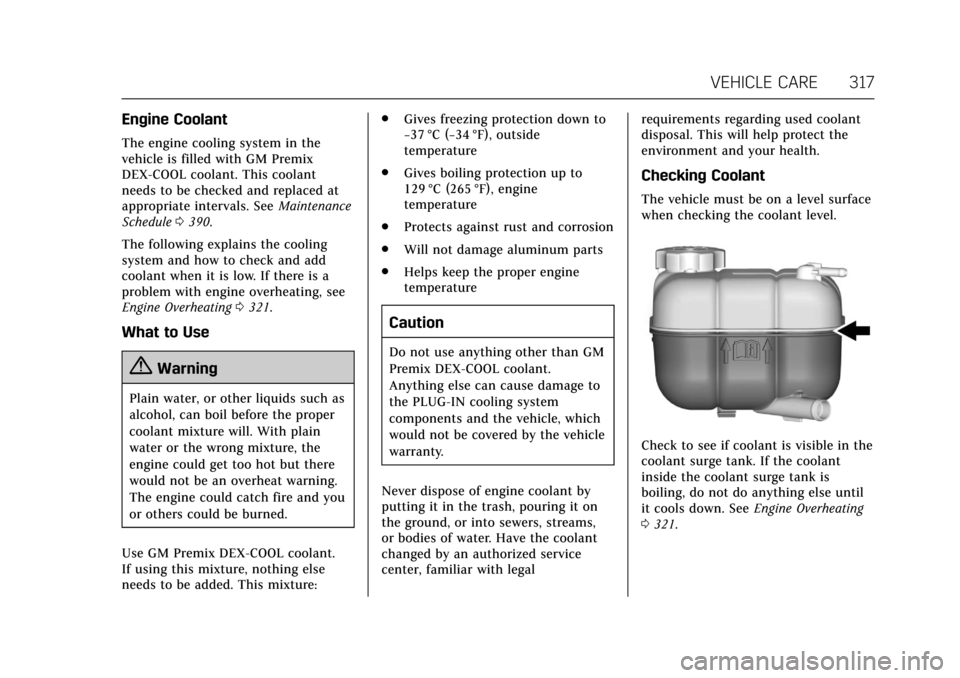
Check to see if coolant is visible in the
coolant surge tank. If the coolant
inside the coolant surge tank is
boiling, do not do anything else until
it cools down. See
Engine Overheating
0 321.
Page 319 of 445

Cadillac CT6 Owner Manual (GMNA-Localizing-U.S./Canada-11292458) -
2018 - crc - 2/15/17
318 VEHICLE CARE
The coolant surge tank is in the
engine compartment on the passenger
side of the vehicle. SeeEngine
Compartment Overview 0300.
How to Add Coolant to the
Coolant Surge Tank
If no problem is found, check to see if
coolant is visible in the coolant surge
tank. If coolant is visible but not at or
above the indicated mark, add GM
Premix DEX-COOL coolant. Be sure
the cooling system, including the
coolant surge tank pressure cap, is
cool before this is done. See Engine
Overheating 0321.
{Warning
Spilling coolant on hot engine parts
can burn you. Coolant contains
ethylene glycol and it will burn if
the engine parts are hot enough.
{Warning
Steam and scalding liquids from a
hot cooling system are under
pressure. Turning the pressure cap,
even a little, can cause them to
come out at high speed and you
could be burned. Never turn the cap
when the cooling system, including
the pressure cap, is hot. Wait for
the cooling system and pressure
cap to cool.
Caution
Failure to follow the specific
coolant fill procedure could cause
the engine to overheat and could
cause system damage. If coolant is
not visible in the surge tank,
contact your dealer.
1. Remove the coolant surge tank
pressure cap when the cooling
system, including the coolant
surge tank pressure cap and
upper radiator hose, is no
longer hot.
Turn the pressure cap slowly
counterclockwise about
one-quarter of a turn. If you hear
a hiss, wait for that to stop. This
will allow any pressure still left
to be vented out the
discharge hose.
2. Keep turning the pressure cap slowly and remove it.
3. Fill the coolant surge tank with the proper mixture to the
indicated level mark.
4. With the coolant surge tank pressure cap off, start the engine
and let it run until you can feel
Page 322 of 445

Cadillac CT6 Owner Manual (GMNA-Localizing-U.S./Canada-11292458) -
2018 - crc - 2/15/17
VEHICLE CARE 321
Engine Overheating
The vehicle has several indicators to
warn of the engine overheating.
There is an engine coolant
temperature gauge and an engine
coolant temperature warning light on
the instrument cluster.
SeeEngine Coolant Temperature Gauge
0 139 and Engine Coolant Temperature
Warning Light 0149. The vehicle may
also display a message on the Driver
Information Center (DIC).
If the decision is made not to lift the
hood when this warning appears, get
service help right away. See Roadside
Service 0411.
If the decision is made to lift the
hood, make sure the vehicle is parked
on a level surface. Then check to see if
the engine cooling fan is running.
If the engine is overheating, the fan
should be running. If it is not, do not
continue to run the engine. Have the
vehicle serviced.Caution
Do not run the engine if there is a
leak in the engine cooling system.
This can cause a loss of all coolant
and can damage the system and
vehicle. Have any leaks fixed
right away.
If Steam Is Coming from the
Engine Compartment
{Warning
Steam and scalding liquids from a
hot cooling system are under
pressure. Turning the pressure cap,
even a little, can cause them to
come out at high speed and you
could be burned. Never turn the cap
when the cooling system, including
the pressure cap, is hot. Wait for
the cooling system and pressure
cap to cool.
If No Steam Is Coming from the
Engine Compartment
If an engine overheat warning is
displayed but no steam can be seen or
heard, the problem may not be too
serious. Sometimes the engine can get
a little too hot when the vehicle:
. Climbs a long hill on a hot day
. Stops after high-speed driving
. Idles for long periods in traffic
If the overheat warning is displayed
with no sign of steam: 1. Turn the air conditioning off.
2. Turn the heater on to the highest temperature and to the highest
fan speed. Open the windows as
necessary.
3. When it is safe to do so, pull off the road, shift to P (Park) or
N (Neutral), and let the
engine idle.
If the engine coolant temperature
gauge is no longer in the overheated
area or the engine coolant
temperature warning light no longer
displays, the vehicle can be driven.
Continue to drive the vehicle slowly
Page 326 of 445

Cadillac CT6 Owner Manual (GMNA-Localizing-U.S./Canada-11292458) -
2018 - crc - 2/15/17
VEHICLE CARE 325
Stop/Start System
The vehicle has a Stop/Start system to
shut off the engine to help conserve
fuel.
SeeStarting the Engine (PLUG-IN Only)
0 218 orStarting the Engine (Gasoline
Only) 0221.
{Warning
WARNING: Battery posts,
terminals, and related accessories
contain lead and lead compounds,
chemicals known to the State of
California to cause cancer and birth
defects or other reproductive harm.
Batteries also contain other
chemicals known to the State of
California to cause cancer. WASH
HANDS AFTER HANDLING. For
more information go to
www.P65Warnings.ca.gov/
passenger-vehicle.
See California Proposition 65 Warning
0 297 and the back cover.
PLUG-IN Vehicle
The PLUG-IN vehicle 12-volt battery is
in the trunk. PLUG-IN vehicles also
have a high voltage battery. Only a
trained service technician with the
proper knowledge and tools should
inspect, test, or replace the high
voltage battery. See your dealer if
either the 12-volt or the high voltage
battery needs service. The dealer has
information on how to recycle the
high voltage battery.
{Warning
Damage to the high voltage battery
or high voltage system can create a
risk of electric shock, overheating,
or fire.
If the vehicle is damaged from a
moderate to severe crash, flood,
fire, or other event, the vehicle
should be inspected as soon as
possible. Until the vehicle has been
inspected, store it outside at least
15 m (50 ft) from any structure or
(Continued)
Warning (Continued)
anything that can burn. Ventilate
the vehicle by opening a window or
a door.
Contact your dealer as soon as
possible to determine whether an
inspection is needed.
Vehicle Storage
{Warning
Batteries have acid that can burn
you and gas that can explode. You
can be badly hurt if you are not
careful. SeeJump Starting - North
America 0374 for tips on working
around a battery without
getting hurt.
Infrequent Usage: Remove the 12-volt
battery black, negative (−) cable from
the battery to keep the battery from
running down.
Page 332 of 445
Cadillac CT6 Owner Manual (GMNA-Localizing-U.S./Canada-11292458) -
2018 - crc - 2/15/17
VEHICLE CARE 331
Electrical System
Electrical System Overload
The vehicle has fuses and circuit
breakers to protect against an
electrical system overload.
When the current electrical load is too
heavy, the circuit breaker opens and
closes, protecting the circuit until the
current load returns to normal or the
problem is fixed. This greatly reduces
the chance of circuit overload and fire
caused by electrical problems.
Fuses and circuit breakers protect
power devices in the vehicle.
Replace a bad fuse with a new one of
the identical size and rating.
If there is a problem on the road and
a fuse needs to be replaced, the
same amperage fuse can be borrowed.
Choose some feature of the vehicle
that is not needed to use and replace
it as soon as possible.
Headlamp Wiring
An electrical overload may cause the
lamps to go on and off, or in some
cases to remain off. Have the
headlamp wiring checked right away if
the lamps go on and off or remain off.
Windshield Wipers
If the wiper motor overheats due to
heavy snow or ice, the windshield
wipers will stop. Wiper function is
available immediately after the wiper
switch is set to off, and back to on.
To protect the wiper motor from
overheating, the wipers may slow
down when the windshield is dry for a
long period of time. If a period of dry
operation, or little moisture, exceeds
10 minutes, the wipers may switch to
intermittent operation, and remain
there. When moisture is again
detected on the windshield, wiper
operation will return to the operator
selected speed.
Although the circuit is protected from
electrical overload, overload due to
heavy snow or ice may cause wiperlinkage damage. Always clear ice and
heavy snow from the windshield
before using the windshield wipers.
If the overload is caused by an
electrical problem and not snow or
ice, be sure to get it fixed.
Fuses and Circuit Breakers
The wiring circuits in the vehicle are
protected from short circuits by a
combination of fuses and circuit
breakers. This greatly reduces the
chance of damage caused by electrical
problems.
{Danger
Fuses and circuit breakers are
marked with their ampere rating.
Do not exceed the
specified amperage rating when
replacing fuses and circuit breakers.
Use of an oversized fuse or circuit
breaker can result in a vehicle fire.
You and others could be seriously
injured or killed.
Page 341 of 445
Cadillac CT6 Owner Manual (GMNA-Localizing-U.S./Canada-11292458) -
2018 - crc - 2/15/17
340 VEHICLE CARE
FusesUsage
F70 –
F71 –
F72 –
F73 –
F74 –
F75 –
Relays Usage
R1 Rear seat power outlet
R2 Fuel pump
R3 Run/CrankWheels and Tires
Tires
Every new GM vehicle has
high-quality tires made by a
leading tire manufacturer. See the
warranty manual for information
regarding the tire warranty and
where to get service. For
additional information refer to the
tire manufacturer.
{Warning
.Poorly maintained and
improperly used tires are
dangerous.
.Overloading the tires can
cause overheating as a
result of too much flexing.
There could be a blowout
and a serious crash. See
Vehicle Load Limits 0213.
(Continued)
Warning (Continued)
.Underinflated tires pose
the same danger as
overloaded tires. The
resulting crash could cause
serious injury. Check all
tires frequently to
maintain the
recommended pressure.
Tire pressure should be
checked when the tires
are cold.
.Overinflated tires are more
likely to be cut, punctured,
or broken by a sudden
impact —such as when
hitting a pothole. Keep
tires at the recommended
pressure.
.Worn or old tires can
cause a crash. If the tread
is badly worn,
replace them.
(Continued)
Page 348 of 445
Cadillac CT6 Owner Manual (GMNA-Localizing-U.S./Canada-11292458) -
2018 - crc - 2/15/17
VEHICLE CARE 347
placard.
SeeTire Pressure 0347 and Vehicle
Load Limits 0213.
Radial Ply Tire
:A pneumatic tire
in which the ply cords that extend
to the beads are laid at 90 degrees
to the centerline of the tread.
Rim
:A metal support for a tire
and upon which the tire beads are
seated.
Sidewall
:The portion of a tire
between the tread and the bead.
Speed Rating
:An alphanumeric
code assigned to a tire indicating
the maximum speed at which a
tire can operate.
Traction
:The friction between
the tire and the road surface. The
amount of grip provided.
Tread
:The portion of a tire that
comes into contact with the road.
Treadwear Indicators
:Narrow
bands, sometimes called wear
bars, that show across the tread of a tire when only 1.6 mm (1/16 in)
of tread remains. See
When It Is
Time for New Tires 0355.
UTQGS (Uniform Tire Quality
Grading Standards)
:A tire
information system that provides
consumers with ratings for a tire's
traction, temperature, and
treadwear. Ratings are determined
by tire manufacturers using
government testing procedures.
The ratings are molded into the
sidewall of the tire. See Uniform
Tire Quality Grading 0357.
Vehicle Capacity Weight
:The
number of designated seating
positions multiplied by
68 kg (150 lb) plus the rated cargo
load. See Vehicle Load Limits 0213.
Vehicle Maximum Load on the
Tire
:Load on an individual tire
due to curb weight, accessory
weight, occupant weight, and
cargo weight. Vehicle Placard
:A label
permanently attached to a vehicle
showing the vehicle capacity
weight and the original equipment
tire size and recommended
inflation pressure. See “Tire and
Loading Information Label” under
Vehicle Load Limits 0213.
Tire Pressure
Tires need the correct amount of
air pressure to operate effectively.
Caution
Neither tire underinflation nor
overinflation is good.
Underinflated tires, or tires that
do not have enough air, can
result in:
.Tire overloading and
overheating which could
lead to a blowout.
.Premature or
irregular wear.
(Continued)
Page 436 of 445

Cadillac CT6 Owner Manual (GMNA-Localizing-U.S./Canada-11292458) -
2018 - crc - 2/14/17
INDEX 435
Driving (cont'd)Defensive . . . . . . . . . . . . . . . . . . . . . . . . . . 207
Drunk . . . . . . . . . . . . . . . . . . . . . . . . . . . . . . 207
For Better Fuel Economy . . . . . . . . . . . 32
Hill and Mountain Roads . . . . . . . . 211
If the Vehicle is Stuck . . . . . . . . . . . . 212
Loss of Control . . . . . . . . . . . . . . . . . . . . 209
Off-Road Recovery . . . . . . . . . . . . . . . . 209
Vehicle Load Limits . . . . . . . . . . . . . . 213
Wet Roads . . . . . . . . . . . . . . . . . . . . . . . . . 210
Winter . . . . . . . . . . . . . . . . . . . . . . . . . . . . . 211
Winter Mode Light . . . . . . . . . . . . . . . 146
Driving for Better Energy Efficiency . . . . . . . . . . . . . . . . . . . . . . . . . . . 32
E
Electric Parking Brake . . . . . . . . . . . . . . 235
Electric Parking Brake Light . . . . . . . 145
Electrical Equipment, Add-On . . . . . 295
Electrical Requirements for
Battery Charging . . . . . . . . . . . . . . . . . . 285
Electrical System Engine Compartment FuseBlock . . . . . . . . . . . . . . . . . . . . . . . . . . . . . 332
Fuses and Circuit Breakers . . . . . . . 331
Instrument Panel Fuse Block . . . . 335
Overload . . . . . . . . . . . . . . . . . . . . . . . . . . . 331
Rear Compartment Fuse Block . . . . . . . . . . . . . . . . . . . . . . . . . . . . . 337 Emergency
OnStar . . . . . . . . . . . . . . . . . . . . . . . . . . . . . 422
Energy Efficiency Driving . . . . . . . . . . . . . . . . . . . . . . . . . . . . . . 32
Energy Information . . . . . . . . . . . . . . . . . 161
Engine Air Cleaner/Filter . . . . . . . . . . . . . . . . . 311
Check Light (Malfunction
Indicator) . . . . . . . . . . . . . . . . . . . . . . . . 143
Compartment Overview . . . . . . . . . . 300
Coolant Temperature Gauge . . . . . 139
Coolant Temperature Warning Light . . . . . . . . . . . . . . . . . . . 149
Cooling System . . . . . . . . . . . . . . 312, 316
Drive Belt Routing . . . . . . . . . . . . . . . . 406
Exhaust . . . . . . . . . . . . . . . . . . . . . . . . . . . . 230
Heater . . . . . . . . . . . . . . . . . . . . . . . . . . . . . 223
Oil Life System . . . . . . . . . . . . . . . . . . . . 309
Oil Pressure Gauge . . . . . . . . . . . . . . . . 137
Oil Pressure Light . . . . . . . . . . . . . . . . . 149
Overheating . . . . . . . . . . . . . . . . . . . . . . . 321
Power Messages . . . . . . . . . . . . . . . . . . 169
Running While Parked . . . . . . . . . . . 230
Starting . . . . . . . . . . . . . . . . . . . . . . . 218, 221
Engine Oil
Temperature Gauge . . . . . . . . . . . . . . . 138
Engine Unavailable Out of Fuel . . . . . . . . . . . . . . . . . . . . . . . . 227 Entry Lighting . . . . . . . . . . . . . . . . . . . . . . 188
Equipment, Towing . . . . . . . . . . . . . . . . . 294
Event Data Recorders . . . . . . . . . . . . . . 419
Exit Lighting . . . . . . . . . . . . . . . . . . . . . . . . 189
Extended Parking . . . . . . . . . . . . . . . . . . . 226
Extender, Seat Belt . . . . . . . . . . . . . . . . . . 83
Exterior Lamp Controls . . . . . . . . . . . . 183
Exterior Lamps Off Reminder . . . . . . 185
Exterior Lighting Battery Saver . . . . 189
F
Features
Memory . . . . . . . . . . . . . . . . . . . . . . . . . . . . . 13
Filter, Engine Air Cleaner . . . . . . . . . . . . . . . . 311
Flash-to-Pass . . . . . . . . . . . . . . . . . . . . . . . . 185
Flashers, Hazard Warning . . . . . . . . . . 186
Flat Tire . . . . . . . . . . . . . . . . . . . . . . . . . . . . . 360 Changing . . . . . . . . . . . . . . . . . . . . . . . . . . 368
Floor Mats . . . . . . . . . . . . . . . . . . . . . . . . . . . 387
Fluid Automatic Transmission . . . . . . . . . 310
Brakes . . . . . . . . . . . . . . . . . . . . . . . . . . . . . 323
Washer . . . . . . . . . . . . . . . . . . . . . . . . . . . . 322
Folding Mirrors . . . . . . . . . . . . . . . . . . . . . . 55
Forward Automatic Braking . . . . . . . . 262
Forward Collision Alert (FCA) System . . . . . . . . . . . . . . . . . . . . . . . . . . . . . 260
Page 440 of 445

Cadillac CT6 Owner Manual (GMNA-Localizing-U.S./Canada-11292458) -
2018 - crc - 2/14/17
INDEX 439
Oil (cont'd)Engine Oil Pressure Gauge . . . . . . . 137
Pressure Light . . . . . . . . . . . . . . . . . . . . . 149
Older Children, Restraints . . . . . . . . . . . 96
Online Owner Center . . . . . . . . . . . . . . . 411
OnStar . . . . . . . . . . . . . . . . . . . . . . . . . . . . . . . 420
OnStar Additional Information . . . . 426
OnStar Connections . . . . . . . . . . . . . . . . 423
OnStar Diagnostics . . . . . . . . . . . . . . . . . 425
OnStar Emergency . . . . . . . . . . . . . . . . . . 422
OnStar Navigation . . . . . . . . . . . . . . . . . . 423
OnStar Overview . . . . . . . . . . . . . . . . . . . . 421
OnStar Security . . . . . . . . . . . . . . . . . . . . . 422
Ordering
Service Publications . . . . . . . . . . . . . . 416
Out of Fuel/Engine Unavailable . . . . 227
Outlets Power . . . . . . . . . . . . . . . . . . . . . . . . . . . . . . 123
Overheating, Engine . . . . . . . . . . . . . . . . 321
P
Park Shifting Into . . . . . . . . . . . . . . . . . . . . . . 224
Shifting Out of . . . . . . . . . . . . . . . . . . . . 225
Parking Brake and P (Park)Mechanism Check . . . . . . . . . . . . . . . 327
Extended . . . . . . . . . . . . . . . . . . . . . . . . . . 226 Parking (cont'd)
Over Things That Burn . . . . . . . . . . . 225
Parking Assist . . . . . . . . . . . . . . . . . . . . . . . 254
Parking or Backing Assistance Systems . . . . . . . . . . . . . . . 254
Passenger Airbag Status Indicator . . . . . . . . . . . . . . . . . . . . . . . . . . . 141
Passenger Compartment Air Filter . . . . . . . . . . . . . . . . . . . . . . . . . . . . . . . 204
Passenger Sensing System . . . . . . . . . . 91
Pedestrian Ahead Indicator . . . . . . . . 147
Perchlorate Materials Requirements, California . . . . . . . . . 297
Personalization
Vehicle . . . . . . . . . . . . . . . . . . . . . . . . . . . . . 170
Plug-In Charging . . . . . . . . . . . . . . . . . . . . 274
Power Door Locks . . . . . . . . . . . . . . . . . . . . . . . . . . 45
Flows . . . . . . . . . . . . . . . . . . . . . . . . . . . . . . 152
Indicator Gauge . . . . . . . . . . . . . . . . . . . 136
Mirrors . . . . . . . . . . . . . . . . . . . . . . . . . . . . . . 55
Outlets . . . . . . . . . . . . . . . . . . . . . . . . . . . . . 123
Protection, Battery . . . . . . . . . . . . . . . . 189
Retained Accessory (RAP) . . . . . . . . 224
Seat Adjustment . . . . . . . . . . . . . . . . . . . . 67
Windows . . . . . . . . . . . . . . . . . . . . . . . . . . . . 58
Pregnancy, Using Seat Belts . . . . . . . . . 83 Premium Care Maintenance
Cadillac . . . . . . . . . . . . . . . . . . . . . . . . . . . . 390
Privacy Vehicle Data Recording . . . . . . . . . . 419
Program Courtesy Transportation . . . . . . . . . 413
Programmable Charging . . . . . . . . . . . . 152
Proposition
65 Warning,
California . . . . . . . . . . . . . . .297, 324, 374, Back Cover
R
Radio Frequency Statement . . . . . . . . 417
Reading Lamps . . . . . . . . . . . . . . . . . . . . . 188
Ready Indicator . . . . . . . . . . . . . . . . . . . . . 151
Rear Camera Mirror . . . . . . . . . . . . . . . . . 56
Rear Seat Pass-Through Door . . . . . . . 77
Rear Seats . . . . . . . . . . . . . . . . . . . . . . . . . . . . 74
Heated and Ventilated . . . . . . . . . . . . . 77
Rear Storage . . . . . . . . . . . . . . . . . . . . . . . . 116
Rear Vision Camera (RVC) . . . . . . . . . 254
Rear Window Sunshade . . . . . . . . . . . . . 60
Rearview Mirrors
Automatic Dimming . . . . . . . . . . . . . . . . 56
Reclining Seatbacks . . . . . . . . . . . . . . . . . 69
Recommended Fluids and
Lubricants . . . . . . . . . . . . . . . . . . . . . . . . . 399