seats CADILLAC CTS 2007 1.G Owner's Manual
[x] Cancel search | Manufacturer: CADILLAC, Model Year: 2007, Model line: CTS, Model: CADILLAC CTS 2007 1.GPages: 518, PDF Size: 2.77 MB
Page 126 of 518
Manual Transmission Operation
If your vehicle has a manual transmission, the shift
lever is located on the center console between
the front seats. The following explains how to
operate the manual transmission.
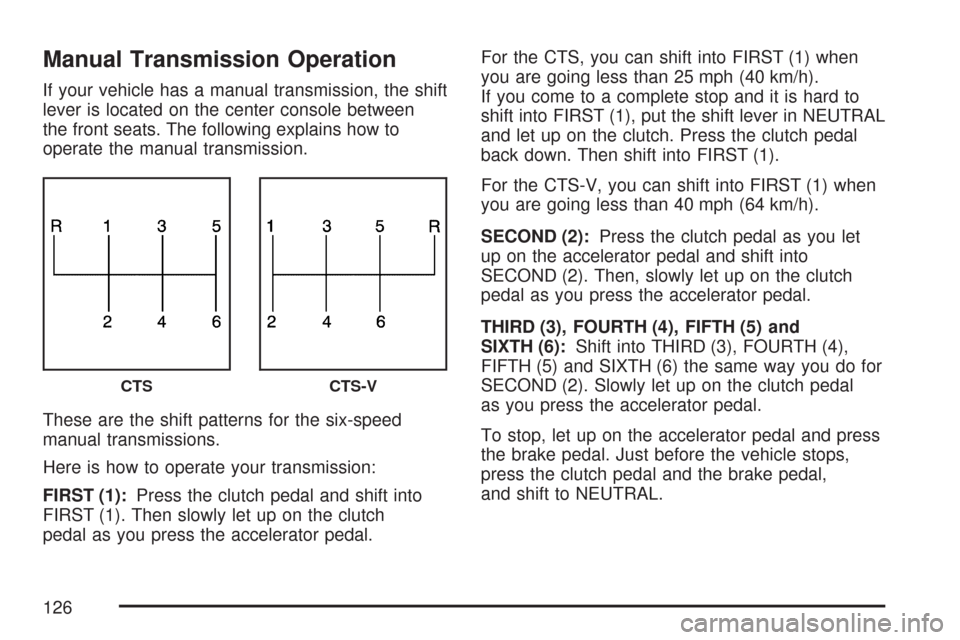
These are the shift patterns for the six-speed
manual transmissions.
Here is how to operate your transmission:
FIRST (1):Press the clutch pedal and shift into
FIRST (1). Then slowly let up on the clutch
pedal as you press the accelerator pedal.For the CTS, you can shift into FIRST (1) when
you are going less than 25 mph (40 km/h).
If you come to a complete stop and it is hard to
shift into FIRST (1), put the shift lever in NEUTRAL
and let up on the clutch. Press the clutch pedal
back down. Then shift into FIRST (1).
For the CTS-V, you can shift into FIRST (1) when
you are going less than 40 mph (64 km/h).
SECOND (2):Press the clutch pedal as you let
up on the accelerator pedal and shift into
SECOND (2). Then, slowly let up on the clutch
pedal as you press the accelerator pedal.
THIRD (3), FOURTH (4), FIFTH (5) and
SIXTH (6):Shift into THIRD (3), FOURTH (4),
FIFTH (5) and SIXTH (6) the same way you do for
SECOND (2). Slowly let up on the clutch pedal
as you press the accelerator pedal.
To stop, let up on the accelerator pedal and press
the brake pedal. Just before the vehicle stops,
press the clutch pedal and the brake pedal,
and shift to NEUTRAL.
CTSCTS-V
126
Page 186 of 518

A high electrical load occurs when several of the
following loads are on: headlamps, high beams,
fog lamps, rear window defogger, climate
control fan at high speed, heated seats, engine
cooling fans, trailer loads, and loads plugged into
accessory power outlets.
EPM works to prevent excessive discharge of the
battery. It does this by balancing the generator’s
output and the vehicle’s electrical needs. It
can increase engine idle speed to generate more
power, whenever needed. It can temporarily
reduce the power demands of some accessories.
Normally, these actions occur in steps or levels,
without being noticeable. In rare cases at the
highest levels of corrective action, this action may
be noticeable to the driver. If so, a Driver
Information Center (DIC) message might be
displayed, such as Battery Saver Active or Service
Battery Charging System. If this message is
displayed, it is recommended that the driver
reduce the electrical loads as much as possible.
SeeDIC Warnings and Messages on page 232.Battery Run-Down Protection
Your vehicle has a feature to help prevent the
battery from being drained, in case the underhood
lamp, vanity mirror lamps, cargo lamps, reading
lamps, console, or glove box lamps are
accidentally left on, or something is left plugged
into the accessory power outlet or cigarette lighter.
If any of the accessory lamps are left on, they
will automatically time-out after about 20 minutes.
To reset the battery protection, all of the above
lamps must be turned off or the ignition must be in
the Acc. position.
Accessory Power Outlet(s)
Accessory power outlets can be used to connect
auxiliary electrical equipment, such as a cellular
telephone or CB radio.
186
Page 191 of 518

If the airow seems low when the fan speed is at
the highest setting, the passenger compartment air
lter may need to be replaced. For more
information, seePassenger Compartment Air Filter
on page 195andScheduled Maintenance on
page 462.
h(Recirculation):This mode keeps outside
air from coming in the vehicle. It can be used
to prevent outside air and odors from entering your
vehicle or to help heat or cool the air inside your
vehicle more quickly. Press this button to
switch between recirculation and fresh air. Press
the auto button to have the system select the best
air delivery mode for your temperature setting.
Recirculation is not available in the defrost mode
and will automatically turn off after 10 minutes
when defog is selected.
Using recirculation for long periods of time may
cause the air inside your vehicle to become too dry
or stuffy. To prevent this from happening, after
the air in your vehicle has cooled, turn the
recirculation mode off or press the auto button.
((Heated Seats):Press this button to turn on
the heated seats. The button on the left controls
the driver’s seat and the button on the right
controls the passenger’s seat. SeeHeated Seats
on page 10.
QPWRR(Power/Driver’s Temperature):Press
the PWR button located on the driver’s side of
the climate control panel to turn the entire climate
control system on or off. Press the up or down
arrow on the switch to increase or decrease
the automatic temperature setting.
QPWRR(Power/Passenger’s Temperature):
Press the PWR button located on the passenger’s
side of the climate control panel to allow the
passenger’s climate control setting to be different
than the driver’s. Press the up or down arrow on the
switch to increase or decrease the automatic
temperature setting for the front passenger.
A/C OFF (Air Conditioning):Press this button to
manually turn off the air conditioning compressor.
Press AUTO to return to automatic operation
or press the A/C OFF button again.
191
Page 195 of 518

Operation Tips
Clear away any ice, snow or leaves from the
air inlets at the base of the windshield that
may block the ow of air into your vehicle.
Use of non-GM approved hood deectors may
adversely affect the performance of the
system.
Keep the path under the front seats clear of
objects to help circulate the air inside of
your vehicle more effectively.
Passenger Compartment Air Filter
The passenger compartment air lter traps most of
the pollen from the air entering your vehicle.
Like your vehicle’s engine air cleaner/lter, it needs
to be changed periodically. SeeScheduled
Maintenance on page 462.
Using the climate control system without the
passenger air lter installed may allow water or
other debris to enter the system. This could cause
a water leak or noises. Make sure to install a
new air lter after removing the old one.The passenger compartment air lter is located
underneath the hood below the windshield
wiper arm on the passenger’s side of the vehicle.
SeeEngine Compartment Overview on page 342
for more information on location.
Use the procedure listed below to replace the
passenger compartment air lter:
1. Turn the ignition to ON with the engine off.
2. Turn on the windshield wipers and turn them
off again when the wipers are straight on the
windshield.
This allows you access to the leaf screen.
The passenger compartment air lter is
located under the leaf screen.
195
Page 326 of 518

If you put things inside your vehicle, like suitcases,
tools, packages, or anything else, they will go as
fast as the vehicle goes. If you have to stop or turn
quickly, or if there is a crash, they will keep going.
{CAUTION:
Things you put inside your vehicle can
strike and injure people in a sudden stop
or turn, or in a crash.
Put things in the trunk of your vehicle.
In a trunk, put them as far forward as
you can. Try to spread the weight
evenly.
Never stack heavier things, like
suitcases, inside the vehicle so that
some of them are above the tops of
the seats.
Do not leave an unsecured child
restraint in your vehicle.
When you carry something inside the
vehicle, secure it whenever you can.
Do not leave a seat folded down
unless you need to.
Towing
Towing Your Vehicle
Consult your dealer or a professional towing
service if you need to have your disabled vehicle
towed. SeeRoadside Service on page 488.
If you want to tow your vehicle behind another
vehicle for recreational purposes (such as behind
a motorhome), see Recreational Vehicle Towing
following.
Recreational Vehicle Towing
Recreational vehicle towing means towing your
vehicle behind another vehicle – such as behind a
motorhome. The two most common types of
recreational vehicle towing are known as “dinghy
towing” (towing your vehicle with all four wheels
on the ground) and “dolly towing” (towing your
vehicle with two wheels on the ground and
two wheels up on a device known as a “dolly”).
326
Page 397 of 518
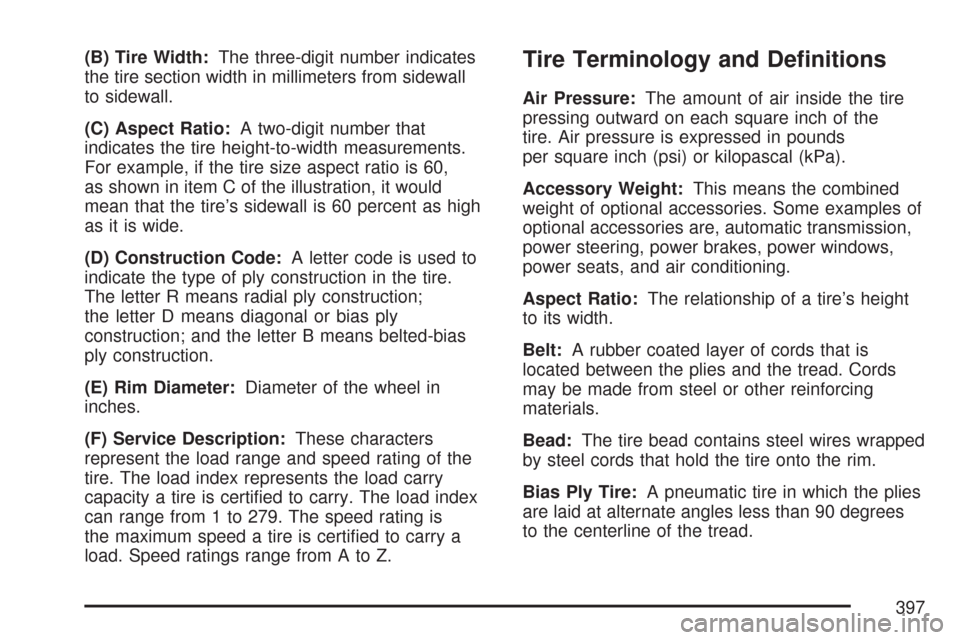
(B) Tire Width:The three-digit number indicates
the tire section width in millimeters from sidewall
to sidewall.
(C) Aspect Ratio:A two-digit number that
indicates the tire height-to-width measurements.
For example, if the tire size aspect ratio is 60,
as shown in item C of the illustration, it would
mean that the tire’s sidewall is 60 percent as high
as it is wide.
(D) Construction Code:A letter code is used to
indicate the type of ply construction in the tire.
The letter R means radial ply construction;
the letter D means diagonal or bias ply
construction; and the letter B means belted-bias
ply construction.
(E) Rim Diameter:Diameter of the wheel in
inches.
(F) Service Description:These characters
represent the load range and speed rating of the
tire. The load index represents the load carry
capacity a tire is certied to carry. The load index
can range from 1 to 279. The speed rating is
the maximum speed a tire is certied to carry a
load. Speed ratings range from A to Z.Tire Terminology and Denitions
Air Pressure:The amount of air inside the tire
pressing outward on each square inch of the
tire. Air pressure is expressed in pounds
per square inch (psi) or kilopascal (kPa).
Accessory Weight:This means the combined
weight of optional accessories. Some examples of
optional accessories are, automatic transmission,
power steering, power brakes, power windows,
power seats, and air conditioning.
Aspect Ratio:The relationship of a tire’s height
to its width.
Belt:A rubber coated layer of cords that is
located between the plies and the tread. Cords
may be made from steel or other reinforcing
materials.
Bead:The tire bead contains steel wires wrapped
by steel cords that hold the tire onto the rim.
Bias Ply Tire:A pneumatic tire in which the plies
are laid at alternate angles less than 90 degrees
to the centerline of the tread.
397
Page 446 of 518
Electrical System
Add-On Electrical Equipment
Notice:Do not add anything electrical to your
vehicle unless you check with your dealer
rst. Some electrical equipment can damage
your vehicle and the damage would not
be covered by your warranty. Some add-on
electrical equipment can keep other
components from working as they should.
Add-on equipment can drain your vehicle’s battery,
even if your vehicle is not operating.
Your vehicle has an airbag system. Before
attempting to add anything electrical to your
vehicle, seeServicing Your Airbag-Equipped
Vehicle on page 88.
Windshield Wiper Fuses
The windshield wiper motor is protected by an
internal circuit breaker. If the wiper motor
overheats due to heavy snow, the wipers will stop
until the motor cools and will then restart.
Power Windows and Other Power
Options
Circuit breakers protect the power windows and
power seats. When the current load is too
heavy, the circuit breaker opens and closes,
protecting the circuit until the problem is xed or
goes away.
446
Page 509 of 518
H
Hazard Warning Flashers............................ 168
Head Restraints............................................ 17
Headlamp
Aiming..................................................... 383
Headlamps.................................................. 180
Bulb Replacement.................................... 386
Daytime Running Lamps.......................... 181
Flash-to-Pass........................................... 172
Front Turn Signal and Fog Lamps............ 387
Halogen Bulbs......................................... 386
High Intensity Discharge (HID) Lighting.... 386
High/Low Beam Changer......................... 172
On Reminder........................................... 181
Washer.................................................... 175
Wiper Activated........................................ 180
Heated Seats................................................ 10
Heater......................................................... 189
Highbeam On Light..................................... 214
High-Speed Operation, Tires........................ 404
Highway Hypnosis....................................... 313
Hill and Mountain Roads............................. 314Hood
Checking Things Under............................ 340
Release................................................... 341
Horn............................................................ 168
Hot Coolant Temperature Warning
Message.................................................. 219
How to Use This Manual................................ 4
How to Wear Safety Belts Properly............... 25
Hydraulic Clutch.......................................... 356
I
Ignition Positions......................................... 117
Immobilizer.................................................. 113
Immobilizer Operation.................................. 114
Infants and Young Children, Restraints.......... 45
Ination - Tire Pressure............................... 402
Instrument Panel
Overview.................................................. 166
Instrument Panel (I/P)
Brightness................................................ 184
Cluster..................................................... 198
509
Page 511 of 518

Loss of Control........................................... 303
Lumbar
Power Controls.......................................... 10
M
Maintenance Schedule
Additional Required Services.................... 465
At Each Fuel Fill...................................... 469
At Least Once a Month............................ 470
At Least Once a Year.............................. 470
Introduction.............................................. 460
Maintenance Footnotes............................ 467
Maintenance Record................................ 477
Maintenance Requirements...................... 460
Normal Maintenance Replacement
Parts.................................................... 475
Owner Checks and Services.................... 469
Recommended Fluids and Lubricants....... 473
Scheduled Maintenance........................... 462
Using....................................................... 461
Your Vehicle and the Environment............ 460
Malfunction Indicator Light........................... 209
Manual Seats.................................................. 8Manual Transmission
Fluid........................................................ 354
Operation................................................. 126
Map Pocket................................................. 160
Memory Seat and Mirrors.............................. 11
Message
Center..................................................... 215
Check Engine Oil Pressure...................... 220
DIC Warnings and Messages................... 232
Hot Coolant Temperature Warning............ 219
Oil Temperature Warning.......................... 220
One-to-Four Shift..................................... 222
Tire Pressure Warning............................. 221
Transmission Fluid Hot............................. 219
Mirrors
Automatic Dimming Rearview with
OnStar
®................................................ 136
Automatic Dimming Rearview with
OnStar
®and Compass......................... 137
Outside Convex Mirror............................. 141
Outside Curb View Assist Mirror............... 141
Outside Heated Mirrors............................ 141
Outside Power Mirrors............................. 140
MyGMLink.com............................................ 485
511
Page 514 of 518
Reporting Safety Defects (cont.)
General Motors........................................ 501
United States Government....................... 500
Restraint System Check
Checking the Restraint Systems................. 90
Replacing Restraint System Parts
After a Crash......................................... 91
Retained Accessory Power (RAP)................ 119
Right Front Passenger Position,
Safety Belts............................................... 34
Roadside
Service.................................................... 488
Rocking Your Vehicle to Get it Out.............. 321
Roof Rack Provisions.................................. 160
Routing, Engine Drive Belt.......................... 476
Run-Flat Tires............................................. 400
Running the Engine While Parked............... 135
S
Safety Belt
Pretensioners............................................. 41
Reminder Light........................................ 201
Safety Belts
Care of.................................................... 439
Driver Position........................................... 26Safety Belts (cont.)
How to Wear Safety Belts Properly............ 25
Questions and Answers About
Safety Belts............................................ 24
Rear Safety Belt Comfort Guides............... 38
Rear Seat Passengers............................... 34
Right Front Passenger Position.................. 34
Safety Belt Extender.................................. 41
Safety Belt Use During Pregnancy............. 33
Safety Belts Are for Everyone.................... 20
Safety Warnings and Symbols......................... 4
Scheduled Maintenance............................... 462
Seats
Head Restraints......................................... 17
Heated Seats............................................. 10
Manual........................................................ 8
Memory, Mirrors......................................... 11
Power Lumbar........................................... 10
Power Seats................................................ 9
Reclining Seatbacks................................... 14
Split Folding Rear Seat.............................. 18
Securing a Child Restraint
Rear Seat Position..................................... 63
Right Front Seat Position........................... 66
Security Light.............................................. 213
Service........................................................ 332
Accessories and Modications.................. 332
514