hood open CADILLAC CTS 2007 1.G Owners Manual
[x] Cancel search | Manufacturer: CADILLAC, Model Year: 2007, Model line: CTS, Model: CADILLAC CTS 2007 1.GPages: 518, PDF Size: 2.77 MB
Page 121 of 518
To Use the Engine Coolant Heater
1. Turn off the engine.
2. Open the hood and unwrap the electrical
cord. For the 2.8L V6 and the 3.6L V6
engines, the cord is located in the engine
compartment on the passenger’s side of the
vehicle in front of the fuse block. For the
6.0L V8 engine, the cord is located in
the engine compartment on the driver’s side
of the vehicle near the inner fender and above
the strut.
Remove the plastic cap to access the plug.
3. Plug it into a normal, grounded 110-volt AC
outlet.{CAUTION:
Plugging the cord into an ungrounded
outlet could cause an electrical shock.
Also, the wrong kind of extension cord
could overheat and cause a re. You
could be seriously injured. Plug the cord
into a properly grounded three-prong
110-volt AC outlet. If the cord will not
reach, use a heavy-duty three-prong
extension cord rated for at least 15 amps.
4. Before starting the engine, be sure to unplug
and store the cord as it was before to keep it
away from moving engine parts. If you do
not, it could be damaged.
How long should you keep the coolant heater
plugged in? The answer depends on the outside
temperature, the kind of oil you have, and
some other things. Instead of trying to list
everything here, we ask that you contact your
dealer in the area where you will be parking your
vehicle. The dealer can give you the best
advice for that particular area.
121
Page 196 of 518

3. Open the hood to access the engine
compartment. SeeHood Release on page 341
for more information.
4. Remove the four screws that hold the leaf
screen in place and lift off the screen by
lifting and sliding toward the center of
the vehicle.
5. Pull out on the two tabs located on each end
of the lter cover.
6. Lift the lter cover off by pulling it straight
upward.
7. Remove the old lter and insert a new one.
Make sure the arrow on the lter is pointing
toward the passenger compartment.
SeeNormal Maintenance Replacement Parts
on page 475for the correct part number
for the lter.
8. Reverse Steps 1 through 6 to reinstall
the cover.Steering Wheel Climate
Controls (CTS)
Your vehicle may have four controls that can be
programmed for use with the climate control
system.
The controls are located
on the left side of the
steering wheel.
SeeRecongurable Steering Wheel Controls
(SWC) (CTS) on page 169for more information on
programming these controls.
196
Page 335 of 518

If your vehicle has the 6.0L V8 engine (VIN
Code U), use premium unleaded gasoline with a
posted octane rating of 91 or higher. You may also
use regular unleaded gasoline rated at 87 octane or
higher, but your vehicle’s acceleration may be
slightly reduced, and you may notice a slight
audible knocking noise, commonly referred to as
spark knock. If the octane is less than 87, you may
notice a heavy knocking noise when you drive.
If this occurs, use a gasoline rated at 87 octane or
higher as soon as possible. Otherwise, you might
damage your engine. If you are using gasoline
rated at 87 octane or higher and you hear heavy
knocking, your engine needs service.
Gasoline Specications
At a minimum, gasoline should meet ASTM
specication D 4814 in the United States or
CAN/CGSB-3.5 in Canada. Some gasolines may
contain an octane-enhancing additive called
methylcyclopentadienyl manganese tricarbonyl
(MMT). General Motors recommends against the
use of gasolines containing MMT. SeeAdditives
on page 336for additional information.
California Fuel
If your vehicle is certied to meet California
Emissions Standards, it is designed to operate on
fuels that meet California specications. See
the underhood emission control label. If this fuel is
not available in states adopting California
emissions standards, your vehicle will operate
satisfactorily on fuels meeting federal
specications, but emission control system
performance may be affected. The malfunction
indicator lamp may turn on and your vehicle may
fail a smog-check test. SeeMalfunction Indicator
Lamp on page 209. If this occurs, return to
your authorized GM dealer for diagnosis. If it is
determined that the condition is caused by the type
of fuel used, repairs may not be covered by
your warranty.
335
Page 341 of 518
Hood Release
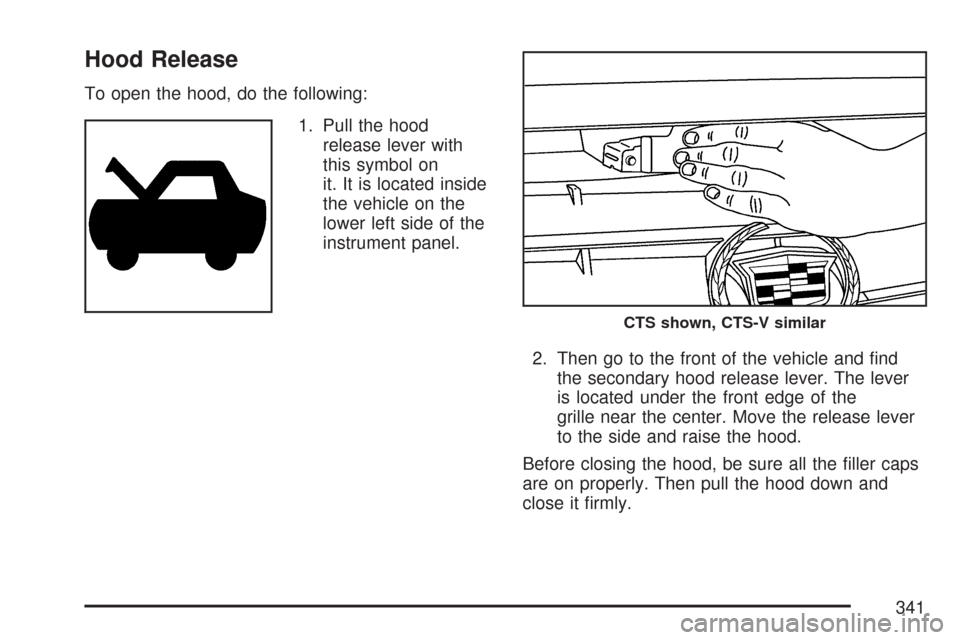
To open the hood, do the following:
1. Pull the hood
release lever with
this symbol on
it. It is located inside
the vehicle on the
lower left side of the
instrument panel.
2. Then go to the front of the vehicle and nd
the secondary hood release lever. The lever
is located under the front edge of the
grille near the center. Move the release lever
to the side and raise the hood.
Before closing the hood, be sure all the ller caps
are on properly. Then pull the hood down and
close it rmly.
CTS shown, CTS-V similar
341
Page 342 of 518

Engine Compartment Overview
When you open the hood on the 3.6L V6 engine (2.8L V6 engine similar), you will see the following:
342
Page 344 of 518
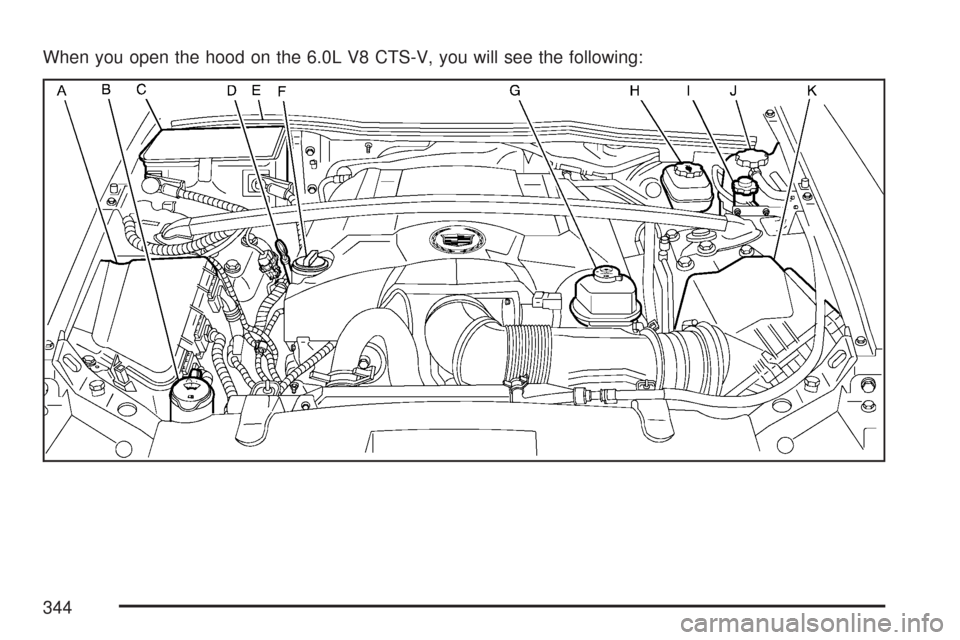
When you open the hood on the 6.0L V8 CTS-V, you will see the following:
344
Page 360 of 518
Coolant Surge Tank Pressure Cap
Notice:If the pressure cap is not tightly
installed, coolant loss and possible engine
damage may occur. Be sure the cap is properly
and tightly secured.
The coolant surge tank pressure cap must be fully
installed on the coolant surge tank. SeeEngine
Compartment Overview on page 342for more
information on location.
Engine Overheating
There are two engine hot messages that may be
displayed in the Driver Information Center
(DIC). SeeDIC Warnings and Messages on
page 232for more information.
If Steam Is Coming From Your Engine
{CAUTION:
Steam from an overheated engine can
burn you badly, even if you just open the
hood. Stay away from the engine if you
see or hear steam coming from it. Turn it
off and get everyone away from the
vehicle until it cools down. Wait until
there is no sign of steam or coolant
before you open the hood.
CAUTION: (Continued)
360
Page 362 of 518

If you get the Engine Coolant Hot - Idle Engine
warning with no sign of steam, try this for a minute
or so:
1. In heavy traffic, let the engine idle in
NEUTRAL (N) while stopped. If it is safe to do
so, pull off the road, shift to PARK (P) or
NEUTRAL (N) and let the engine idle.
2. Set the climate controls to the highest heat
setting and fan speed and open the windows,
as necessary.
If you no longer have the Engine Coolant
Hot - Idle Engine warning, you can drive. Just to
be safe, drive slower for about 10 minutes. If
the warning does not come back on, you can
drive normally.
If the warning continues and you have not
stopped, pull over, stop, and park your vehicle
right away.
If there is still no sign of steam, you can idle the
engine for three minutes while you are parked.
If you still have the warning,turn off the engine
and get everyone out of the vehicleuntil it
cools down.
You may decide not to lift the hood but to get
service help right away.Overheated Engine Protection
Operating Mode
This operating mode allows your vehicle to be
driven to a safe place in an emergency. Should an
hot engine condition exist, an overheat protection
mode which alternates ring groups of cylinders
helps prevent engine damage. In this mode, there
is a loss in power and engine performance.
Driving extended miles (km) and/or towing a trailer
in the overheat protection mode should be
avoided.
Notice:After driving in the overheated engine
protection operating mode, to avoid engine
damage, allow the engine to cool before
attempting any repair. The engine oil will be
severely degraded. Repair the cause of coolant
loss and change the oil. SeeEngine Oil on
page 346.
362
Page 377 of 518

Notice:If you leave your radio or other
accessories on during the jump starting
procedure, they could be damaged. The repairs
would not be covered by your warranty.
Always turn off your radio and other
accessories when jump starting your vehicle.
3. Turn off the ignition on both vehicles.
Unplug unnecessary accessories plugged into
the cigarette lighter or the accessory power
outlets. Turn off the radio and all lamps
that are not needed. This will avoid sparks
and help save both batteries. And it could
save the radio!
4. Open the hoods and locate the positive (+)
and negative (−) terminal locations of the
other vehicle, as well as the positive (+)
terminal location on your vehicle’s battery.
SeeEngine Compartment Overview on
page 342for more information on the location
of the battery.
377
Page 384 of 518

Headlamp aiming is done with the vehicle’s
low-beam headlamps. The high-beam headlamps
will be correctly aimed if the low-beam headlamps
are aimed properly.
To adjust the vertical aim, do the following:
1. Open the hood. SeeHood Release on
page 341for more information.
2. Locate the aim dot on the lens of the
low-beam headlamp.
3. Measure the distance from the ground to the
aim dot on the low-beam headlamp. Record
the distance.4. At the wall measure from the ground
upward (A) to the recorded distance
from Step 3 and mark it.
5. Draw or tape a horizontal line (B) the width of
the vehicle at the wall where it was marked it
Step 4.
Notice:Do not cover a headlamp to improve
beam cut-off when aiming. Covering a
headlamp may cause excessive heat build-up
which may cause damage to the headlamp.
6. Turn on the low-beam headlamps and place a
piece of cardboard or equivalent in front of the
headlamp not being aimed. This should
allow only the beam of light from the headlamp
being aimed to be seen on the at surface.
384