clock CADILLAC CTS 2008 2.G User Guide
[x] Cancel search | Manufacturer: CADILLAC, Model Year: 2008, Model line: CTS, Model: CADILLAC CTS 2008 2.GPages: 490, PDF Size: 2.59 MB
Page 316 of 490
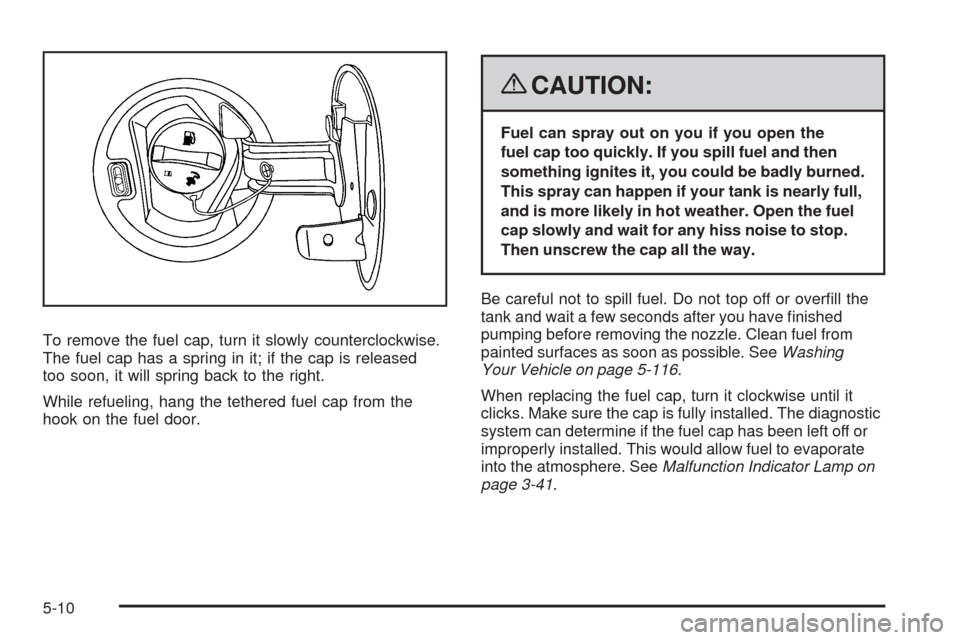
To remove the fuel cap, turn it slowly counterclockwise.
The fuel cap has a spring in it; if the cap is released
too soon, it will spring back to the right.
While refueling, hang the tethered fuel cap from the
hook on the fuel door.
{CAUTION:
Fuel can spray out on you if you open the
fuel cap too quickly. If you spill fuel and then
something ignites it, you could be badly burned.
This spray can happen if your tank is nearly full,
and is more likely in hot weather. Open the fuel
cap slowly and wait for any hiss noise to stop.
Then unscrew the cap all the way.
Be careful not to spill fuel. Do not top off or overll the
tank and wait a few seconds after you have nished
pumping before removing the nozzle. Clean fuel from
painted surfaces as soon as possible. SeeWashing
Your Vehicle on page 5-116.
When replacing the fuel cap, turn it clockwise until it
clicks. Make sure the cap is fully installed. The diagnostic
system can determine if the fuel cap has been left off or
improperly installed. This would allow fuel to evaporate
into the atmosphere. SeeMalfunction Indicator Lamp on
page 3-41.
5-10
Page 343 of 490

{CAUTION:
You can be burned if you spill coolant on hot
engine parts. Coolant contains eythylene glycol
and it will burn if the engine parts are hot
enough. Do not spill coolant on a hot engine.
If no coolant is visible in the surge tank, add coolant as
follows:
1. Remove the coolant surge tank pressure cap when
the cooling system, including the coolant surge tank
pressure cap and upper radiator hose, is no longer
hot. Turn the pressure cap slowly counterclockwise
about one-quarter turn and then stop.
If you hear a hiss, wait for that to stop. A hiss
means there is still some pressure left.2. Then keep turning the pressure cap slowly, and
remove it.
5-37
Page 360 of 490

7. Locate the vertical headlamp aiming screws, which
are under the hood near each headlamp assembly.
The adjustment screw can be turned with a
6 mm hex socket.
8. Turn the vertical aiming screw until the headlamp
beam is aimed to the horizontal tape line. Turn it
clockwise or counterclockwise to raise or lower the
angle of the beam.
The top edge of the cut-off should be positioned at
the bottom edge of the horizontal tape line.9. Make sure that the light from the headlamp is
positioned at the bottom edge of the horizontal tape
line. The lamp on the left (A) shows the correct
headlamp aim. The lamp on the right (B) shows
the incorrect headlamp aim.
10. Repeat Steps 7 through 9 for the opposite
headlamp. Driver Side Shown
5-54
Page 362 of 490
Front Turn Signal and Fog Lamps
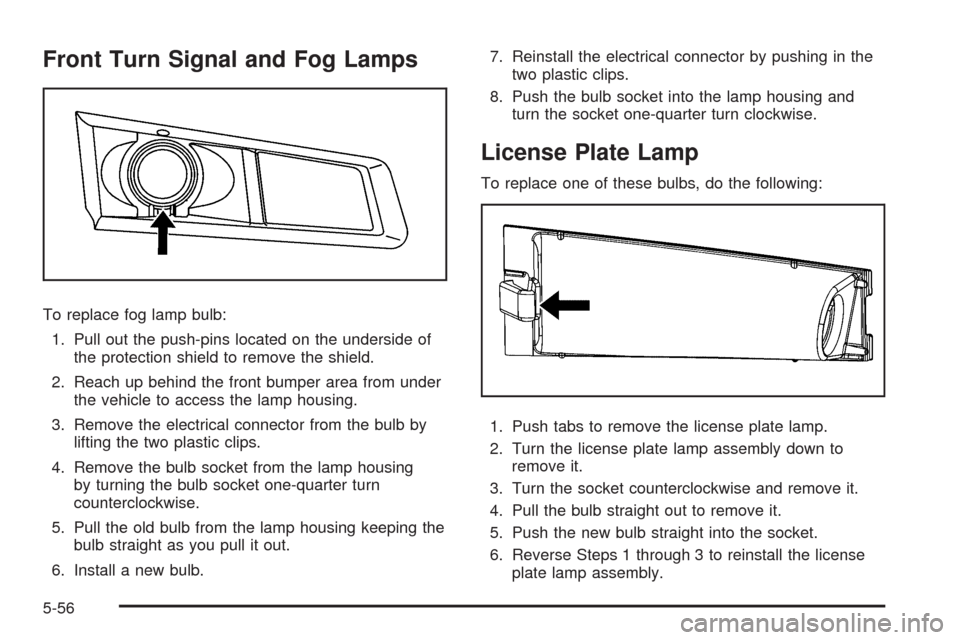
To replace fog lamp bulb:
1. Pull out the push-pins located on the underside of
the protection shield to remove the shield.
2. Reach up behind the front bumper area from under
the vehicle to access the lamp housing.
3. Remove the electrical connector from the bulb by
lifting the two plastic clips.
4. Remove the bulb socket from the lamp housing
by turning the bulb socket one-quarter turn
counterclockwise.
5. Pull the old bulb from the lamp housing keeping the
bulb straight as you pull it out.
6. Install a new bulb.7. Reinstall the electrical connector by pushing in the
two plastic clips.
8. Push the bulb socket into the lamp housing and
turn the socket one-quarter turn clockwise.
License Plate Lamp
To replace one of these bulbs, do the following:
1. Push tabs to remove the license plate lamp.
2. Turn the license plate lamp assembly down to
remove it.
3. Turn the socket counterclockwise and remove it.
4. Pull the bulb straight out to remove it.
5. Push the new bulb straight into the socket.
6. Reverse Steps 1 through 3 to reinstall the license
plate lamp assembly.
5-56
Page 391 of 490
Accessing the Tire Sealant and
Compressor Kit
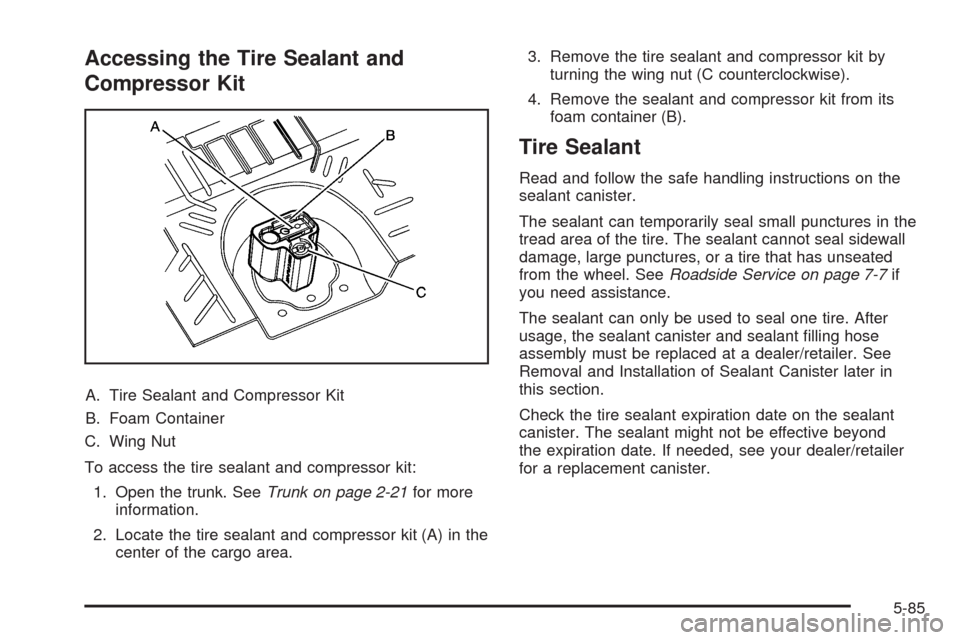
A. Tire Sealant and Compressor Kit
B. Foam Container
C. Wing Nut
To access the tire sealant and compressor kit:
1. Open the trunk. SeeTrunk on page 2-21for more
information.
2. Locate the tire sealant and compressor kit (A) in the
center of the cargo area.3. Remove the tire sealant and compressor kit by
turning the wing nut (C counterclockwise).
4. Remove the sealant and compressor kit from its
foam container (B).
Tire Sealant
Read and follow the safe handling instructions on the
sealant canister.
The sealant can temporarily seal small punctures in the
tread area of the tire. The sealant cannot seal sidewall
damage, large punctures, or a tire that has unseated
from the wheel. SeeRoadside Service on page 7-7if
you need assistance.
The sealant can only be used to seal one tire. After
usage, the sealant canister and sealant lling hose
assembly must be replaced at a dealer/retailer. See
Removal and Installation of Sealant Canister later in
this section.
Check the tire sealant expiration date on the sealant
canister. The sealant might not be effective beyond
the expiration date. If needed, see your dealer/retailer
for a replacement canister.
5-85
Page 392 of 490
Using the Tire Sealant and
Compressor Kit
Follow these directions closely for correct sealant
usage.
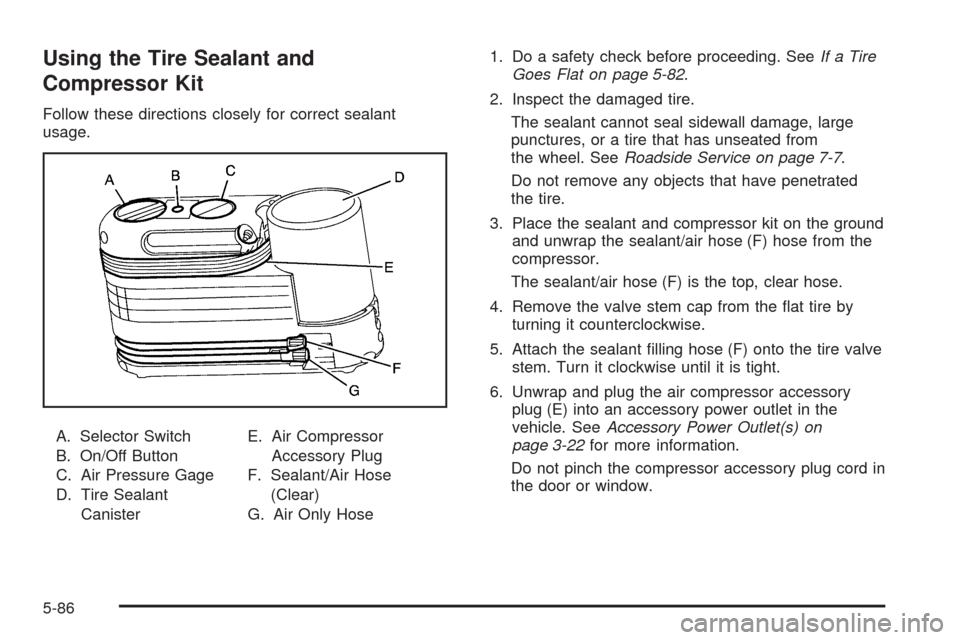
A. Selector Switch
B. On/Off Button
C. Air Pressure Gage
D. Tire Sealant
CanisterE. Air Compressor
Accessory Plug
F. Sealant/Air Hose
(Clear)
G. Air Only Hose1. Do a safety check before proceeding. SeeIf a Tire
Goes Flat on page 5-82.
2. Inspect the damaged tire.
The sealant cannot seal sidewall damage, large
punctures, or a tire that has unseated from
the wheel. SeeRoadside Service on page 7-7.
Do not remove any objects that have penetrated
the tire.
3. Place the sealant and compressor kit on the ground
and unwrap the sealant/air hose (F) hose from the
compressor.
The sealant/air hose (F) is the top, clear hose.
4. Remove the valve stem cap from the at tire by
turning it counterclockwise.
5. Attach the sealant lling hose (F) onto the tire valve
stem. Turn it clockwise until it is tight.
6. Unwrap and plug the air compressor accessory
plug (E) into an accessory power outlet in the
vehicle. SeeAccessory Power Outlet(s) on
page 3-22for more information.
Do not pinch the compressor accessory plug cord in
the door or window.
5-86
Page 393 of 490

{CAUTION:
Idling the engine in a closed-in place or with
the climate control system off can cause
deadly carbon monoxide (CO). SeeEngine
Exhaust on page 2-48.
7. Start the vehicle. SeeStarting the Engine on
page 2-35for more information. The vehicle must
be running while using the air compressor.
{CAUTION:
Overination could cause the tire to rupture,
and you or others could be injured. Be sure to
read the inator instructions, and inate the
tire to its recommended pressure. Do not
exceed 36 psi (248 kPa).
8. Turn the selector switch (A) counterclockwise to the
sealant and air position.9. Push the On/Off button (B).
The sealant and compressor kit will inject sealant
and air into the tire. Sealant may leak from the
puncture until the vehicle is driven and the hole
has sealed.
The pressure gage (C) will initially show a high
pressure while the compressor pushes the sealant
into the tire. Once the sealant is completely
dispersed into the tire, the pressure will quickly drop
and start to rise again as the tire inates with air.
10. Inate the tire to the recommended ination
pressure, found on the Tire and Loading Information
label located on the vehicle’s center pillar (B-pillar)
below the vehicle’s door latch, using the air pressure
gage on the top of the unit.
The pressure gage reads high while the compressor
is running. Turn the compressor off to get an
accurate pressure reading.
Notice:If the recommended pressure cannot be
reached after approximately 25 minutes, the vehicle
should not be driven farther. The tire is too severely
damaged and the tire sealant and compressor kit
cannot inate the tire. Remove the air compressor
plug from the accessory power outlet and unscrew
the inating hose from the tire valve. SeeRoadside
Service on page 7-7.
11. Turn the compressor off by pushing the On/Off
button (B).
5-87
Page 394 of 490
12. The tire is not sealed and will continue to leak
air until the vehicle is driven and the sealant is
distributed in the tire.
Steps 11 through 18 must be done right after
Step 10.
13. Unplug the air compressor accessory plug (F) from
the accessory power outlet in the vehicle.
14. Disconnect the sealant/air hose from the tire valve
stem or tire pressure monitoring sensor cap, by
turning it counterclockwise, and replace the
tire valve stem cap.
Be careful when handling the tire inator
components as they may be hot after usage.
15. Wrap the sealant/air hose around the air
compressor channel to stow it in its original location.
16. Wrap the air compressor accessory plug (E)
back into place.17. If the at tire was
able to inate to the
recommended ination
pressure, remove the
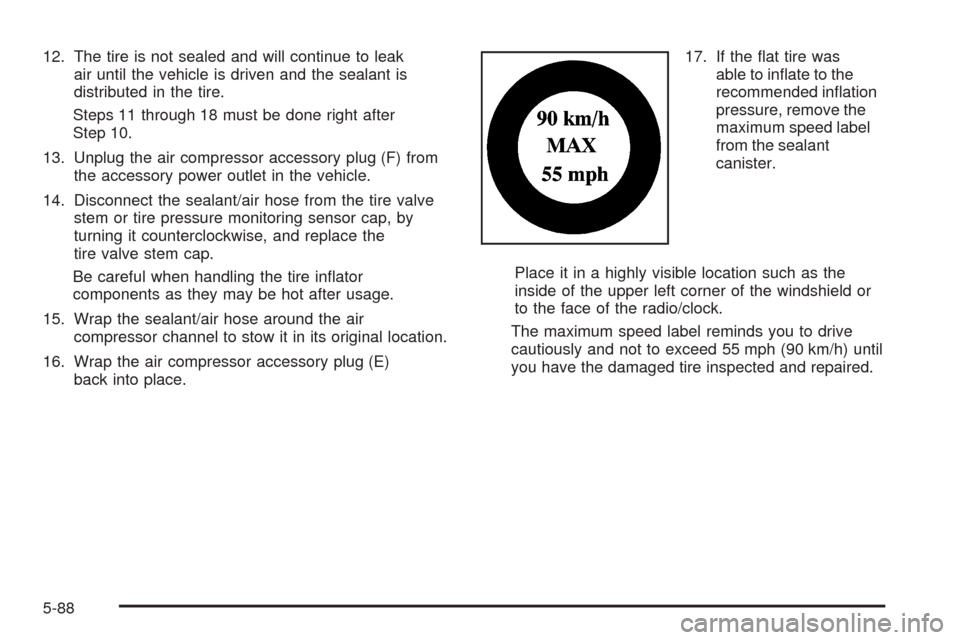
maximum speed label
from the sealant
canister.
Place it in a highly visible location such as the
inside of the upper left corner of the windshield or
to the face of the radio/clock.
The maximum speed label reminds you to drive
cautiously and not to exceed 55 mph (90 km/h) until
you have the damaged tire inspected and repaired.
5-88
Page 397 of 490
3. Attach the air only hose (G) onto the valve stem to
secure into place.
4. Plug the air compressor accessory plug (E) into an
accessory power outlet in the vehicle. SeeAccessory
Power Outlet(s) on page 3-22for more information.
{CAUTION:
Idling the engine in a closed-in place or with
the climate control system off can cause
deadly carbon monoxide (CO). SeeEngine
Exhaust on page 2-48.
5. Start the vehicle. SeeStarting the Engine on
page 2-35for more information. The vehicle must
be running while using the air compressor.
{CAUTION:
Overination could cause the tire to rupture,
and you or others could be injured. Be sure to
read the inator instructions, and inate the
tire to its recommended pressure. Do not
exceed 36 psi (248 kPa).
6. Turn the selector switch (A) clockwise to the air
only position.
7. Push the On/Off button (B).
8. Inate the tire up to the recommended ination
pressure using the air pressure gage (C) on the
top of the unit.
The pressure gage read high while the compressor
is running. Turn the compressor off to get an
accurate reading.
5-91
Page 401 of 490
The sealant can temporarily seal a puncture up to 6 mm
in the tread area of the tire ire. The sealant cannot
seal sidewall damage, large punctures, or a tire that
has unseated from the wheel. SeeRoadside Service
on page 7-7.
Using the Tire Sealant and Compressor
Kit to Temporarily Seal and Inate a
Punctured Tire
Follow these directions closely for correct sealant
usage.
1. Do a safety check before proceeding. SeeIf a Tire
Goes Flat on page 5-82.
2. Inspect the damaged tire.
The sealant cannot seal sidewall damage, large
punctures, or a tire that has unseated from
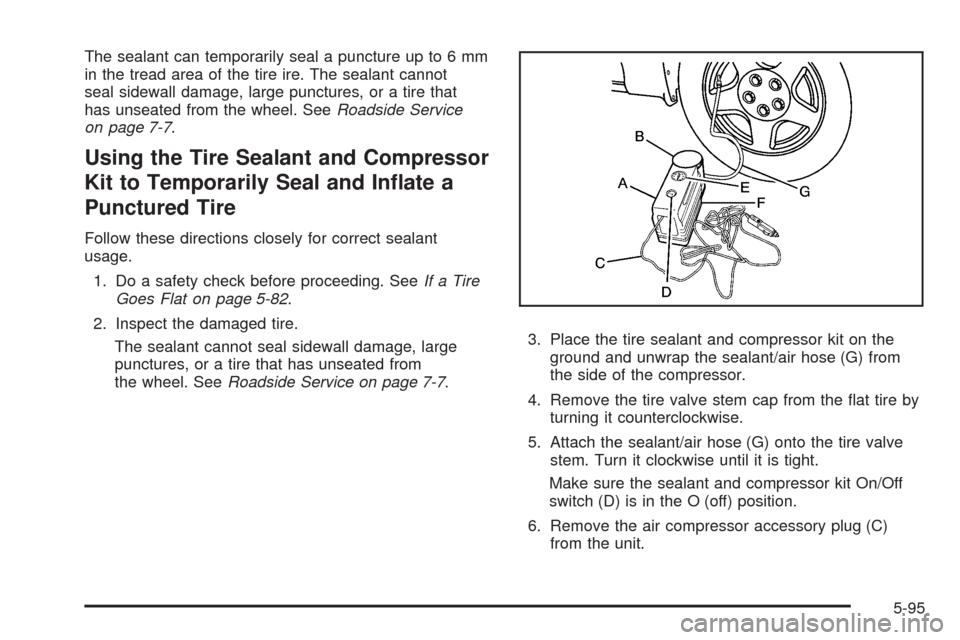
the wheel. SeeRoadside Service on page 7-7.3. Place the tire sealant and compressor kit on the
ground and unwrap the sealant/air hose (G) from
the side of the compressor.
4. Remove the tire valve stem cap from the at tire by
turning it counterclockwise.
5. Attach the sealant/air hose (G) onto the tire valve
stem. Turn it clockwise until it is tight.
Make sure the sealant and compressor kit On/Off
switch (D) is in the O (off) position.
6. Remove the air compressor accessory plug (C)
from the unit.
5-95