cooling CADILLAC CTS 2009 2.G User Guide
[x] Cancel search | Manufacturer: CADILLAC, Model Year: 2009, Model line: CTS, Model: CADILLAC CTS 2009 2.GPages: 490, PDF Size: 2.68 MB
Page 343 of 490

Checking Coolant (CTS)
The vehicle must be on a level surface when checking
the coolant level.
The engine coolant reservoir is located in the engine
compartment on the driver side of the vehicle. See
Engine Compartment Overview on page 5-14.
Check to see if coolant is visible in the surge tank.
If the coolant inside the surge tank is boiling, do not do
anything else until it cools down. If coolant is visible
but the coolant level is not at or above the FULL COLD
mark, add a 50/50 mixture of clean, drinkable water
and DEX-COOL
®coolant at the coolant surge tank,
but be sure the cooling system is cool before this
is done. SeeEngine Coolant on page 5-32for more
information.
If the engine is warm or hot, the coolant level should be
at or above the FROID/FULL COLD line on the side
of the coolant surge tank. If the engine is cold, the
coolant level should be near the FROID/FULL COLD
line on the side of the coolant surge tank. If it is
not, there could be a leak in the cooling system.
How to Add Coolant to the Surge Tank
{CAUTION:
You can be burned if you spill coolant on hot
engine parts. Coolant contains ethylene glycol
and it will burn if the engine parts are hot enough.
Do not spill coolant on a hot engine.
Notice:This vehicle has a specic coolant ll
procedure. Failure to follow this procedure could
cause the engine to overheat and be severely
damaged.
{CAUTION:
An electric engine cooling fan under the hood can
start up even when the engine is not running and
can cause injury. Keep hands, clothing, and tools
away from any underhood electric fan.
5-33
Page 344 of 490
{CAUTION:
Steam and scalding liquids from a hot cooling
system can blow out and burn you badly. They are
under pressure, and if you turn the surge tank
pressure cap — even a little — they can come
out at high speed. Never turn the cap when the
cooling system, including the surge tank pressure
cap, is hot. Wait for the cooling system and surge
tank pressure cap to cool if you ever have to turn
the pressure cap.
If coolant is needed, add the proper DEX-COOL
®
coolant mixture at the coolant surge tank.If no coolant is visible in the surge tank, add coolant as
follows:
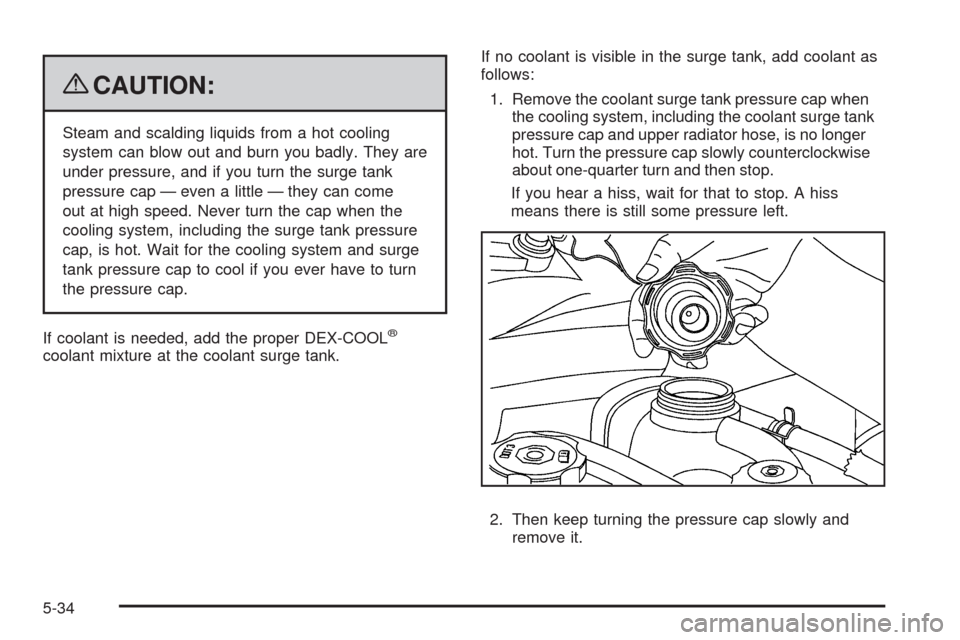
1. Remove the coolant surge tank pressure cap when
the cooling system, including the coolant surge tank
pressure cap and upper radiator hose, is no longer
hot. Turn the pressure cap slowly counterclockwise
about one-quarter turn and then stop.
If you hear a hiss, wait for that to stop. A hiss
means there is still some pressure left.
2. Then keep turning the pressure cap slowly and
remove it.
5-34
Page 345 of 490

3. Fill the coolant surge tank with the proper mixture,
to slightly above the FROID/FULL COLD line on the
side of the coolant surge tank.4. With the coolant surge tank pressure cap off, start
the engine and let it run until you can feel the upper
radiator hose getting hot. The upper radiator
hose is the top hose coming out of the radiator, on
the passenger side of the vehicle. Watch out for
the engine cooling fans.
By this time, the coolant level inside the coolant
surge tank may be lower. If the level is lower, add
more of the proper mixture to the coolant surge tank
until the level reaches the FROID/FULL COLD
line on the side of the coolant surge tank.
5. Then replace the pressure cap. Be sure the
pressure cap is hand-tight and fully seated.
Notice:If the pressure cap is not tightly installed,
coolant loss and possible engine damage may
occur. Be sure the cap is properly and tightly
secured.
Recheck the coolant level in the bottle next time you
use your vehicle to insure the system is full when cold.
SeeEngine Coolant on page 5-32.
5-35
Page 346 of 490

Checking Coolant in the Intercooler
System (CTS-V)
The vehicle must be on a level surface when checking
the coolant level.
The super charged engine intercooler coolant ll bottle
is located in the engine compartment on the passenger
side of the vehicle. SeeEngine Compartment
Overview on page 5-14.
Check to see if coolant is visible in the coolant ll bottle.
If the coolant inside the coolant ll bottle is boiling, do not
do anything else until it cools down. If coolant is visible
but the coolant level is not at or above the COLD FILL
mark, add a 50/50 mixture of clean, drinkable water and
DEX-COOL
®coolant at the coolant ll bottle, but be sure
the cooling system is cool before this is done.
If the engine is warm or hot, the coolant level should be
at or above the COLD FILL line on the side of the coolant
ll bottle. If the engine is cold, the coolant level should be
near the COLD FILL line on the side of the coolant ll
bottle. If it is not, you could have a leak in the cooling
system.
Adding Coolant to the Intercooler
System Coolant (CTS-V)
1. Remove the intercooler system pressure cap when
the intercooler system hoses are no longer hot.
Turn the pressure cap slowly counterclockwise
about one-quarter of a turn. If you hear a hiss, wait
for that to stop. This allows any pressure still left
to be vented.
2. Then keep turning the pressure cap slowly and
remove it.
5-36
Page 348 of 490

If you do decide to lift the hood, make sure the vehicle
is parked on a level surface.
Then check to see if the engine cooling fans are
running. If the engine is overheating, both fans should
be running. If they are not, do not continue to run
the engine and have the vehicle serviced.
Notice:Engine damage from running the engine
without coolant is not covered by the warranty.
Notice:If the engine catches re while driving with
no coolant, the vehicle can be badly damaged.
The costly repairs would not be covered by
the vehicle warranty. SeeOverheated Engine
Protection Operating Mode on page 5-39for
information on driving to a safe place in an
emergency.If Steam Is Coming From The Engine
Compartment
{CAUTION:
Steam from an overheated engine can burn you
badly, even if you just open the hood. Stay away
from the engine if you see or hear steam coming
from it. Turn it off and get everyone away from the
vehicle until it cools down. Wait until there is no sign
of steam or coolant before you open the hood.
If you keep driving when the vehicles engine is
overheated, the liquids in it can catch re. You or
others could be badly burned. Stop the engine if it
overheats, and get out of the vehicle until the
engine is cool.
SeeOverheated Engine Protection Operating Mode
on page 5-39for information on driving to a safe
place in an emergency.
5-38
Page 393 of 490

Each new wheel should have the same load-carrying
capacity, diameter, width, offset and be mounted
the same way as the one it replaces.
If you need to replace any of your wheels, wheel bolts
or wheel nuts, replace them only with new GM
original equipment parts. This way, you will be sure to
have the right wheel, wheel bolts and wheel nuts
for your vehicle.
{CAUTION:
Using the wrong replacement wheels, wheel bolts,
or wheel nuts on your vehicle can be dangerous. It
could affect the braking and handling of your
vehicle, make your tires lose air and make you lose
control. You could have a collision in which you or
others could be injured. Always use the correct
wheel, wheel bolts, and wheel nuts for replacement.
Notice:The wrong wheel can also cause problems
with bearing life, brake cooling, speedometer or
odometer calibration, headlamp aim, bumper height,
vehicle ground clearance, and tire clearance to
the body and chassis.
{CAUTION:
Rust or dirt on a wheel, or on the parts to
which it is fastened, can make wheel nuts
become loose after a time. The wheel could
come off and cause a crash. When you
change a wheel, remove any rust or dirt from
places where the wheel attaches to the
vehicle. In an emergency, you can use a
cloth or a paper towel to do this; but be sure
to use a scraper or wire brush later, if you
need to, to get all the rust or dirt off.
{CAUTION:
Never use oil or grease on studs or the threads of
the wheel nuts. If you do, the wheel nuts might
come loose and the wheel could fall off, causing
a crash.
5-83
Page 428 of 490

Mini-Fuses Usage
STR/WHL/
ILLUMSteering Wheel Illumination
TCM BATTTransmission Control Module
Battery
MAN SPD
SNSRManual Speed Sensor
WPR Windshield Wiper
ENG PUMP Engine Pump
J-Case Fuses Usage
ABS MTR ABS Motor
BLWR Blower
BRK VAC
PUMPBrake Vacuum Pump
FAN 1 Cooling Fan 1
FAN 2 Cooling Fan 2
REAR DEFOG Rear Defogger
SPARE Spare
EPB Electric Park Brake
J-Case Fuses Usage
SPARE Spare
STRTR Starter
SPARE Spare
WSW/HTR Windshield Washer Heater
Relays Usage
A/C CMPRSR
CLTCHAir Conditioning Compressor Clutch
DRL (W/O HID)
LO BEAM (HID)Daytime Running Lamps
(without High Intensity Discharge),
Low-Beam Headlamps
(High Intensity Discharge)
ENG PUMP Engine Pump
FAN S/P Cooling Fan Series/Parallel
FAN 1 Cooling Fan 1
FAN 2 Cooling Fan 2
HI BEAM High-Beam Headlamp
HORN Horn
IGN 1 Ignition 1
5-118
Page 431 of 490

Mini-Fuses Usage
BCM 4 Body Control Module 4
BCM 5 Body Control Module 5
SPARE Spare
BCM 6, BCM 7 Body Control Module 6 and 7
DISPLY Display
DRL RT Right Daytime Running Lamp (DRL)
DRL/WSWDaytime Running Lamps/Windshield
Washer Pump
ECM Engine Control Module (ECM)
ECM/TCM IGNECM, Transmission Control
Module (TCM), Instrument Panel
Cluster (IPC), PASS-Key III+ Module
EMIS 1 Emission 1
EMIS 2 Emission 2
EVEN COILS Even Coils
FRT FOG Front Fog Lamps
HDM WASH Headlamp Driver Module Washer
HORN Horn
DRL LT Left Daytime Running Lamps
LT HI BEAM Left High-Beam Headlamp
SPARE Spare
LT LO BEAM Left Low-Beam Headlamp
LTR Cigarette Lighter
MISC IGN IgnitionMini-Fuses Usage
NAV MTR Navigation Motor
ODD COILS Odd Coils
PED PRO Not Used
PWR MODINGPASS-Key III+ Module, Body Control
Module
RT HI BEAM Right High-Beam Headlamp
RT LO BEAM Right Low-Beam Headlamp
SPARE Spare
SPARE Spare
SPARE Spare
STR/WHL/
ILLUMSteering Wheel Illumination
TCM BATTTransmission Control Module
Battery
SPARE Spare
WPR Windshield Wiper
INCLR Intercooler Pump
J-Case Fuses Usage
ABS MTR ABS Motor
BLWR Blower
SPARE Spare
FAN 1 Cooling Fan 1
FAN 2 Cooling Fan 2
5-121
Page 432 of 490
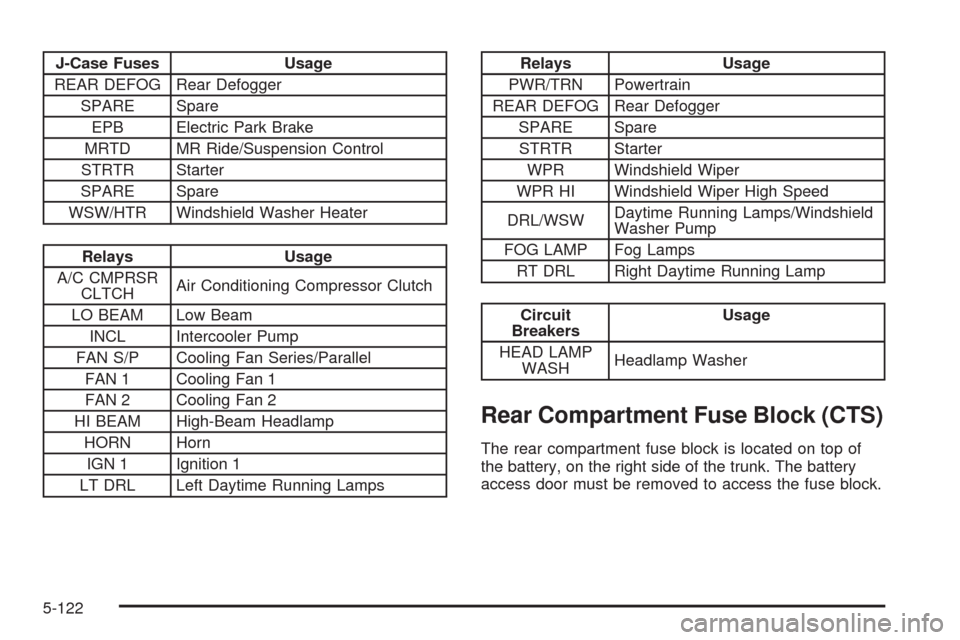
J-Case Fuses Usage
REAR DEFOG Rear Defogger
SPARE Spare
EPB Electric Park Brake
MRTD MR Ride/Suspension Control
STRTR Starter
SPARE Spare
WSW/HTR Windshield Washer Heater
Relays Usage
A/C CMPRSR
CLTCHAir Conditioning Compressor Clutch
LO BEAM Low Beam
INCL Intercooler Pump
FAN S/P Cooling Fan Series/Parallel
FAN 1 Cooling Fan 1
FAN 2 Cooling Fan 2
HI BEAM High-Beam Headlamp
HORN Horn
IGN 1 Ignition 1
LT DRL Left Daytime Running Lamps
Relays Usage
PWR/TRN Powertrain
REAR DEFOG Rear Defogger
SPARE Spare
STRTR Starter
WPR Windshield Wiper
WPR HI Windshield Wiper High Speed
DRL/WSWDaytime Running Lamps/Windshield
Washer Pump
FOG LAMP Fog Lamps
RT DRL Right Daytime Running Lamp
Circuit
BreakersUsage
HEAD LAMP
WASHHeadlamp Washer
Rear Compartment Fuse Block (CTS)
The rear compartment fuse block is located on top of
the battery, on the right side of the trunk. The battery
access door must be removed to access the fuse block.
5-122
Page 437 of 490

Capacities and Specications
The following approximate capacities are given in English and metric conversions. SeeRecommended Fluids and
Lubricants on page 6-14for more information.
ApplicationCapacities
English Metric
Air Conditioning Refrigerant R134aFor the air conditioning system refrigerant charge
amount, see the refrigerant caution label located
under the hood. See your dealer/retailer for more
information.
Cooling System
3.6L V6 Engine (VIN Code 7) 10.3 qt 9.7 L
3.6L V6 Engine (VIN Code V) 10.6 qt 10.0 L
6.2L V8 Engine — Cooling System 13.4 qt 12.7 L
6.2L V8 Engine — Intercooler Cooling System 3.2 qt 3.0 L
Engine Oil with Filter
3.6L V6 Engine 6.0 qt 5.7 L
6.2L V8 Engine 6.0 qt 5.7 L
Fuel Tank 18.0 gal 68.1 L
5-127