fuse CADILLAC CTS 2009 2.G User Guide
[x] Cancel search | Manufacturer: CADILLAC, Model Year: 2009, Model line: CTS, Model: CADILLAC CTS 2009 2.GPages: 490, PDF Size: 2.68 MB
Page 312 of 490
Tire Pressure Monitor Operation.....................5-73
Tire Inspection and Rotation...........................5-76
When It Is Time for New Tires.......................5-77
Buying New Tires.........................................5-78
Different Size Tires and Wheels......................5-80
Uniform Tire Quality Grading..........................5-80
Wheel Alignment and Tire Balance..................5-82
Wheel Replacement......................................5-82
Tire Chains..................................................5-84
If a Tire Goes Flat........................................5-85
Tire Sealant and Compressor Kit....................5-86
Tire Sealant and Compressor Kit Storage.........5-95
Changing a Flat Tire.....................................5-96
Removing the Spare Tire and Tools................5-98
Removing the Flat Tire and Installing the
Spare Tire................................................5-99
Storing a Flat or Spare Tire and Tools...........5-104
Compact Spare Tire....................................5-105
Appearance Care..........................................5-106
Interior Cleaning.........................................5-106
Fabric/Carpet..............................................5-107
Leather......................................................5-108
Instrument Panel, Vinyl, and Other Plastic
Surfaces.................................................5-108
Wood Panels..............................................5-109
Speaker Covers..........................................5-109Care of Safety Belts....................................5-109
Weatherstrips.............................................5-109
Washing Your Vehicle..................................5-110
Cleaning Exterior Lamps/Lenses....................5-110
Finish Care................................................5-110
Windshield and Wiper Blades.......................5-111
Aluminum or Chrome-Plated Wheels
and Trim.................................................5-112
Tires.........................................................5-113
Sheet Metal Damage..................................
.5-113
Finish Damage...........................................5-113
Underbody Maintenance...............................5-113
Chemical Paint Spotting...............................5-113
Vehicle Identication.....................................5-114
Vehicle Identication Number (VIN)................5-114
Service Parts Identication Label...................5-114
Electrical System..........................................5-114
Add-On Electrical Equipment.........................5-114
Windshield Wiper Fuses...............................5-115
Power Windows and Other Power Options......5-115
Fuses and Circuit Breakers..........................5-115
Underhood Fuse Block (CTS).......................5-115
Underhood Fuse Block (CTS-V)....................5-119
Rear Compartment Fuse Block (CTS)..............5-122
Rear Compartment Fuse Block (CTS-V).........5-124
Capacities and Specications........................5-127
Section 5 Service and Appearance Care
5-2
Page 314 of 490

California Proposition 65 Warning
Most motor vehicles, including this one, contain and/or
emit chemicals known to the State of California to cause
cancer and birth defects or other reproductive harm.
Engine exhaust, many parts and systems (including
some inside the vehicle), many uids, and some
component wear by-products contain and/or emit
these chemicals.
California Perchlorate Materials
Requirements
Certain types of automotive applications, such as airbag
initiators, seat belt pretensioners, and lithium batteries
contained in remote keyless transmitters, may contain
perchlorate materials. Special handling may be
necessary. For additional information, see
www.dtsc.ca.gov/hazardouswaste/perchlorate.
Doing Your Own Service Work
{CAUTION:
You can be injured and the vehicle could be
damaged if you try to do service work on a vehicle
without knowing enough about it.
Be sure you have sufficient knowledge,
experience, the proper replacement parts,
and tools before attempting any vehicle
maintenance task.
Be sure to use the proper nuts, bolts, and
other fasteners. English and metric fasteners
can be easily confused. If the wrong fasteners
are used, parts can later break or fall off.
You could be hurt.
5-4
Page 325 of 490

A. Windshield Washer Fluid Reservoir. See “Adding
Washer Fluid” underWindshield Washer Fluid
on page 5-41.
B.Underhood Fuse Block (CTS) on page 5-115or
Underhood Fuse Block (CTS-V) on page 5-119.
C. Remote Positive (+) Terminal. SeeJump Starting on
page 5-46.
D. Remote Negative (+) Terminal. SeeJump Starting
on page 5-46.
E. Passenger Compartment Air Filter. SeePassenger
Compartment Air Filter on page 3-29.
F. Engine Cooling Fan. SeeCooling System on
page 5-31.G. Power Steering Fluid Reservoir (Under Engine
Cover). SeePower Steering Fluid on page 5-40.
H. Engine Oil Fill Cap. SeeEngine Oil on page 5-18.
I. Engine Oil Dipstick (Out of View). SeeEngine Oil on
page 5-18.
J. Hydraulic Clutch Reservoir (If Equipped) (Not
Shown). See “When to Check and What to Use”
underHydraulic Clutch on page 5-30.
K. Brake Master Cylinder Reservoir (Out of View).
SeeBrakes on page 5-42.
L. Engine Coolant Surge Tank and Pressure Cap.
SeeCooling System on page 5-31.
M.Engine Air Cleaner/Filter on page 5-25.
5-15
Page 327 of 490
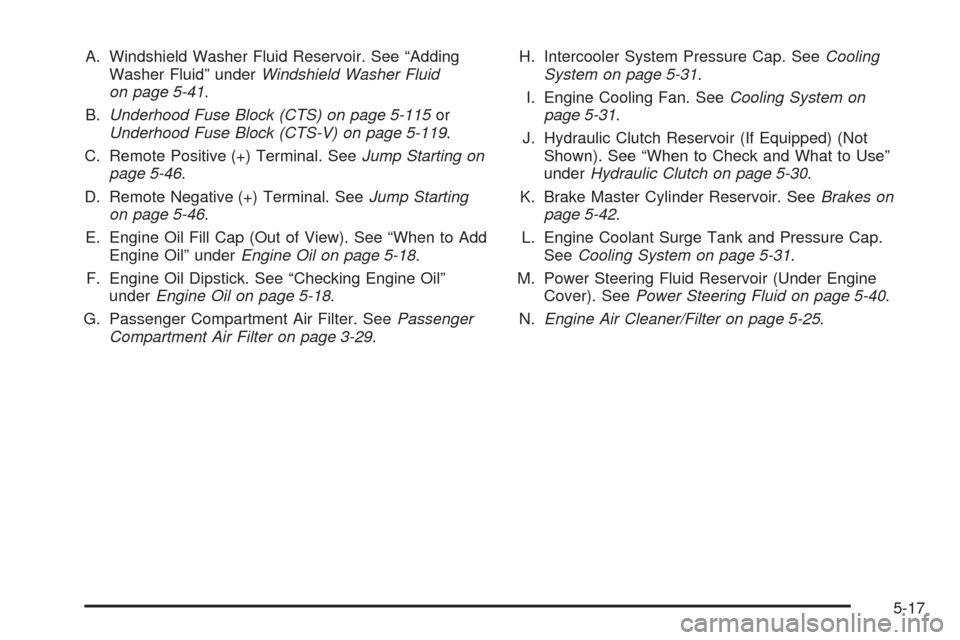
A. Windshield Washer Fluid Reservoir. See “Adding
Washer Fluid” underWindshield Washer Fluid
on page 5-41.
B.Underhood Fuse Block (CTS) on page 5-115or
Underhood Fuse Block (CTS-V) on page 5-119.
C. Remote Positive (+) Terminal. SeeJump Starting on
page 5-46.
D. Remote Negative (+) Terminal. SeeJump Starting
on page 5-46.
E. Engine Oil Fill Cap (Out of View). See “When to Add
Engine Oil” underEngine Oil on page 5-18.
F. Engine Oil Dipstick. See “Checking Engine Oil”
underEngine Oil on page 5-18.
G. Passenger Compartment Air Filter. SeePassenger
Compartment Air Filter on page 3-29.H. Intercooler System Pressure Cap. SeeCooling
System on page 5-31.
I. Engine Cooling Fan. SeeCooling System on
page 5-31.
J. Hydraulic Clutch Reservoir (If Equipped) (Not
Shown). See “When to Check and What to Use”
underHydraulic Clutch on page 5-30.
K. Brake Master Cylinder Reservoir. SeeBrakes on
page 5-42.
L. Engine Coolant Surge Tank and Pressure Cap.
SeeCooling System on page 5-31.
M. Power Steering Fluid Reservoir (Under Engine
Cover). SeePower Steering Fluid on page 5-40.
N.Engine Air Cleaner/Filter on page 5-25.
5-17
Page 355 of 490

Replacing Brake System Parts
The braking system on a vehicle is complex. Its many
parts have to be of top quality and work well together if
the vehicle is to have really good braking. The vehicle
was designed and tested with top-quality brake parts.
When parts of the braking system are replaced — for
example, when the brake linings wear down and new
ones are installed — be sure to get new approved
replacement parts. If this is not done, the brakes might
not work properly. For example, if someone puts in brake
linings that are wrong for the vehicle, the balance
between the front and rear brakes can change — for the
worse. The braking performance expected can change in
many other ways if the wrong replacement brake parts
are installed.
Battery
This vehicle has a maintenance free battery. It is located
in the trunk, behind the trim panel, on the passenger side
of the vehicle. When it is time for a new battery, see your
dealer/retailer for one that has the replacement number
shown on the original battery’s label.Warning:Battery posts, terminals, and related
accessories contain lead and lead compounds,
chemicals known to the State of California to cause
cancer and reproductive harm. Wash hands after
handling.
After a power loss, such as disconnecting the battery
or removing the maxi fuses in the power distribution
fuse block, the following steps must be performed
to calibrate the electronic throttle control. If this is
not done, the engine will not run properly.
1. Turn the ignition to ON/RUN. Do not start the
engine.
2. Leave the ignition in ON/RUN for at least three
minutes so that the electronic throttle control will
cycle and re-learn its home position.
3. Turn the ignition to LOCK/OFF.
4. Start and run the engine for at least 30 seconds.
5-45
Page 425 of 490

Windshield Wiper Fuses
The windshield wiper motor is protected by an internal
circuit breaker. If the wiper motor overheats due to
heavy snow, the wipers will stop until the motor cools
and will then restart.
Power Windows and Other Power
Options
Circuit breakers in the fuse block protect the power
windows and other power accessories. When the
current load is too heavy, the circuit breaker opens and
closes, protecting the circuit until the problem is xed or
goes away.
Fuses and Circuit Breakers
The wiring circuits in your vehicle are protected from
short circuits by a combination of fuses and circuit
breakers. This greatly reduces the chance of res
caused by electrical problems.
Look at the silver-colored band inside the fuse. If the
band is broken or melted, replace the fuse. Be sure you
replace a bad fuse with a new one of the identical size
and rating.If you ever have a problem on the road and don’t have
a spare fuse, you can borrow one that has the same
amperage. Just pick some feature of your vehicle
that you can get along without — like the radio or
cigarette lighter — and use its fuse, if it is the correct
amperage. Replace it as soon as you can.
Underhood Fuse Block (CTS)
The underhood fuse block is located on the passenger
side of the engine compartment.
Lift the fuse block cover to access the fuses.
Notice:Spilling liquid on any electrical components
on the vehicle may damage it. Always keep the
covers on any electrical component.
5-115
Page 426 of 490
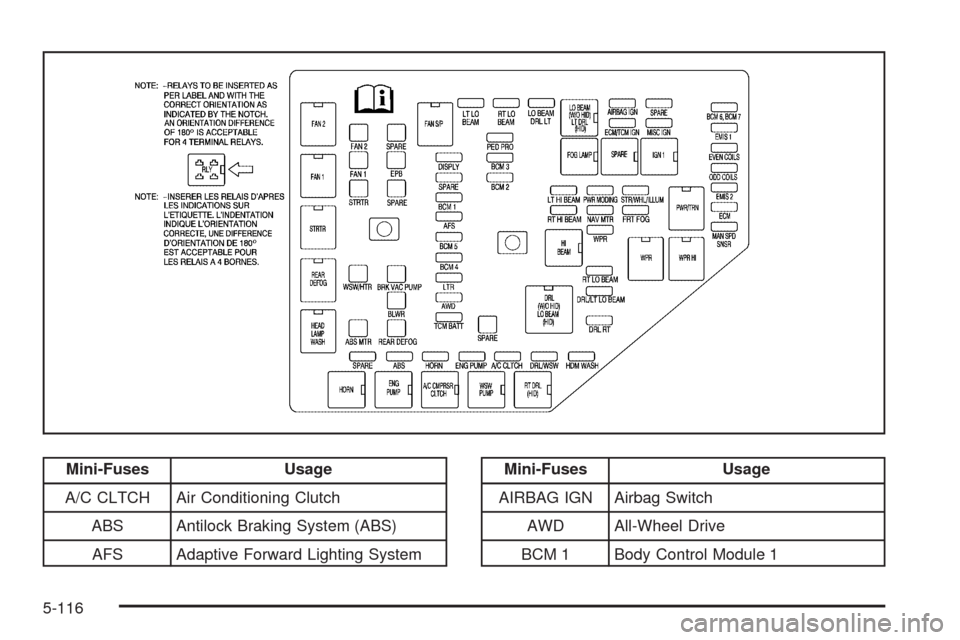
Mini-Fuses Usage
A/C CLTCH Air Conditioning Clutch
ABS Antilock Braking System (ABS)
AFS Adaptive Forward Lighting SystemMini-Fuses Usage
AIRBAG IGN Airbag Switch
AWD All-Wheel Drive
BCM 1 Body Control Module 1
5-116
Page 427 of 490

Mini-Fuses Usage
BCM 2 Body Control Module 2
BCM 3 Body Control Module 3
BCM 4 Body Control Module 4
BCM 5 Body Control Module 5
SPARE Spare
BCM 6, BCM 7 Body Control Module 6 and 7
DISPLY Display
DRL RT Right Daytime Running Lamp (DRL)
DRL/WSWDaytime Running Lamps/Windshield
Washer Pump
ECM Engine Control Module (ECM)
ECM/TCM IGNECM, Transmission Control
Module (TCM), Instrument Panel
Cluster (IPC), PASS-Key III+ Module
EMIS 1 Emission 1
EMIS 2 Emission 2
EVEN COILS Even Coils
FRT FOG Front Fog Lamps
HDM WASH Headlamp Driver Module WasherMini-Fuses Usage
HORN Horn
LO BEAM
DRL LEFTLow-Beam Daytime Running
Lamps (Left)
LT HI BEAM Left High-Beam Headlamp
LT LO BEAM Left Low-Beam Headlamp
DRL/LT
LO BEAMDaytime Running Lamps / Left
Low-Beam Headlamp
LTR Cigarette Lighter
MISC IGN Ignition
NAV MTR Navigation Motor
ODD COILS Odd Coils
PED PRO Not Used
PWR MODINGPASS-Key III+ Module, Body Control
Module
RT HI BEAM Right High-Beam Headlamp
RT LO BEAM Right Low-Beam Headlamp
RT LO BEAM Right Low-Beam Headlamp
SPARE Spare
SPARE Spare
5-117
Page 428 of 490

Mini-Fuses Usage
STR/WHL/
ILLUMSteering Wheel Illumination
TCM BATTTransmission Control Module
Battery
MAN SPD
SNSRManual Speed Sensor
WPR Windshield Wiper
ENG PUMP Engine Pump
J-Case Fuses Usage
ABS MTR ABS Motor
BLWR Blower
BRK VAC
PUMPBrake Vacuum Pump
FAN 1 Cooling Fan 1
FAN 2 Cooling Fan 2
REAR DEFOG Rear Defogger
SPARE Spare
EPB Electric Park Brake
J-Case Fuses Usage
SPARE Spare
STRTR Starter
SPARE Spare
WSW/HTR Windshield Washer Heater
Relays Usage
A/C CMPRSR
CLTCHAir Conditioning Compressor Clutch
DRL (W/O HID)
LO BEAM (HID)Daytime Running Lamps
(without High Intensity Discharge),
Low-Beam Headlamps
(High Intensity Discharge)
ENG PUMP Engine Pump
FAN S/P Cooling Fan Series/Parallel
FAN 1 Cooling Fan 1
FAN 2 Cooling Fan 2
HI BEAM High-Beam Headlamp
HORN Horn
IGN 1 Ignition 1
5-118
Page 429 of 490

Relays Usage
LO BEAM (W/O
HID) LT
DRL (HID)Low-Beam (without High Intensity
Discharge), Left Daytime Running
Lamp (High Intensity Discharge)
PWR/TRN Powertrain
REAR DEFOG Rear Defogger
SPARE Spare
STRTR Starter
WPR Windshield Wiper
WPR HI Windshield Wiper High Speed
WSW PUMP Windshield Washer Pump
FOG LAMP Fog Lamps
RT DRL (HID)Right Daytime Running Lamp
(High Intensity Discharge)
Circuit
BreakersUsage
HEAD LAMP
WASHHeadlamp Washer
Underhood Fuse Block (CTS-V)
The underhood fuse block is located on the passenger
side of the engine compartment.
Lift the fuse block cover to access the fuses.
Notice:Spilling liquid on any electrical components
on the vehicle may damage it. Always keep the
covers on any electrical component.
5-119