light CADILLAC CTS 2009 2.G User Guide
[x] Cancel search | Manufacturer: CADILLAC, Model Year: 2009, Model line: CTS, Model: CADILLAC CTS 2009 2.GPages: 490, PDF Size: 2.68 MB
Page 81 of 490
Replacing Restraint System Parts
After a Crash
{CAUTION:
A crash can damage the restraint systems in your
vehicle. A damaged restraint system may not
properly protect the person using it, resulting in
serious injury or even death in a crash. To help
make sure your restraint systems are working
properly after a crash, have them inspected and
any necessary replacements made as soon as
possible.If the vehicle has been in a crash, do you need new
safety belts or LATCH system (if equipped) parts?
After a very minor crash, nothing may be necessary.
But the safety belt assemblies that were used during any
crash may have been stressed or damaged. See your
dealer/retailer to have the safety belt assemblies
inspected or replaced.
If the vehicle has the LATCH system and it was being
used during a crash, you may need new LATCH
system parts.
New parts and repairs may be necessary even if the
safety belt or LATCH system (if equipped), was
not being used at the time of the crash.
If an airbag inates, you will need to replace airbag
system parts. See the part on the airbag system earlier
in this section.
Have the safety belt pretensioners checked if the
vehicle has been in a crash, if the airbag readiness light
stays on after the vehicle is started, or while you are
driving. SeeAirbag Readiness Light on page 3-36.
1-75
Page 103 of 490

Close the trunk by pulling on the handle. Do not use the
handle as a tie-down.
Rear-Seat Pass Through
If the vehicle has the rear seat-pass through door,
the trunk can be accessed through the rear seat.
This is useful when transporting long items.
To open the door, pull down the rear seat armrest.
Then pull the lever all the way down to release the door.
To close the door, push it up and back into place.
Then try to open the door without pulling up on the lever
to make sure it is locked into place.
Emergency Trunk Release Handle
Notice:Do not use the emergency trunk release
handle as a tie-down or anchor point when securing
items in the trunk as it could damage the handle.
The emergency trunk release handle is only
intended to aid a person trapped in a latched trunk,
enabling them to open the trunk from the inside.
There is a glow-in-the-dark emergency trunk release
handle located on the back wall of the trunk. This handle
will glow following exposure to light. Pull the release
handle toward the front of the vehicle to open the trunk
from the inside.
2-21
Page 107 of 490

Express Window Anti-Pinch Override
{CAUTION:
If express override is activated, the window will not
reverse automatically. You or others could be
injured and the window could be damaged. Before
you use express override, make sure that all people
and obstructions are clear of the window path.
In an emergency, the anti-pinch feature can be
overridden in a supervised mode. Hold the window
switch all the way up to the second position. The window
will rise for as long as the switch is held. Once the
switch is released, the express mode is re-activated.
In this mode, the window can still close on an object in
its path. Use care when using the override mode.
Window Lockout
o
(Window Lockout):The rear window lockout button
is located on the driver door near the window switches.
Press the right side of the button to disable the rear
window controls. The light on the button will illuminate,
indicating the feature is in use. The rear windows
still can be raised or lowered using the driver window
switches when the lockout feature is active.
To restore power to the rear windows, press the button
again. The light on the button will go out.
Sun Visors
Swing down the visor to block out glare. It can also be
detached from the center mount and moved to the
side to block glare from that direction.
The driver visor may also have buttons for a built-in
garage door opener. SeeUniversal Home Remote
System on page 2-60for more information.
Lighted Visor Vanity Mirror
Pull the visor down and lift the cover to access the
mirror. A light comes on when the cover is lifted and
goes out when it is closed.
2-25
Page 108 of 490
Theft-Deterrent Systems
Vehicle theft is big business, especially in some cities.
This vehicle has theft-deterrent features, however,
they do not make it impossible to steal.
Theft-Deterrent System
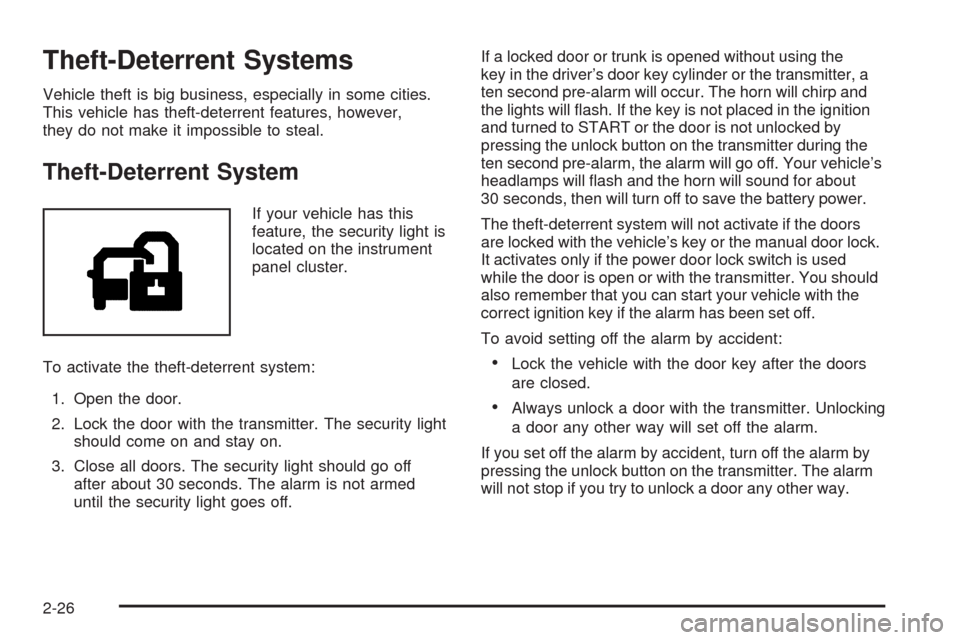
If your vehicle has this
feature, the security light is
located on the instrument
panel cluster.
To activate the theft-deterrent system:
1. Open the door.
2. Lock the door with the transmitter. The security light
should come on and stay on.
3. Close all doors. The security light should go off
after about 30 seconds. The alarm is not armed
until the security light goes off.If a locked door or trunk is opened without using the
key in the driver’s door key cylinder or the transmitter, a
ten second pre-alarm will occur. The horn will chirp and
the lights will ash. If the key is not placed in the ignition
and turned to START or the door is not unlocked by
pressing the unlock button on the transmitter during the
ten second pre-alarm, the alarm will go off. Your vehicle’s
headlamps will ash and the horn will sound for about
30 seconds, then will turn off to save the battery power.
The theft-deterrent system will not activate if the doors
are locked with the vehicle’s key or the manual door lock.
It activates only if the power door lock switch is used
while the door is open or with the transmitter. You should
also remember that you can start your vehicle with the
correct ignition key if the alarm has been set off.
To avoid setting off the alarm by accident:
Lock the vehicle with the door key after the doors
are closed.
Always unlock a door with the transmitter. Unlocking
a door any other way will set off the alarm.
If you set off the alarm by accident, turn off the alarm by
pressing the unlock button on the transmitter. The alarm
will not stop if you try to unlock a door any other way.
2-26
Page 109 of 490
Testing the Alarm
The alarm can be tested by following these steps:
1. From inside the vehicle, lower the driver’s window
and open the driver’s door.
2. Activate the system by locking the doors with the
transmitter.
3. Get out of the vehicle, close the door and wait for
the security light to go out.
4. Then reach in through the window, unlock the
door with the manual door lock and open the door.
This should set off the alarm.
While the alarm is set, the power door unlock switch will
not work.
If the alarm does not sound when it should but the
headlamps ash, check to see if the horn works.
The horn fuse may be blown. To replace the fuse,
seeFuses and Circuit Breakers on page 5-115Fuses
and Circuit Breakers.
If the alarm does not sound or the headlamps do not
ash, the vehicle should be serviced by your
dealer/retailer.
Immobilizer
This device complies with Part 15 of the FCC Rules.
Operation is subject to the following two conditions:
1. This device may not cause interference.
2. This device must accept any interference received,
including interference that may cause undesired
operation.
This device complies with RSS-210 of Industry Canada.
Operation is subject to the following two conditions:
1. This device may not cause interference.
2. This device must accept any interference received,
including interference that may cause undesired
operation of the device.
Changes or modications to this system by other than
an authorized service facility could void authorization to
use this equipment.
2-27
Page 110 of 490

Immobilizer Operation (Key Access)
Your vehicle has a passive theft-deterrent system.
The system is automatically armed when the key
is removed from the ignition.
The theft-deterrent system is disarmed when the key is
turned to ON/RUN.
You do not have to manually arm or disarm the system.
The security light will come on if there is a problem
with arming or disarming the theft-deterrent system.
The key uses a transponder that matches an immobilizer
control unit in your vehicle and automatically disarms the
system. Only the correct key will start the vehicle. If the
key is ever damaged, you may not be able to start your
vehicle.
When trying to start the vehicle, if the engine does not
start and the security light comes on, there may be a
problem with your theft-deterrent system. Turn the
ignition off and try again.
If the engine still does not start, and the key appears to
be undamaged, try another ignition key. At this time, you
may also want to check the fuse. SeeFuses and Circuit
Breakers on page 5-115. If the engine still does not start
with the other key, your vehicle needs service. If your
vehicle does start, the rst key may be faulty. See your
dealer/retailer who can service the theft-deterrent system
and have a new key made.It is possible for the theft-deterrent system decoder to
learn the transponder value of a new or replacement key.
Up to 10 keys can be programmed for the vehicle.
The following procedure is for programming additional
keys only.
To program a new key do the following:
1. Verify that the new key has
1stamped on it.
2. Insert the current driver’s key in the ignition and
start the engine. If the engine will not start see
your dealer/retailer for service.
3. After the engine has started, turn the key to
LOCK/OFF, and remove the key.
4. Insert the key to be programmed and turn it to
ON/RUN within ve seconds of the ignition being
turned to LOCK/OFF in Step 3.
5. The security light will turn off once the key has
been programmed. It may not be apparent that
the security light went on due to how quickly the key
is programmed.
6. Repeat the Steps 1 through 4 if additional keys are
to be programmed.
In an emergency, contact Cadillac Roadside Service.
SeeRoadside Service on page 7-7.
Do not leave the key or device that disarms or
deactivates the theft deterrent system in the vehicle.
2-28
Page 111 of 490

Immobilizer Operation
(Keyless Access)
Your vehicle has a passive theft-deterrent system.
The system is automatically armed when the ignition
control knob is turned to LOCK/OFF.
The immobilization system is disarmed when the ignition
control knob is pushed in and a valid transmitter is
found in the vehicle.
You do not have to manually arm or disarm the system.
The security light will come on if there is a problem
with arming or disarming the theft-deterrent system.
The system has one or more keyless access transmitters
that are matched to an immobilizer control unit in your
vehicle. Only a correctly matched keyless access
transmitter will start the vehicle. If the keyless access
transmitter is ever damaged, you may not be able to
start your vehicle.
When trying to start the vehicle, if the engine does not
start and the security light comes on, there may be a
problem with your immobilizer system. Turn the ignition
control knob off and try again.If the ignition control knob does not rotate, and the
keyless access transmitter appears to be undamaged,
try another keyless access transmitter. Or, you may
try placing the transmitter in the transmitter pocket
located in the center console. See “Electronic Key Not
Detected” underDIC Warnings and Messages on
page 3-58. At this time, you may also want to check the
fuse. SeeFuses and Circuit Breakers on page 5-115.
If the ignition control knob still does not rotate with
the other transmitter, your vehicle needs service. If the
ignition control knob does rotate, the rst transmitter
may be faulty. See your dealer/retailer who can service
the theft-deterrent system and have a new keyless
access transmitter programmed to the vehicle.
It is possible for the immobilizer system to learn new or
replacement keyless access transmitters. Up to 4 keyless
access transmitters can be programmed for the vehicle.
To program additional transmitters, see “Matching
transmitter(s) to Your Vehicle” underKeyless Access
System Operation on page 2-8.
Do not leave the key or device that disarms or
deactivates the theft deterrent system in the vehicle.
2-29
Page 121 of 490

CTS-V vehicles use tracer lights around the outside of the
tachometer as a performance up-shift light. These tracers
ash to indicate when to shift to the next higher gear to
avoid the engine speed limit. SeeTachometer on
page 3-34for more information.
While using the DSC feature, the vehicle will have rmer,
quicker shifting. You can use this for sport driving or when
climbing or descending hills, to stay in gear longer, or to
down shift for more power or engine braking.
The transmission will only allow you to shift into
gears appropriate for the vehicle speed and engine
Revolutions Per Minute (RPM). The transmission will
not automatically shift to the next lower gear if the
engine RPM is too high.
If shifting is prevented for any reason, the currently
selected gear will ash multiple times, indicating that
the transmission has not shifted gears.
While in the DSC mode, the CTS automatic transmission
will automatically downshift when the vehicle comes
to a stop. This will allow for more power during take-off.
The CTS-V automatic transmission will not automatically
downshift on hard acceleration when in DSC mode.
When accelerating your vehicle from a stop in snowy and
icy conditions, you may want to shift into second gear.
A higher gear ratio allows you to gain more traction on
slippery surfaces.Tap Shift
To use Tap Shift, the shift lever must be in Manual
Mode. Vehicles with this feature have switches on the
back of the steering wheel. Tap the left switch to
downshift, and the right switch to upshift.
The tachometer display on the instrument panel cluster
will show which gear the vehicle is in and a number
indicating the requested gear range when moving the
shift lever forward or rearward. SeeSpeedometer and
Odometer on page 3-33for more information on the
odometer.
2-39
Page 122 of 490

CTS-V vehicles use tracer lights around the outside of the
tachometer as a performance up-shift light. These tracers
ash to indicate when to shift to the next higher gear to
avoid the engine speed limit. SeeTachometer on
page 3-34for more information.
While using the Tap Shift feature, the vehicle will have
rmer, quicker shifting for increased performance.
You can use this for sport driving or when climbing or
descending hills, to stay in gear longer, or to down shift
for more power or engine braking.
The transmission will only allow you to shift into
gears appropriate for the vehicle speed and engine
Revolutions Per Minute (RPM). The transmission will not
automatically shift to the next lower gear if the engine
RPM is too high.
If shifting is prevented for any reason, the currently
selected gear will ash multiple times, indicating that the
transmission has not shifted gears.
While in the Tap Shift mode, the transmission will not
automatically downshift on hard acceleration.
When accelerating your vehicle from a stop in snowy
and icy conditions, you may want to shift into second
gear. A higher gear ratio allows you to gain more traction
on slippery surfaces.Manual Transmission Operation
If the vehicle has a manual transmission, the shift lever is
located on the center console between the front seats.
The following explains how to operate the manual
transmission.
1 (First):Press the clutch pedal and shift into 1 (First).
Then slowly let up on the clutch pedal as you press
the accelerator pedal.
Shift into 1 (First) when you are going less than
25 mph (40 km/h). For CTS-V, shift into 1 (First)
when you are going less than 40 mph (64 km/h).
If you come to a complete stop and it is hard to shift
into 1 (First), put the shift lever in Neutral and let up
on the clutch. Press the clutch pedal back down.
Then shift into 1 (First).CTS
CTS-V
2-40
Page 124 of 490
Up-Shift Light
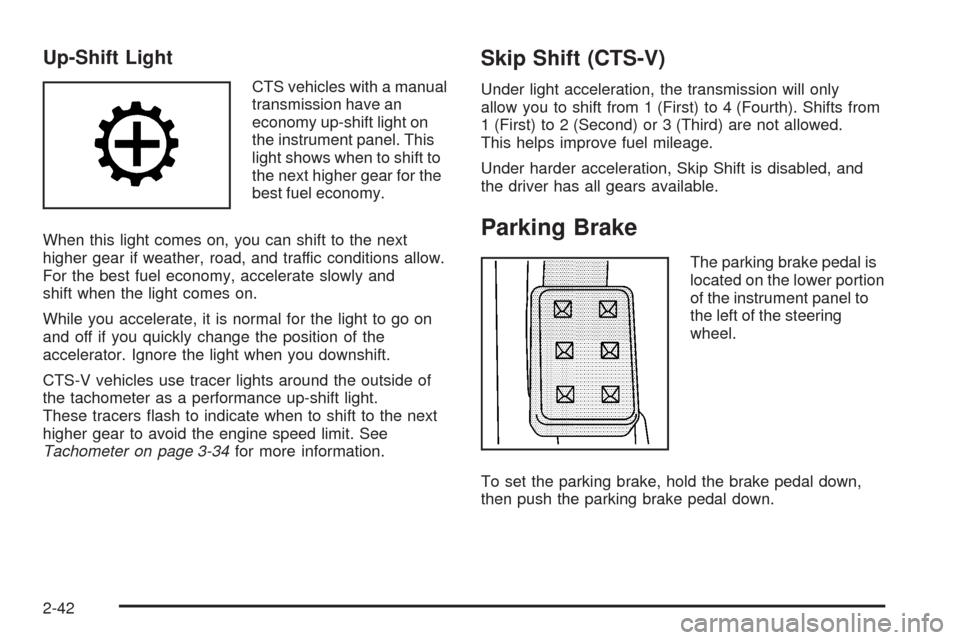
CTS vehicles with a manual
transmission have an
economy up-shift light on
the instrument panel. This
light shows when to shift to
the next higher gear for the
best fuel economy.
When this light comes on, you can shift to the next
higher gear if weather, road, and traffic conditions allow.
For the best fuel economy, accelerate slowly and
shift when the light comes on.
While you accelerate, it is normal for the light to go on
and off if you quickly change the position of the
accelerator. Ignore the light when you downshift.
CTS-V vehicles use tracer lights around the outside of
the tachometer as a performance up-shift light.
These tracers ash to indicate when to shift to the next
higher gear to avoid the engine speed limit. See
Tachometer on page 3-34for more information.
Skip Shift (CTS-V)
Under light acceleration, the transmission will only
allow you to shift from 1 (First) to 4 (Fourth). Shifts from
1 (First) to 2 (Second) or 3 (Third) are not allowed.
This helps improve fuel mileage.
Under harder acceleration, Skip Shift is disabled, and
the driver has all gears available.
Parking Brake
The parking brake pedal is
located on the lower portion
of the instrument panel to
the left of the steering
wheel.
To set the parking brake, hold the brake pedal down,
then push the parking brake pedal down.
2-42