wheel CADILLAC CTS 2009 2.G User Guide
[x] Cancel search | Manufacturer: CADILLAC, Model Year: 2009, Model line: CTS, Model: CADILLAC CTS 2009 2.GPages: 490, PDF Size: 2.68 MB
Page 79 of 490

Adding Equipment to Your
Airbag-Equipped Vehicle
Q:Is there anything I might add to or change
about the vehicle that could keep the airbags
from working properly?
A:Yes. If you add things that change the vehicle’s
frame, bumper system, height, front end or side
sheet metal, they may keep the airbag system from
working properly. Changing or moving any parts
of the front seats, safety belts, the airbag sensing
and diagnostic module, steering wheel, instrument
panel, roof-rail airbag modules, ceiling headliner
or pillar garnish trim, front sensors, or airbag wiring
can affect the operation of the airbag system.
In addition, the vehicle has a passenger sensing
system for the right front passenger position, which
includes sensors that are part of the passenger’s
seat. The passenger sensing system may not
operate properly if the original seat trim is replaced
with non-GM covers, upholstery or trim, or with
GM covers, upholstery or trim designed for a
different vehicle. Any object, such as an aftermarket
seat heater or a comfort enhancing pad or device,
installed under or on top of the seat fabric, could alsointerfere with the operation of the passenger sensing
system. This could either prevent proper deployment
of the passenger airbag(s) or prevent the passenger
sensing system from properly turning off the
passenger airbag(s). SeePassenger Sensing
System on page 1-67.
If you have any questions, call Customer
Assistance. The phone numbers and addresses
for Customer Assistance are in Step Two of
the Customer Satisfaction Procedure in this manual.
SeeCustomer Satisfaction Procedure on page 7-2.
Q:Because I have a disability, I have to get
my vehicle modied. How can I nd out whether
this will affect my airbag system?
A:If you have questions, call Customer Assistance.
The phone numbers and addresses for Customer
Assistance are in Step Two of the Customer
Satisfaction Procedure in this manual. See
Customer Satisfaction Procedure on page 7-2.
In addition, your dealer/retailer and the service
manual have information about the location of the
airbag sensors, sensing and diagnostic module and
airbag wiring.
1-73
Page 88 of 490
Remote Keyless Entry (RKE)
System Operation
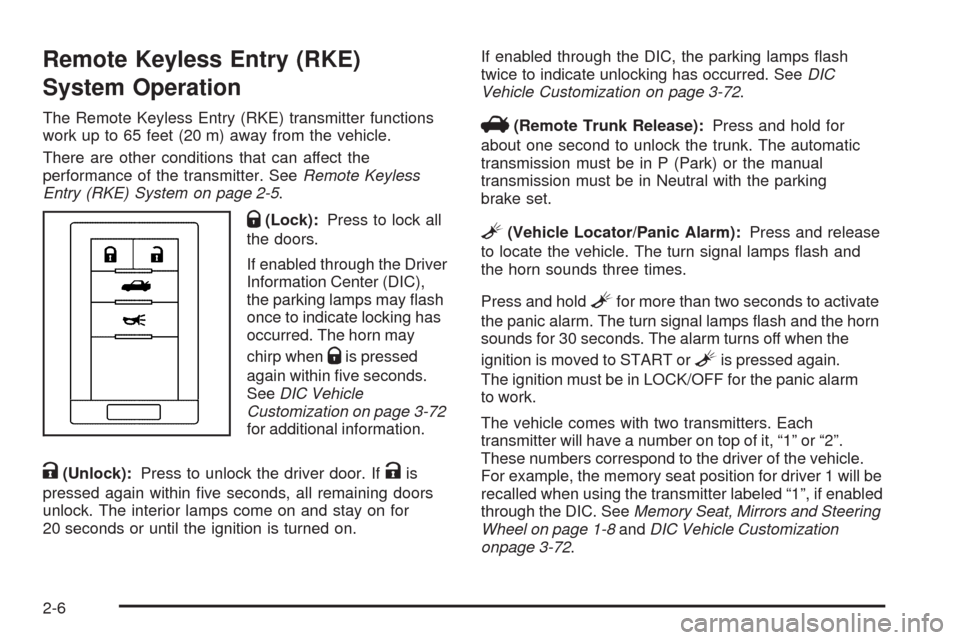
The Remote Keyless Entry (RKE) transmitter functions
work up to 65 feet (20 m) away from the vehicle.
There are other conditions that can affect the
performance of the transmitter. SeeRemote Keyless
Entry (RKE) System on page 2-5.
Q(Lock):Press to lock all
the doors.
If enabled through the Driver
Information Center (DIC),
the parking lamps may ash
once to indicate locking has
occurred. The horn may
chirp when
Qis pressed
again within ve seconds.
SeeDIC Vehicle
Customization on page 3-72
for additional information.
K(Unlock):Press to unlock the driver door. IfKis
pressed again within ve seconds, all remaining doors
unlock. The interior lamps come on and stay on for
20 seconds or until the ignition is turned on.If enabled through the DIC, the parking lamps ash
twice to indicate unlocking has occurred. SeeDIC
Vehicle Customization on page 3-72.
V(Remote Trunk Release):Press and hold for
about one second to unlock the trunk. The automatic
transmission must be in P (Park) or the manual
transmission must be in Neutral with the parking
brake set.
L(Vehicle Locator/Panic Alarm):Press and release
to locate the vehicle. The turn signal lamps ash and
the horn sounds three times.
Press and hold
Lfor more than two seconds to activate
the panic alarm. The turn signal lamps ash and the horn
sounds for 30 seconds. The alarm turns off when the
ignition is moved to START or
Lis pressed again.
The ignition must be in LOCK/OFF for the panic alarm
to work.
The vehicle comes with two transmitters. Each
transmitter will have a number on top of it, “1” or “2”.
These numbers correspond to the driver of the vehicle.
For example, the memory seat position for driver 1 will be
recalled when using the transmitter labeled “1”, if enabled
through the DIC. SeeMemory Seat, Mirrors and Steering
Wheel on page 1-8andDIC Vehicle Customization
onpage 3-72.
2-6
Page 92 of 490
For vehicles with the memory feature, pressKon the
keyless access transmitter to program and recall the
memory settings. SeeMemory Seat, Mirrors and Steering
Wheel on page 1-8for more information.
/(Remote Start):Press to operate the remote start
feature. SeeRemote Vehicle Start on page 2-14
for additional information.
G(Trunk):Press and hold for about one second to
unlock the trunk. If the engine is running, the shift lever
must be in P (Park) for an automatic transmission or in
Neutral with the parking brake set for a manual
transmission.
L(Vehicle Locator/Panic Alarm):Press and release
to locate the vehicle. The horn sounds three times
and the turn signal lamps ash three times.
Press and hold
Lfor three seconds to sound the panic
alarm. The horn sounds and the turn signal lamps ash
for 30 seconds. Press and release
Lagain to stop the
alarm.
The vehicle comes with two transmitters. Each
transmitter will have a number on top of it, “1” or “2”.
These numbers correspond to the driver of the vehicle.
For example, the memory seat position for driver 1 will be
recalled when using the transmitter labeled “1”, if enabled
through the DIC. SeeMemory Seat, Mirrors and Steering
Wheel on page 1-8andDIC Vehicle Customization
onpage 3-72.
Programming Transmitters to the
Vehicle
Only keyless access transmitters programmed to the
vehicle will work. If a transmitter is lost or stolen,
a replacement can be purchased and programmed
through your dealer/retailer. The vehicle can be
reprogrammed so that lost or stolen transmitters no
longer work. Each vehicle can have up to four
transmitters matched to it.
Programming with a Recognized
Transmitter
A new transmitter can be programmed to the vehicle
when there is one recognized transmitter. For vehicles
sold in Canada, two recognized transmitters are required
to program a new transmitter.
1. The vehicle must be off.
2. Both the recognized and new transmitters must be
with you.
3. Insert the vehicle key into the key lock cylinder
located on the outside of the driver door.
2-10
Page 113 of 490

Ignition Positions (Key Access)
The key can be turned to four different positions.
To shift out of P (Park), the ignition must be in the
ON/RUN or ACC/ACCESSORY and the brake pedal
must be applied.
Notice:Using a tool to force the key from its
cylinder could cause damage or break the key. Use
the correct key and turn the key only with your hand.
Make sure the key is all the way in. If it is and you
have a manual transmission vehicle, turn the steering
wheel left and right while you turn the key hard. If
none of this works, then the vehicle needs service.A (LOCK/OFF):This is the only position in which the
key can be inserted or removed. This position locks the
ignition and shifter on automatic transmission vehicles,
and the ignition and steering wheel on manual
transmission vehicles.
B (ACC/ACCESSORY):This position lets you use
things like the radio and the windshield wipers when
the engine is off. This position allows you to turn off
the engine.
C (ON/RUN):This position is for driving. It is the
position the ignition switch returns to after the engine
starts, and the key is released.
To shift the transmission out of P (Park), the ignition
key has to be in ACC/ACCESSORY or ON/RUN.
The battery could be drained if the key is left in the
ACC/ACCESSORY or ON/RUN position with the
engine off. The vehicle might not start if the battery
is allowed to drain for an extended period of time.
D (START):This position starts the engine. When
the engine starts, release the key. The ignition switch
returns to ON/RUN for driving.
A warning tone will sound when the driver door is
opened, the ignition is in ACC/ACCESSORY or
LOCK/OFF and the key is in the ignition.
2-31
Page 114 of 490

Ignition Positions (Keyless Access)
You can turn the ignition control knob to four different
positions.
To shift out of P (Park), ignition must be in the ON/RUN
or ACC/ACCESSORY and the regular brake pedal
must be applied.
Using a tool to force the ignition control knob from its
cylinder could damage it.
Make sure the keyless access transmitter is inside the
vehicle when trying to turn the ignition control knob.A (LOCK/OFF):The ignition control knob cannot be
removed from the vehicle. The keyless access
transmitter must be inside the vehicle to start the
engine. This position locks the ignition and shifter on
automatic transmission vehicles, and the ignition
and steering wheel on manual transmission vehicles.
B (ACC/ACCESSORY):This position allows you to use
things like the radio and the windshield wipers when
the engine is off. This position will allow you to turn off
the engine.
C (ON/RUN):This position is for driving. It is the position
the ignition switch returns to after the engine starts, and
the control knob is released.
If you need to shift the transmission out of P (Park), the
ignition control knob has to be in ACC/ACCESSORY or
ON/RUN.
The battery could be drained if you leave the key in the
ACC/ACCESSORY or ON/RUN position with the engine
off. You may not be able to start your vehicle if the battery
is allowed to drain for an extended period of time.
D (START):This position starts the engine.
2-32
Page 118 of 490

Automatic Transmission Operation
The shift lever is located on the center console between
the front seats.
There are several different
positions for the shift lever.
P (Park):This position locks the rear wheels. It is the
best position to use when you start the engine because
the vehicle cannot move easily.{CAUTION:
It is dangerous to get out of the vehicle if the shift
lever is not fully in P (Park) with the parking brake
rmly set. The vehicle can roll.
Do not leave the vehicle when the engine is running
unless you have to. If you have left the engine
running, the vehicle can move suddenly. You or
others could be injured. To be sure the vehicle will
not move, even when you are on fairly level ground,
always set the parking brake and move the shift
lever to P (Park). SeeShifting Into Park (Automatic
Transmission) on page 2-47. If you are pulling a
trailer, seeTowing a Trailer (CTS-V) on page 4-27
orTowing a Trailer (CTS) on page 4-28.
Make sure the shift lever is fully in P (Park) before starting
the engine. The vehicle has an automatic transmission
shift lock control system. You must fully apply the regular
brakes rst and then press the shift lever button before
you can shift from P (Park) when the ignition key is in
ON/RUN. If you cannot shift out of P (Park), ease
pressure on the shift lever and push the shift lever all the
way into P (Park) as you maintain brake application. Then
press the shift lever button and move the shift lever into
another gear. SeeShifting Out of Park on page 2-48.
2-36
Page 119 of 490

Notice:Shifting to R (Reverse) while the vehicle is
moving forward could damage the transmission. The
repairs would not be covered by the vehicle warranty.
Shift to R (Reverse) only after the vehicle is stopped.
R (Reverse):Use this gear to back up.
At low vehicle speeds, R (Reverse) can be used to rock
the vehicle back and forth to get out of snow, ice, or
sand without damaging your transmission. SeeIf Your
Vehicle is Stuck in Sand, Mud, Ice, or Snow on
page 4-19for additional information.
N (Neutral):In this position, the engine does not
connect with the wheels. To restart when the vehicle is
already moving, use N (Neutral) only. You can also
use N (Neutral) when the vehicle is being towed.
{CAUTION:
Shifting into a drive gear while the engine is
running at high speed is dangerous. Unless your
foot is rmly on the brake pedal, the vehicle could
move very rapidly. You could lose control and hit
people or objects. Do not shift into a drive gear
while the engine is running at high speed.Notice:Shifting out of P (Park) or N (Neutral) with
the engine running at high speed may damage
the transmission. The repairs would not be covered
by the vehicle warranty. Be sure the engine is
not running at high speed when shifting the vehicle.
D (Drive):This position is for normal driving. It provides
the best fuel economy. If you need more power for
passing, and you are:
Going less than 35 mph (55 km/h), push the
accelerator pedal about halfway down.
Going about 35 mph (55 km/h) or more, push the
accelerator all the way down.
The transmission will shift down to a lower gear and
have more power.
Downshifting the transmission in slippery road conditions
could result in skidding, see Skidding underLoss of
Control on page 4-11
While in D (Drive), the CTS-V vehicle’s rst forward
gear automatic shift after starting the vehicle will be
from 1 (First). Afterwards, the CTS-V vehicles will always
start in 2 (Second) gear. While in M (Manual Mode),
for increased performance, the vehicle will start in
1 (First) gear.
2-37
Page 121 of 490

CTS-V vehicles use tracer lights around the outside of the
tachometer as a performance up-shift light. These tracers
ash to indicate when to shift to the next higher gear to
avoid the engine speed limit. SeeTachometer on
page 3-34for more information.
While using the DSC feature, the vehicle will have rmer,
quicker shifting. You can use this for sport driving or when
climbing or descending hills, to stay in gear longer, or to
down shift for more power or engine braking.
The transmission will only allow you to shift into
gears appropriate for the vehicle speed and engine
Revolutions Per Minute (RPM). The transmission will
not automatically shift to the next lower gear if the
engine RPM is too high.
If shifting is prevented for any reason, the currently
selected gear will ash multiple times, indicating that
the transmission has not shifted gears.
While in the DSC mode, the CTS automatic transmission
will automatically downshift when the vehicle comes
to a stop. This will allow for more power during take-off.
The CTS-V automatic transmission will not automatically
downshift on hard acceleration when in DSC mode.
When accelerating your vehicle from a stop in snowy and
icy conditions, you may want to shift into second gear.
A higher gear ratio allows you to gain more traction on
slippery surfaces.Tap Shift
To use Tap Shift, the shift lever must be in Manual
Mode. Vehicles with this feature have switches on the
back of the steering wheel. Tap the left switch to
downshift, and the right switch to upshift.
The tachometer display on the instrument panel cluster
will show which gear the vehicle is in and a number
indicating the requested gear range when moving the
shift lever forward or rearward. SeeSpeedometer and
Odometer on page 3-33for more information on the
odometer.
2-39
Page 124 of 490
Up-Shift Light
CTS vehicles with a manual
transmission have an
economy up-shift light on
the instrument panel. This
light shows when to shift to
the next higher gear for the
best fuel economy.
When this light comes on, you can shift to the next
higher gear if weather, road, and traffic conditions allow.
For the best fuel economy, accelerate slowly and
shift when the light comes on.
While you accelerate, it is normal for the light to go on
and off if you quickly change the position of the
accelerator. Ignore the light when you downshift.
CTS-V vehicles use tracer lights around the outside of
the tachometer as a performance up-shift light.
These tracers ash to indicate when to shift to the next
higher gear to avoid the engine speed limit. See
Tachometer on page 3-34for more information.
Skip Shift (CTS-V)
Under light acceleration, the transmission will only
allow you to shift from 1 (First) to 4 (Fourth). Shifts from
1 (First) to 2 (Second) or 3 (Third) are not allowed.
This helps improve fuel mileage.
Under harder acceleration, Skip Shift is disabled, and
the driver has all gears available.
Parking Brake
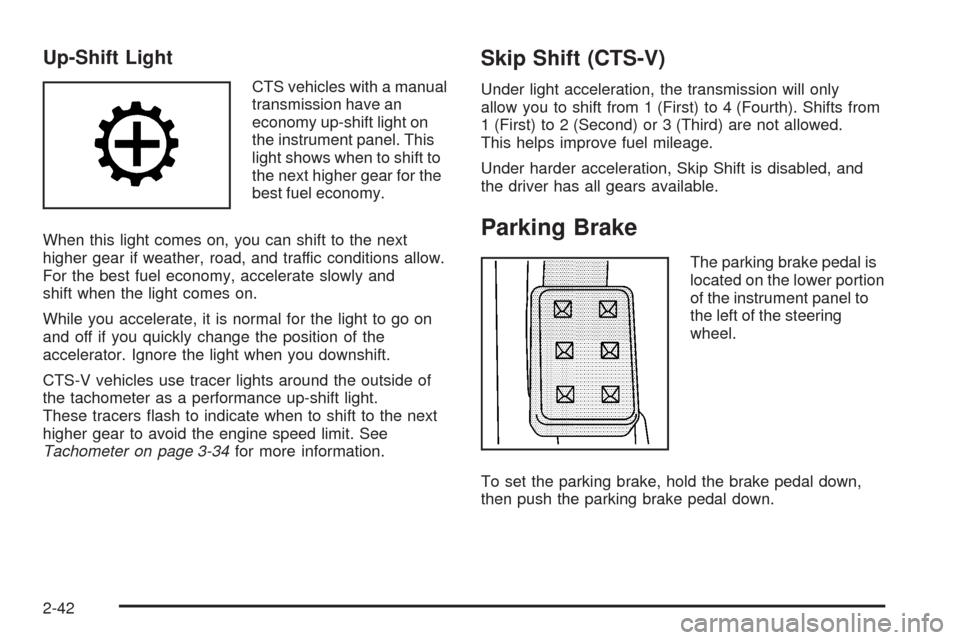
The parking brake pedal is
located on the lower portion
of the instrument panel to
the left of the steering
wheel.
To set the parking brake, hold the brake pedal down,
then push the parking brake pedal down.
2-42
Page 125 of 490

If the ignition is on, the brake system warning light on the
instrument panel cluster should come on. If it does not,
you need to have the vehicle serviced. SeeBrake System
Warning Light on page 3-39for more information.
To release the parking brake, pull the release lever
located to the left of the steering wheel on the instrument
panel.Notice:Driving with the parking brake on can
overheat the brake system and cause premature
wear or damage to brake system parts. Make sure
that the parking brake is fully released and the brake
warning light is off before driving.
A warning chime will sound if the parking brake is set,
the ignition is on, and the vehicle begins to move.
To stop the chime, fully release the parking brake.
If you are towing a trailer and parking on a hill,
seeTowing a Trailer (CTS-V) on page 4-27orTowing a
Trailer (CTS) on page 4-28for more information.
2-43