wheel CADILLAC CTS 2012 2.G Manual Online
[x] Cancel search | Manufacturer: CADILLAC, Model Year: 2012, Model line: CTS, Model: CADILLAC CTS 2012 2.GPages: 496, PDF Size: 6.36 MB
Page 403 of 496
Black plate (91,1)Cadillac CTS/CTS-V Owner Manual (Include Mex) - 2012
Vehicle Care 10-91
Using the Tire Sealant and
Compressor Kit without
Sealant to Inflate a Tire (Not
Punctured)
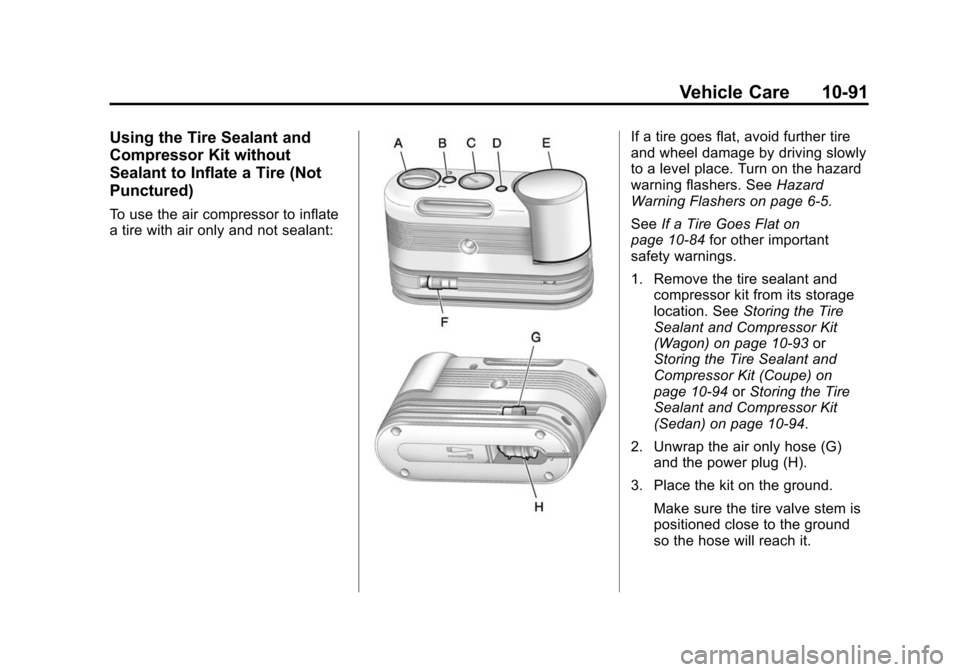
To use the air compressor to inflate
a tire with air only and not sealant:
If a tire goes flat, avoid further tire
and wheel damage by driving slowly
to a level place. Turn on the hazard
warning flashers. SeeHazard
Warning Flashers on page 6‑5.
See If a Tire Goes Flat on
page 10‑84 for other important
safety warnings.
1. Remove the tire sealant and compressor kit from its storage
location. See Storing the Tire
Sealant and Compressor Kit
(Wagon) on page 10‑93 or
Storing the Tire Sealant and
Compressor Kit (Coupe) on
page 10‑94 orStoring the Tire
Sealant and Compressor Kit
(Sedan) on page 10‑94.
2. Unwrap the air only hose (G) and the power plug (H).
3. Place the kit on the ground. Make sure the tire valve stem is
positioned close to the ground
so the hose will reach it.
Page 407 of 496

Black plate (95,1)Cadillac CTS/CTS-V Owner Manual (Include Mex) - 2012
Vehicle Care 10-95
3. Remove the wing nut (C) thatholds the tire sealant and
compressor kit (A) in place.
4. Remove the tire sealant and compressor kit (A) from the foam
container (B).
To store the tire sealant and
compressor kit, reverse the steps.Tire Changing
Removing the Spare Tire and
Tools (Sedan)
Sedan
A. Wing Nut
B. Spare Tire
C. Jack
D. Wheel Wrench
E. Extension (If Equipped)
F. Strap To access the spare tire and jacking
equipment:
1. Remove the spare tire cover.
2. Remove the stow rod cap by
pulling it straight up off of
the rod.
3. Turn the wing nut (A) on the compact spare tire (B)
counterclockwise to remove.
4. Remove the spare tire and place it next to the flat tire.
5. The tools you will be using next include the jack (C), wheel
wrench (D), and extension (E),
if the vehicle has one.
Page 408 of 496
Black plate (96,1)Cadillac CTS/CTS-V Owner Manual (Include Mex) - 2012
10-96 Vehicle Care
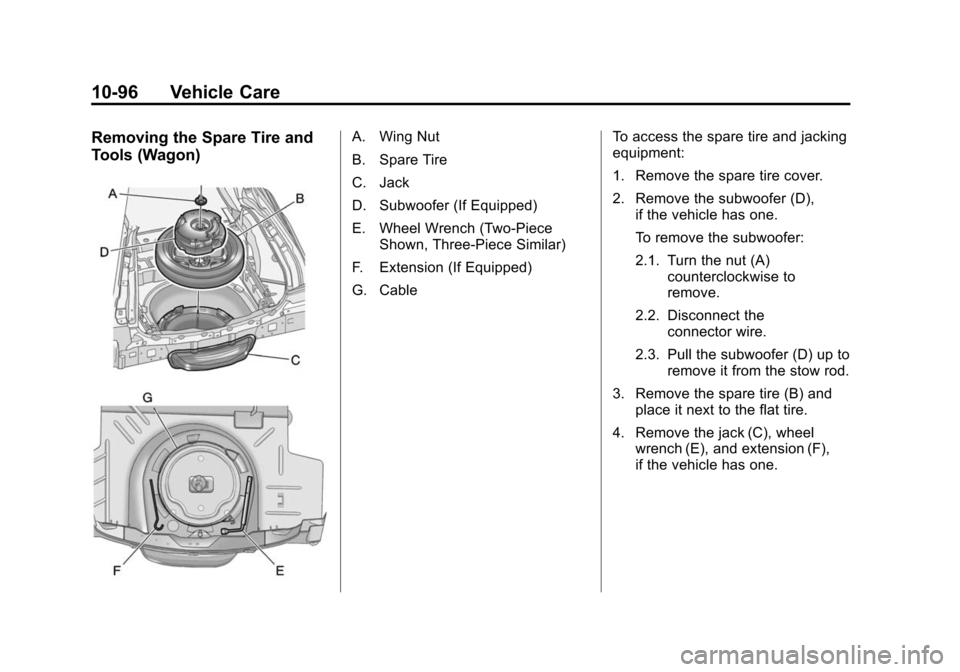
Removing the Spare Tire and
Tools (Wagon)A. Wing Nut
B. Spare Tire
C. Jack
D. Subwoofer (If Equipped)
E. Wheel Wrench (Two-PieceShown, Three-Piece Similar)
F. Extension (If Equipped)
G. Cable To access the spare tire and jacking
equipment:
1. Remove the spare tire cover.
2. Remove the subwoofer (D),
if the vehicle has one.
To remove the subwoofer:
2.1. Turn the nut (A) counterclockwise to
remove.
2.2. Disconnect the connector wire.
2.3. Pull the subwoofer (D) up to remove it from the stow rod.
3. Remove the spare tire (B) and place it next to the flat tire.
4. Remove the jack (C), wheel wrench (E), and extension (F),
if the vehicle has one.
Page 409 of 496
Black plate (97,1)Cadillac CTS/CTS-V Owner Manual (Include Mex) - 2012
Vehicle Care 10-97
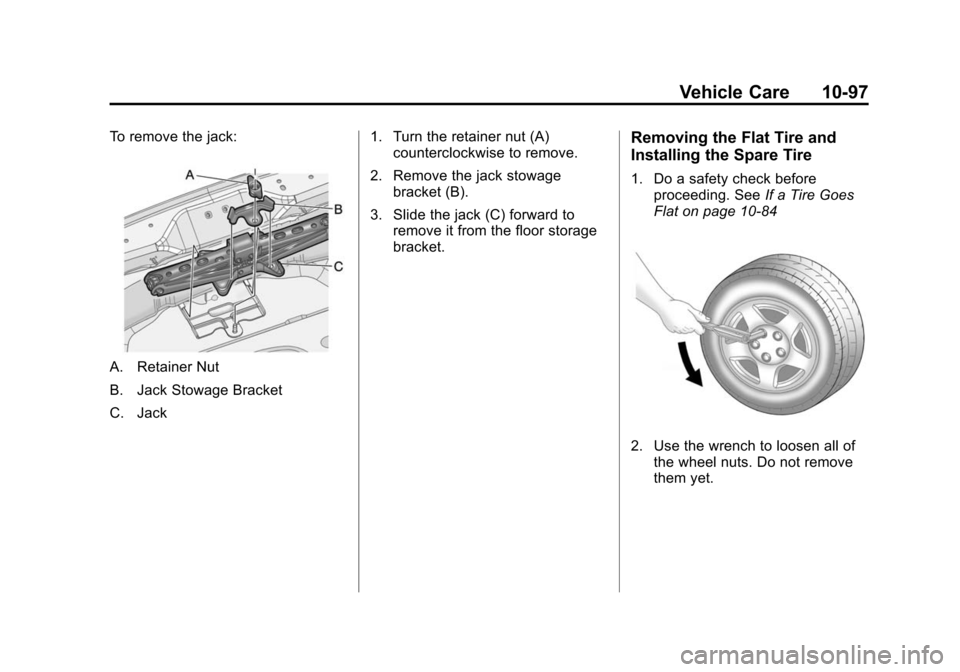
To remove the jack:
A. Retainer Nut
B. Jack Stowage Bracket
C. Jack1. Turn the retainer nut (A)
counterclockwise to remove.
2. Remove the jack stowage bracket (B).
3. Slide the jack (C) forward to remove it from the floor storage
bracket.
Removing the Flat Tire and
Installing the Spare Tire
1. Do a safety check before
proceeding. See If a Tire Goes
Flat on page 10‑84
2. Use the wrench to loosen all of the wheel nuts. Do not remove
them yet.
Page 411 of 496
Black plate (99,1)Cadillac CTS/CTS-V Owner Manual (Include Mex) - 2012
Vehicle Care 10-99
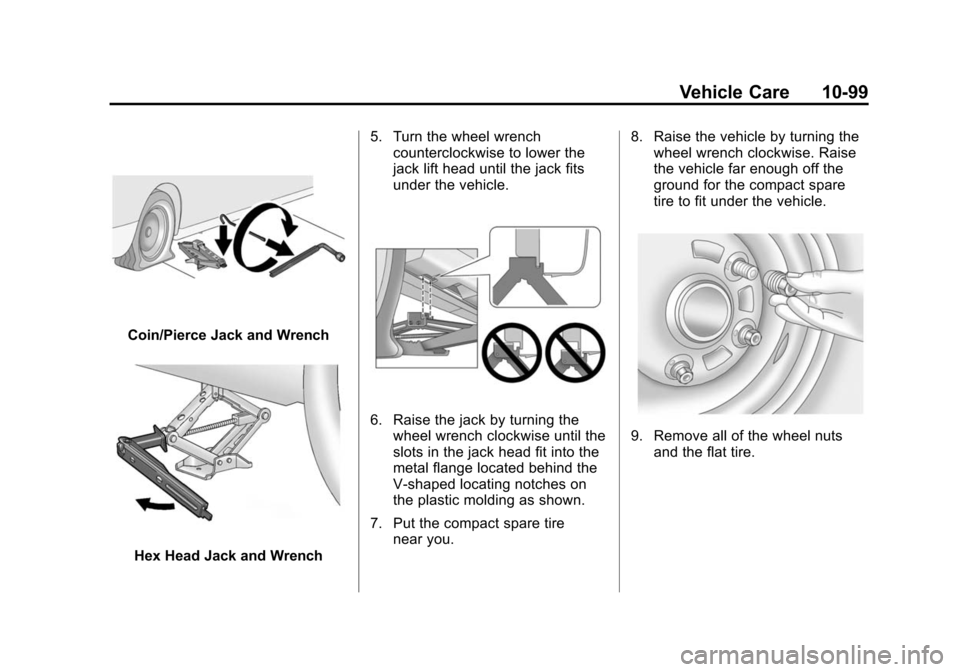
Coin/Pierce Jack and Wrench
Hex Head Jack and Wrench5. Turn the wheel wrench
counterclockwise to lower the
jack lift head until the jack fits
under the vehicle.
6. Raise the jack by turning the
wheel wrench clockwise until the
slots in the jack head fit into the
metal flange located behind the
V‐shaped locating notches on
the plastic molding as shown.
7. Put the compact spare tire near you. 8. Raise the vehicle by turning the
wheel wrench clockwise. Raise
the vehicle far enough off the
ground for the compact spare
tire to fit under the vehicle.9. Remove all of the wheel nuts
and the flat tire.
Page 412 of 496
Black plate (100,1)Cadillac CTS/CTS-V Owner Manual (Include Mex) - 2012
10-100 Vehicle Care
{WARNING
Rust or dirt on a wheel, or on the
parts to which it is fastened, can
make wheel nuts become loose
after time. The wheel could come
off and cause an accident. When
changing a wheel, remove any
rust or dirt from places where the
wheel attaches to the vehicle. In
an emergency, a cloth or a paper
towel can be used; however, use
a scraper or wire brush later to
remove all rust or dirt.
{WARNING
Never use oil or grease on bolts
or nuts because the nuts might
come loose. The vehicle's wheel
could fall off, causing a crash.
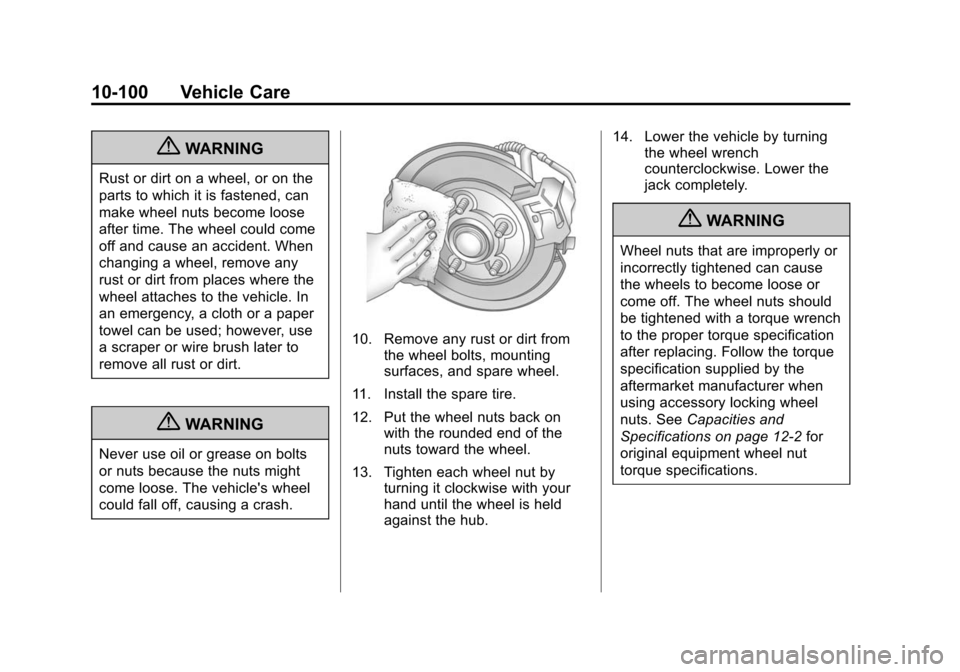
10. Remove any rust or dirt fromthe wheel bolts, mounting
surfaces, and spare wheel.
11. Install the spare tire.
12. Put the wheel nuts back on with the rounded end of the
nuts toward the wheel.
13. Tighten each wheel nut by turning it clockwise with your
hand until the wheel is held
against the hub. 14. Lower the vehicle by turning
the wheel wrench
counterclockwise. Lower the
jack completely.
{WARNING
Wheel nuts that are improperly or
incorrectly tightened can cause
the wheels to become loose or
come off. The wheel nuts should
be tightened with a torque wrench
to the proper torque specification
after replacing. Follow the torque
specification supplied by the
aftermarket manufacturer when
using accessory locking wheel
nuts. See Capacities and
Specifications on page 12‑2 for
original equipment wheel nut
torque specifications.
Page 413 of 496
Black plate (101,1)Cadillac CTS/CTS-V Owner Manual (Include Mex) - 2012
Vehicle Care 10-101
Notice:Improperly tightened
wheel nuts can lead to brake
pulsation and rotor damage. To
avoid expensive brake repairs,
evenly tighten the wheel nuts in
the proper sequence and to the
proper torque specification. See
Capacities and Specifications on
page 12‑2 for the wheel nut
torque specification.
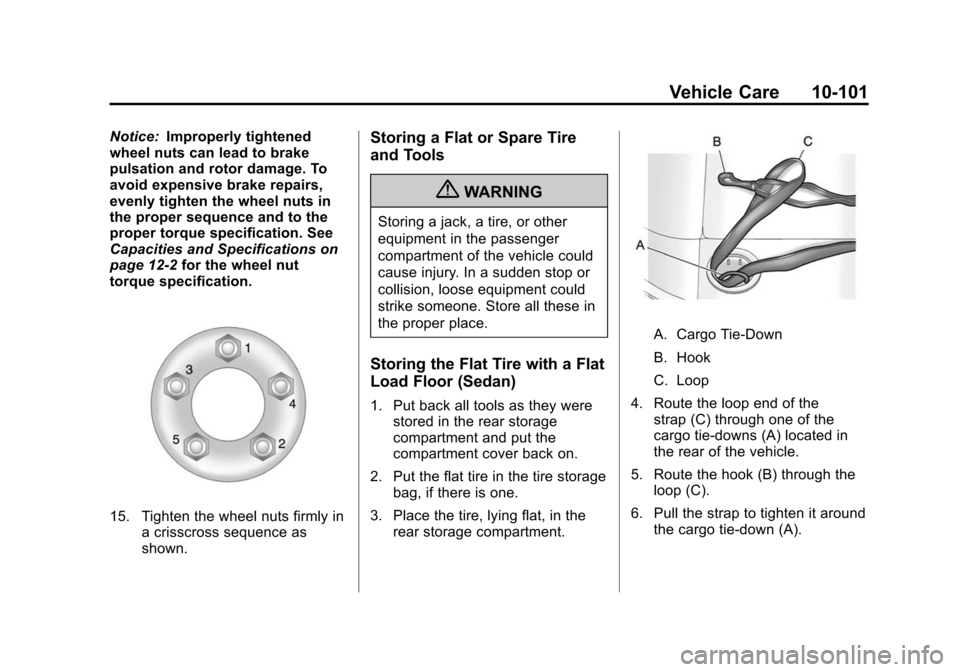
15. Tighten the wheel nuts firmly in a crisscross sequence as
shown.
Storing a Flat or Spare Tire
and Tools
{WARNING
Storing a jack, a tire, or other
equipment in the passenger
compartment of the vehicle could
cause injury. In a sudden stop or
collision, loose equipment could
strike someone. Store all these in
the proper place.
Storing the Flat Tire with a Flat
Load Floor (Sedan)
1. Put back all tools as they were
stored in the rear storage
compartment and put the
compartment cover back on.
2. Put the flat tire in the tire storage bag, if there is one.
3. Place the tire, lying flat, in the rear storage compartment.
A. Cargo Tie-Down
B. Hook
C. Loop
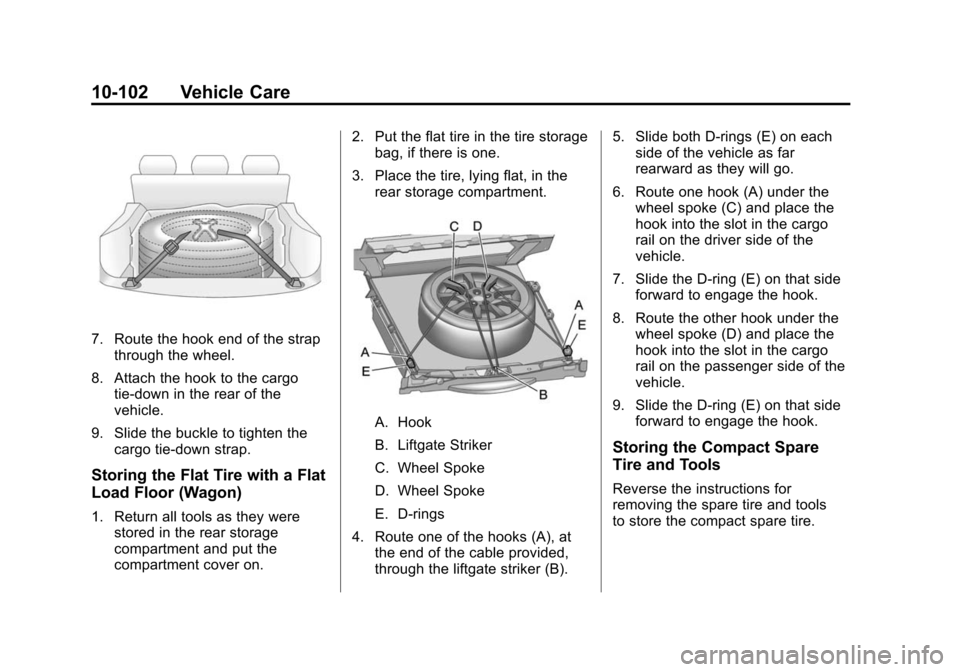
4. Route the loop end of the strap (C) through one of the
cargo tie-downs (A) located in
the rear of the vehicle.
5. Route the hook (B) through the loop (C).
6. Pull the strap to tighten it around the cargo tie-down (A).
Page 414 of 496
Black plate (102,1)Cadillac CTS/CTS-V Owner Manual (Include Mex) - 2012
10-102 Vehicle Care
7. Route the hook end of the strapthrough the wheel.
8. Attach the hook to the cargo tie-down in the rear of the
vehicle.
9. Slide the buckle to tighten the cargo tie-down strap.
Storing the Flat Tire with a Flat
Load Floor (Wagon)
1. Return all tools as they werestored in the rear storage
compartment and put the
compartment cover on. 2. Put the flat tire in the tire storage
bag, if there is one.
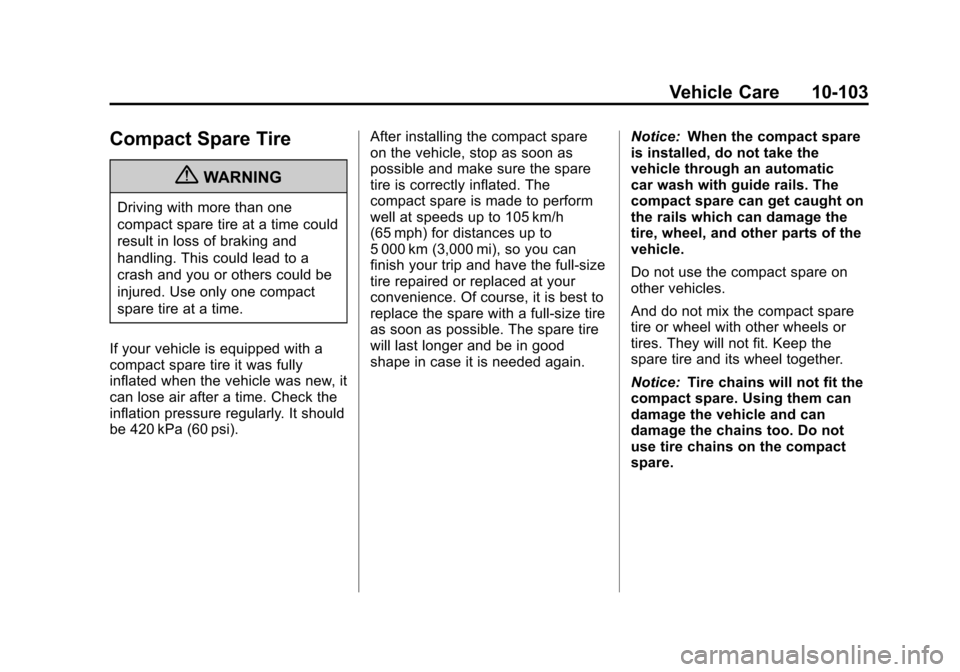
3. Place the tire, lying flat, in the rear storage compartment.
A. Hook
B. Liftgate Striker
C. Wheel Spoke
D. Wheel Spoke
E. D-rings
4. Route one of the hooks (A), at the end of the cable provided,
through the liftgate striker (B). 5. Slide both D-rings (E) on each
side of the vehicle as far
rearward as they will go.
6. Route one hook (A) under the wheel spoke (C) and place the
hook into the slot in the cargo
rail on the driver side of the
vehicle.
7. Slide the D-ring (E) on that side forward to engage the hook.
8. Route the other hook under the wheel spoke (D) and place the
hook into the slot in the cargo
rail on the passenger side of the
vehicle.
9. Slide the D-ring (E) on that side forward to engage the hook.
Storing the Compact Spare
Tire and Tools
Reverse the instructions for
removing the spare tire and tools
to store the compact spare tire.
Page 415 of 496
Black plate (103,1)Cadillac CTS/CTS-V Owner Manual (Include Mex) - 2012
Vehicle Care 10-103
Compact Spare Tire
{WARNING
Driving with more than one
compact spare tire at a time could
result in loss of braking and
handling. This could lead to a
crash and you or others could be
injured. Use only one compact
spare tire at a time.
If your vehicle is equipped with a
compact spare tire it was fully
inflated when the vehicle was new, it
can lose air after a time. Check the
inflation pressure regularly. It should
be 420 kPa (60 psi). After installing the compact spare
on the vehicle, stop as soon as
possible and make sure the spare
tire is correctly inflated. The
compact spare is made to perform
well at speeds up to 105 km/h
(65 mph) for distances up to
5 000 km (3,000 mi), so you can
finish your trip and have the full-size
tire repaired or replaced at your
convenience. Of course, it is best to
replace the spare with a full-size tire
as soon as possible. The spare tire
will last longer and be in good
shape in case it is needed again.
Notice:
When the compact spare
is installed, do not take the
vehicle through an automatic
car wash with guide rails. The
compact spare can get caught on
the rails which can damage the
tire, wheel, and other parts of the
vehicle.
Do not use the compact spare on
other vehicles.
And do not mix the compact spare
tire or wheel with other wheels or
tires. They will not fit. Keep the
spare tire and its wheel together.
Notice: Tire chains will not fit the
compact spare. Using them can
damage the vehicle and can
damage the chains too. Do not
use tire chains on the compact
spare.
Page 420 of 496
Black plate (108,1)Cadillac CTS/CTS-V Owner Manual (Include Mex) - 2012
10-108 Vehicle Care
To disconnect the jumper cables
from both vehicles, do the following:
1. Disconnect the blacknegative (−) cable from the
vehicle that had the dead
battery.
2. Disconnect the black negative (−) cable from the
vehicle with the good battery.
3. Disconnect the red positive (+) cable from the vehicle with the
good battery.
4. Disconnect the red positive (+) cable from the other vehicle.Towing
Towing the Vehicle
Notice: To avoid damage, the
disabled vehicle should be towed
with all four wheels off the
ground. Care must be taken with
vehicles that have low ground
clearance and/or special
equipment. Always flatbed on a
car carrier.
Consult your dealer or a
professional towing service if the
disabled vehicle must be towed.
See Roadside Service (U.S. and
Canada) on page 13‑7 orRoadside
Service (Mexico) on page 13‑9.
To tow the vehicle behind another
vehicle for recreational purposes,
such as behind a motor home, see
“Recreational Vehicle Towing” in this
section.
Recreational Vehicle
Towing
Recreational vehicle towing means
towing the vehicle behind another
vehicle –such as behind a
motorhome. The two most common
types of recreational vehicle towing
are known as dinghy towing and
dolly towing. Dingy towing is towing
the vehicle with all four wheels on
the ground. Dolly towing is towing
the vehicle with two wheels on the
ground and two wheels up on a
device known as a dolly.
Here are some important things to
consider before recreational vehicle
towing:
.What is the towing capacity of
the towing vehicle? Be sure to
read the tow vehicle
manufacturer's
recommendations.
.What is the distance that will be
travelled? Some vehicles have
restrictions on how far and how
long they can tow.