wheel CADILLAC CTS 2012 2.G Workshop Manual
[x] Cancel search | Manufacturer: CADILLAC, Model Year: 2012, Model line: CTS, Model: CADILLAC CTS 2012 2.GPages: 496, PDF Size: 6.36 MB
Page 293 of 496
Black plate (43,1)Cadillac CTS/CTS-V Owner Manual (Include Mex) - 2012
Driving and Operating 9-43
.To slow down in small amounts,
press the−SET button on the
steering wheel briefly. Each time
this is done, the vehicle goes
about 1.6 km/h (1 mph) slower.
Passing Another Vehicle While
Using Cruise Control
Use the accelerator pedal to
increase the vehicle's speed. When
you take your foot off the pedal, the
vehicle will slow down to the
previous set cruise speed. Using Cruise Control on Hills
How well the cruise control works
on hills depends upon the vehicle
speed, load, and the steepness of
the hills. When going up steep hills,
you might have to step on the
accelerator pedal to maintain the
vehicle speed. When going
downhill, the vehicle may
automatically shift to a lower gear to
keep the vehicle's speed down. The
vehicle may then shift to a higher
gear when braking assistance is no
longer required. When the brakes
are applied manually the cruise
control is disengaged.Ending Cruise Control
There are four ways to end cruise
control:
.Step lightly on the brake pedal
(manual and automatic
transmissions).
.Press the clutch pedal to the
floor (manual transmissions).
.Press[on the steering wheel.
.To turn off the cruise control,
press
Ion the steering wheel.
Erasing Speed Memory
The cruise control set speed is
erased from memory by pressing
Ior if the ignition is turned off.
Page 306 of 496

Black plate (56,1)Cadillac CTS/CTS-V Owner Manual (Include Mex) - 2012
9-56 Driving and Operating
vehicle such as a motor home, see
Recreational Vehicle Towing on
page 10‑108.
Driving Characteristics
and Towing Tips
{WARNING
The driver can lose control when
pulling a trailer if the correct
equipment is not used or the
vehicle is not driven properly. For
example, if the trailer is too
heavy, the brakes may not work
well—or even at all. The driver
and passengers could be
seriously injured. The vehicle may
also be damaged; the resulting
repairs would not be covered by
the vehicle warranty. Pull a trailer
only if all the steps in this section
have been followed. Ask your
dealer for advice and information
about towing a trailer with the
vehicle. The vehicle can tow a trailer if it is
equipped with the proper trailer
towing equipment. To identify the
trailering capacity of the vehicle, see
Trailer Towing (CTS-V and Coupe)
on page 9‑59
orTrailer Towing
(Except CTS-V and Coupe) on
page 9‑59. Trailering changes
handling, acceleration, braking,
durability, and fuel economy. With
the added weight, the engine,
transmission, wheel assemblies,
and tires are forced to work harder
and under greater loads. The trailer
also adds wind resistance,
increasing the pulling requirements.
For safe trailering, correctly use the
proper trailering equipment.
The following information has
important trailering tips and rules for
your safety and that of your
passengers. Read this section
carefully before pulling a trailer.
Pulling a Trailer
Here are some important points:
.There are many laws, including
speed limit restrictions that apply
to trailering. Check for legal
requirements with state or
provincial police.
.Do not tow a trailer at all during
the first 1 600 km (1,000 mi) the
new vehicle is driven. The
engine or other parts could be
damaged.
.During the first 800 km (500 mi)
that a trailer is towed, do not
drive over 80 km/h (50 mph) and
do not make starts at full throttle.
This reduces wear on the
vehicle.
.Vehicles with automatic
transmissions can tow in
D (Drive) but M (Manual Mode)
is recommended. See Manual
Mode on page 9‑29 for more
information. Use a lower gear if
the transmission shifts too often.
Page 307 of 496
Black plate (57,1)Cadillac CTS/CTS-V Owner Manual (Include Mex) - 2012
Driving and Operating 9-57
For vehicles with a manual
transmission, it is better not to
use the highest gear.
.Use the cruise control when
towing.
.Obey speed limit restrictions. Do
not drive faster than the
maximum posted speed for
trailers, or no more than 90 km/h
(55 mph), to reduce wear on the
vehicle.
Driving with a Trailer
Towing a trailer requires experience.
Get familiar with handling and
braking with the added trailer
weight. The vehicle is now longer
and not as responsive as the
vehicle is by itself.
Check all trailer hitch parts and
attachments, safety chains,
electrical connectors, lamps, tires,
and mirror adjustments. If the trailer
has electric brakes, start the vehicleand trailer moving and then apply
the trailer brake controller by hand
to be sure the brakes are working.
During the trip, check regularly to be
sure that the load is secure, and the
lamps and trailer brakes are working
properly.
Towing with a Stability Control
System
When towing, the sound of the
stability control system might be
heard. The system is reacting to the
vehicle movement caused by the
trailer, which mainly occurs during
cornering. This is normal when
towing heavier trailers.
Following Distance
Stay at least twice as far behind the
vehicle ahead as you would when
driving the vehicle without a trailer.
This can help to avoid situations
that require heavy braking and
sudden turns.
Passing
More passing distance is needed
when towing a trailer. Because the
rig is longer, it is necessary to go
much farther beyond the passed
vehicle before returning to the lane.
Backing Up
Hold the bottom of the steering
wheel with one hand. Then, to move
the trailer to the left, move that hand
to the left. To move the trailer to the
right, move your hand to the right.
Always back up slowly and,
if possible, have someone
guide you.
Making Turns
Notice:
Making very sharp turns
while trailering could cause the
trailer to come in contact with the
vehicle. The vehicle could be
damaged. Avoid making very
sharp turns while trailering.
When turning with a trailer, make
wider turns than normal. Do this so
the trailer will not strike soft
Page 309 of 496

Black plate (59,1)Cadillac CTS/CTS-V Owner Manual (Include Mex) - 2012
Driving and Operating 9-59
transmission. Turn the wheels
into the curb if facing downhill or
into traffic if facing uphill.
2. Have someone place chocks under the trailer wheels.
3. When the wheel chocks are in place, release the brake pedal
until the chocks absorb the load.
4. Reapply the brake pedal. Then apply the parking brake and shift
into P (Park) for vehicles with an
automatic transmission or into
gear for vehicles with a manual
transmission.
5. Release the brake pedal.
Leaving After Parking on a Hill
1. Apply and hold the brake pedal while you:
1.1. Start the engine.
1.2. Shift into a gear.
1.3. Release the parking brake.
2. Let up on the brake pedal. 3. Drive slowly until the trailer is
clear of the chocks.
4. Stop and have someone pick up and store the chocks.
Maintenance When Trailer
Towing
The vehicle needs service more
often when pulling a trailer. See this
manual's Maintenance Schedule or
Index for more information. Things
that are especially important in
trailer operation are automatic
transmission fluid, engine oil, axle
lubricant, belts, cooling system, and
brake system. It is a good idea to
inspect these before and during
the trip.
Check periodically to see that all
hitch nuts and bolts are tight.
Engine Cooling When Trailer
Towing
The cooling system may temporarily
overheat during severe operating
conditions. See Engine Overheating
on page 10‑23.
Trailer Towing (CTS-V and
Coupe)
The vehicle is neither designed nor
intended to tow a trailer.
Trailer Towing (Except
CTS-V and Coupe)
Before pulling a trailer, there are
three important considerations that
have to do with weight:
.The weight of the trailer.
.The weight of the trailer tongue.
.The total weight on the vehicle's
tires.
Weight of the Trailer
How heavy can a trailer safely be?
It should never weigh more than
450 kg (1,000 lbs). But even that
can be too heavy.
Speed, altitude, road grades,
outside temperature, special
equipment, and the amount of
tongue weight the vehicle can carry
Page 313 of 496

Black plate (1,1)Cadillac CTS/CTS-V Owner Manual (Include Mex) - 2012
Vehicle Care 10-1
Vehicle Care
General Information
General Information . . . . . . . . . . 10-3
California Proposition 65Warning . . . . . . . . . . . . . . . . . . . . 10-3
California Perchlorate Materials Requirements . . . . 10-3
Accessories and Modifications . . . . . . . . . . . . . . . 10-3
Vehicle Checks
Doing Your OwnService Work . . . . . . . . . . . . . . . 10-4
Hood . . . . . . . . . . . . . . . . . . . . . . . . 10-5
Engine Compartment Overview . . . . . . . . . . . . . . . . . . . 10-6
Engine Cover . . . . . . . . . . . . . . . . 10-9
Engine Oil . . . . . . . . . . . . . . . . . . 10-10
Engine Oil Life System . . . . . 10-12
Automatic Transmission Fluid . . . . . . . . . . . . . . . . . . . . . . 10-14
Manual Transmission Fluid . . . . . . . . . . . . . . . . . . . . . . 10-14 Hydraulic Clutch . . . . . . . . . . . . 10-14
Engine Air Cleaner/Filter . . . . 10-15
Cooling System . . . . . . . . . . . . 10-18
Engine Coolant . . . . . . . . . . . . . 10-18
Engine Overheating . . . . . . . . 10-23
Overheated Engine
Protection
Operating Mode . . . . . . . . . . . 10-24
Power Steering Fluid . . . . . . . 10-24
Washer Fluid . . . . . . . . . . . . . . . 10-25
Brakes . . . . . . . . . . . . . . . . . . . . . 10-26
Brake Fluid . . . . . . . . . . . . . . . . . 10-27
Battery . . . . . . . . . . . . . . . . . . . . . 10-29
All-Wheel Drive . . . . . . . . . . . . . 10-30
Starter Switch Check . . . . . . . 10-30
Automatic Transmission Shift Lock Control Function
Check . . . . . . . . . . . . . . . . . . . . . 10-31
Ignition Transmission Lock Check . . . . . . . . . . . . . . . . . . . . . 10-31
Park Brake and P (Park) Mechanism Check . . . . . . . . 10-32
Wiper Blade Replacement . . . . . . . . . . . . . . 10-32
Headlamp Aiming
Headlamp Aiming . . . . . . . . . . 10-34
Bulb Replacement
Bulb Replacement . . . . . . . . . . 10-37
Halogen Bulbs . . . . . . . . . . . . . . 10-37
High Intensity Discharge(HID) Lighting . . . . . . . . . . . . . 10-37
Fog Lamps . . . . . . . . . . . . . . . . . 10-37
License Plate Lamp (Coupe and Sedan) . . . . . . . . . . . . . . . 10-38
License Plate Lamp (Wagon) . . . . . . . . . . . . . . . . . . 10-38
Replacement Bulbs . . . . . . . . . 10-39
Electrical System
Electrical System Overload . . . . . . . . . . . . . . . . . . 10-39
Fuses and Circuit Breakers . . . . . . . . . . . . . . . . . . 10-40
Engine Compartment Fuse Block (CTS Coupe and
Sedan) . . . . . . . . . . . . . . . . . . . . 10-40
Engine Compartment Fuse Block (CTS V Coupe and
Sedan) . . . . . . . . . . . . . . . . . . . . 10-44
Page 314 of 496

Black plate (2,1)Cadillac CTS/CTS-V Owner Manual (Include Mex) - 2012
10-2 Vehicle Care
Engine Compartment FuseBlock (CTS Wagon) . . . . . . . 10-47
Engine Compartment Fuse Block (CTS V Wagon) . . . . . 10-51
Rear Compartment Fuse
Block (CTS Coupe and
Sedan) . . . . . . . . . . . . . . . . . . . . 10-54
Rear Compartment Fuse Block (CTS-V Coupe and
Sedan) . . . . . . . . . . . . . . . . . . . . 10-56
Rear Compartment Fuse Block (CTS Wagon) . . . . . . . 10-58
Rear Compartment Fuse Block (CTS-V Wagon) . . . . . 10-60
Wheels and Tires
Tires . . . . . . . . . . . . . . . . . . . . . . . . 10-63
Winter Tires . . . . . . . . . . . . . . . . 10-64
Low-Profile Tires . . . . . . . . . . . 10-64
Tire Sidewall Labeling . . . . . . 10-65
Tire Designations . . . . . . . . . . . 10-67
Tire Terminology andDefinitions . . . . . . . . . . . . . . . . 10-68 Tire Pressure . . . . . . . . . . . . . . . 10-70
Tire Pressure for High-Speed
Operation . . . . . . . . . . . . . . . . . 10-72
Tire Pressure Monitor System . . . . . . . . . . . . . . . . . . . 10-72
Tire Pressure Monitor Operation . . . . . . . . . . . . . . . . . 10-73
Tire Inspection . . . . . . . . . . . . . . 10-76
Tire Rotation . . . . . . . . . . . . . . . 10-77
When It Is Time for New Tires . . . . . . . . . . . . . . . . . . . . . . 10-78
Buying New Tires . . . . . . . . . . . 10-79
Different Size Tires and Wheels . . . . . . . . . . . . . . . . . . . 10-80
Uniform Tire Quality Grading . . . . . . . . . . . . . . . . . . . 10-81
Wheel Alignment and Tire Balance . . . . . . . . . . . . . . . . . . . 10-82
Wheel Replacement . . . . . . . . 10-82
Tire Chains . . . . . . . . . . . . . . . . . 10-83
If a Tire Goes Flat . . . . . . . . . . 10-84
Tire Sealant and Compressor Kit . . . . . . . . . . . 10-86 Storing the Tire Sealant and
Compressor Kit
(Wagon) . . . . . . . . . . . . . . . . . . 10-93
Storing the Tire Sealant and Compressor Kit
(Coupe) . . . . . . . . . . . . . . . . . . . 10-94
Storing the Tire Sealant and Compressor Kit
(Sedan) . . . . . . . . . . . . . . . . . . . 10-94
Tire Changing . . . . . . . . . . . . . . 10-95
Compact Spare Tire . . . . . . . 10-103
Jump Starting
Jump Starting . . . . . . . . . . . . . 10-104
Towing
Towing the Vehicle . . . . . . . . 10-108
Recreational Vehicle Towing . . . . . . . . . . . . . . . . . . . 10-108
Appearance Care
Exterior Care . . . . . . . . . . . . . . 10-110
Interior Care . . . . . . . . . . . . . . . 10-113
Floor Mats . . . . . . . . . . . . . . . . . 10-116
Page 339 of 496
Black plate (27,1)Cadillac CTS/CTS-V Owner Manual (Include Mex) - 2012
Vehicle Care 10-27
Some driving conditions or climates
can cause a brake squeal when the
brakes are first applied or lightly
applied. This does not mean
something is wrong with the brakes.
Properly torqued wheel nuts are
necessary to help prevent brake
pulsation. When tires are rotated,
inspect brake pads for wear and
evenly tighten wheel nuts in the
proper sequence to torque
specifications inCapacities and
Specifications on page 12‑2.
Brake linings should always be
replaced as complete axle sets.
Brake Pedal Travel
See your dealer if the brake pedal
does not return to normal height,
or if there is a rapid increase in
pedal travel. This could be a sign
that brake service might be
required.
Brake Adjustment
Every time the brakes are applied,
with or without the vehicle moving,
the brakes adjust for wear.
Replacing Brake System Parts
The braking system on a vehicle is
complex. Its many parts have to be
of top quality and work well together
if the vehicle is to have really good
braking. The vehicle was designed
and tested with top-quality brake
parts. When parts of the braking
system are replaced, be sure to get
new, approved replacement parts.
If this is not done, the brakes might
not work properly. For example,
installing disc brake pads that are
wrong for the vehicle, can change
the balance between the front and
rear brakes —for the worse. The
braking performance expected can
change in many other ways if the
wrong replacement brake parts are
installed.
Brake Fluid
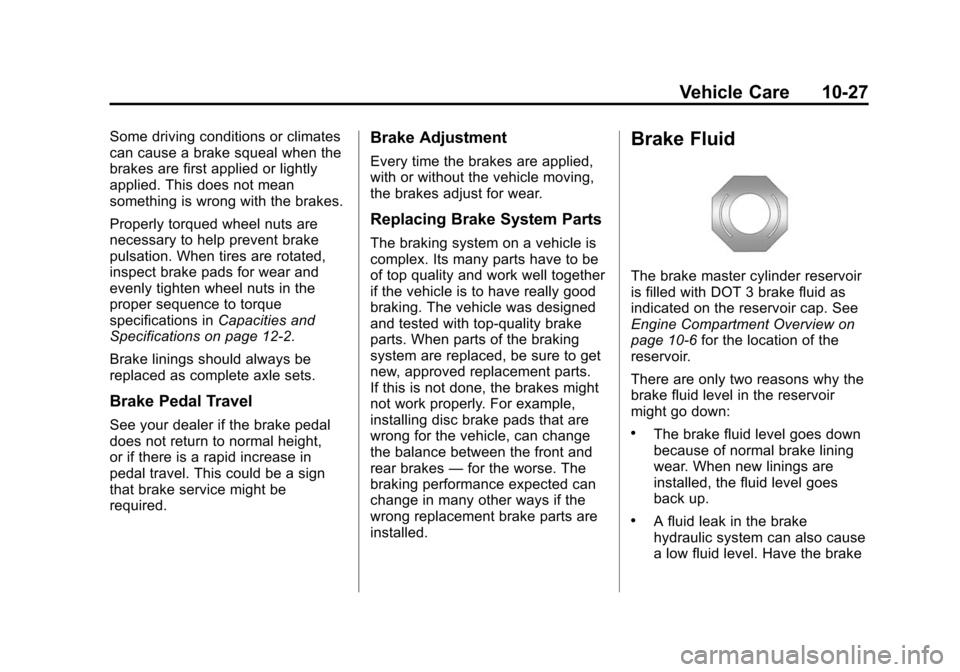
The brake master cylinder reservoir
is filled with DOT 3 brake fluid as
indicated on the reservoir cap. See
Engine Compartment Overview on
page 10‑6 for the location of the
reservoir.
There are only two reasons why the
brake fluid level in the reservoir
might go down:
.The brake fluid level goes down
because of normal brake lining
wear. When new linings are
installed, the fluid level goes
back up.
.A fluid leak in the brake
hydraulic system can also cause
a low fluid level. Have the brake
Page 342 of 496
Black plate (30,1)Cadillac CTS/CTS-V Owner Manual (Include Mex) - 2012
10-30 Vehicle Care
All-Wheel Drive
If your vehicle is equipped with
all-wheel-drive, this is an additional
system that needs lubrication.
Transfer Case
When to Check Lubricant
It is not necessary to regularly
check the transfer case fluid unless
you suspect there is a leak or you
hear an unusual noise. A fluid loss
could indicate a problem. Have it
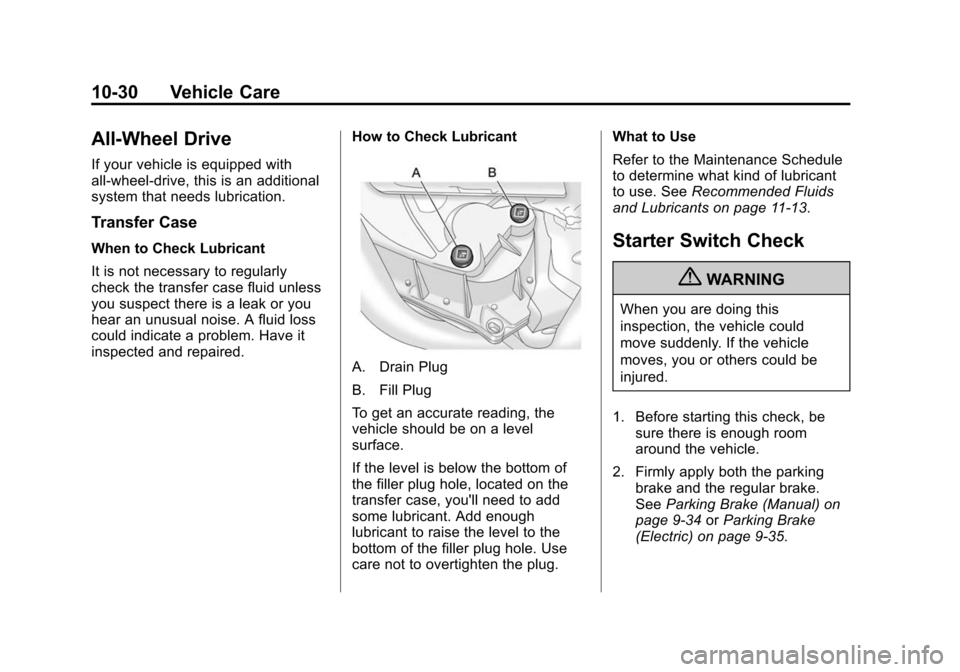
inspected and repaired.How to Check Lubricant
A. Drain Plug
B. Fill Plug
To get an accurate reading, the
vehicle should be on a level
surface.
If the level is below the bottom of
the filler plug hole, located on the
transfer case, you'll need to add
some lubricant. Add enough
lubricant to raise the level to the
bottom of the filler plug hole. Use
care not to overtighten the plug.What to Use
Refer to the Maintenance Schedule
to determine what kind of lubricant
to use. See
Recommended Fluids
and Lubricants on page 11‑13.
Starter Switch Check
{WARNING
When you are doing this
inspection, the vehicle could
move suddenly. If the vehicle
moves, you or others could be
injured.
1. Before starting this check, be sure there is enough room
around the vehicle.
2. Firmly apply both the parking brake and the regular brake.
See Parking Brake (Manual) on
page 9‑34 orParking Brake
(Electric) on page 9‑35.
Page 354 of 496
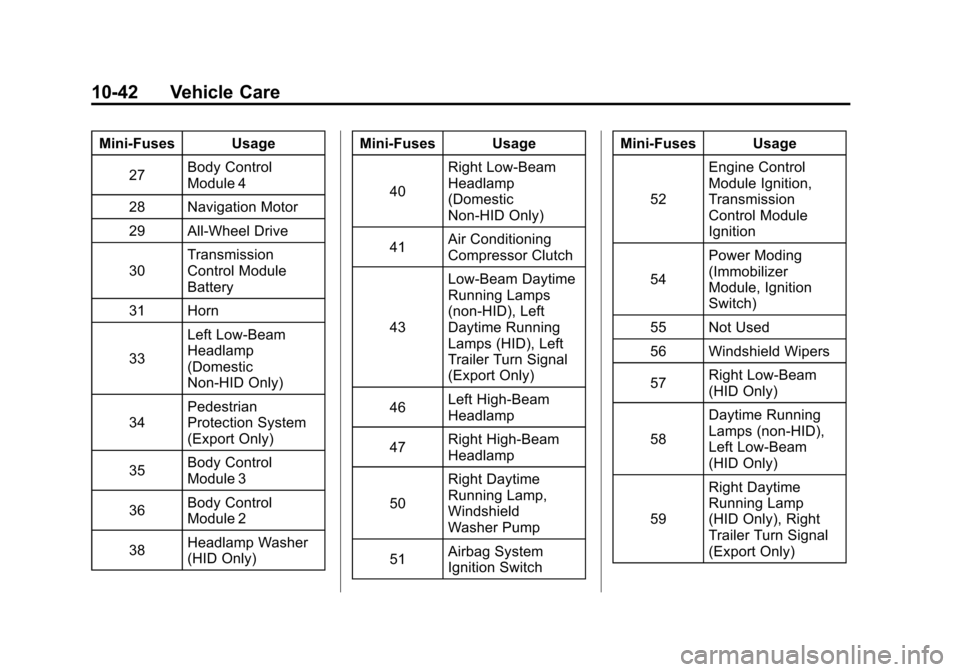
Black plate (42,1)Cadillac CTS/CTS-V Owner Manual (Include Mex) - 2012
10-42 Vehicle Care
Mini‐Fuses Usage27 Body Control
Module 4
28 Navigation Motor
29 All-Wheel Drive
30 Transmission
Control Module
Battery
31 Horn
33 Left Low‐Beam
Headlamp
(Domestic
Non‐HID Only)
34 Pedestrian
Protection System
(Export Only)
35 Body Control
Module 3
36 Body Control
Module 2
38 Headlamp Washer
(HID Only) Mini‐Fuses Usage
40 Right Low‐Beam
Headlamp
(Domestic
Non‐HID Only)
41 Air Conditioning
Compressor Clutch
43 Low‐Beam Daytime
Running Lamps
(non‐HID), Left
Daytime Running
Lamps (HID), Left
Trailer Turn Signal
(Export Only)
46 Left High‐Beam
Headlamp
47 Right High‐Beam
Headlamp
50 Right Daytime
Running Lamp,
Windshield
Washer Pump
51 Airbag System
Ignition Switch Mini‐Fuses Usage
52 Engine Control
Module Ignition,
Transmission
Control Module
Ignition
54 Power Moding
(Immobilizer
Module, Ignition
Switch)
55 Not Used
56 Windshield Wipers
57 Right Low‐Beam
(HID Only)
58 Daytime Running
Lamps (non‐HID),
Left Low‐Beam
(HID Only)
59 Right Daytime
Running Lamp
(HID Only), Right
Trailer Turn Signal
(Export Only)
Page 355 of 496

Black plate (43,1)Cadillac CTS/CTS-V Owner Manual (Include Mex) - 2012
Vehicle Care 10-43
Mini‐Fuses Usage60 Instrument Panel
Auxiliary Power
Outlet
61 Air Quality Sensor,
Inside Rear View
Mirror, Rear
Camera
62 Ignition
64 Steering Wheel
Illumination
65 Front Fog Lamps
(HID Only)
69 Body Control
Module 6, Body
Control Module 7
70 Emissions 1
71 Even Ignition Coils
72 Engine Control
Module
73 Emissions 2
74 Odd Ignition Coils Mini‐Fuses Usage
75 Transmission
Output Speed
Sensor, Brake
Vacuum Relay
76 Spare
77 Spare
78 Spare
79 Spare
80 Spare
81 Spare
J-Case Fuses Usage
6 Cooling Fan 2
7 Cooling Fan 1
8 Starter
9 Brake
Vacuum Pump
10 Antilock Brake
System Motor J-Case
Fuses Usage
13 Not Used
14 Electric Parking
Brake
15 Not Used
16 Not Used
17 Blower Motor
18 Rear Window
Defogger
37 Not Used
Relays Usage 1 Cooling Fan 2
2 Cooling Fan 1
3 Starter
4 Rear Window
Defogger
5 Instrument Panel
Auxiliary Power
Outlet