roof CADILLAC CTS 2016 3.G User Guide
[x] Cancel search | Manufacturer: CADILLAC, Model Year: 2016, Model line: CTS, Model: CADILLAC CTS 2016 3.GPages: 354, PDF Size: 3.56 MB
Page 76 of 354

Cadillac CTS/CTS-V Owner Manual (GMNA-Localizing-MidEast-9369309) -
2016 - crc - 7/30/15
Seats and Restraints 75
Frontal airbags are not intended to
inflate during vehicle rollovers, in
rear impacts, or in many side
impacts.
In addition, the vehicle has
advanced technology frontal
airbags. Advanced technology
frontal airbags adjust the restraint
according to crash severity.
Knee airbags are designed to inflate
in moderate to severe frontal or
near frontal impacts. Knee airbags
are not designed to inflate during
vehicle rollovers, in rear impacts,
or in many side impacts.
The vehicle also has a seat position
sensor that enables the sensing
system to monitor the position of the
front outboard passenger seat. The
passenger seat position sensor and
the passenger safety belt buckle
provide information that is used to
determine if the passenger knee
airbag should inflate.
Seat-mounted side impact airbags
are designed to inflate in moderate
to severe side crashes depending
on the location of the impact.
Seat-mounted side impact airbagsare not designed to inflate in frontal
impacts, near frontal impacts,
rollovers, or rear impacts.
A seat-mounted side impact airbag
is designed to inflate on the side of
the vehicle that is struck.
Roof-rail airbags are designed to
inflate in moderate to severe side
crashes depending on the location
of the impact. In addition, these
roof-rail airbags are designed to
inflate during a rollover or in a
severe frontal impact. Roof-rail
airbags are not designed to inflate in
rear impacts. Both roof-rail airbags
will inflate when either side of the
vehicle is struck, if the sensing
system predicts that the vehicle is
about to roll over on its side, or in a
severe frontal impact.
In any particular crash, no one can
say whether an airbag should have
inflated simply because of the
vehicle damage or repair costs.What Makes an Airbag
Inflate?
In a deployment event, the sensing
system sends an electrical signal
triggering a release of gas from the
inflator. Gas from the inflator fills the
airbag causing the bag to break out
of the cover. The inflator, the airbag,
and related hardware are all part of
the airbag module.
For airbag locations, see
Where Are
the Airbags? 073.
How Does an Airbag
Restrain?
In moderate to severe frontal or
near frontal collisions, even belted
occupants can contact the steering
wheel or the instrument panel. In
moderate to severe side collisions,
even belted occupants can contact
the inside of the vehicle.
Airbags supplement the protection
provided by safety belts by
distributing the force of the impact
more evenly over the
occupant's body.
Page 77 of 354
Cadillac CTS/CTS-V Owner Manual (GMNA-Localizing-MidEast-9369309) -
2016 - crc - 7/30/15
76 Seats and Restraints
Rollover capable roof-rail airbags
are designed to help contain the
head and chest of occupants in the
outboard seating positions in the
first and second rows. The rollover
capable roof-rail airbags are
designed to help reduce the risk of
full or partial ejection in rollover
events, although no system can
prevent all such ejections.
But airbags would not help in many
types of collisions, primarily
because the occupant's motion is
not toward those airbags. SeeWhen
Should an Airbag Inflate? 074.
Airbags should never be regarded
as anything more than a supplement
to safety belts.
What Will You See after
an Airbag Inflates?
After the frontal airbags and
seat-mounted side impact airbags
inflate, they quickly deflate, so
quickly that some people may not
even realize an airbag inflated.
Roof-rail airbags may still be at least
partially inflated for some time after
they inflate. Some components of the airbag module may be hot for
several minutes. For location of the
airbags, see
Where Are the
Airbags? 073.
The parts of the airbag that come
into contact with you may be warm,
but not too hot to touch. There may
be some smoke and dust coming
from the vents in the deflated
airbags. Airbag inflation does not
prevent the driver from seeing out of
the windshield or being able to steer
the vehicle, nor does it prevent
people from leaving the vehicle.
{Warning
When an airbag inflates, there
may be dust in the air. This dust
could cause breathing problems
for people with a history of
asthma or other breathing trouble.
To avoid this, everyone in the
vehicle should get out as soon as
it is safe to do so. If you have
breathing problems but cannot
get out of the vehicle after an
airbag inflates, then get fresh air (Continued)
Warning (Continued)
by opening a window or a door.
If you experience breathing
problems following an airbag
deployment, you should seek
medical attention.
The vehicle has a feature that may
automatically unlock the doors, turn
on the interior lamps and hazard
warning flashers, and shut off the
fuel system after the airbags inflate.
The feature may also activate,
without airbag inflation, after an
event that exceeds a predetermined
threshold. You can lock the doors,
and turn off the interior lamps, and
turn off the hazard warning flashers
by using the controls for those
features.
{Warning
A crash severe enough to inflate
the airbags may have also
damaged important functions in (Continued)
Page 83 of 354

Cadillac CTS/CTS-V Owner Manual (GMNA-Localizing-MidEast-9369309) -
2016 - crc - 7/30/15
82 Seats and Restraints
Adding Equipment to the
Airbag-Equipped Vehicle
Adding accessories that change the
vehicle's frame, bumper system,
height, front end, or side sheet
metal, may keep the airbag system
from working properly. The
operation of the airbag system can
also be affected by changing or
moving any parts of the front seats,
safety belts, the airbag sensing and
diagnostic module, steering wheel,
instrument panel, any of the airbag
modules, ceiling headliner or pillar
garnish trim, overhead console,
front sensors, side impact sensors,
or airbag wiring.
Your dealer and the service manual
have information about the location
of the airbag sensors, sensing and
diagnostic module, and airbag
wiring.
In addition, the vehicle has a
passenger sensing system for the
front outboard passenger position,
which includes sensors that are part
of the passenger seat. The
passenger sensing system may not
operate properly if the original seattrim is replaced with non-GM
covers, upholstery, or trim; or with
GM covers, upholstery, or trim
designed for a different vehicle. Any
object, such as an aftermarket seat
heater or a comfort-enhancing pad
or device, installed under or on top
of the seat fabric, could also
interfere with the operation of the
passenger sensing system. This
could either prevent proper
deployment of the passenger
airbag(s) or prevent the passenger
sensing system from properly
turning off the passenger airbag(s).
See
Passenger Sensing System
0 77.
If the vehicle has rollover roof-rail
airbags, see Different Size Tires
and Wheels 0302 for additional
important information.
If you have to modify your vehicle
because you have a disability and
you have questions about whether
the modifications will affect the
vehicle's airbag system, or if you
have questions about whether the
airbag system will be affected if the
vehicle is modified for any other
reason, see your dealer.
Airbag System Check
The airbag system does not need
regularly scheduled maintenance or
replacement. Make sure the airbag
readiness light is working. See
Airbag Readiness Light 0119.
Caution
If an airbag covering is damaged,
opened, or broken, the airbag
may not work properly. Do not
open or break the airbag
coverings. If there are any
opened or broken airbag
coverings, have the airbag
covering and/or airbag module
replaced. For the location of the
airbags, see Where Are the
Airbags? 073. See your dealer
for service.
Page 198 of 354
Cadillac CTS/CTS-V Owner Manual (GMNA-Localizing-MidEast-9369309) -
2016 - crc - 7/30/15
Driving and Operating 197
.The outside temperature is not
in the required operating range.
Typically below −10 °C (14 °F) or
above 50 °C (122 °F).
. The shift lever is in any gear
other than D (Drive).
. The battery has been recently
disconnected.
. The battery charge is low.
. The interior comfort level has not
reached the required level for
the climate control system or
defog settings. See Dual
Automatic Climate Control
System 0169.
. The Auto Stop time is greater
than two minutes.
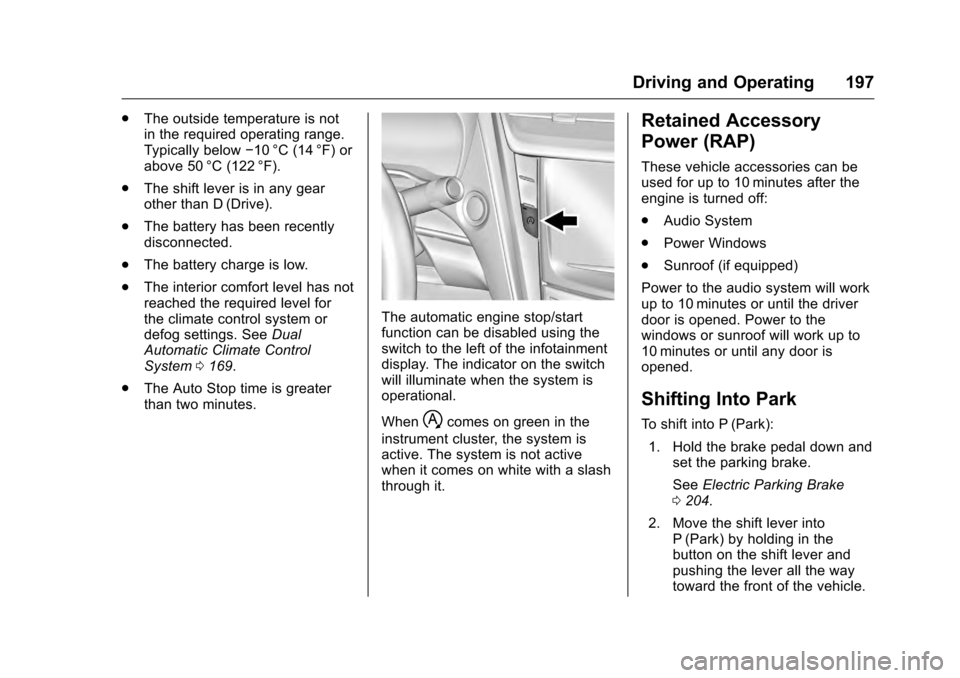
The automatic engine stop/start
function can be disabled using the
switch to the left of the infotainment
display. The indicator on the switch
will illuminate when the system is
operational.
When
hcomes on green in the
instrument cluster, the system is
active. The system is not active
when it comes on white with a slash
through it.
Retained Accessory
Power (RAP)
These vehicle accessories can be
used for up to 10 minutes after the
engine is turned off:
. Audio System
. Power Windows
. Sunroof (if equipped)
Power to the audio system will work
up to 10 minutes or until the driver
door is opened. Power to the
windows or sunroof will work up to
10 minutes or until any door is
opened.
Shifting Into Park
To shift into P (Park):
1. Hold the brake pedal down and set the parking brake.
See Electric Parking Brake
0 204.
2. Move the shift lever into P (Park) by holding in the
button on the shift lever and
pushing the lever all the way
toward the front of the vehicle.
Page 284 of 354

Cadillac CTS/CTS-V Owner Manual (GMNA-Localizing-MidEast-9369309) -
2016 - crc - 7/30/15
Vehicle Care 283
Number Usage21 Not used
*22 Driver motorized safety belt
23 Wiper control relay
24 Wiper speed relay
25 Engine control module relay
26 Not used
27 Spare/Heated seat 2
28 Spare/Reverse Lock Out
*29 AFS AHL/ pedestrian
protection
30 Not used
31 Passenger Window Switch
32 Not used
33 Sunroof
34 Front wiper
*35 Steering column lock Number Usage
36 Rear Bussed Electrical Center
37 Spare/MIL ignition
38 Spare/PT Fuse
39 O2 sensor
40 Ignition coil injector
41 Spare/Ignition coil injector
42 Engine control module
43 Not used
44 Not used
45 Washer
46 Not used
47 Front washer relay
48 IP body ignition
49 Fuel system control module ignition
50 Heated steering wheel
51 Engine control module ignition Number Usage
52 Transmission control module
ignition
*53 Coolant pump
*54 Coolant pump relay 55 Not used
56 Transmission control module/
spare
*57 Headlamp low relay 58 Headlamp high relay
59 Run/crank relay
*60 Starter 2 relay
*61 Vacuum pump relay 62 Starter relay
63 Air conditioning control relay
*64 Automatic head lamps
*65 Left high intensity discharge
Page 331 of 354
Cadillac CTS/CTS-V Owner Manual (GMNA-Localizing-MidEast-9369309) -
2016 - crc - 7/30/15
330 Service and Maintenance
.Tire wear inspection. See Tire
Inspection 0298.
. Rotate tires if necessary. See
Tire Rotation 0299.
. Fluids visual leak check (or
every 12 months, whichever
occurs first). A leak in any
system must be repaired and the
fluid level checked.
. Engine air cleaner filter
inspection. See Engine Air
Cleaner/Filter 0263.
. Brake system inspection (or
every 12 months, whichever
occurs first). See Exterior Care
0 318.
. Steering and suspension
inspection. Visual inspection for
damaged, loose, or missing
parts or signs of wear.
. Body hinges and latches, key
lock cylinders, folding seat
hardware, and sunroof (if
equipped) lubrication. See
Recommended Fluids and
Lubricants 0333. More frequent
lubrication may be required
when the vehicle is exposed to a corrosive environment. Applying
silicone grease on weatherstrips
with a clean cloth makes them
last longer, seal better, and not
stick or squeak.
. Restraint system component
check. See Safety System
Check 070.
. Fuel system inspection for
damage or leaks.
. Exhaust system and nearby heat
shields inspection for loose or
damaged components.
Additional Required Services
Every Service
.Rotate tires. Tires should be
rotated every service. See Tire
Rotation 0299.
At Each Fuel Stop
. Engine oil level check. See
Engine Oil 0259.
. Engine coolant level check. See
Engine Coolant 0266.
. Windshield washer fluid level
check. See Washer Fluid 0271. Once a Month
.
Tire inflation check. See Tire
Pressure 0292.
. Tire wear inspection. See Tire
Inspection 0298.
. Sunroof track and seal
inspection, if equipped. See
Sunroof 049.
Once a Year
. See Automatic Transmission
Shift Lock Control Function
Check 0276.
. See Park Brake and P (Park)
Mechanism Check 0276.
. Accelerator pedal check for
damage, high effort, or binding.
Replace if needed.
. Underbody flushing service. See
Exterior Care 0318.
. Hood/Decklid/Liftgate/Liftglass
Support Gas Strut Service:
Visually inspect gas strut,
if equipped, for signs of wear,
cracks, or other damage. Check
the hold open ability of the gas
strut. Contact your dealer if
service is required.
Page 352 of 354

Cadillac CTS/CTS-V Owner Manual (GMNA-Localizing-MidEast-9369309) -
2016 - crc - 7/30/15
Index 351
RestraintsWhere to Put . . . . . . . . . . . . . . . . . . . 88
Retained Accessory Power (RAP) . . . . . . . . . . . . . . . . . . 197
Reverse Tilt Mirrors . . . . . . . . . . . . . . 44
Ride Control Systems Enhanced Traction
System (ETS) . . . . . . . . . . . . . . . 214
Messages . . . . . . . . . . . . . . . . . . . . 142
Roads Driving, Wet . . . . . . . . . . . . . . . . . . 186
Roof Sunroof . . . . . . . . . . . . . . . . . . . . . . . . . 49
Rotation, Tires . . . . . . . . . . . . . . . . . . 299
Routing, Engine Drive Belt . . . . . . 341
Run-Flat Tires . . . . . . . . . . . . . . . . . . 291
Running the Vehicle While Parked . . . . . . . . . . . . . . . . . . . . . . . . 199
S
Safety Belts . . . . . . . . . . . . . . . . . . . . . 64Care . . . . . . . . . . . . . . . . . . . . . . . . . . . . 70
How to Wear Safety BeltsProperly . . . . . . . . . . . . . . . . . . . . . . . 65
Lap-Shoulder Belt . . . . . . . . . . . . . . 66
Messages . . . . . . . . . . . . . . . . . . . . 145
Reminders . . . . . . . . . . . . . . . . . . . . .118
Replacing after a Crash . . . . . . . . 70 Safety Belts (cont'd)
Use During Pregnancy . . . . . . . . . . 69
Safety Locks . . . . . . . . . . . . . . . . . . . . . 38
Safety System Check . . . . . . . . . . . . 70
Sealant Kit, Tire . . . . . . . . . . . . . . . . 306
Seats Head Restraints . . . . . . . . . . . . . . . . 52
Heated and Ventilated Front . . . . 60
Heated, Rear . . . . . . . . . . . . . . . . . . . 63
Lumbar Adjustment, Front . . . . . . 56
Memory . . . . . . . . . . . . . . . . . . . . . . . . . 58
Power Adjustment, Front . . . . . . . 54
Rear . . . . . . . . . . . . . . . . . . . . . . . . . . . . 61
Reclining Seatbacks . . . . . . . . . . . . 57
Securing Child Restraints . . . . 95, 96
Security Light . . . . . . . . . . . . . . . . . . . . . . . . . . 127
Messages . . . . . . . . . . . . . . . . . . . . 145
Vehicle . . . . . . . . . . . . . . . . . . . . . . . . . 41
Vehicle Alarm . . . . . . . . . . . . . . . . . . . 41
Service . . . . . . . . . . . . . . . . . . . . . . . . . 177 Accessories andModifications . . . . . . . . . . . . . . . . 250
Doing Your Own Work . . . . . . . . 251
Engine Soon Light . . . . . . . . . . . . 121
Maintenance Records . . . . . . . . 336
Maintenance, General Information . . . . . . . . . . . . . . . . . . 328 Service (cont'd)
Parts Identification Label . . . . . 337
Vehicle Messages . . . . . . . . . . . . 145
Service Electric Parking
Brake Light . . . . . . . . . . . . . . . . . . . . 123
Servicing the Airbag . . . . . . . . . . . . . 81
Shift Lock Control Function Check, Automatic
Transmission . . . . . . . . . . . . . . . . . . 276
Shifting Into Park . . . . . . . . . . . . . . . . . . . . . . 197
Out of Park . . . . . . . . . . . . . . . . . . . 198
Side Blind Zone Alert (SBZA) . . . 236
Signals, Turn and Lane-Change . . . . . . . . . . . . . . . . . 159
Specifications and Capacities . . . . . . . . . . . . . . . . . . . . . 338
Speedometer . . . . . . . . . . . . . . . . . . . 116
StabiliTrak
OFF Light . . . . . . . . . . . . . . . . . . . . . 125
Start Vehicle, Remote . . . . . . . . . . . 33
Starter Switch Check . . . . . . . . . . . 275
Starting the Engine . . . . . . . . . 20, 195
Starting the Vehicle Messages . . . . . . . . . . . . . . . . . . . . . 145
Steering . . . . . . . . . . . . . . . . . . . . . . . . 180 Heated Wheel . . . . . . . . . . . . . . . . 105
Wheel Adjustment . . . . . . . . . . . . 104
Page 353 of 354

Cadillac CTS/CTS-V Owner Manual (GMNA-Localizing-MidEast-9369309) -
2016 - crc - 7/30/15
352 Index
Steering (cont'd)Wheel Controls . . . . . . . . . . . . . . . 105
Storage Areas Armrest . . . . . . . . . . . . . . . . . . . . . . . 101
Center Console . . . . . . . . . . . . . . . 101
Convenience Net . . . . . . . . . . . . . 102
Glove Box . . . . . . . . . . . . . . . . . . . . 100
Instrument Panel . . . . . . . . . . . . . 100
Storage Compartments . . . . . . . . . 100
Storing the Tire Sealant and
Compressor Kit . . . . . . . . . . . . . . . 312
Stuck Vehicle . . . . . . . . . . . . . . . . . . . 189
Summer Tires . . . . . . . . . . . . . . . . . . 292
Sun Visors . . . . . . . . . . . . . . . . . . . . . . . 48
Sunroof . . . . . . . . . . . . . . . . . . . . . . . . . . 49
Sunshade Rear Window . . . . . . . . . . . . . . . . . . . 48
Symbols . . . . . . . . . . . . . . . . . . . . . . . . . . 3
System
Forward CollisionAlert (FCA) . . . . . . . . . . . . . . . . . . 232
Infotainment . . . . . . . . . . . . . 163, 343
Systems
Driver Assistance . . . . . . . . . . . . . 224T
Tachometer . . . . . . . . . . . . . . . . . . . . . 116
Theft-Deterrent Systems . . . . . . . . . 42
Thigh Support Adjustment . . . . . . . 57
Time . . . . . . . . . . . . . . . . . . . . . . . . . . . . 107
Tires . . . . . . . . . . . . . . . . . . . . . . . . . . . . 289All-Season . . . . . . . . . . . . . . . . . . . . 290
Buying New Tires . . . . . . . . . . . . . 301
Chains . . . . . . . . . . . . . . . . . . . . . . . . 304
Different Size . . . . . . . . . . . . . . . . . 302
If a Tire Goes Flat . . . . . . . . . . . . 304
Inspection . . . . . . . . . . . . . . . . . . . . 298
Low Profile . . . . . . . . . . . . . . . . . . . 292
Messages . . . . . . . . . . . . . . . . . . . . 146
Pressure . . . . . . . . . . . . . . . . . . . . . . 294
Pressure Light . . . . . . . . . . . . . . . . 126
Pressure Monitor Operation . . 295
Pressure Monitor System . . . . . 294
Rotation . . . . . . . . . . . . . . . . . . . . . . 299
Run-Flat . . . . . . . . . . . . . . . . . . . . . . 291
Sealant andCompressor Kit . . . . . . . . . . . . . 306
Sealant and Compressor Kit, Storing . . . . . . . . . . . . . . . . . . 312
Wheel Alignment and Tire Balance . . . . . . . . . . . . . . . . . . . . . 303
Wheel Replacement . . . . . . . . . . 303 Tires (cont'd)
When It Is Time for New
Tires . . . . . . . . . . . . . . . . . . . . . . . . 300
Winter . . . . . . . . . . . . . . . . . . . . . . . . 290
Towing Driving Characteristics . . . . . . . . 243
Equipment . . . . . . . . . . . . . . . 247, 248
General Information . . . . . . . . . . 243
Recreational Vehicle . . . . . . . . . . 316
Trailer . . . . . . . . . . . . . . . . . . . 246–248
Vehicle . . . . . . . . . . . . . . . . . . . . . . . 315
Track Events and Competitive Driving . . . . . . . . . . . 182
Traction
Control System (TCS)/StabiliTrak
®Light . . . . . . . . . . . . 125
Limited-Slip Differential . . . . . . . 214
Off Light . . . . . . . . . . . . . . . . . . . . . . 125
Traction Control/Electronic Stability Control . . . . . . . . . . . . . . . 206
Trailer Towing . . . . . . . . . . . . . . . . . . . 246–248
Transmission
Automatic . . . . . . . . . . . . . . . . . . . . . 200
Fluid, Automatic . . . . . . . . . . . . . . 262
Messages . . . . . . . . . . . . . . . . . . . . 146
Trip Odometer . . . . . . . . . . . . . . . . . . 116
Trunk . . . . . . . . . . . . . . . . . . . . . . . . . . . . 39