oil level CADILLAC CTS 2018 User Guide
[x] Cancel search | Manufacturer: CADILLAC, Model Year: 2018, Model line: CTS, Model: CADILLAC CTS 2018Pages: 394, PDF Size: 6.48 MB
Page 272 of 394
Cadillac CTS/CTS-V Owner Manual (GMNA-Localizing-U.S./Canada/Mexico-
11349156) - 2018 - CRC - 9/29/17
VEHICLE CARE 271
What to Use
{Warning
Do not touch heater or radiator
hoses, or other engine parts. They
can be very hot and can burn you.
Do not run the engine if there is a
leak; all coolant could leak out.
That could cause an engine fire and
can burn you. Fix any leak before
driving the vehicle.
Use a 50/50 mixture of clean
drinkable water and DEX-COOL
coolant. This mixture:
. Gives freezing protection down to
−37 °C (−34 °F), outside
temperature.
. Gives boiling protection up to
129 °C (265 °F), engine
temperature.
. Protects against rust and
corrosion.
. Will not damage aluminum parts.
. Helps keep the proper engine
temperature.
Caution
Do not use anything other than a
mix of DEX-COOL coolant that
meets GM Standard GMW3420 and
clean, drinkable water. Anything
else can cause damage to the
engine cooling system and the
vehicle, which would not be covered
by the vehicle warranty.
Never dispose of engine coolant by
putting it in the trash, pouring it on
the ground, or into sewers, streams,
or bodies of water. Have the coolant
changed by an authorized service
center, familiar with legal
requirements regarding used coolant
disposal. This will help protect the
environment and your health.
Checking Coolant
The vehicle must be on a level surface
when checking the coolant level. It is normal to see coolant moving in
the upper coolant hose return line
when the engine is running. It is also
normal to see bubbles entering the
surge tank through the small hose.
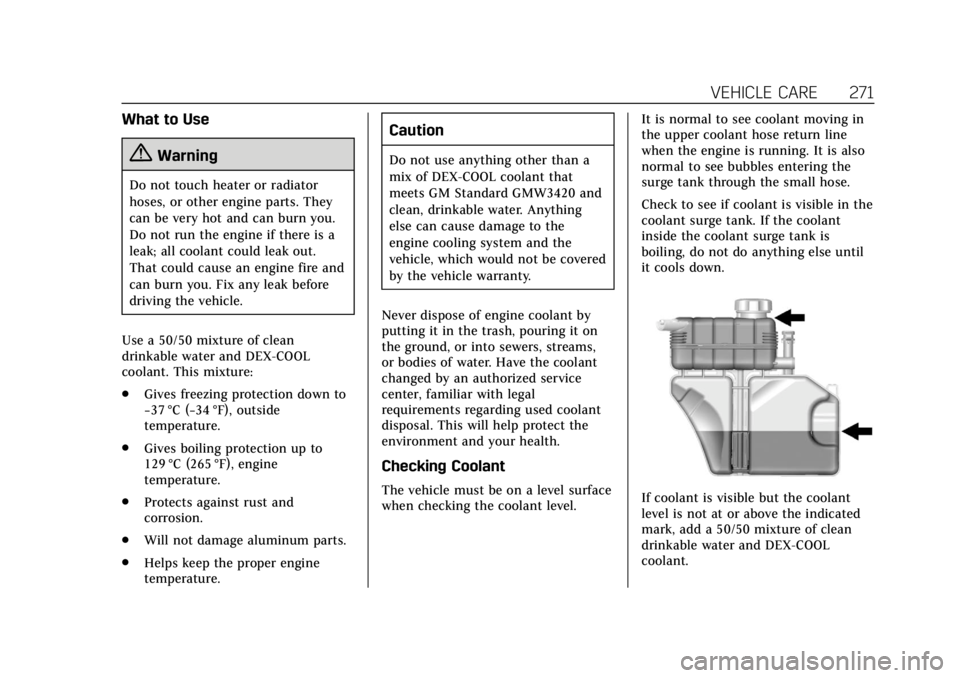
Check to see if coolant is visible in the
coolant surge tank. If the coolant
inside the coolant surge tank is
boiling, do not do anything else until
it cools down.If coolant is visible but the coolant
level is not at or above the indicated
mark, add a 50/50 mixture of clean
drinkable water and DEX-COOL
coolant.
Page 273 of 394
Cadillac CTS/CTS-V Owner Manual (GMNA-Localizing-U.S./Canada/Mexico-
11349156) - 2018 - CRC - 9/29/17
272 VEHICLE CARE
Be sure the cooling system is cool
before this is done.
It is normal for the coolant level in
the bottom chamber to rise and fall
with operating temperature and
ambient conditions. Coolant will
evaporate from the bottom chamber
in normal operation. This will happen
faster when the vehicle is driven for
long periods in hot, dry conditions.
If no coolant is visible in the coolant
surge tank, add coolant as follows:
How to Add Coolant to the
Coolant Surge Tank
{Warning
Spilling coolant on hot engine parts
can burn you. Coolant contains
ethylene glycol and it will burn if
the engine parts are hot enough.
{Warning
Plain water, or other liquids such as
alcohol, can boil before the proper
coolant mixture will. With plain
water or the wrong mixture, the
engine could get too hot but there
would not be an overheat warning.
The engine could catch fire and you
or others could be burned.
{Warning
Steam and scalding liquids from a
hot cooling system are under
pressure. Turning the pressure cap,
even a little, can cause them to
come out at high speed and you
could be burned. Never turn the cap
when the cooling system, including
the pressure cap, is hot. Wait for
the cooling system and pressure
cap to cool.
Caution
Failure to follow the specific
coolant fill procedure could cause
the engine to overheat and could
cause system damage. If coolant is
not visible in the surge tank,
contact your dealer.
If no problem is found, check to see if
coolant is visible in the coolant surge
tank. If coolant is visible but the
coolant level is not at the bottom of
the fill neck, add a 50/50 mixture of
clean, drinkable water and DEX-COOL
coolant at the coolant surge tank, but
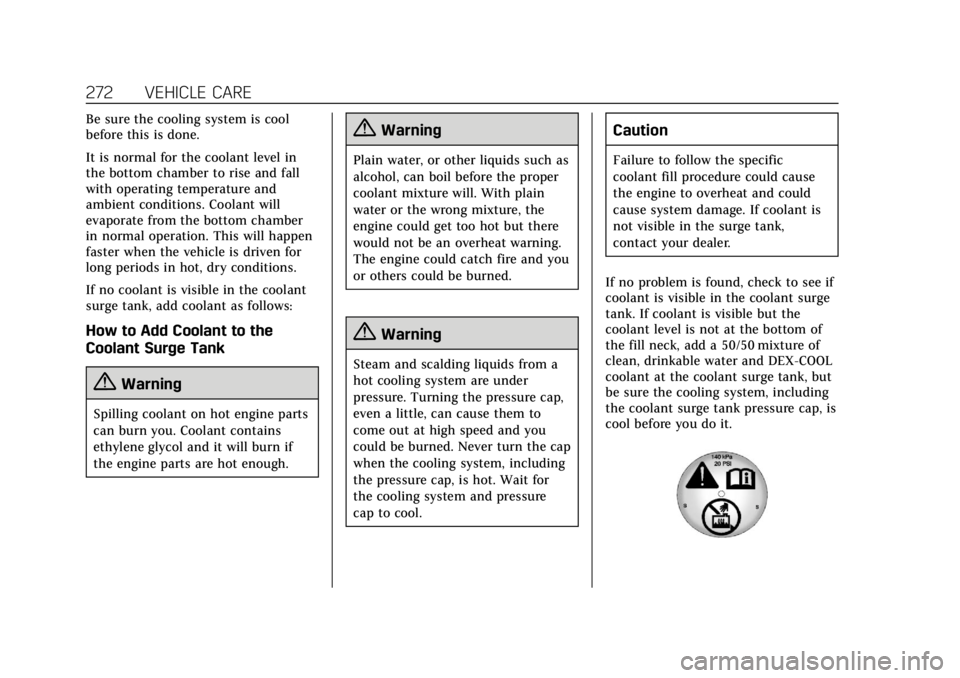
be sure the cooling system, including
the coolant surge tank pressure cap, is
cool before you do it.
Page 289 of 394
Cadillac CTS/CTS-V Owner Manual (GMNA-Localizing-U.S./Canada/Mexico-
11349156) - 2018 - CRC - 9/29/17
288 VEHICLE CARE
FusesUsage
22 Driver motorized seat belt
26 –
27 –/Heated seat 2
28 –/Reverse lock out
29 Adaptive forward lighting, Automatic
headlamp leveling/
Pedestrian protection
30 –
31 Passenger window switch
32 –
33 Sunroof
34 Front wiper
35 Steering column lock
36 Rear bussed electrical center/Ignition
37 –/Malfunction
Indicator Lamp/
Ignition
38 Aeroshutter Fuses
Usage
39 O2 sensor/Emissions
40 Ignition coil even/O2 sensor
41 Ignition coil odd
42 Engine control module
43 –
44 –
45 Washer
48 Instrument panel/ Body/Ignition
49 Fuel system control module/Ignition
50 Heated steering wheel
51 Engine control module/Ignition
52 Transmission control module/Ignition
53 Coolant pump
55 – Fuses
Usage
56 Transmission control module
64 Adaptive headlamp leveling
65 Left HID headlamp
66 Right HID headlamp
67 Left/Right high-beam headlamp
68 Headlamp leveling motor
69 Horn
71 Cooling fan
72 Starter 2
73 Brake vacuum pump
74 Starter 1
75 Air conditioning clutch
76 –
Relays Usage
8 Headlamp washer
23 Wiper control
Page 340 of 394
Cadillac CTS/CTS-V Owner Manual (GMNA-Localizing-U.S./Canada/Mexico-
11349156) - 2018 - CRC - 9/29/17
SERVICE AND MAINTENANCE 339
Cadillac Premium Care
Maintenance
This vehicle comes with Cadillac
Premium Care Maintenance. It is a
maintenance program that covers
select services, when scheduled in
accordance with the owner’s manual,
including:
.Oil changes based on the vehicle's
oil life monitor system.
. Tire rotation every 12 000 km
(7,500 mi).
. Passenger compartment air filter
replacement.
. Multi-point vehicle inspection
(MPVI) performed by a qualified
technician.
Cadillac requires that all Cadillac
Premium Care Maintenance services
be performed by a Cadillac authorized
service dealer.
Maintenance Schedule
Owner Checks and Services
At Each Fuel Stop
. Check the engine oil level. See
Engine Oil 0263.
Once a Month
. Check the tire inflation pressures.
See Tire Pressure 0301.
. Inspect the tires for wear. See Tire
Inspection 0307.
. Check the windshield washer fluid
level. See Washer Fluid 0275.
Engine Oil Change
When the CHANGE ENGINE OIL
SOON message displays, have the
engine oil and filter changed within
the next 1 000 km/600 mi. If driven
under the best conditions, the engine
oil life system may not indicate the
need for vehicle service for up to a
year. The engine oil and filter must be
changed at least once a year and the
oil life system must be reset. Your
trained dealer technician can perform
this work. If the engine oil life system is reset accidentally, service the
vehicle within 5 000 km/3,000 mi since
the last service. Reset the oil life
system when the oil is changed. See
Engine Oil Life System
0265.
Tire Rotation and Required
Services Every 12 000 km/
7,500 mi
Rotate the tires, if recommended for
the vehicle, and perform the following
services. See Tire Rotation0307.
. Check engine oil level and oil
life percentage. If needed, change
engine oil and filter, and reset oil
life system. See Engine Oil0263
and Engine Oil Life System 0265.
. Check engine coolant level. See
Cooling System 0269.
. Check windshield washer fluid
level. See Washer Fluid 0275.
. Visually inspect windshield wiper
blades for wear, cracking,
or contamination. See Exterior
Care 0329. Replace worn or
damaged wiper blades. See Wiper
Blade Replacement 0280.
Page 342 of 394
Cadillac CTS/CTS-V Owner Manual (GMNA-Localizing-U.S./Canada/Mexico-
11349156) - 2018 - CRC - 9/29/17
SERVICE AND MAINTENANCE 341
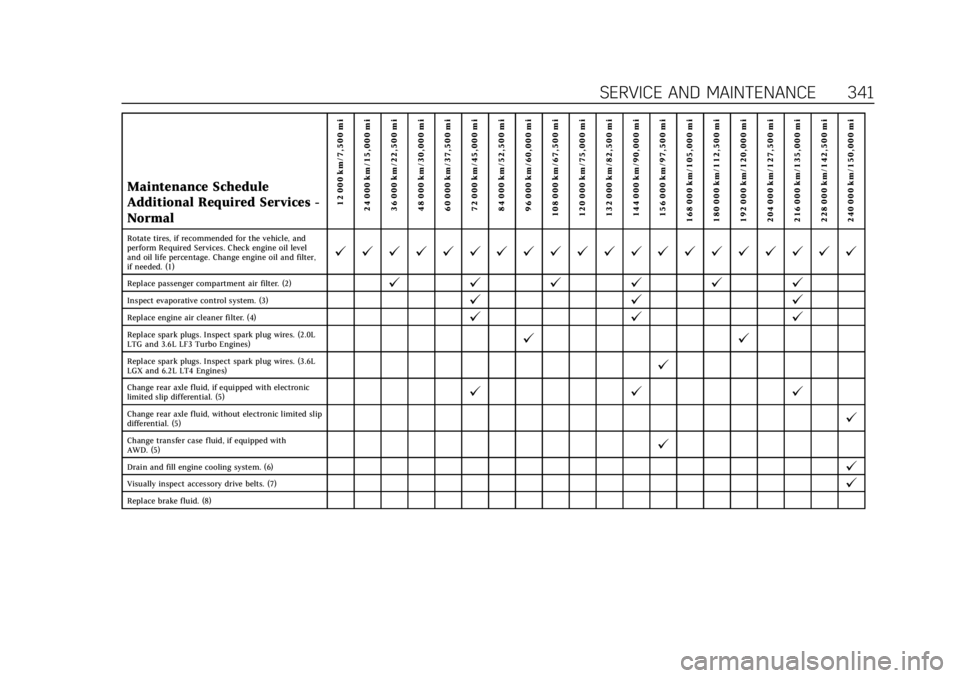
Maintenance Schedule
Additional Required Services -
Normal12 000 km/7,500 mi
24 000 km/15,000 mi
36 000 km/22,500 mi
48 000 km/30,000 mi
60 000 km/37,500 mi
72 000 km/45,000 mi
84 000 km/52,500 mi
96 000 km/60,000 mi
108 000 km/67,500 mi
120 000 km/75,000 mi
132 000 km/82,500 mi
144 000 km/90,000 mi
156 000 km/97,500 mi
168 000 km/105,000 mi
180 000 km/112,500 mi
192 000 km/120,000 mi
204 000 km/127,500 mi
216 000 km/135,000 mi
228 000 km/142,500 mi
240 000 km/150,000 mi
Rotate tires, if recommended for the vehicle, and
perform Required Services. Check engine oil level
and oil life percentage. Change engine oil and filter,
if needed. (1)@ @ @ @ @ @ @ @ @ @ @ @ @ @ @ @ @ @ @ @
Replace passenger compartment air filter. (2)@ @@@@@
Inspect evaporative control system. (3)@ @@
Replace engine air cleaner filter. (4)@@@
Replace spark plugs. Inspect spark plug wires. (2.0L
LTG and 3.6L LF3 Turbo Engines)@ @
Replace spark plugs. Inspect spark plug wires. (3.6L
LGX and 6.2L LT4 Engines)@
Change rear axle fluid, if equipped with electronic
limited slip differential. (5)@@@
Change rear axle fluid, without electronic limited slip
differential. (5)@
Change transfer case fluid, if equipped with
AWD. (5)@
Drain and fill engine cooling system. (6)@
Visually inspect accessory drive belts. (7)@
Replace brake fluid. (8)
Page 343 of 394
Cadillac CTS/CTS-V Owner Manual (GMNA-Localizing-U.S./Canada/Mexico-
11349156) - 2018 - CRC - 9/29/17
342 SERVICE AND MAINTENANCE
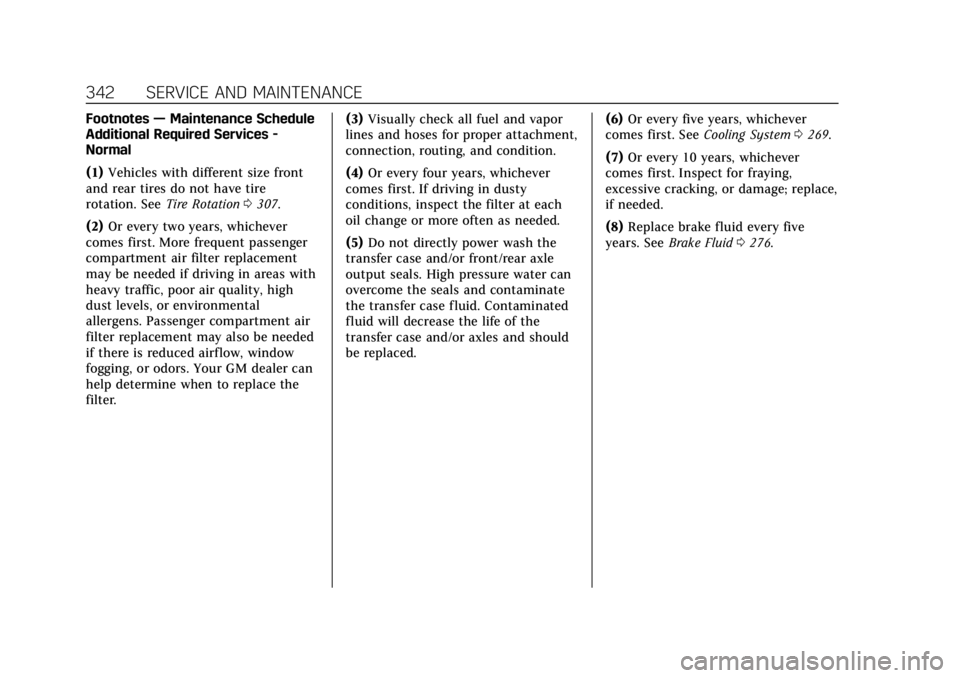
Footnotes—Maintenance Schedule
Additional Required Services -
Normal
(1) Vehicles with different size front
and rear tires do not have tire
rotation. See Tire Rotation0307.
(2) Or every two years, whichever
comes first. More frequent passenger
compartment air filter replacement
may be needed if driving in areas with
heavy traffic, poor air quality, high
dust levels, or environmental
allergens. Passenger compartment air
filter replacement may also be needed
if there is reduced airf low, window
fogging, or odors. Your GM dealer can
help determine when to replace the
filter. (3)
Visually check all fuel and vapor
lines and hoses for proper attachment,
connection, routing, and condition.
(4) Or every four years, whichever
comes first. If driving in dusty
conditions, inspect the filter at each
oil change or more often as needed.
(5) Do not directly power wash the
transfer case and/or front/rear axle
output seals. High pressure water can
overcome the seals and contaminate
the transfer case fluid. Contaminated
fluid will decrease the life of the
transfer case and/or axles and should
be replaced. (6)
Or every five years, whichever
comes first. See Cooling System0269.
(7) Or every 10 years, whichever
comes first. Inspect for fraying,
excessive cracking, or damage; replace,
if needed.
(8) Replace brake fluid every five
years. See Brake Fluid 0276.
Page 344 of 394
Cadillac CTS/CTS-V Owner Manual (GMNA-Localizing-U.S./Canada/Mexico-
11349156) - 2018 - CRC - 9/29/17
SERVICE AND MAINTENANCE 343
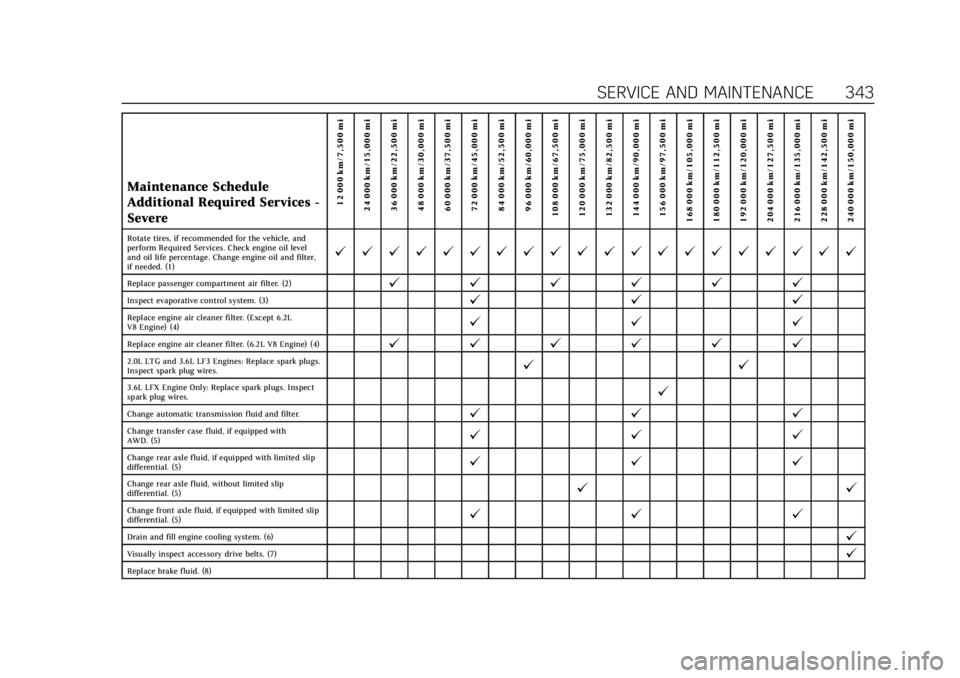
Maintenance Schedule
Additional Required Services -
Severe12 000 km/7,500 mi
24 000 km/15,000 mi
36 000 km/22,500 mi
48 000 km/30,000 mi
60 000 km/37,500 mi
72 000 km/45,000 mi
84 000 km/52,500 mi
96 000 km/60,000 mi
108 000 km/67,500 mi
120 000 km/75,000 mi
132 000 km/82,500 mi
144 000 km/90,000 mi
156 000 km/97,500 mi
168 000 km/105,000 mi
180 000 km/112,500 mi
192 000 km/120,000 mi
204 000 km/127,500 mi
216 000 km/135,000 mi
228 000 km/142,500 mi
240 000 km/150,000 mi
Rotate tires, if recommended for the vehicle, and
perform Required Services. Check engine oil level
and oil life percentage. Change engine oil and filter,
if needed. (1)@ @ @ @ @ @ @ @ @ @ @ @ @ @ @ @ @ @ @ @
Replace passenger compartment air filter. (2)@ @@@@@
Inspect evaporative control system. (3)@ @@
Replace engine air cleaner filter. (Except 6.2L
V8 Engine) (4)@@@
Replace engine air cleaner filter. (6.2L V8 Engine) (4)@@@@@@
2.0L LTG and 3.6L LF3 Engines: Replace spark plugs.
Inspect spark plug wires.@ @
3.6L LFX Engine Only: Replace spark plugs. Inspect
spark plug wires.@
Change automatic transmission fluid and filter.@@@
Change transfer case fluid, if equipped with
AWD. (5)@@@
Change rear axle fluid, if equipped with limited slip
differential. (5)@@@
Change rear axle fluid, without limited slip
differential. (5)@ @
Change front axle fluid, if equipped with limited slip
differential. (5)@@@
Drain and fill engine cooling system. (6)@
Visually inspect accessory drive belts. (7)@
Replace brake fluid. (8)
Page 345 of 394
Cadillac CTS/CTS-V Owner Manual (GMNA-Localizing-U.S./Canada/Mexico-
11349156) - 2018 - CRC - 9/29/17
344 SERVICE AND MAINTENANCE
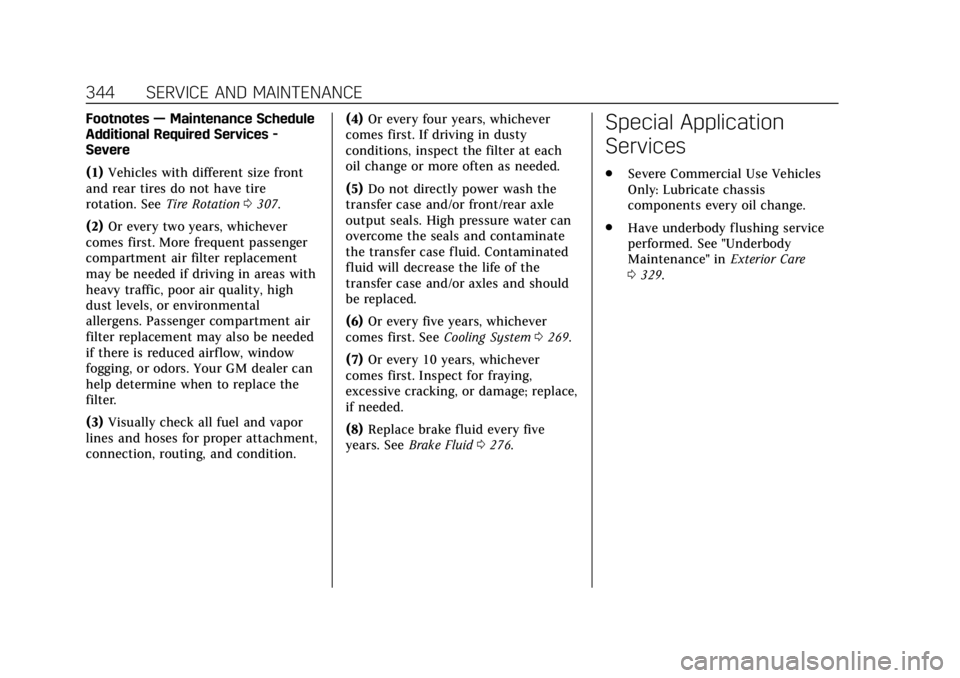
Footnotes—Maintenance Schedule
Additional Required Services -
Severe
(1) Vehicles with different size front
and rear tires do not have tire
rotation. See Tire Rotation0307.
(2) Or every two years, whichever
comes first. More frequent passenger
compartment air filter replacement
may be needed if driving in areas with
heavy traffic, poor air quality, high
dust levels, or environmental
allergens. Passenger compartment air
filter replacement may also be needed
if there is reduced airf low, window
fogging, or odors. Your GM dealer can
help determine when to replace the
filter.
(3) Visually check all fuel and vapor
lines and hoses for proper attachment,
connection, routing, and condition. (4)
Or every four years, whichever
comes first. If driving in dusty
conditions, inspect the filter at each
oil change or more often as needed.
(5) Do not directly power wash the
transfer case and/or front/rear axle
output seals. High pressure water can
overcome the seals and contaminate
the transfer case fluid. Contaminated
fluid will decrease the life of the
transfer case and/or axles and should
be replaced.
(6) Or every five years, whichever
comes first. See Cooling System0269.
(7) Or every 10 years, whichever
comes first. Inspect for fraying,
excessive cracking, or damage; replace,
if needed.
(8) Replace brake fluid every five
years. See Brake Fluid 0276.Special Application
Services
.
Severe Commercial Use Vehicles
Only: Lubricate chassis
components every oil change.
. Have underbody flushing service
performed. See "Underbody
Maintenance" in Exterior Care
0 329.
Page 346 of 394

Cadillac CTS/CTS-V Owner Manual (GMNA-Localizing-U.S./Canada/Mexico-
11349156) - 2018 - CRC - 9/29/17
SERVICE AND MAINTENANCE 345
Additional Maintenance
and Care
Your vehicle is an important
investment and caring for it properly
may help to avoid future costly
repairs. To maintain vehicle
performance, additional maintenance
services may be required.
It is recommended that your dealer
perform these services—their trained
dealer technicians know your vehicle
best. Your dealer can also perform a
thorough assessment with a
multi-point inspection to recommend
when your vehicle may need
attention.
The following list is intended to
explain the services and conditions to
look for that may indicate services are
required. Battery
The 12-volt battery supplies power to
start the engine and operate any
additional electrical accessories.
.
To avoid break-down or failure to
start the vehicle, maintain a
battery with full cranking power.
. Trained dealer technicians have
the diagnostic equipment to test
the battery and ensure that the
connections and cables are
corrosion-free.
Belts
. Belts may need replacing if they
squeak or show signs of cracking
or splitting.
. Trained dealer technicians have
access to tools and equipment to
inspect the belts and recommend
adjustment or replacement when
necessary. Brakes
Brakes stop the vehicle and are crucial
to safe driving.
.
Signs of brake wear may include
chirping, grinding, or squealing
noises, or difficulty stopping.
. Trained dealer technicians have
access to tools and equipment to
inspect the brakes and recommend
quality parts engineered for the
vehicle.
Fluids
Proper fluid levels and approved fluids
protect the vehicle’s systems and
components. See Recommended Fluids
and Lubricants 0348 for GM approved
fluids.
. Engine oil and windshield washer
fluid levels should be checked at
every fuel fill.
. Instrument cluster lights may
come on to indicate that fluids
may be low and need to be filled.
Page 355 of 394

Cadillac CTS/CTS-V Owner Manual (GMNA-Localizing-U.S./Canada/Mexico-
11349156) - 2018 - CRC - 9/29/17
354 TECHNICAL DATA
ApplicationCapacities
Metric English
Engine Oil with Filter
2.0L L4 Engine RWD 4.7 L 5.0 qt
2.0L L4 Engine AWD 5.7 L 6.0 qt
3.6L V6 Engine (LGX) RWD (without oil cooler) 5.2 L 5.5 qt
3.6L V6 Engine (LGX) RWD (with oil cooler) 5.7 L 6.0 qt
3.6L V6 Engine (LGX) AWD 6.15 L 6.5 qt
3.6L V6 Engine (LF3) 6.6 L 7.0 qt
6.2L V8 Engine (V-Series) 9.5 L 10.0 qt
Fuel Tank 72 L 19 gal
Transfer Case –AWD 0.8 L 0.8 qt
Rear Axle (with limited slip) 1.2 L 1.3 qt
Wheel Nut Torque 190 Y140 lb ft
All capacities are approximate. When adding, be sure to fill to the approximate level, as recommended in this manual.
Recheck fluid level after filling.