cooling CADILLAC CTS V 2005 1.G User Guide
[x] Cancel search | Manufacturer: CADILLAC, Model Year: 2005, Model line: CTS V, Model: CADILLAC CTS V 2005 1.GPages: 432, PDF Size: 2.52 MB
Page 306 of 432
A 50/50 mixture of clean, drinkable water and
DEX-COOL®coolant will:
Give freezing protection down to−34°F (−37°C).
Give boiling protection up to 265°F (129°C).
Protect against rust and corrosion.
Help keep the proper engine temperature.
Let the warning lights and gages work as
they should.
Notice:Using coolant other than DEX-COOL
®may
cause premature engine, heater core or radiator
corrosion. In addition, the engine coolant may
require changing sooner, at 30,000 miles (50 000 km)
or 24 months, whichever occurs rst. Any repairs
would not be covered by your warranty. Always use
DEX-COOL
®(silicate-free) coolant in your vehicle.
What to Use
Use a mixture of one-half clean, drinkable water and
one-half DEX-COOL®coolant which will not damage
aluminum parts. If you use this coolant mixture, you
do not need to add anything else.
{CAUTION:
Adding only plain water to your cooling
system can be dangerous. Plain water, or
some other liquid such as alcohol, can boil
before the proper coolant mixture will. Your
vehicle’s coolant warning system is set for the
proper coolant mixture. With plain water or the
wrong mixture, your engine could get too hot
but you would not get the overheat warning.
Your engine could catch re and you or others
could be burned. Use a 50/50 mixture of clean,
drinkable water and DEX-COOL
®coolant.
Notice:If you use an improper coolant mixture, your
engine could overheat and be badly damaged. The
repair cost would not be covered by your warranty.
Too much water in the mixture can freeze and crack
the engine, radiator, heater core and other parts.
If you have to add coolant more than once or twice a
year, have your dealer check your cooling system.
Notice:If you use the proper coolant, you do not
have to add extra inhibitors or additives which claim
to improve the system. These can be harmful.
5-26
Page 311 of 432

Cooling System
When you decide it is safe to lift the hood, here is what
you will see:
A. Coolant Surge Tank and Pressure Cap
B. Electric Engine Cooling Fans{CAUTION:
An electric engine cooling fan under the hood
can start up even when the engine is not
running and can injure you. Keep hands,
clothing and tools away from any underhood
electric fan.
If the coolant inside the coolant surge tank is boiling,
do not do anything else until it cools down. The vehicle
should be parked on a level surface.
3.6L V6 engine shown, 2.8L V6 and 5.7L V8
engines similar
5-31
Page 312 of 432

If the engine is warm or hot, the coolant level should be
at or above the FULL COLD/FROID line on the side
of the coolant surge tank. If the engine is cold, the
coolant level should be near the FULL COLD/FROID
line on the side of the coolant surge tank. If it is not, you
may have a leak at the pressure cap or in the radiator
hoses, heater hoses, radiator, water pump or
somewhere else in the cooling system.
{CAUTION:
Heater and radiator hoses, and other engine
parts, can be very hot. Do not touch them.
If you do, you can be burned.
Do not run the engine if there is a leak. If you
run the engine, it could lose all coolant. That
could cause an engine re, and you could be
burned. Get any leak xed before you drive
the vehicle.If there seems to be no leak, with the engine on, check
to see if the electric engine cooling fans are running.
If the engine is overheating, both fans should be
running. If they are not, your vehicle needs service.
Notice:Engine damage from running your engine
without coolant is not covered by your warranty. See
Overheated Engine Protection Operating Mode on
page 5-30for information on driving to a safe place
in an emergency.
Notice:Using coolant other than DEX-COOL
®may
cause premature engine, heater core or radiator
corrosion. In addition, the engine coolant may
require changing sooner, at 30,000 miles (50 000 km)
or 24 months, whichever occurs rst. Any repairs
would not be covered by your warranty. Always use
DEX-COOL
®(silicate-free) coolant in your vehicle.
5-32
Page 313 of 432
How to Add Coolant to the Coolant
Surge Tank
If you have not found a problem yet, check to see if
coolant is visible in the surge tank. If coolant is visible
but the coolant level is not at the FULL COLD/FROID
line on the side of the coolant surge tank, add a
50/50 mixture ofclean, drinkable waterand DEX-COOL
®
coolant at the coolant surge tank, but be sure the
cooling system, including the coolant surge tank
pressure cap, is cool before you do it. SeeEngine
Coolant on page 5-25for more information.
{CAUTION:
Steam and scalding liquids from a hot cooling
system can blow out and burn you badly. They
are under pressure, and if you turn the coolant
surge tank pressure cap — even a little — they
can come out at high speed. Never turn the
cap when the cooling system, including the
coolant surge tank pressure cap, is hot. Wait
for the cooling system and coolant surge tank
pressure cap to cool if you ever have to turn
the pressure cap.
{CAUTION:
Adding only plain water to your cooling
system can be dangerous. Plain water, or
some other liquid such as alcohol, can boil
before the proper coolant mixture will. Your
vehicle’s coolant warning system is set for the
proper coolant mixture. With plain water or the
wrong mixture, your engine could get too hot
but you would not get the overheat warning.
Your engine could catch re and you or others
could be burned. Use a 50/50 mixture of clean,
drinkable water and DEX-COOL
®coolant.
Notice:In cold weather, water can freeze and crack
the engine, radiator, heater core and other parts.
Use the recommended coolant and the proper
coolant mixture.
5-33
Page 314 of 432

{CAUTION:
You can be burned if you spill coolant on hot
engine parts. Coolant contains ethylene glycol
and it will burn if the engine parts are hot
enough. Do not spill coolant on a hot engine.
If no coolant is visible in the surge tank, add coolant as
follows:
1. You can remove the coolant surge tank pressure
cap when the cooling system, including the
coolant surge tank pressure cap and upper radiator
hose, is no longer hot. Turn the pressure cap
slowly counterclockwise (left) about one-quarter
turn and then stop.
If you hear a hiss, wait for that to stop. A hiss
means there is still some pressure left.2. Then keep turning the pressure cap slowly, and
remove it.
5-34
Page 315 of 432

3. Fill the coolant surge tank with the proper mixture,
to slightly above the FULL COLD/FROID line on the
side of the coolant surge tank.4. With the coolant surge tank pressure cap off, start
the engine and let it run until you can feel the
upper radiator hose getting hot. The upper radiator
hose is the top hose coming out of the radiator,
on the passenger’s side of the vehicle. Watch out
for the engine cooling fans.
By this time, the coolant level inside the coolant
surge tank may be lower. If the level is lower, add
more of the proper mixture to the coolant surge tank
until the level reaches the FULL COLD/FROID
line on the side of the coolant surge tank.
5. Then replace the pressure cap. Be sure the
pressure cap is hand-tight and fully seated.
Start the engine and allow it to warm up. If the
Check Coolant Level message does not appear on
the Driver Information Center (DIC), the coolant is at
the proper ll level. If a Check Coolant Level message
does appear, repeat Steps 1 to 3 then reinstall the
pressure cap, or see your dealer.
5-35
Page 353 of 432

{CAUTION:
Using the wrong replacement wheels, wheel
bolts or wheel nuts on your vehicle can be
dangerous. It could affect the braking and
handling of your vehicle, make your tires lose
air and make you lose control. You could have
a collision in which you or others could be
injured. Always use the correct wheel, wheel
bolts and wheel nuts for replacement.
Notice:The wrong wheel can also cause problems
with bearing life, brake cooling, speedometer or
odometer calibration, headlamp aim, bumper height,
vehicle ground clearance and tire or tire chain
clearance to the body and chassis.
SeeChanging a Flat Tire (CTS) on page 5-76for more
information.
Used Replacement Wheels
{CAUTION:
Putting a used wheel on your vehicle is
dangerous. You can’t know how it’s been
used or how far it’s been driven. It could fail
suddenly and cause a crash. If you have to
replace a wheel, use a new GM original
equipment wheel.
5-73
Page 378 of 432

Relays Usage
MAIN RELAY
MICROPowertrain/ECM
STARTER
RELAY MINIStarter Solenoid
CMP CLU
RELAY MICROCompressor Clutch
IGN-1 RELAY
MICROIgnition Switch (ON)
Wiring
HarnessesUsage
BODY W/H Wiring Harness Connection
I/P W/H Wiring Harness Connection
ENG W/H Engine Wiring Harness Connection
FORWARD
LAMPForward Lamp Wiring Harness
Connection
J Cases Usage
R REARRRPDB (Passenger’s Side Rear
Power Distribution Box)
R REARRRPDB (Passenger’s Side Rear
Power Distribution Box)
L REARLRPDB (Driver’s Side Rear Power
Distribution Box)
L REARLRPDB (Driver’s Side Rear Power
Distribution Box)
HI FAN High Cooling Fan Motor
LO FAN Low Cooling Fan Motor
BLOWER PWM Fan Motor Assembly
STARTER Starter Solenoid
ABS Anti-Lock Brake System
5-98
Page 380 of 432

Fuses Usage
SPARE Not Used
IGN MOD/MAF Front Bank Ignition Modules
ELEC PRNDL Electronic PRNDL
SPARE Not Used
SPARE Not Used
IGN SWIgnition Switch (Power to IGN-3
and CRANK)
VOLT CHECK DIM (Dash Integration Module)
ECM/TCMTCM (Transmission Control Module),
ECM (Electronic Control Module),
IPC (Instrument Panel Cluster),
PASS-Key
®III+ Module
WPR MOD Windshield Wiper Module Assembly
ODD INJ/
COILSOdd Ignition Coils, Fuel Injectors,
Odd Injection Coils
COMP CLUTCH Compressor Clutch
WPR SW Windshield Wiper/Washer Switch
Fuses Usage
FOG LAMP Fog Lamps
OUTLETCenter Console Accessory
Power Outlet
POST 02Driver’s and Passenger’s Side
Oxygen Sensors, LRPDB
(Pusher Cooling Fan Relay)
I/P OUTLETInstrument Panel Accessory
Power Outlet
CCP Climate Control
EVEN INJ/
COILSEven Injection Coils
SPARE Not Used
SPARE Not Used
SPARE Not Used
Circuit
BreakersUsage
HDLP WASH
C/B-OPTHeadlamp Washer Motor
5-100
Page 387 of 432
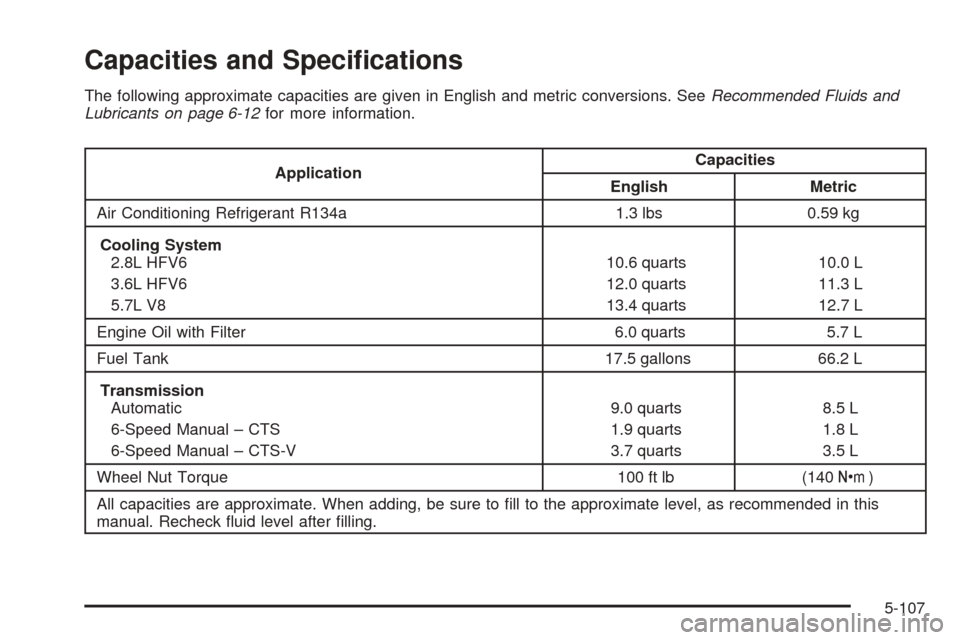
Capacities and Specications
The following approximate capacities are given in English and metric conversions. SeeRecommended Fluids and
Lubricants on page 6-12for more information.
ApplicationCapacities
English Metric
Air Conditioning Refrigerant R134a 1.3 lbs 0.59 kg
Cooling System
2.8L HFV6
3.6L HFV6
5.7L V810.6 quarts
12.0 quarts
13.4 quarts10.0 L
11.3 L
12.7 L
Engine Oil with Filter 6.0 quarts 5.7 L
Fuel Tank 17.5 gallons 66.2 L
Transmission
Automatic
6-Speed Manual – CTS
6-Speed Manual – CTS-V9.0 quarts
1.9 quarts
3.7 quarts8.5 L
1.8 L
3.5 L
Wheel Nut Torque 100 ft lb (140Y)
All capacities are approximate. When adding, be sure to ll to the approximate level, as recommended in this
manual. Recheck uid level after lling.
5-107