lights CADILLAC DEVILLE 1993 7.G User Guide
[x] Cancel search | Manufacturer: CADILLAC, Model Year: 1993, Model line: DEVILLE, Model: CADILLAC DEVILLE 1993 7.GPages: 406, PDF Size: 20.78 MB
Page 119 of 406
Downloaded from www.Manualslib.com manuals search engine To operate it, leave the light switch off and move the Twilight Sentinel
control
to any position but “OFE”
If you move the control all the way to MAX, your lights will remain on for
three minutes after you turn off your engine. If you move the control
almost all the way in the other direction,
so it’s just on, the lights will go
off quickly when you turn
off your engine.
You can change this delay time from only a
few seconds to three minutes. -
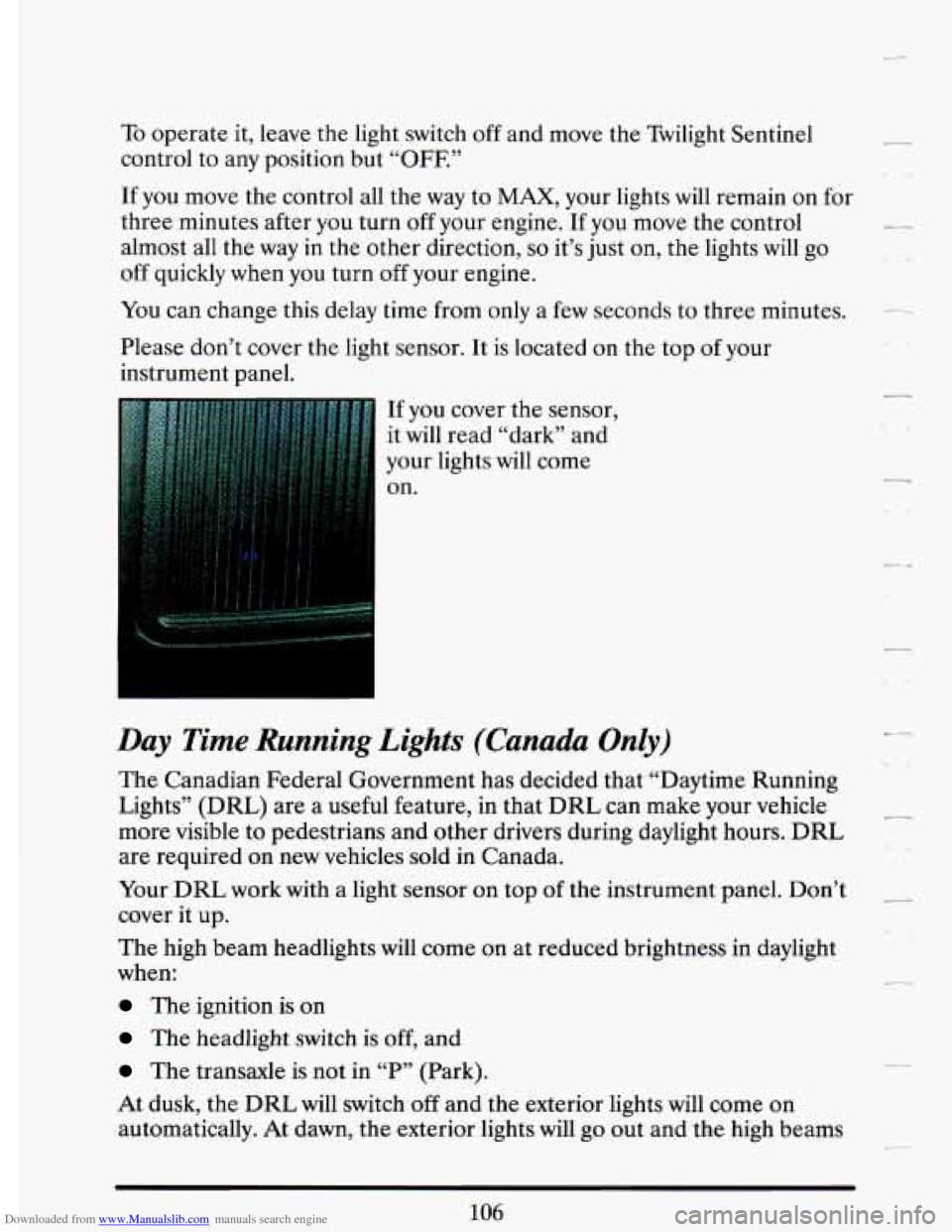
Please don’t cover the light sensor. It is located on the top of your
instrument panel.
If you cover the sensor,
it will read “dark” and
your lights will come
on.
‘I. i
Day Time Running Lights (Canada Only)
The Canadian Federal Government has decided that “Daytime Running
Lights” (DRL) are a useful feature, in that DRL can make your vehicle
more visible to pedestrians and other drivers during daylight hours. DRL
are required on new vehicles sold in Canada.
Your
DRL work with a light sensor on top of the instrument panel. Don’t -
cover it up.
The high beam headlights will come on at reduced brightness in daylight
when:
The ignition is on
The headlight switch is off, and
The transaxle is not in “P” (Park).
At dusk, the
DRL will switch off and the exterior lights will come on
automatically. At dawn, the exterior lights will
go out and the high beams
-
__ ~-
Page 120 of 406
Downloaded from www.Manualslib.com manuals search engine - will change to the reduced brightness of DRL (if the headlight switch is
off).
Of course, you may still turn on the headlights any time you need to.
To idle your vehicle with the DRL off, shift the transaxle into “P” (Park).
The
DRL will stay off until you shift out of “P” (Park).
---
- -- Rear Fog Lights (Export Only)
-- I
-- L
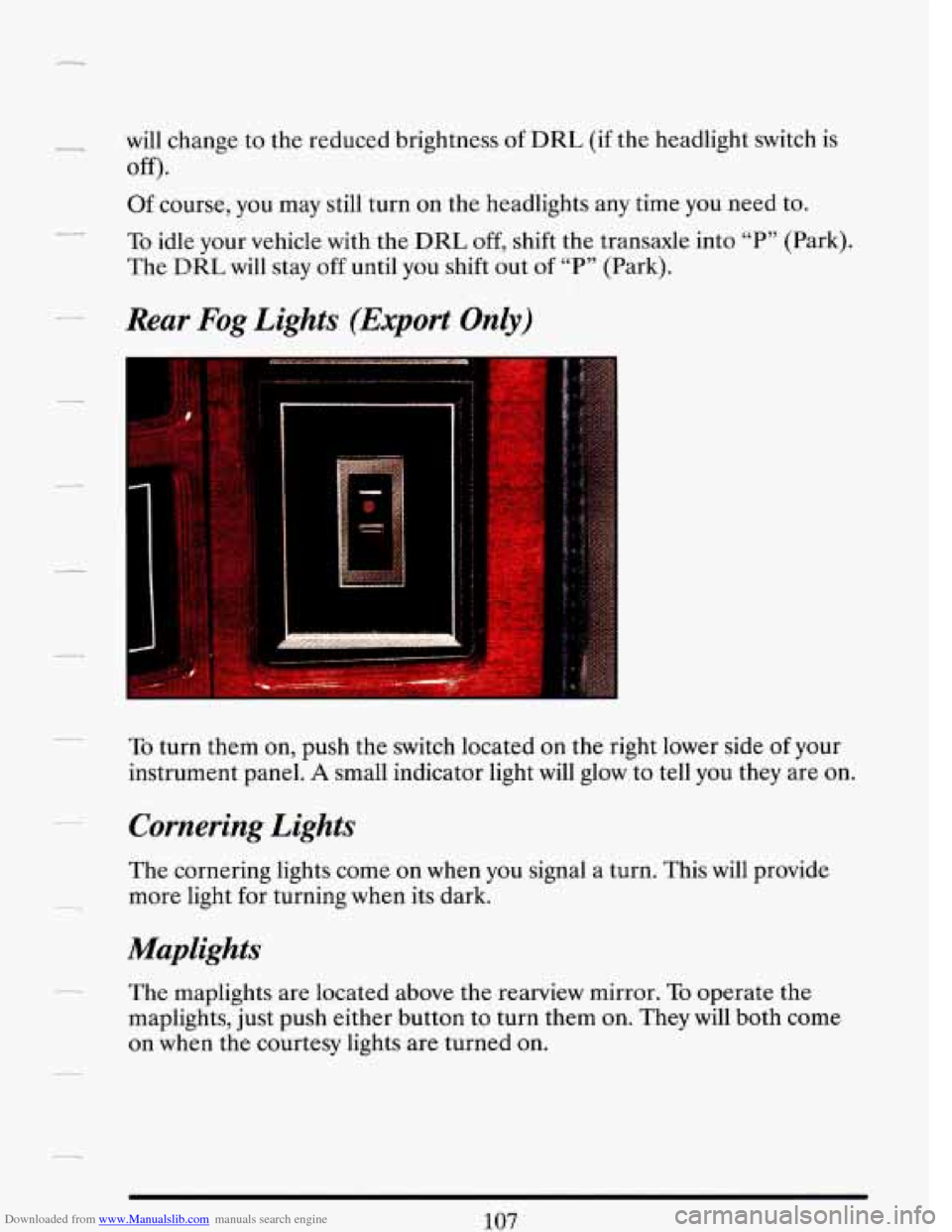
c_ To turn them on, push the switch located on the right lower side of your
instrument panel.
A small indicator light will glow to tell you they are on.
- ~. Cornering Lights
The cornering lights come on when you signal a turn. This will provide
more light for turning when its dark.
Maplights
--- The maplights are located above the rearview mirror. To operate the
maplights, just push either button to turn them on. They will both come
on when the courtesy lights are turned
on.
Page 121 of 406
Downloaded from www.Manualslib.com manuals search engine Lump Monitors
5- %
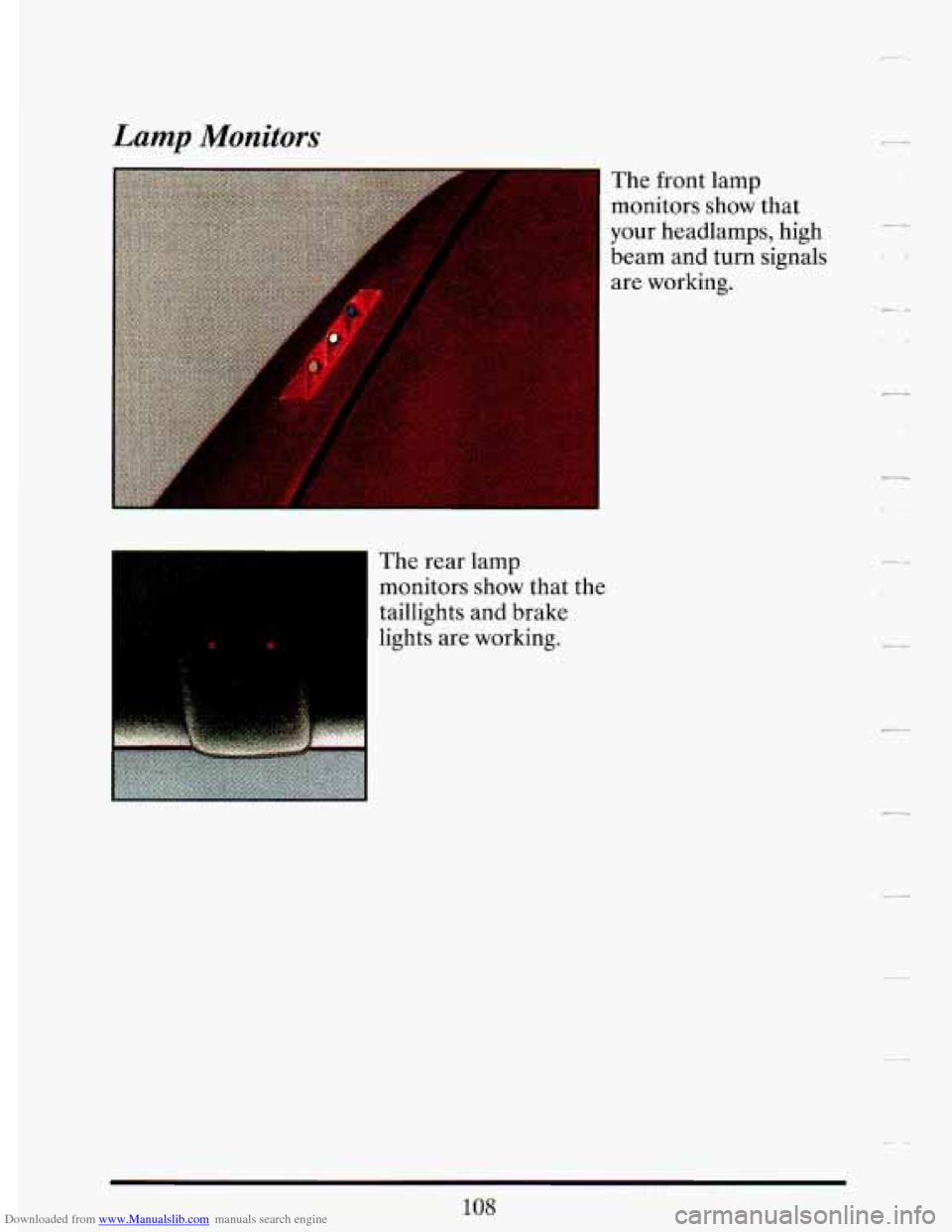
The front lamp
monitors show that
your headlamps, high
beam and turn signals
are working.
The rear lamp
monitors show that the
taillights and brake
lights
are working.
108
Page 122 of 406
Downloaded from www.Manualslib.com manuals search engine 7 MIRRORS
Automatic DaylNight Inside Rearview Mirror
7
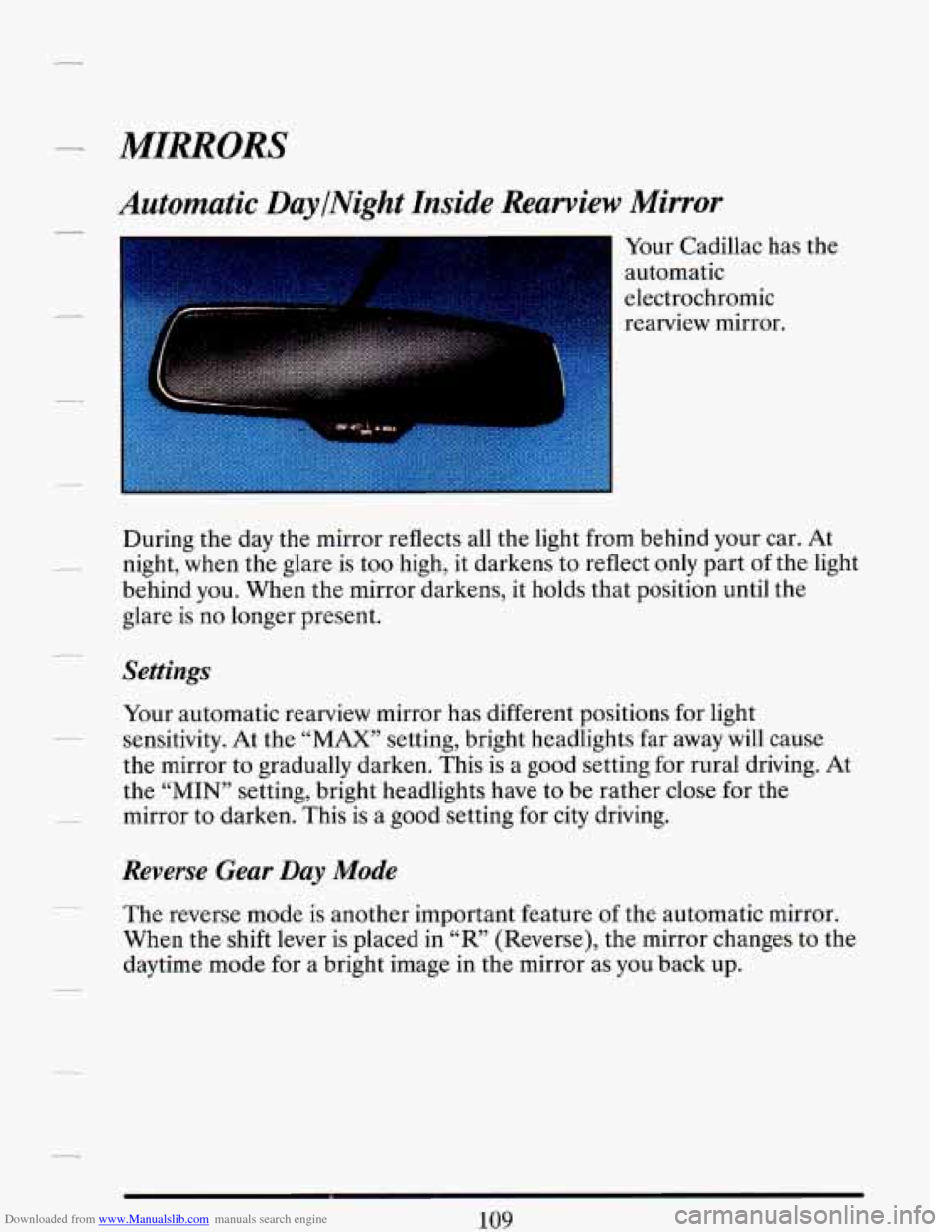
- Your Cadillac has the
automatic
electrochromic
rearview mirror.
During the day the mirror reflects all the light from behind your car. At
-. night, when the glare is too high, it darkens to reflect only part of the light
behind you. When the mirror darkens, it holds that position until the
glare is no longer present.
--
Settings
Your automatic rearview mirror has different positions for light
the mirror to gradually darken. This is a good setting for rural driving. At
the
“MIN” setting, bright headlights have to be rather close for the
__ sensitivity. At the “MAX” setting, bright headlights far away will cause
-. mirror to darken. This is a good setting for city driving.
Reverse Gear Day Mode
The reverse mode is another important feature of the automatic mirror.
When the shift lever is placed in
“R’ (Reverse), the mirror changes to the
daytime mode for a bright image in the mirror as you back up.
109
Page 133 of 406

Downloaded from www.Manualslib.com manuals search engine Odometer
Your Cadillac has a “tamper-resistant odometer.” On the analog
odometer, if
you see silver lines between the numbers, probably someone
has tried to turn it back.
The numbers may not be true. If you have the
optional digital odometer, it will say
ERROR if someone has tampered
with it.
You may wonder what happens
if a car has to have a new odometer
installed. If possible, the new one
has to be set to the same reading the
old one had.
If it can’t be, then it’s set at zero, but a label on the driver’s
door must show the old reading and when the new one was installed.
WMING LIGHTS
This section describes the warning lights that are on your vehicle. The
pictures will help you locate them.
Warning lights can signal that something is wrong before it becomes
serious enough to cause an expensive repair or replacement. Paying
attention to your warning lights could also save you or others from injury.
Warning lights go on when there may be or is a problem with one
of your
vehicle’s functions.
As you will see in the details on the next few pages,
some warning lights come
on briefly when you turn the ignition key just to
let you know they’re working.
If you are familiar with this section, you
should not be alarmed when this happens.
c.
Page 134 of 406

Downloaded from www.Manualslib.com manuals search engine When one of the warning lights comes on and stays on when you are
driving, check the section that tells you what to do about it. Pkase
follow
the manual’s advice. Waiting to do repairs can be costly -- and even
dangerous.
So please get to know your warning lights. They’re a big help.
Brake System Warning Light
Your Cadillac’s hydraulic brake system is divided into two parts. If one
part isn’t working, the other part can still work and stop you. For good
braking, though,
you need both parts working well.
If the warning light goes on, there could be a brake problem. Have your
brake system inspected right away.
This light shoula
come
on and turn off as you
start the vehicle. If it
doesn’t come on then,
have it fixed
so it will
be ready to warn you
if
there’s a problem.
This light will also come on when you set your parking brake, and will
- stay on if your parking brake doesn’t release fully. If it stays on after your
parking brake is fully released, it means you have a brake problem. If the
light comes on while driving, pull
off the road and stop carefully. You may
-_ notice that the pedal is harder to push. Or, the pedal may go closer to the
floor. It may take longer to stop.
If the light is still on, have the vehicle
towed for service.
(See “Towing Your Vehicle” in the Index.)
121
Page 139 of 406

Downloaded from www.Manualslib.com manuals search engine HOT COOLANT CAN BURN YOU BADLY!
In “Problems on the Road,” this manual shows what to do. See “Engine
Overheating” in the Index.
L
P
I
Charge Light
When you turn the key
to “Run,” this light will
come on briefly, to
show that your
alternator and battery
charging systems are
working.
If a light stays on, you need service, and you should take your Cadillac to
the dealer at once.
To save your battery until you get there, turn off all
accessories, and set your Electronic Climate Control system to “OFF.”
Service Engine SoonlService Vehicle Soon Lights
KGf NE
I I,
ZVICE
VEHICLE
So(
A computer monitors operation of your fuel, ignition and emission
control systems. This light should come on when the ignition is on, but
the engine
is not running, as a check to show you it is working..
Page 186 of 406
Downloaded from www.Manualslib.com manuals search engine TRAFFIC LIGHTS
m
-1
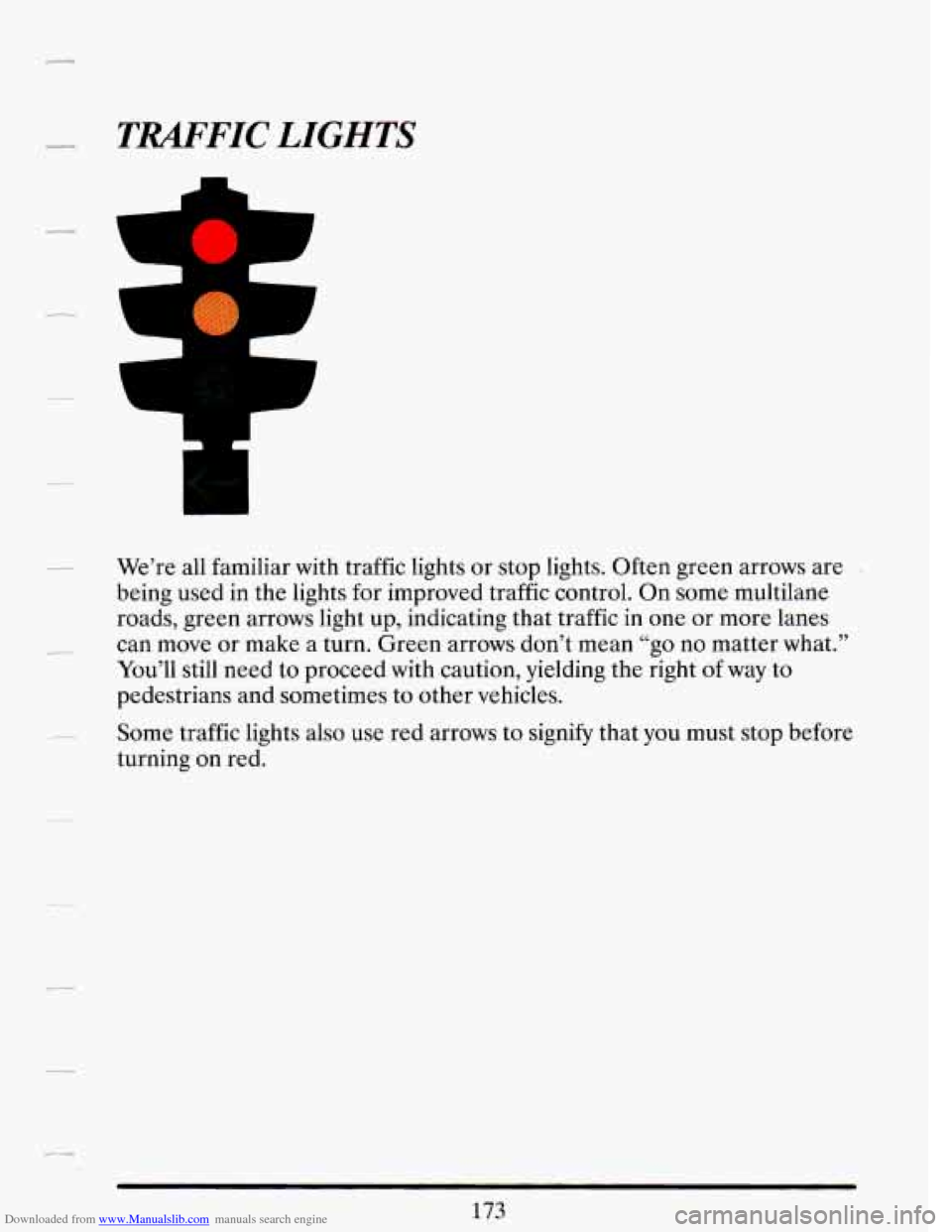
We’re all familiar with traffic lights or stop lights. Often green arrows are -
being used in the lights for improved traffic control. On some multilane
roads, green arrows light up, indicating that traffic in one or more lanes
can move or make
a turn. Green arrows don’t mean “go no matter what.’’
You’ll still need to proceed with caution, yielding the right
of way to
pedestrians and sometimes to other vehicles.
Some traffic lights also use red arrows to
signify that you must stop before
turning
on red.
Page 188 of 406
Downloaded from www.Manualslib.com manuals search engine - YOUR OWN SIGNALS
Drivers signal to others, too. It’s not only more polite, it’s safer to let
requires driver signals.
- other drivers know what you are doing. And in some places the law
Turn and lane change signals. Always signal when you plan to turn or
change lanes.
If necessary, you can use hand signals out the window: Left arm straight
out
for a left turn, down for slow or about-to-stop, and up for a right turn.
Slowing down. If time allows, tap the brake pedal once or twice
in
advance of slowing or stopping. This warns the driver behind you.
Disabled. Your four-way flashers signal that your vehicle
is disabled or is
a hazard. See “Hazard Warning Flashers” in the Index.
- TRAFFIC OFFICER
The traffic police officer is also a source of important information. The
officer’s signals govern, no matter what the traffic lights or other signs
say.
The next section discusses some of the road conditions you may
encounter.
DEFENSIKE DmNG
The best advice anyone can give about driving is: Drive defensively.
Please start with a very important safety device in your Cadillac: Buckle
up. (See “Safety Belts” in the Index.)
Defensive driving really means “be ready for anything.”
On city streets,
rural roads, or freeways, it means “always expect the unexpected.”
Assume that pedestrians or other drivers are going to be careless and
make mistakes. Anticipate what they might do. Be ready for their
mistakes.
Expect children to dash out from behind parked cars, often followed
by
other children. Expect occupants in parked cars to open doors into traffic.
Watch for movement in parked cars
-- someone may be about to open a
door.
175
~ -.
Page 201 of 406

Downloaded from www.Manualslib.com manuals search engine Try to adjust your speed so you can “drive” through the curve. Maintain a
reasonable, steady speed. Wait to accelerate until you are out of
the
curve, and then accelerate gently into the straightaway.
When you drive into a curve at night, it’s harder to see the road ahead
of
you because it bends away from the straight beams of your lights. This is
one good reason to drive slower.
Steering in Emergencies
There are times when steering can be more effective than braking. For
example, you come over a hill and find a truck stopped in your lane, or a
car suddenly pulls out from nowhere, or a child darts out from between
parked cars and stops right in front of you. You can avoid these problems
by braking
-- if you can stop in time. But sometimes you can’t; there isn’t
room. That’s the time for evasive action
-- steering around the problem.
Your Cadillac can perform
very well in emergencies like these. First apply
your brakes. It is better to remove as much speed as you can from a
possible collision. Then steer around the problem, to the left or right
depending on the space available.
An emergency like this requires close attention and a quick decision. If
you are holding the steering wheel at the recommended 9 and 3 o’clock
positions, you can turn it a
full 180 degrees very quickly without removing
either hand. But you have to act fast, steer quickly, and just as quickly
straighten the wheel once you have avoided the object. You must then be
prepared to steer back to your original lane and then brake to a
controlled stop.
Depending on your speed, this can be rather violent for an unprepared
driver. This is one of the reasons driving experts recommend that you use
your safety belts and keep both hands on the steering wheel.
188
-‘ I
-
I cc
-.
r
)--r
-
LL