light CADILLAC DEVILLE 1993 7.G Repair Manual
[x] Cancel search | Manufacturer: CADILLAC, Model Year: 1993, Model line: DEVILLE, Model: CADILLAC DEVILLE 1993 7.GPages: 406, PDF Size: 20.78 MB
Page 188 of 406
Downloaded from www.Manualslib.com manuals search engine - YOUR OWN SIGNALS
Drivers signal to others, too. It’s not only more polite, it’s safer to let
requires driver signals.
- other drivers know what you are doing. And in some places the law
Turn and lane change signals. Always signal when you plan to turn or
change lanes.
If necessary, you can use hand signals out the window: Left arm straight
out
for a left turn, down for slow or about-to-stop, and up for a right turn.
Slowing down. If time allows, tap the brake pedal once or twice
in
advance of slowing or stopping. This warns the driver behind you.
Disabled. Your four-way flashers signal that your vehicle
is disabled or is
a hazard. See “Hazard Warning Flashers” in the Index.
- TRAFFIC OFFICER
The traffic police officer is also a source of important information. The
officer’s signals govern, no matter what the traffic lights or other signs
say.
The next section discusses some of the road conditions you may
encounter.
DEFENSIKE DmNG
The best advice anyone can give about driving is: Drive defensively.
Please start with a very important safety device in your Cadillac: Buckle
up. (See “Safety Belts” in the Index.)
Defensive driving really means “be ready for anything.”
On city streets,
rural roads, or freeways, it means “always expect the unexpected.”
Assume that pedestrians or other drivers are going to be careless and
make mistakes. Anticipate what they might do. Be ready for their
mistakes.
Expect children to dash out from behind parked cars, often followed
by
other children. Expect occupants in parked cars to open doors into traffic.
Watch for movement in parked cars
-- someone may be about to open a
door.
175
~ -.
Page 191 of 406
Downloaded from www.Manualslib.com manuals search engine mixed drinks if each had 1-1/2 ounces (45 ml) of a liquor like whiskey, gin
or vodka.
It’s the amount
of alcohol that counts. For example, if the same person
drank three double martinis
(3 ounces or 90 ml of liquor each) within an
hour, the person’s BAC would be close to 0.12 percent.
A person who
consumes food just before or during drinking will have a slightly lower
BAC
level.
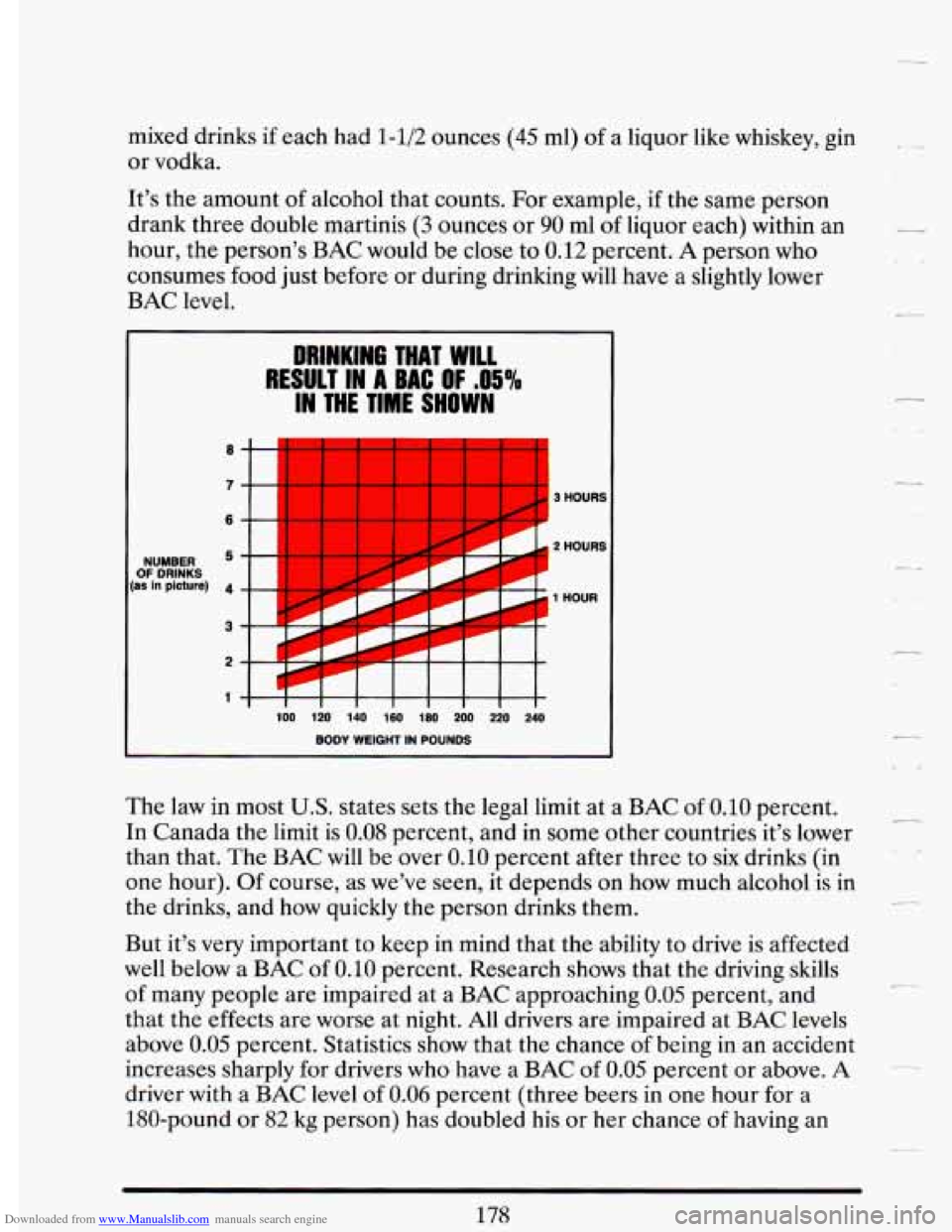
DRINKING THAT WILL
RESULT IN A BAC OF .05°/o
IN THE TIME SHOWN
6
NUMBER OF DRINKS IS In picture)
I
3 HOURS
2 HOURS
1
HOUR
I 100 120 140 160 180 200 220 240
BODY WEIQHT IN POUNDS
The law in most US. states sets the legal limit at a BAC of 0.10 percent.
In Canada the limit
is 0.08 percent, and in some other countries it’s lower
than that. The BAC will be over 0.10 percent after three to six drinks (in
one hour).
Of course, as we’ve seen, it depends on how much alcohol is in
the drinks, and how quickly the person drinks them.
But it’s
very important to keep in mind that the ability to drive .is affected
well below a BAC of
0.10 percent. Research shows that the driving skills
of many people are impaired at a BAC approaching 0.05 percent, and
that the effects are worse at night. All drivers are impaired at BAC levels
above
0.05 percent. Statistics show that the chance of being in an accident
increases sharply
for drivers who have a BAC of 0.05 percent or above. A
driver with a BAC level of
0.06 percent (three beers in one hour for a
180-pound or 82 kg person) has doubled his or her chance of having an
r
L-r
178
~.
Page 194 of 406
Downloaded from www.Manualslib.com manuals search engine with traffic. This is a mistake. Your brakes may not have time to cool
between hard
stops. Your brakes will wear out much faster if you do a
lot
of heavy braking.
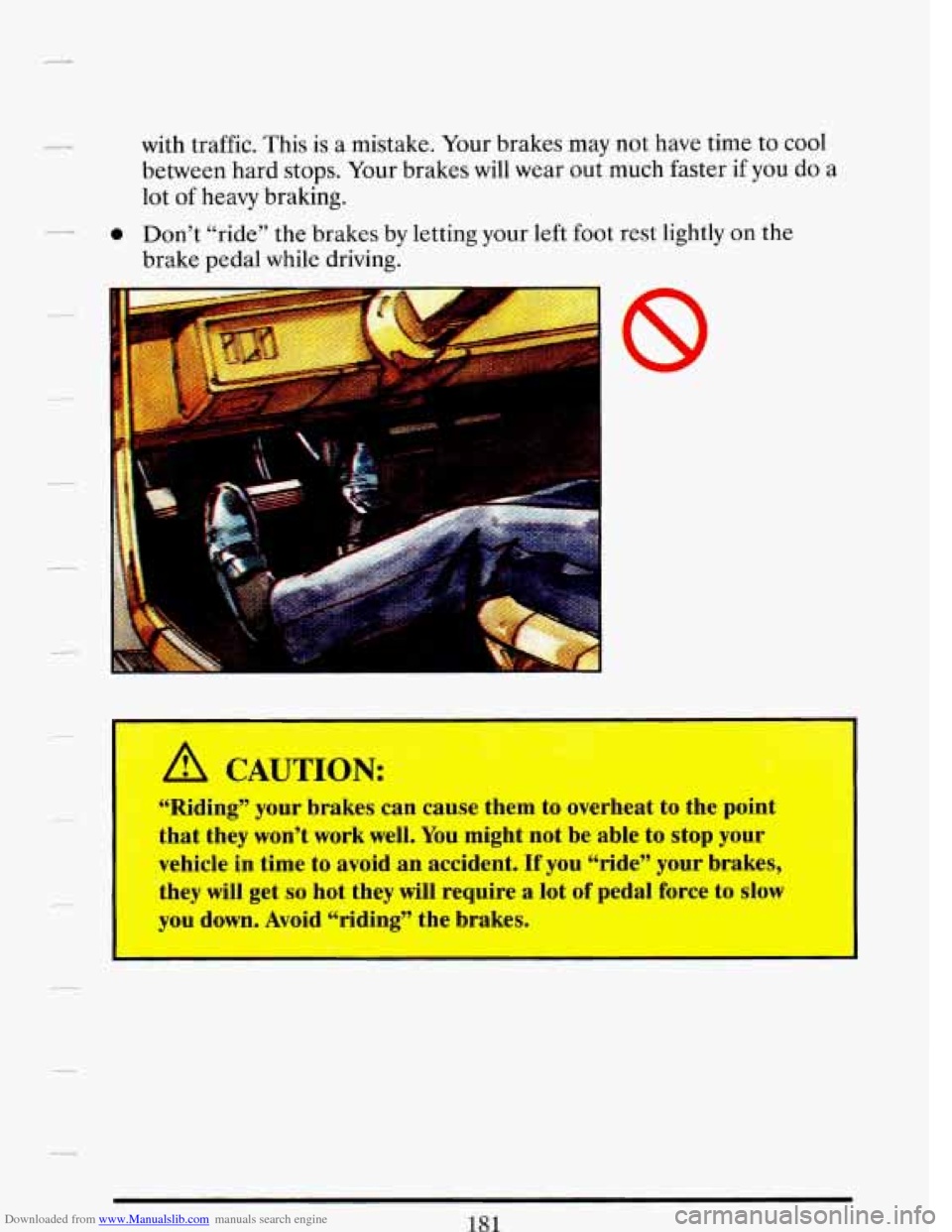
a Don’t “ride” the brakes by letting your left foot rest lightly on the
brake pedal while driving.
CAUTION:
“Riding” your braws can cause them to overheat to the point
that they won’t work well. You might not be able to stop your
vehicle in time to avoid an accident.
If you “ride” your brakes,
they will get
so hot they will require a lot of pedal force to slow
you down. Avoid “riding” the brakes.
Page 195 of 406
Downloaded from www.Manualslib.com manuals search engine If you keep pace with the traffic and allow realistic following distances,
you
will eliminate a lot of unnecessary braking. That means better
braking and longer brake life.
If your engine ever stops while you’re driving, brake normally but
don’t pump your brakes.
If you do, the pedal may get harder to push
down. If your engine stops, you will still have some power brake assist.
But you will use
it when you brake. Once the power assist is used up, it
may take longer
to stop and the brake pedal will be harder to push.
Anti-Lock Brakes (ABS)
Your Cadillac has an advanced electronic braking system that will help
prevent skidding.
This light on the
instrument panel will
go on when you start
your vehicle.
I
Lr
See “Anti-lock Brake System Warning Light” in the Index.
Page 197 of 406
Downloaded from www.Manualslib.com manuals search engine A CAUTION:
I Anti-lock doesn’t change the time you need to get your foot up to
the brake pedal.
If you get too close to the vehicle in front of
you, you won’t have time to apply your brakes if that vehicle
suddenly slows
or stops. Always leave enough room up ahead to.
stop, even
t- lug ~OU have anti-lock brakes. ..
To Use Anti-Lock:
Don’t pump the brakes. Just hold the brake pedal down and let anti-lock
work for you.
When you start your vehicle and begin to drive away,
you may hear a
momentary motor or clicking noise. And you may even notice that your
brake pedal moves a little while this is going
on. This is the ABS system
testing itself. You may also hear this during
a hard stop.
Traction Control System (Option)
Your vehicle may have a traction control system that limits wheel spin.
This is especially useful in slippery road conditions. The traction control
system works at low speeds only, such as when you accelerate from
a stop.
It applies brake pressure to an individual wheel that the system senses is
about to spin.
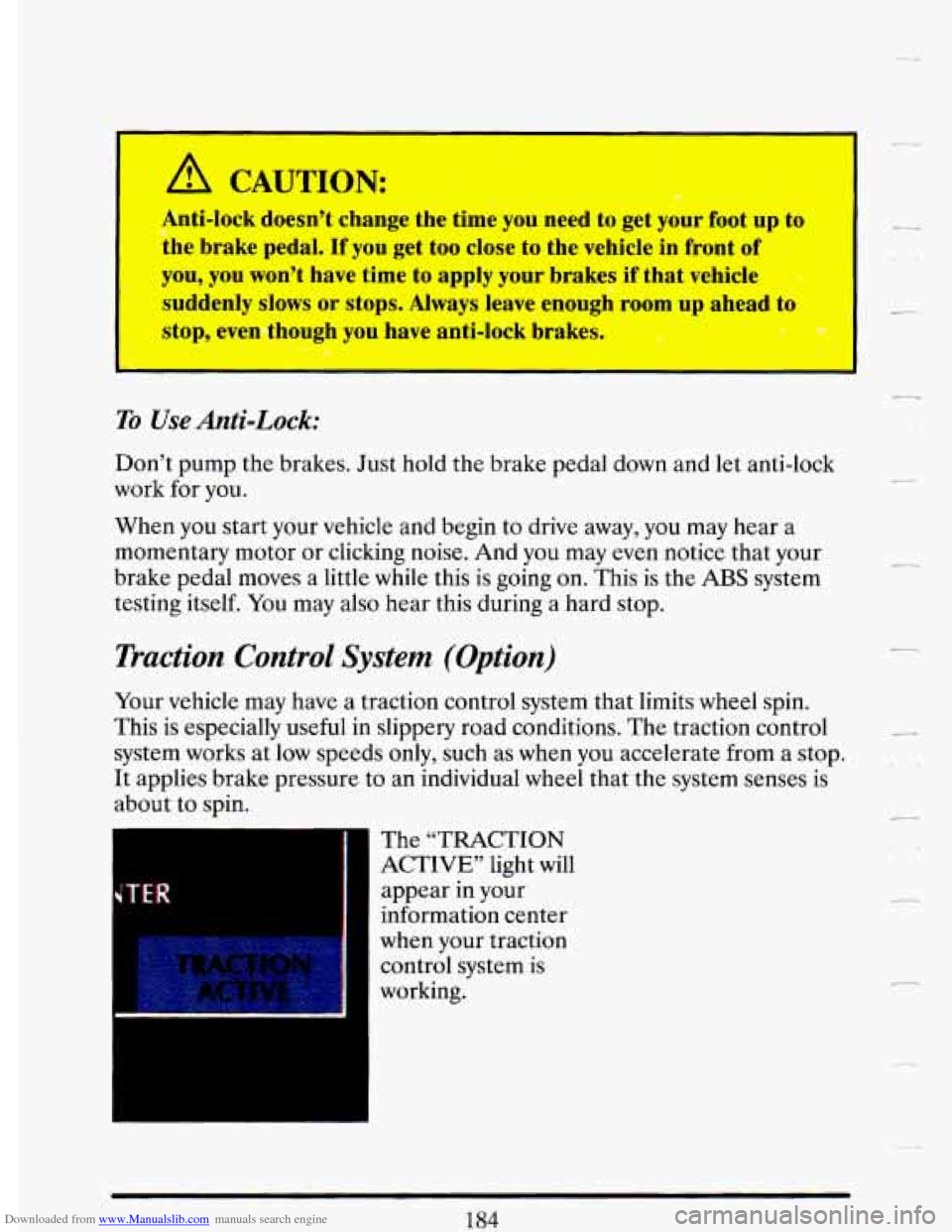
ITER
The “TRACTION
ACTIVE’’ light will
appear in your
information center
when your traction
control system is
working.
r
184
Page 198 of 406

Downloaded from www.Manualslib.com manuals search engine r
.-
You may feel the system working, or you may notice some noise, but this
is normal.
The “TRACTION
OFF” warning light
lets you know if your
traction control
I
system is not working.
See “Traction Control
System Warning
, , ,, . I , -1
Light” in the Index.
Disc Brake Wear Indicators
Your Cadillac has front disc brakes and rear drum brakes.
Disc brake pads have built-in wear indicators that make a high-pitched
warning sound when the brake pads are worn and new pads are needed.
The sound may come and
go or be heard all the time your vehicle is
moving (except when you are pushing on the brake pedal firmly).
A CAUTION
The brake wear waming sound means thgt sooner or later your
brakes won’t work well. That could lead to an accident. when
you hear the brake wear warning sound, have your vehicle
serviced. 5-
., I
185
Page 199 of 406
Downloaded from www.Manualslib.com manuals search engine VOTICE:
Cmtinuing to drive with worn-out brake pads could result in
I
costly brake repair
Some driving conditions or climates may cause a brake squeal when the
brakes are first applied or lightly applied. This does not mean something
is wrong with your brakes.
Rear Drum Brakes
Your rear drum brakes don’t have wear indicators, but if you ever hear a
rear brake rubbing noise, have the rear brake linings inspected.
Also, the
rear brake drums should be removed and inspected each time the tires
are removed for rotation or changing. When
you have the front brakes
replaced, have the rear brakes inspected, too.
Brake linings should always be replaced as complete axle sets.
Brake Pedal Travel
See your dealer if the brake pedal does not return to normal height, or if
there is a rapid increase in pedal travel. This could be a sign of brake
trouble.
Brake Adjustment
Every time you make a moderate brake stop, your brakes adjust for wear.
If you rarely make a moderate or heavier stop, then your brakes might
not adjust correctly. If you drive in that way, then
-- very carefully -- make
a
few moderate brake stops about every 1000 miles (1600 km), so your
brakes will adjust properly.
Braking in Emergencies
Use your anti-lock braking system when you need to. With anti-lock, you
can steer and brake at the same time.
In many emergencies, steering can
help you more than
even the very best braking.
186
- i
c
r
Page 201 of 406

Downloaded from www.Manualslib.com manuals search engine Try to adjust your speed so you can “drive” through the curve. Maintain a
reasonable, steady speed. Wait to accelerate until you are out of
the
curve, and then accelerate gently into the straightaway.
When you drive into a curve at night, it’s harder to see the road ahead
of
you because it bends away from the straight beams of your lights. This is
one good reason to drive slower.
Steering in Emergencies
There are times when steering can be more effective than braking. For
example, you come over a hill and find a truck stopped in your lane, or a
car suddenly pulls out from nowhere, or a child darts out from between
parked cars and stops right in front of you. You can avoid these problems
by braking
-- if you can stop in time. But sometimes you can’t; there isn’t
room. That’s the time for evasive action
-- steering around the problem.
Your Cadillac can perform
very well in emergencies like these. First apply
your brakes. It is better to remove as much speed as you can from a
possible collision. Then steer around the problem, to the left or right
depending on the space available.
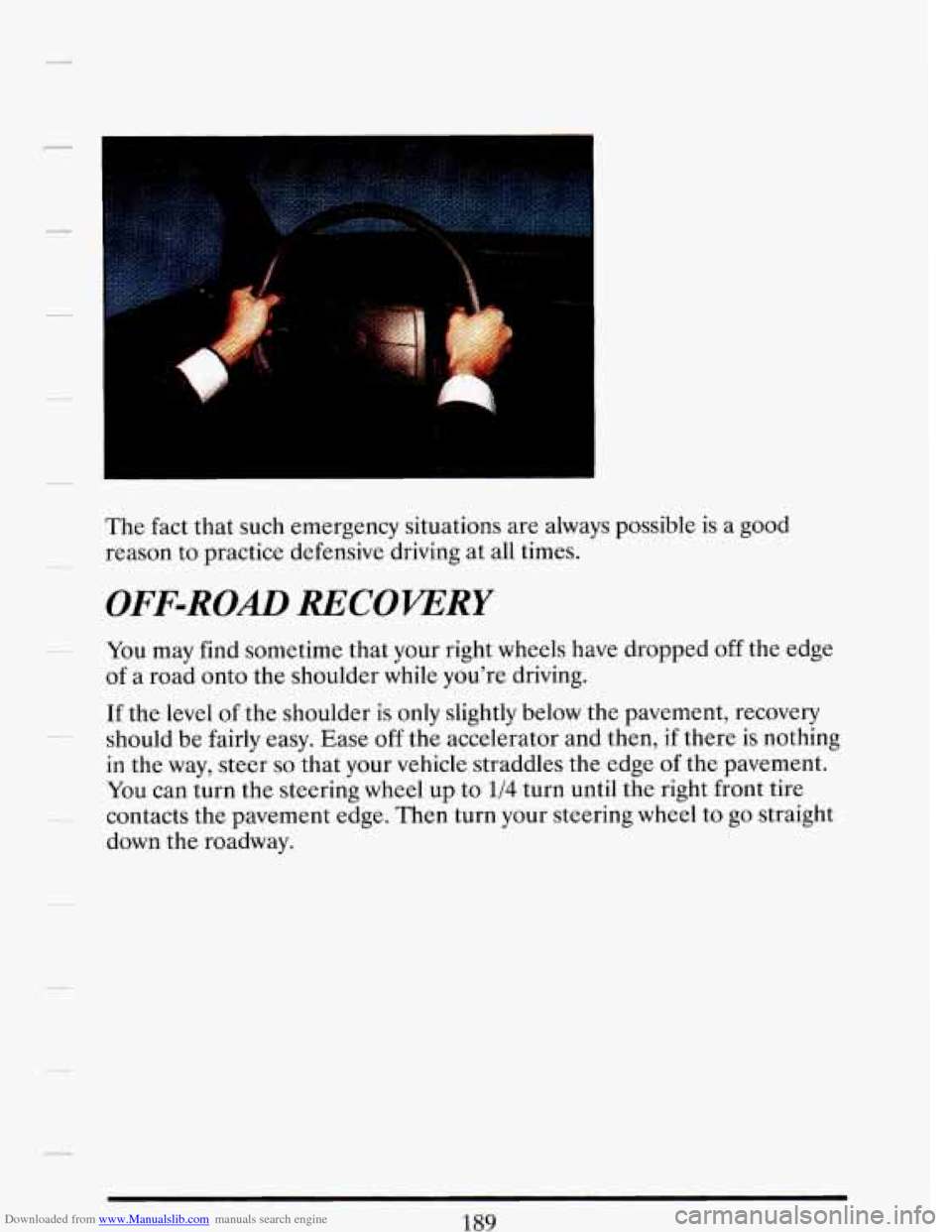
An emergency like this requires close attention and a quick decision. If
you are holding the steering wheel at the recommended 9 and 3 o’clock
positions, you can turn it a
full 180 degrees very quickly without removing
either hand. But you have to act fast, steer quickly, and just as quickly
straighten the wheel once you have avoided the object. You must then be
prepared to steer back to your original lane and then brake to a
controlled stop.
Depending on your speed, this can be rather violent for an unprepared
driver. This is one of the reasons driving experts recommend that you use
your safety belts and keep both hands on the steering wheel.
188
-‘ I
-
I cc
-.
r
)--r
-
LL
Page 202 of 406
Downloaded from www.Manualslib.com manuals search engine The fact that such emergency situations are always possible is a good
reason to practice defensive driving at all times.
OFF-ROAD RECOVERY
You may find sometime that your right wheels have dropped off the edge
of a road onto the shoulder while you’re driving.
If the level of the shoulder is only slightly below the pavement, recovery
should be
fairly easy. Ease off the accelerator and then, if there is nothing
in the way, steer
so that your vehicle straddles the edge of the pavement.
You can turn the steering wheel up to 1/4 turn until the right front tire
contacts the pavement edge. Then turn your steering wheel to
go straight
down the roadway.
189
Page 205 of 406
Downloaded from www.Manualslib.com manuals search engine Try not to pass more than one vehicle at a time on two-lane roads.
Reconsider before passing
the next vehicle.
Don’t overtake a slowly moving vehicle too rapidly. Even though the
brake lights are not flashing, it may be slowing down or starting to
turn.
0 If you’re being passed, make it easy for the following driver to get
ahead
of you. Perhaps you can ease a little to the right.
LOSS OF CONTROL
Let’s review what driving experts say about what happens when the three
control systems (brakes, steering and acceleration) don’t have enough
friction where the tires meet
the road to do what the driver has asked.
In any emergency, don’t give up. Keep trying to steer and constantly seek
an escape route or area
of less danger.
Skidding
In a skid, a driver can lose control of the vehicle. Defensive drivers avoid
most skids by taking reasonable care suited to existing conditions, and by
not “overdriving” those conditions. But skids are always possible.
The three types of skids correspond to your Cadillac’s three control
systems. In the braking skid your
wheels aren’t rolling. In the steering or
cornering skid, too much speed or steering
in a curve causes tires to slip
and lose cornering force. And in the acceleration skid too much throttle
causes the driving wheels to spin.
A cornering skid and an acceleration skid are best handled by easing your
foot off the accelerator pedal.
If your vehicle starts to slide (as when you turn
a corner on a wet, snow-
or ice-covered road), ease your foot off the accelerator pedal as
soon as
you feel the vehicle start to slide. Quickly steer the way you want the
vehicle to go. If you start steering quickly enough, your vehicle will
straighten out.
As it does, straighten the front wheels.
Of course, traction is reduced when water, snow, ice, gravel, or other
material is
on the road. For safety, you’ll want to slow down and adjust
your driving to these conditions. It is important
to slow down on slippery
192