Ant CADILLAC DEVILLE 1994 7.G User Guide
[x] Cancel search | Manufacturer: CADILLAC, Model Year: 1994, Model line: DEVILLE, Model: CADILLAC DEVILLE 1994 7.GPages: 399, PDF Size: 20.97 MB
Page 52 of 399

Downloaded from www.Manualslib.com manuals search engine r
r
i !
r
SAFETYBELT USE DURING PREGNANCY
Safety belts work for everyone, including pregnant women. Like all
occupants, they are more likely to be seriously injured
if they don’t wear
safety belts.
A pregnant woman should wear a lap-shoulder belt, and the lap portion
should be worn as low aspossible thr*oughout the-pregnancy.
The best way’to protect the fetus is to protect the mother. When a safety
belt is worn properly, it’s more likely that the fetus won’t be hurt in a
crash. For pregnant women, as for anyone, the key to making safety belts
effective is wearing them properly.
39
l-
Page 55 of 399
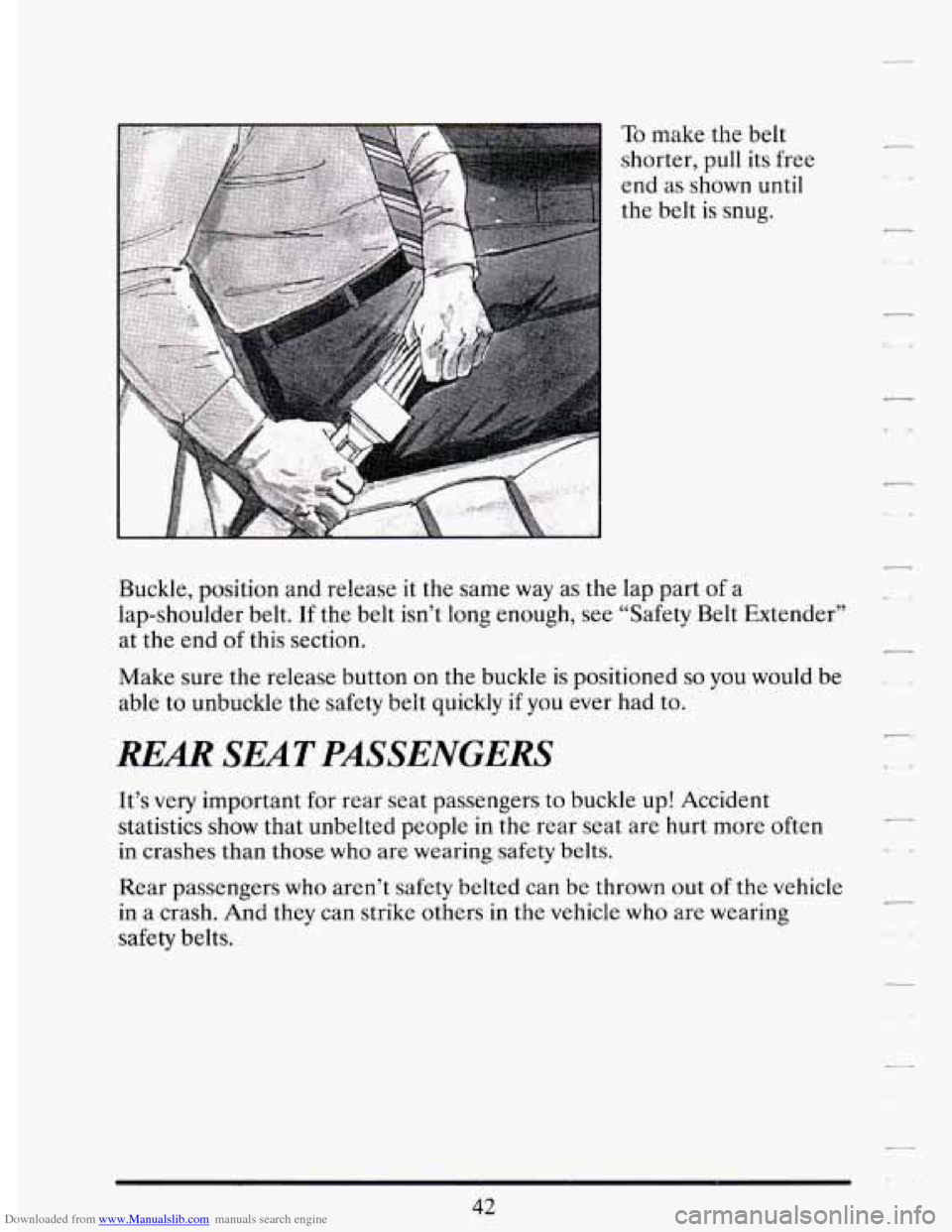
Downloaded from www.Manualslib.com manuals search engine To make the belt
shorter,
pull its free
end as shown until
the belt is snug.
Buckle, position and release it the same way as the lap part
of a
lap-shoulder belt.
If the belt isn’t long enough, see “Safety Belt Extender”
at the end
of this section. 7
Make sure the release button on the buckle is positioned so you would be
able to unbuckle the safety belt quickly
if you ever had to.
REAR SEAT PASSENGERS
It’s very important for rear seat passengers to buckle up! Accident
statistics show that unbelted people
in the rear seat are hurt more often
in crashes than those who are wearing safety belts.
-4
r. 1
Rear passengers who aren’t safety belted can be thrown out of the vehicle
in a crash.
And they can strike others in the vehicle who are wearing
safety belts. 7
42
Page 62 of 399

Downloaded from www.Manualslib.com manuals search engine r
r
r
CHILD RESTRAINTS ..
., . .. .. I_
Be sure to follow the instructions for the restraint. You may find these
instructions on the restraint itself or in a booklet, or both. These
restraints use the belt system in your vehicle, but the child also has to be
secured within the restraint to help reduce the chance of personal injury.
The instructions that come with the infant or child restraint
will show you
how to do that.
Mere to Put the Restraint
Accident statistics show that children are safer if they are restrained in
the rear rather than the front seat. We at General Motors therefore
recommend that
you put your child restraint in the rear seat. NEVER put
a rear-facing child restraint in the front passenger seat. Here’s why:
r
49
Page 63 of 399

Downloaded from www.Manualslib.com manuals search engine Wherever you install it, be sure to secure the child restraint properly.
Keep in mind that an unsecured child restraint can move around in a
collision or sudden stop and injure people in the vehicle. Be sure to
properly secure any child restraint
in your vehicle
in it.
-- even when no child is
Top Strap
If your child restraint
has
a top strap, it
should be anchored.
t. A
If you need to have an anchor installed, you can ask your Cadillac dealer
to put it
in for you. If you want to install an anchor yourself, your dealer
can tell you
how to do it.
For cars first sold in Canada, child restraints with a top strap must be
anchored according to Canadian Law.
Your dealer can obtain the hardware kit and install it for you, or you may
install it yourself using the instructions provided
in the kit.
Use the tether hardware kit available from the dealer. The hardware and
installation instructions were specifically designed for this vehicle.
50
Page 75 of 399
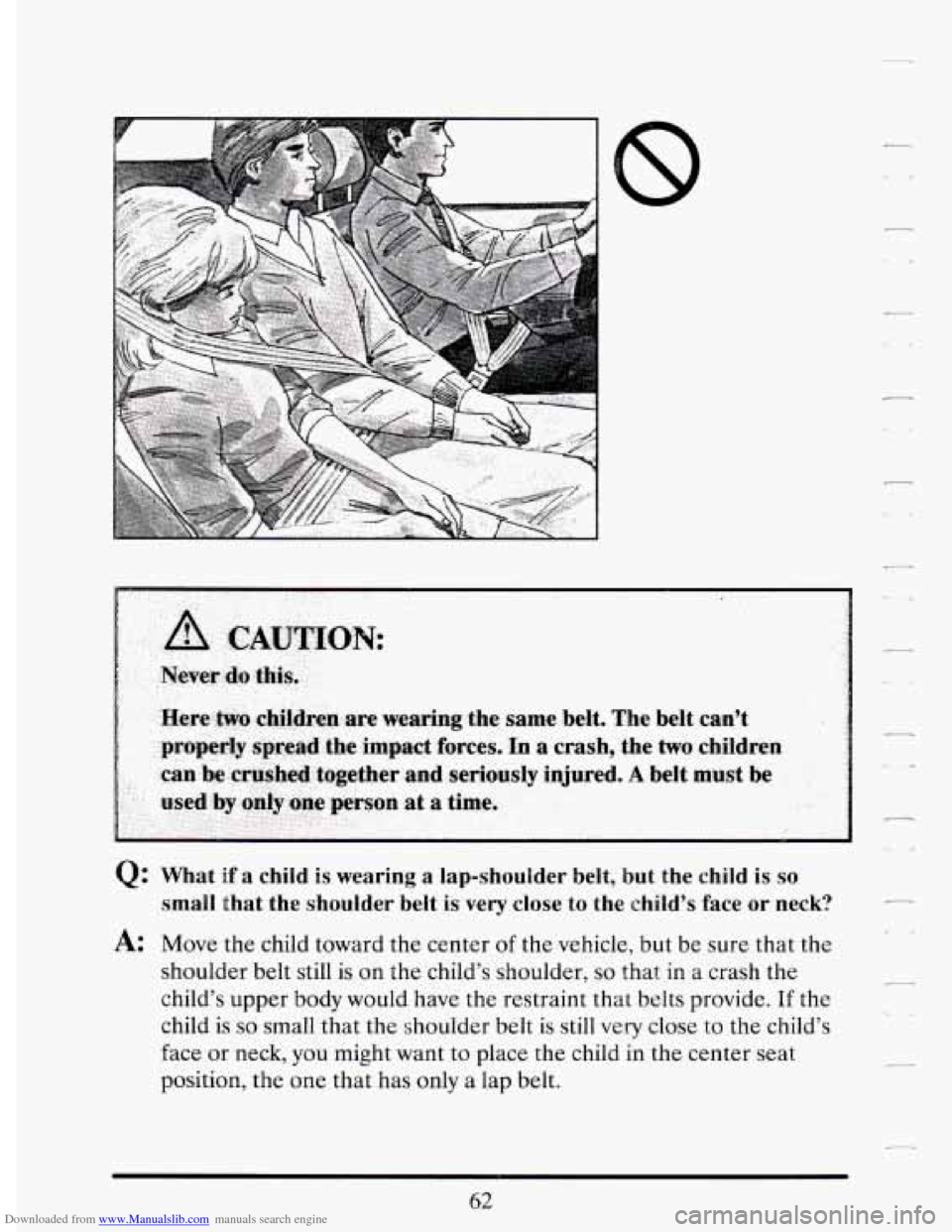
Downloaded from www.Manualslib.com manuals search engine Q: What if a child is wearing a lap-shoulder belt, but the child is so
small that the shoulder belt is very close to the child’s face or neck?
A: Move the child toward the center of the vehicle, but be sure that the
shoulder belt still is
on the child’s shoulder, so that in a crash the
child’s upper body would. have the restraint that belts provide.
If the
child
is so small that the shoulder belt is still very close to the child’s
face or neck, you might want to place the child in the center seat
position, the one that has
only a lap belt.
62
Page 84 of 399

Downloaded from www.Manualslib.com manuals search engine .-
3. Do the same thing to the other rear door lock.
The rear doors of your vehicle cannot be opened from the inside when
this feature
is in use.
When you want to open
a rear door when the security lock is on:
1. Unlock the door from the inside.
2. Then open the door from the outside.
To cancel the rear door lock:
1. Unlock the door from the inside and open the door from the outside.
2. Move the lever all the way down.
3. Do the same for the other rear door.
The rear door locks
will now work normally.
Automatic Door Locks
Just close your doors and turn on the ignition. Every time you move your
shift lever out of
‘‘Y (Park) all of the doors will lock. And, every time you
stop and move your shift lever into “P” (Park), your doors
will unlock. If
someone needs to get out while you’re not
in “P77 (Park), have that person
use the manual or power lock. When the door
is closed again, it will not
lock automatically. Just use the manual or power lock to lock the door
again.
You can also have this feature changed where the doors
will stay locked
when you shift back into “P” (Park), ask your dealership for details.
Leaving Your Whicle
If you are leaving the vehicle, set the locks from inside, get out and close
the door.
Central Door Unlocking System
Your vehicle may be equipped with this feature. When unlocking either
door, you can unlock the other doors
by holding the key in the turned
position for
a few seconds.
Page 85 of 399
Downloaded from www.Manualslib.com manuals search engine .-.
Anti-Lockout Feature
Your vehicle is equipped with this feature. If you leave the key in the
ignition whether
in the Accessory, Lock, or Off position with the driver's
door open,
you can not lock your vehicle using the power locks. If you close
the door you can lock
it using the Remote Keyless Entry System. It is always
recommended that you remove
your ignition key when locking your vehicle.
When the engine is running the Anti-Lockout feature is disabled.
Illuminated Entry System
Your illuminated entry system turns on all the courtesy lights when a door
is opened or if you push the Remote Keyless Entry button. When the
door is closed, the courtesy lights
will go out.
REMOTE KEYLESS ENTRY SYSTEM
With this feature you can turn on your interior lights, lock and unlock
your doors, or unlock your
trunk from up to 15 feet (4.5 mm) using the
key chain transmitter supplied with your vehicle.
Your Remote Keyless Entry System
is intended to be used as a
supplementary vehicle entry device. It is not intended to replace, but
rather should be used in conjunction
with a door lock key. It operates on
a radio frequency subject to Federal Communications Commission
(FCC) Rules.
This device complies
with Part 15 of the FCC Rules. Operation is subject
to the following two conditions: (1) This device may not cause harmful
interference, and
(2) This device must accept any interference received,
including interference that may cause undesired operation.
Should interference to this system occur, try this:
Check
to determine if battery replacement is necessary. See the
instructions on battery replacement.
0 Check the distance. You may be too far from your vehicle. This
product has a maximum range.
0 Check the location. Other vehicles or objects may be blocking the
signal.
See your Cadillac dealer or a qualified technician for service.
-.
L
.-
.:
Y
r-
-
7
. . .a
-
'72
Page 90 of 399

Downloaded from www.Manualslib.com manuals search engine The glove box is directly in front of the front passenger seat. To unlock
the door, insert the round key into the lock cylinder and turn it to the left.
To lock the door, turn the key to the right and remove the key. The key
may be removed in the locked or unlocked position.
Trunk Security Override
Inside the glove box ik an override switch that is useful if you want to
leave valuables in the trunk when using a commercial parking lot.
Push the button to disable the Remote Trunk Release button. Then lock
your glove box with the door
key. If you have your door key with you, this
will help keep someone from getting into your trunk. Push the button
again to make the power trunk release button usable.
You can still use your Remote Keyless Entry transmitter to open the
trunk even
if the override button is pushed in.
Page 96 of 399
Downloaded from www.Manualslib.com manuals search engine This light reminds you to arm the theft deterrent system. Here’s how to
do it:
1. Open the door.
2. Lock the door with the power door lock switch or Keyless Entry
System. The “SECURITY” light should come
on and stay on.
3. Close all doors. The “SECURITY” light should go off.
If a door
is opened without the key or Keyless Entry System, the alarm
will go off. It
will also go off if the trunk lock is damaged. Your vehicle’s
lights will flash and the horn
will sound for 3 minutes, then will go off to
save battery power.
Remember, the theft deterrent system won’t arm
if you lock the doors
with a key or manual door lock. It arms only
if you use a power door lock
switch
or Keyless Entry System.
Here’s how to avoid setting
off the alarm by accident:
__ If you don’t want to arm the theft deterrent system, the vehicle should
be locked with the door
key after the doors are closed.
Always unlock a door with a key, or use the Keyless Entry System.
Unlocking a door any other way
will set off the alarm.
If you set off the alarm by accident, unlock any door with your key. You
can also turn
off the alarm by using the Keyless Entry System. The alarm
won’t stop
if you try to unlock a door any other way.
How to Test The Alarm
From outside the vehicle, roll down your window and lock the vehicle
using the power door lock or the Keyless
Entry System and close the
door.
door. The horn will sound and your headlights will flash.
0 Reach in and unlock the door using the manual lock, and open the
If the alarm does not sound when
it should, check to see if the horn
works. The horn fuse may be blown.
To replace the fuse, see “Fuses and
Circuit Breakers”
in the Index.
To reduce the possibility of theft, always arm the theft deterrent system
when leaving your vehicle.
83
Page 97 of 399
Downloaded from www.Manualslib.com manuals search engine PASS-KEY’II
Your vehicle is equipped with the PASS-Key’II (Personalized
Automotive Security System) theft deterrent system. PASS-Key% is a
passive theft deterrent system. This means you don’t have to do anything
different to arm or disarm the system. It works when you insert or remove
the key from the ignition. PASS-Key’II uses a resistor pellet in the
ignition key that matches a decoder in your vehicle.
When the PASS-Key% system senses that someone is using the wrong
key, it shuts down the vehicle’s starter and fuel systems. For about three
minutes, the starter won’t work and fuel won’t go to the engine.
If
someone tries to start your vehicle again or uses another key during this
time, the vehicle
will not start. This discourages someone from randomly
trying different keys with different resistor pellets
in an attempt to make a
match.
The ignition key must be clean and dry before it’s inserted in the ignition
or the engine may not start.
If the engine does not start and the -
STARTING DISABLED DUE TO THEFT SYSTEM REMOVE L1
IGNITION KEY messgge is displayed the key may be dirty or wet. Turn
the ignition
off.
Clean and dry the key. Wait about three minutes and try again. The
SECURITY light
will remain on during this time. If the starter still won’t
work, and the key appears to be clean and dry, wait about three minutes
and try the other ignition key. At this time, you may also want to check
the fuses (see “Fuses and Circuit Breakers” in the Index). If the starter
won’t work with the other key, your vehicle needs service.
If your vehicle
does start, the first ignition key may be faulty. See your Cadillac dealer or
a locksmith who can service the PASS-K@II.
If you accidentally use a key that has a damaged or missing resistor pellet,
the starter won’t work, you don’t have to wait three minutes before trying
one
of the other ignition keys.
See your Cadillac dealer
or a locksmith who can service the PASS-Key@II
to have
a new key made.