brake CADILLAC DEVILLE 1995 7.G Owner's Manual
[x] Cancel search | Manufacturer: CADILLAC, Model Year: 1995, Model line: DEVILLE, Model: CADILLAC DEVILLE 1995 7.GPages: 403, PDF Size: 20.69 MB
Page 208 of 403
Downloaded from www.Manualslib.com manuals search engine 0 Don't overtake a slowly moving vehicle too rapidly. Even though the
brake lamps are not flashing,
it may be slowing down or starting to turn,
0 If you're being passed, make it easv for the following driver to get
ahead
of you. Perhaps you can easi a little to the right.
LOSS OF CONTROL
Let's review what driving experts sav about what happens when the three
control svstems (brakes, steering an> acceleration)
don't have enough
friction where the tires meet the road to do what the driver has asked.
In any emergency, don't give up. Keep trying to steer and constantly seek
an escape route or area of less danger.
In a skid, a driver can lose control of the vehicle. Defensive drivers avoid
most skids
by taking reasonable care suited to existing conditions, and by
not "overdriving" those conditions.
But skids are always possible.
The three types of skids correspond to your Cadillac's three control
systems.
In the braking skid your wheels aren't rolling. In the steering or
cornering skid, too much speed or steering
in a curve causes tires to slip
and lose cornering force. And
in the acceleration skid too much throttle
causes
the driving wheels to spin.
A cornering skid is best handled by easing your foot off the accelerator
pedal.
Remember: Any traction control system helps avoid only the acceleration skid.
If your traction control system
is off? then an acceleration skid is also best
handled by easing your
foot off the accelerator pedal.
If your vehicle starts to slide, ease your foot off the accelerator pedal and
quickly steer
the way you want the vehicle to go. If you start steering
quickly enough, your vehicle may straighten out. Always be ready for a
second skid
if it occurs.
Of course, traction is reduced when water, snow, ice, gravel, or other material
is on the road. For safety, you'll want to slow down and adjust your driving to
these conditions. It is important to
slow down on slippery surfaces because
stopping distance will be longer and vehicle control more limited.
4-15
Page 209 of 403

Downloaded from www.Manualslib.com manuals search engine While driving on a surface with reduced traction, try Vour best to avoid
sudden steering, acceleration?
or braking (including engine braking by
shifting to a lower gear). Any sudden changes could cause the tires to
slide. You may not realize the surfdce is slippery until your vehicle is
skidding.
Leain to recognize warning clues -- such as enough water, ice or
packed snow on the road to make a “mirrored surface” -- and slow down
when
you have any doubt.
Remember:
Any anti-lock brake system (ABS) helps avoid only the
braking L. skid.
DRIVING AT NIGHT
Night driving is more dangerous than day driving. One reason is that some
drivers are likely to be impaired -- by alcohol or drugs, with night vision
problems,
or by fatigue.
Here are some tips on night driving.
0 Drive defensively.
0 Don’t drink and drive.
4-16
.I
Page 218 of 403

Downloaded from www.Manualslib.com manuals search engine -
HILL AND MOUNTMN ROADS
I.
Driving on steep hills or mountains is different from driving in flat or
rolling terrain.
If you drive regularly in steep country, or if you’re planning to visit there?
here are
some tips that can make your trips safer and more enjoyable.
0 Keep your vchicle in good shape. Check all fluid levels and also the
brake;. tires. cooling system and transaxle. These parts can work hard
on mountain roads.
Know how to go down hills. The most important thing to know is this:
let your engine do some of the slowing down. Shift to a lower gear
when
you go down a steep or long hill.
4-25
Page 231 of 403
Downloaded from www.Manualslib.com manuals search engine It's important to have the correct hitch equipment. Crosswinds, large
trucks
going by, and rough roads are a few reasons why you'll need the
right hitch. Here are some rules
to follow:
Will you have to make any holes in the body of your vehicle when you
install a trailer hitch? If you do, then be sure tokal the holes later
when you remove the hitch. If you don't seal them? deadly carbon
monoxide (CO) from your exhaust can get into your vehicle (see
"Carbon Monoxide'? in the Index). Dirt al~d water can, too.
The bumpers on your vehicle are not intended for hitches. Do not
attach rental hitches or other bumper-type hitches to them. Use only a
frame-nwuntcd hitch that does not attach to the bumper.
Safety Chains
You should always attach chains between your vehicle and your trailer.
Cross the
safety chains under the tongue of the trailer so that the tongue
will not drop to the road if it becomes separated from the hitch.
Instructions about safety chains
may be provided by thc hitch
manufacturer or
by the trai1c1- manufacturer. Follow the manufacturer's
recommendation
for attaching safety chains and do not attach them to the
bumper. Always 1e;we just enough slack so VOLI can turn with your rig. U
And, never allow safety chains to drag OII the ground.
Trailer Brakes
4-38
Page 232 of 403
Downloaded from www.Manualslib.com manuals search engine Driving with a Trailer
Towing a trailer requires a certain amount of experience. Before setting
out for the open road, you’ll want to get to know your rig. Acquaint
yourself
with the feel of Ilandling and braking with the added weight of
the trailer. And always keep in mind that thc vehicle you are driving is
now a good deal longer and not nearly as responsivs as your vehicle is by
itself.
Before you start, check thc trailer hitch
and platform (and attachments),
safety chains, electrical connector, lamps, tires
and mirror adjustment. If
the trailer has electric brakes, start your vehicle and trailer moving and
then apply the trailer brake controlier by hand
to be sure the brakes are
working.
This lets you check your electrical connection at the same time.
During \Tour trip, check occasionally to
be sure that the load is secure, and
that the’lights and any trailer brakes are still working.
Following Distance
Stay at least twice as far behind the vehicle ahead as you would when
driving your vehicle without a trailer. This can help
you avoid situations
that require heavy braking and sudden turns.
Passing
You’ll need more passing distance up ahead when you’re towing a trailer.
And, because you‘re a good deal longer,
you’ll need to go much farther
beyond
the passed vehicle before you can return to your lane.
Bucking Up
Hold the bottom of the steering wheel with one hand. Then, to move the
trailer
to the left, just move that hand to the left. To move the trailer to
the right, move your hand to the right. Always back up slowly and, if
possible, havc someone guide you.
4-39
Page 233 of 403
Downloaded from www.Manualslib.com manuals search engine NOTICE:
Making very sharp turns while trailering coulcl cause the trailer
to come in contact with the vehicle. Your whicle could be
damagecl. Avoid making very sharp turns while trailering.
When towing a trailer? the green arrows on your instrument panel will
flash for turns even if the bulbs on the trailcr are burned out. Th, you
may think drivers behind you are seeing your signal when they are not. It's
important to check occasionally to be sure the trailer bulbs are still
working.
Driving On Grades
Reduce speed and shift to a lowcr gear bcfow VOLI start clown a long or
steep downgrade. If you don't shift down. youkight have to use your
brakes so much that they would get hot and no longer work well.
On a long uphill grade. shift down ;1nd reduce your speed to u-ound
45 mph (70 km/h) or less to reduce the possibility of engine and transaxle
overheating.
4-4:)
c-
c
.c
Page 234 of 403
Downloaded from www.Manualslib.com manuals search engine Parking on Hills
You really should not park your vehicle, with a trailer attached, on a hill.
If something goes wrong, y&r riq could start to move. People can be
injured, and
both your vel;icle and the trailer can be darnagecl.
L.
But if you ever have to park your rig on a hill, here‘s how to do it:
1. Apply your regular brakes, but do not shift into PARK (P).
2. ILiave sonleone place chocks under the trailer whecls.
Wzen You Are Ready to Leave A@r Parking on n Hill
3
2. Let up on the brake pedal.
3. Drivc slowly until the trailer is clear of the chocks.
4. Stop and have someone pick up and store the chocks.
Maintenance when Trailer Towing
Your vehicle will need service more often when you’re pulling a trailer.
See the Maintenance Schedule for more on this. Things that are especially
important
in trailer operation are automatic transaxle fluid (don’t
overfill), engine
oil, belt, cooling system, and brake adjustment. Each of
these is covered in this manual, and the Index will help you find them
quickly.
If you’re trailering, it’s a good idea to review these sections before
you start your trip.
Check periodically
to see that all hitch nuts and bolts are tight.
4-4 1
Page 295 of 403

Downloaded from www.Manualslib.com manuals search engine BRAKES
Page 296 of 403
Downloaded from www.Manualslib.com manuals search engine r
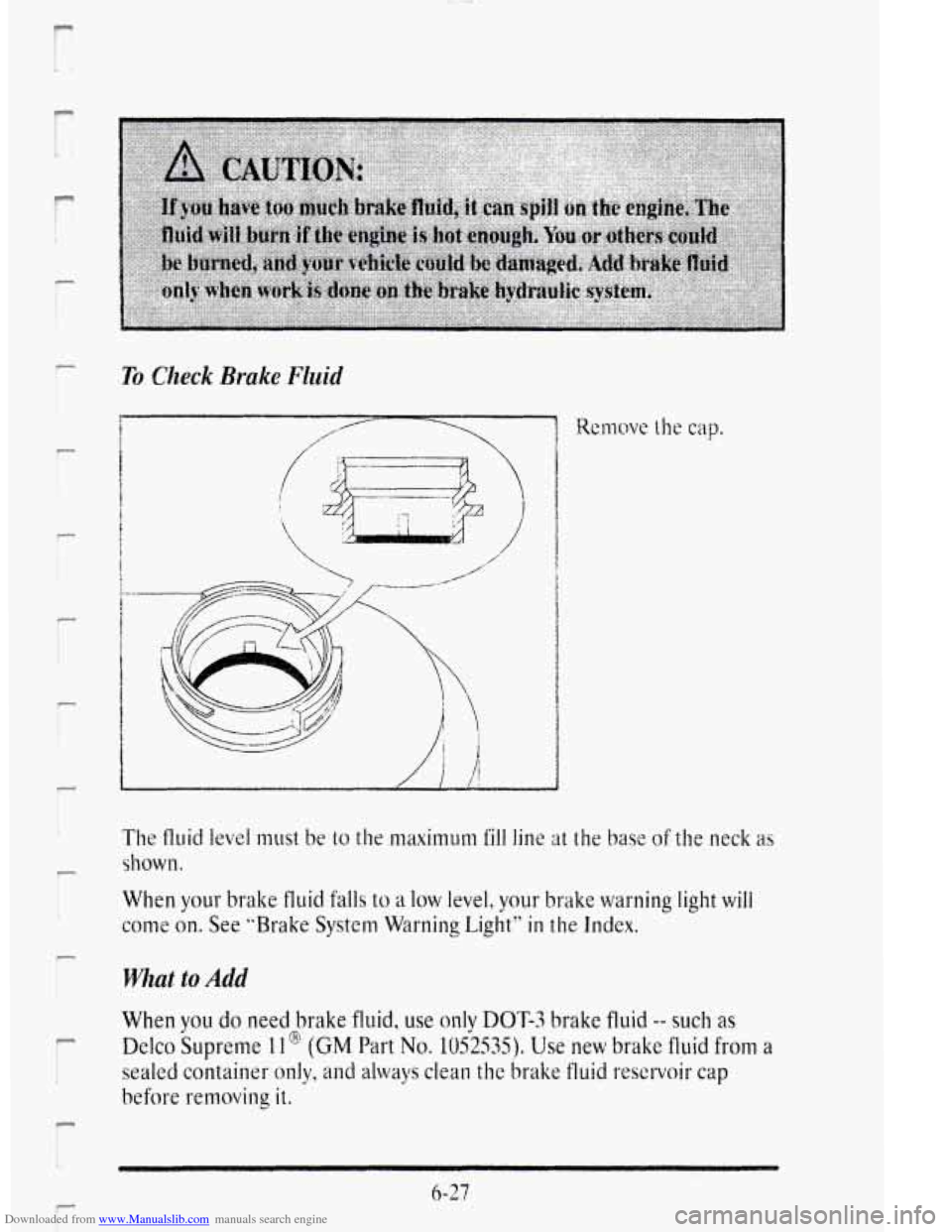
To Check Brake Fjzlid
r-
P
P
r
I.
The fluid level must be to the maximum fill line at the base of the neck as
i;hown.
When your brake fluid fdls to a low level, your brake warning light will
come on. See “Brake System Warning Light” in the Index.
Wzat to Add
When you do need brake fluid, use only DOT-3 brake fluid -- such as
Delco Supreme 1 l@ (GM Part No. 1052535). LJse new brake fluid from a
sealed
container only, and always clean the hake fluid resetvoir cap
before removing it.
6-27
Page 297 of 403
Downloaded from www.Manualslib.com manuals search engine NOTICE:
Don't let someone put in the wrong kind of fluid. For
example? just a few drops
of mineral-based oil, such as
engine
oil, in your brake system can damage brake system
parts
so badIy that they'll have to be replaced.
Brake fluid can damage paint, so be careful not to spill brake
fluid on your vehicle. If you do, wash it off immediately. See
"Appearance Care"
in the Index.
Brake Wear
Your Cadillac has four-tvhecl disc brakes.
Disc brake pads have built-in wear indicators that make a high-pitched
warning sound when the brake pads are worn and new pads are needed.
The sound may come and go or be heard all the time your vehicle is
moving (except when you are pushing on the brake pedal firmly).
NOTICE:
Continuing to drive with worn-out brake pads could result in
costly brake repair.
6-28
c
u