cooling CADILLAC DEVILLE 1996 7.G User Guide
[x] Cancel search | Manufacturer: CADILLAC, Model Year: 1996, Model line: DEVILLE, Model: CADILLAC DEVILLE 1996 7.GPages: 354, PDF Size: 20.32 MB
Page 243 of 354
Downloaded from www.Manualslib.com manuals search engine I NOTICE:
Engine damage if you keep running your engine
without coolant isn’t covered
by your warranty.
See “Overheated Engine Protection Operating
Mode” in the Index.
If there seems to
be no leak, with the engine on, check to
see if the electric engine fans are running. If the engine
is overheating, both fans should
be running. If they
aren’t, your vehicle needs service.
How to Add Coolant to the Coolant Surge
Tank
If you haven? found a problem yet, but the coolant level
isn’t at
the proper level (2.5 inches (60 mm) below the
base
of the fill neck), add a 50/50 mixture of clean
water (preferably distilled) and DEX-COOL TM
antifreeze at the coolant surge tank, but be sure the
cooling system, including
the coolant surge tank
pressure cap, is cool before you do it. (See “Engine Coolant”
in the Index for more information.)
I A CAUTION:
Steam and scalding liquids from a hot cooling
system
can blow out and burn you badly. They are
under pressure, and if you turn the coolant surge
tank pressure cap -- even a little -- they can come
out at
high speed. Never turn the cap when the
cooling system, including the coolant surge tank
pressure cap,
is hot. Wait for the cooling system
and coolantsurge tank pressure cap to cool if you
ever
have to turn the pressure cap.
5-20
Page 244 of 354
Downloaded from www.Manualslib.com manuals search engine c
A CAUTION:
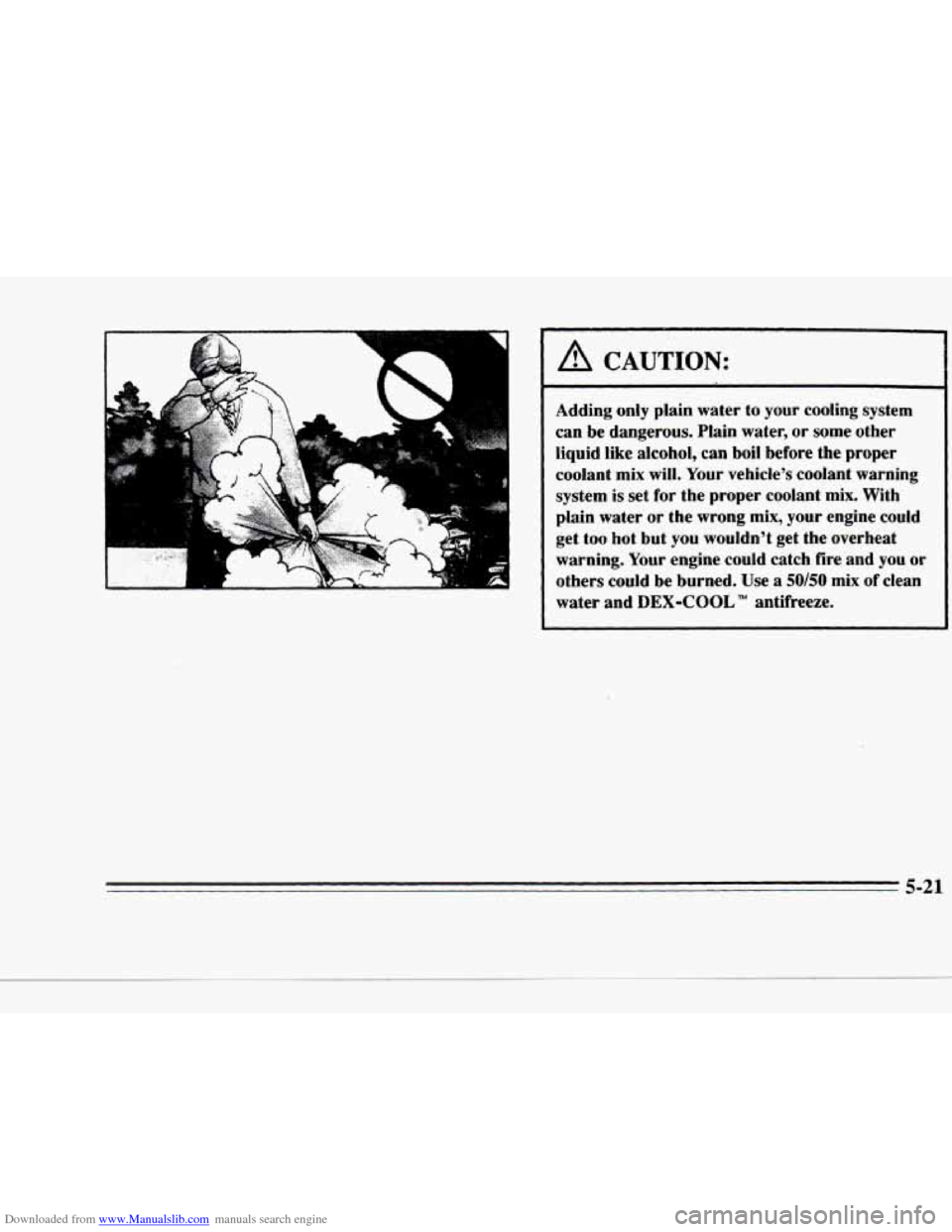
Adding only plain water to your cooling system
can be dangerous. Plain water, or some other
liquid like alcohol,
can boil before the proper
coolant mix will. Your vehicle's coolant warning
system
is set for the proper coolant mix. With
plain water or the wrong mix, your engine could
get too hot but you wouldn't
get the overheat
warning. Your engine could catch fire and you
or
others could be burned. Use a 50/50 mix of clean
water and
DEX-COOL TM antifreeze.
5-21
c
Page 245 of 354
Downloaded from www.Manualslib.com manuals search engine NOTICE:
In cold weather, water can freeze and crack the
engine, radiator, heater core and other parts.
So
use the recommended coolant.
A CAUTION:
You can be burned if you spill coolant on hot
engine parts. Coolant contains ethylene glycol
and it
will burn if the engine parts are hot
enough. Don't spill coolant on
a hot engine.
A
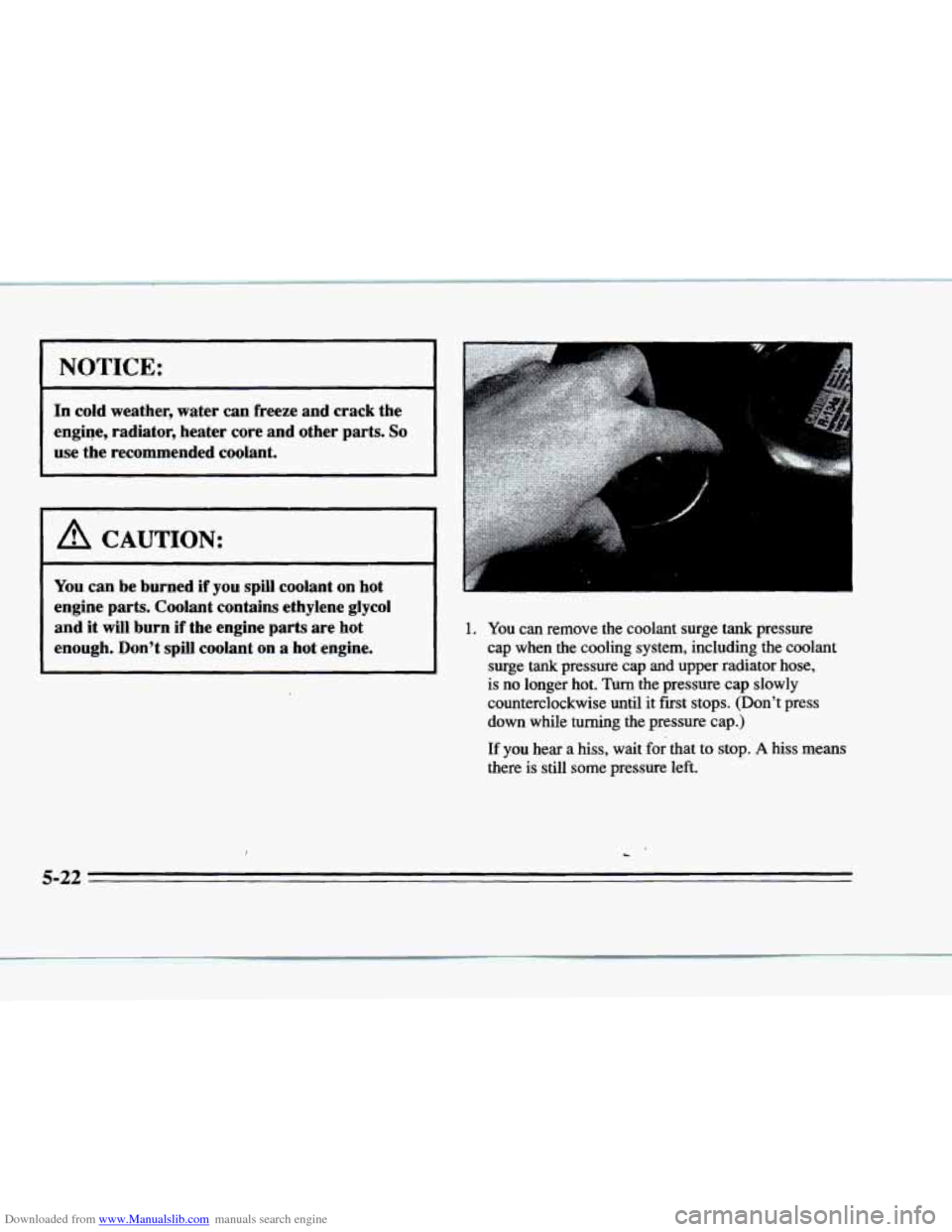
1. You can remove the coolant surge tank pressure
cap when
the cooling system, including the coolant
surge tank pressure cap and upper radiator hose,
is no longer hot.
Turn the pressure cap slowly
counterclockwise until it first stops. (Don't press
down while turning the pressure cap.)
If you hear a hiss, wait for that to stop. A hiss means
there is
still some pressure left.
Page 281 of 354
Downloaded from www.Manualslib.com manuals search engine Engine Coolant
The cooling system in your vehicle is filled with new
DEX-COOL (orange-colored, silicate-free) engine
coolant. This coolant is designed to remain in your vehicle for
5 years or 100,000 miles (166 0o0 km),
whichever occurs first.
The following explains your cooling system and how
to
add coolant when it is low. If you have a problem with
engine overheating, see “Engine Overheating” in
the Index.
A 50/50 mixture of water and the proper coolant for
your Cadillac will:
Give freezing protection down to -34°F (-37 O C).
Give boiling protection up to 265 “F (129 “C).
Protect against rust and corrosion.
0 Help keep the proper engine temperature.
Let the warning lights and gages work as they should.
NOTICE:
When adding coolant it is important that you use
DEX-COOL TM (orange-colored, silicate-free)
coolant meeting
GM Specification 6277M.
If silicated coolant is added to the system,
premature engine, heater core or radiator
corrosion may result. In addition, the engine
coolant
will require change sooner -- at
30,000 miles (50 000 km) or 24 months,
whichever occurs first.
What
to Use
Use a mixture of one-half clean water (preferably
distilled) and one-half
DEX-COOL (orange-colored,
silicate-free) antifreeze that meets
GM Specification
6277M, which won’t damage aluminum parts. Use
GM Engine Coolant Supplement (sealer) (GM Part
No. 3634621) with any complete coolant change. If you
use this mixture, you don’t need
to add anything else.
A special procedure is required for adding sealer; see the
Cadillac service manual.
(To order a service manual, see
“Service and Owner Publications”
in the Index.)
6-20 Y
Page 282 of 354
Downloaded from www.Manualslib.com manuals search engine c
c
L
A CAUTION:
Adding only plain water to your cooling system
can be dangerous. Plain water, or
some other
liquid like alcohol, can boil before the proper
coolant mix will. Your vehicle’s coolant warning
system is set for the proper coolant mix. With
plain water
or the wrong mix, your engine could
get too hot but you wouldn’t get the overheat
warning. Your engine could catch fire and you
or
others could be burned. Use a 50/50 mix of clean
water and
DEX-COOL (orange-colored,
silicate-free) antifreeze.
NOTICE:
If you use an improper coolant mix, your engine
could overheat and be badly damaged. The
repair cost wouldn’t be covered by your
warranty.
Too much water in the mix can freeze
and crack the engine, radiator, heater core and
other parts.
[f you have to add coolant more than four times a year,
lave your dealer check your cooling system.
NOTICE:
If you use the proper coolant, you don’t have to
add extra inhibitors or additives which claim to
improve the system. These can be harmful.
Page 283 of 354
Downloaded from www.Manualslib.com manuals search engine Checking Coolant
.
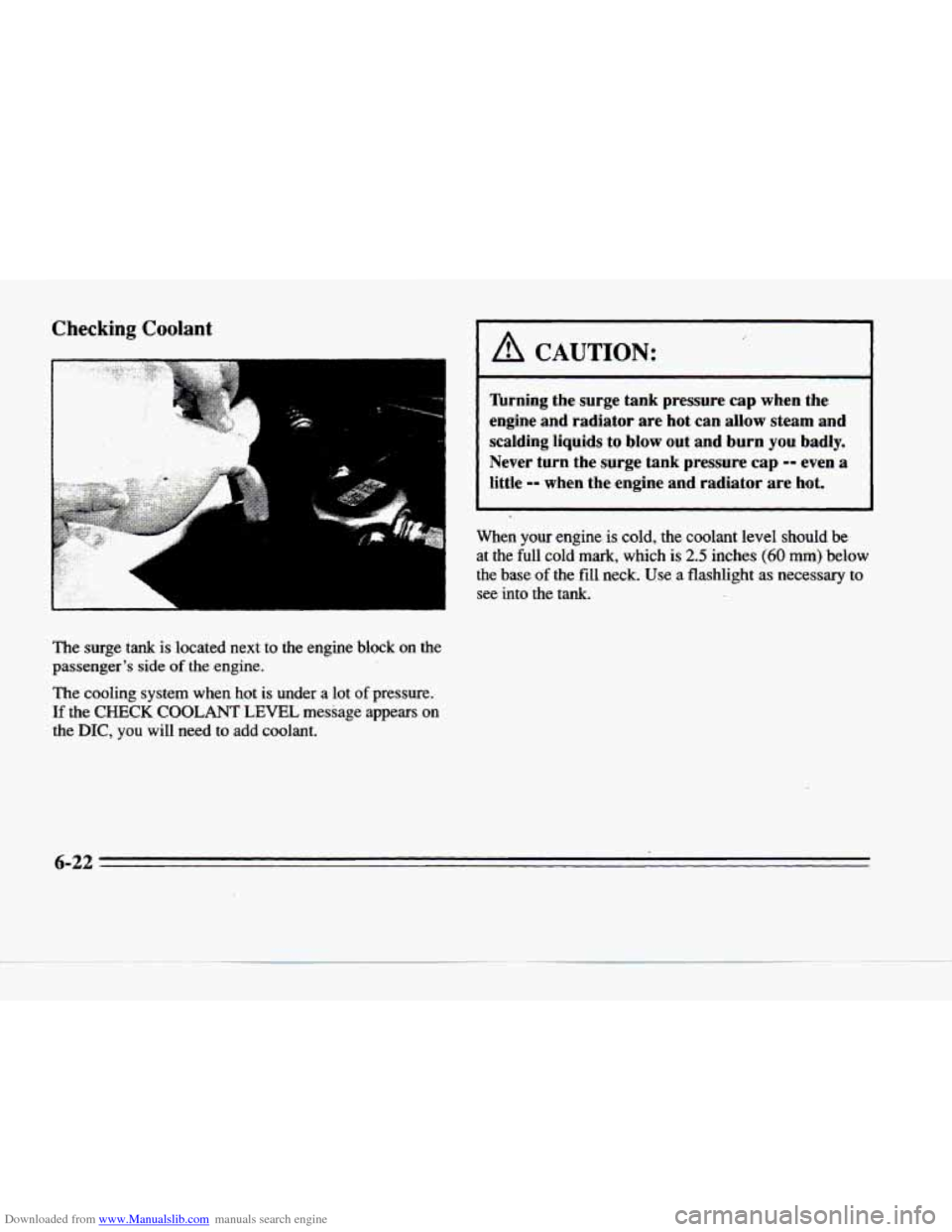
The surge tank is located next to the engine block on the
passenger’s side of the engine.
The cooling system when hot is under a lot of pressure.
If the CHECK COOLANT LEVEL message appears on
the
DIC, you will’need to add coolant.
A CAUTION:
I’urning the surge tank pressure cap when the
engine and radiator are hot can allow steam and
scalding liquids to blow out and burn you badly. Never turn the surge tank pressure cap
-- even a
little
-- when the engine and radiator are hot.
When your engine is cold, the coolant level should be
at the full cold mark, which is 2.5 inches (60 mm) below
the
base of the fill neck. Use a flashlight as necessary to
see into the tank.
Page 303 of 354
Downloaded from www.Manualslib.com manuals search engine Wheel Replacement
Replace any wheel that is bent, cracked, or badly rusted
or corroded.
If wheel nuts keep coming loose, the wheel,
wheel bolts and wheel nuts should be replaced.
If the
wheel leaks air, replace it (except some aluminum
wheels, which can sometimes
be repaired). See your
Cadillac dealer if
any of these conditions exist.
Your dealer will know the kind
of wheel you need.
Each new wheel should have the same load carrying
capacity, diameter, width, offset and be mounted the
same way as the one it replaces.
If you need to replace any of your wheels, wheel bolts
or wheel nuts, replace them only with new GM original
equipment parts. This way, you will
be sure to have the
right wheel, wheel bolts and wheel nuts for your Cadillac
model.
A CAUTION:
Using the wrong replacement wheels, wheel bolts
or wheel nuts on your vehicle can be dangerous.
It could affect the braking and handling of your
vehicle, make your tires lose
air and make you
lose control. You could have
a collision in which
you or others could be injured.
Always use
the correct wheel, wheel bolts and wheel nuts
for replacement.
NOTICE:
The wrong wheel can also cause problems with
bearing life, brake cooling, speedometer/odometer
calibration, headlamp aim, bumper height, vehicle
ground clearance and tire
or tire chain clearance
to
the body and chassis.
See “Changing
a Flat Tire” in the Index for
more information.
-.
1
Page 318 of 354
Downloaded from www.Manualslib.com manuals search engine c
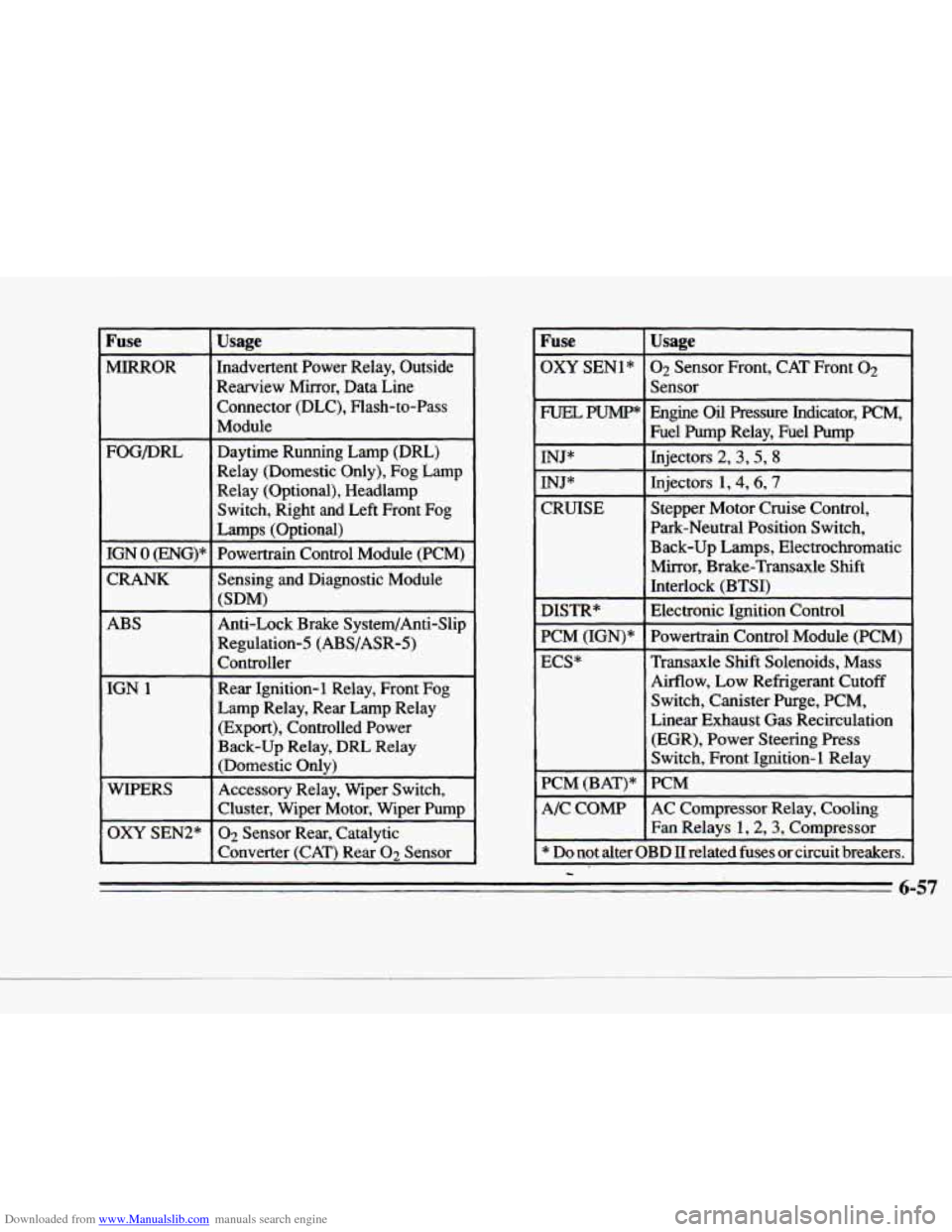
Fuse
MIRROR
FOG/DRL
[GN 0 mG)*
CRANK
ABS
IGN 1
WIPERS
OXY SEN2"
Usage
Inadvertent Power Relay, Outside
Rearview Mirror, Data Line Connector
(DLC), Flash-to-Pass
Module
Daytime Running Lamp
(DRL)
Relay (Domestic Only), Fog Lm
Relay (Optional), Headlamp
Switch, Right and Left Front Fog
Lamps (Optional)
Powertrain Control Module
(PC1
Sensing and Diagnostic Module
(SDM)
Anti-Lock Brake System/Anti-SI
Regulation-5 (ABS/ASR-5) Controller
Rear Ignition-
1 Relay, Front Fog
Lamp Relay, Rear Lamp Relay
(Export), Controlled Power
Back-up Relay,
DRL Relay
(Domestic Only)
Accessory Relay, Wiper Switch,
Cluster, Wiper
Motor, wiper Pump I
02 Sensor Rear, Catalytic
Converter (CAT) Rear
09 Sensor 1
~ ~ ~ ~ ~~~
OXY SENl*
=PUMP*
[NJ*
rnJ*
CRUISE
DISTR"
PCM
(IGN)*
PCM (BAT)*
A/C COMP
Usage
02 Sensor Front, CAT Front 02
Sensor
Engine
Oil Pressure Indicator, PCM,
Fuel Pump Relay, Fuel Pump
Injectors
2,3,5,8
Injectors 1,4,6,7
Stepper Motor Cruise Control,
Park-Neutral Position Switch,
Back-up Lamps, Electrochromatic
Mirror, Brake-Transaxle Shift
Interlock (BTSI)
Electronic Ignition Control
Powertrain Control Module (PCM)
Transaxle Shift Solenoids, Mass Airflow,
Low Refrigerant Cutoff
Switch, Canister Purge, PCM,
Linear Exhaust Gas Recirculation (EGR), Power Steering Press
Switch, Front Ignition-
1 Relay
PCM
AC Compressor Relay, Cooling
Fan Relays
1,2,3, Compressor
BD
11 related fuses or circuit breakers.
Page 320 of 354
Downloaded from www.Manualslib.com manuals search engine c
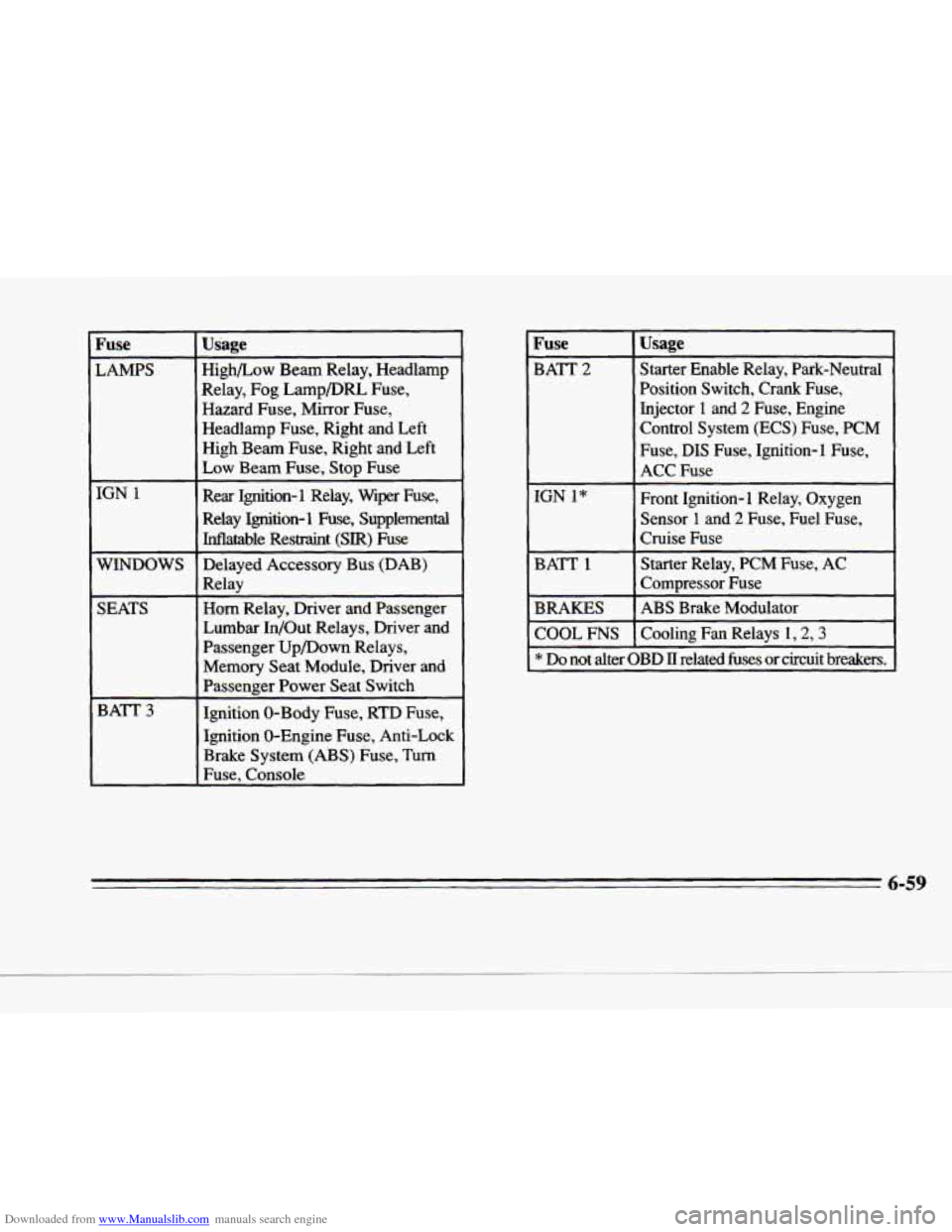
I Fuse I Usage
LAMPS High/Low Beam Relay, Headlamp
Relay,
Fog LampDRL Fuse,
Hazard Fuse, Mirror Fuse,
Headlamp Fuse, Right
and Left
High Beam Fuse, Right and Left
Low Beam Fuse, Stop Fuse
IGN 1 Rear Ignition- 1 Relay, Wiper Fuse,
Relay Ignition-1 Fuse, Supplemental
Inflatable Restraint
(SIR) Fuse
WINDOWS Delayed Accessory Bus (DAB)
I Relay
SEATS Horn Relay, Driver and Passenger
Lumbar In/Out Relays, Driver and
Passenger Up/Down Relays, Memory Seat Module, Driver and
Passenger Power Seat Switch
BAm 3
Ignition 0-Body Fuse, RTD Fuse,
I
Ignition 0-Engine Fuse, Anti-Lock
Brake System (ABS) Fuse, Turn
I I Fuse, Console
I Fuse I Usage I
I BATT 2 Starter Enable Relay, Park-Neutral
Position Switch, Crank Fuse,
Injector 1 and
2 Fuse, Engine
Control System (ECS) Fuse, PCM
Fuse,
DIS Fuse, Ignition-1 Fuse,
ACC Fuse
IGN 1" Front Ignition- 1 Relay, Oxygen
Sensor
1 and 2 Fuse, Fuel Fuse,
Cruise Fuse
Compressor Fuse
BATT
1 Starter Relay, PCM Fuse, AC
I BRAKES I ABS Brake Modulator I I
ICOOL FNS I Cooling Fan Relays
1,2,3 1
I * Do not alter OBD II related fuses or circuit breakersl
6-59
Page 325 of 354
Downloaded from www.Manualslib.com manuals search engine Capacities and Specifications (Continued)
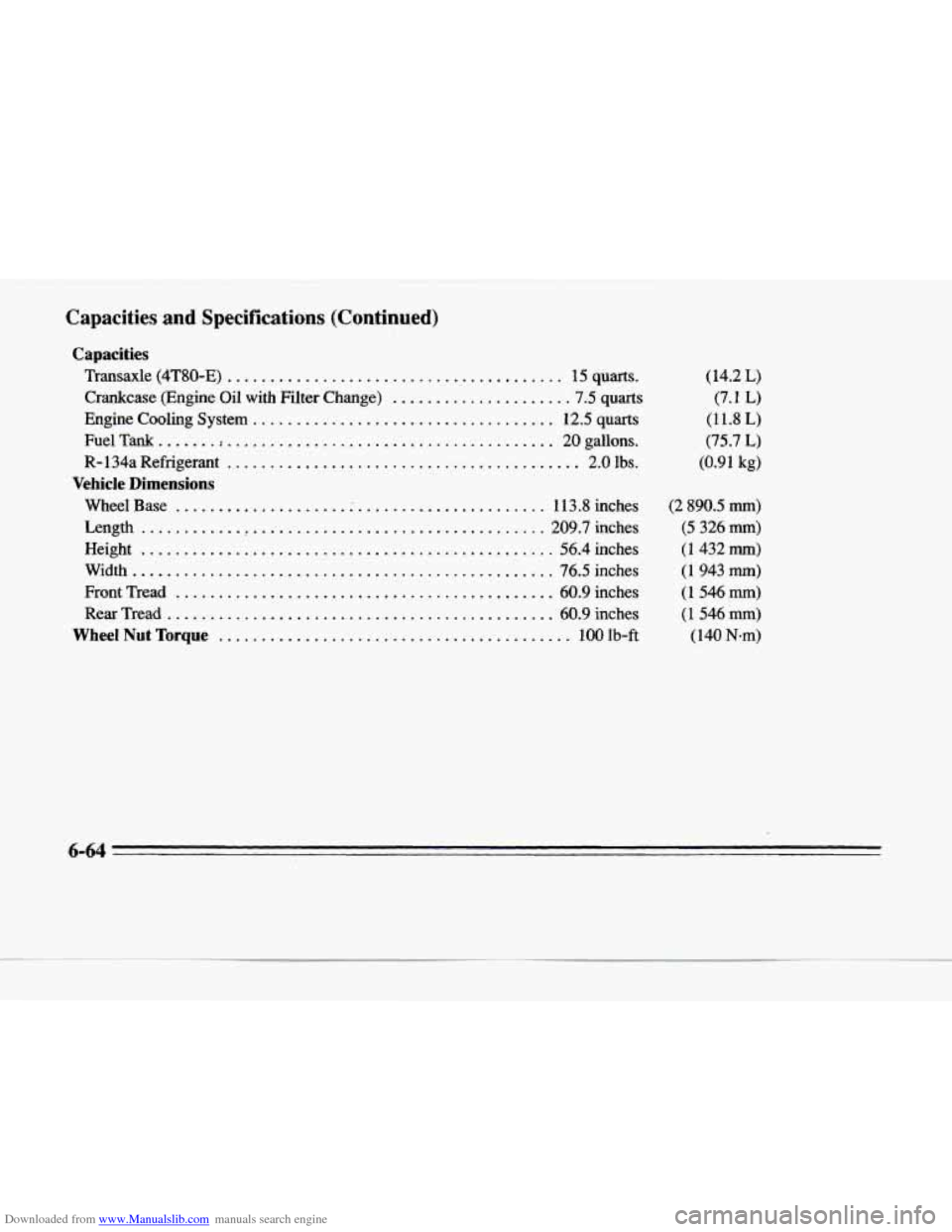
Capacities
Transaxle (4T80-E) ....................................... 15 quarts.
Engine Cooling System
................................... 12.5 quarts
R- 134a Refrigerant ......................................... 2.0 lbs.
Crankcase (Engine Oil with Filter Change) .................... .7.5 quarts
FuelTank ....... ....................................... 20gallons.
Vehicle Dimensions
Wheel Base .................... ; ...................... 113.8 inches
Length
............................................... 209.7inches
Height
................................................ 56.4 inches
Wid
................................................... 76.5inches
Front Tread ............................................ 60.9 inches
Rear Tread ............................................. 60.9 inches
Wheel Nut Torque ......................................... 100 lb-ft (14.2
L)
(7.1 L)
(11.8 L)
(75.7 L)
(0.91 kg)
(2 890.5 mm)
(5 326 mm)
(1 432 mm)
(1 943 mm)
(1 546 mm)
(1
546 mm)
(140 Nm)
-.
6-64