steering CADILLAC DEVILLE 1996 7.G User Guide
[x] Cancel search | Manufacturer: CADILLAC, Model Year: 1996, Model line: DEVILLE, Model: CADILLAC DEVILLE 1996 7.GPages: 354, PDF Size: 20.32 MB
Page 88 of 354
Downloaded from www.Manualslib.com manuals search engine f
r
r
r
r
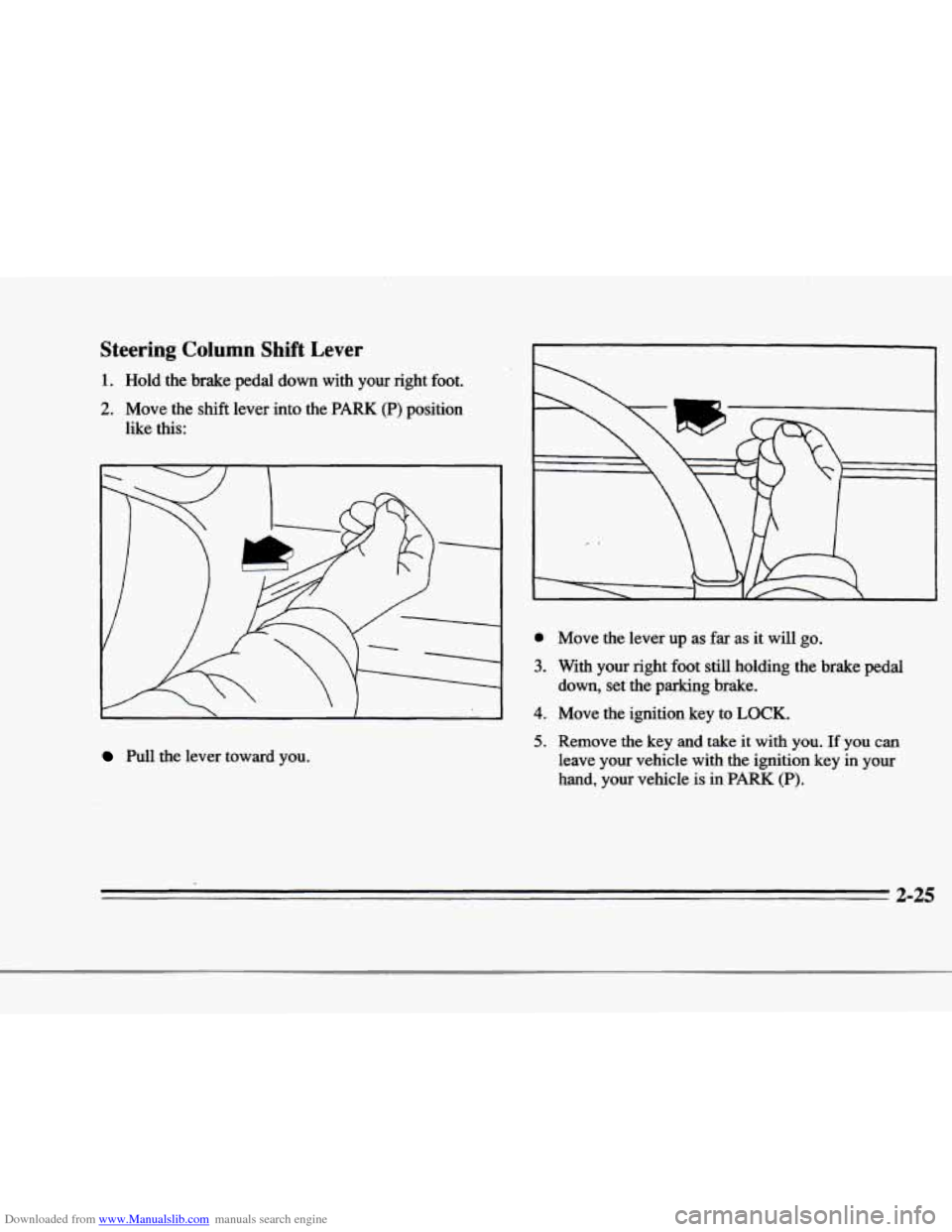
Steering Column Shift Lever
1. Hold the brake pedal down with your right foot.
2. Move the shift lever into the PARK (P) position
like this:
Pull the lever toward you.
r
r .
e
3.
4.
5.
Move the lever up as far as it will go.
With your right foot still holding the brake pedal
down, set the parking brake.
Move the ignition key to
LOCK.
Remove the key and take it with you. If you can
leave
your vehicle with the ignition key in your
hand, your vehicle is
in PARK (P).
2-25
Page 93 of 354
Downloaded from www.Manualslib.com manuals search engine Your vehicle has RAP. When you stop your vehicle and Rear Window Lockout
turn the ignition key to OFF, you can still use your
power windows. The electrical power to operate the
windows will not shut off until
you open a door or 10
minutes have passed. If you want this power for another
10 minutes, turn the key to RUN and back to OFF.
Express-Down Window
This feature is present on the driver’s power window.
Pressing the control rearward
will lower the window
completely.
If you want to stop the window as it is
lowering, press
the control forward. Press the control
forward to raise the window.
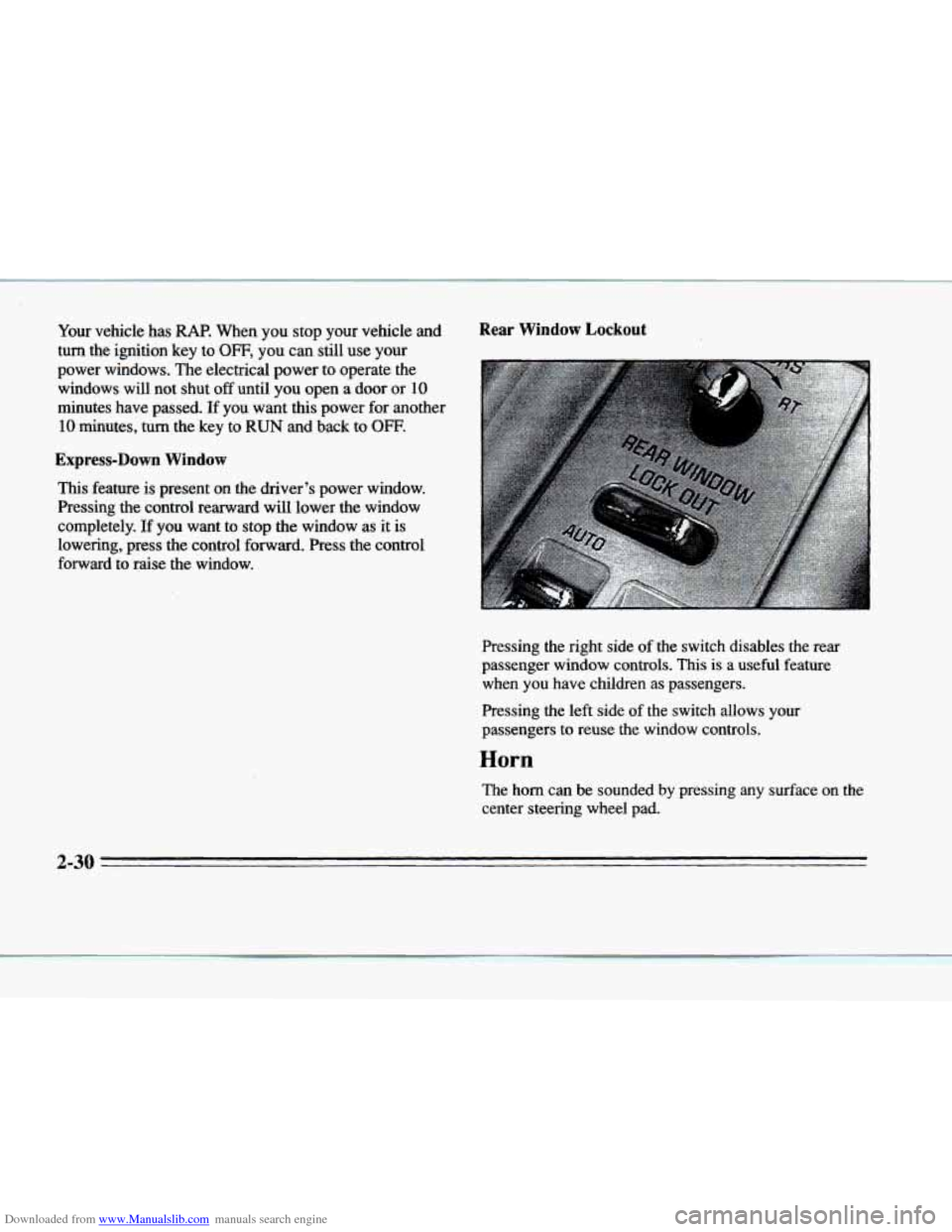
Pressing the right side
of the switch disables the rear
passenger window controls. This
is a useful feature
when you have children as passengers.
Pressing the
left side of the switch allows your
passengers to reuse the window controls.
Horn
The horn can be sounded by pressing any surface on the
center steering wheel pad.
2-30
Page 94 of 354
Downloaded from www.Manualslib.com manuals search engine Tilt Wheel
P
c
c
c
P
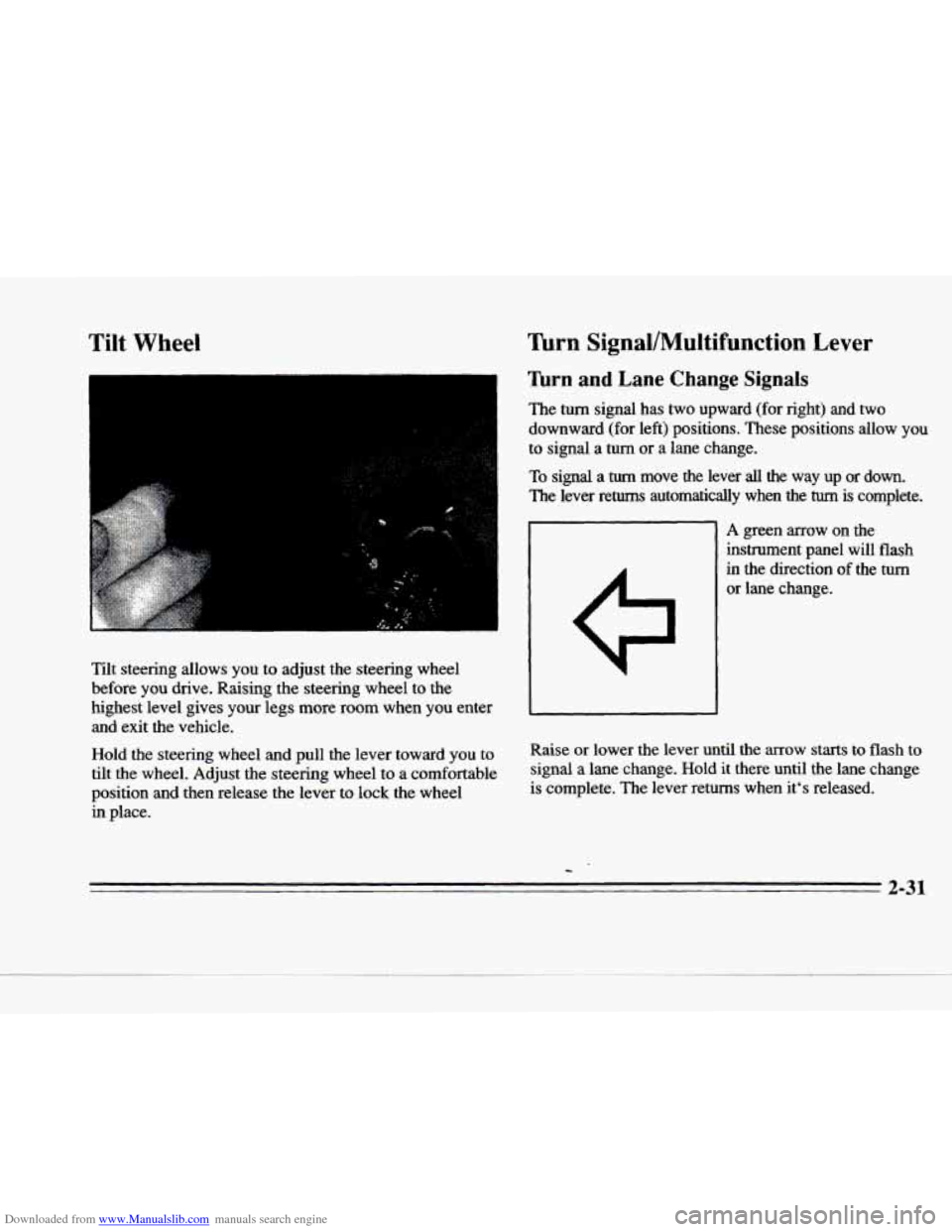
zit steering allows you to adjust the steering wheel
before you drive. Raising the steering wheel to the
highest level gives
your legs more room when you enter
and exit the vehicle.
Hold the steering wheel
and pull the lever toward you to
tilt the wheel. Adjust the steering wheel to a comfortable
position
and then release the lever to lock the wheel
in place.
Turn Signal/Multifunction Lever
lhrn and Lane Change Signals
The turn signal has two upward (for right) and two
downward (for left) positions.
These positions allow you
to signal a turn or a lane change.
To signal a turn move the lever all the way up or down.
The lever returns automatically when the turn is complete.
A green mow on the
instrument panel will
flash
in the direction of the turn
or lane change.
Raise or lower the lever until the
arrow starts to flash to
signal
a lane change. Hold it there until the lane change
is complete. The lever returns when it's released.
2-31
Page 118 of 354
Downloaded from www.Manualslib.com manuals search engine r
P
Visor Vanity Mirror Illuminated Rear Seat Visor Vanity Mirror
To use
one, turn the sunshade down and lift the cover to (Concours Only)
see the mirror.
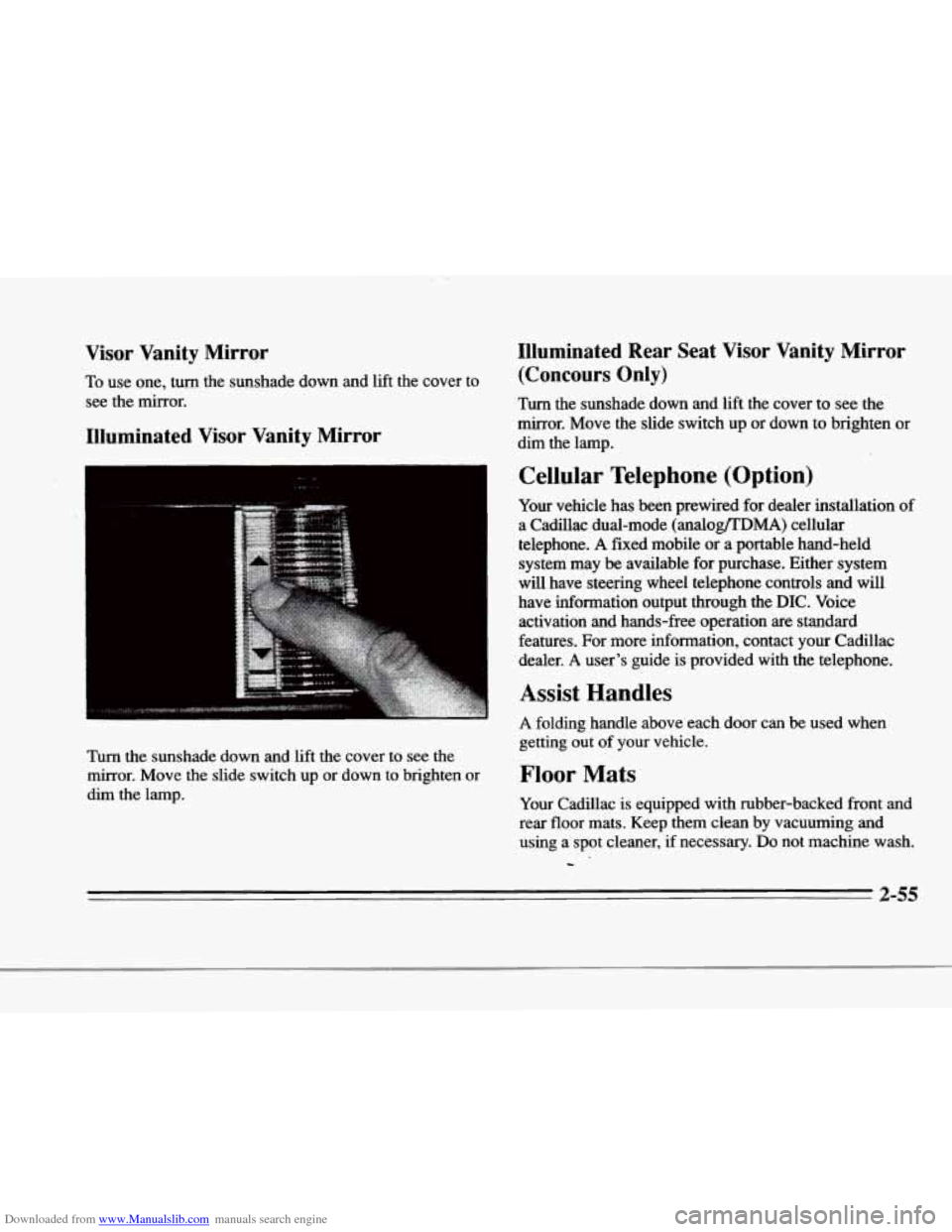
Illuminated Visor Vanity Mirror
Turn the sunshade down and lift the cover to see the
mirror. Move the slide switch up or down to brighten or
dim the lamp.
Cellular Telephone (Option)
Turn the sunshade down and lift the cover to see the
mirror. Move the slide switch up or down to brighten
or
dim the lamp. Your vehicle has been prewired
for dealer installation of
a Cadillac dual-mode (analog/TDMA) cellular
telephone.
A fixed mobile or a portable hand-held
system may be available for purchase. Either system
will have steering wheel telephone controls
and will
have information output through the DIC. Voice
activation and hands-free operation are standard
features. For more information, contact your Cadillac
dealer.
A user's guide is provided with the telephone.
Assist Handles
A folding handle above each door can be used when
getting out
of your vehicle.
Floor Mats
Your Cadillac is equipped with rubber-backed front and
rear floor mats. Keep them clean by vacuuming and
using a spot cleaner,
if necessary. Do not machine wash.
2-55
Page 124 of 354
Downloaded from www.Manualslib.com manuals search engine F-
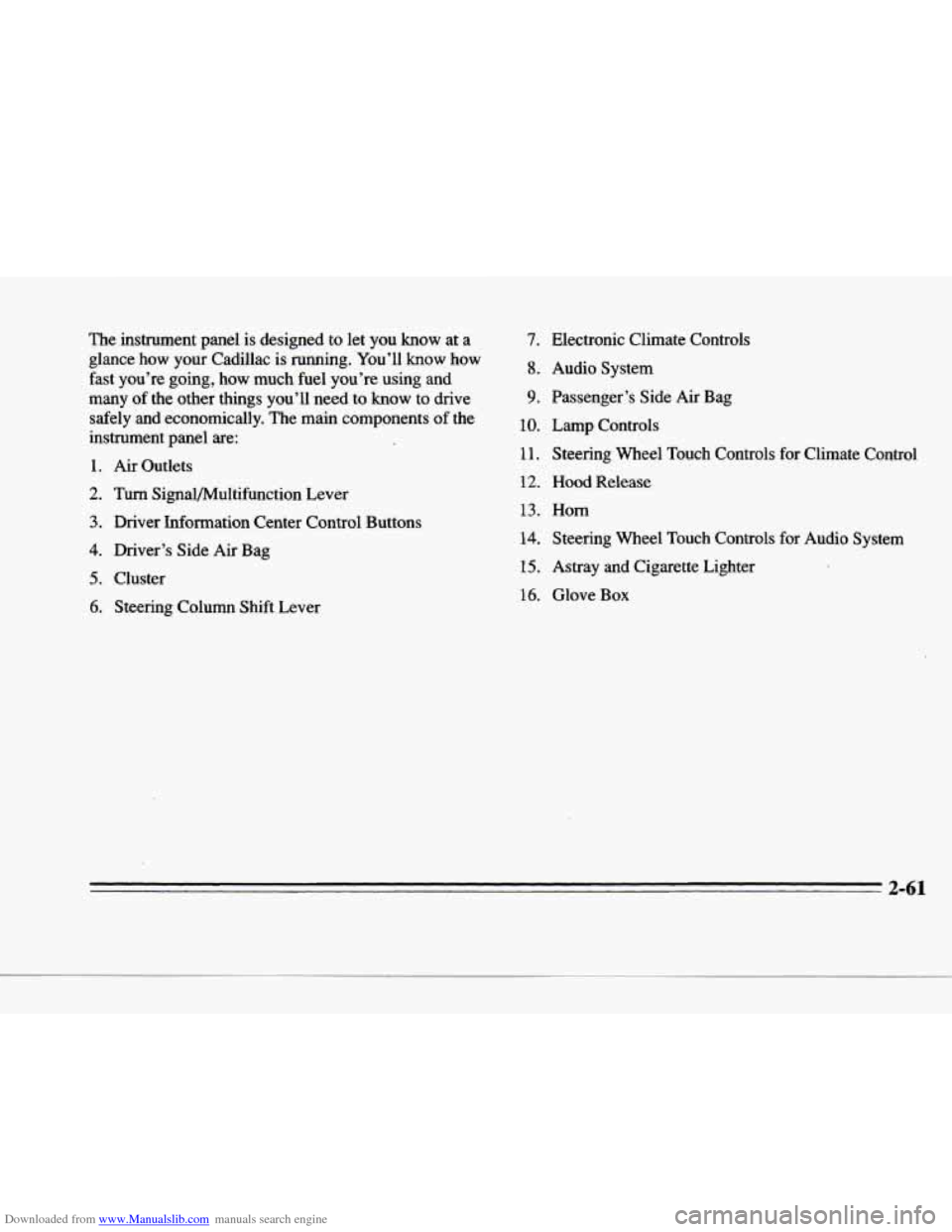
The instrument panel is designed to let you know at a
glance
how your Cadillac is running. You’ll know how
fast you’re going, how much fuel you’re using and
many
of the other things you’ll need to know to drive
safely and economically. The main components
of the
instrument panel are:
1. Air Outlets
2. Turn Signal/Multifunction Lever
3. Driver Information Center Control Buttons
c
4. Driver’s Side Air Bag
5. Cluster
6. Steering Column Shift Lever
7. Electronic Climate Controls
8. Audio System
9. Passenger’s Side Air Bag
10. Lamp Controls
11. Steering Wheel Touch Controls for Climate Control
12. Hood Release
13. Horn
14. Steering Wheel Touch Controls for Audio System
15. Astray and Cigarette Lighter
16. Glove Box
2-61
Page 156 of 354
Downloaded from www.Manualslib.com manuals search engine P
L-
c
(@ Rear Window Defogger
The lines you see on the rear window warrn the glass.
Press the button to turn on the rear defogger. With it,
the rear window and both outside rearview mirrors are heated.
The system will automatically shut off after
10 minutes. If further defogging is desired, press the
button again.
Do not attach a temporary vehicle license, tape or decals
across the defogger grid on the rear window.
NOTICE:
Scraping the inside of your rear window could
cut and damage the heating grids.
Your warranty
would not cover this damage.
And don’t put
decals there;
you might have to scrape them off.
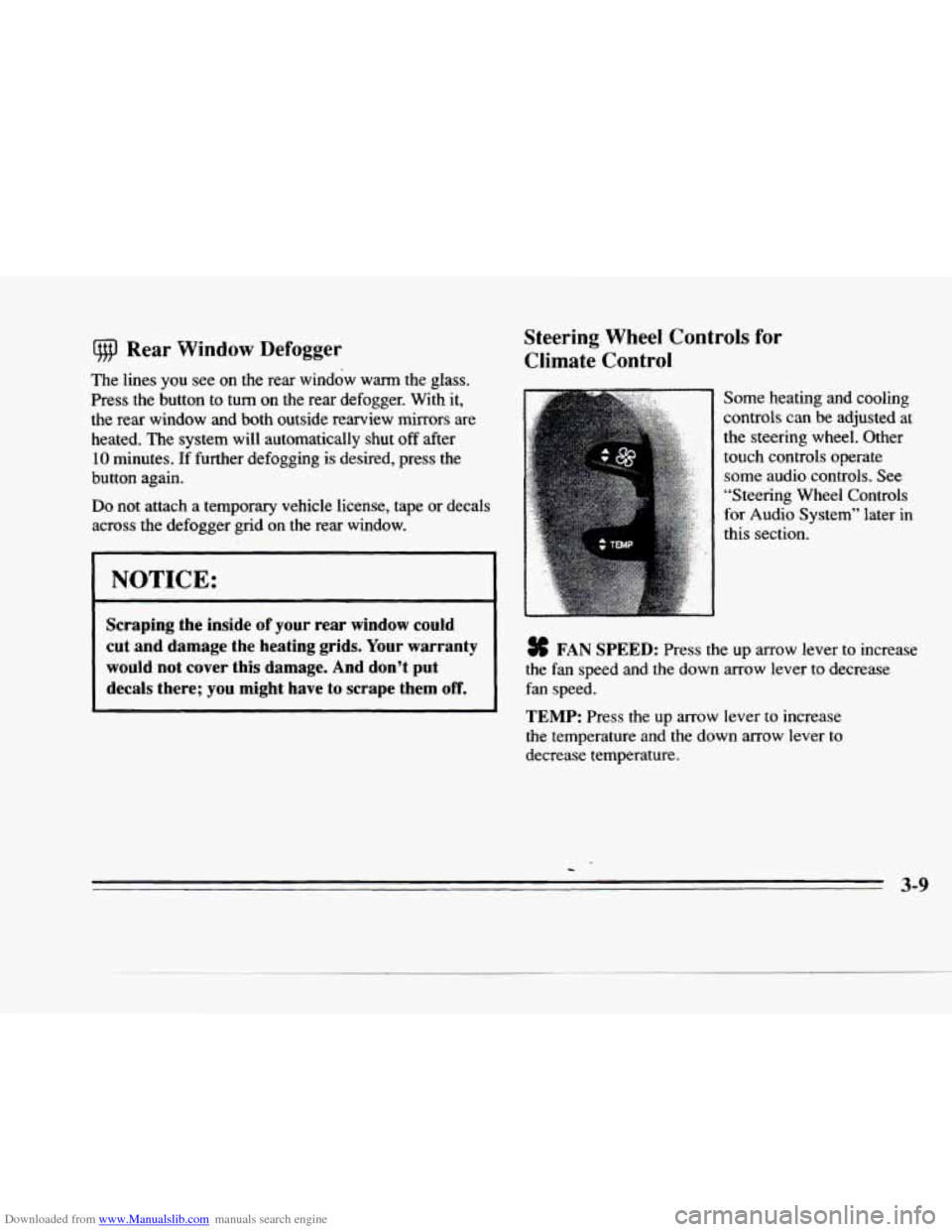
Steering Wheel Controls for
Climate Control
Some heating and cooling
controls can be adjusted at
the steering wheel. Other touch controls operate some audio controls. See
“Steering Wheel Controls
for Audio System’’ later in
this section.
# FAN SPEED: Press the up arrow lever to increase
the
fan speed and the down arrow lever to decrease
fan speed.
TEMP: Press the up arrow lever to increase
the temperature and the down arrow lever to
decrease temperature.
c
Page 176 of 354
Downloaded from www.Manualslib.com manuals search engine c
CD CHANGER DOOR OPEN is displayed when the
CD changer door is left open. Completely close the
changer door to restore normal operation.
CD CHANGER
NO DISCS is displayed when an empty
magazine is inserted
in the CD changer. Try the
magazine again with a disc loaded on one
of the trays.
If any error occurs repeatedly or if an error cannot be
corrected, please contact your dealer.
If your radio
displays an error number, write
it down and provide it to
your dealer when reporting the problem.
Theft-Deterrent Feature
Your Cadillac has a “built-in” theft-deterrent feature on
each radio that is automatic -- there is no programming
required. The radio in your Cadillac cannot be used in
any other vehicle besides another Cadillac if it were to
be removed.
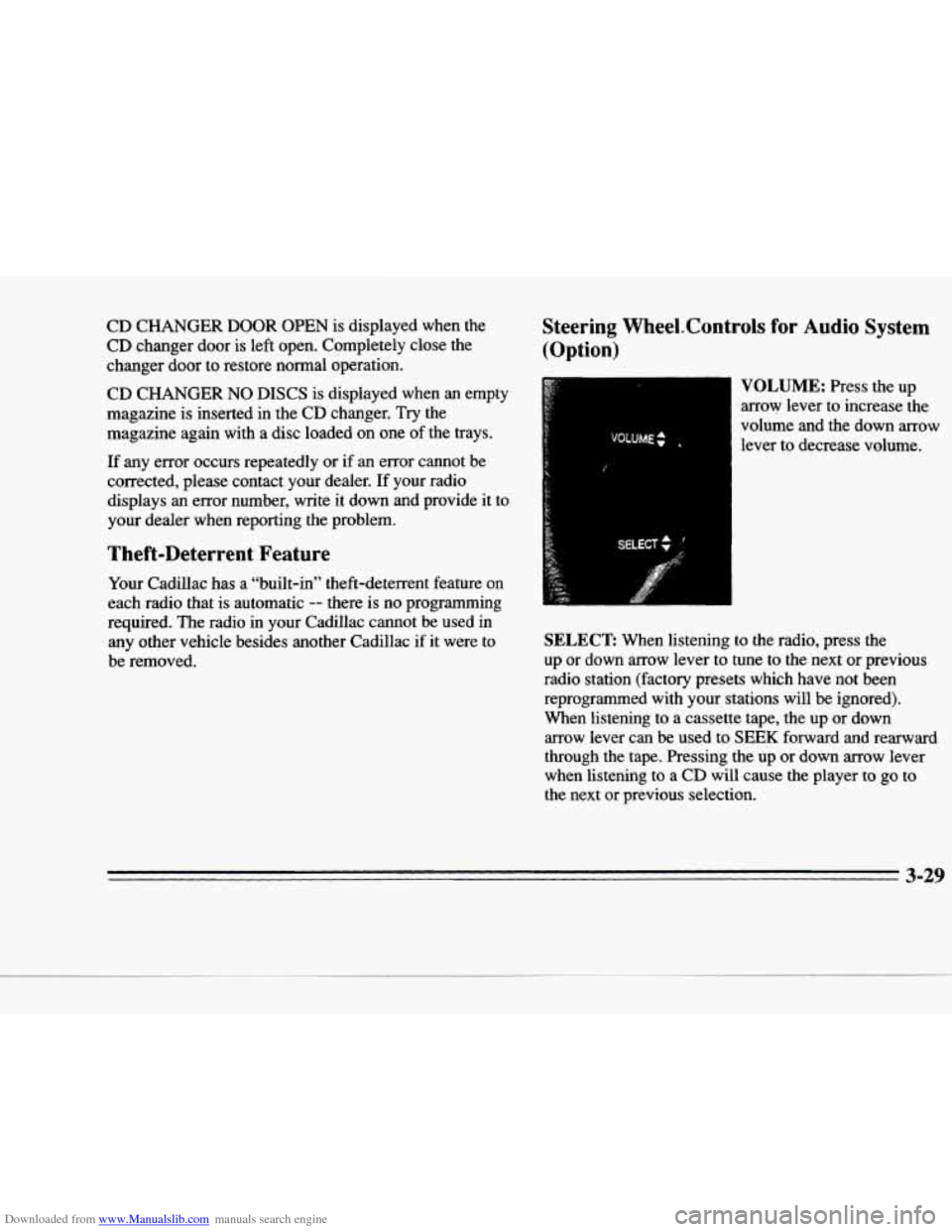
Steering Wheel.Controls for Audio System
(Option)
I VOLUME: Press the up
arrow lever to increase the
volume and the down arrow lever
to decrease volume.
SELECT When listening to the radio, press the
up or down
arrow lever to tune to the next or previous
radio station (factory presets which have not been
reprogrammed with your stations will be ignored).
When listening to a cassette tape, the up or down
arrow lever can be used to SEEK forward and rearward
through the tape. Pressing the up or down
arrow lever
when listening to
a CD will cause the player to go to
the next or previous selection.
3-29
Page 186 of 354
Downloaded from www.Manualslib.com manuals search engine 1
c
c
Control of a Vehicle
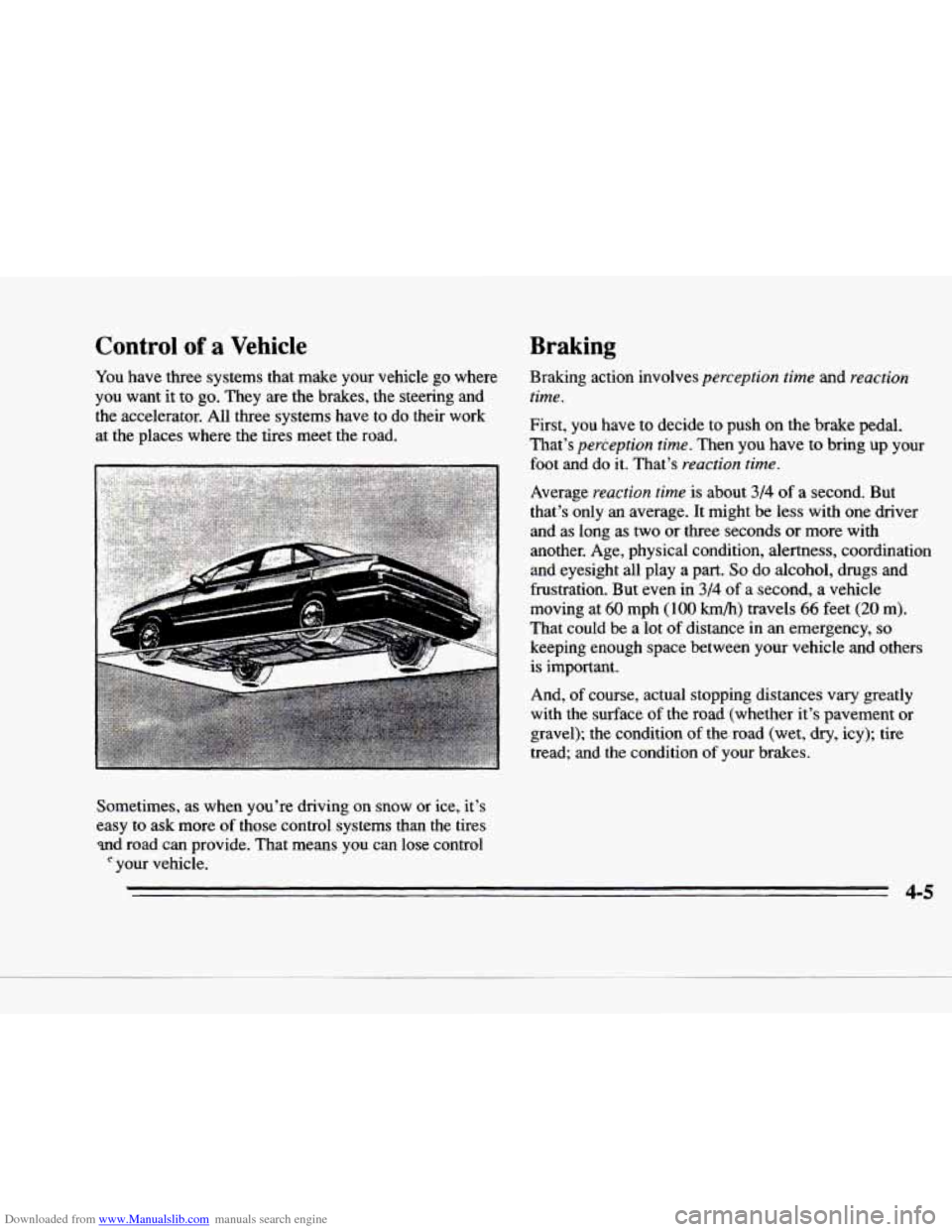
You have three systems that make your vehicle go where
you want it to
go. They are the brakes, the steering and
the accelerator. All three systems have to do their work at the places where the tires meet the road.
Braking
Braking action involves perception time and reaction
time.
First, you have to decide to push on the brake pedal.
That’s
perception time. Then you have to bring up your
foot and do it. That’s
reaction time.
Average reaction time is about 3/4 of a second. But
that’s only an average. It might be less with one driver
and as long as two or three seconds
or more with
another. Age, physical condition, alertness, coordination
and eyesight all play a part.
So do alcohol, drugs and
frustration. But even in
3/4 of a second, a vehicle
moving at
60 mph (100 km/h) travels 66 feet (20 m).
That could be a lot of distance in an emergency, so
keeping enough space between your vehicle and others
is important.
And,
of course, actual stopping distances vary greatly
with the surface of the road (whether it’s pavement
or
gravel); the condition of the road (wet, dry, icy); tire
tread; and the condition
of your brakes.
Sometimes, as when you’re driving on snow or ice, it’s
easy to ask more
of those control systems than the tires
md road can provide. That means you can lose control
your vehicle.
4-5
Page 191 of 354
Downloaded from www.Manualslib.com manuals search engine Braking in Emergencies
Use your anti-lock braking system when you need to.
With anti-lock, you can steer
and brake at the same
time.
In many emergencies, steering can help you more
than even the very best braking.
Steering
Power Steering
If you lose power steering assist because the engine
stops or
the system is not functioning, you can steer but
it will take much more effort.
MAGNASTEER TM (Concours Only)
Your vehicle may be equipped with GM MAGNASTEER,
a system that continuously adjusts the effort you feel when
steering at
all vehicle speeds. It provides ease when
parking yet a fm, solid feel at highway speeds.
Speed Sensitive Steering (SSS)
(DeVille Only)
This system varies the amount of steering effort
proportionate to your vehicle speed. Steering is easier at
a lower speed for maneuvering and parking ease. As
your vehicle speed increases, the steering effort also
increases.
At highway speeds, the amount of steering
effort is increased
to provide manual-like steering for
maximum control and stability.
Steering Tips
Driving on Curves
It’s important to take curves at a reasonable speed.
A lot of the “driver lost control” accidents mentioned on
the news happen on curves. Here’s why:
Experienced driver or beginner, each
of us is subject to
the same laws
of physics when driving on curves. The
traction
of the tires against the road surface makes it
possible for the vehicle
to change its path when you turn
the front wheels. If there’s no traction, inertia will keep
the vehicle going
in the same direction. If you’ve ever
tried to steer
a vehicle on wet ice, you’ll understand this.
4-10
Page 192 of 354
Downloaded from www.Manualslib.com manuals search engine CI
c-
The traction you can get in a curve depends on the
condition
of your tires and the road surface, the angle at
which the curve is banked and your speed. While you’re
in a curve, speed is the one factor you can control.
Suppose you’re steering through a sharp curve. Then
you suddenly accelerate.
Both control systems -- steering
and acceleration
-- have to do their work where the tires
meet the road. Unless your traction control system is on, adding the sudden acceleration can demand too much
of
those places. You can lose control.
What should you do
if this ever happens? Ease up on the
accelerator pedal, steer the vehicle the way you
want it
to go, and slow down.
Speed limit signs near curves warn that you should
adjust your speed. Of course, the posted speeds are
based on good weather and road conditions. Under less favorable conditions you’ll want to
go slower.
If you need to reduce your speed as you approach a
curve, do
it before you enter the curve, while your front
wheels are straight ahead.
Try to adjust your speed so you can “drive” through the
curve. Maintain
a reasonable, steady speed. Wait to
accelerate until you are out of the curve, and then
accelerate gently into the straightaway.
Steering in Emergencies
There are times when steering can be more effective
than braking. For example, you come over a hill and
find a truck stopped
in your lane, or a car suddenly pulls
out from nowhere, or a child darts out from between
parked cars and stops right
in front of you. You can
avoid these problems by braking
-- if you can stop in
time. But sometimes you can’t; there isn’t room. That’s\
the time for evasive action
-- steering around the
problem.
Your Cadillac can perform very well in emergencies like
these. First apply your brakes. (See “Braking
in
Emergencies’’ earlier in this section.) It is better to
remove as much speed as you can
from a possible
collision. Then steer around the problem, to the left or right depending on the space available.
4-11
c