change time CADILLAC DEVILLE 1996 7.G Owner's Manual
[x] Cancel search | Manufacturer: CADILLAC, Model Year: 1996, Model line: DEVILLE, Model: CADILLAC DEVILLE 1996 7.GPages: 354, PDF Size: 20.32 MB
Page 191 of 354
Downloaded from www.Manualslib.com manuals search engine Braking in Emergencies
Use your anti-lock braking system when you need to.
With anti-lock, you can steer
and brake at the same
time.
In many emergencies, steering can help you more
than even the very best braking.
Steering
Power Steering
If you lose power steering assist because the engine
stops or
the system is not functioning, you can steer but
it will take much more effort.
MAGNASTEER TM (Concours Only)
Your vehicle may be equipped with GM MAGNASTEER,
a system that continuously adjusts the effort you feel when
steering at
all vehicle speeds. It provides ease when
parking yet a fm, solid feel at highway speeds.
Speed Sensitive Steering (SSS)
(DeVille Only)
This system varies the amount of steering effort
proportionate to your vehicle speed. Steering is easier at
a lower speed for maneuvering and parking ease. As
your vehicle speed increases, the steering effort also
increases.
At highway speeds, the amount of steering
effort is increased
to provide manual-like steering for
maximum control and stability.
Steering Tips
Driving on Curves
It’s important to take curves at a reasonable speed.
A lot of the “driver lost control” accidents mentioned on
the news happen on curves. Here’s why:
Experienced driver or beginner, each
of us is subject to
the same laws
of physics when driving on curves. The
traction
of the tires against the road surface makes it
possible for the vehicle
to change its path when you turn
the front wheels. If there’s no traction, inertia will keep
the vehicle going
in the same direction. If you’ve ever
tried to steer
a vehicle on wet ice, you’ll understand this.
4-10
Page 195 of 354
Downloaded from www.Manualslib.com manuals search engine 0
0
a
a
Check your mirrors, glance over your shoulder and
start your left lane change signal before moving out
of the right lane to pass. When you are far enough
ahead of the passed vehicle to see its front in your
inside mirror, activate your right lane change signal
and move back into the right lane. (Remember that
your right outside mirror is convex. The vehicle you
just passed may seem to be farther away from you
than it really is.)
Try not to pass more than one vehicle at a time on
two-lane roads. Reconsider before passing the next
vehicle.
Don’t overtake a slowly moving vehicle too rapidly.
Even though the brake
lamps are not flashing, it may
be slowing down or starting to turn.
If you’re being passed, make it easy for the
following driver
to get ahead of you. Perhaps you
can ease a little to the right.
Loss of Control
Let’s review what driving experts say about what
happens when the three control systems (brakes, steering
and acceleration) don’t have enough friction where
the
tires meet the road to do what the driver has asked.
In any emergency, don’t give up. Keep trying to steer and
constantly seek
an escape route or area of less danger.
Skidding
In a skid, a driver can lose control of the vehicle.
Defensive drivers avoid most skids
by taking reasonable
care suited to existing conditions, and by not “overdriving”\
those conditions. But skids are always possible.
The three types
of skids correspond to your Cadillac’s
three control systems. In the braking skid, your wheels aren’t rolling.
In the steering or cornering skid, too
much speed or steering in a curve causes tires to slip and
lose comering force. And in the acceleration skid, too
much throttle causes the driving wheels
to spin.
A cornering skid is best handled by easing your foot off
the accelerator pedal.
Remember: Any traction control system helps avoid
only the acceleration skid.
If your traction control system is
off, then an
acceleration skid is also best handled by easing your
foot
off the accelerator pedal.
If your vehicle starts to slide, ease your foot off the
accelerator pedal and quickly steer the way you want the
vehicle to go. If you
start steering quickly enough, your
vehicle may straighten out. Always be ready for a
second skid
if it occurs.
4-14
Page 213 of 354
Downloaded from www.Manualslib.com manuals search engine Your vehicle can tow a trailer if it is equipped with
proper towing equipment.
To identify what the vehicle
trailering capacity
is for your vehicle, you should read
the information
in “Weight of the Trailer” that appears
later
in this section. But trailering is different than just
driving your vehicle by itself. Trailering means changes
in handling, durability and fuel economy. Successful,
safe trailering takes correct equipment, and it has to be
used properly.
That’s the reason for this part. In
it are many
time-tested, important trailering tips and safety rules.
Many of these are important for your safety and that of
your passengers.
So please read this section carefully
before you pull a trailer.
Load-pulling components such
as the engine, transaxle,
wheel assemblies and tires are forced
to work harder
against the drag of
the added weight. The engine is
required to operate at relatively higher speeds and under
greater loads, generating extra heat. What’s more, the
trailer adds considerably to wind resistance, increasing the pulling requirements.
If You Do Decide To Pull A Trailer
If you do, here are some important points.
0
0
e
0
0
There are many different laws, including speed limit
restrictions, having to do with trailering. Make sure
your rig will be legal, not only where you live but
also where you’ll be driving.
A good source for this
information can be state or provincial police.
Consider
using a sway control if your trailer will
weigh
2,000 lbs. (900 kg) or less. You should always
use a sway control if your trailer will weigh more
than
2,000 lbs. (900 kg). You can ask a hitch dealer
about sway controls.
Don’t tow a trailer at all during the first
1 ,OOO miles
(1
600 km) your new vehicle is driven. Your engine,
axle
or other parts could be damaged.
Then, during the first
500 miles (800 km) that you
tow a trailer, don’t drive over
50 mph (80 kmh) and
don’t make starts at full throttle. This helps your
engine and other parts of your vehicle wear in at the
heavier loads.
Obey speed limit restrictions when towing a trailer.
Don’t drive faster than the maximum posted speed
for trailers (or no more than
55 mph (90 km/h)) to
save wear on your vehicle’s parts.
-.
4-32
Page 254 of 354
Downloaded from www.Manualslib.com manuals search engine r
r
P
t
r
r
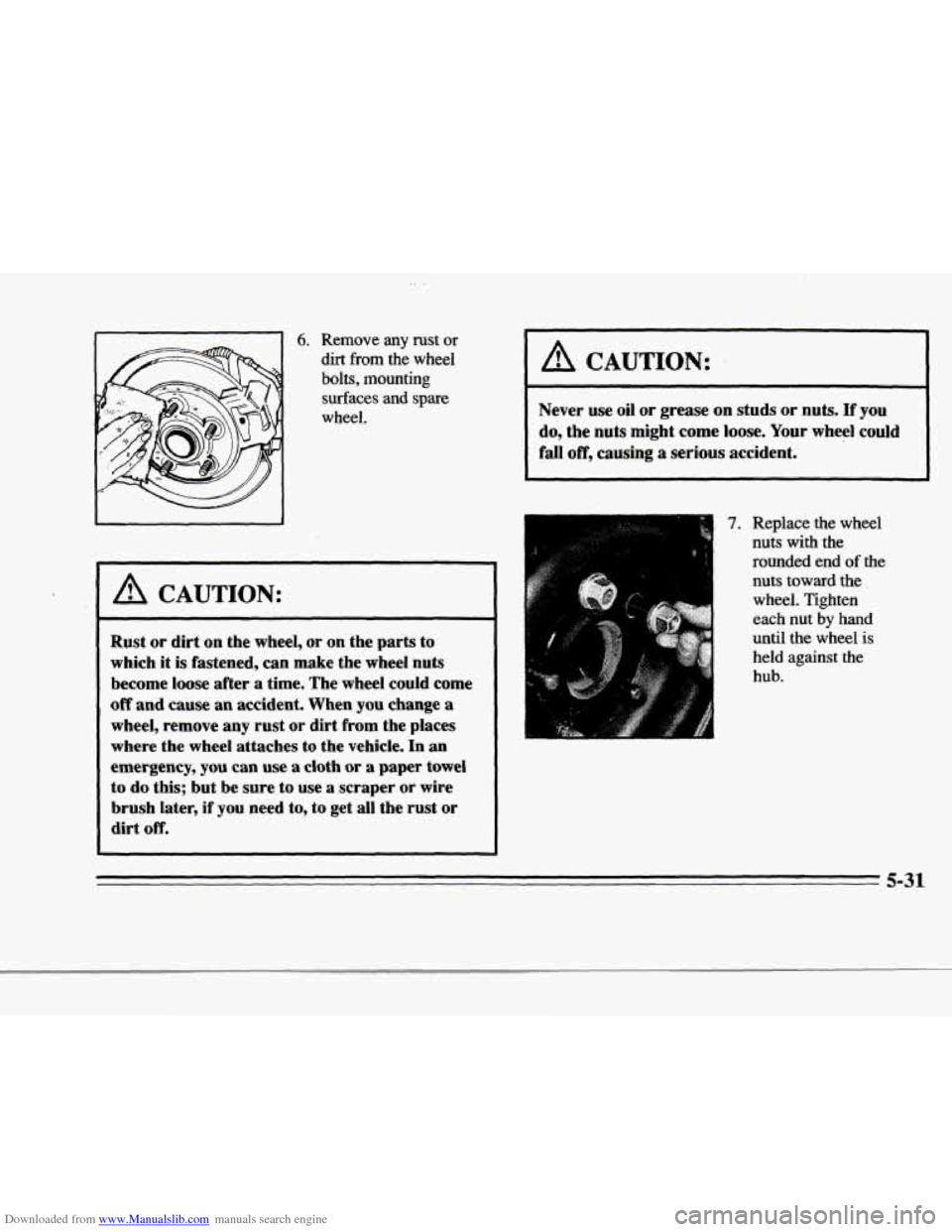
dirt from the wheel
bolts, mounting surfaces
and spare
wheel.
A CAUTION:
Rust or dirt on the wheel, or on the parts to
which it is fastened, can make the wheel
nuts
become loose after a time. The wheel could come
off and cause an accident. When you change a
wheel, remove any rust or dirt from the places
where the wheel attaches to the vehicle.
In an
emergency, you can use a cloth or a paper towel
to do this; but be sure to use a scraper or wire
brush later, if you need to, to get all the rust or
dirt off.
I A CAUTION:
~ ~~
Never use oil or grease on studs or nuts. If you
do, the nuts might come loose. Your wheel could
fall off, causing a serious accident.
- 7. Replace the wheel
nuts with the
rounded end of the
nuts toward the wheel. Tighten
each nut
by hand
until the wheel
is
held against the
hub.
5-3 1
P I
Page 274 of 354
Downloaded from www.Manualslib.com manuals search engine CI
c-
c
When to Change Engine Oil
Your Cadillac has an Oil Life Indicator. This feature
will let you know when to change your oil and
filter
-- usually between 3,000 miles (5 000 km) and
7,500 miles (12 500 km) since your last oil change.
Under severe conditions, the indicator may come on
before
3,000 miles (5 OOO km). Never drive your vehicle
more than
7,500 miles (12 500 km) or 12 months,
(whichever occurs first) without an oil change.
The system won’t detect dust in the oil.
So, if you
drive in a dusty area, be sure to change your oil every
3,000 miles (5 000 km) or sooner if the CHANGE
ENGINE OIL message comes on. Remember to reset
the
Oil Life Indicator when the oil has been changed.
For more information, see “Oil Life Indicator”
in
the Index.
How to Reset the Oil Life Indicator
After the oil has been changed, display the OIL LIFE
LEFT message by pressing the INFORMATION button.
Then press and hold the RESET button until the display
shows
“100.” This resets the oil life index. The message
will remain off until the next oil change is needed. The
percentage of oil life remaining may be checked at any
time by pressing the INFORMATION button several
times until the
OIL LIFE LEFT message appears. For more information
on the Oil Life Index
feature, see “oil
Life Indicator” in the Index.
What to Do with Used Oil
Did you know that used engine oil contains certain
elements that may be unhealthy for your skin and could
even cause cancer? Don’t let used oil stay
on your skin
for very long. Clean your skin and nails with soap and
water, or a good hand cleaner. Wash
;or properly throw
away clothing
or rags containing used engine oil. (See
the manufacturer’s warnings about the use
and disposal
of oil products.)
Used oil can be a real threat to the environment. If you
change your own oil, be sure to drain
all free-flowing oil
from the filter before disposal. Don’t ever dispose of oil
by putting it in the trash, pouring it on the ground, into
sewers, or into streams or bodies of water. Instead,
recycle
it by taking it to a place that collects used oil. If
you have a problem properly disposing
of your used oil,
ask your dealer, a service station or a local recycling
center for help.
6-13
Page 278 of 354
Downloaded from www.Manualslib.com manuals search engine rc
c
c
c
Automatic Transaxle Fluid
When to Check and Change
A good time to check your automatic transaxle fluid
level is when the engine oil is changed.
Change
both the fluid and filter every 50,000 miles
(83 0oO km) if the vehicle is mainly driven under one or
more of these conditions:
In heavy city traffic where the outside temperature
In hilly or mountainous terrain.
regularly reaches
90°F (32°C) or higher.
0 When doing frequent trailer towing.
0 Uses such
as found in taxi, police or delivery service.
If you do not use your vehicle under any of these
conditions, the fluid
and filter do not require changing.
See “Scheduled Maintenance Services” in the
Maintenance Schedule booklet.
How to Check
Because this operation can be a little difficult, you may
choose to have this done at
your Cadillac dealership
service department.
If you do it yourself, be sure to follow all the instructions
here,
or you could get a false reading on the dipstick.
I NOTICE:
Too much or too little fluid can damage your
transaxle.
Too much can mean that some of the
fluid could come out and fall on hot engine parts
or exhaust ,system parts, starting a fire. Be sure to
get an accurate reading if
you check your
transaxle fluid.
6-17
c
Page 280 of 354
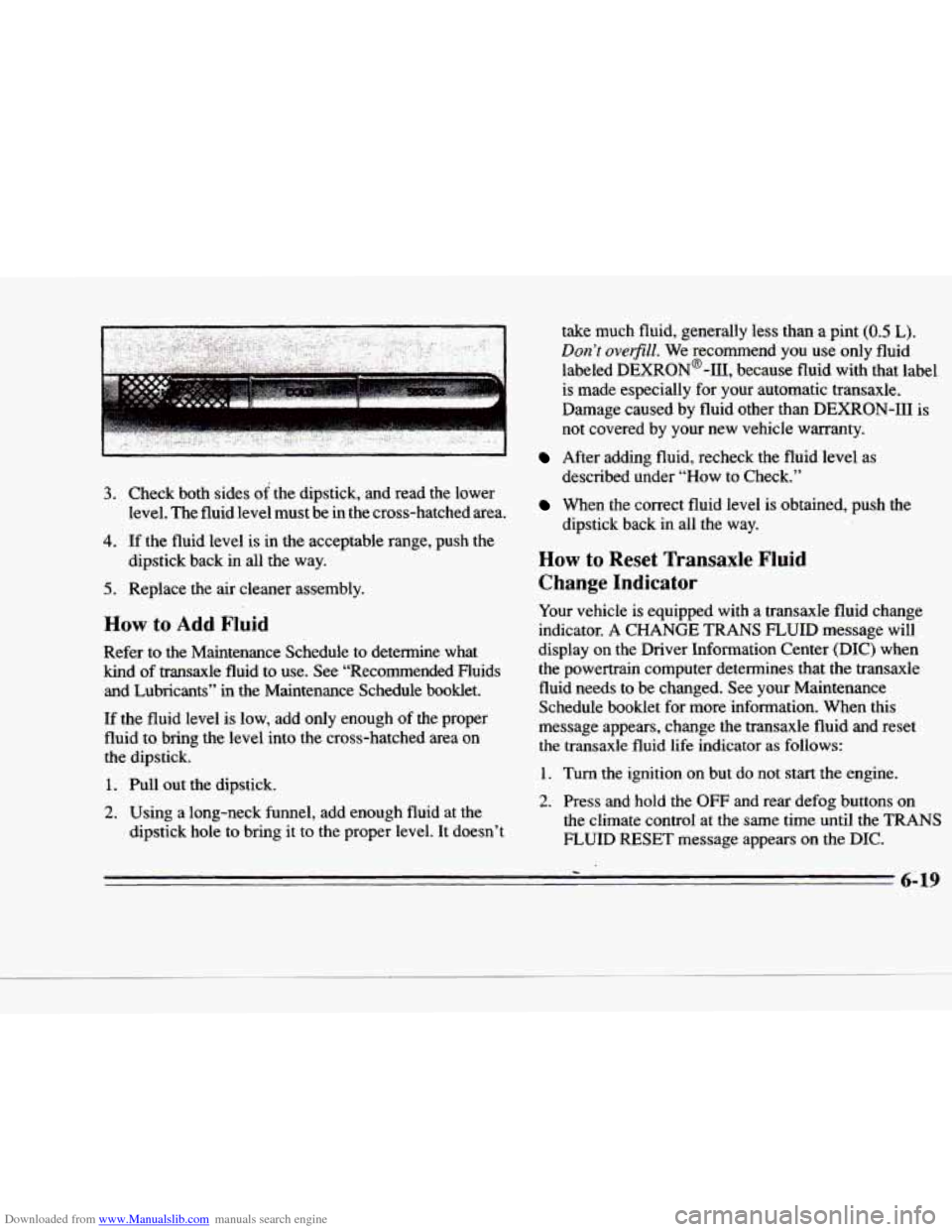
Downloaded from www.Manualslib.com manuals search engine 3. Check both sides of the dipstick, and read the lower
level. The fluid level must be
in the cross-hatched area.
4. If the fluid level is in the acceptable range, push the
dipstick back
in all the way.
5. Replace the air cleaner assembly.
How to Add Fluid
Refer to the Maintenance Schedule to determine what
kind of transaxle fluid to use. See “Recommended Fluids
and Lubricants”
in the Maintenance Schedule booklet.
If the fluid level is low, add only enough of the proper
fluid
to bring the level into the cross-hatched area on
the dipstick.
1. Pull out the dipstick.
2. Using a long-neck funnel, add enough fluid at the
dipstick hole to bring
it to the proper level. It doesn’t take
much fluid, generally less than a pint (0.5 L).
Don’t oveflll. We
recommend you use only fluid
labeled
DEXRON@-111, because fluid with that label
is made especially for your automatic transaxle.
Damage caused by fluid other
than DEXRON-I11 is
not covered by your new vehicle warranty.
After adding fluid, recheck the fluid level as
described under “How to Check.”
When the correct fluid level is obtained, push the
dipstick back in all the way.
How to Reset Transaxle Fluid
Change Indicator
Your vehicle is equipped with a transaxle fluid change
indicator.
A CHANGE TRANS FLUID message will
display on the Driver Information Center (DIC) when
the powertrain computer determines that the transaxle
fluid needs to be changed. See your Maintenance Schedule booklet for more information. When this
message appears, change the transaxle fluid and reset
the transaxle fluid life indicator as
follows:
1. Turn the ignition on but do not start the engine.
2. Press and hold the OFF and rear defog buttons on
the climate control at the same time until the
TRANS
FLUID RESET message appears on the DIC.
z
6-19
Page 289 of 354
Downloaded from www.Manualslib.com manuals search engine I NOTICE:
Continuing to drive with worn-out brake pads
could result
in costly brake repair.
Some driving conditions or climates may cause a brake
squeal when the brakes are first applied
or lightly
applied. This does not mean something is wrong with
your brakes.
Free movement of brake calipers and proprely torqued
wheel nuts are necessary
to help prevent brake
pulsation. When tires are rotated, inspect brake calipers
for movement, brake pads for wear, and evenly torque wheel nuts in the proper sequence to
GM Specifications.
Brake linings should always
be replaced as complete
axle sets.
Brake Pedal Travel Brake Adjustment
Every time you apply the brakes, with
or without the
vehicle moving,
your brakes adjust for wear.
Replacing Brake System Parts
The braking system on a modem vehicle is complex.
Its many parts have to
be of top quality and work well
together if the vehicle
is to have really good braking.
Vehicles
we design and test have top-quality GM brake
parts in them, as your Cadillac does when it is new.
When you replace
parts of your braking system -- for
example, when your brake linings wear down and you
have to have new ones put in
-- be sure you get new
genuine
GM replacement parts. If you don’t, your
brakes may no longer work properly. For example, if
someone puts in brake linings that are wrong for your
vehicle, the balance between your front and rear brakes
can change -- for the worse. The braking performance
you’ve come to expect can change in many other ways if
someone puts in the wrong replacement brake
parts.
--
See your dealer if the brake pedal does not return to
normal height,
or if there is a rapid increase in pedal
travel.
This could be a sign of brake trouble.
6-28
Page 299 of 354
Downloaded from www.Manualslib.com manuals search engine I I
I I
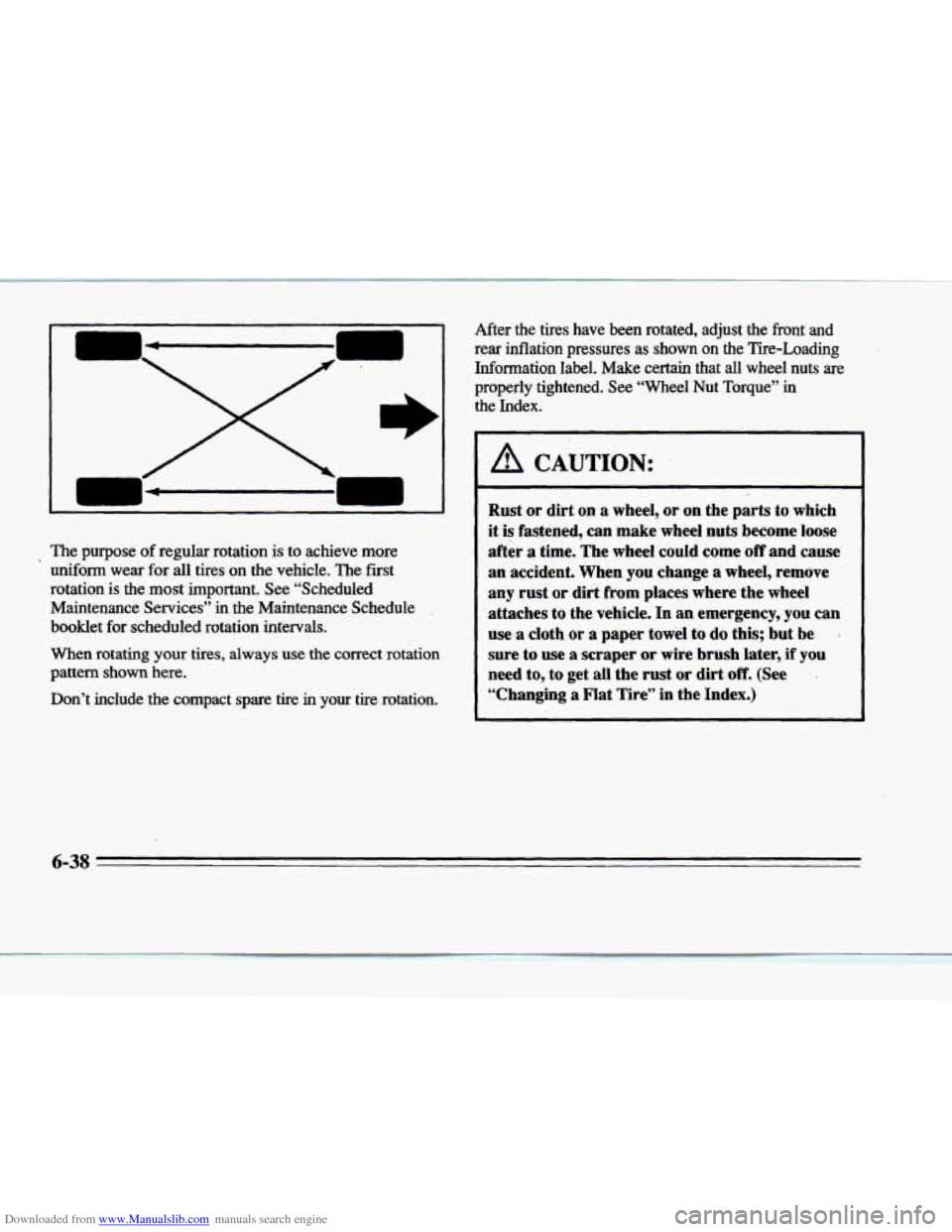
The purpose of regular rotation is to achieve more
uniform wear
for all tires on the vehicle. The first
rotation is the most important. See “Scheduled
Maintenance Services”
in the Maintenance Schedule
booklet for scheduled rotation intervals.
When rotating
your tires, always use the correct rotation
pattern
shown here.
Don’t include the compact spare
tire in your tire rotation. After
the tires have been rotated, adjust the front and
rear inflation pressures as shown on the Tire-Loading
Information label. Make certain that all wheel nuts are
properly tightened. See “Wheel
Nut Torque” in
the Index.
A CAUTION:
Rust or dirt on a wheel, or on the parts to which
it is fastened,
can make wheel nuts become loose
after
a time. The wheel could come off and cause
an accident. When
you change a wheel, remove
any rust
or dirt from places where the wheel
attaches to the vehicle. In an emergency,
you can
use a cloth or a paper towel to do this; but be I
sure to use a scraper or wire brush later, if you
need to, to get
all the rust or dirt off. (See I
“Changing a Flat Tire” in the Index.)
I
.. .
6-38
Page 335 of 354
Downloaded from www.Manualslib.com manuals search engine Plan Ahead When Possible
Whenever possible, schedule an appointment for your
vehicle’s warranty work. Your Cadillac dealer can then
prepare
to meet your alternative transportation needs
and minimize inconveniences typically associated with
warranty repairs.
Owner Responsibilities
There are only two things which you will be responsible
for during the use
of your courtesy vehicle. You are
required to provide insurance coverage and replenish the
fuel used.
In many cases your own auto insurance policy may
provide primary coverage for the courtesy vehicle, similar to rental car agreements. Please, check
with your
insurance company to be certain what’s covered.
This service is provided to
you under the terms of the
New Vehicle Warranty, therefore, it is imperative that
your vehicle 6e picked up from the dealership at the
completion
of the warranty service. Vehicles not picked
up in a timely fashion may incur rental fees charged to
the customer.
GM Participation in BBB AUTO
LINE - Alternative Dispute
Resolution
Program*
*This program may not be available in all states,
depending
on state law. Canadian owners refer to your
Warranty and Owner Assistance Information booklet.
General Motors reserves the right to change eligibility limitations and/or to discontinue its participation
in this
program.
Both Cadillac and your Cadillac dealer are committed to
making sure you are completely satisfied with your new
vehicle. Our experience has shown that,
if a situation
arises where you feel your concern has not been
adequately addressed, the Customer Satisfaction
Procedure described earlier in this section is very successful.
There may be instances where an impartial third party can assist in arriving at a solution to a disagreement
regarding vehicle repairs or interpretation of the New
Vehicle Limited Warranty.
To assist in resolving these
disagreements, Cadillac voluntarily participates
in BBB
AUTO LINE.
7-8