lock CADILLAC DEVILLE 1996 7.G Repair Manual
[x] Cancel search | Manufacturer: CADILLAC, Model Year: 1996, Model line: DEVILLE, Model: CADILLAC DEVILLE 1996 7.GPages: 354, PDF Size: 20.32 MB
Page 216 of 354
Downloaded from www.Manualslib.com manuals search engine Hitches
It’s important to have the correct hitch equipment.
Crosswinds, large trucks going by and rough roads are a
few reasons
why you’ll need the right hitch. Here are
some rules to follow:
Safety Chains
You should always attach chains between your vehicle
and your trailer. Cross the safety chains under the tongue
of the trailer so that the tongue will not drop to the road
if it becomes separated from the hitch. Instructions
about safety chains may be provided by the hitch
manufacturer or by the trailer manufacturer. Follow the manufacturer’s recommendation for attaching safety
chains and
do not attach them to the bumper. Always
leave just enough slack
so you can turn with your rig.
And, never allow safety chains to drag
on the ground.
c
c
c
0 If you’ll be pulling a trailer that, when loaded, will
weigh more
than 2,000 lbs. (900 kg), be sure to use
a properly mounted, weight-distributing hitch and sway control of the proper size. This equipment is
very important for proper vehicle loading and good
handling when you’re driving.
0 Will you have to make any holes in the body of your
vehicle when you install a trailer hitch? If you do,
then be sure to seal the holes later when you remove
the hitch.
If you don’t seal them, deadly carbon
monoxide (CO) from your exhaust can get into your
vehicle (see “Carbon Monoxide”
in the Index). Dirt
and water can, too.
The bumpers on your vehicle are not intended
for hitches.
Do not attach rental hitches or other
bumper-type hitches to them. Use’only
a
frame-mounted hitch that does not attach to
the bumper.
Trailer Brakes
Because you have anti-lock brakes, don’t try to tap into
your vehicle’s hydraulic brake system. If you do, both
brake systems won’t work well, or at all.
Be sure to read and follow the instructions for the trailer
brakes
so you’ll be able to maintain them properly.
4-35
Page 233 of 354
Downloaded from www.Manualslib.com manuals search engine A CAUTION:
A vehicle can fall from a car carrier if it isn’t
adequately secured. This can cause
a collision,
serious personal injury and vehicle damage. The
vehicle should be tightly secured with chains
or
steel cables before it is transported.
Don’t use substitutes (ropes, leather straps,
canvas webbing, etc.) that can
be cut by sharp
edges underneath the towed vehicle. Always use
T-hooks inserted in the front
T-hook slots or
R-hooks inserted in the rear R-hook slots. Never
use
J-hooks. They will damage drivetrain and
suspension components.
When your vehicle is being towed, have the ignition key
turned to
the OFF position. The steering wheel should
be clamped in a straight-ahead position, with a clamping
device designed for towing service.
Do not use the
vehicle’s steering column lock for this.
The transaxle
should
be in NEUTRAL (N) and the parking brake
released.
Don’t have your vehicle towed on the drive wheels
unless you
must. If the vehicle must be towed on the
drive wheels,
be sure to follow the speed and distance
restrictions later in this section or your transaxle will be
damaged.
If these limitations must be exceeded, then the
drive wheels have to be supported on a dolly.
1
7
Page 245 of 354
Downloaded from www.Manualslib.com manuals search engine NOTICE:
In cold weather, water can freeze and crack the
engine, radiator, heater core and other parts.
So
use the recommended coolant.
A CAUTION:
You can be burned if you spill coolant on hot
engine parts. Coolant contains ethylene glycol
and it
will burn if the engine parts are hot
enough. Don't spill coolant on
a hot engine.
A
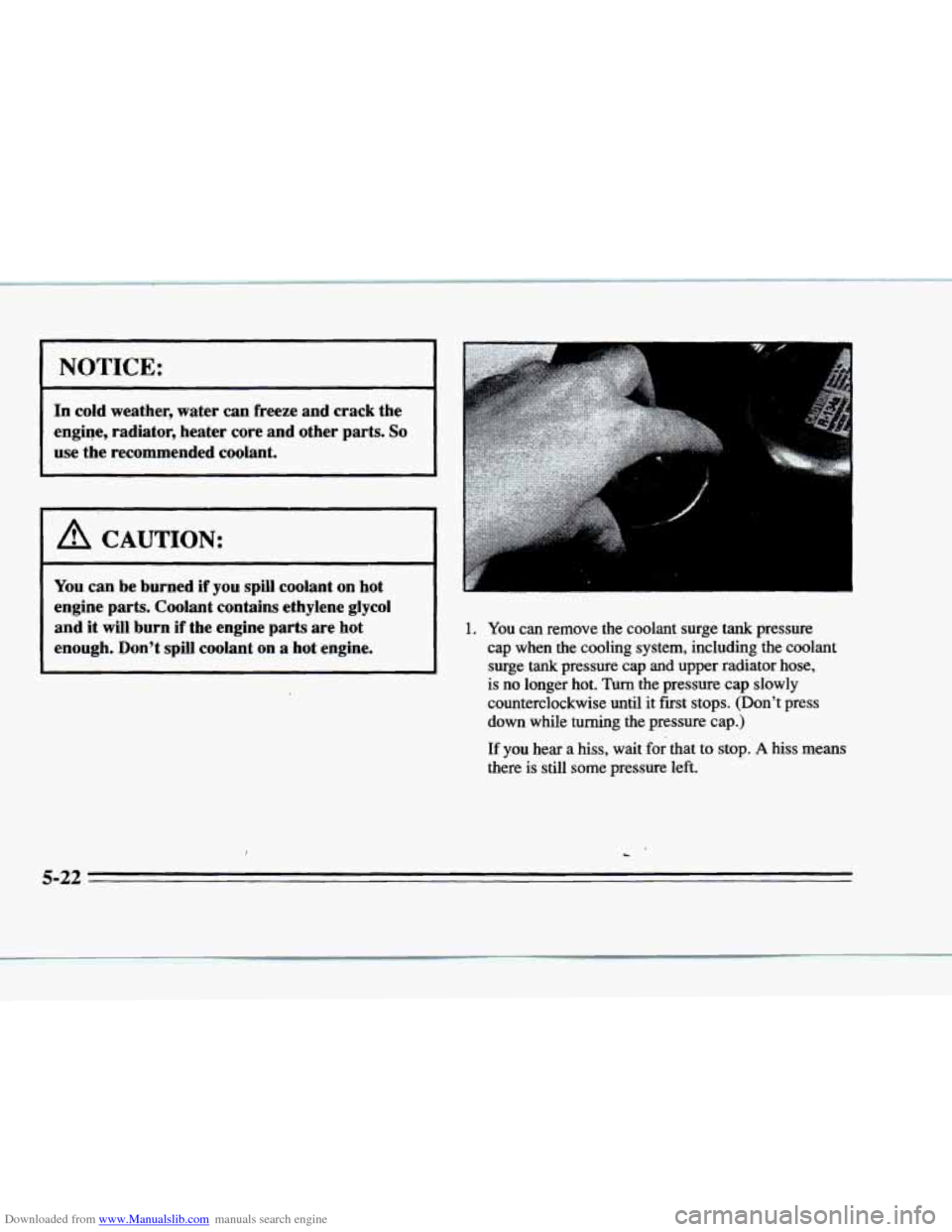
1. You can remove the coolant surge tank pressure
cap when
the cooling system, including the coolant
surge tank pressure cap and upper radiator hose,
is no longer hot.
Turn the pressure cap slowly
counterclockwise until it first stops. (Don't press
down while turning the pressure cap.)
If you hear a hiss, wait for that to stop. A hiss means
there is
still some pressure left.
Page 248 of 354
Downloaded from www.Manualslib.com manuals search engine c
LI
c
c
If a Tire Goes Flat
It’s unusual for a tire to “blow out” while you’re driving,
especially if you maintain
your tires properly. If air goes
out of
a tire, it’s much more likely to leak out slowly.
But if
you should ever have a “blowout,” here are a few
tips about what to expect and
what to do:
If a front tire fails, the flat tire will create a drag that
pulls the vehicle toward that side. Take your foot
off the
accelerator pedal and grip the steering wheel firmly.
Steer to maintain lane position, and then gently brake to
a stop well out
of the traffic lane.
A rear blowout, particularly on a curve, acts much like a
skid and
may require the same correction you’d use in a
skid. In any rear blowout, remove your foot from the
accelerator pedal. Get the vehicle under control
.by
steering the way you want the vehicle to go. It may be
very bumpy and noisy, but you can still steer. Gently
brake
to a stop -- well off the road if possible.
If a tire goes flat, the next
part shows how to use your
jacking equipment
to change a flat tire safely.
Changing a Flat Tire
If a tire goes flat, avoid further tire and wheel damage
by driving slowly to
a level place. Turn on your hazard
warning flashers.
A CAUTION:
~~
Changing a tire can cause an injury. The vehicle
can slip
off the jack and roll over you or.other
people. You and they could be badly injured.
Find
a level place to change your tire. To help
prevent the vehicle from moving:
1. Put the shift lever in PARK (P).
2. Set the parking brake firmly.
3. lhrn off the engine.
To be even more certain the vehicle won’t move,
you can put blocks
at the front and rear of the
tire farthest
away from the one being changed.
That
would be the tire on the other side of the
vehicle, at the opposite end.
5-25
Page 249 of 354
Downloaded from www.Manualslib.com manuals search engine I
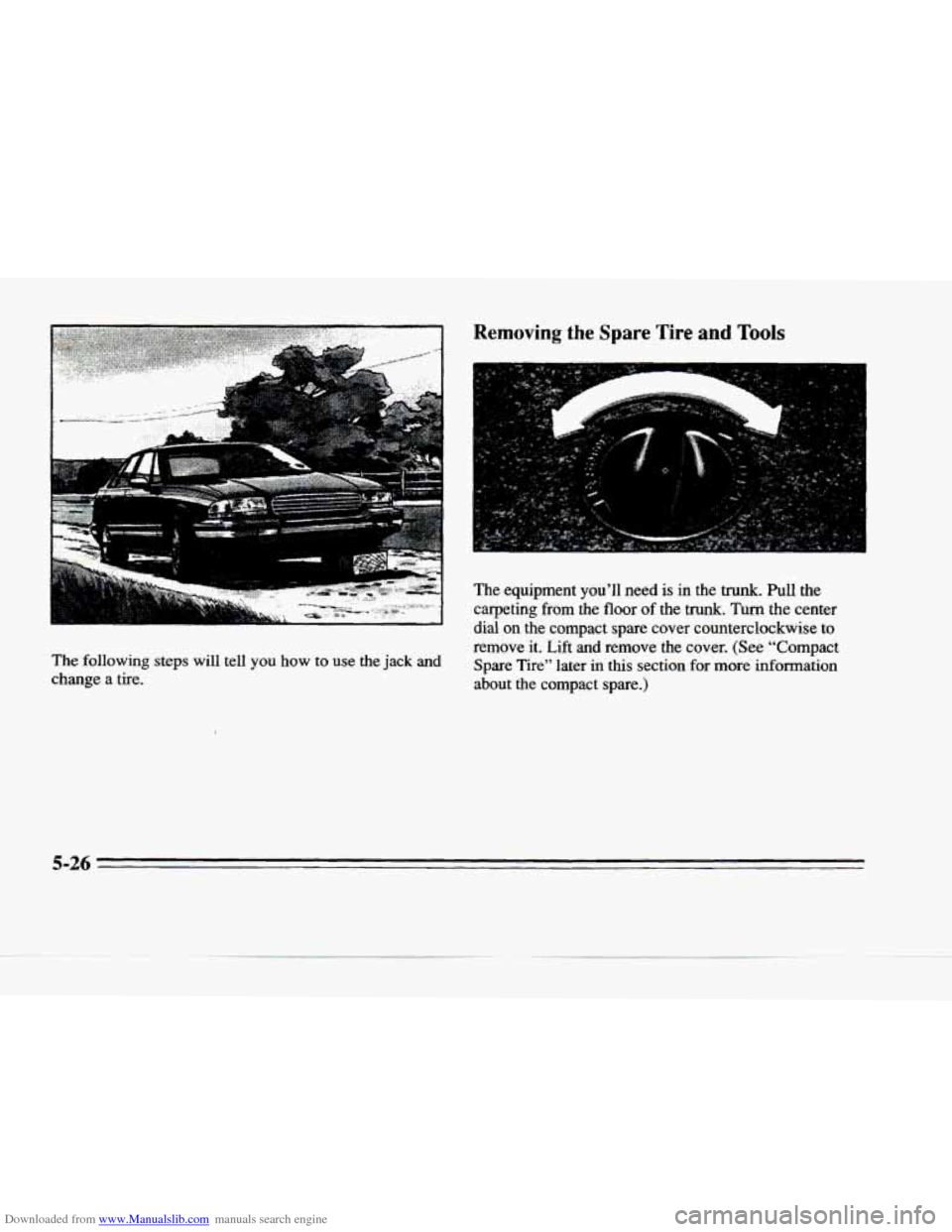
The following steps will tell you how to use the jack and
change a tire.
Removing the Spare Tire and Tools
m
..
The equipment you’ll need is in the trunk. Pull the
carpeting from the floor
of the trunk. Turn the center
dial on the compact spare cover counterclockwise to
remove
it. Lift and remove the cover. (See “Compact
Spare Tire” later in this section
for more information
about the compact spare.)
5-26
Page 250 of 354
Downloaded from www.Manualslib.com manuals search engine c
**
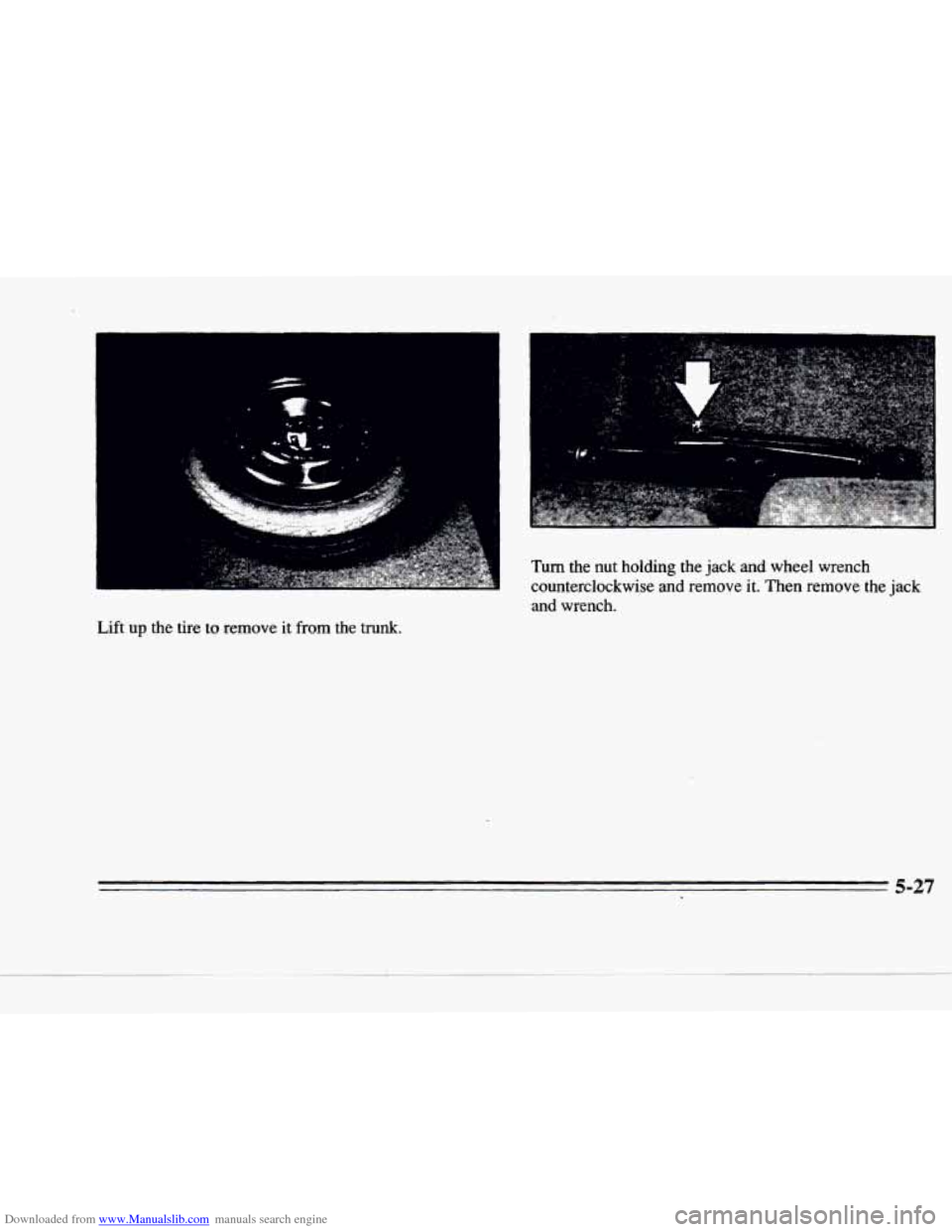
Lift up the tire to remove it from the trunk. Turn
the nut
holding the jack and wheel wrench
counterclockwise
and remove it. Then remove the jack
and wrench.
5-27
Page 252 of 354
Downloaded from www.Manualslib.com manuals search engine Removing the Flat Tire and Installing the
Spare Tire
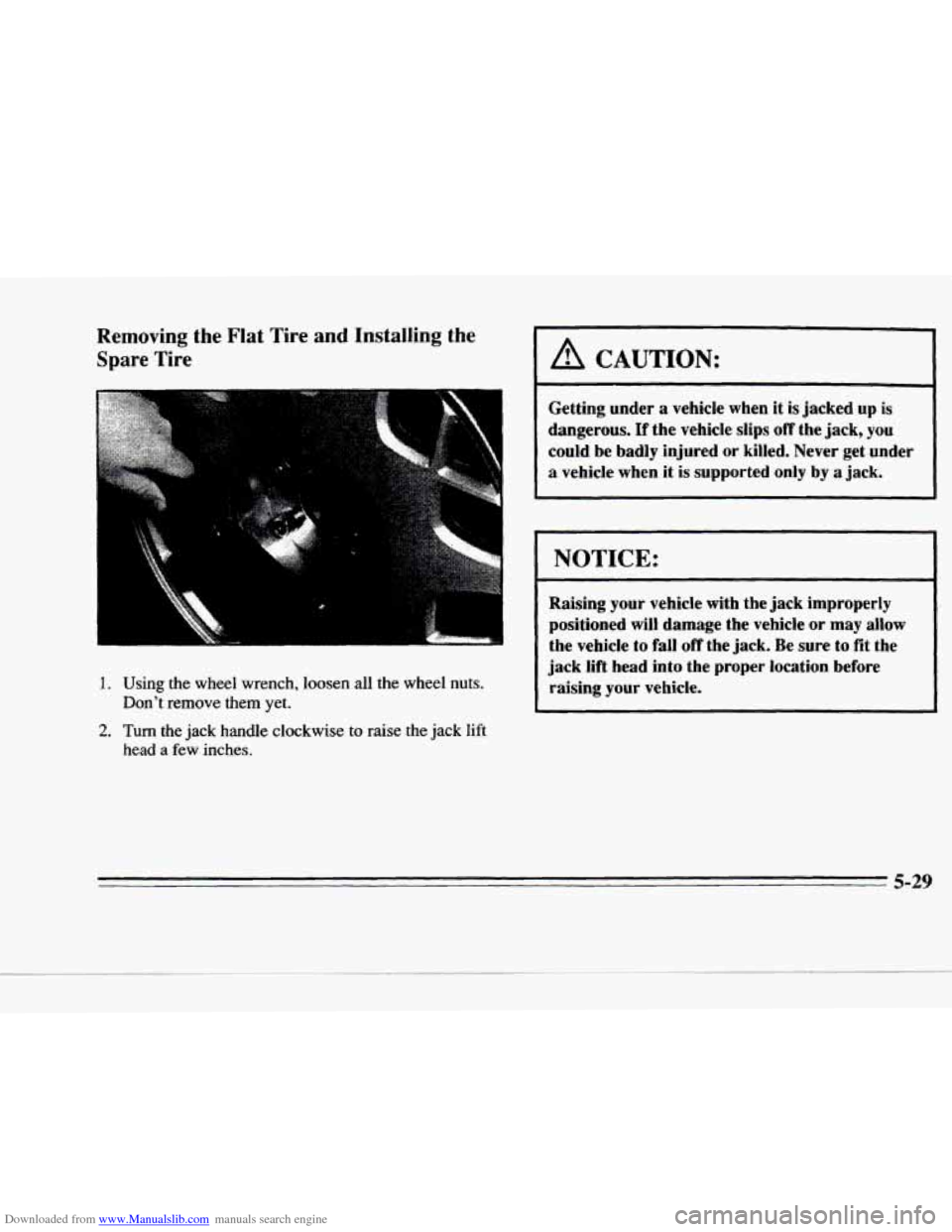
1. Using the wheel wrench, loosen all the wheel nuts.
Don’t remove them yet.
2. Turn the jack handle clockwise to raise the jack lift
head a few inches.
A CAUTION:
Getting under a vehicle when it is jacked up is
dangerous. If the vehicle slips off the jack, you
could be badly injured or killed. Never get under
a vehicle when it is supported only by a jack.
NOTICE:
Raising your vehicle with the jack improperly
positioned will damage the vehicle or may allow
the vehicle to
fall off the jack. Be sure to fit the
jack lift head into the proper location before
raising your vehicle.
5-29
Page 253 of 354
Downloaded from www.Manualslib.com manuals search engine 10.5 INCHES
(270 mm)
5.8 INCHES
(150 mm)
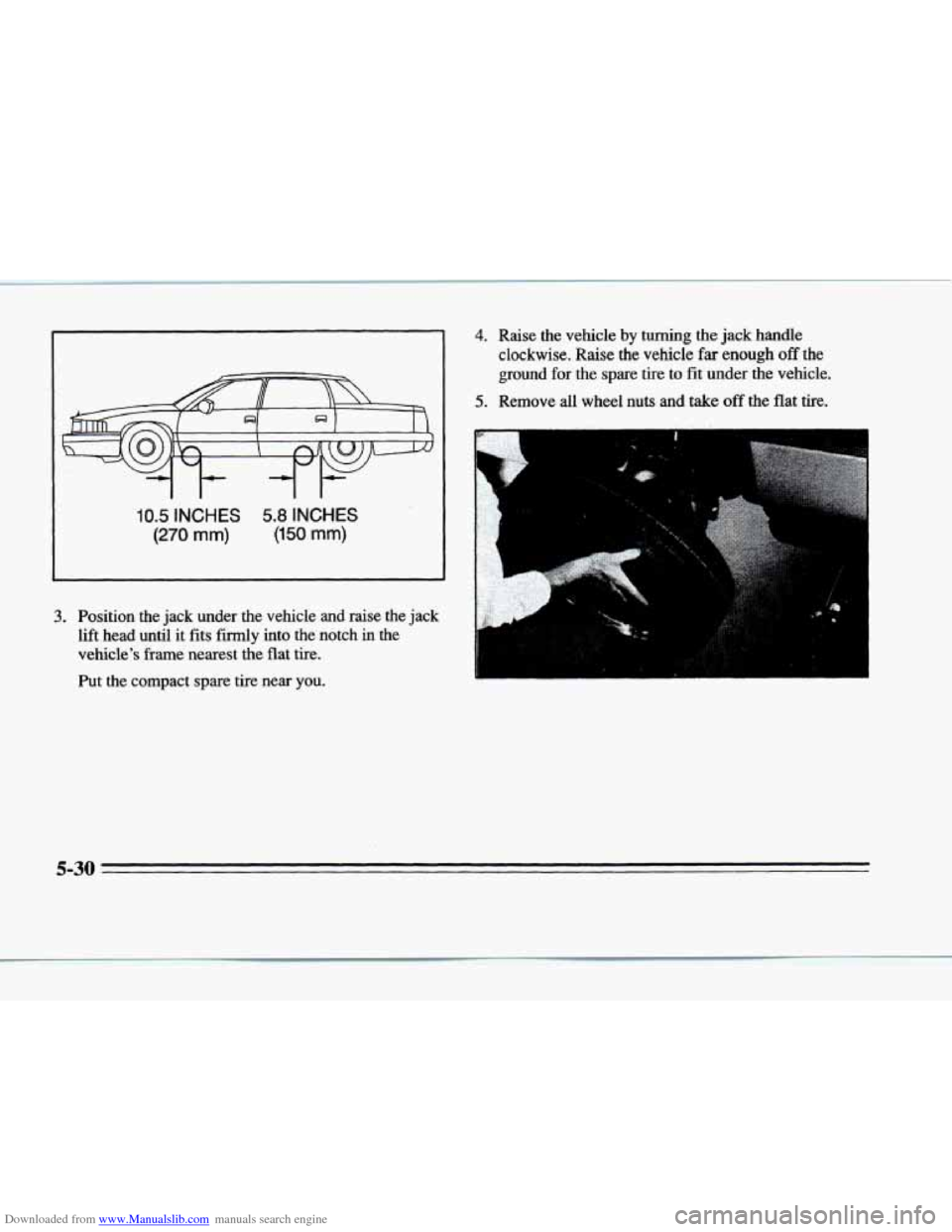
3. Position the jack under the vehicle and raise the jack lift head until it fits firmly into the notch
in the
vehicle's
frame nearest the flat tire.
Put the compact spare tire near
you.
4. Raise the vehicle by turning the jack handle
clockwise. Raise the vehicle
far enough off the
ground
for the spare tire to fit under the vehicle.
5. Remove all wheel nuts and take off the flat tire.
Page 255 of 354

Downloaded from www.Manualslib.com manuals search engine 8. Lower the vehicle by turning the jack handle
counterclockwise. Lower the jack completely.
9. Tighten the
wheel nuts firmly
in a criss-cross
sequence
as shown.
A CAUTION:
Incorrect wheel nuts or improperly tightened
wheel nuts can cause the wheel
to become loose
and
even come off. This could lead to an accident.
Be
sure to use the correct wheel nuts. If you have
to replace them, be sure to get the right kind.
Stop somewhere
as soon as you can and have the
nuts tightened with a torque wrench to
100 lb-ft
(140 N-m).
5-32
Page 266 of 354
Downloaded from www.Manualslib.com manuals search engine P
.. ..
-.;: 3
A CAUTION:
If you get gasoline on yourself and then
something ignites it, you could
be badly burned.
Gasoline can spray out
on you if you open the
fuel filler cap too quickly. This spray can happen
if your tank
is nearly full, and is more likely in
hot weather. Open the fuel filler cap slowly and
wait for
any “hiss” noise to stop. Then unscrew
the cap all the way.
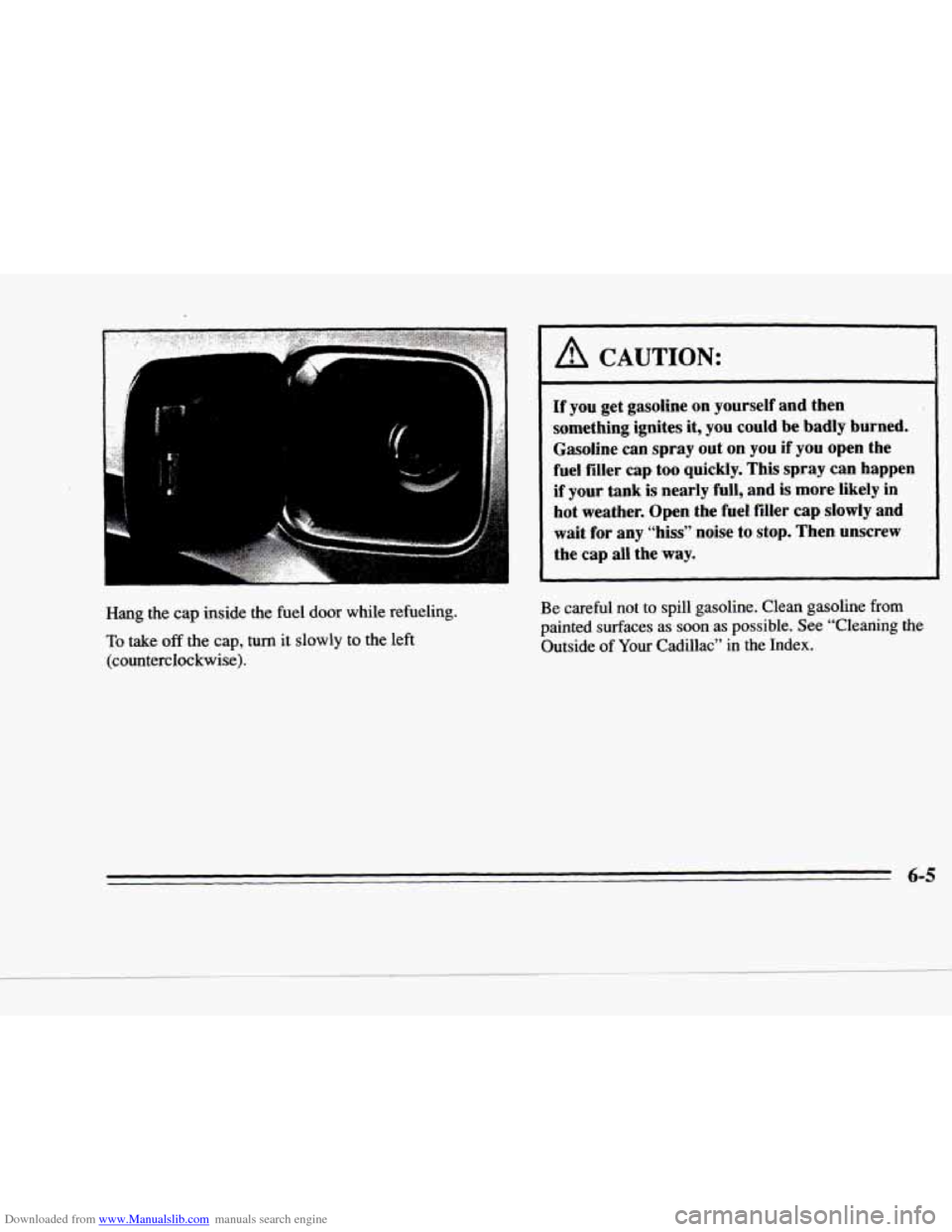
Hang the cap inside the fuel door while refueling.
TO take off the cap, turn it slowly to the left
(counterclockwise). Be careful not to
spill gasoline. Clean gasoline from
painted surfaces as soon as possible.
See “Cleaning the
Outside of Your Cadillac” in the Index.
6-5