child seat CADILLAC DEVILLE 1997 7.G Owners Manual
[x] Cancel search | Manufacturer: CADILLAC, Model Year: 1997, Model line: DEVILLE, Model: CADILLAC DEVILLE 1997 7.GPages: 386, PDF Size: 21.61 MB
Page 16 of 386

Downloaded from www.Manualslib.com manuals search engine &&* -A*,
Section 1 Seats and Restraint Systems
Here you’ll find information about the seats in your Cadillac and how to use your safety belts properly. You can also
learn about some things you should
not do with air bags and safety belts.
1-2
1-7
1-12 1-13
1-13
1-21
1-22
1-22 Seats
and Seat Controls
Safety Belts: They’re for Everyone
Here Are Questions Many People Ask About
Safety Belts
-- and the Answers
How to Wear Safety Belts Properly
Driver Position
Safety Belt Use During Pregnancy
Right Front Passenger Position
Supplemental Inflatable Restraint (SIR)
Systems 1-30
1-31
1-35
1-37
1-45 1-48
1-48
1-48 Center Passenger Position
Rear
Seat Passengers
Children
Child Restraints
Larger Children Safety Belt Extender
Checking Your Restraint Systems
Replacing Restraint System
Parts
After a Crash
Page 28 of 386
Downloaded from www.Manualslib.com manuals search engine How to Wear Safety Belts Properly
Adults
This part is only for people of adult size.
Be aware that there
are special things to know about
safety belts and chldren. And there are different rules
for smaller children and babies.
If a child will be riding
in your Cadillac, see the part of this manual called
“Children.” Follow those rules for everyone’s protection.
First, you’ll want to know which restraint systems your
vehicle has.
We’ll start with the driver position.
Driver Position
This part describes the driver’s restraint system.
Lap-Shoulder Belt
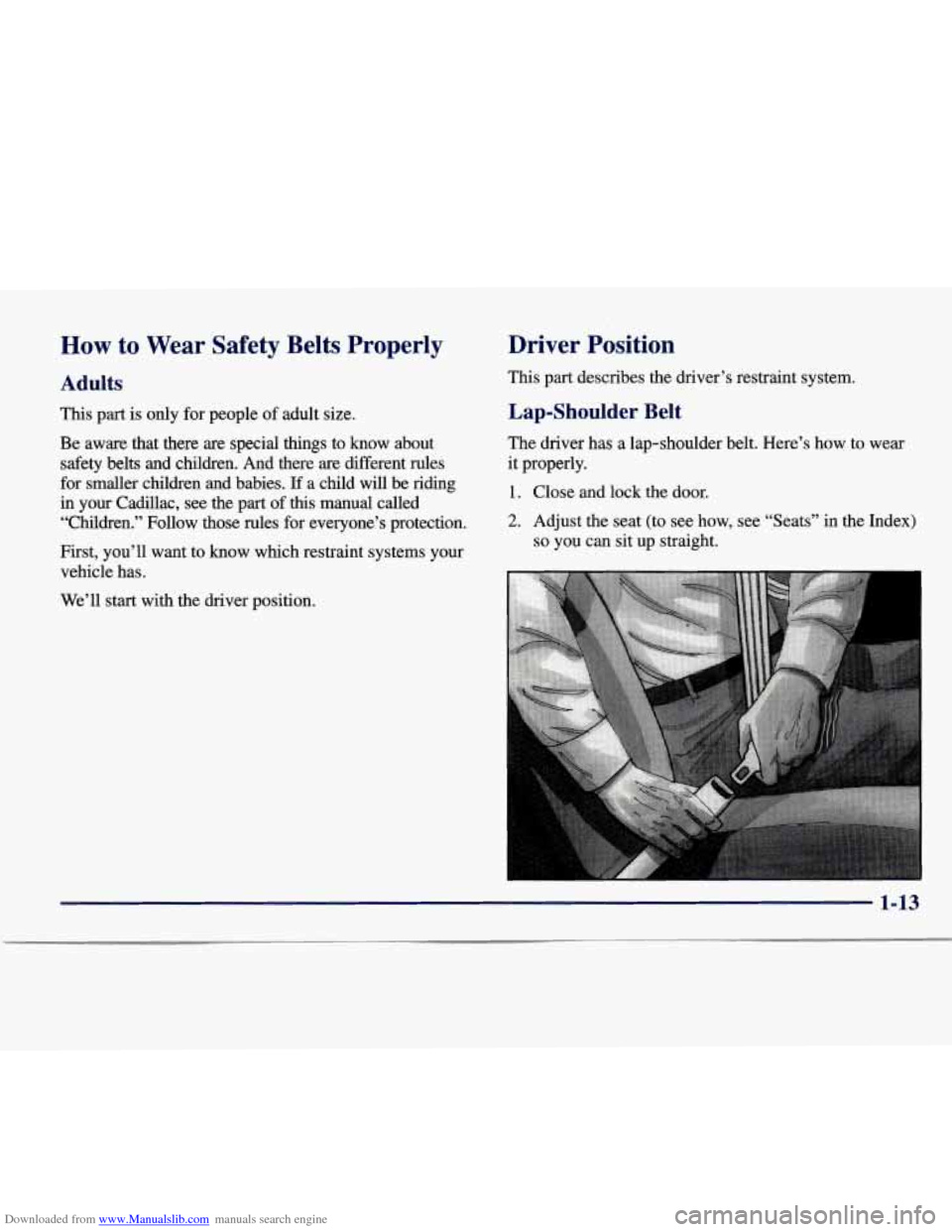
The driver has a lap-shoulder belt. Here’s how to wear
it properly.
1. Close and lock the door.
2. Adjust the seat (to see how, see “Seats’’ in the Index)
so you can sit up straight.
1-13
Page 52 of 386

Downloaded from www.Manualslib.com manuals search engine Child Restraints
Be sure the child restraint is designed to be used in a
vehicle.
If it is, it will have a label saying that it meets
Federal Motor Vehicle Safety Standards.
Then follow the instructions for the restraint. You may
find these instructions on the restraint itself or in a
booklet, or both. These restraints use the belt system in
your vehicle, but the child also has to be secured within
the restraint to help reduce the chance of personal injury.
The instructions that come with the infant
or child
restraint will show you how to do that.
Where to Put the Restraint
Accident statistics show that children are safer if they
are restrained in the rear rather than the front seat. We at
General Motors therefore recommend that you put your
child restraint in the rear seat.
Never put a rear-facing
child restraint in the front passenger seat. Here’s why:
/! CAI, LION:
A child in a rearfacing child restraint can be
seriously injured if the right front passenger’s
air bag inflates. This is because the back of a
rear-facing child restraint would be very close to
the inflating air bag. Always secure a rear-facing
child restraint in the rear seat.
You may, however, secure a forward-facing child
restraint in the right front seat. Before you secure
a forward-facing child restraint, always move the
front passenger seat as far back as it will go. Or,
secure the child restraint in the rear seat.
1-37
Page 53 of 386

Downloaded from www.Manualslib.com manuals search engine I A CAUTION:
I
A child in a child restraint in the center front seat
can be badly injured by the right front passenger
air bag if it inflates. Never secure a child restraint
in the center front seat. It’s always better to
secure a child restraint in the rear seat. You may,
however, secure a forward-facing child restraint
in the right front passenger seat, but onlv with
the seat moved all the way back.
Wherever you install it, be sure to secure the child
restraint properly.
Keep in mind that an unsecured child restraint can
move
around in a collision or sudden stop and injure people in
the vehicle. Be sure to properly secure any child
restraint in your vehicle
-- even when no child is in it.
Top Strap
If your child restraint has a top strap, it should be
anchored. If you need to have an anchor installed, you
can ask your Cadillac dealer to put it in for you.
If you
want to install an anchor yourself, your dealer can tell
you how to do it.
1-38
Page 54 of 386

Downloaded from www.Manualslib.com manuals search engine Canadian law requires that child restraints have a top
strap, and that the strap be anchored.
If your child restraint has
a top strap, your dealer can
obtain
a kit with anchor hardware and installation
instructions specifically designed for this vehicle. The
dealer can then install the anchor for you. In Canada,
this work will be done for
you free of charge. Or, you
may install the anchor yourself using the instructions
provided in the kit.
Securing a Child Restraint in a Rear
Outside Seat Position
U
You’ll be using the lap-shoulder belt. See the earlier part
about the top strap if the child restraint has one.
1. Put the restraint on the seat. Follow the instructions
for the child restraint.
2. Secure the child in the child restraint as the
instructions say.
3. Pick up the latch plate, and run the lap and shoulder
portions
of the vehicle’s safety belt through or
around the restraint. The child restraint instructions
will show
you how.
Tilt the latch plate to adjust the belt if needed.
If the shoulder belt goes in front
of the child’s face or
neck, put it behind the child restraint.
1-39
Page 56 of 386

Downloaded from www.Manualslib.com manuals search engine Securing a Child Restraint in the Center
Rear Seat Position See the earlier part about the top strap if the child
restraint has one.
You’ll be using the lap belt.
A child in a child restraint in the center front seat
can be badly injured by the right front passenger
air bag if it inflates. Never secure a child restraint
in the center front seat. It’s always better to
secure a child restraint in the rear seat. You may,
latch 1. Make the belt as long as possible by tilting the
plate and pulling it along the belt.
however, secure a forward-facing child restraint
in the right front passenger seat, but only with
the seat moved all the way back.
for the child restraint.
2. Put the restraint on the seat. Follow the instructions
3. Secure the child in the child restraint as the L instructions say.
1-41
Page 58 of 386

Downloaded from www.Manualslib.com manuals search engine Securing a Child Restraint in the Right
Front Seat Position
Your vehicle has a right front passenger air bag. Never
put a rear-facing child restraint in this seat. Here’s why:
A CAUTION:
A child in a rearfacing child restraint can be
seriously injured if the right front passenger’s air
bag inflates. This is because the back of a rear-facing child restraint would be very close to
the inflating air bag. Always secure a rearfacing
child restraint in the rear seat.
You’ll be using the lap-shoulder belt. See the earlier part
about the top strap if the child restraint has one.
1. Because your vehicle has a right front passenger air
bag, always move the seat as
far back as it will go
before securing a forward-facing child restraint. (See
“Seats”
in the Index.)
2. Put the restraint on the seat. Follow the instructions
for the child restraint.
3. Secure the child in the child restraint as the
instructions say.
4. Pick up the latch plate, and run the lap and shoulder
portions of the vehicle’s safety belt through or
around the restraint. The child restraint instructions
will show you how.
If the shoulder belt goes in front of the child’s face or
neck, put it behind the child restraint.
Page 61 of 386

Downloaded from www.Manualslib.com manuals search engine Accident statistics show that children are safer if they
are restrained in the rear seat. But they need to use the
safety belts properly.
0 Children who aren’t buckled up can be thrown out in
a crash.
Children who aren’t buckled up can strike other
people who are. Never
do this.
Here two children are wearing the same belt. The
belt can’t properly spread the impact forces. In a
crash, the two children can be crushed together
and seriously injured.
A belt must be used by
only one person at a time.
&.” What if a child is wearing a lap-shoulder belt,
but the child is
so small that the shoulder belt is
very close to the child’s face or neck?
A: Move the child toward the center of the vehicle, but
be sure that the shoulder belt still is on the child’s shoulder,
so that in a crash the child’s upper body
would have the restraint that belts provide.
If the
child is
so small that the shoulder belt is still very
close to the child’s face
or neck, you might want to
place the child in the center seat position, the one
that has only a lap belt.
1-46
Page 62 of 386

Downloaded from www.Manualslib.com manuals search engine A CAUTION:
I
Never do this. Here a child is sitting in a seat that has a
lap-shoulder belt, but the shoulder part is behind
the child.
If the child wears the belt in this way, in
a crash the child might slide under the belt. The
belt’s force would then be applied right on the
child’s abdomen. That could cause serious or
fatal injuries.
Wherever the child sits, the lap portion of the belt
should be
worn low and snug on the hips, just touching
the child’s thighs. This applies belt
force to the child’s
pelvic bones in a crash.
Page 233 of 386

Downloaded from www.Manualslib.com manuals search engine A CAUTION:
Things you put inside your vehicle can strike and
injure people in
a sudden stop or turn, or in
a crash.
Put things in the trunk of your vehicle. In a
trunk, put them as far forward as you can.
Try to spread the weight evenly.
Never stack heavier things, like suitcases,
inside the vehicle
so that some of them are
above the tops of the seats.
0 Don’t leave an unsecured child restraint in
your vehicle.
When you carry something inside the
vehicle, secure
it whenever you can.
Electronic Level Control
This feature keeps the rear of your vehicle level as the
load changes. It’s automatic
-- you don’t need to adjust
anything.
Towing a Trailer
A CAUTION:
If you don’t use the correct equipment and drive
properly, you can lose control when you pull
a
trailer. For example, if the trailer is too heavy, the
brakes may not work well
-- or even at all. You
and your passengers could be seriously injured.
Pull
a trailer only if you have followed all the
steps in this section. Ask your Cadillac dealer for
advice and information about towing
a trailer
with your vehicle.
I NOTICE:
Pulling a trailer improperly can damage your
vehicle and result in costly repairs not covered by
your warranty.
To pull a trailer correctly, follow
the advice in this part, and see your Cadillac
dealer for important information about towing
a
trailer with your vehicle.