maintenance schedule CADILLAC DEVILLE 1997 7.G Owners Manual
[x] Cancel search | Manufacturer: CADILLAC, Model Year: 1997, Model line: DEVILLE, Model: CADILLAC DEVILLE 1997 7.GPages: 386, PDF Size: 21.61 MB
Page 155 of 386

Downloaded from www.Manualslib.com manuals search engine voltage on the DIC by pressing the INFORMATION
(INFO) button. The normal range is 11.5 to 15.5 volts.
BRAKE VACUUM PROBLEM - 10s: The circuit in
the brake booster vacuum has shorted
or is loose when
this message appears. Your vehicle may lose power
brakes but you will still have the use of manual brakes.
The power brakes will not be affected if the problem is
caused by a failed sensor. Have your vehicle serviced
immediately at your Cadillac dealership.
CHANGE ENGINE OIL - 82: This means that the life
of the engine oil has expired and
it should be changed
within 200 miles. See “Engine Oil” and “Filter
Recommendations”
in the Maintenance Schedule booklet.
After an oil change, the Oil Life Indicator must be reset. See “Oil Life Indicator”
in the Index on how to reset it.
CHANGE TRANS FLUID - 47: This message will
appear when it is time to replace the transaxle fluid. See
the Maintenance Schedule booklet for the proper fluid
and change intervals.
CJ3ECK BRAKE FLUID LEVEL - 37: This message
will display if the ignition is in the
RUN position to
inform the driver that the brake fluid level is low. Check
the brake reservoir level and add fluid as needed. Have
the brake system serviced by a Cadillac technician as soon
as possible. If the brake warning light is on, follow
the directions in that part.
CHECK COOLANT LEVEL - 02: This message will
appear when there is a low level
of engine coolant. Have
the cooling system serviced by a Cadillac technician as soon as possible.
CHECK FUEL GAGE - 39: This message will appear
when the fuel supply
is less than four gallons (15.2 L)
and the display is turned off (digital clusters only).
A single chime will also sound when this message
is displayed.
CHECK OIL LEVEL - 36: For correct operation of
the low oil sensing system, your vehicle should be on a
level surface.
A false CHECK OIL LEVEL message
may appear if the vehicle is parked
on grades. The oil
level sensing system does not check for actual oil level
if the engine has been off for a short period of time, and
the oil level
is never sensed while the engine is running.
If the CHECK OIL LEVEL message appears, and your
vehicle has been parked on level ground with the engine
off for at least 30 minutes, the oil level should be
checked by observing the oil dipstick. Prior to checking
the oil level, be sure the engine has been off for five
minutes and your vehicle is on a level surface. Then
check the dipstick and add oil if necessary. See “Engine
Oil” in the Index.
Page 162 of 386

Downloaded from www.Manualslib.com manuals search engine The DIC may display a CHECK OIL LEVEL message.
Always keep a written record of the mileage and date
when you changed your oil. For more information, see
the Cadillac Maintenance Schedule booklet. If you see
CHECK
OIL LEVEL, it means that you have less than
10 percent of the oil life left and you should consider
changing your engine oil. If you see CHANGE
ENGINE OIL, it means the oil life is gone and you
should change the oil right away.
The system should indicate changing the oil between
3,000 miles (5 000 km) and 7,500 miles (12 500 km).
It may indicate changing the oil before 3,000 miles
(5 000 km) depending on your driving habits. If the vehicle has been driven
7,500 miles (12 500 km), it will
indicate to change the oil.
If you drive in a dusty area,
you should change your oil every
3,000 miles (5 000
km) or three months (whichever comes first) unless the
display indicates changing it sooner. The system doesn’t
check
how much oil you have, so you’ll still have to
check for that.
To see how, see “Engine Oil” in
the Index.
When new oil
is added, you’ll need to reset the system.
To reset, display the Oil Life Indicator by pressing the
INFORMATION (INFO) button. Then press and hold
the RESET button until the display shows 100% OIL
LIFE LEFT.
2-97
. ~
Page 240 of 386
Downloaded from www.Manualslib.com manuals search engine Parking on Hills
You really should not park your vehicle, with a trailer
attached, on a hill.
If something goes wrong, your rig
could start to move. People can be injured, and both
your vehicle and the trailer can be damaged.
But if you ever have to park your rig on a hill, here’s
how to do it:
1. Apply your regular brakes, but do not shift into
PARK (P).
2. Have someone place chocks under the trailer wheels.
3. When the wheel chocks are in place, release the
regular brakes until the chocks absorb the load.
4. Reapply the regular brakes. Then shift into
PARK (P) firmly and apply your parking brakes.
5. Release the regular brakes.
When You Are Ready to Leave After
Parking on a Hill
1. Apply your regular brakes and hold the pedal down
while you:
0 Start your engine;
Shift into a gear; and
0 Be sure the parking brake has released.
2. Let up on the brake pedal.
3. Drive slowly until the trailer is clear of the chocks.
4. Stop and have someone pick up and store the chocks.
Maintenance When Trailer Towing
Your vehicle will need service more often when you’re
pulling a trailer. See the Maintenance Schedule for more
on
this. Things that are especially important in trailer
operation are automatic transaxle fluid (don’t overfill),
engine oil, belt, cooling system and brake adjustment.
Each of these is covered in
this manual, and the Index
will help you find them quickly.
If you’re trailering, it’s
a good idea to review these sections before you start
your trip.
Check periodically to see that
all hitch nuts and bolts
are tight.
4-39
Page 285 of 386
Downloaded from www.Manualslib.com manuals search engine Service
Your Cadillac dealer knows your vehicle best and wants
you to be happy with it. We hope you’ll go to your
dealer for all your service needs. You’ll get genuine GM
parts and GM-trained and supported service people.
We hope you’ll want to keep your GM vehicle all GM.
Genuine GM parts have one
of these marks: Your
vehicle has an air bag system. Before attempting
to
do your own service work, see “Servicing Your Air
Bag-Equipped Cadillac” in the Index.
You should keep a record with all parts receipts and list
the mileage and the date of any service work you
perform. See “Maintenance Record”
in the Maintenance
Schedule booklet.
em”
n
Delco
Doing Your Own Service Work
If you want to do some of your own service work, you’ll
want to get the proper Cadillac Service Manual. It tells
you much more about how
to service your Cadillac than
this manual can.
To order the proper service manual, see
“Service and Owner Publications’’
in the Index. You
can be injured and your vehicle could be
damaged
if you try to do service work on a
vehicle without knowing enough about it.
0 Be sure you have sufficient knowledge,
experience, the proper replacement parts
and tools before you attempt any vehicle
maintenance task.
0 Be sure to use the proper nuts, bolts ana
other fasteners. “English” and “metric”
fasteners can be easily confused.
If you use
the wrong fasteners,
parts can later break
or fall
off. You could be hurt.
6-2
Page 300 of 386

Downloaded from www.Manualslib.com manuals search engine Follow these steps to reinstall the air cleaner assembly:
1. Slide the air cleaner lid into the slots in the front
edge of the air cleaner base.
2. Pivot the air cleaner cover and the air duct assembly
downward. Make sure that both latches are secure
and fully engaged.
3. Reinstall the clean air duct over the mass airflow
sensor. Make sure that the duct is secure around the
entire outer edge of the sensor.
4. Tighten the air duct clamp.
5. Reconnect the IAT sensor.
Refer to the Maintenance Schedule to determine when to
replace the
air filter.
See “Scheduled Maintenance Services” in the
Maintenance Schedule booklet.
Operating the engine with the air cleaner off can
cause you or others
to be burned. The air cleaner
not only cleans the
air, it stops flames if the
engine backfires.
If it isn’t there, and the engine
backfires, you could be burned. Don’t drive with
it off, and be careful working on the engine with
the
air cleaner off.
NOTICE:
If the air cleaner is off, a backfire can cause a
damaging engine fire. And, dirt can easily get
into your engine, which will damage it. Always
have the
air cleaner in place when you’re driving.
6-17
Page 301 of 386

Downloaded from www.Manualslib.com manuals search engine Automatic Transaxle Fluid
When to Check and Change
A good time to check your automatic transaxle fluid
level
is when the engine oil is changed.
Change both the fluid and filter every
50,000 miles
(83
000 km) if the vehicle is mainly driven under one or
more of these conditions:
0 In heavy city traffic where the outside temperature
regularly reaches
90°F (32°C) or higher.
0 In hilly or mountainous terrain.
0 When doing frequent trailer towing.
0 Uses such as found in taxi, police or delivery service.
Use such as limousine service.
If you do not use your vehicle under any of these
conditions, the fluid and filter do not require changing.
See “Scheduled Maintenance Services”
in the
Maintenance Schedule booklet.
How to Check
Because this operation can be a little difficult, you may
choose to have this done at your Cadillac dealership
service department.
If you do it yourself, be sure to follow
all the instructions
here,
or you could get a false reading on the dipstick.
NOTICE:
Too much or too little fluid can damage your
transaxle.
Too much can mean that some of the
fluid could come out and fall on hot engine parts or exhaust system parts, starting a
fire. Be sure to
get an accurate reading if you check your
transaxle fluid.
Wait at least 30 minutes before checking the transaxle
fluid level if you have been driving:
When outside temperatures are above 90°F (32°C).
At high speed for quite a while.
0 In heavy traffic -- especially in hot weather.
e While pulling a trailer.
6-18
Page 303 of 386

Downloaded from www.Manualslib.com manuals search engine 2. Push it back in all the way, wait three seconds and
then pull it back out ‘again.
3. Check both sides of the dipstick, and read the
lower level. The fluid level must be in the
cross-hatched area.
4. If the fluid level is in the acceptable range, push
the dipstick back in
all the way. Replace the air
cleaner assembly.
How to Add Fluid
Refer to the Maintenance Schedule to determine
what kind of transaxle fluid to use. See
“Recommended Fluids and Lubricants” in
the Maintenance Schedule booklet.
If the fluid level is low, add only enough of the proper
fluid to bring the level into the cross-hatched area on
the dipstick.
1. Pull out the dipstick.
2. Using a long-neck funnel, add enough fluid at the
dipstick hole to bring it
to the proper level.
It doesn’t take much fluid, generally less than
one pint
(0.5 L). Don’t oveflll.
NOTICE:
We recommend you use only fluid labeled
DEXRON@-111, because fluid with that label .is
made especially for your automatic transaxle.
Damage caused by fluid other than DEXRON-In
is not covered by your new vehicle warranty.
3. After adding fluid, recheck the fluid level as
4. When the correct fluid level is obtained, push the
described under “How to Check.”
dipstick
back in all the way.
6-20
Page 308 of 386

Downloaded from www.Manualslib.com manuals search engine Power Steering Fluid
The power steering fluid
reservoir is located next to the coolant surge tank
When to Check Power Steering Fluid
It is not necessary to regularly check power steering
fluid unless you suspect there is a leak in the system or
you hear an unusual noise.
A fluid loss in this system
could indicate a problem. Have the system inspected
and repaired.
How To Check Power Steering Fluid
When the engine compartment is cool, wipe the cap and
the top of the reservoir clean, then unscrew the cap and
wipe the dipstick with a clean rag. Replace the cap and
completely tighten it. Then remove the cap again and
look
at the fluid level on the dipstick.
The level should be at the
FULL COLD mark. If
necessary, add only enough fluid to bring the level up
to the mark.
What to Use
To determine what kind of fluid to use, see
“Recommended Fluids and Lubricants” in the
Maintenance Schedule booklet. Always use the proper
fluid. Failure to use the proper fluid can cause leaks and
damage hoses and seals.
Windshield Washer Fluid
What to Use
When you need windshield washer fluid, be sure to read
the manufacturer’s instructions before use. If you will be
operating your vehicle in an area where the temperature
may fall below freezing, use a fluid that has sufficient
protection against freezing.
6-25
Page 312 of 386

Downloaded from www.Manualslib.com manuals search engine Brake Wear
Your Cadillac has four-wheel disc brakes.
Disc brake pads have built-in wear indicators that
make a high-pitched warning sound when the brake
pads are worn and new pads are needed. The sound
may come and go or be heard all the time your vehicle
is moving (except when you
are pushing on the brake
pedal firmly).
c
The brake wear warning sound means that soon
your brakes won’t work well. That could lead to
an accident. When you hear the brake wear
warning sound, have your vehicle serviced.
I NOTICE:
Continuing to drive with worn-out brake pads
could result in costly brake repair.
Some driving conditions or climates may cause a
brake squeal when the brakes are first applied or lightly
applied. This does not mean something is wrong with
your brakes.
Properly torqued wheel nuts
are necessary to help
prevent brake pulsation. When tires are rotated, inspect
brake pads for wear and evenly torque wheel nuts in
the proper sequence to
GM specifications.
Brake linings should always be replaced as complete
axle sets.
See “Brake System Inspection’, in the Maintenance
Schedule booklet under Part C “Periodic Maintenance
Inspections”.
Brake Pedal Travel
See your dealer if the brake pedal does not return to
normal height,
or if there is a rapid increase in pedal
travel.
This could be a sign of brake trouble.
Brake Adjustment
Every time you apply the brakes, with or without the
vehicle moving, your brakes adjust for wear.
Page 325 of 386
Downloaded from www.Manualslib.com manuals search engine When to Check
Check your tires once a month or more.
Don’t forget your compact spare tire. It should be at
60 psi (420 Pa).
How to Check
Use a good quality pocket-type gage to check tire
pressure. You can’t tell if your tires are properly
inflated simply by looking at them. Radial tires may
look properly inflated even when they’re underinflated.
Be sure to put the valve caps back on the valve stems.
They help prevent leaks by keeping out dirt and
moisture.
Tire Inspection and Rotation
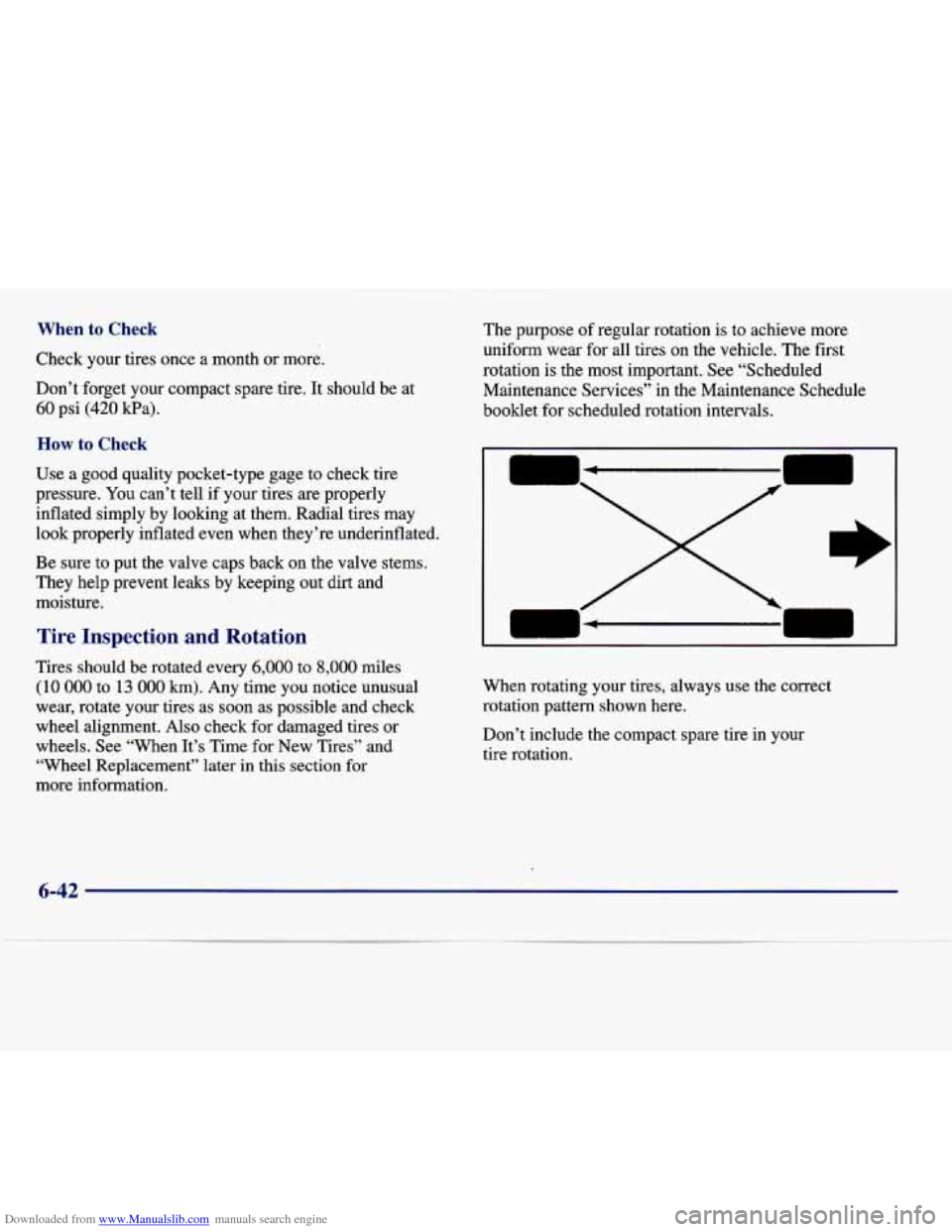
Tires should be rotated every 6,000 to 8,000 miles
(10 000 to 13 000 km). Any time you notice unusual
wear, rotate your tires as soon as possible and check
wheel alignment. Also check for damaged tires or
wheels. See “When It’s Time for New Tires” and
“Wheel Replacement’’ later in this section for
more information. The
purpose of regular rotation is to achieve more
uniform wear for all tires on the vehicle. The first
rotation is the most important. See “Scheduled
Maintenance Services” in the Maintenance Schedule
booklet for scheduled rotation intervals.
When rotating your tires, always use the correct
rotation pattern shown here.
Don’t include the compact spare tire in your
tire rotation.
6-42