maintenance CADILLAC DEVILLE 1997 7.G Owners Manual
[x] Cancel search | Manufacturer: CADILLAC, Model Year: 1997, Model line: DEVILLE, Model: CADILLAC DEVILLE 1997 7.GPages: 386, PDF Size: 21.61 MB
Page 44 of 386
Downloaded from www.Manualslib.com manuals search engine Let only qualified technicians work on your air
bag systems. Improper service can mean that an
air bag system won’t work properly. See your dealer
for service.
NOTICE:
If you damage the covering for the driver’s or
the right front passenger’s
air bag, or the air
bag covering on the driver’s and right front
passenger’s door, the bag may not work properly.
You may have to replace the air bag module in
the steering wheel, both the
air bag module and
the instrument panel for the right front
passenger’s
air bag, or both the air bag module
and door panel for the driver’s and right front
passenger’s side impact
air bag. Do not open or
break the
air bag coverings. Servicing
Your
Air Bag-Equipped Cadillac
Air bags affect how your Cadillac should be serviced.
There are parts
of the air bag systems in several places
around your vehicle. Your Cadillac dealer and the
Cadillac Service Manual have information about
servicing your vehicle and the air bag systems.
To
purchase a service manual, see “Service and Owner
Publications” in the Index.
For up to
10 seconds after the ignition key is
turned off and the battery
is disconnected, an air
bag can still inflate during improper service. You
can be injured if you are close to an
air bag when
it inflates. Avoid wires wrapped with yellow tape
or yellow connectors. They are probably part
of
the air bag systems. Be sure to follow proper
service procedures, and make sure the person
performing work for you is qualified to do
so.
The air bag systems do not need regular maintenance.
1-29
~
Page 63 of 386

Downloaded from www.Manualslib.com manuals search engine Safety Belt Extender
If the vehicle’s safety belt will fasten around you, you
should use it.
But
if a safety belt isn’t long enough to fasten, your
dealer will order you an extender. It’s free. When you go
in to order it, take the heaviest coat you will wear,
so the
extender will be long enough for you. The extender will
be just for you, and just for the seat in your vehicle that
you choose. Don’t let someone else use it, and use it
only for the seat it is made to fit.
To wear it, just attach it
to the regular safety belt.
Checking Your Restraint Systems
Now and then, make sure the safety belt reminder light
and all your belts, buckles, latch plates, retractors and
anchorages are working properly.
Look for any other
loose or damaged safety belt system parts. If you see
anything that might keep a safety belt system from
doing its job, have
it repaired.
Tom
or frayed safety belts may not protect you in a
crash. They can rip apart under impact forces. If a belt
is torn or frayed, get a new one right away.
Also look for any opened or broken air bag covers, and
have them repaired
or replaced. (The air bag system
does not need regular maintenance.)
Replacing Restraint System Parts
After
a Crash
If you’ve had a crash, do you need new belts?
After a very minor collision, nothing may be necessary.
But if the belts were stretched, as they would be
if worn
during a more severe crash, then you need new belts.
If belts are cut or damaged, replace them. Collision
damage also may mean you will need to have safety belt
or seat parts repaired or replaced. New parts and repairs
may be necessary even if the belt wasn’t being used at
the time of the collision.
If an air bag inflates, you’ll need to replace air bag
system parts. See the part on the air bag system earlier
in this section.
Page 155 of 386

Downloaded from www.Manualslib.com manuals search engine voltage on the DIC by pressing the INFORMATION
(INFO) button. The normal range is 11.5 to 15.5 volts.
BRAKE VACUUM PROBLEM - 10s: The circuit in
the brake booster vacuum has shorted
or is loose when
this message appears. Your vehicle may lose power
brakes but you will still have the use of manual brakes.
The power brakes will not be affected if the problem is
caused by a failed sensor. Have your vehicle serviced
immediately at your Cadillac dealership.
CHANGE ENGINE OIL - 82: This means that the life
of the engine oil has expired and
it should be changed
within 200 miles. See “Engine Oil” and “Filter
Recommendations”
in the Maintenance Schedule booklet.
After an oil change, the Oil Life Indicator must be reset. See “Oil Life Indicator”
in the Index on how to reset it.
CHANGE TRANS FLUID - 47: This message will
appear when it is time to replace the transaxle fluid. See
the Maintenance Schedule booklet for the proper fluid
and change intervals.
CJ3ECK BRAKE FLUID LEVEL - 37: This message
will display if the ignition is in the
RUN position to
inform the driver that the brake fluid level is low. Check
the brake reservoir level and add fluid as needed. Have
the brake system serviced by a Cadillac technician as soon
as possible. If the brake warning light is on, follow
the directions in that part.
CHECK COOLANT LEVEL - 02: This message will
appear when there is a low level
of engine coolant. Have
the cooling system serviced by a Cadillac technician as soon as possible.
CHECK FUEL GAGE - 39: This message will appear
when the fuel supply
is less than four gallons (15.2 L)
and the display is turned off (digital clusters only).
A single chime will also sound when this message
is displayed.
CHECK OIL LEVEL - 36: For correct operation of
the low oil sensing system, your vehicle should be on a
level surface.
A false CHECK OIL LEVEL message
may appear if the vehicle is parked
on grades. The oil
level sensing system does not check for actual oil level
if the engine has been off for a short period of time, and
the oil level
is never sensed while the engine is running.
If the CHECK OIL LEVEL message appears, and your
vehicle has been parked on level ground with the engine
off for at least 30 minutes, the oil level should be
checked by observing the oil dipstick. Prior to checking
the oil level, be sure the engine has been off for five
minutes and your vehicle is on a level surface. Then
check the dipstick and add oil if necessary. See “Engine
Oil” in the Index.
Page 162 of 386

Downloaded from www.Manualslib.com manuals search engine The DIC may display a CHECK OIL LEVEL message.
Always keep a written record of the mileage and date
when you changed your oil. For more information, see
the Cadillac Maintenance Schedule booklet. If you see
CHECK
OIL LEVEL, it means that you have less than
10 percent of the oil life left and you should consider
changing your engine oil. If you see CHANGE
ENGINE OIL, it means the oil life is gone and you
should change the oil right away.
The system should indicate changing the oil between
3,000 miles (5 000 km) and 7,500 miles (12 500 km).
It may indicate changing the oil before 3,000 miles
(5 000 km) depending on your driving habits. If the vehicle has been driven
7,500 miles (12 500 km), it will
indicate to change the oil.
If you drive in a dusty area,
you should change your oil every
3,000 miles (5 000
km) or three months (whichever comes first) unless the
display indicates changing it sooner. The system doesn’t
check
how much oil you have, so you’ll still have to
check for that.
To see how, see “Engine Oil” in
the Index.
When new oil
is added, you’ll need to reset the system.
To reset, display the Oil Life Indicator by pressing the
INFORMATION (INFO) button. Then press and hold
the RESET button until the display shows 100% OIL
LIFE LEFT.
2-97
. ~
Page 240 of 386
Downloaded from www.Manualslib.com manuals search engine Parking on Hills
You really should not park your vehicle, with a trailer
attached, on a hill.
If something goes wrong, your rig
could start to move. People can be injured, and both
your vehicle and the trailer can be damaged.
But if you ever have to park your rig on a hill, here’s
how to do it:
1. Apply your regular brakes, but do not shift into
PARK (P).
2. Have someone place chocks under the trailer wheels.
3. When the wheel chocks are in place, release the
regular brakes until the chocks absorb the load.
4. Reapply the regular brakes. Then shift into
PARK (P) firmly and apply your parking brakes.
5. Release the regular brakes.
When You Are Ready to Leave After
Parking on a Hill
1. Apply your regular brakes and hold the pedal down
while you:
0 Start your engine;
Shift into a gear; and
0 Be sure the parking brake has released.
2. Let up on the brake pedal.
3. Drive slowly until the trailer is clear of the chocks.
4. Stop and have someone pick up and store the chocks.
Maintenance When Trailer Towing
Your vehicle will need service more often when you’re
pulling a trailer. See the Maintenance Schedule for more
on
this. Things that are especially important in trailer
operation are automatic transaxle fluid (don’t overfill),
engine oil, belt, cooling system and brake adjustment.
Each of these is covered in
this manual, and the Index
will help you find them quickly.
If you’re trailering, it’s
a good idea to review these sections before you start
your trip.
Check periodically to see that
all hitch nuts and bolts
are tight.
4-39
Page 284 of 386

Downloaded from www.Manualslib.com manuals search engine $z=* ‘dc
Section 6 Service and Appearance Care
Here you will find information about the care of your Cadillac. This section begins with service and fuel information,
and then it shows how to check important fluid and lubricant levels. There is also technical information about your
6-2 6-3
6-4
6-5
6-7
6-10
6-15
6-18
6-2
1
6-25
6-27
6-30
6-3
1
6-39
6-40
6-48
6-49
6-52
vehicle, and a part
devoted to its appearance care.
Service
Fuel
Fuels in Foreign Countries
Filling Your Tank
Checking Things Under the Hood
Engine Oil
Air Cleaner
Automatic Transaxle Fluid
Engine Coolant
Windshield Washer Fluid
Brakes
Battery
Bulb Replacement
Windshield Wiper Blade Replacement
Tires
Appearance Care
Cleaning the Inside of Your Cadillac
Care
of Safety Belts 6-52
6-5 3
6-53
6-53
6-54
6-55
6-55
6-56
6-57
6-58
6-58
6-59
6-69
6-69
6-70
6-70 Cleaning Glass
Surfaces
Cleaning the Outside of the Windshield and
Wiper Blades
Weatherstrips Cleaning the Outside of Your Cadillac
Cleaning Aluminum or Chrome Wheels
(If Equipped)
Cleaning Tires
Sheet Metal Damage
Chemical Paint Spotting
Appearance Care Materials Chart
Vehicle Identification Number
(VIN)
Service Parts Identification Label
Electrical System
Replacement Bulbs
Capacities and Specifications
Air Conditioning Refrigerants
Normal Maintenance Replacement Parts
6-1
Page 285 of 386
Downloaded from www.Manualslib.com manuals search engine Service
Your Cadillac dealer knows your vehicle best and wants
you to be happy with it. We hope you’ll go to your
dealer for all your service needs. You’ll get genuine GM
parts and GM-trained and supported service people.
We hope you’ll want to keep your GM vehicle all GM.
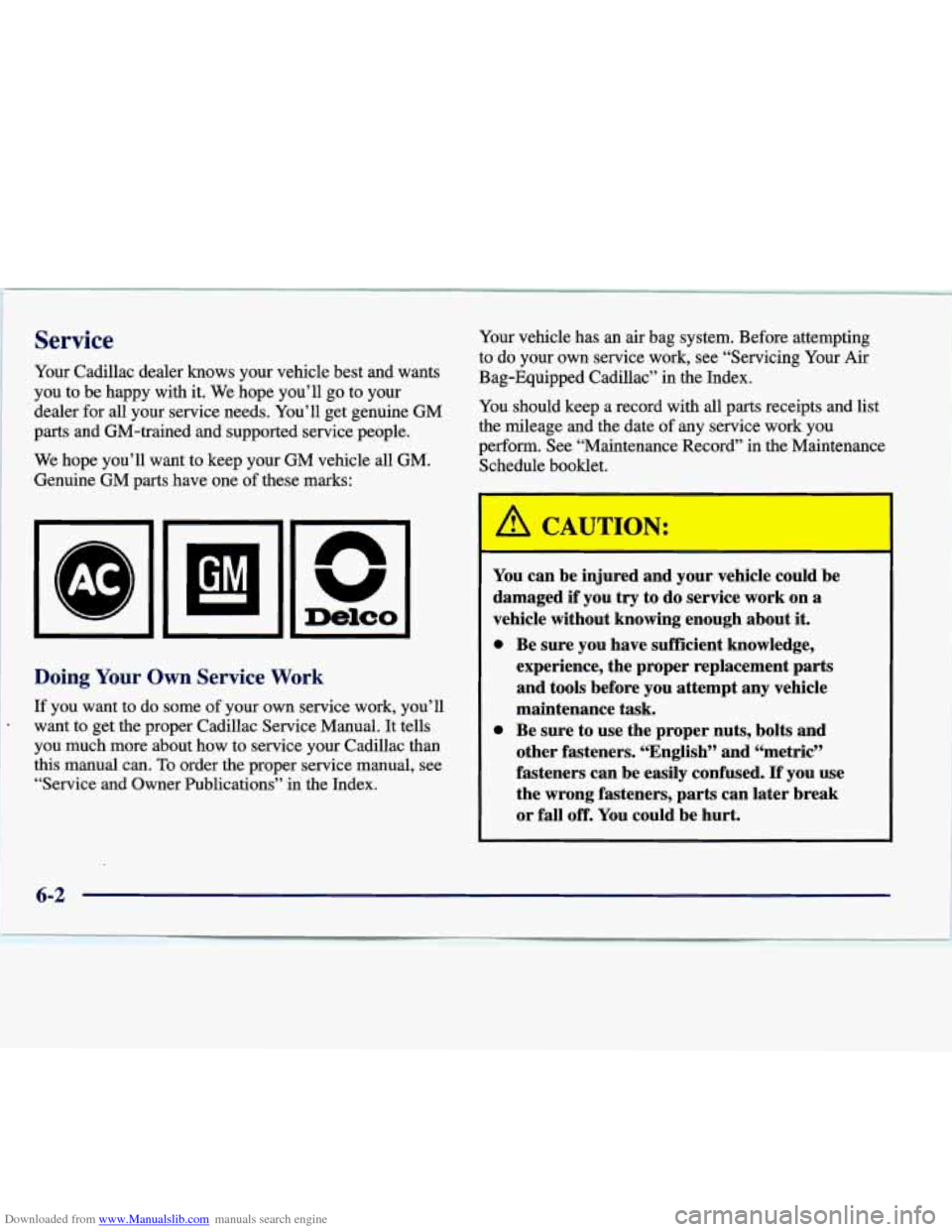
Genuine GM parts have one
of these marks: Your
vehicle has an air bag system. Before attempting
to
do your own service work, see “Servicing Your Air
Bag-Equipped Cadillac” in the Index.
You should keep a record with all parts receipts and list
the mileage and the date of any service work you
perform. See “Maintenance Record”
in the Maintenance
Schedule booklet.
em”
n
Delco
Doing Your Own Service Work
If you want to do some of your own service work, you’ll
want to get the proper Cadillac Service Manual. It tells
you much more about how
to service your Cadillac than
this manual can.
To order the proper service manual, see
“Service and Owner Publications’’
in the Index. You
can be injured and your vehicle could be
damaged
if you try to do service work on a
vehicle without knowing enough about it.
0 Be sure you have sufficient knowledge,
experience, the proper replacement parts
and tools before you attempt any vehicle
maintenance task.
0 Be sure to use the proper nuts, bolts ana
other fasteners. “English” and “metric”
fasteners can be easily confused.
If you use
the wrong fasteners,
parts can later break
or fall
off. You could be hurt.
6-2
Page 299 of 386

Downloaded from www.Manualslib.com manuals search engine 4. Unhook both air cleaner cover latches. One latch is
located near the radiator hose (not shown) and the
other latch
is located next to the IAT sensor.
5. Pivot the air cleaner and air duct assembly toward
the front
of the vehicle. Remove the cover.
6. Take out the air cleaner filter and remove any loose debris that may be found laying in the air
cleaner base.
7. Install a new air filter element. See “Normal
Maintenance Replacement Parts” in the Index.
6-16
Page 300 of 386

Downloaded from www.Manualslib.com manuals search engine Follow these steps to reinstall the air cleaner assembly:
1. Slide the air cleaner lid into the slots in the front
edge of the air cleaner base.
2. Pivot the air cleaner cover and the air duct assembly
downward. Make sure that both latches are secure
and fully engaged.
3. Reinstall the clean air duct over the mass airflow
sensor. Make sure that the duct is secure around the
entire outer edge of the sensor.
4. Tighten the air duct clamp.
5. Reconnect the IAT sensor.
Refer to the Maintenance Schedule to determine when to
replace the
air filter.
See “Scheduled Maintenance Services” in the
Maintenance Schedule booklet.
Operating the engine with the air cleaner off can
cause you or others
to be burned. The air cleaner
not only cleans the
air, it stops flames if the
engine backfires.
If it isn’t there, and the engine
backfires, you could be burned. Don’t drive with
it off, and be careful working on the engine with
the
air cleaner off.
NOTICE:
If the air cleaner is off, a backfire can cause a
damaging engine fire. And, dirt can easily get
into your engine, which will damage it. Always
have the
air cleaner in place when you’re driving.
6-17
Page 301 of 386

Downloaded from www.Manualslib.com manuals search engine Automatic Transaxle Fluid
When to Check and Change
A good time to check your automatic transaxle fluid
level
is when the engine oil is changed.
Change both the fluid and filter every
50,000 miles
(83
000 km) if the vehicle is mainly driven under one or
more of these conditions:
0 In heavy city traffic where the outside temperature
regularly reaches
90°F (32°C) or higher.
0 In hilly or mountainous terrain.
0 When doing frequent trailer towing.
0 Uses such as found in taxi, police or delivery service.
Use such as limousine service.
If you do not use your vehicle under any of these
conditions, the fluid and filter do not require changing.
See “Scheduled Maintenance Services”
in the
Maintenance Schedule booklet.
How to Check
Because this operation can be a little difficult, you may
choose to have this done at your Cadillac dealership
service department.
If you do it yourself, be sure to follow
all the instructions
here,
or you could get a false reading on the dipstick.
NOTICE:
Too much or too little fluid can damage your
transaxle.
Too much can mean that some of the
fluid could come out and fall on hot engine parts or exhaust system parts, starting a
fire. Be sure to
get an accurate reading if you check your
transaxle fluid.
Wait at least 30 minutes before checking the transaxle
fluid level if you have been driving:
When outside temperatures are above 90°F (32°C).
At high speed for quite a while.
0 In heavy traffic -- especially in hot weather.
e While pulling a trailer.
6-18