brake CADILLAC DEVILLE 2003 8.G Repair Manual
[x] Cancel search | Manufacturer: CADILLAC, Model Year: 2003, Model line: DEVILLE, Model: CADILLAC DEVILLE 2003 8.GPages: 423, PDF Size: 2.91 MB
Page 370 of 423

Fuses Usage
10 Lamps Park Right
11 Fuel Tank Ventilation Solenoid
12 Ignition 1
13 Interior Lamp Dimmer Module
14 Sunshade
15 Navigation
16 Heated Seat Left Front
17 Interior Lamps
18 Right Rear Door Module
19 Stoplamps
20 Park/Reverse
21 Audio
22Retained Accessory Power for
Sunroof
23 Lamps, Parking Left
24 Night Vision
25 Passenger Door Module
26 Body
27 Export Lights, Power LocksFuses Usage
28 Rear HVAC Blower
29 Ignition Switch
30 Hazard Signal
31 Reverse, Locks
32Continuous Variable Road Sensing
Suspension
33 Heating, Ventilation, Air Conditioning
34 Ignition 3 Rear
35 Antilock Braking System
36 Heated Seat, Right Front
37 Heated Seat, Right Rear
38 Dimmer
60 Park Brake
61 Rear Defog
62 HVAC Blower
63 Audio Ampli®er
64 ELC Compressor/Exhaust
65 Cigar Lighter
66 Not Used
5-99
Page 371 of 423

Relays Usage
39 Fuel Pump
40 Parking Lamps
41 Ignition 1
42 Park Brake A
43 Park Brake B
44 Park Shift Interlock
45 Reverse Lamps
46Retained Accessory Power for
Sunroof
47 Reverse Lockout
48 Suspension Dampers
49 Ignition 3
50 Fuel Tank Door Release
51 Interior Lamps
52 Trunk Release
53 Not Used
54 Lock, Cylinder
55 Automatic Level Control Compressor
58 Cigar Lighter
59 Rear DefogCircuit
BreakersUsage
56 Power Seats
57 Power Windows
The spare fuses and fuse puller are located in the
underhood fuse block. See ªUnderhood Fuse Blockº
listed previously under
Fuses and Circuit Breakers
on page 5-94for more information.
5-100
Page 376 of 423

Maintenance Schedule......................................6-2
Introduction...................................................6-2
Your Vehicle and the Environment....................6-2
Maintenance Requirements..............................6-2
How This Section is Organized.........................6-3
Part A: Scheduled Maintenance Services...........6-4
Using Your Maintenance Schedule....................6-4
Scheduled Maintenance...................................6-4
Part B: Owner Checks and Services.................6-9
At Each Fuel Fill............................................6-9
At Least Once a Month...................................6-9
At Least Twice a Year...................................6-10At Least Once a Year...................................6-10
Part C: Periodic MaintenanceInspections.........6-13
Steering, Suspension and Front Drive Axle
Boot and Seal Inspection............................6-13
Exhaust System Inspection............................6-13
Fuel System Inspection..................................6-13
Engine Cooling System Inspection...................6-14
Throttle System Inspection.............................6-14
Brake System Inspection................................6-14
Part D: Recommended Fluids and Lubricants. . . .6-15
Part E: Maintenance Record...........................6-16
Section 6 Maintenance Schedule
6-1
Page 380 of 423

SeePart B: Owner Checks and Services on page 6-9andPart C: Periodic MaintenanceInspections on
page 6-13.
Footnotes
²The U.S. Environmental Protection Agency or the
California Air Resources Board has determined that the
failure to perform this maintenance item will not nullify
the emission warranty or limit recall liability prior to
the completion of the vehicle's useful life. We, however,
urge that all recommended maintenance services be
performed at the indicated intervals and the
maintenance be recorded.
+A good time to check your brakes is during tire
rotation. See Brake System Inspection on page 6-14.
Engine Oil Scheduled Maintenance
Change engine oil and ®lter as indicated by the GM
Oil Life System (or every 12 months, whichever
occurs ®rst). Reset the system.
Your vehicle has a computer system that lets you know
when to change the engine oil and ®lter. This is based on
engine revolutions and engine temperature, and not on
mileage. Based on driving conditions, the mileage at
which an oil change will be indicated can vary
considerably. For the oil life system to work properly, you
must reset the system every time the oil is changed.When the system has calculated that oil life has been
diminished, it will indicate that an oil change is necessary.
A CHANGE ENGINE OIL message in the Driver
Information Center (DIC) will come on. Change your oil
as soon as possible within the next two times you stop for
fuel. It is possible that, if you are driving under the best
conditions, the oil life system may not indicate that an oil
change is necessary for over a year. However, your
engine oil and ®lter must be changed at least once a year
and at this time the system must be reset. Your dealer
has GM-trained service people who will perform this work
using genuine GM parts and reset the system.
It is also important to check your oil regularly and keep
it at the proper level.
If the system is ever reset accidentally, you must
change your oil at 3,000 miles (5 000 km) since your
last oil change. Remember to reset the oil life system
whenever the oil is changed. SeeEngine Oil on
page 5-13for information on resetting the system.
An Emission Control Service.
See the mileage intervals following for additional services
that may be performed with an engine oil change. After
the services are performed, record the date, odometer
reading and who performed the service on the
maintenance record pages in Part E of this schedule.
6-5
Page 386 of 423

Starter Switch Check
{CAUTION:
When you are doing this check, the vehicle
could move suddenly. If it does, you or others
could be injured. Follow the steps below.
1. Before you start, be sure you have enough room
around the vehicle.
2. Firmly apply both the parking brake and the regular
brake. See
Parking Brake on page 2-32if
necessary.
Do not use the accelerator pedal, and be ready to
turn off the engine immediately if it starts.
3. Try to start the engine in each gear. The starter
should work only in PARK (P) or NEUTRAL (N).
If the starter works in any other position, your
vehicle needs service.
Automatic Transaxle Shift Lock Control
System Check
{CAUTION:
When you are doing this check, the vehicle
could move suddenly. If it does, you or others
could be injured. Follow the steps below.
1. Before you start, be sure you have enough room
around the vehicle. It should be parked on a level
surface.
2. Firmly apply the parking brake. See
Parking Brake
on page 2-32if necessary.
Be ready to apply the regular brake immediately if
the vehicle begins to move.
3. With the engine off, turn the key to the ON position,
but don't start the engine. Without applying the
regular brake, try to move the shift lever out
of PARK (P) with normal effort. If the shift lever
moves out of PARK (P), your vehicle needs service.
6-11
Page 387 of 423

Ignition Transaxle Lock Check
While parked, and with the parking brake set, try to turn
the ignition key to OFF in each shift lever position.
·The key should turn to OFF only when the shift lever
is in PARK (P).
·The key should come out only in OFF.
Parking Brake and Automatic Transaxle
Park (P) Mechanism Check
{CAUTION:
When you are doing this check, your vehicle
could begin to move. You or others could be
injured and property could be damaged. Make
sure there is room in front of your vehicle in
case it begins to roll. Be ready to apply the
regular brake at once should the vehicle begin
to move.Park on a fairly steep hill, with the vehicle facing
downhill. Keeping your foot on the regular brake, set the
parking brake.
·To check the parking brake's holding ability: With
the engine running and transaxle in NEUTRAL (N),
slowly remove foot pressure from the regular
brake pedal. Do this until the vehicle is held by the
parking brake only.
·To check the PARK (P) mechanism's holding ability:
With the engine running, shift to PARK (P). Then
release the parking brake followed by the regular
brake.
Underbody Flushing Service
At least every spring, use plain water to ¯ush any
corrosive materials from the underbody. Take care to
clean thoroughly any areas where mud and other debris
can collect.
6-12
Page 389 of 423

Engine Cooling System Inspection
Inspect the hoses and have them replaced if they
are cracked, swollen or deteriorated. Inspect all pipes,
®ttings and clamps; replace as needed. Clean the
outside of the radiator and air conditioning condenser.
To help ensure proper operation, a pressure test of
the cooling system and pressure cap is recommended
at least once a year.
Throttle System Inspection
Inspect the throttle system for interference or binding,
and for damaged or missing parts. Replace parts
as needed. Replace any components that have high
effort or excessive wear. Do not lubricate accelerator
and cruise control cables.
Brake System Inspection
Inspect the complete system. Inspect brake lines and
hoses for proper hook-up, binding, leaks, cracks,
cha®ng, etc. Inspect disc brake pads for wear and rotors
for surface condition. Inspect other brake parts,
including calipers, parking brake, etc. You may need to
have your brakes inspected more often if your driving
habits or conditions result in frequent braking.
6-14
Page 390 of 423
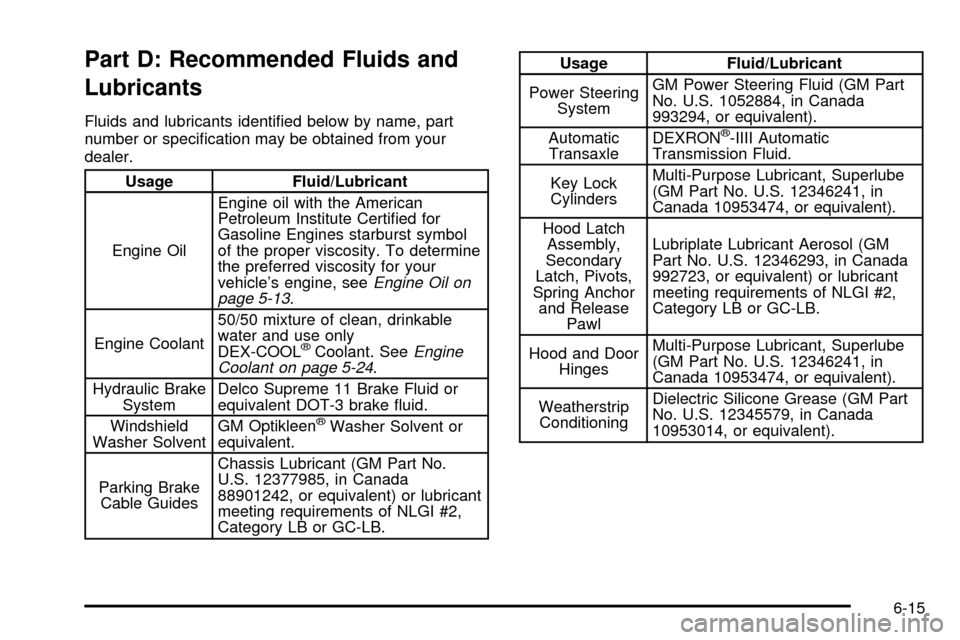
Part D: Recommended Fluids and
Lubricants
Fluids and lubricants identi®ed below by name, part
number or speci®cation may be obtained from your
dealer.
Usage Fluid/Lubricant
Engine OilEngine oil with the American
Petroleum Institute Certi®ed for
Gasoline Engines starburst symbol
of the proper viscosity. To determine
the preferred viscosity for your
vehicle's engine, see
Engine Oil on
page 5-13.
Engine Coolant50/50 mixture of clean, drinkable
water and use only
DEX-COOL
žCoolant. SeeEngine
Coolant on page 5-24.
Hydraulic Brake
SystemDelco Supreme 11 Brake Fluid or
equivalent DOT-3 brake ¯uid.
Windshield
Washer SolventGM Optikleen
žWasher Solvent or
equivalent.
Parking Brake
Cable GuidesChassis Lubricant (GM Part No.
U.S. 12377985, in Canada
88901242, or equivalent) or lubricant
meeting requirements of NLGI #2,
Category LB or GC-LB.
Usage Fluid/Lubricant
Power Steering
SystemGM Power Steering Fluid (GM Part
No. U.S. 1052884, in Canada
993294, or equivalent).
Automatic
TransaxleDEXRON
ž-IIII Automatic
Transmission Fluid.
Key Lock
CylindersMulti-Purpose Lubricant, Superlube
(GM Part No. U.S. 12346241, in
Canada 10953474, or equivalent).
Hood Latch
Assembly,
Secondary
Latch, Pivots,
Spring Anchor
and Release
PawlLubriplate Lubricant Aerosol (GM
Part No. U.S. 12346293, in Canada
992723, or equivalent) or lubricant
meeting requirements of NLGI #2,
Category LB or GC-LB.
Hood and Door
HingesMulti-Purpose Lubricant, Superlube
(GM Part No. U.S. 12346241, in
Canada 10953474, or equivalent).
Weatherstrip
ConditioningDielectric Silicone Grease (GM Part
No. U.S. 12345579, in Canada
10953014, or equivalent).
6-15
Page 404 of 423

Reporting Safety Defects to
General Motors
In addition to notifying NHTSA (or Transport Canada) in
a situation like this, we certainly hope you'll notify us.
Please call us at 1-800-458-8006, or write:
Cadillac Customer Assistance Center
Cadillac Motor Car Division
P.O. Box 33169
Detroit, MI 48232-5169
In Canada, please call us at 1-800-263-3777 (English)
or 1-800-263-7854 (French). Or, write:
Customer Communication Centre, 163-005
General Motors of Canada Limited
1908 Colonel Sam Drive
Oshawa, Ontario L1H 8P7
Service Publications Ordering
Information
Service Manuals
Service Manuals have the diagnosis and repair
information on engines, transmission, axle, suspension,
brakes, electrical, steering, body, etc.
RETAIL SELL PRICE: $120.00
Transmission, Transaxle, Transfer
Case Unit Repair Manual
This manual provides information on unit repair service
procedures, adjustments and speci®cations for GM
transmissions, transaxles and transfer cases.
RETAIL SELL PRICE: $50.00
7-11
Page 406 of 423

A
Accessory Power Outlets.................................3-27
Adaptive Seat Controls...................................... 1-3
Adding Washer Fluid.......................................5-37
Additional Program Information........................... 7-9
Additives, Fuel................................................. 5-6
Add-On Electrical Equipment............................5-93
Adjusting the Speakers (Balance/Fade)......3-83, 3-92
Air Bag Systems.............................................1-49
How Does an Air Bag Restrain?....................1-56
Servicing Your Air Bag-Equipped Vehicle.........1-59
What Makes an Air Bag In¯ate?....................1-56
What Will You See After an Air Bag In¯ates?......1-57
When Should an Air Bag In¯ate?...................1-55
Where Are the Air Bags?..............................1-52
Air Bag .........................................................3-45
Readiness Light..........................................3-45
Air Cleaner/Filter, Engine.................................5-19
AM .............................................................3-105
Analog Cluster................................................3-42
Antenna, Diversity Antenna System..................3-108
Antenna, XMŸ Satellite Radio
Antenna System........................................3-108
Anti-lock Brake System (ABS)............................ 4-7
Anti-Lock Brake, System Warning Light..............3-48
Anti-Pinch Feature..........................................2-17
Appearance Care............................................5-84
Care of Safety Belts....................................5-87
Chemical Paint Spotting...............................5-90Appearance Care (cont.)
Cleaning the Inside of Your Vehicle................5-84
Cleaning the Outside of Your Vehicle..............5-88
Finish Damage............................................5-90
Sheet Metal Damage...................................5-90
Underbody Maintenance...............................5-90
Vehicle Care/Appearance Materials................5-91
Weatherstrips..............................................5-87
Ashtrays........................................................3-28
Assist Handles...............................................2-53
Audio System(s).............................................3-80
Audio Steering Wheel Controls....................3-105
Care of Your Cassette Tape Player...............3-106
Care of Your CD Player..............................3-107
Care of Your CDs......................................3-107
Diversity Antenna System............................3-108
Glovebox-Mounted CD Changer...................3-100
Navigation/Radio System.............................3-100
Radio Personalization with Home and Away
Feature.................................................3-103
Radio with Cassette and CD.................3-81, 3-89
Setting the Time for Radios with Radio Data
Systems (RDS)........................................3-80
Setting the Time for Radios without Radio
Data Systems (RDS)................................3-80
Theft-Deterrent Feature...............................3-104
Understanding Radio Reception...................3-105
XMŸ Satellite Radio Antenna System...........3-108
Auto Exit Seat................................................3-69
Auto Exit Steering Wheel.................................3-70
1