battery CADILLAC DTS 2006 1.G Owner's Manual
[x] Cancel search | Manufacturer: CADILLAC, Model Year: 2006, Model line: DTS, Model: CADILLAC DTS 2006 1.GPages: 450, PDF Size: 2.55 MB
Page 340 of 450

The battery is located under the rear seat cushion. To
access the battery, seeRear Underseat Fuse Block on
page 5-96. You do not need to access the battery to jump
start your vehicle. SeeJump Starting on page 5-39.
{CAUTION:
A battery that is not properly vented can let
sulfuric acid fumes into the area under the rear
seat cushion. These fumes can damage your
rear seat safety belt systems. You may not be
able to see this damage, and the safety belts
might not provide the protection needed in a
crash. If a replacement battery is ever needed,
it must be vented in the same manner as the
original battery. Always make sure that the
vent hose is properly reattached before
reinstalling the seat cushion.To be sure the vent hose (A) is properly attached, the
vent hose connectors (B) must be securely reattached to
the vent outlets (C) on each side of the battery, and
the vent assembly grommet (D) must be secured to the
oor pan (E).
5-38
Page 341 of 450

Vehicle Storage
If you are not going to drive your vehicle for 25 days
or more, remove the black, negative (−) cable from
the battery. This will help keep your battery from
running down.
{CAUTION:
Batteries have acid that can burn you and gas
that can explode. You can be badly hurt if you
are not careful. SeeJump Starting on
page 5-39for tips on working around a battery
without getting hurt.
Jump Starting
If your vehicle’s battery has run down, you may want to
use another vehicle and some jumper cables to start
your vehicle. Be sure to use the following steps to do
it safely.
{CAUTION:
Batteries can hurt you. They can be dangerous
because:
They contain acid that can burn you.
They contain gas that can explode
or ignite.
They contain enough electricity to
burn you.
If you do not follow these steps exactly, some
or all of these things can hurt you.
Notice:Ignoring these steps could result in costly
damage to your vehicle that would not be covered
by your warranty.
Trying to start your vehicle by pushing or pulling it
will not work, and it could damage your vehicle.
1. Check the other vehicle. It must have a 12-volt
battery with a negative ground system.
Notice:If the other vehicle’s system is not a 12-volt
system with a negative ground, both vehicles can
be damaged. Only use vehicles with 12-volt systems
with negative grounds to jump start your vehicle.
5-39
Page 343 of 450

You will not see the battery of your vehicle under
the hood. It is located under the rear passenger’s
seat. You will not need to access the battery
for jump starting. The remote terminals are for that
purpose.
{CAUTION:
An electric fan can start up even when the
engine is not running and can injure you. Keep
hands, clothing and tools away from any
underhood electric fan.
{CAUTION:
Using a match near a battery can cause battery
gas to explode. People have been hurt doing
this, and some have been blinded. Use a
ashlight if you need more light.
CAUTION: (Continued)
CAUTION: (Continued)
Be sure the battery has enough water. You do
not need to add water to the battery installed
in your new vehicle. But if a battery has ller
caps, be sure the right amount of uid is there.
If it is low, add water to take care of that rst.
If you do not, explosive gas could be present.
Battery uid contains acid that can burn you.
Do not get it on you. If you accidentally get it
in your eyes or on your skin, ush the place
with water and get medical help immediately.
{CAUTION:
Fans or other moving engine parts can injure
you badly. Keep your hands away from moving
parts once the engine is running.
5-41
Page 344 of 450

5. Check that the jumper cables do not have loose or
missing insulation. If they do, you could get a
shock. The vehicles could be damaged too.
Before you connect the cables, here are some
basic things you should know. Positive (+) will go to
positive (+) or to a remote positive (+) terminal if
the vehicle has one. Negative (−) will go to a heavy,
unpainted metal engine part or to a remote
negative (−) terminal if the vehicle has one.
Do not connect positive (+) to negative (−)oryou
will get a short that would damage the battery
and maybe other parts too. And do not connect the
negative (−) cable to the negative (−) terminal on
the dead battery because this can cause sparks.
6. Connect the red positive (+) cable to the remote
positive (+) terminal location on the vehicle with
the dead battery. Use a remote positive (+) terminal
if the vehicle has one.
7. Do not let the other end touch metal. Connect it to
the positive (+) terminal location of the vehicle with
the good battery. Use a remote positive (+)
terminal if the vehicle has one.8. Now connect the black negative (−) cable to the
negative (−) terminal location of the vehicle with
the good battery. Use a remote negative (−) terminal
if the vehicle has one.
Do not let the other end of the cable touch anything
until the next step. The other end of the negative (−)
cable does not go to the dead battery. It goes to
a heavy, unpainted metal engine part or to a
remote negative (−) terminal on the vehicle with
the dead battery.
9. Connect the other end of the negative (−) cable to
the negative (−) terminal location on the vehicle with
the dead battery. Your vehicle has a remote
negative (−) terminal marked GND (−).
10. Now start the vehicle with the good battery and run
the engine for a while.
11. Try to start the vehicle that had the dead battery.
If it will not start after a few tries, it probably
needs service.
5-42
Page 345 of 450
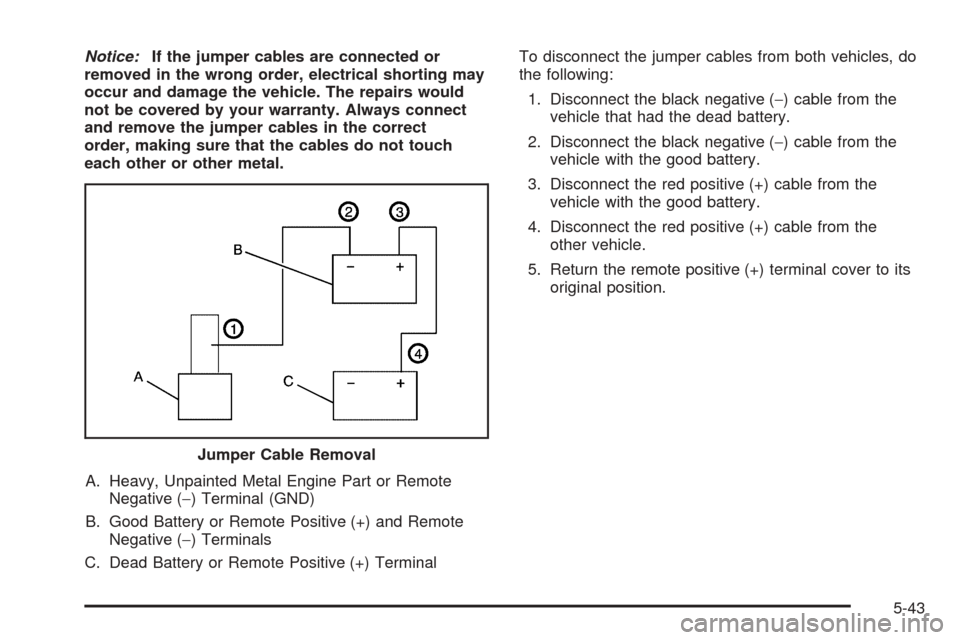
Notice:If the jumper cables are connected or
removed in the wrong order, electrical shorting may
occur and damage the vehicle. The repairs would
not be covered by your warranty. Always connect
and remove the jumper cables in the correct
order, making sure that the cables do not touch
each other or other metal.
A. Heavy, Unpainted Metal Engine Part or Remote
Negative (−) Terminal (GND)
B. Good Battery or Remote Positive (+) and Remote
Negative (−) Terminals
C. Dead Battery or Remote Positive (+) TerminalTo disconnect the jumper cables from both vehicles, do
the following:
1. Disconnect the black negative (−) cable from the
vehicle that had the dead battery.
2. Disconnect the black negative (−) cable from the
vehicle with the good battery.
3. Disconnect the red positive (+) cable from the
vehicle with the good battery.
4. Disconnect the red positive (+) cable from the
other vehicle.
5. Return the remote positive (+) terminal cover to its
original position.
Jumper Cable Removal
5-43
Page 398 of 450
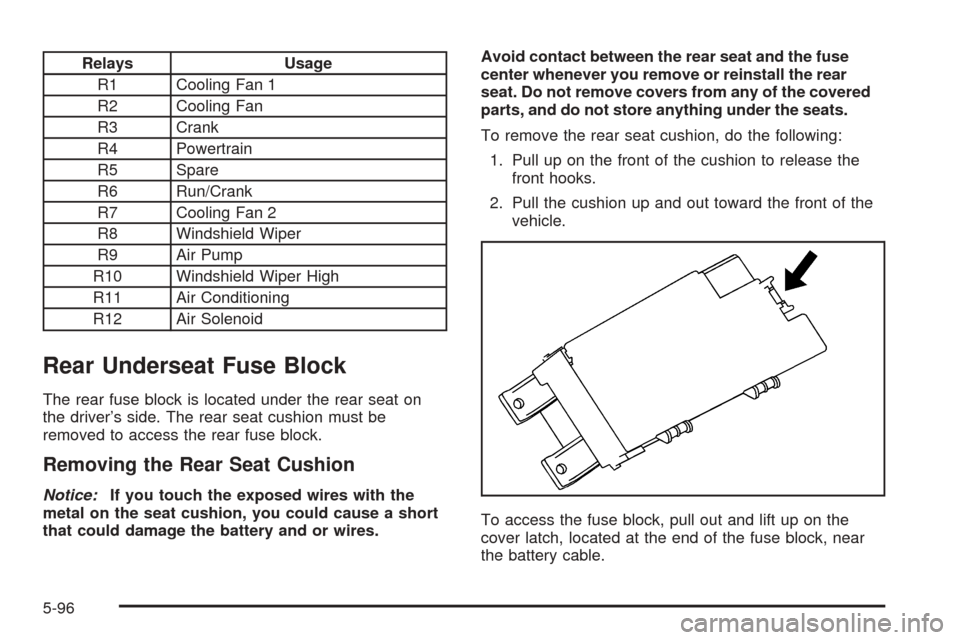
Relays Usage
R1 Cooling Fan 1
R2 Cooling Fan
R3 Crank
R4 Powertrain
R5 Spare
R6 Run/Crank
R7 Cooling Fan 2
R8 Windshield Wiper
R9 Air Pump
R10 Windshield Wiper High
R11 Air Conditioning
R12 Air Solenoid
Rear Underseat Fuse Block
The rear fuse block is located under the rear seat on
the driver’s side. The rear seat cushion must be
removed to access the rear fuse block.
Removing the Rear Seat Cushion
Notice:If you touch the exposed wires with the
metal on the seat cushion, you could cause a short
that could damage the battery and or wires.Avoid contact between the rear seat and the fuse
center whenever you remove or reinstall the rear
seat. Do not remove covers from any of the covered
parts, and do not store anything under the seats.
To remove the rear seat cushion, do the following:
1. Pull up on the front of the cushion to release the
front hooks.
2. Pull the cushion up and out toward the front of the
vehicle.
To access the fuse block, pull out and lift up on the
cover latch, located at the end of the fuse block, near
the battery cable.
5-96
Page 426 of 450

Roadside Service
Cadillac’s exceptional Roadside Service is more than an
auto club or towing service. It provides every Cadillac
owner with the advantage of contacting a Cadillac
advisor and, where available, a Cadillac trained dealer
technician who can provide on-site service.
Each technician travels with a specially equipped
service vehicle complete with the necessary Cadillac
parts and tools required to handle most roadside repairs.
Cadillac Roadside Service
®can be reached by dialing
1-800-882-1112, 24 hours a day, 365 days a year.
This service is provided at no charge for any situation
covered by the base warranty coverage and at a
nominal charge if the Cadillac is no longer covered by
the base warranty. Roadside Service is available only in
the United States and Canada.
Cadillac Owner Privileges™
Roadside Service provides several Cadillac Owner
Privileges™ at “no charge,” throughout yourCadillac
Warranty Period — 48 months/50,000 miles (80 000 km).
Emergency Road Service is performed on site for the
following situations:
Towing Service
Battery Jump Starting
Lock Out Assistance
Fuel Delivery
Flat Tire Change (Covers change only)
Trip Interruption — If your trip is interrupted due to
a warranty failure, incidental expenses may be
reimbursed during the 48 months/50,000 miles
(80 000 km) warranty period. Items covered
are hotel, meals, and rental car.
7-6
Page 438 of 450
Ashtray(s)......................................................3-43
Audio System(s).............................................3-97
Audio Steering Wheel Controls....................3-122
Care of Your CD Player..............................3-124
Care of Your CDs......................................3-124
Diversity Antenna System............................3-124
Navigation/Radio System, see
Navigation Manual..................................3-121
Radio with CD...........................................3-102
Setting the Time................................3-98, 3-100
Theft-Deterrent Feature...............................3-121
Understanding Radio Reception...................3-123
XM™ Satellite Radio Antenna System...........3-125
Automatic Transaxle
Fluid..........................................................5-19
Operation...................................................2-26
B
Battery..........................................................5-37
Exterior Lighting Battery Saver......................3-35
Inadvertent Power Saver..............................3-37
Load Management.......................................3-37
Before Leaving on a Long Trip.........................4-23
Brake
Anti-Lock Brake System (ABS)........................ 4-7
Emergencies................................................ 4-8
Panic Assist................................................4-11Brake (cont.)
Parking......................................................2-30
System Warning Light..................................3-62
Brakes..........................................................5-35
Braking........................................................... 4-6
Braking in Emergencies..................................... 4-8
Break-In, New Vehicle.....................................2-23
Bulb Replacement...........................................5-47
Headlamp Aiming........................................5-44
High Intensity Discharge (HID) Lighting...........5-47
Buying New Tires...........................................5-65
C
Calibration...............................1-8, 2-35, 2-37, 2-39
California Fuel.................................................. 5-6
California Proposition 65 Warning....................... 5-3
Canadian Owners................................................ ii
Capacities and Specications..........................5-101
Carbon Monoxide...................2-13, 2-33, 4-26, 4-38
Care of
Safety Belts................................................5-86
Your CD Player.........................................3-124
Your CDs .................................................3-124
Center Console Storage Area...........................2-50
Center Flex Storage Unit.................................2-50
Center Front Passenger Position,
Safety Belts................................................1-23
2
Page 441 of 450
E
Electrical System
Add-On Equipment......................................5-92
Fuses and Circuit Breakers...........................5-93
Headlamp Wiring.........................................5-92
Power Windows and Other Power Options.........5-93
Rear Underseat Fuse Block..........................5-96
Underhood Fuse Block.................................5-93
Windshield Wiper Fuses...............................5-92
Engine
Air Cleaner/Filter.........................................5-18
Battery.......................................................5-37
Check and Service Engine Soon Light............3-66
Coolant......................................................5-22
Coolant Heater............................................2-25
Coolant Temperature Gage...........................3-65
Coolant Temperature Warning Light................3-65
Engine Compartment Overview......................5-12
Exhaust.....................................................2-33
Oil .............................................................5-13
Oil Life System...........................................5-16
Overheated Protection Operating Mode...........5-27
Overheating................................................5-25
Starting......................................................2-24
Entry Lighting.................................................3-36
Event Data Recorders (EDR)............................. 7-9
Extender, Safety Belt.......................................1-29Exterior Lamps...............................................3-30
Exterior Lighting Battery Saver..........................3-35
F
Filter
Engine Air Cleaner......................................5-18
Finish Damage...............................................5-89
Flashers, Hazard Warning.................................. 3-6
Flash-to-Pass.................................................3-13
Flat Tire........................................................5-71
Flat Tire, Changing.........................................5-72
Flat Tire, Storing.............................................5-81
Fluid
Automatic Transaxle.....................................5-19
Power Steering...........................................5-33
Windshield Washer......................................5-34
Fog Lamp Light..............................................3-69
Fog Lamp Light, Rear.....................................3-69
Fog Lamps....................................................3-35
Forward Collision Alert (FAC) System.................. 3-9
Fuel............................................................... 5-5
Additives...................................................... 5-6
California Fuel.............................................. 5-6
Filling a Portable Fuel Container....................5-10
Filling Your Tank........................................... 5-8
Fuels in Foreign Countries.............................. 5-7
5
Page 443 of 450
I
Ignition Positions.............................................2-23
Inadvertent Power Battery Saver.......................3-37
Infants and Young Children, Restraints...............1-33
Ination - Tire Pressure...................................5-56
Instrument Panel
Overview..................................................... 3-4
Instrument Panel (I/P)
Brightness..................................................3-36
Cluster.......................................................3-56
J
Jump Starting.................................................5-39
K
Keyless Entry System....................................... 2-4
Keys............................................................... 2-3
L
Labeling, Tire Sidewall.....................................5-50
Lamps
Battery Load Management............................3-37
Cornering...................................................3-35
Courtesy....................................................3-36
Exterior......................................................3-30
Exterior Lighting Battery Saver......................3-35
Fog ...........................................................3-35
Inadvertent Power Battery Saver....................3-37
Reading.....................................................3-37
LATCH System
Child Restraints...........................................1-41
Light
Airbag Readiness........................................3-58
Anti-Lock Brake System Warning...................3-63
Brake System Warning.................................3-62
Charging System.........................................3-61
Cruise Control.............................................3-70
Engine Coolant Temperature Warning.............3-65
Fog Lamp..................................................3-69
Fog Lamp, Rear..........................................3-69
Highbeam On.............................................3-70
Lights On Reminder.....................................3-70
Low Tire Pressure Warning Light...................3-63
Malfunction Indicator....................................3-66
Oil Pressure...............................................3-68
7