brake CADILLAC DTS 2007 1.G Workshop Manual
[x] Cancel search | Manufacturer: CADILLAC, Model Year: 2007, Model line: DTS, Model: CADILLAC DTS 2007 1.GPages: 518, PDF Size: 2.77 MB
Page 330 of 518

The Anti-Lock Brake System (ABS) improves your
vehicle’s stability when you make a hard stop
on a slippery road. Even though you have ABS,
you will want to begin stopping sooner than
you would on dry pavement. SeeAnti-Lock Brake
System (ABS) on page 307.
Allow greater following distance on any
slippery road.
Watch for slippery spots. The road might be
ne until you hit a spot that is covered with
ice. On an otherwise clear road, ice patches
may appear in shaded areas where the
sun cannot reach, such as around clumps of
trees, behind buildings, or under bridges.
Sometimes the surface of a curve or an
overpass may remain icy when the
surrounding roads are clear. If you see a
patch of ice ahead of you, brake before you
are on it. Try not to brake while you are
actually on the ice, and avoid sudden
steering maneuvers.
If You Are Caught in a Blizzard
If you are stopped by heavy snow, you could be in
a serious situation. You should probably stay
with your vehicle unless you know for sure that you
are near help and you can hike through the
snow. Here are some things to do to summon
help and keep yourself and your passengers safe:
Turn on your hazard ashers.
Tie a red cloth to your vehicle to alert police
that you have been stopped by the snow.
Put on extra clothing or wrap a blanket
around you. If you do not have blankets
or extra clothing, make body insulators from
newspapers, burlap bags, rags, oor
mats — anything you can wrap around
yourself or tuck under your clothing to
keep warm.
330
Page 341 of 518
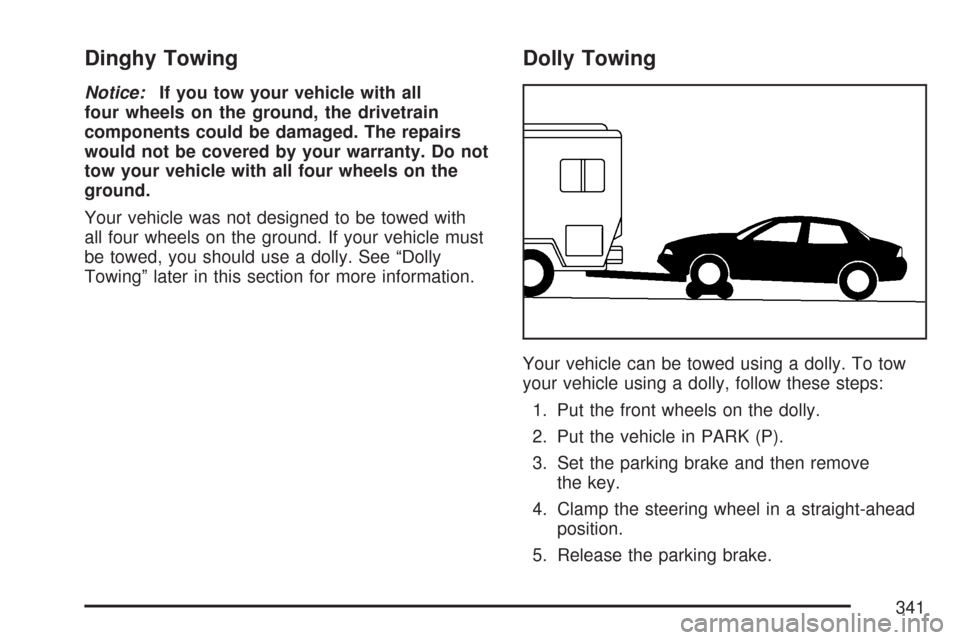
Dinghy Towing
Notice:If you tow your vehicle with all
four wheels on the ground, the drivetrain
components could be damaged. The repairs
would not be covered by your warranty. Do not
tow your vehicle with all four wheels on the
ground.
Your vehicle was not designed to be towed with
all four wheels on the ground. If your vehicle must
be towed, you should use a dolly. See “Dolly
Towing” later in this section for more information.
Dolly Towing
Your vehicle can be towed using a dolly. To tow
your vehicle using a dolly, follow these steps:
1. Put the front wheels on the dolly.
2. Put the vehicle in PARK (P).
3. Set the parking brake and then remove
the key.
4. Clamp the steering wheel in a straight-ahead
position.
5. Release the parking brake.
341
Page 342 of 518
Towing a Trailer
The Cadillac Professional Vehicle cannot tow
a trailer.
{CAUTION:
If you do not use the correct equipment
and drive properly, you can lose control
when you pull a trailer. For example, if the
trailer is too heavy, the brakes may not
work well — or even at all. You and your
passengers could be seriously injured.
You may also damage your vehicle; the
resulting repairs would not be covered by
your warranty. Pull a trailer only if you
have followed all the steps in this section.
Ask your dealer/retailer for advice and
information about towing a trailer with
your vehicle.Your vehicle can tow a trailer if it is equipped with
the proper trailer towing equipment. To identify
the trailering capacity of your vehicle, you should
read the information in “Weight of the Trailer”
that appears later in this section. Trailering
is different than just driving your vehicle by itself.
Trailering means changes in handling, durability
and fuel economy. Successful, safe trailering takes
correct equipment, and it has to be used properly.
That is the reason for this part. In it are many
time-tested, important trailering tips and safety
rules. Many of these are important for your safety
and that of your passengers. So please read
this section carefully before you pull a trailer.
Load-pulling components such as the engine,
transmission, wheel assemblies and tires
are forced to work harder against the drag of the
added weight. The engine is required to operate
at relatively higher speeds and under greater
loads, generating extra heat. What is more, the
trailer adds considerably to wind resistance,
increasing the pulling requirements.
342
Page 345 of 518
Total Weight on Your Vehicle’s Tires
Be sure your vehicle’s tires are inated to the upper
limit for cold tires. You will nd these numbers on
the Tire and Loading Information Label. See
Loading Your Vehicle on page 333. Then be sure
you do not go over the GVW limit for your vehicle,
including the weight of the trailer tongue.
Hitches
It is important to have the correct hitch equipment.
Crosswinds, large trucks going by and rough
roads are a few reasons why you will need the
right hitch. Here are some rules to follow:
The rear bumper on your vehicle is not
intended for hitches. Do not attach rental
hitches or other bumper-type hitches to it. Use
only a frame-mounted hitch that does not
attach to the bumper.
Will you have to make any holes in the body
of your vehicle when you install a trailer
hitch? If you do, then be sure to seal the holes
later when you remove the hitch. If you do
not seal them, deadly carbon monoxide (CO)
from your exhaust can get into your vehicle.
SeeEngine Exhaust on page 130. Dirt
and water can, too.
Safety Chains
You should always attach chains between your
vehicle and your trailer. Cross the safety
chains under the tongue of the trailer so that the
tongue will not drop to the road if it becomes
separated from the hitch. Instructions about safety
chains may be provided by the hitch manufacturer
or by the trailer manufacturer. Follow the
manufacturer’s recommendation for attaching
safety chains and do not attach them to the
bumper. Always leave just enough slack so you
can turn with your rig. And, never allow safety
chains to drag on the ground.
Trailer Brakes
Because your vehicle has anti-lock brakes, do not
try to tap into your vehicle’s hydraulic brake
system. If you do, both brake systems will not
work well, or at all.
Be sure to read and follow the instructions for the
trailer brakes so you will be able to maintain
them properly.
345
Page 346 of 518

Driving with a Trailer
Towing a trailer requires a certain amount of
experience. Before setting out for the open road,
you will want to get to know your rig. Acquaint
yourself with the feel of handling and braking with
the added weight of the trailer. And always
keep in mind that the vehicle you are driving is
now a good deal longer and not nearly as
responsive as your vehicle is by itself.
Before you start, check the trailer hitch and
platform, parts and attachments, safety chains,
electrical connector, lamps, tires and mirror
adjustment. If the trailer has electric brakes, start
your vehicle and trailer moving and then apply
the trailer brake controller by hand to be sure the
brakes are working. This lets you check your
electrical connection at the same time.
During your trip, check occasionally to be sure
that the load is secure, and that the lamps and any
trailer brakes are still working.
Following Distance
Stay at least twice as far behind the vehicle ahead
as you would when driving your vehicle without
a trailer. This can help you avoid situations
that require heavy braking and sudden turns.
Passing
You will need more passing distance up ahead
when you are towing a trailer. And, because
the vehicle is a good deal longer, you will need to
go much farther beyond the passed vehicle
before you can return to your lane.
Backing Up
Hold the bottom of the steering wheel with
one hand. Then, to move the trailer to the left, just
move that hand to the left. To move the trailer
to the right, move your hand to the right. Always
back up slowly and, if possible, have someone
guide you.
346
Page 347 of 518

Making Turns
Notice:Making very sharp turns while
trailering could cause the trailer to come in
contact with the vehicle. Your vehicle could be
damaged. Avoid making very sharp turns
while trailering.
When you are turning with a trailer, make wider
turns than normal. Do this so your trailer will
not strike soft shoulders, curbs, road signs, trees
or other objects. Avoid jerky or sudden
maneuvers. Signal well in advance.
Turn Signals When Towing a Trailer
When you tow a trailer, your vehicle may need a
different turn signal asher and/or extra wiring.
Check with your /retailer. The arrows on your
instrument panel will ash whenever you signal a
turn or lane change. Properly hooked up, the
trailer lamps will also ash, telling other drivers you
are about to turn, change lanes or stop.When towing a trailer, the arrows on your
instrument panel will ash for turns even if the
bulbs on the trailer are burned out. Thus, you may
think drivers behind you are seeing your signal
when they are not. It is important to check
occasionally to be sure the trailer bulbs are
still working.
Driving on Grades
Reduce speed and shift to a lower gearbefore
you start down a long or steep downgrade. If you
do not shift down, you might have to use your
brakes so much that they would get hot and
no longer work well.
On a long uphill grade, shift down and reduce
your speed to around 45 mph (70 km/h) to reduce
the possibility of the engine and the transmission
overheating.
347
Page 348 of 518
Parking on Hills
{CAUTION:
You really should not park your vehicle,
with a trailer attached, on a hill. If
something goes wrong, your rig could
start to move. People can be injured, and
both your vehicle and the trailer can be
damaged.But if you ever have to park your rig on a hill, here
is how to do it:
1. Apply your regular brakes, but do not shift into
PARK (P).
2. Have someone place chocks behind the
trailer wheels.
3. When the wheel chocks are in place, release
the regular brakes until the chocks absorb
the load.
4. Reapply the regular brakes. Then shift into
PARK (P) rmly and apply your parking
brake.
5. Release the regular brakes.
348
Page 349 of 518
When You Are Ready to Leave After
Parking on a Hill
1. Apply your regular brakes and hold the pedal
down while you:
Start your engine,
Shift into a gear, and
Make sure the parking brake has released.
2. Let up on the brake pedal.
3. Drive slowly until the trailer is clear of
the chocks.
4. Stop and have someone pick up and store
the chocks.
Maintenance When Trailer Towing
Your vehicle will need service more often when
you are pulling a trailer. See the Maintenance
Schedule for more on this. Things that are
especially important in trailer operation are
automatic transmission uid (do not overll),
engine oil, drive belt, cooling system and brake
system. Each of these is covered in this manual,
and the Index will help you nd them quickly.
If you are trailering, it is a good idea to review this
information before you start your trip.
Check periodically to see that all hitch nuts and
bolts are tight.
Engine Cooling When Trailer Towing
Your cooling system may temporarily overheat
during severe operating conditions. SeeEngine
Overheating on page 377.
349
Page 351 of 518
Service........................................................ 353
Accessories and Modications................... 353
California Proposition 65 Warning.............. 354
Doing Your Own Service Work.................. 354
Adding Equipment to the Outside of
Your Vehicle.......................................... 355
Fuel............................................................. 355
Gasoline Octane........................................ 356
Gasoline Specications.............................. 356
California Fuel........................................... 356
Additives................................................... 357
Fuels in Foreign Countries........................ 358
Filling the Tank......................................... 358
Filling a Portable Fuel Container............... 361
Checking Things Under the Hood.............. 362
Hood Release........................................... 363
Engine Compartment Overview.................. 364
Engine Oil................................................. 365
Engine Oil Life System.............................. 368
Engine Air Cleaner/Filter............................ 370
Automatic Transaxle Fluid......................... 372
Engine Coolant.......................................... 374
Coolant Surge Tank Pressure Cap............ 377
Engine Overheating................................... 377Overheated Engine Protection
Operating Mode..................................... 379
Cooling System......................................... 380
Power Steering Fluid................................. 385
Windshield Washer Fluid........................... 386
Brakes...................................................... 387
Battery...................................................... 390
Jump Starting............................................ 392
Headlamp Aiming........................................ 397
Bulb Replacement....................................... 400
High Intensity Discharge (HID) Lighting..... 400
Windshield Wiper Blade Replacement....... 400
Tires............................................................ 402
Tire Sidewall Labeling............................... 403
Tire Terminology and Denitions............... 408
Ination - Tire Pressure............................. 411
High-Speed Operation............................... 413
Tire Pressure Monitor System................... 414
Tire Inspection and Rotation...................... 418
When It Is Time for New Tires.................. 419
Buying New Tires...................................... 420
Different Size Tires and Wheels................ 422
Uniform Tire Quality Grading..................... 422
Section 5 Service and Appearance Care
351
Page 353 of 518

Service
Your dealer knows your vehicle best and wants
you to be happy with it. We hope you will go
to your dealer for all your service needs. You will
get genuine GM parts and GM-trained and
supported service people.
We hope you will want to keep your
GM vehicle all GM. Genuine GM parts
have one of these marks:
Accessories and Modications
When you add non-GM accessories to your
vehicle they can affect your vehicle’s performance
and safety, including such things as, airbags,
braking, stability, ride and handling, emissions
systems, aerodynamics, durability, and electronic
systems like anti-lock brakes, traction control
and stability control. Some of these accessories
may even cause malfunction or damage not
covered by warranty.
GM Accessories are designed to complement
and function with other systems on your vehicle.
Your GM dealer/retailer can accessorize your
vehicle using genuine GM Accessories. When you
go to your GM dealer/retailer and ask for GM
Accessories, you will know that GM-trained and
supported service technicians will perform the work
using genuine GM Accessories.
353