brake CADILLAC DTS 2008 1.G User Guide
[x] Cancel search | Manufacturer: CADILLAC, Model Year: 2008, Model line: DTS, Model: CADILLAC DTS 2008 1.GPages: 454, PDF Size: 2.48 MB
Page 111 of 454

Running the Vehicle While Parked
It is better not to park with the engine running. But if you
ever have to, here are some things to know.
{CAUTION:
Idling the engine with the climate control
system off could allow dangerous exhaust into
your vehicle. See the earlier caution under
Engine Exhaust on page 2-34.
Also, idling in a closed-in place can let deadly
carbon monoxide (CO) into your vehicle even if
the climate control fan is at the highest setting.
One place this can happen is a garage.
Exhaust — with CO — can come in easily.
NEVER park in a garage with the engine
running.
Also see “If You Are Caught in a Blizzard” under
Winter Driving on page 4-16.
{CAUTION:
It can be dangerous to get out of your vehicle if
the shift lever is not fully in PARK (P) with the
parking brake rmly set. Your vehicle can roll.
Do not leave your vehicle when the engine is
running unless you have to. If you have left the
engine running, the vehicle can move suddenly.
You or others could be injured. To be sure your
vehicle will not move, even when you are on
fairly level ground, always set the parking brake
after you move the shift lever to PARK (P).
Follow the proper steps to be sure your vehicle will not
move. SeeShifting Into Park on page 2-31.
If you are parking on a hill and if you are pulling a
trailer, also seeTowing a Trailer on page 4-27.
2-35
Page 119 of 454

When the System Does Not Seem to
Work Properly
The driver disables the system.
The parking brake pedal is depressed.
The ultrasonic sensors are not kept clean. So be
sure to keep your vehicle’s front and rear bumpers
free of mud, dirt, snow, ice and slush. For cleaning
instructions, seeWashing Your Vehicle on
page 5-94.
A trailer was attached to your vehicle, or a bicycle or
an object was hanging out of your trunk during your
last drive cycle, the red light may illuminate in the
rear display. Once the attached object is removed,
UFRPA will return to normal operation.
A tow bar is attached to your vehicle.
The vehicle’s bumper is damaged. Take the vehicle
to your dealer/retailer to repair the system.
Other conditions may affect system performance,
such as vibrations from a jackhammer or the
compression of air brakes on a very large truck.
If the system is still disabled after driving forward at
least 15 mph (25 km/h), take your vehicle to your
dealer/retailer.
Side Blind Zone Alert (SBZA)
Your vehicle may have a Side Blind Zone Alert (SBZA)
system. Read this entire section before using the system.
The SBZA system operates on a radio frequency
subject to Federal Communications Commission (FCC)
Rules and with Industry Canada.
This device complies with Part 15 of the FCC Rules.
Operation is subject to the following two conditions:
1. This device may not cause harmful interference.
2. This device must accept any interference received,
including interference that may cause undesired
operation.
This device complies with RSS-310 of Industry Canada.
Operation is subject to the following two conditions:
1. This device may not cause harmful interference.
2. This device must accept any interference received,
including interference that may cause undesired
operation.
Frequency of operation: 24.05GHz – 24.25GHz
Field Strength: Not greater than 2.5V/m peak (0.25V/m
average) at a distance of 3m
2-43
Page 139 of 454
Instrument Panel Overview...............................3-4
Hazard Warning Flashers................................3-6
Other Warning Devices...................................3-6
Horn .............................................................3-6
Tilt Wheel.....................................................3-6
Power Tilt Wheel and Telescopic Steering
Column......................................................3-7
Heated Steering Wheel...................................3-7
Turn Signal/Multifunction Lever.........................3-8
Turn and Lane-Change Signals........................3-9
Headlamp High/Low-Beam Changer..................3-9
Forward Collision Alert (FCA) System..............3-10
Flash-to-Pass...............................................3-13
Windshield Wipers........................................3-13
Rainsense™ II Wipers...................................3-14
Windshield Washer.......................................3-15
Cruise Control..............................................3-16
Adaptive Cruise Control.................................3-19
Exterior Lamps.............................................3-32
Wiper Activated Headlamps............................3-35
Headlamps on Reminder................................3-35
Daytime Running Lamps (DRL).......................3-35
Fog Lamps ..................................................3-36
Cornering Lamps..........................................3-37
Exterior Lighting Battery Saver........................3-37
Instrument Panel Brightness...........................3-37
Courtesy Lamps...........................................3-37Entry Lighting...............................................3-37
Parade Dimming...........................................3-38
Reading Lamps............................................3-38
Footwell Lamps............................................3-38
Battery Load Management.............................3-38
Electric Power Management...........................3-39
Inadvertent Power Battery Saver.....................3-40
Battery Run-Down Protection..........................3-40
Accessory Power Outlet(s).............................3-40
Ashtray(s)....................................................3-41
Analog Clock...............................................3-42
Climate Controls............................................3-42
Dual Climate Control System..........................3-42
Outlet Adjustment.........................................3-48
Rear Climate Control System.........................3-49
Passenger Compartment Air Filter...................3-51
Warning Lights, Gages, and Indicators............3-53
Instrument Panel Cluster................................3-54
Speedometer and Odometer...........................3-55
Tachometer.................................................3-55
Safety Belt Reminders...................................3-56
Airbag Readiness Light..................................3-57
Passenger Airbag Status Indicator...................3-58
Charging System Light..................................3-60
Brake System Warning Light..........................3-60
Antilock Brake System (ABS) Warning Light.....3-61
Section 3 Instrument Panel
3-1
Page 143 of 454
The main components of the instrument panel are the following:
A. Air Outlets. SeeOutlet Adjustment on page 3-48.
B. Driver Information Center (DIC) Buttons. SeeDriver
Information Center (DIC) on page 3-70.
C. Exterior Lamp Controls. SeeExterior Lamps on
page 3-32.
D. Instrument Panel Cluster. SeeInstrument Panel
Cluster on page 3-54.
E. Horn. SeeHorn on page 3-6.
F. Audio Steering Wheel Controls. SeeAudio Steering
Wheel Controls on page 3-118.
G. Ultrasonic Front and Rear Parking Assist and
Adaptive Cruise Control Display (If Equipped). See
Ultrasonic Front and Rear Parking Assist (UFRPA)
on page 2-40andAdaptive Cruise Control on
page 3-19.
H. Analog Clock. SeeAnalog Clock on page 3-42.
I. Hazard Warning Flashers Button. SeeHazard
Warning Flashers on page 3-6.
J. Radio. SeeAudio System(s) on page 3-96.
K. Trunk Release Button. SeeTrunk on page 2-12.
L. Instrument Panel Brightness Control. SeeInstrument
Panel Brightness on page 3-37.
M. Lane Departure Warning. SeeLane Departure
Warning (LDW) on page 2-46.N. Turn Signal/Multifunction Lever. SeeTurn
Signal/Multifunction Lever on page 3-8.
O. Hood Release. SeeHood Release on page 5-12.
P. Parking Brake. SeeParking Brake on page 2-30.
Q. Heated Steering Wheel Button (If Equipped).
SeeHeated Steering Wheel on page 3-7.
R. Cruise Control or Adaptive Cruise Control. See
Cruise Control on page 3-16orAdaptive Cruise
Control on page 3-19.
S. Tilt Wheel. SeeTilt Wheel on page 3-6. Power Tilt
and Telescopic Steering Wheel (If Equipped).
SeePower Tilt Wheel and Telescopic Steering
Column on page 3-7.
T. Climate Controls. SeeDual Climate Control System
on page 3-42.
U. Traction Control System Button (Console-Shift
Vehicles). SeeTraction Control System (TCS) on
page 4-5.
V. Shift Lever. SeeAutomatic Transmission Operation
on page 2-27.
W. Accessory Power Outlet. SeeAccessory Power
Outlet(s) on page 3-40.
X. Glove Box. SeeGlove Box on page 2-59. Valet
Lockout Switch. SeeValet Lockout Switch on
page 2-18.
3-5
Page 148 of 454
Forward Collision Alert (FCA)
System
If your vehicle has this feature, be sure to read this
entire section before using it.
The system operates on a radio frequency subject to
Federal Communications Commission (FCC) Rules and
with Industry Canada.
This device complies with Part 15 of the FCC Rules.
Operation is subject to the following two conditions:
1. This device may not cause interference.
2. This device must accept any interference received,
including interference that may cause undesired
operation of the device.
This device complies with RSS-210 of Industry Canada.
Operation is subject to the following two conditions:
1. This device may not cause interference.
2. This device must accept any interference received,
including interference that may cause undesired
operation of the device.
Changes or modications to this system by other than
an authorized service facility could void authorization to
use this equipment.The Forward Collision Alert (FCA) system provides an
audible and visual alert if you approach a vehicle
too quickly that is directly ahead. FCA also provides a
visual alert with no audible alert if you are following
another vehicle much too closely. The FCA alert symbol
is located on top of the instrument panel to the right
of the driver. FCA uses the Adaptive Cruise Control
radar to detect a vehicle directly ahead, in your path,
within a distance of 328 ft (100 m) and operates at
speeds above 20 mph (32 km/h).
{CAUTION:
FCA is only a warning system and does not
apply the brakes. When you are approaching a
vehicle or object too rapidly or when you are
following a vehicle too closely that is ahead of
you, FCA may not provide you with enough
time to avoid a collision. FCA is not designed
to warn the driver of pedestrians or animals.
Your complete attention is always required
while driving and you should be ready to take
action and apply the brakes. For more
information, seeDefensive Driving on page 4-2.
3-10
Page 154 of 454
Cruise Control
With cruise control, you can maintain a speed of
approximately 25 mph (40 km/h) or more without
keeping your foot on the accelerator. This is helpful on
long trips. Cruise control does not work at speeds
below about 25 mph (40 km/h). When cruise control is
on, you will see a cruise light on the instrument
panel cluster.
When you apply your brakes, the cruise control
shuts off.{CAUTION:
Cruise control can be dangerous where you
cannot drive safely at a steady speed. So, do
not use your cruise control on winding roads
or in heavy traffic.
Cruise control can be dangerous on slippery
roads. On such roads, fast changes in tire
traction can cause excessive wheel slip, and
you could lose control. Do not use cruise
control on slippery roads.
If your vehicle is in cruise control when the Traction
Control System (TCS) begins to limit wheel spin,
the cruise control automatically turns off. SeeTraction
Control System (TCS) on page 4-5. When road
conditions let you safely use it again, you can turn the
cruise control back on.
3-16
Page 155 of 454
Setting Cruise Control
{CAUTION:
If you leave your cruise control on when you
are not using cruise, you might hit a button
and go into cruise when you do not want to.
You could be startled and even lose control.
Keep the cruise control switch off until you
want to use cruise control.
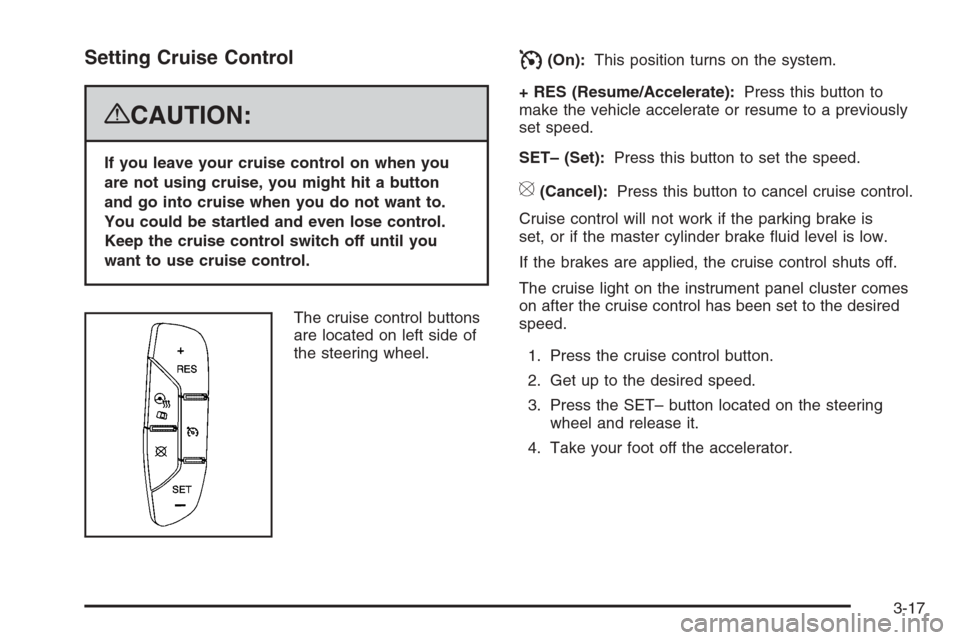
The cruise control buttons
are located on left side of
the steering wheel.
I(On):This position turns on the system.
+ RES (Resume/Accelerate):Press this button to
make the vehicle accelerate or resume to a previously
set speed.
SET– (Set):Press this button to set the speed.
[(Cancel):Press this button to cancel cruise control.
Cruise control will not work if the parking brake is
set, or if the master cylinder brake uid level is low.
If the brakes are applied, the cruise control shuts off.
The cruise light on the instrument panel cluster comes
on after the cruise control has been set to the desired
speed.
1. Press the cruise control button.
2. Get up to the desired speed.
3. Press the SET– button located on the steering
wheel and release it.
4. Take your foot off the accelerator.
3-17
Page 156 of 454

Resuming a Set Speed
Suppose you set the cruise control at a desired speed
and then you apply the brake. This shuts off the
cruise control. But you do not need to reset it.
Once the vehicle is traveling approximately 25 mph
(40 km/h) or more, you can press the +RES
(resume/accelerate) button to return to your desired
preset speed. The cruise light displays again.
The vehicle returns to and stays at your preset speed.
If you press and hold the +RES button, the vehicle
speed increases until you release the button or apply
the brake. Do not hold in the +RES button, if you do not
want the vehicle speed to increase.
Increasing Speed While Using Cruise
Control
There are two ways to go to a higher speed:
Use the accelerator pedal to get to the higher
speed. Press the SET– button, then release
the button and the accelerator pedal. The vehicle
now cruises at the higher speed.
Press the +RES button. Hold it there until you get
up to the desired speed, and then release the
button. To increase your speed in very small
amounts, briey press the +RES button and then
release it. Each time you do this, the vehicle
accelerates approximately 1 mph (1.6 km/h).
The accelerate feature only works after you have set
the cruise control speed by pressing the SET– button.
Reducing Speed While Using Cruise
Control
There are two ways to reduce your speed while using
cruise control:
Press the SET– button until you reach the lower
desired speed, then release it.
To slow down in very small amounts, push the
SET– button briey. Each time you do this, the
vehicle slows down approximately 1 mph (1.6 km/h).
Passing Another Vehicle While Using
Cruise Control
Use the accelerator pedal to increase your speed.
When you take your foot off the pedal, the vehicle slows
down to your previous cruise control speed.
3-18
Page 157 of 454
Using Cruise Control on Hills
How well your cruise control works on hills depends
upon the vehicle speed, load, and the steepness of the
hills. When going up steep hills, you might have to
step on the accelerator pedal to maintain the vehicle’s
speed. When going downhill, you might have to brake or
shift to a lower gear to keep the vehicle’s speed
down. Applying the brake or shifting into a lower gear
ends cruise control. If you need to apply the brake
or shift to a lower gear due to the grade of the downhill
slope, you might not want to attempt to use the
cruise control feature.
Ending Cruise Control
To turn off the cruise control, step lightly on the brake
pedal, or press the cancel button on the steering wheel.
Erasing Speed Memory
When you turn off the cruise control or the ignition, your
cruise control set speed memory is erased.
Adaptive Cruise Control
If your vehicle has this feature, be sure to read this
entire section before using it.
The system operates on a radio frequency subject to
Federal Communications Commission (FCC) Rules and
with Industry Canada.This device complies with Part 15 of the FCC Rules.
Operation is subject to the following two conditions:
1. This device may not cause interference.
2. This device must accept any interference received,
including interference that may cause undesired
operation of the device.
This device complies with RSS-210 of Industry Canada.
Operation is subject to the following two conditions:
1. This device may not cause interference.
2. This device must accept any interference received,
including interference that may cause undesired
operation of the device.
Changes or modications to this system by other than
an authorized service facility could void authorization to
use this equipment.
Adaptive Cruise Control is an enhancement to traditional
cruise control. It allows you to keep cruise control
engaged in moderate traffic conditions without having to
constantly reset your cruise control. Adaptive Cruise
Control uses radar to detect a vehicle directly ahead in
your path, within a distance of 330 ft (100 m), and
operates at speeds above 25 mph (40 km/h). When it is
engaged by the driver, the system can apply limited
braking or acceleration of the vehicle automatically to
maintain a selected follow distance to the vehicle ahead.
3-19
Page 158 of 454

Braking is limited to 0.25 g’s (2.45 m/sec2) of
deceleration, which is comparable to moderate
application of the vehicle’s brakes. To disengage
Adaptive Cruise Control, apply the brake. If no vehicle
is in your path, the vehicle will react like traditional cruise
control.
{CAUTION:
Adaptive Cruise Control will not apply hard
braking or bring the vehicle to a complete
stop. It will not respond to stopped vehicles,
pedestrians or animals. When you are
approaching a vehicle or object, Adaptive
Cruise Control may not have time to slow your
vehicle enough to avoid a collision. Your
complete attention is always required while
driving and you should be ready to take action
and apply the brakes. For more information,
seeDefensive Driving on page 4-2.
{CAUTION:
On winding roads, Adaptive Cruise Control
may not detect a vehicle ahead. You could
crash into a vehicle ahead of you. Do
not use Adaptive Cruise Control on
winding roads.
Adaptive Cruise Control may not have time
to slow your vehicle enough to avoid a
crash when you are driving in conditions
where vehicles may suddenly slow or stop
ahead of you, enter your lane, or cross
your vehicle’s path. If you are driving in
these conditions, do not use Adaptive
Cruise Control. The warning beep and alert
symbol may indicate that you are driving
in conditions where Adaptive Cruise
Control should not be used. See “Alerting
the Driver” in this section.
CAUTION: (Continued)
3-20