remote start CADILLAC DTS 2008 1.G User Guide
[x] Cancel search | Manufacturer: CADILLAC, Model Year: 2008, Model line: DTS, Model: CADILLAC DTS 2008 1.GPages: 454, PDF Size: 2.48 MB
Page 307 of 454
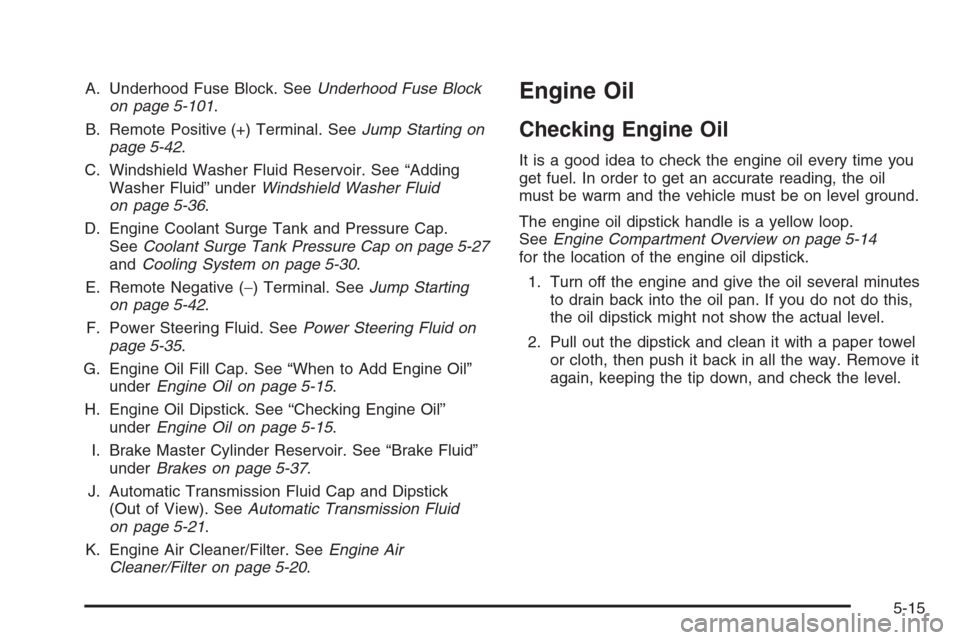
A. Underhood Fuse Block. SeeUnderhood Fuse Block
on page 5-101.
B. Remote Positive (+) Terminal. SeeJump Starting on
page 5-42.
C. Windshield Washer Fluid Reservoir. See “Adding
Washer Fluid” underWindshield Washer Fluid
on page 5-36.
D. Engine Coolant Surge Tank and Pressure Cap.
SeeCoolant Surge Tank Pressure Cap on page 5-27
andCooling System on page 5-30.
E. Remote Negative (−) Terminal. SeeJump Starting
on page 5-42.
F. Power Steering Fluid. SeePower Steering Fluid on
page 5-35.
G. Engine Oil Fill Cap. See “When to Add Engine Oil”
underEngine Oil on page 5-15.
H. Engine Oil Dipstick. See “Checking Engine Oil”
underEngine Oil on page 5-15.
I. Brake Master Cylinder Reservoir. See “Brake Fluid”
underBrakes on page 5-37.
J. Automatic Transmission Fluid Cap and Dipstick
(Out of View). SeeAutomatic Transmission Fluid
on page 5-21.
K. Engine Air Cleaner/Filter. SeeEngine Air
Cleaner/Filter on page 5-20.Engine Oil
Checking Engine Oil
It is a good idea to check the engine oil every time you
get fuel. In order to get an accurate reading, the oil
must be warm and the vehicle must be on level ground.
The engine oil dipstick handle is a yellow loop.
SeeEngine Compartment Overview on page 5-14
for the location of the engine oil dipstick.
1. Turn off the engine and give the oil several minutes
to drain back into the oil pan. If you do not do this,
the oil dipstick might not show the actual level.
2. Pull out the dipstick and clean it with a paper towel
or cloth, then push it back in all the way. Remove it
again, keeping the tip down, and check the level.
5-15
Page 335 of 454

Notice:If you leave your radio or other accessories
on during the jump starting procedure, they could
be damaged. The repairs would not be covered
by your warranty. Always turn off your radio and
other accessories when jump starting your vehicle.
3. Turn off the ignition on both vehicles. Unplug
unnecessary accessories plugged into the cigarette
lighter or the accessory power outlets. Turn off
the radio and all lamps that are not needed. This
will avoid sparks and help save both batteries.
And it could save the radio!
4. Open the hoods and locate the positive (+) and
negative (−) terminal locations on the other vehicle.
Your vehicle has a remote positive (+) jump starting
terminal and a remote negative (−) jump starting
terminal.The remote positive (+) terminal is located in the
engine compartment on the passenger’s side of the
vehicle. Lift the red plastic cap to access the terminal.
SeeEngine Compartment Overview on page 5-14
for more information on the location of the remote
positive (+) terminal.
A second remote positive (+) terminal is located on
the rear underseat fuse block.
The remote negative (−) terminal is located behind
the power steering pulley, near the engine cover.
It is marked GND (−). 4.6L LD8 Engine shown,
4.6L L37 Engine
similar
5-43
Page 336 of 454
You will not see the battery of your vehicle under
the hood. It is located under the rear passenger’s
seat. You will not need to access the battery
for jump starting. The remote terminals are for
that purpose.
{CAUTION:
An electric fan can start up even when the
engine is not running and can injure you.
Keep hands, clothing and tools away from
any underhood electric fan.
{CAUTION:
Using a match near a battery can cause battery
gas to explode. People have been hurt doing
this, and some have been blinded. Use a
ashlight if you need more light.
Be sure the battery has enough water. You do
not need to add water to the battery installed
in your new vehicle. But if a battery has ller
caps, be sure the right amount of uid is there.
If it is low, add water to take care of that rst.
If you do not, explosive gas could be present.
Battery uid contains acid that can burn you.
Do not get it on you. If you accidentally get it
in your eyes or on your skin, ush the place
with water and get medical help immediately.
5-44
Page 337 of 454

{CAUTION:
Fans or other moving engine parts can injure
you badly. Keep your hands away from moving
parts once the engine is running.
5. Check that the jumper cables do not have loose
or missing insulation. If they do, you could get a
shock. The vehicles could be damaged too.
Before you connect the cables, here are some
basic things you should know. Positive (+) will go
to positive (+) or to a remote positive (+) terminal
if the vehicle has one. Negative (−) will go to a
heavy, unpainted metal engine part or to a remote
negative (−) terminal if the vehicle has one.
Do not connect positive (+) to negative (−)oryou
will get a short that would damage the battery
and maybe other parts too. And do not connect the
negative (−) cable to the negative (−) terminal on
the dead battery because this can cause sparks.
6. Connect the red positive (+) cable to the remote
positive (+) terminal location on the vehicle with
the dead battery. Use a remote positive (+) terminal
if the vehicle has one.7. Do not let the other end touch metal. Connect it to
the positive (+) terminal location of the vehicle with
the good battery. Use a remote positive (+) terminal if
the vehicle has one.
8. Now connect the black negative (−) cable to the
negative (−) terminal location of the vehicle with
the good battery. Use a remote negative (−) terminal
if the vehicle has one.
Do not let the other end of the cable touch anything
until the next step. The other end of the negative (−)
cable does not go to the dead battery. It goes to
a heavy, unpainted metal engine part or to a remote
negative (−) terminal on the vehicle with the dead
battery.
9. Connect the other end of the negative (−) cable to
the negative (−) terminal location on the vehicle
with the dead battery. Your vehicle has a remote
negative (−) terminal marked GND (−).
10. Now start the vehicle with the good battery and run
the engine for a while.
11. Try to start the vehicle that had the dead battery.
If it will not start after a few tries, it probably needs
service.
5-45
Page 359 of 454
TPMS Sensor Matching Process
Each TPMS sensor has a unique identication code.
Any time you rotate your vehicle’s tires or replace one or
more of the TPMS sensors, the identication codes will
need to be matched to the new tire/wheel position. The
sensors are matched to the tire/wheel positions in the
following order: driver side front tire, passenger side front
tire, passenger side rear tire, and driver side rear tire
using a TPMS diagnostic tool. See your dealer/retailer
for service.
The TPMS sensors can also be matched to each
tire/wheel position by increasing or decreasing the tire’s
air pressure. If increasing the tire’s air pressure, do
not exceed the maximum ination pressure indicated
on the tire’s sidewall.
To decrease air-pressure out of a tire you can use the
pointed end of the valve cap, a pencil-style air pressure
gage, or a key.
You have two minutes to match the rst tire/wheel
position, and ve minutes overall to match all
four tire/wheel positions. If it takes longer than
two minutes, to match the rst tire and wheel, or more
than ve minutes to match all four tire and wheel
positions the matching process stops and you need
to start over.The TPMS sensor matching process is outlined below:
1. Set the parking brake.
2. Turn the ignition switch to ON/RUN with the
engine off.
3. Press the Remote Keyless Entry (RKE) transmitter’s
LOCK and UNLOCK buttons at the same time
for approximately ve seconds. The horn sounds
twice to signal the receiver is in relearn mode
and TIRE LEARNING ACTIVE message displays
on the DIC screen.
4. Start with the driver side front tire.
5. Remove the valve cap from the valve cap stem.
Activate the TPMS sensor by increasing or
decreasing the tire’s air pressure for ve seconds,
or until a horn chirp sounds. The horn chirp,
which may take up to 30 seconds to sound,
conrms that the sensor identication code has
been matched to this tire and wheel position.
5-67
Page 429 of 454
Emergency Road Service is performed on site for the
following situations:
Fuel Delivery:Delivery of enough fuel for the
vehicle to get to the nearest service station
(approximately $5 in Canada). In Canada, for safety
reasons, propane and other alternative fuels will
not be provided through this service.
Lock-out Service:Lock-out service will be covered
at no charge if you are unable to gain entry into
your vehicle. A remote unlock may be available
if you have an active OnStar
®subscription.
To ensure security, the driver must present personal
identication before lock-out service is provided.
In Canada, the vehicle registration is also required.
Emergency Tow From a Public Roadway or
Highway:Tow to the nearest dealership for warranty
service or in the event of a vehicle-disabling crash.
Winch-out assistance is provided when the vehicle is
mired in sand, mud, or snow.
Flat Tire Change:Installation of a spare tire in good
condition, when equipped and properly inated, is
covered at no charge. The customer is responsible
for the repair or replacement of the tire if not covered
by a warrantable failure.
Jump Start:A battery jump start is covered at no
charge if the vehicle does not start.
Trip Routing Service:Upon request, Cadillac
Roadside Service will send you detailed, computer
personalized maps, highlighting your choice of either
the most direct route or the most scenic route to your
destination, anywhere in North America, along with
helpful travel information pertaining to your trip.
Please allow three weeks before your planned
departure date. In Canada, trip routing requests will
be limited to six per calendar year.
Trip Interruption Benets and Assistance:If your
trip is interrupted due to a warranty failure, incidental
expenses may be reimbursed during the 60 months/
100,000 miles (160 000 km) warranty period. Items
covered are hotel, meals, and rental car.
Alternative Service (Canada only):There may be
times when Roadside Service cannot provide timely
assistance. Your advisor may authorize you to
secure local emergency road service, and you will be
reimbursed up to $100 upon submission of the
original receipt to Cadillac Roadside Service.
Cadillac and General Motors of Canada Limited reserve
the right to limit services or reimbursement to an
owner or driver when, in their sole discretion, the claims
become excessive in frequency or type of occurrence.
7-9
Page 439 of 454

To read data recorded by an EDR, special equipment is
required, and access to the vehicle or the EDR is
needed. In addition to the vehicle manufacturer, other
parties, such as law enforcement, that have the special
equipment, can read the information if they have
access to the vehicle or the EDR.
GM will not access this data or share it with others
except: with the consent of the vehicle owner or, if the
vehicle is leased, with the consent of the lessee; in
response to an official request of police or similar
government office; as part of GM’s defense of litigation
through the discovery process; or, as required by law.
Data that GM collects or receives may also be used for
GM research needs or may be made available to others
for research purposes, where a need is shown and the
data is not tied to a specic vehicle or vehicle owner.
OnStar®
If your vehicle has OnStar and you subscribe to the
OnStar services, please refer to the OnStar Terms and
Conditions for information on data collection and
use. See alsoOnStar
®System on page 2-49in this
manual for more information.
Navigation System
If your vehicle has a navigation system, use of the
system may result in the storage of destinations,
addresses, telephone numbers, and other trip
information. Refer to the navigation system operating
manual for information on stored data and for deletion
instructions.
Radio Frequency
Identication (RFID)
RFID technology is used in some vehicles for functions
such as tire pressure monitoring and ignition system
security, as well as in connection with conveniences
such as key fobs for remote door locking/unlocking and
starting, and in-vehicle transmitters for garage door
openers. RFID technology in GM vehicles does not use
or record personal information or link with any other
GM system containing personal information.
7-19
Page 451 of 454

Rearview Mirror, Automatic Dimming..................2-36
Rearview Mirror with Compass and Temperature . . . 1-9
Reclining Seatbacks, Power............................... 1-6
Recommended Fluids and Lubricants.................6-13
Recreational Vehicle Towing.............................4-26
Remote Keyless Entry (RKE) System.................. 2-4
Remote Keyless Entry (RKE) System, Operation . . . 2-5
Remote Vehicle Start........................................ 2-8
Removing the Flat Tire and Installing the
Spare Tire..................................................5-81
Removing the Spare Tire and Tools...................5-80
Replacement Parts, Maintenance......................6-14
Reporting Safety Defects
Canadian Government..................................7-16
General Motors...........................................7-16
United States Government............................7-16
Restraint System Check
Checking the Restraint Systems....................1-70
Replacing Restraint System Parts
After a Crash..........................................1-71
Retained Accessory Power (RAP)......................2-24
Roadside
Service........................................................ 7-8
Rocking Your Vehicle to Get it Out....................4-20
Routing, Engine Drive Belt...............................6-15
Running Out of Fuel........................................2-35S
Safety Belt
Reminder Light............................................3-56
Safety Belts
Care of ......................................................5-93
How to Wear Safety Belts Properly................1-16
Lap Belt.....................................................1-29
Lap-Shoulder Belt........................................1-24
Safety Belt Extender....................................1-30
Safety Belt Use During Pregnancy.................1-29
Safety Belts Are for Everyone.......................1-10
Safety Warnings and Symbols.............................. iii
Scheduled Maintenance..................................... 6-4
Seats
Center Seat.................................................. 1-8
Head Restraints............................................ 1-7
Heated and Cooled Seats.............................. 1-3
Heated Seats - Rear..................................... 1-9
Massaging Lumbar........................................ 1-3
Memory, Mirrors............................................ 1-4
Power Lumbar .............................................. 1-2
Power Lumbar, Rear....................................1-10
Power Reclining Seatbacks............................. 1-6
Power Seats................................................. 1-2
11
Page 452 of 454

Securing a Child Restraint
Center Front Seat Position............................1-49
Rear Seat Position......................................1-47
Right Front Seat Position..............................1-50
Security Light.................................................3-68
Service........................................................... 5-3
Accessories and Modications......................... 5-3
Adding Equipment to the Outside of the
Vehicle..................................................... 5-5
California Perchlorate Materials Requirements.... 5-4
California Proposition 65 Warning.................... 5-4
Doing Your Own Work................................... 5-4
Engine Soon Light.......................................3-65
Publications Ordering Information...................7-17
Service, Scheduling Appointments.....................7-11
Servicing Your Airbag-Equipped Vehicle..............1-68
Setting the Clock............................................3-97
Sheet Metal Damage.......................................5-97
Shifting Into Park............................................2-31
Shifting Out of Park........................................2-33
Side Blind Zone Alert......................................2-43
Signals, Turn and Lane-Change.......................... 3-9
Spare Tire.....................................................5-89
Installing....................................................5-81
Removing...................................................5-80
Storing.......................................................5-87Specications, Capacities...............................5-109
Speedometer..................................................3-55
StabiliTrak
®Indicator Light...............................3-62
Stabilitrak®System........................................... 4-7
Start Vehicle, Remote....................................... 2-8
Starting the Engine.........................................2-24
Steering.......................................................... 4-8
Steering Wheel Controls, Audio.......................3-118
Steering Wheel Controls, Memory....................... 1-4
Steering Wheel, Heated..................................... 3-7
Steering Wheel, Power Tilt Wheel and
Telescopic Steering Column............................ 3-7
Steering Wheel, Tilt Wheel................................. 3-6
Storage Areas
Center Console Storage Area........................2-59
Center Flex Storage Unit..............................2-60
Coinholder(s)..............................................2-59
Convenience Net.........................................2-60
Cupholders.................................................2-59
Front Storage Area......................................2-59
Glove Box..................................................2-59
Rear Seat Armrest.......................................2-60
Stuck in Sand, Mud, Ice, or Snow.....................4-19
Sun Visors.....................................................2-17
Sunroof.........................................................2-61
12
Page 454 of 454

U
Ultrasonic Front and Rear Parking
Assist (UFRPA)............................................2-40
Uniform Tire Quality Grading............................5-74
Universal Home Remote System.......................2-52
Operation...................................................2-52
Using this Manual................................................ ii
V
Valet Lockout Switch.......................................2-18
Vehicle
Control........................................................ 4-3
Damage Warnings........................................... iv
Loading......................................................4-20
Symbols......................................................... iv
Vehicle Customization, DIC..............................3-87
Vehicle Data Recording and Privacy..................7-18
Vehicle Identication
Number (VIN).............................................5-99
Service Parts Identication Label...................5-99
Vehicle, Remote Start....................................... 2-8
Ventilation Adjustment......................................3-48
Visors...........................................................2-17
W
Warning Lights, Gages, and Indicators...............3-53
Warnings
DIC Warnings and Messages........................3-75
Hazard Warning Flashers............................... 3-6Warnings (cont.)
Other Warning Devices.................................. 3-6
Safety and Symbols......................................... iii
Vehicle Damage.............................................. iv
Wheels
Alignment and Tire Balance..........................5-75
Different Size..............................................5-73
Replacement...............................................5-75
Where to Put the Restraint...............................1-40
Windows.......................................................2-14
Power ........................................................2-15
Windshield
Rainsense™ II Wipers..................................3-14
Washer......................................................3-15
Washer Fluid..............................................5-36
Wiper Blade Replacement.............................5-50
Wiper Blades, Cleaning................................5-95
Wiper Fuses.............................................5-100
Wipers.......................................................3-13
Winter Driving................................................4-16
Wiper Activated Headlamps..............................3-35
X
XM Radio Messages.....................................3-117
XM™ Satellite Radio Antenna System..............3-120
Y
Your Vehicle and the Environment....................... 6-2
14