transmission CADILLAC DTS 2009 1.G User Guide
[x] Cancel search | Manufacturer: CADILLAC, Model Year: 2009, Model line: DTS, Model: CADILLAC DTS 2009 1.GPages: 462, PDF Size: 2.46 MB
Page 110 of 462

Leaving the Vehicle With the Engine
Running
{CAUTION:
It can be dangerous to leave the vehicle with the
engine running. The vehicle could move suddenly
if the shift lever is not fully in P (Park) with the
parking brake rmly set. And, if you leave the
vehicle with the engine running, it could overheat
and even catch re. You or others could be
injured. Do not leave the vehicle with the engine
running.
If you have to leave the vehicle with the engine running,
be sure your vehicle is in P (Park) and the parking
brake is rmly set before you leave it. SeeParking Brake
on page 2-32for more information.
Torque Lock
Torque lock is when the weight of the vehicle puts too
much force on the parking pawl in the transmission.
This happens when parking on a hill and shifting
the transmission into P (Park) is not done properly and
then it is difficult to shift out of P (Park). To prevent
torque lock, set the parking brake and then shift into
P (Park). To nd out how, see “Shifting Into Park” in this
section.
If torque lock does occur, your vehicle may need to be
pushed uphill by another vehicle to relieve the parking
pawl pressure, so you can shift out of P (Park).
Shifting Out of Park
Automatic Transmission Shift Lock
This vehicle has an electronic shift lock release system.
The shift lock release is designed to:
Prevent ignition key removal unless the shift lever
is in P (Park)
Prevent movement of the shift lever out of
P (Park), unless the ignition is in ON/RUN or
ACC/ACCESSORY and the regular brake pedal
is applied.
2-34
Page 113 of 462

Running the Vehicle While Parked
It is better not to park with the engine running. But if you
ever have to, here are some things to know.
{CAUTION:
Idling a vehicle in an enclosed area with poor
ventilation is dangerous. Engine exhaust may
enter the vehicle. Engine exhaust contains Carbon
Monoxide (CO) which cannot be seen or smelled.
It can cause unconsciousness and even death.
Never run the engine in an enclosed area that has
no fresh air ventilation. For more information,
seeEngine Exhaust on page 2-36.
{CAUTION:
It can be dangerous to get out of the vehicle if the
automatic transmission shift lever is not fully in
P (Park) with the parking brake rmly set.
The vehicle can roll. Do not leave the vehicle
when the engine is running unless you have to.
If you have left the engine running, the vehicle can
move suddenly. You or others could be injured.
To be sure the vehicle will not move, even when
you are on fairly level ground, always set the
parking brake after you move the shift lever
to P (Park).
Follow the proper steps to be sure the vehicle will not
move. SeeShifting Into Park on page 2-33.
If parking on a hill and pulling a trailer, seeTowing a
Trailer on page 4-28.
2-37
Page 145 of 462
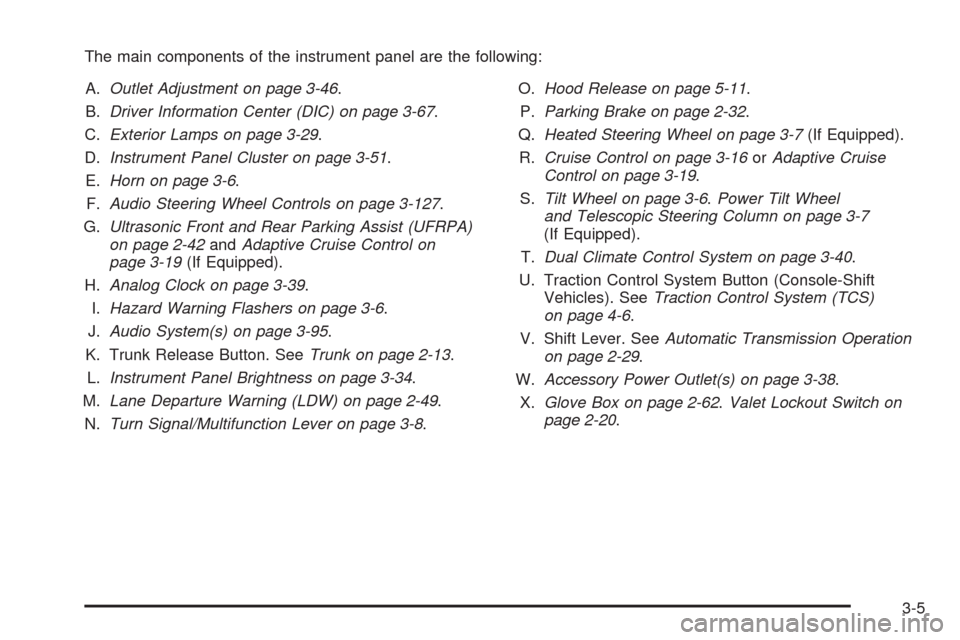
The main components of the instrument panel are the following:
A.Outlet Adjustment on page 3-46.
B.Driver Information Center (DIC) on page 3-67.
C.Exterior Lamps on page 3-29.
D.Instrument Panel Cluster on page 3-51.
E.Horn on page 3-6.
F.Audio Steering Wheel Controls on page 3-127.
G.Ultrasonic Front and Rear Parking Assist (UFRPA)
on page 2-42andAdaptive Cruise Control on
page 3-19(If Equipped).
H.Analog Clock on page 3-39.
I.Hazard Warning Flashers on page 3-6.
J.Audio System(s) on page 3-95.
K. Trunk Release Button. SeeTrunk on page 2-13.
L.Instrument Panel Brightness on page 3-34.
M.Lane Departure Warning (LDW) on page 2-49.
N.Turn Signal/Multifunction Lever on page 3-8.O.Hood Release on page 5-11.
P.Parking Brake on page 2-32.
Q.Heated Steering Wheel on page 3-7(If Equipped).
R.Cruise Control on page 3-16orAdaptive Cruise
Control on page 3-19.
S.Tilt Wheel on page 3-6.Power Tilt Wheel
and Telescopic Steering Column on page 3-7
(If Equipped).
T.Dual Climate Control System on page 3-40.
U. Traction Control System Button (Console-Shift
Vehicles). SeeTraction Control System (TCS)
on page 4-6.
V. Shift Lever. SeeAutomatic Transmission Operation
on page 2-29.
W.Accessory Power Outlet(s) on page 3-38.
X.Glove Box on page 2-62.Valet Lockout Switch on
page 2-20.
3-5
Page 173 of 462
Headlamps on Reminder
A warning chime will sound if the exterior lamp control
is left on in either the headlamp or parking lamp position
and the driver’s door is opened with the ignition off.
Daytime Running Lamps (DRL)
Daytime Running Lamps (DRL) can make it easier for
others to see the front of your vehicle during the day.
Fully functional daytime running lamps are required
on all vehicles rst sold in Canada.
The DRL system makes the turn signal lamps come on
when the following conditions are met:
It is still daylight and the ignition is on.
The exterior lamp control is in the off position.
The transmission is not in P (Park)
(United States only).
The light sensor is covered or not detecting light.
See “Sensors” underDual Climate Control System
on page 3-40.
When DRL are on, no other exterior lamps such as the
parking lamps, taillamps, etc. will be on when the DRL
are being used. The instrument panel will not be lit
up either.When automatic lighting is on and it is dark enough
outside, the turn signal lamps turn off and normal
low-beam headlamp operation occurs.
When automatic lighting is on and it is bright enough
outside, the regular lamps go off, and the DRL takes over.
If the vehicle is started in a dark garage, the automatic
headlamp system comes on immediately. Once you
leave the garage, it will take approximately one minute
for the automatic headlamp system to change to DRL if
there is light outside. During that delay, the instrument
panel cluster may not be as bright as usual. Make sure
the instrument panel brightness knob is in the full bright
position. SeeInstrument Panel Brightness on page 3-34.
Turning on automatic lighting or the headlamps will
deactivate the DRL. If the parking lamps or the fog lamps
were turned on instead, the DRL will still deactivate.
To idle the vehicle with the DRL off at night, turn off
automatic lighting and shift the transmission into P (Park).
Placing the vehicle in P (Park) disables the DRL. The
DRL will stay off until the vehicle is shifted out of P (Park).
To drive the vehicle with the DRL off, turn off automatic
lighting and manually turn on the parking lamps or
fog lamps, if the vehicle has them.
The regular headlamp system should be turned on
when needed.
3-33
Page 202 of 462
Malfunctions often are indicated by the system before
any problem is apparent. Being aware of the light
can prevent more serious damage to the vehicle.
This system assists the service technician in correctly
diagnosing any malfunction.
Notice:If the vehicle is continually driven with
this light on, after a while, the emission controls
might not work as well, the vehicle’s fuel economy
might not be as good, and the engine might not
run as smoothly. This could lead to costly repairs
that might not be covered by the vehicle warranty.
Notice:Modications made to the engine,
transmission, exhaust, intake, or fuel system
of the vehicle or the replacement of the original
tires with other than those of the same Tire
Performance Criteria (TPC) can affect the vehicle’s
emission controls and can cause this light to
come on. Modications to these systems could
lead to costly repairs not covered by the vehicle
warranty. This could also result in a failure to pass
a required Emission Inspection/Maintenance test.
SeeAccessories and Modifications on page 5-3.This light comes on during a malfunction in one of
two ways:
Light Flashing:A misre condition has been detected.
A misre increases vehicle emissions and could damage
the emission control system on the vehicle. Diagnosis
and service might be required.
To prevent more serious damage to the vehicle:
Reduce vehicle speed.
Avoid hard accelerations.
Avoid steep uphill grades.
If towing a trailer, reduce the amount of cargo being
hauled as soon as it is possible.
If the light continues to ash, when it is safe to do so,
stop the vehicle. Find a safe place to park the vehicle.
Turn the key off, wait at least 10 seconds, and restart
the engine. If the light is still ashing, follow the previous
steps and see your dealer/retailer for service as soon
as possible.
3-62
Page 222 of 462

SERVICE SUSPENSION SYS (System)
This message displays when the magnetic ride
control or automatic leveling control system is not
operating properly. Have your vehicle serviced by
your dealer/retailer.
SERVICE THEFT DETERRENT SYSTEM
This message displays when there is a problem with
the theft-deterrent system programmed in the key. A fault
has been detected in the system which means that the
system is disabled and it is not protecting the vehicle.
The vehicle usually restarts; however, you may want to
take the vehicle to your dealer/retailer before turning off
the engine. SeePASS-Key
®III+ Electronic Immobilizer
Operation on page 2-23for more information.
SERVICE TIRE MONITOR SYSTEM
On vehicles with the Tire Pressure Monitor System
(TPMS), this message displays if a part on the TPMS
is not working properly. The tire pressure light
also ashes and then remains on during the same
ignition cycle. SeeTire Pressure Light on page 3-60.
Several conditions may cause this message to appear.
SeeTire Pressure Monitor Operation on page 5-61for
more information. If the warning comes on and stays
on, there may be a problem with the TPMS, see your
dealer/retailer.
SERVICE TRACTION CONTROL
This message displays when there is a problem with the
Traction Control System (TCS). When this message is
displayed, the system will not limit wheel spin. Adjust your
driving accordingly. See your dealer/retailer for service.
SeeTraction Control System (TCS) on page 4-6for more
information.
SERVICE TRANSMISSION
This message displays when there is a problem with the
vehicle’s transmission. Have your vehicle serviced by
your dealer/retailer.
SERVICE VEHICLE SOON
This message displays when a non-emissions related
malfunction occurs. Have your vehicle serviced by your
dealer/retailer as soon as possible.
SET SPD (Speed)
If your vehicle has Adaptive Cruise Control (ACC),
this message displays whenever the cruise control is
set. First, the “CRUISE SET TO XXX MPH (km/h)”
message appears. After a few seconds, the “CRUISE
SET TO XXX MPH (km/h)” message clears and the
message “SET SPD XX” displays at the bottom of the
DIC. See “CRUISE SET TO XXX MPH (km/h)” earlier in
this section andAdaptive Cruise Control on page 3-19
for more information.
3-82
Page 225 of 462

TRANSMISSION HOT IDLE ENGINE
Notice:If you drive your vehicle while the
transmission uid is overheating and the
transmission temperature warning is displayed
on the instrument panel cluster and/or DIC, you
can damage the transmission. This could lead
to costly repairs that would not be covered by
your warranty. Do not drive your vehicle with
overheated transmission uid or while the
transmission temperature warning is displayed.
This message displays when the transmission uid
in your vehicle is too hot. Stop the vehicle and allow it
to idle until the transmission cools down or until this
message is removed.
TRUNK OPEN
This symbol appears with
this message.
This message displays when the trunk is not closed
completely. Make sure that the trunk is closed
completely.
TURN SIGNAL ON
This message displays as a reminder to turn off the
turn signal if you drive your vehicle for more than about
1 mile (1.6 km) with a turn signal on. A multiple chime
sounds when this message is displayed.
WASHER FLUID LOW ADD FLUID
This symbol appears with
this message.
This message displays when your vehicle is low on
windshield washer uid. Rell the windshield washer
uid reservoir as soon as possible. SeeWindshield
Washer Fluid on page 5-32for more information.
3-85
Page 285 of 462
Hill and Mountain Roads
Driving on steep hills or through mountains is different
than driving on at or rolling terrain. Tips for driving
in these conditions include:
Keep the vehicle serviced and in good shape.
Check all uid levels and brakes, tires, cooling
system, and transmission.
Going down steep or long hills, shift to a
lower gear.
{CAUTION:
If you do not shift down, the brakes could get so
hot that they would not work well. You would then
have poor braking or even none going down a hill.
You could crash. Shift down to let the engine
assist the brakes on a steep downhill slope.
{CAUTION:
Coasting downhill in N (Neutral) or with the ignition
off is dangerous. The brakes will have to do all the
work of slowing down and they could get so hot
that they would not work well. You would then
have poor braking or even none going down a hill.
You could crash. Always have the engine running
and the vehicle in gear when going downhill.
Stay in your own lane. Do not swing wide or cut
across the center of the road. Drive at speeds
that let you stay in your own lane.
Top of hills: Be alert — something could be in your
lane (stalled car, accident).
Pay attention to special road signs (falling rocks
area, winding roads, long grades, passing or
no-passing zones) and take appropriate action.
4-15
Page 289 of 462

Rocking Your Vehicle to Get It Out
Turn the steering wheel left and right to clear the
area around the front wheels. Turn off any traction or
stability system. Shift back and forth between
R (Reverse) and a forward gear, spinning the wheels as
little as possible. To prevent transmission wear, wait
until the wheels stop spinning before shifting gears.
Release the accelerator pedal while shifting, and press
lightly on the accelerator pedal when the transmission
is in gear. Slowly spinning the wheels in the forward and
reverse directions causes a rocking motion that could
free the vehicle. If that does not get the vehicle out after
a few tries, it might need to be towed out. If the
vehicle does need to be towed out, seeTowing Your
Vehicle on page 4-26.
Loading the Vehicle
It is very important to know how much weight your
vehicle can carry. This weight is called the vehicle
capacity weight and includes the weight of all
occupants, cargo, and all nonfactory-installed
options. Two labels on your vehicle show how much
weight it may properly carry, the Tire and Loading
Information label and the Certication label.
{CAUTION:
Do not load the vehicle any heavier than the
Gross Vehicle Weight Rating (GVWR), or
either the maximum front or rear Gross Axle
Weight Rating (GAWR). If you do, parts on the
vehicle can break, and it can change the way
your vehicle handles. These could cause you
to lose control and crash. Also, overloading
can shorten the life of the vehicle.
4-19
Page 298 of 462
Towing a Trailer
The Cadillac Professional Vehicle cannot tow a trailer.
{CAUTION:
The driver can lose control when pulling a trailer if
the correct equipment is not used or the vehicle is
not driven properly. For example, if the trailer is
too heavy, the brakes may not work well — or
even at all. The driver and passengers could be
seriously injured. The vehicle may also be
damaged; the resulting repairs would not be
covered by the vehicle warranty. Pull a trailer only
if all the steps in this section have been followed.
Ask your dealer/retailer for advice and information
about towing a trailer with the vehicle.
Notice:Pulling a trailer improperly can damage the
vehicle and result in costly repairs not covered
by the vehicle warranty. To pull a trailer correctly,
follow the advice in this section and see your
dealer/retailer for important information about
towing a trailer with the vehicle.The vehicle can tow a trailer if it is equipped with the
proper trailer towing equipment. To identify the trailering
capacity of the vehicle, read the information in “Weight
of the Trailer” that appears later in this section. Trailering
is different than just driving the vehicle by itself.
Trailering means changes in handling, acceleration,
braking, durability and fuel economy. Successful, safe
trailering takes correct equipment, and it has to be used
properly.
The following information has many time-tested,
important trailering tips and safety rules. Many of these
are important for the safety of the driver and the
passengers. So please read this section carefully before
pulling a trailer.
Load-pulling components such as the engine,
transmission, axles, wheel assemblies and tires are
forced to work harder against the drag of the added
weight. The engine is required to operate at relatively
higher speeds and under greater loads, generating extra
heat. The trailer also adds considerably to wind
resistance, increasing the pulling requirements.
4-28