brake light CADILLAC DTS 2009 1.G Owners Manual
[x] Cancel search | Manufacturer: CADILLAC, Model Year: 2009, Model line: DTS, Model: CADILLAC DTS 2009 1.GPages: 462, PDF Size: 2.46 MB
Page 4 of 462
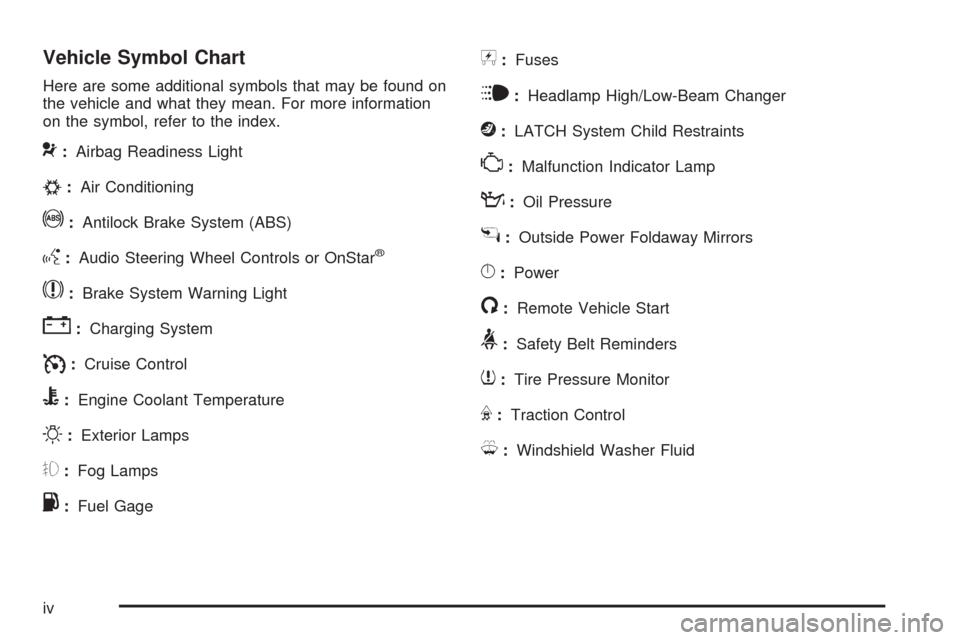
Vehicle Symbol Chart
Here are some additional symbols that may be found on
the vehicle and what they mean. For more information
on the symbol, refer to the index.
9:Airbag Readiness Light
#:Air Conditioning
!:Antilock Brake System (ABS)
g:Audio Steering Wheel Controls or OnStar®
$:Brake System Warning Light
":Charging System
I:Cruise Control
B:Engine Coolant Temperature
O:Exterior Lamps
#:Fog Lamps
.:Fuel Gage
+:Fuses
i:Headlamp High/Low-Beam Changer
j:LATCH System Child Restraints
*:Malfunction Indicator Lamp
::Oil Pressure
g:Outside Power Foldaway Mirrors
}:Power
/:Remote Vehicle Start
>:Safety Belt Reminders
7:Tire Pressure Monitor
F:Traction Control
M:Windshield Washer Fluid
iv
Page 100 of 462

See your dealer/retailer or a locksmith who can service
PASS-Key®III+ to get a new key blank that is cut
exactly as the ignition key that operates the system.
To program the new key:
1. Verify that the new key has a
1stamped on it.
2. Insert the original, already programmed, key in the
ignition and start the engine. If the engine will not
start, see your dealer/retailer for service.
3. After the engine has started, turn the key to
LOCK/OFF, and remove the key.
4. Insert the new key to be programmed and turn it to
the ON/RUN position within ve seconds of turning
the original key to LOCK/OFF.
The security light will turn off once the key has
been programmed.
5. Repeat Steps 1 through 4 if additional keys are to
be programmed.
If you lose or damage your PASS-Key
®III+ key, see
your dealer/retailer or a locksmith who can service
PASS-Key
®III+ to have a new key made.
Do not leave the key or device that disarms or
deactivates the theft deterrent system in the vehicle.
Starting and Operating
Your Vehicle
New Vehicle Break-In
Notice:The vehicle does not need an elaborate
break-in. But it will perform better in the long run if
you follow these guidelines:
Do not drive at any one constant speed, fast or
slow, for the rst 500 miles (805 km). Do not
make full-throttle starts. Avoid downshifting to
brake or slow the vehicle.
Avoid making hard stops for the rst 200 miles
(322 km) or so. During this time the new brake
linings are not yet broken in. Hard stops
with new linings can mean premature wear and
earlier replacement. Follow this breaking-in
guideline every time you get new brake linings.
Do not tow a trailer during break-in. SeeTowing
a Trailer on page 4-28for the trailer towing
capabilities of your vehicle and more
information.
Following break-in, engine speed and load can be
gradually increased.
2-24
Page 101 of 462
Ignition Positions
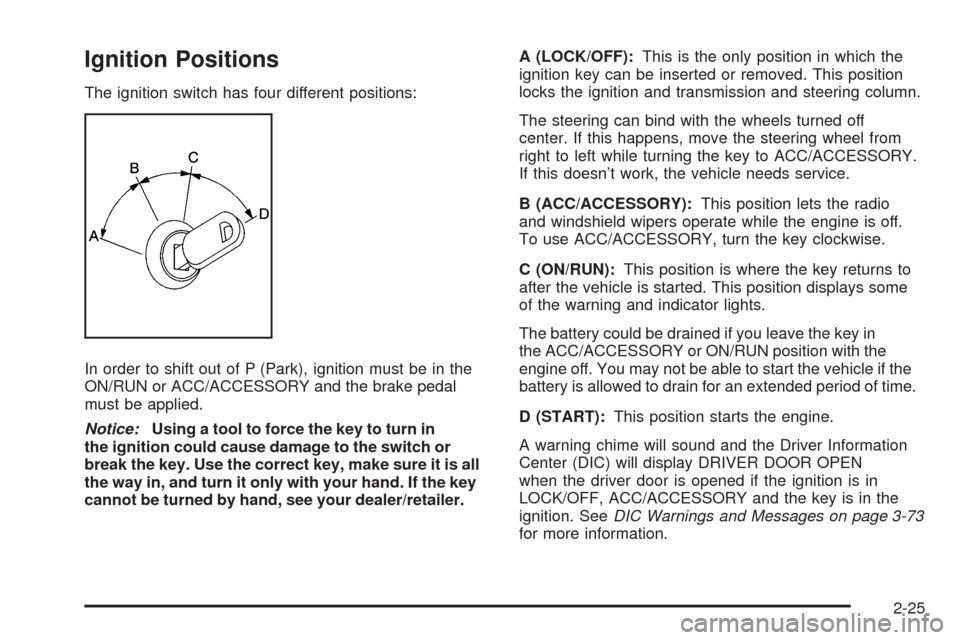
The ignition switch has four different positions:
In order to shift out of P (Park), ignition must be in the
ON/RUN or ACC/ACCESSORY and the brake pedal
must be applied.
Notice:Using a tool to force the key to turn in
the ignition could cause damage to the switch or
break the key. Use the correct key, make sure it is all
the way in, and turn it only with your hand. If the key
cannot be turned by hand, see your dealer/retailer.A (LOCK/OFF):This is the only position in which the
ignition key can be inserted or removed. This position
locks the ignition and transmission and steering column.
The steering can bind with the wheels turned off
center. If this happens, move the steering wheel from
right to left while turning the key to ACC/ACCESSORY.
If this doesn’t work, the vehicle needs service.
B (ACC/ACCESSORY):This position lets the radio
and windshield wipers operate while the engine is off.
To use ACC/ACCESSORY, turn the key clockwise.
C (ON/RUN):This position is where the key returns to
after the vehicle is started. This position displays some
of the warning and indicator lights.
The battery could be drained if you leave the key in
the ACC/ACCESSORY or ON/RUN position with the
engine off. You may not be able to start the vehicle if the
battery is allowed to drain for an extended period of time.
D (START):This position starts the engine.
A warning chime will sound and the Driver Information
Center (DIC) will display DRIVER DOOR OPEN
when the driver door is opened if the ignition is in
LOCK/OFF, ACC/ACCESSORY and the key is in the
ignition. SeeDIC Warnings and Messages on page 3-73
for more information.
2-25
Page 108 of 462
Performance Shifting
If the vehicle has this feature, it can detect a change in
driving patterns. If you make an aggressive driving
maneuver, the vehicle’s transmission automatically
shifts to the lowest possible gear to maximize vehicle
performance. The vehicle will automatically return
to normal operation when you return to normal driving
patterns.
Parking Brake
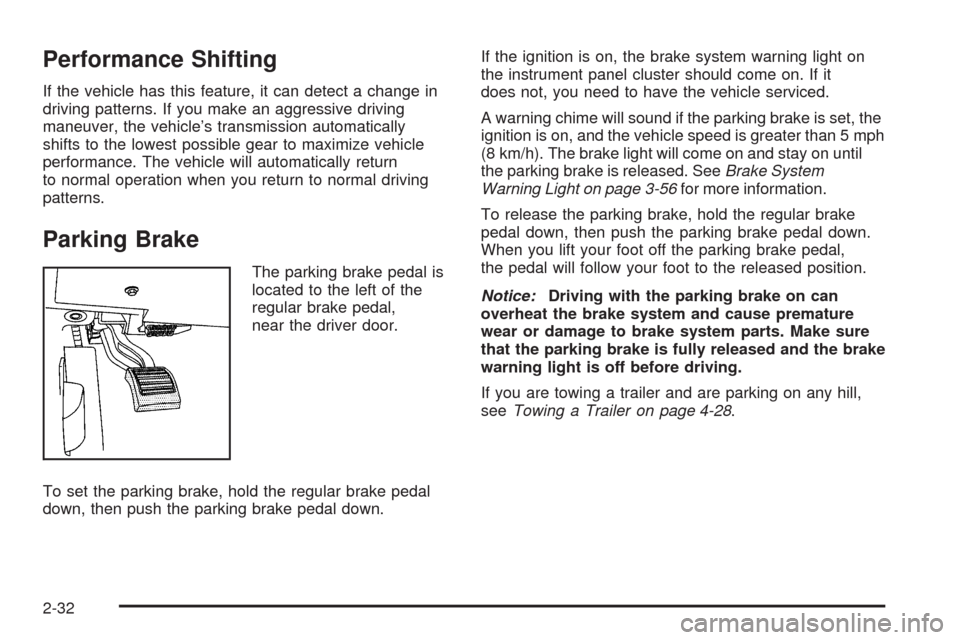
The parking brake pedal is
located to the left of the
regular brake pedal,
near the driver door.
To set the parking brake, hold the regular brake pedal
down, then push the parking brake pedal down.If the ignition is on, the brake system warning light on
the instrument panel cluster should come on. If it
does not, you need to have the vehicle serviced.
A warning chime will sound if the parking brake is set, the
ignition is on, and the vehicle speed is greater than 5 mph
(8 km/h). The brake light will come on and stay on until
the parking brake is released. SeeBrake System
Warning Light on page 3-56for more information.
To release the parking brake, hold the regular brake
pedal down, then push the parking brake pedal down.
When you lift your foot off the parking brake pedal,
the pedal will follow your foot to the released position.
Notice:Driving with the parking brake on can
overheat the brake system and cause premature
wear or damage to brake system parts. Make sure
that the parking brake is fully released and the brake
warning light is off before driving.
If you are towing a trailer and are parking on any hill,
seeTowing a Trailer on page 4-28.
2-32
Page 121 of 462
When the System Does Not Seem to
Work Properly
If the URPA system will not activate due to a temporary
condition, the message PARK ASSIST OFF will be
displayed on the DIC and a red light will be shown on
the rear URPA display when the shift lever is moved into
R (Reverse). This occurs under the following conditions:
The driver disables the system.
The ultrasonic sensors are not clean. Keep the
vehicle’s rear bumper free of mud, dirt, snow,
ice and slush. For cleaning instructions, see
Washing Your Vehicle on page 5-90.
A trailer was attached to the vehicle, or a bicycle or
an object was hanging out of the trunk during the
last drive cycle, the red light may illuminate in
the rear display. Once the attached object is
removed, URPA will return to normal operation.
A tow bar is attached to the vehicle.
The vehicle’s bumper is damaged. Take the vehicle
to your dealer/retailer to repair the system.
Other conditions may affect system performance,
such as vibrations from a jackhammer or the
compression of air brakes on a very large truck.
If the system is still disabled after driving forward at
least 15 mph (25 km/h), take the vehicle to your
dealer/retailer.
Side Blind Zone Alert (SBZA)
The vehicle may have a Side Blind Zone Alert (SBZA)
system. Read this entire section before using the system.
The SBZA system operates on a radio frequency
subject to Federal Communications Commission (FCC)
Rules and with Industry Canada.
This device complies with Part 15 of the FCC Rules.
Operation is subject to the following two conditions:
1. This device may not cause harmful interference.
2. This device must accept any interference received,
including interference that may cause undesired
operation.
This device complies with RSS-310 of Industry Canada.
Operation is subject to the following two conditions:
1. This device may not cause harmful interference.
2. This device must accept any interference received,
including interference that may cause undesired
operation.
Frequency of operation: 24.05GHz – 24.25GHz
Field Strength: Not greater than 2.5V/m peak (0.25V/m
average) at a distance of 3m
2-45
Page 142 of 462

Brake System Warning Light..........................3-56
Antilock Brake System (ABS) Warning Light.....3-57
Traction Control System (TCS) Warning Light . . .3-58
StabiliTrak
®Indicator Light.............................3-58
Lane Departure Warning (LDW) Light..............3-59
Engine Coolant Temperature Warning Light......3-59
Engine Coolant Temperature Gage..................3-60
Tire Pressure Light.......................................3-60
Malfunction Indicator Lamp.............................3-61
Oil Pressure Light.........................................3-64
Security Light...............................................3-65
Fog Lamp Light............................................3-65
Lights On Reminder......................................3-65
Cruise Control Light......................................3-66
Highbeam On Light.......................................3-66
Fuel Gage...................................................3-66Driver Information Center (DIC).......................3-67
DIC Operation and Displays...........................3-68
DIC Warnings and Messages.........................3-73
DIC Vehicle Customization.............................3-86
Audio System(s).............................................3-95
Setting the Clock..........................................3-96
Radio(s) (MP3).............................................3-99
Using an MP3............................................3-110
XM Radio Messages...................................3-115
Navigation/Radio System..............................3-116
Bluetooth
®.................................................3-116
Theft-Deterrent Feature................................3-127
Audio Steering Wheel Controls......................3-127
Radio Reception.........................................3-128
Backglass Antenna......................................3-129
XM™ Satellite Radio Antenna System............3-129
Section 3 Instrument Panel
3-2
Page 150 of 462

The Forward Collision Alert (FCA) system provides
an audible and visual alert if you approach a vehicle too
quickly that is directly ahead. FCA also provides a visual
alert with no audible alert if you are following another
vehicle much too closely. The FCA alert symbol is located
on top of the instrument panel to the right of the driver.
FCA uses the Adaptive Cruise Control radar to detect a
vehicle directly ahead, in your path, within a distance of
328 ft (100 m) and operates at speeds above 20 mph
(32 km/h).
{CAUTION:
FCA is only a warning system and does not apply
the brakes. When you are approaching a vehicle
or object too rapidly or when you are following a
vehicle too closely that is ahead of you, FCA may
not provide you with enough time to avoid a
collision. FCA is not designed to warn the driver
of pedestrians or animals. Your complete attention
is always required while driving and you should
be ready to take action and apply the brakes.
For more information, seeDefensive Driving on
page 4-2.The FCA control is located
on the steering wheel.
To enable or disable FCA, press the Adaptive Cruise
Control button. SeeAdaptive Cruise Control on
page 3-19.
FCA is enabled when the green light on the button is lit.
FCA is disabled when the indicator light is amber.
3-10
Page 156 of 462

Cruise Control
With cruise control, a speed of approximately 25 mph
(40 km/h) or more can be maintained without keeping
your foot on the accelerator. Cruise control does not work
at speeds below about 25 mph (40 km/h). A cruise control
light appears in the instrument panel cluster when the
cruise control is on.
When the brakes are applied, the cruise control
shuts off.{CAUTION:
Cruise control can be dangerous where you
cannot drive safely at a steady speed. So, do
not use the cruise control on winding roads or
in heavy traffic.
Cruise control can be dangerous on slippery roads.
On such roads, fast changes in tire traction can
cause excessive wheel slip, and you could lose
control. Do not use cruise control on slippery roads.
If your vehicle is in cruise control when the Traction
Control System (TCS) begins to limit wheel spin, the
cruise control automatically turns off. SeeTraction
Control System (TCS) on page 4-6. When road
conditions let you safely use it again, the cruise
control can be turned back on.
3-16
Page 157 of 462

Setting Cruise Control
{CAUTION:
If you leave your cruise control on when you
are not using cruise, you might hit a button and go
into cruise when you do not want to. You could be
startled and even lose control. Keep the cruise
control switch off until you want to use cruise
control.
The cruise control buttons
are located on left side of
the steering wheel.
I(On):Turns on the cruise control system.
+ RES (Resume/Accelerate):Press to make the
vehicle accelerate or resume to a previously set speed.
SET– (Set):Press to set the speed.
[(Cancel):Press to cancel cruise control.
Cruise control will not work if the parking brake is set, or
if the master cylinder brake uid level is low.
If the brakes are applied, the cruise control shuts off.
The cruise light on the instrument panel cluster comes
on after the cruise control has been set to the desired
speed.
1. Press
I.
2. Get up to the desired speed.
3. Press the SET– button located on the steering
wheel and release it.
4. Take your foot off the accelerator.
3-17
Page 158 of 462

Resuming a Set Speed
Suppose the cruise control is set at a desired speed
and then the brakes are applied. This shuts off the
cruise control. But it does not need to be reset.
Once the vehicle is traveling approximately 25 mph
(40 km/h) or more, press the +RES (resume/accelerate)
button to return to the desired preset speed. The cruise
light displays again.
The vehicle returns to and stays at the preset speed.
If you press and hold the +RES button, the vehicle
speed increases until the button is released or the brake
is applied. Do not hold in the +RES button, if you do
not want the vehicle speed to increase.
Increasing Speed While Using Cruise
Control
There are two ways to go to a higher speed:
Use the accelerator pedal to get to the higher
speed. Press the SET– button, then release
the button and the accelerator pedal. The vehicle
now cruises at the higher speed.
Press the +RES button. Hold it there until the
desired speed is reached, and then release
the button. To increase the vehicle speed in very
small amounts, briey press the +RES button
and then release it. Each time this is done, the
vehicle accelerates approximately 1 mph (1.6 km/h).
The accelerate feature only works after the cruise
control speed is set by pressing the SET– button.
Reducing Speed While Using Cruise
Control
There are two ways to reduce the vehicle speed while
using cruise control:
Press the SET– button until the lower speed
desired is reached, then release it.
To slow down in very small amounts, push the
SET– button briey. Each time this is done, the
vehicle slows down approximately 1 mph (1.6 km/h).
3-18