automatic transmission CADILLAC DTS 2010 1.G User Guide
[x] Cancel search | Manufacturer: CADILLAC, Model Year: 2010, Model line: DTS, Model: CADILLAC DTS 2010 1.GPages: 480, PDF Size: 17.56 MB
Page 321 of 480

Service. . . . . . . . . . . . . . . . . . . . . . . . . . . . . . . . . . . . . . . . . . . . . . . . . . . . . . . . . . . .6-3Accessories and Modifications . . . . . . . . . . . . . . . . . . . . . . . . . .6-3California Proposition 65 Warning . . . . . . . . . . . . . . . . . . . . .6-4California Perchlorate Materials Requirements . . . . .6-4Doing Your Own Service Work . . . . . . . . . . . . . . . . . . . . . . . . .6-4Adding Equipment to the Outsideof the Vehicle . . . . . . . . . . . . . . . . . . . . . . . . . . . . . . . . . . . . . . . . . . . . .6-5
Fuel. . . . . . . . . . . . . . . . . . . . . . . . . . . . . . . . . . . . . . . . . . . . . . . . . . . . . . . . . . . . . . . .6-5Gasoline Octane . . . . . . . . . . . . . . . . . . . . . . . . . . . . . . . . . . . . . . . . . . . .6-5Gasoline Specifications . . . . . . . . . . . . . . . . . . . . . . . . . . . . . . . . . . . .6-6California Fuel . . . . . . . . . . . . . . . . . . . . . . . . . . . . . . . . . . . . . . . . . . . . . . .6-6Additives . . . . . . . . . . . . . . . . . . . . . . . . . . . . . . . . . . . . . . . . . . . . . . . . . . . . . . .6-6Fuels in Foreign Countries . . . . . . . . . . . . . . . . . . . . . . . . . . . . . . .6-7Filling the Tank . . . . . . . . . . . . . . . . . . . . . . . . . . . . . . . . . . . . . . . . . . . . . .6-8Filling a Portable Fuel Container . . . . . . . . . . . . . . . . . . . . .6-10
Checking Things Under the Hood. . . . . . . . . . . . . . . . . . . .6-10Hood Release . . . . . . . . . . . . . . . . . . . . . . . . . . . . . . . . . . . . . . . . . . . . . .6-11Engine Compartment Overview . . . . . . . . . . . . . . . . . . . . . . .6-12Engine Oil . . . . . . . . . . . . . . . . . . . . . . . . . . . . . . . . . . . . . . . . . . . . . . . . . . .6-13Engine Oil Life System . . . . . . . . . . . . . . . . . . . . . . . . . . . . . . . . . .6-16Engine Air Cleaner/Filter . . . . . . . . . . . . . . . . . . . . . . . . . . . . . . . .6-17Automatic Transmission Fluid . . . . . . . . . . . . . . . . . . . . . . . . .6-19Cooling System . . . . . . . . . . . . . . . . . . . . . . . . . . . . . . . . . . . . . . . . . . . .6-22Engine Coolant . . . . . . . . . . . . . . . . . . . . . . . . . . . . . . . . . . . . . . . . . . . . .6-23Engine Overheating . . . . . . . . . . . . . . . . . . . . . . . . . . . . . . . . . . . . . . .6-27
Overheated Engine ProtectionOperating Mode . . . . . . . . . . . . . . . . . . . . . . . . . . . . . . . . . . . . . . . .6-29Power Steering Fluid . . . . . . . . . . . . . . . . . . . . . . . . . . . . . . . . . . . . .6-30Windshield Washer Fluid . . . . . . . . . . . . . . . . . . . . . . . . . . . . . . . .6-31Brakes . . . . . . . . . . . . . . . . . . . . . . . . . . . . . . . . . . . . . . . . . . . . . . . . . . . . . . . .6-32Battery . . . . . . . . . . . . . . . . . . . . . . . . . . . . . . . . . . . . . . . . . . . . . . . . . . . . . . . .6-34Jump Starting . . . . . . . . . . . . . . . . . . . . . . . . . . . . . . . . . . . . . . . . . . . . . . .6-36
Headlamp Aiming. . . . . . . . . . . . . . . . . . . . . . . . . . . . . . . . . . . . . . . . . . .6-40
Bulb Replacement. . . . . . . . . . . . . . . . . . . . . . . . . . . . . . . . . . . . . . . . . .6-43High Intensity Discharge (HID) Lighting . . . . . . . . . . . .6-43
Windshield Wiper Blade Replacement. . . . . . . . . . . . . .6-44
Tires. . . . . . . . . . . . . . . . . . . . . . . . . . . . . . . . . . . . . . . . . . . . . . . . . . . . . . . . . . . . . .6-46Tire Sidewall Labeling . . . . . . . . . . . . . . . . . . . . . . . . . . . . . . . . . . .6-47Tire Terminology and Definitions . . . . . . . . . . . . . . . . . . . . .6-52Inflation - Tire Pressure . . . . . . . . . . . . . . . . . . . . . . . . . . . . . . . . .6-54High-Speed Operation . . . . . . . . . . . . . . . . . . . . . . . . . . . . . . . . . . .6-56Tire Pressure Monitor System . . . . . . . . . . . . . . . . . . . . . . . . .6-57Tire Pressure Monitor Operation . . . . . . . . . . . . . . . . . . . . .6-58Tire Inspection and Rotation . . . . . . . . . . . . . . . . . . . . . . . . . . .6-62When It Is Time for New Tires . . . . . . . . . . . . . . . . . . . . . . .6-64Buying New Tires . . . . . . . . . . . . . . . . . . . . . . . . . . . . . . . . . . . . . . . . .6-64Different Size Tires and Wheels . . . . . . . . . . . . . . . . . . . . . .6-66Uniform Tire Quality Grading . . . . . . . . . . . . . . . . . . . . . . . . . .6-67Wheel Alignment and Tire Balance . . . . . . . . . . . . . . . . . .6-68Wheel Replacement . . . . . . . . . . . . . . . . . . . . . . . . . . . . . . . . . . . . . .6-68
Section 6 Service and Appearance Care
6-1
Page 333 of 480

A.Underhood Fuse Block on page 6-101.
B. Remote Positive (+) Terminal. SeeJump Starting onpage 6-36.
C. Windshield Washer Fluid Reservoir. See “AddingWasher Fluid” underWindshield Washer Fluidon page 6-31.
D. Engine Coolant Surge Tank and Pressure Cap.SeeEngine Coolant on page 6-23.
E. Remote Negative (!) Terminal. SeeJump Startingon page 6-36.
F.Power Steering Fluid on page 6-30.
G. Engine Oil Fill Cap. See “When to Add Engine Oil”underEngine Oil on page 6-13.
H. Engine Oil Dipstick. See “Checking Engine Oil”underEngine Oil on page 6-13.
I. Brake Master Cylinder Reservoir. See “Brake Fluid”underBrakes on page 6-32.
J. Automatic Transmission Fluid Cap and Dipstick(Out of View). SeeAutomatic Transmission Fluid onpage 6-19.
K.Engine Air Cleaner/Filter on page 6-17.
Engine Oil
Checking Engine Oil
It is a good idea to check the engine oil level at eachfuel fill. In order to get an accurate reading, the oil mustbe warm and the vehicle must be on level ground.
The engine oil dipstick handle is a yellow loop. SeeEngine Compartment Overview on page 6-12forthe location of the engine oil dipstick.
1. Turn off the engine and give the oil several minutesto drain back into the oil pan. If this is not done, theoil dipstick might not show the actual level.
2. Pull out the dipstick and clean it with a paper towelor cloth, then push it back in all the way. Remove itagain, keeping the tip down, and check the level.
6-13
Page 339 of 480
{WARNING:
Operating the engine with the air cleaner/filter off
can cause you or others to be burned. The air
cleaner not only cleans the air; it helps to stop
flames if the engine backfires. If it is not there and
the engine backfires, you could be burned. Do not
drive with it off, and be careful working on the
engine with the air cleaner/filter off.
Notice:If the air cleaner/filter is off, a backfire cancause a damaging engine fire. And, dirt caneasily get into the engine, which will damage it.Always have the air cleaner/filter in place when youare driving.
Automatic Transmission Fluid
When to Check and Change Automatic
Transmission Fluid
A good time to check the automatic transmission fluidlevel is when the engine oil is changed.
Change the fluid and filter at the intervals listed inScheduled Maintenance on page 7-3, and be sure touse the transmission fluid listed inRecommended Fluidsand Lubricants on page 7-8.
6-19
Page 340 of 480

How to Check Automatic
Transmission Fluid
Because this operation can be a little difficult, you maychoose to have this done at the dealer/retailer servicedepartment.
If you do it yourself, be sure to follow all the instructionshere or you could get a false reading on the dipstick.
Notice:Too much or too little fluid can damageyour transmission. Too much can mean that someof the fluid could come out and fall on hot engineparts or exhaust system parts, starting a fire.Too little fluid could cause the transmission tooverheat. Be sure to get an accurate reading if youcheck your transmission fluid.
Wait at least 30 minutes before checking thetransmission fluid level if you have been driving:
•When outside temperatures are above 32°C (90°F).
•At high speed for quite a while.
•In heavy traffic — especially in hot weather.
•While pulling a trailer.
To get the right reading, the fluid should be atnormal operating temperature, which is 82°C to 93°C(180°F to 200°F).
Get the vehicle warmed up by driving about 24 km(15 miles) when outside temperatures are above10°C (50°F). If it is colder than 10°C (50°F), you mayhave to drive longer.
Checking the Fluid Level
Prepare the vehicle as follows:
1. Park the vehicle on a level place. Keep the enginerunning.
2. With the parking brake applied, place the shift leverin P (Park).
3. With your foot on the brake pedal, move the shiftlever through each gear range, pausing for aboutthree seconds in each range. Then, positionthe shift lever in P (Park).
4. Let the engine run at idle for three to five minutes.
Then, without shutting off the engine, follow these steps:
1. Locate the transmission fluid cap which is locatednext to the radiator hose and below the engine aircleaner/filter assembly on the driver side of thevehicle. The cap is marked TRANS FLUID.SeeEngine Compartment Overview on page 6-12for more information on location.
2. After removing the engine air cleaner/filter assemblyto reach the transmission fluid cap, turn the capcounterclockwise to remove. Pull out the dipstickand wipe it with a clean rag or paper towel.
6-20
Page 341 of 480

3. Push it back in all the way, wait three seconds, andthen pull it back out again.
4. Check both sides of the dipstick and readthe lower level. The fluid level must be in thecross-hatched area.
5. If the fluid level is in the acceptable range, push thedipstick back in all the way and turn the handleclockwise.
6. Reinstall the engine air cleaner/filter assembly.
How to Add Automatic Transmission
Fluid
Refer to the Maintenance Schedule to determine whatkind of transmission fluid to use. SeeRecommendedFluids and Lubricants on page 7-8.
If the fluid level is low, add only enough of the properfluid to bring the level into the cross-hatched area onthe dipstick.
1. Pull out the dipstick.
2. Using a long-neck funnel, add enough fluid at thedipstick hole to bring it to the proper level.
It does not take much fluid, generally less thanone pint (0.5 L). Do not overfill.
Notice:Use of the incorrect automatic transmissionfluid may damage the vehicle, and the damagesmay not be covered by the vehicle’s warranty.Always use the automatic transmission fluid listedinRecommended Fluids and Lubricants on page 7-8.
3. After adding fluid, recheck the fluid level asdescribed under “How to Check AutomaticTransmission Fluid,” earlier in this section.
4. When the correct fluid level is obtained, pushthe dipstick back in all the way and turn thehandle clockwise.
6-21
Page 357 of 480

2. Get the vehicles close enough so the jumper cablescan reach, but be sure the vehicles are not touchingeach other. If they are, it could cause a groundconnection you do not want. You would not be ableto start your vehicle and the bad grounding coulddamage the electrical systems.
To avoid the possibility of the vehicles rolling, setthe parking brake firmly on both vehicles involved inthe jump start procedure. Put an automatictransmission in P (Park) or a manual transmissionin NEUTRAL before setting the parking brake.
Notice:If you leave the radio or other accessorieson during the jump starting procedure, they could bedamaged. The repairs would not be covered by thewarranty. Always turn off the radio and otheraccessories when jump starting the vehicle.
3. Turn off the ignition on both vehicles. Unplugunnecessary accessories plugged into the cigarettelighter or the accessory power outlets. Turn offthe radio and all lamps that are not needed. Thiswill avoid sparks and help save both batteries.And it could save the radio!
4. Open the hoods and locate the positive (+) andnegative (!) terminal locations on the othervehicle. Your vehicle has a remote positive (+) jumpstarting terminal and a remote negative (!) jumpstarting terminal.
The remote positive (+) terminal is located in theengine compartment on the passenger’s side of thevehicle. Lift the red plastic cap to access theterminal. SeeEngine Compartment Overview onpage 6-12for more information on the locationof the remote positive (+) terminal.
A second remote positive (+) terminal is located onthe rear underseat fuse block.
The remote negative (!) terminal is located behindthe power steering pulley, near the engine cover.It is marked GND (!).
4.6L LD8 Engine shown,4.6L L37 Enginesimilar
6-37
Page 372 of 480

Tire Terminology and Definitions
Air Pressure:The amount of air inside thetire pressing outward on each square inch of thetire. Air pressure is expressed in pounds persquare inch (psi) or kilopascal (kPa).
Accessory Weight:This means the combinedweight of optional accessories. Some examples ofoptional accessories are, automatic transmission,power steering, power brakes, power windows,power seats, and air conditioning.
Aspect Ratio:The relationship of a tire’s heightto its width.
Belt:A rubber coated layer of cords that is locatedbetween the plies and the tread. Cords may bemade from steel or other reinforcing materials.
Bead:The tire bead contains steel wires wrappedby steel cords that hold the tire onto the rim.
Bias Ply Tire:A pneumatic tire in which the pliesare laid at alternate angles less than 90 degreesto the centerline of the tread.
Cold Tire Pressure:The amount of air pressure ina tire, measured in pounds per square inch (psi) orkilopascals (kPa) before a tire has built up heatfrom driving. SeeInflation - Tire Pressure onpage 6-54.
Curb Weight:The weight of a motor vehicle withstandard and optional equipment including themaximum capacity of fuel, oil, and coolant,but without passengers and cargo.
DOT Markings:A code molded into the sidewallof a tire signifying that the tire is in compliancewith the U.S. Department of Transportation (DOT)motor vehicle safety standards. The DOT codeincludes the Tire Identification Number (TIN),an alphanumeric designator which can also identifythe tire manufacturer, production plant, brand,and date of production.
GVWR:Gross Vehicle Weight Rating. SeeLoading the Vehicle on page 5-18.
GAWR FRT:Gross Axle Weight Rating for thefront axle. SeeLoading the Vehicle on page 5-18.
GAWR RR:Gross Axle Weight Rating for therear axle. SeeLoading the Vehicle on page 5-18.
Intended Outboard Sidewall:The side of anasymmetrical tire, that must always face outwardwhen mounted on a vehicle.
Kilopascal (kPa):The metric unit for air pressure.
Light Truck (LT-Metric) Tire:A tire used onlight duty trucks and some multipurpose passengervehicles.
6-52
Page 429 of 480
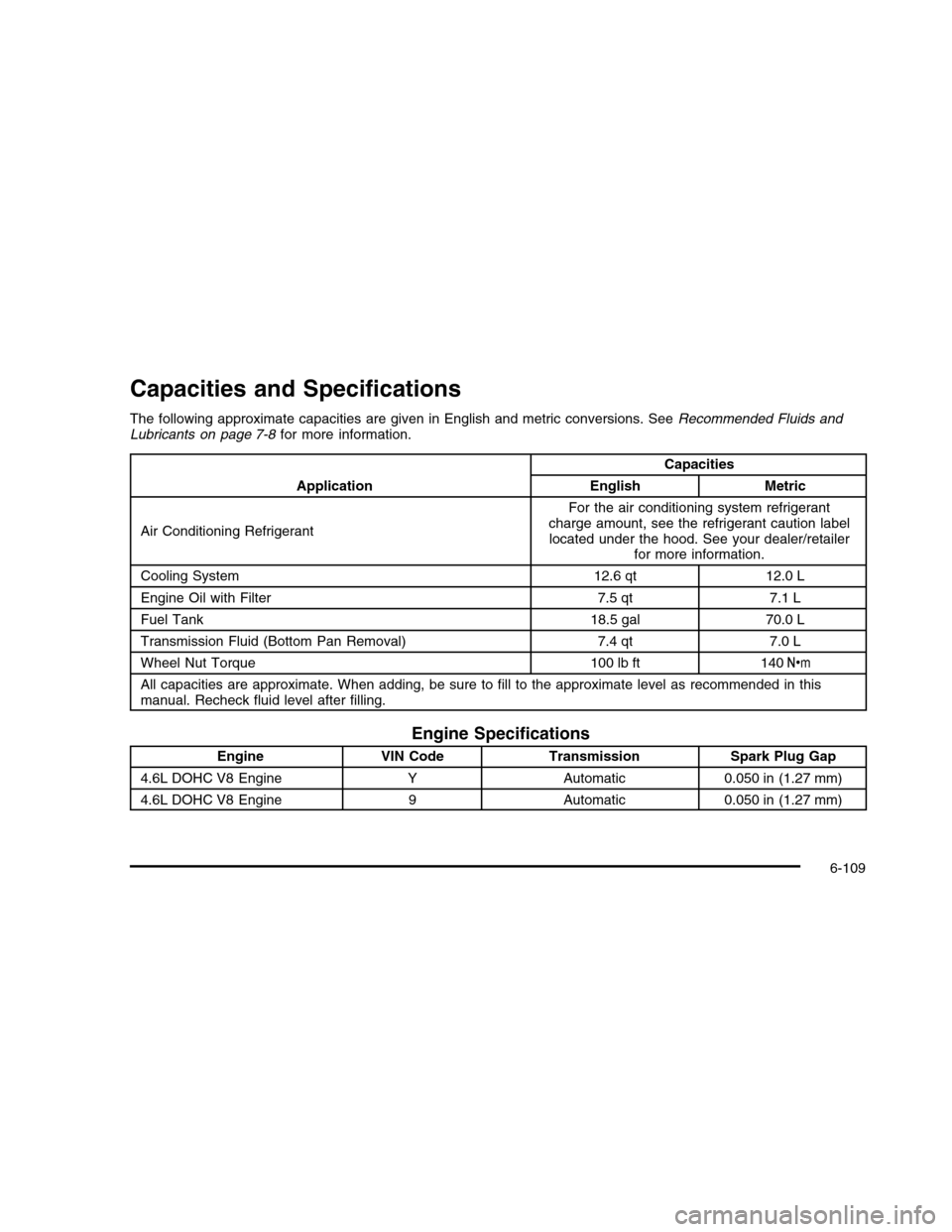
Capacities and Specifications
The following approximate capacities are given in English and metric conversions. SeeRecommended Fluids andLubricants on page 7-8for more information.
Application
Capacities
EnglishMetric
Air Conditioning Refrigerant
For the air conditioning system refrigerantcharge amount, see the refrigerant caution labellocated under the hood. See your dealer/retailerfor more information.
Cooling System12.6 qt12.0 L
Engine Oil with Filter7.5 qt7.1 L
Fuel Tank18.5 gal70.0 L
Transmission Fluid (Bottom Pan Removal)7.4 qt7.0 L
Wheel Nut Torque100 lb ft140Y
All capacities are approximate. When adding, be sure to fill to the approximate level as recommended in thismanual. Recheck fluid level after filling.
Engine Specifications
EngineVIN CodeTransmissionSpark Plug Gap
4.6L DOHC V8 EngineYAutomatic0.050 in (1.27 mm)
4.6L DOHC V8 Engine9Automatic0.050 in (1.27 mm)
6-109
Page 434 of 480

•Fluids visual leak check (or every 12 months,
whichever occurs first). A leak in any system mustbe repaired and the fluid level checked.
•Engine air cleaner filter inspection. SeeEngine Air
Cleaner/Filter on page 6-17.
•Brake system inspection (or every 12 months,
whichever occurs first).
•Steering and suspension inspection. Visual
inspection for damaged, loose, or missing parts orsigns of wear.
•Engine cooling system inspection. Visual inspection
of hoses, pipes, fittings, and clamps andreplacement, if needed.
•Windshield wiper blade inspection for wear,
cracking, or contamination and windshield and wiperblade cleaning, if contaminated. SeeWindshieldand Wiper Blades on page 6-97. Worn or damagedwiper blade replacement. SeeWindshield WiperBlade Replacement on page 6-44.
•Body hinges and latches, key lock cylinders,
console hinges, and glove box door hingeslubrication. SeeRecommended Fluids andLubricants on page 7-8. More frequent lubricationmay be required when vehicle is exposed to acorrosive environment.
Applying silicone grease on weatherstrips with aclean cloth makes them last longer, seal better, andnot stick or squeak.
•Restraint system component check. SeeChecking
the Restraint Systems on page 2-74.
•Automatic transmission fluid level check and adding
fluid, if needed. SeeAutomatic Transmission Fluidon page 6-19.
Additional Required Services
At Each Fuel Stop
•Engine oil level check. SeeEngine Oil on
page 6-13.
•Engine coolant level check. SeeEngine Coolant on
page 6-23.
•Windshield washer fluid level check. SeeWindshield
Washer Fluid on page 6-31.
Once a Month
•Tire inflation check. SeeInflation - Tire Pressure on
page 6-54.
•Tire wear inspection. SeeTire Inspection and
Rotation on page 6-62.
7-4
Page 435 of 480

Once a Year
•Starter switch check. SeeOwner Checks and
Services on page 7-6.
•Parking brake and automatic transmission P (Park)
mechanism check. SeeOwner Checks andServices on page 7-6.
•Automatic transmission shiftlock control system
check. SeeOwner Checks and Services onpage 7-6.
•Ignition transmission lock check. SeeOwner
Checks and Services on page 7-6.
•Engine cooling system and pressure cap pressure
check. Radiator and air conditioning condenseroutside cleaning. SeeCooling System on page 6-22.
•Exhaust system and nearby heat shields inspection
for loose or damaged components.
•Accelerator pedal check for damage, high effort, or
binding. Replace if needed.
First Engine Oil Change After Every
40 000 km/25,000 Miles
•Fuel system inspection for damage or leaks.
•Passenger compartment air filter replacement
(or every 12 months, whichever occurs first). Morefrequent replacement may be required if vehicleis driven regularly under dusty conditions.
First Engine Oil Change After Every
80 000 km/50,000 Miles
•Engine air cleaner filter replacement. SeeEngine
Air Cleaner/Filter on page 6-17.
•Automatic transmission fluid and filter change
(severe service) for vehicles mainly driven in heavycity traffic in hot weather, in hilly or mountainousterrain, when frequently towing a trailer, or used fortaxi, police, or delivery service. SeeAutomaticTransmission Fluid on page 6-19.
7-5