tire size CADILLAC DTS 2010 1.G User Guide
[x] Cancel search | Manufacturer: CADILLAC, Model Year: 2010, Model line: DTS, Model: CADILLAC DTS 2010 1.GPages: 480, PDF Size: 17.56 MB
Page 379 of 480

At the same time a message to check the pressure in aspecific tire appears on the Driver Information Center(DIC) display. The low tire pressure warning lightand the DIC warning message come on at each ignitioncycle until the tires are inflated to the correct inflationpressure. Using the DIC, tire pressure levels canbe viewed by the driver. For additional information anddetails about the DIC operation and displays seeDIC Operation and Displays on page 4-62andDICWarnings and Messages on page 4-67.
The low tire pressure warning light may come on in coolweather when the vehicle is first started, and thenturn off as you start to drive. This could be an earlyindicator that the air pressure in the tire(s) are gettinglow and need to be inflated to the proper pressure.
A Tire and Loading Information label, attached to yourvehicle, shows the size of your vehicle’s originalequipment tires and the correct inflation pressure foryour vehicle’s tires when they are cold. SeeLoading theVehicle on page 5-18, for an example of the Tire andLoading Information label and its location on yourvehicle. Also seeInflation - Tire Pressure on page 6-54.
Your vehicle’s TPMS can warn you about a low tirepressure condition but it does not replace normaltire maintenance. SeeTire Inspection and Rotation onpage 6-62andTires on page 6-46.
Notice:Using non-approved tire sealants coulddamage the Tire Pressure Monitor System (TPMS)sensors. TPMS sensor damage caused by usingan incorrect tire sealant is not covered by thevehicle warranty. Always use the GM approved tiresealant available through your dealer/retailer.
Factory-installed Tire Inflator Kits use a GM approvedliquid tire sealant. Using non-approved tire sealantscould damage the TPMS sensors. SeeTire Sealant andCompressor Kit on page 6-71for information regardingthe inflator kit materials and instructions.
TPMS Malfunction Light and Message
The TPMS will not function properly if one or more of theTPMS sensors are missing or inoperable. When thesystem detects a malfunction, the low tire warning lightflashes for about one minute and then stays on forthe remainder of the ignition cycle. A DIC warningmessage is also displayed. The low tire warning lightand DIC warning message come on at each ignitioncycle until the problem is corrected. Some of theconditions that can cause the malfunction light and DICmessage to come on are:
•One of the road tires has been replaced with the
spare tire. The spare tire does not have a TPMSsensor. The TPMS malfunction light and DICmessage should go off once you re-install the roadtire containing the TPMS sensor.
6-59
Page 383 of 480
A five-tire rotation pattern may be used for yourprofessional vehicle, if it has a full-size sparetire and wheel assembly that matches the originalequipment tires and wheels in size, type andbrand. The correct five-tire rotation patternis shown.
After the tires have been rotated, adjust the frontand rear inflation pressures as shown on theTire and Loading Information label. SeeLoadingthe Vehicle on page 5-18.
Vehicles that have the Tire Pressure MonitorSystem (TPMS) will need to have the sensorsreset after a tire rotation is performed. SeeTire Pressure Monitor System on page 6-57.
Make certain that all wheel nuts are properlytightened. See “Wheel Nut Torque” underCapacities and Specifications on page 6-109.
{WARNING:
Rust or dirt on a wheel, or on the parts towhich it is fastened, can make wheel nutsbecome loose after time. The wheel couldcome off and cause an accident. When youchange a wheel, remove any rust or dirt fromplaces where the wheel attaches to thevehicle. In an emergency, you can use acloth or a paper towel to do this; but be sureto use a scraper or wire brush later, ifneeded, to get all the rust or dirt off. SeeChanging a Flat Tire on page 6-80.
6-63
Page 384 of 480

When It Is Time for New Tires
Various factors, such as maintenance, temperatures,driving speeds, vehicle loading, and road conditionsinfluence when you need new tires.
One way to tell when it istime for new tires is tocheck the treadwearindicators, which willappear when your tireshave only 1/16 inch(1.6 mm) or less of treadremaining.
You need new tires if any of the following statementsare true:
•You can see the indicators at three or more places
around the tire.
•You can see cord or fabric showing through the
tire’s rubber.
•The tread or sidewall is cracked, cut, or snagged
deep enough to show cord or fabric.
•The tire has a bump, bulge, or split.
•The tire has a puncture, cut, or other damage that
cannot be repaired well because of the size orlocation of the damage.
The rubber in tires degrades over time, even if they arenot being used. This is also true for the spare tire, ifyour vehicle has one. Multiple conditions affect how fastthis aging takes place, including temperatures, loadingconditions, and inflation pressure maintenance. Withproper care and maintenance tires will typically wear outbefore they degrade due to age. If you are unsureabout the need to replace your tires as they get older,consult the tire manufacturer for more information.
Buying New Tires
GM has developed and matched specific tires for yourvehicle. The original equipment tires installed onyour vehicle, when it was new, were designed to meetGeneral Motors Tire Performance Criteria Specification(TPC Spec) system rating. If you need replacementtires, GM strongly recommends that you get tires withthe same TPC Spec rating. This way, your vehiclewill continue to have tires that are designed to give thesame performance and vehicle safety, during normaluse, as the original tires.
6-64
Page 385 of 480
GM’s exclusive TPC Spec system considers over adozen critical specifications that impact the overallperformance of your vehicle, including brake systemperformance, ride and handling, traction control, and tirepressure monitoring performance. GM’s TPC Specnumber is molded onto the tire’s sidewall near the tiresize. If the tires have an all-season tread design,the TPC Spec number will be followed by an MS formud and snow. SeeTire Sidewall Labeling on page 6-47for additional information.
GM recommends replacing tires in sets of four. This isbecause uniform tread depth on all tires will helpkeep your vehicle performing most like it did when thetires were new. Replacing less than a full set of tires canaffect the braking and handling performance of yourvehicle. SeeTire Inspection and Rotation on page 6-62for information on proper tire rotation.
{WARNING:
Mixing tires could cause you to lose control of
your vehicle while driving. If you mix tires of
different sizes, brands, or types (radial and
bias-belted tires), the vehicle may not handle
properly, and you could have a crash. Using tires
of different sizes, brands, or types may also cause
damage to your vehicle. Be sure to use the correct
size, brand, and type of tires on all wheels.
Your vehicle may have a compact spare tire and
wheel assembly. If the vehicle has a compact
spare tire and wheel, they have the same overall
diameter as your vehicle’s full-size tires and
wheels. Because they were designed and
developed for use on your vehicle, it is all right to
drive your vehicle with the compact spare installed
properly. Compact spare tires are designed for
temporary use only. SeeSpare Tire on page 6-90.
6-65
Page 386 of 480

{WARNING:
If you use bias-ply tires on the vehicle, thewheel rim flanges could develop cracks aftermany miles of driving. A tire and/or wheelcould fail suddenly, causing a crash. Useonly radial-ply tires with the wheels onthe vehicle.
If you must replace your vehicle’s tires with those thatdo not have a TPC Spec number, make sure theyare the same size, load range, speed rating, andconstruction type (radial and bias-belted tires) as yourvehicle’s original tires.
Vehicles that have a tire pressure monitoring systemcould give an inaccurate low-pressure warning ifnon-TPC Spec rated tires are installed on your vehicle.Non-TPC Spec rated tires may give a low-pressurewarning that is higher or lower than the proper warninglevel you would get with TPC Spec rated tires. SeeTire Pressure Monitor System on page 6-57.
Your vehicle’s original equipment tires are listed on theTire and Loading Information Label. SeeLoadingthe Vehicle on page 5-18, for more information aboutthe Tire and Loading Information Label and its locationon your vehicle.
Different Size Tires and Wheels
If you add wheels or tires that are a different size thanyour original equipment wheels and tires, this mayaffect the way your vehicle performs, including itsbraking, ride and handling characteristics, stability, andresistance to rollover. Additionally, if your vehiclehas electronic systems such as, antilock brakes, tractioncontrol, and electronic stability control, the performanceof these systems can be affected.
{WARNING:
If you add different sized wheels, your vehicle may
not provide an acceptable level of performance
and safety if tires not recommended for those
wheels are selected. You may increase the
chance that you will crash and suffer serious
injury. Only use GM specific wheel and tire
systems developed for your vehicle, and have
them properly installed by a GM certified
technician.
SeeBuying New Tires on page 6-64andAccessoriesand Modifications on page 6-3for additional information.
6-66
Page 390 of 480
Tire Chains
{WARNING:
Do not use tire chains. There is not enough
clearance. Tire chains used on a vehicle without
the proper amount of clearance can cause
damage to the brakes, suspension or other vehicle
parts. The area damaged by the tire chains could
cause you to lose control of the vehicle and you or
others may be injured in a crash.
Use another type of traction device only if its
manufacturer recommends it for use on the
vehicle and tire size combination and road
conditions. Follow that manufacturer’s instructions.
To help avoid damage to the vehicle, drive slowly,
readjust or remove the device if it is contacting the
vehicle, and do not spin the vehicle’s wheels. If
you do find traction devices that will fit, install
them on the front tires.
If a Tire Goes Flat
It is unusual for a tire to blowout while you are driving,especially if you maintain your vehicle’s tires properly.If air goes out of a tire, it is much more likely to leak outslowly. But if you should ever have a blowout, hereare a few tips about what to expect and what to do:
If a front tire fails, the flat tire creates a drag that pullsthe vehicle toward that side. Take your foot off theaccelerator pedal and grip the steering wheel firmly.Steer to maintain lane position, and then gently brake toa stop well out of the traffic lane.
A rear blowout, particularly on a curve, acts much like askid and may require the same correction you woulduse in a skid. In any rear blowout remove your foot fromthe accelerator pedal. Get the vehicle under controlby steering the way you want the vehicle to go. It maybe very bumpy and noisy, but you can still steer. Gentlybrake to a stop, well off the road if possible.
6-70
Page 408 of 480
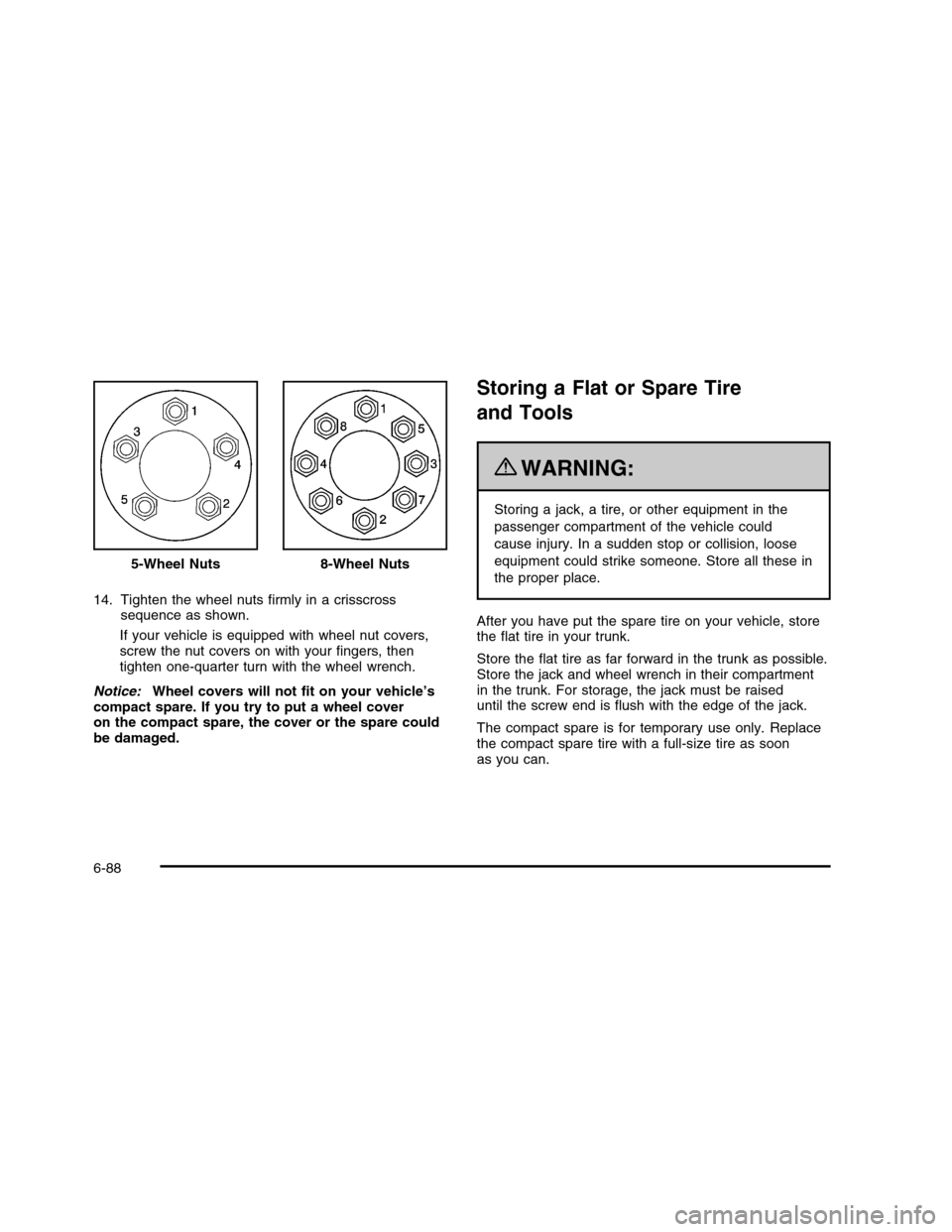
14. Tighten the wheel nuts firmly in a crisscrosssequence as shown.
If your vehicle is equipped with wheel nut covers,screw the nut covers on with your fingers, thentighten one-quarter turn with the wheel wrench.
Notice:Wheel covers will not fit on your vehicle’scompact spare. If you try to put a wheel coveron the compact spare, the cover or the spare couldbe damaged.
Storing a Flat or Spare Tire
and Tools
{WARNING:
Storing a jack, a tire, or other equipment in the
passenger compartment of the vehicle could
cause injury. In a sudden stop or collision, loose
equipment could strike someone. Store all these in
the proper place.
After you have put the spare tire on your vehicle, storethe flat tire in your trunk.
Store the flat tire as far forward in the trunk as possible.Store the jack and wheel wrench in their compartmentin the trunk. For storage, the jack must be raiseduntil the screw end is flush with the edge of the jack.
The compact spare is for temporary use only. Replacethe compact spare tire with a full-size tire as soonas you can.
5-Wheel Nuts8-Wheel Nuts
6-88
Page 410 of 480

Spare Tire
Compact Spare Tire
{WARNING:
Driving with more than one compact spare tire
at a time could result in loss of braking and
handling. This could lead to a crash and you or
others could be injured. Use only one compact
spare tire at a time.
This vehicle may have a compact spare tire. Although thecompact spare tire was fully inflated when the vehiclewas new, it can lose air after a time. Check the inflationpressure regularly. It should be 60 psi (420 kPa).
After installing the compact spare on the vehicle, stopas soon as possible and make sure the spare tireis correctly inflated. The compact spare is made toperform well at speeds up to 65 mph (105 km/h)for distances up to 3,000 miles (5 000 km), so you canfinish your trip and have the full-size tire repaired orreplaced at your convenience. Of course, it is bestto replace the spare with a full-size tire as soon aspossible. The spare tire will last longer and be in goodshape in case it is needed again.
Notice:When the compact spare is installed, donot take the vehicle through an automatic car washwith guide rails. The compact spare can getcaught on the rails which can damage the tire,wheel and other parts of the vehicle.
Do not use the compact spare on other vehicles.
And do not mix the compact spare tire or wheel withother wheels or tires. They will not fit. Keep thespare tire and its wheel together.
Notice:Tire chains will not fit the compact spare.Using them can damage the vehicle and can damagethe chains too. Do not use tire chains on thecompact spare.
6-90
Page 411 of 480

Spare Tire
This vehicle may have a spare tire, which, when new,was fully inflated. A spare tire may lose air over time, socheck its inflation pressure regularly. SeeInflation - TirePressure on page 6-54andLoading the Vehicle onpage 5-18for information regarding proper tire inflationand loading your vehicle. For instructions on how toremove, install or store a spare tire, seeRemoving theFlat Tire and Installing the Spare Tire on page 6-83.
After installing the spare tire on your vehicle, you shouldstop as soon as possible and make sure the spare iscorrectly inflated. Have the damaged or flat roadtire repaired or replaced as soon as you can andinstalled back onto your vehicle. This way, a spare tirewill be available in case you need it again.
Your vehicle may have a different size spare tire thanthe road tire originally installed on your vehicle.This spare tire was developed for use on your vehicle,so it is all right to drive on it.
If your vehicle has a spare tire that does not match yourvehicle’s original road tires and wheels in size andtype, do not include the spare in the tire rotation.
Appearance Care
Interior Cleaning
The vehicle’s interior will continue to look its best if it iscleaned often. Although not always visible, dust anddirt can accumulate on the upholstery. Dirt can damagecarpet, fabric, leather, and plastic surfaces. Regularvacuuming is recommended to remove particles from theupholstery. It is important to keep the upholstery frombecoming and remaining heavily soiled. Soils should beremoved as quickly as possible. The vehicle’s interiormay experience extremes of heat that could causestains to set rapidly.
Lighter colored interiors may require more frequentcleaning. Use care because newspapers and garmentsthat transfer color to home furnishings may alsotransfer color to the vehicle’s interior.
When cleaning the vehicle’s interior, only use cleanersspecifically designed for the surfaces being cleaned.Permanent damage may result from using cleaners onsurfaces for which they were not intended. Use glasscleaner only on glass. Remove any accidental over-sprayfrom other surfaces immediately. To prevent over-spray,apply cleaner directly to the cleaning cloth.
6-91
Page 478 of 480
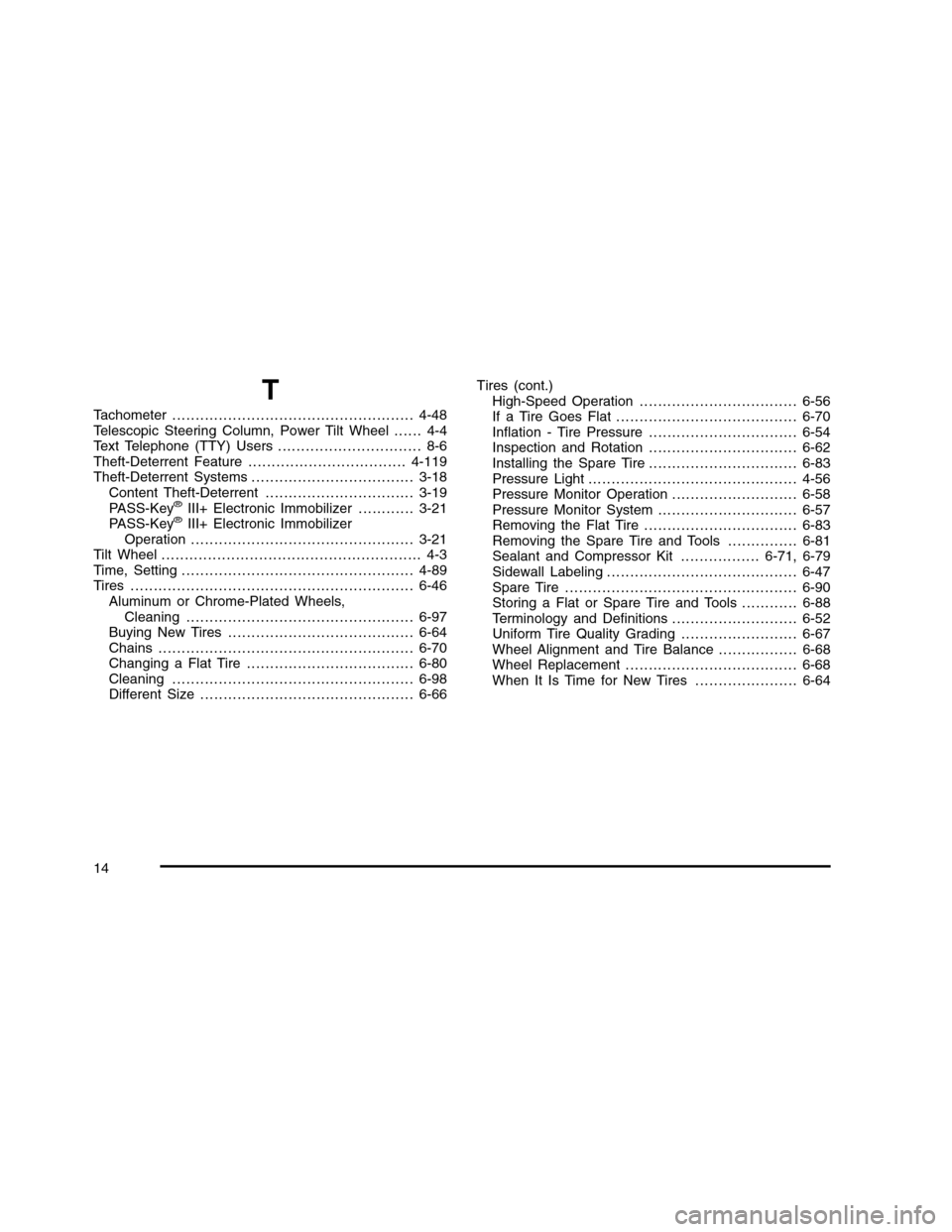
T
Tachometer . . . . . . . . . . . . . . . . . . . . . . . . . . . . . . . . . . . . . . . . . . . . . . . . . . . . 4-48Telescopic Steering Column, Power Tilt Wheel . . . . . . 4-4Text Telephone (TTY) Users . . . . . . . . . . . . . . . . . . . . . . . . . . . . . . . 8-6Theft-Deterrent Feature . . . . . . . . . . . . . . . . . . . . . . . . . . . . . . . . . . 4-119Theft-Deterrent Systems . . . . . . . . . . . . . . . . . . . . . . . . . . . . . . . . . . . 3-18Content Theft-Deterrent . . . . . . . . . . . . . . . . . . . . . . . . . . . . . . . . 3-19PASS-Key®III+ Electronic Immobilizer . . . . . . . . . . . . 3-21PASS-Key®III+ Electronic ImmobilizerOperation . . . . . . . . . . . . . . . . . . . . . . . . . . . . . . . . . . . . . . . . . . . . . . . . 3-21Tilt Wheel . . . . . . . . . . . . . . . . . . . . . . . . . . . . . . . . . . . . . . . . . . . . . . . . . . . . . . . . 4-3Time, Setting . . . . . . . . . . . . . . . . . . . . . . . . . . . . . . . . . . . . . . . . . . . . . . . . . . 4-89Tires . . . . . . . . . . . . . . . . . . . . . . . . . . . . . . . . . . . . . . . . . . . . . . . . . . . . . . . . . . . . . 6-46Aluminum or Chrome-Plated Wheels,Cleaning . . . . . . . . . . . . . . . . . . . . . . . . . . . . . . . . . . . . . . . . . . . . . . . . . 6-97Buying New Tires . . . . . . . . . . . . . . . . . . . . . . . . . . . . . . . . . . . . . . . . 6-64Chains . . . . . . . . . . . . . . . . . . . . . . . . . . . . . . . . . . . . . . . . . . . . . . . . . . . . . . . 6-70Changing a Flat Tire . . . . . . . . . . . . . . . . . . . . . . . . . . . . . . . . . . . . 6-80Cleaning . . . . . . . . . . . . . . . . . . . . . . . . . . . . . . . . . . . . . . . . . . . . . . . . . . . . 6-98Different Size . . . . . . . . . . . . . . . . . . . . . . . . . . . . . . . . . . . . . . . . . . . . . . 6-66
Tires (cont.)High-Speed Operation . . . . . . . . . . . . . . . . . . . . . . . . . . . . . . . . . . 6-56If a Tire Goes Flat . . . . . . . . . . . . . . . . . . . . . . . . . . . . . . . . . . . . . . . 6-70Inflation - Tire Pressure . . . . . . . . . . . . . . . . . . . . . . . . . . . . . . . . 6-54Inspection and Rotation . . . . . . . . . . . . . . . . . . . . . . . . . . . . . . . . 6-62Installing the Spare Tire . . . . . . . . . . . . . . . . . . . . . . . . . . . . . . . . 6-83Pressure Light . . . . . . . . . . . . . . . . . . . . . . . . . . . . . . . . . . . . . . . . . . . . . 4-56Pressure Monitor Operation . . . . . . . . . . . . . . . . . . . . . . . . . . . 6-58Pressure Monitor System . . . . . . . . . . . . . . . . . . . . . . . . . . . . . . 6-57Removing the Flat Tire . . . . . . . . . . . . . . . . . . . . . . . . . . . . . . . . . 6-83Removing the Spare Tire and Tools . . . . . . . . . . . . . . . 6-81Sealant and Compressor Kit . . . . . . . . . . . . . . . . . 6-71, 6-79Sidewall Labeling . . . . . . . . . . . . . . . . . . . . . . . . . . . . . . . . . . . . . . . . . 6-47Spare Tire . . . . . . . . . . . . . . . . . . . . . . . . . . . . . . . . . . . . . . . . . . . . . . . . . . 6-90Storing a Flat or Spare Tire and Tools . . . . . . . . . . . . 6-88Terminology and Definitions . . . . . . . . . . . . . . . . . . . . . . . . . . . 6-52Uniform Tire Quality Grading . . . . . . . . . . . . . . . . . . . . . . . . . 6-67Wheel Alignment and Tire Balance . . . . . . . . . . . . . . . . . 6-68Wheel Replacement . . . . . . . . . . . . . . . . . . . . . . . . . . . . . . . . . . . . . 6-68When It Is Time for New Tires . . . . . . . . . . . . . . . . . . . . . . 6-64
14