fuel cap CADILLAC DTS 2010 1.G Owners Manual
[x] Cancel search | Manufacturer: CADILLAC, Model Year: 2010, Model line: DTS, Model: CADILLAC DTS 2010 1.GPages: 480, PDF Size: 17.56 MB
Page 224 of 480

This light comes on during a malfunction in one oftwo ways:
Light Flashing:A misfire condition has been detected.A misfire increases vehicle emissions and coulddamage the emission control system on the vehicle.Diagnosis and service might be required.
To prevent more serious damage to the vehicle:
•Reduce vehicle speed.
•Avoid hard accelerations.
•Avoid steep uphill grades.
•If towing a trailer, reduce the amount of cargo being
hauled as soon as it is possible.
If the light continues to flash, when it is safe to do so, stopthe vehicle. Find a safe place to park the vehicle. Turn thekey off, wait at least 10 seconds, and restart the engine. Ifthe light is still flashing, follow the previous steps and seeyour dealer/retailer for service as soon as possible.
Light On Steady:An emission control systemmalfunction has been detected on the vehicle. Diagnosisand service might be required.
An emission system malfunction might be corrected bydoing the following:
•Make sure the fuel cap is fully installed. SeeFilling
the Tank on page 6-8. The diagnostic system candetermine if the fuel cap has been left off or
improperly installed. A loose or missing fuel capallows fuel to evaporate into the atmosphere. A fewdriving trips with the cap properly installed shouldturn the light off.
•If the vehicle has been driven through a deep
puddle of water, the vehicle’s electrical systemmight be wet. The condition is usually correctedwhen the electrical system dries out. A few drivingtrips should turn the light off.
•Make sure to fuel the vehicle with quality fuel.
Poor fuel quality causes the engine not to runas efficiently as designed and can cause: stallingafter start-up, stalling when the vehicle is changedinto gear, misfiring, hesitation on acceleration,or stumbling on acceleration. These conditionsmight go away once the engine is warmed up.
If one or more of these conditions occurs, changethe fuel brand used. It will require at least onefull tank of the proper fuel to turn the light off.
SeeGasoline Octane on page 6-5.
If none of the above have made the light turn off, yourdealer/retailer can check the vehicle. The dealer/retailerhas the proper test equipment and diagnostic tools tofix any mechanical or electrical problems that mighthave developed.
4-58
Page 227 of 480

Highbeam On Light
This light comes on whenthe high-beam headlampsare in use.
SeeHeadlamp High/Low-Beam Changer on page 4-6for more information.
Fuel Gage
The fuel gage showsapproximately how muchfuel is in the tank. Itworks only when theengine is on.
An arrow on the fuel gage indicates the side of thevehicle the fuel door is on.
If the fuel supply gets low, the FUEL LEVEL LOWmessage appears in the Driver Information Center anda single chime sounds. SeeDIC Warnings andMessages on page 4-67for more information.
Here are a few situations that may occur with the fuelgage. All of these situations are normal and do notindicate that anything is wrong with the fuel gage:
•At the gas station the gas pump shuts off before the
gage reads full.
•The gage may change when the vehicle is turning,
stops quickly or accelerates quickly.
•It takes a little more or less fuel to fill the tank than
the gage indicated. For example, the gage mayhave indicated that the tank was half full, butit actually took a little more or less than half thetank’s capacity to fill the tank.
Driver Information Center (DIC)
The Driver Information Center (DIC) gives you thestatus of many of your vehicle’s systems. The DIC isalso used to display warning/status messages. Allmessages will appear in the DIC display located at thebottom of the instrument panel cluster, below thetachometer and speedometer. The DIC buttons arelocated on the instrument panel, to the left of thesteering wheel.
4-61
Page 244 of 480

STABILITRAK NOT READY
If your vehicle has StabiliTrak, this message may displayand the Traction Control System and StabiliTrak WarningLight on the instrument panel cluster may be on after firstdriving the vehicle and exceeding 30 km/h (19 mph) for30 seconds. The StabiliTrak system is not functional untilthe light has turned off. SeeStabiliTrak®System onpage 5-5for more information.
STARTING DISABLED SERVICE
THROTTLE
This message displays when your vehicle’s throttlesystem is not functioning properly. Have your vehicleserviced by your dealer/retailer.
THEFT ATTEMPTED
This symbol appears withthis message.
This message displays if the content theft-deterrentsystem has detected a break-in attempt while you wereaway from your vehicle. SeeContent Theft-Deterrenton page 3-19for more information.
TIGHTEN GAS CAP
This message displays when the fuel cap has not beenfully tightened. Recheck the fuel cap to ensure that itis on and tightened properly.
TIRE LEARNING ACTIVE
This message displays when the Tire Pressure MonitorSystem (TPMS) is re-learning the tire positions on yourvehicle. The tire positions must be re-learned afterrotating the tires or after replacing a tire or sensor. SeeTire Inspection and Rotation on page 6-62,Tire PressureMonitor System on page 6-57, andInflation - TirePressure on page 6-54for more information.
TRACTION CONTROL OFF
This message displays when the Traction ControlSystem (TCS) is turned off. Adjust your drivingaccordingly. SeeTraction Control System (TCS) onpage 5-6for more information.
4-78
Page 310 of 480
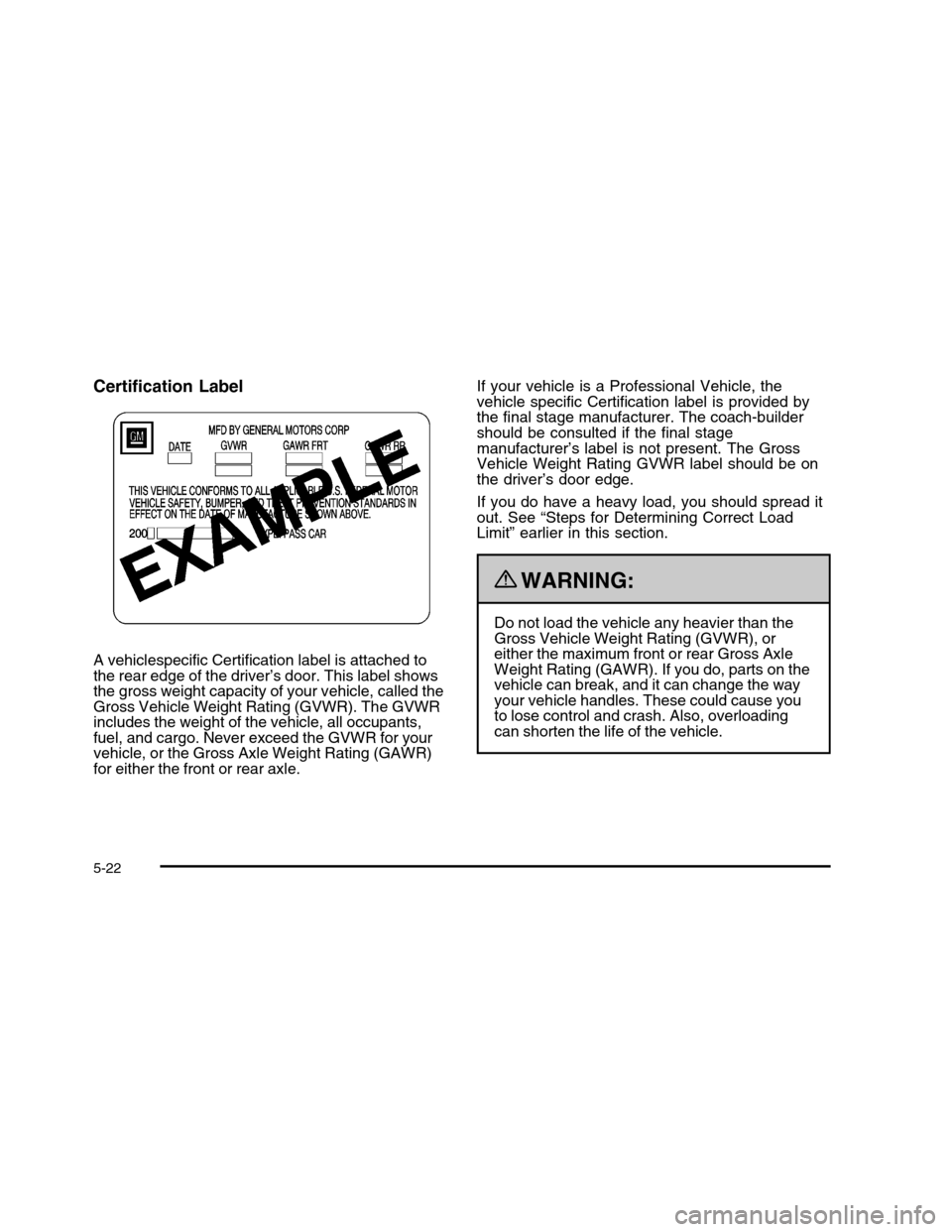
Certification Label
A vehiclespecific Certification label is attached tothe rear edge of the driver’s door. This label showsthe gross weight capacity of your vehicle, called theGross Vehicle Weight Rating (GVWR). The GVWRincludes the weight of the vehicle, all occupants,fuel, and cargo. Never exceed the GVWR for yourvehicle, or the Gross Axle Weight Rating (GAWR)for either the front or rear axle.
If your vehicle is a Professional Vehicle, thevehicle specific Certification label is provided bythe final stage manufacturer. The coach-buildershould be consulted if the final stagemanufacturer’s label is not present. The GrossVehicle Weight Rating GVWR label should be onthe driver’s door edge.
If you do have a heavy load, you should spread itout. See “Steps for Determining Correct LoadLimit” earlier in this section.
{WARNING:
Do not load the vehicle any heavier than theGross Vehicle Weight Rating (GVWR), oreither the maximum front or rear Gross AxleWeight Rating (GAWR). If you do, parts on thevehicle can break, and it can change the wayyour vehicle handles. These could cause youto lose control and crash. Also, overloadingcan shorten the life of the vehicle.
5-22
Page 314 of 480

Towing a Trailer
The Cadillac Professional Vehicle cannot tow a trailer.
{WARNING:
The driver can lose control when pulling a trailer if
the correct equipment is not used or the vehicle is
not driven properly. For example, if the trailer is
too heavy, the brakes may not work well — or
even at all. The driver and passengers could be
seriously injured. The vehicle may also be
damaged; the resulting repairs would not be
covered by the vehicle warranty. Pull a trailer only
if all the steps in this section have been followed.
Ask your dealer/retailer for advice and information
about towing a trailer with the vehicle.
Notice:Pulling a trailer improperly can damage thevehicle and result in costly repairs not coveredby the vehicle warranty. To pull a trailer correctly,follow the advice in this section and see yourdealer/retailer for important information abouttowing a trailer with the vehicle.
The vehicle can tow a trailer if it is equipped with theproper trailer towing equipment. To identify the traileringcapacity of the vehicle, read the information in “Weightof the Trailer” that appears later in this section. Traileringis different than just driving the vehicle by itself.Trailering means changes in handling, acceleration,braking, durability and fuel economy. Successful, safetrailering takes correct equipment, and it has to beused properly.
The following information has many time-tested,important trailering tips and safety rules. Many of theseare important for the safety of the driver and thepassengers. So please read this section carefully beforepulling a trailer.
Load-pulling components such as the engine,transmission, axles, wheel assemblies and tires areforced to work harder against the drag of the addedweight. The engine is required to operate at relativelyhigher speeds and under greater loads, generating extraheat. The trailer also adds considerably to windresistance, increasing the pulling requirements.
5-26
Page 328 of 480
Filling the Tank
{WARNING:
Fuel vapor burns violently and a fuel fire can
cause bad injuries. To help avoid injuries to you
and others, read and follow all the instructions on
the fuel pump island. Turn off the engine when
refueling. Do not smoke near fuel or when
refueling the vehicle. Do not use cellular phones.
Keep sparks, flames, and smoking materials away
from fuel. Do not leave the fuel pump unattended
when refueling the vehicle. This is against the law
in some places. Do not re-enter the vehicle while
pumping fuel. Keep children away from the fuel
pump; never let children pump fuel.
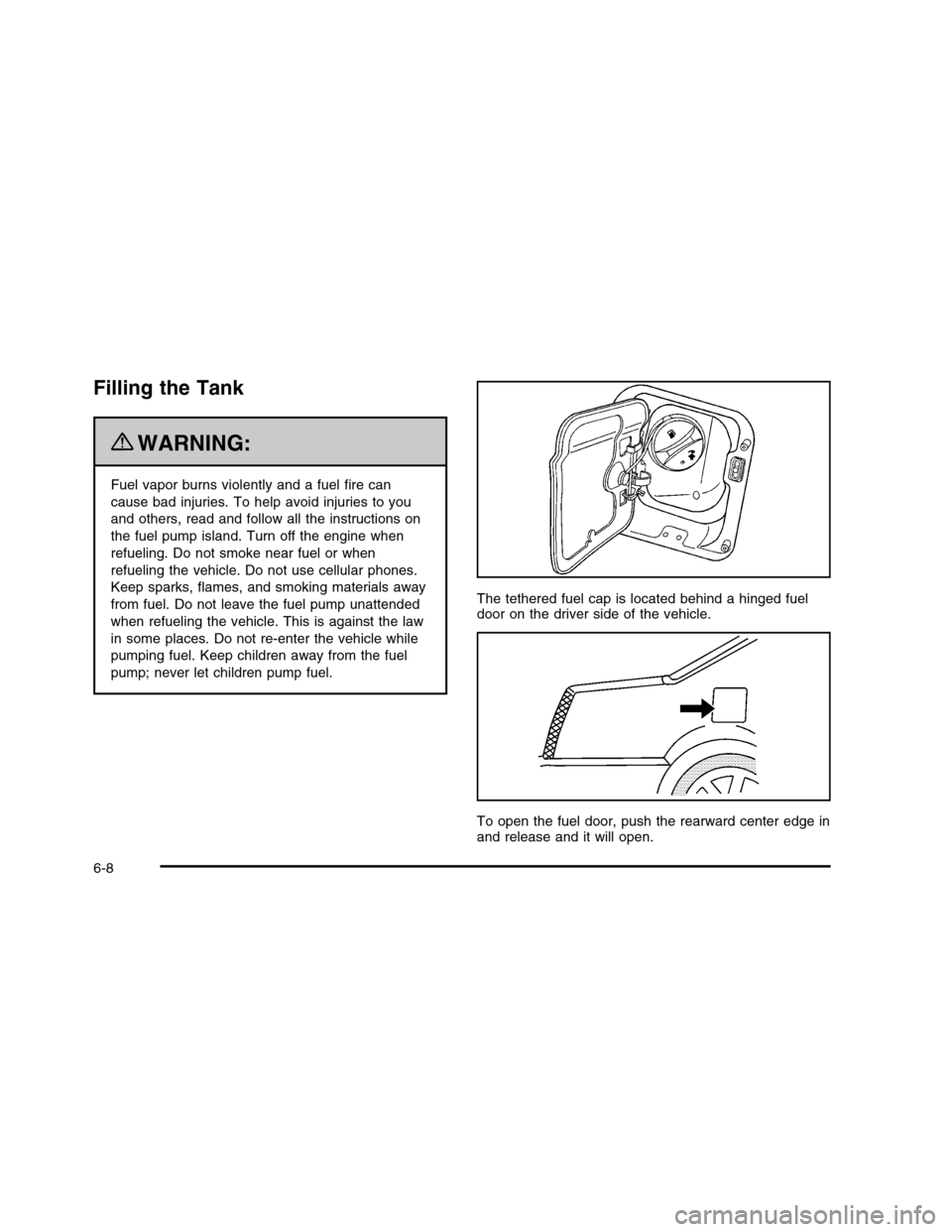
The tethered fuel cap is located behind a hinged fueldoor on the driver side of the vehicle.
To open the fuel door, push the rearward center edge inand release and it will open.
6-8
Page 329 of 480
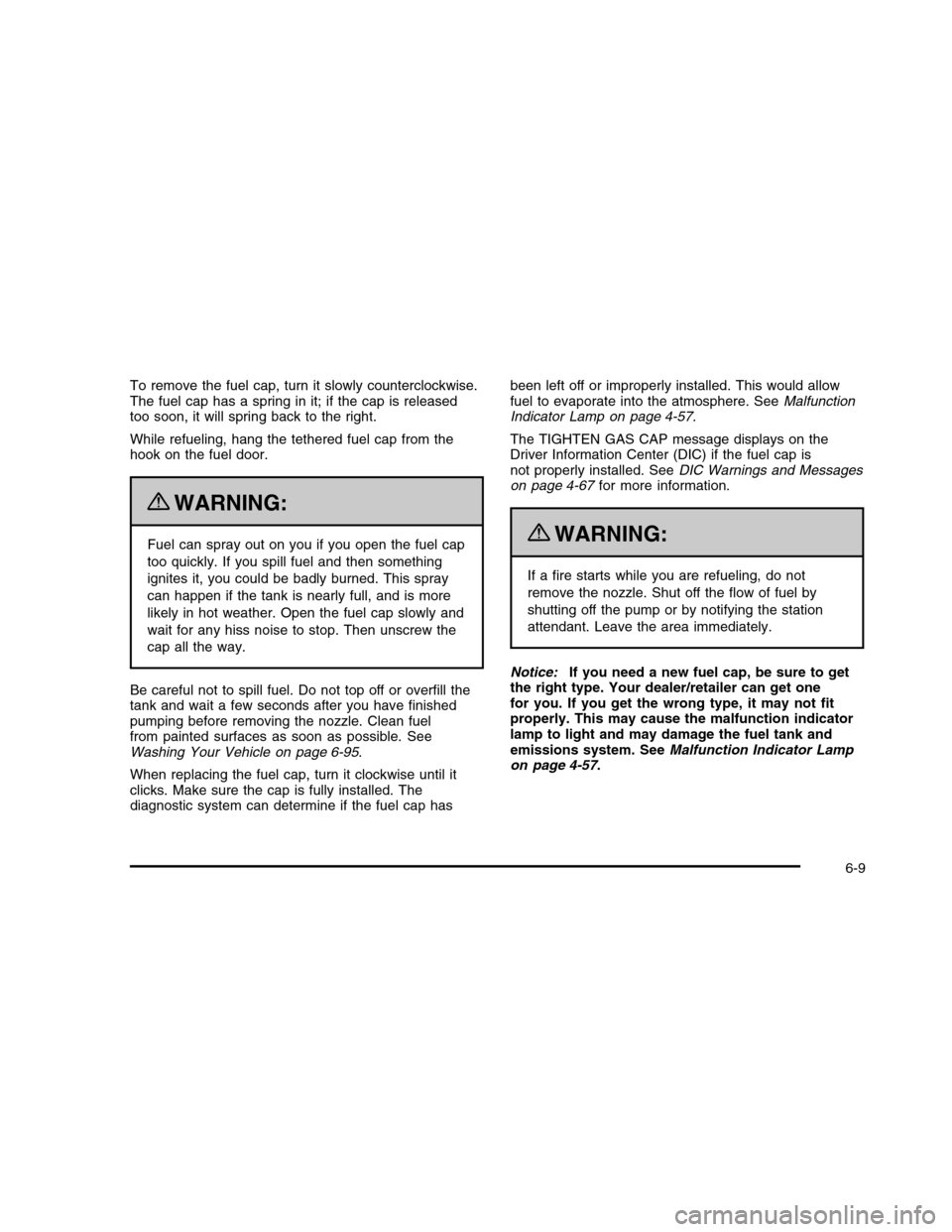
To remove the fuel cap, turn it slowly counterclockwise.The fuel cap has a spring in it; if the cap is releasedtoo soon, it will spring back to the right.
While refueling, hang the tethered fuel cap from thehook on the fuel door.
{WARNING:
Fuel can spray out on you if you open the fuel cap
too quickly. If you spill fuel and then something
ignites it, you could be badly burned. This spray
can happen if the tank is nearly full, and is more
likely in hot weather. Open the fuel cap slowly and
wait for any hiss noise to stop. Then unscrew the
cap all the way.
Be careful not to spill fuel. Do not top off or overfill thetank and wait a few seconds after you have finishedpumping before removing the nozzle. Clean fuelfrom painted surfaces as soon as possible. SeeWashing Your Vehicle on page 6-95.
When replacing the fuel cap, turn it clockwise until itclicks. Make sure the cap is fully installed. Thediagnostic system can determine if the fuel cap has
been left off or improperly installed. This would allowfuel to evaporate into the atmosphere. SeeMalfunctionIndicator Lamp on page 4-57.
The TIGHTEN GAS CAP message displays on theDriver Information Center (DIC) if the fuel cap isnot properly installed. SeeDIC Warnings and Messageson page 4-67for more information.
{WARNING:
If a fire starts while you are refueling, do not
remove the nozzle. Shut off the flow of fuel by
shutting off the pump or by notifying the station
attendant. Leave the area immediately.
Notice:If you need a new fuel cap, be sure to getthe right type. Your dealer/retailer can get onefor you. If you get the wrong type, it may not fitproperly. This may cause the malfunction indicatorlamp to light and may damage the fuel tank andemissions system. SeeMalfunction Indicator Lampon page 4-57.
6-9
Page 333 of 480

A.Underhood Fuse Block on page 6-101.
B. Remote Positive (+) Terminal. SeeJump Starting onpage 6-36.
C. Windshield Washer Fluid Reservoir. See “AddingWasher Fluid” underWindshield Washer Fluidon page 6-31.
D. Engine Coolant Surge Tank and Pressure Cap.SeeEngine Coolant on page 6-23.
E. Remote Negative (!) Terminal. SeeJump Startingon page 6-36.
F.Power Steering Fluid on page 6-30.
G. Engine Oil Fill Cap. See “When to Add Engine Oil”underEngine Oil on page 6-13.
H. Engine Oil Dipstick. See “Checking Engine Oil”underEngine Oil on page 6-13.
I. Brake Master Cylinder Reservoir. See “Brake Fluid”underBrakes on page 6-32.
J. Automatic Transmission Fluid Cap and Dipstick(Out of View). SeeAutomatic Transmission Fluid onpage 6-19.
K.Engine Air Cleaner/Filter on page 6-17.
Engine Oil
Checking Engine Oil
It is a good idea to check the engine oil level at eachfuel fill. In order to get an accurate reading, the oil mustbe warm and the vehicle must be on level ground.
The engine oil dipstick handle is a yellow loop. SeeEngine Compartment Overview on page 6-12forthe location of the engine oil dipstick.
1. Turn off the engine and give the oil several minutesto drain back into the oil pan. If this is not done, theoil dipstick might not show the actual level.
2. Pull out the dipstick and clean it with a paper towelor cloth, then push it back in all the way. Remove itagain, keeping the tip down, and check the level.
6-13
Page 372 of 480

Tire Terminology and Definitions
Air Pressure:The amount of air inside thetire pressing outward on each square inch of thetire. Air pressure is expressed in pounds persquare inch (psi) or kilopascal (kPa).
Accessory Weight:This means the combinedweight of optional accessories. Some examples ofoptional accessories are, automatic transmission,power steering, power brakes, power windows,power seats, and air conditioning.
Aspect Ratio:The relationship of a tire’s heightto its width.
Belt:A rubber coated layer of cords that is locatedbetween the plies and the tread. Cords may bemade from steel or other reinforcing materials.
Bead:The tire bead contains steel wires wrappedby steel cords that hold the tire onto the rim.
Bias Ply Tire:A pneumatic tire in which the pliesare laid at alternate angles less than 90 degreesto the centerline of the tread.
Cold Tire Pressure:The amount of air pressure ina tire, measured in pounds per square inch (psi) orkilopascals (kPa) before a tire has built up heatfrom driving. SeeInflation - Tire Pressure onpage 6-54.
Curb Weight:The weight of a motor vehicle withstandard and optional equipment including themaximum capacity of fuel, oil, and coolant,but without passengers and cargo.
DOT Markings:A code molded into the sidewallof a tire signifying that the tire is in compliancewith the U.S. Department of Transportation (DOT)motor vehicle safety standards. The DOT codeincludes the Tire Identification Number (TIN),an alphanumeric designator which can also identifythe tire manufacturer, production plant, brand,and date of production.
GVWR:Gross Vehicle Weight Rating. SeeLoading the Vehicle on page 5-18.
GAWR FRT:Gross Axle Weight Rating for thefront axle. SeeLoading the Vehicle on page 5-18.
GAWR RR:Gross Axle Weight Rating for therear axle. SeeLoading the Vehicle on page 5-18.
Intended Outboard Sidewall:The side of anasymmetrical tire, that must always face outwardwhen mounted on a vehicle.
Kilopascal (kPa):The metric unit for air pressure.
Light Truck (LT-Metric) Tire:A tire used onlight duty trucks and some multipurpose passengervehicles.
6-52
Page 374 of 480

Treadwear Indicators:Narrow bands, sometimescalled wear bars, that show across the tread ofa tire when only 1/16 inch (1.6 mm) of treadremains. SeeWhen It Is Time for New Tires onpage 6-64.
UTQGS (Uniform Tire Quality GradingStandards):A tire information system thatprovides consumers with ratings for a tire’straction, temperature, and treadwear. Ratings aredetermined by tire manufacturers usinggovernment testing procedures. The ratings aremolded into the sidewall of the tire. SeeUniformTire Quality Grading on page 6-67.
Vehicle Capacity Weight:The number ofdesignated seating positions multiplied by 150 lbs(68 kg) plus the rated cargo load. SeeLoadingthe Vehicle on page 5-18.
Vehicle Maximum Load on the Tire:Load on anindividual tire due to curb weight, accessoryweight, occupant weight, and cargo weight.
Vehicle Placard:A label permanently attached toa vehicle showing the vehicle’s capacity weightand the original equipment tire size andrecommended inflation pressure. See “Tire andLoading Information Label” underLoadingthe Vehicle on page 5-18.
Inflation - Tire Pressure
Tires need the correct amount of air pressure tooperate effectively.
Notice:Do not let anyone tell you thatunder-inflation or over-inflation is all right. It isnot. If your tires do not have enough air(under-inflation), you can get the following:
•Too much flexing
•Too much heat
•Tire overloading
•Premature or irregular wear
•Poor handling
•Reduced fuel economy
If your tires have too much air (over-inflation),you can get the following:
•Unusual wear
•Poor handling
•Rough ride
•Needless damage from road hazards
6-54