light CADILLAC DTS 2011 1.G User Guide
[x] Cancel search | Manufacturer: CADILLAC, Model Year: 2011, Model line: DTS, Model: CADILLAC DTS 2011 1.GPages: 470, PDF Size: 4.72 MB
Page 42 of 470
Black plate (10,1)Cadillac DTS Owner Manual - 2011
Rear Seats
Heated Seats
{WARNING:
If you cannot feel temperature change or pain to
the skin, the seat heater may cause burns even at
low temperatures. See the Warning underHeated
and Ventilated Seats on page 2‑5.
Your vehicle may have heated rear seats.
To operate the rear heated seats, the ignition must
be on.
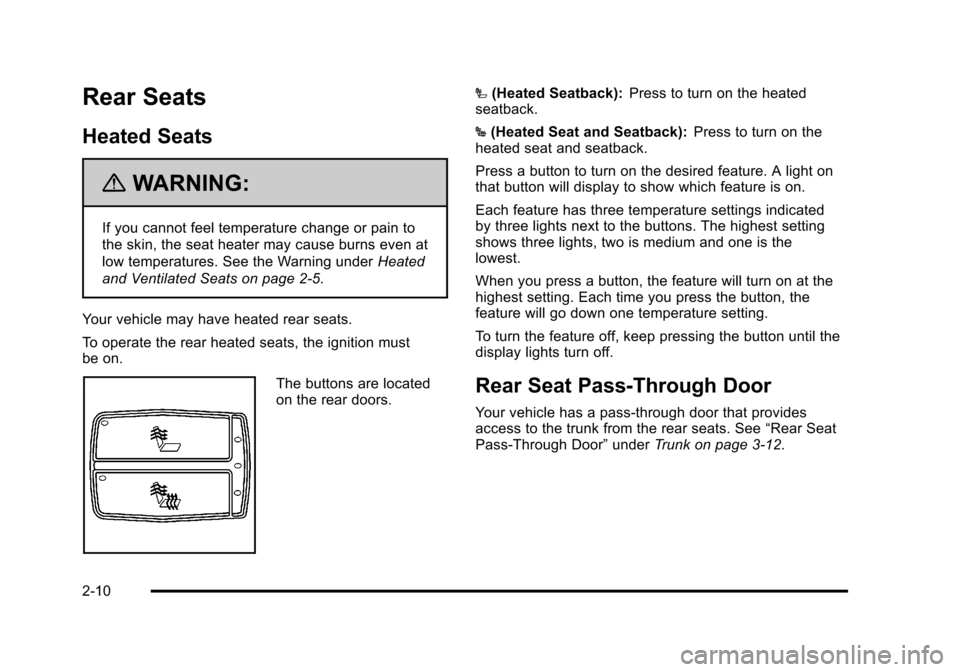
The buttons are located
on the rear doors. I
(Heated Seatback): Press to turn on the heated
seatback.
J (Heated Seat and Seatback): Press to turn on the
heated seat and seatback.
Press a button to turn on the desired feature. A light on
that button will display to show which feature is on.
Each feature has three temperature settings indicated
by three lights next to the buttons. The highest setting
shows three lights, two is medium and one is the
lowest.
When you press a button, the feature will turn on at the
highest setting. Each time you press the button, the
feature will go down one temperature setting.
To turn the feature off, keep pressing the button until the
display lights turn off.Rear Seat Pass-Through Door
Your vehicle has a pass‐through door that provides
access to the trunk from the rear seats. See “Rear Seat
Pass‐Through Door” underTrunk on page 3‑12.
2-10
Page 56 of 470
Black plate (24,1)Cadillac DTS Owner Manual - 2011
Lap-Shoulder Belt
All seating positions in the vehicle have a lap-shoulder
except for the center front passenger position
(if equipped), which has a lap belt. SeeLap Belt
on
page 2‑29for more information.
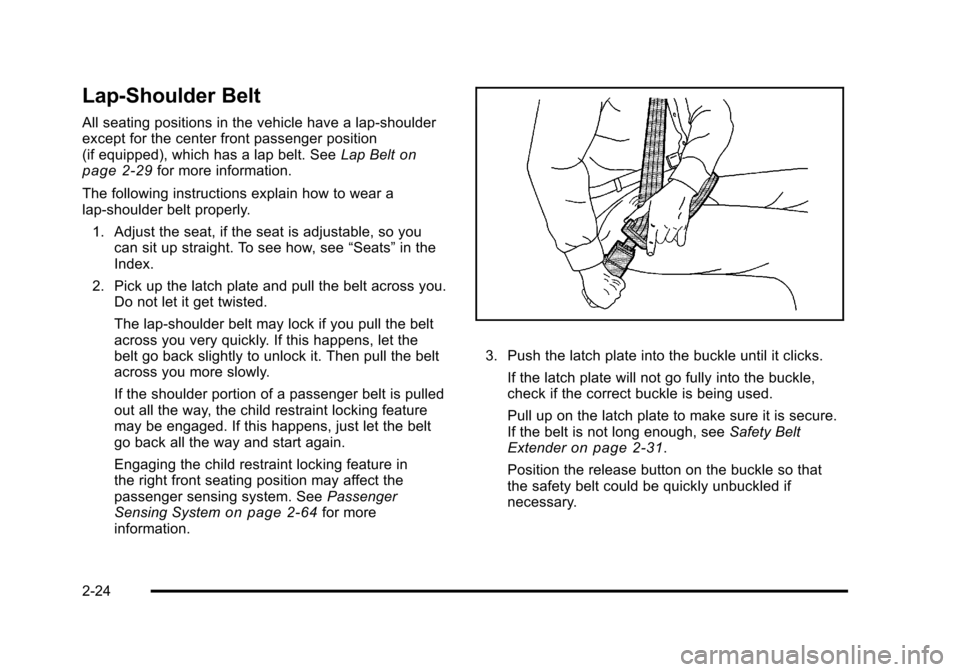
The following instructions explain how to wear a
lap-shoulder belt properly. 1. Adjust the seat, if the seat is adjustable, so you can sit up straight. To see how, see “Seats”in the
Index.
2. Pick up the latch plate and pull the belt across you. Do not let it get twisted.
The lap-shoulder belt may lock if you pull the belt
across you very quickly. If this happens, let the
belt go back slightly to unlock it. Then pull the belt
across you more slowly.
If the shoulder portion of a passenger belt is pulled
out all the way, the child restraint locking feature
may be engaged. If this happens, just let the belt
go back all the way and start again.
Engaging the child restraint locking feature in
the right front seating position may affect the
passenger sensing system. See Passenger
Sensing System
on page 2‑64for more
information.
3. Push the latch plate into the buckle until it clicks.
If the latch plate will not go fully into the buckle,
check if the correct buckle is being used.
Pull up on the latch plate to make sure it is secure.
If the belt is not long enough, see Safety Belt
Extender
on page 2‑31.
Position the release button on the buckle so that
the safety belt could be quickly unbuckled if
necessary.
2-24
Page 83 of 470
Black plate (51,1)Cadillac DTS Owner Manual - 2011
WARNING: (Continued)
Even if the passenger sensing system has turned
off the right front passenger frontal airbag, no
system is fail-safe. No one can guarantee that
an airbag will not deploy under some unusual
circumstance, even though it is turned off.
Secure rear-facing child restraints in a rear
seat, even if the airbag is off. If you secure a
forward-facing child restraint in the right front seat,
always move the front passenger seat as far back
as it will go. It is better to secure the child restraint
in a rear seat.
SeePassenger Sensing System
on page 2‑64
for additional information.
If the child restraint has the LATCH system, see
Lower Anchors and Tethers for Children (LATCH)
on
page 2‑41for how and where to install the child
restraint using LATCH. If a child restraint is secured
using a safety belt and it uses a top tether, see Lower
Anchors and Tethers for Children (LATCH)
on
page 2‑41for top tether anchor locations. Do not secure a child seat in a position without a top
tether anchor if a national or local law requires that the
top tether be anchored, or if the instructions that come
with the child restraint say that the top strap must be
anchored.
In Canada, the law requires that forward-facing child
restraints have a top tether, and that the tether be
attached.
You will be using the lap-shoulder belt to secure the
child restraint in this position. Follow the instructions
that came with the child restraint.
1. Move the seat as far back as it will go before securing the forward-facing child restraint.
When the passenger sensing system has turned
off the right front passenger frontal airbag and
seat-mounted side impact airbag, the off indicator
on the passenger airbag status indicator should
light and stay lit when you start the vehicle. See
Passenger Airbag Status Indicator on page 4‑48.
2. Put the child restraint on the seat.
3. Pick up the latch plate, and run the lap and shoulder portions of the vehicle's safety belt
through or around the restraint. The child restraint
instructions will show you how.
2-51
Page 88 of 470
Black plate (56,1)Cadillac DTS Owner Manual - 2011
{WARNING:
Children who are up against, or very close to, any
airbag when it inflates can be seriously injured
or killed. Airbags plus lap-shoulder belts offer
protection for adults and older children, but not for
young children and infants. Neither the vehicle's
safety belt system nor its airbag system is
designed for them. Young children and infants
need the protection that a child restraint system
can provide. Always secure children properly in
your vehicle. To read how, seeOlder Children
on
page 2‑31
or Infants and Young Childrenon
page 2‑34
.
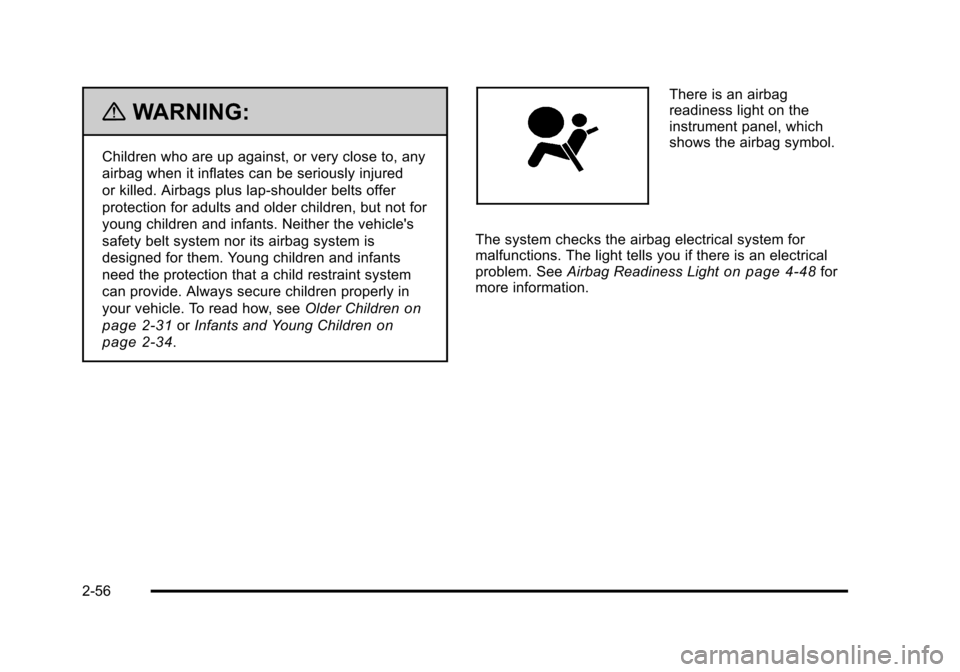
There is an airbag
readiness light on the
instrument panel, which
shows the airbag symbol.
The system checks the airbag electrical system for
malfunctions. The light tells you if there is an electrical
problem. See Airbag Readiness Light
on page 4‑48for
more information.
2-56
Page 97 of 470
Black plate (65,1)Cadillac DTS Owner Manual - 2011
WARNING: (Continued)
forward-facing child restraint can be seriously
injured or killed if the right front passenger airbag
inflates and the passenger seat is in a forward
position.
Even if the passenger sensing system has turned
off the right front passenger frontal airbag and
seat-mounted side impact airbag (if equipped),
no system is fail-safe. No one can guarantee that
an airbag will not deploy under some unusual
circumstance, even though the airbag(s) are off.
Secure rear-facing child restraints in a rear seat,
even if the airbag(s) are off. If you secure a
forward-facing child restraint in the right front seat,
always move the front passenger seat as far back
as it will go. It is better to secure the child restraint
in a rear seat.
The passenger sensing system is designed to turn off
the right front passenger airbag and seat‐mounted side
impact airbag if:
.The right front passenger seat is unoccupied.
.The system determines that an infant is present in
a rear-facing infant seat.
.The system determines that a small child is
present in a child restraint.
.The system determines that a small child is
present in a booster seat.
.A right front passenger takes his/her weight off of
the seat for a period of time.
.The right front passenger seat is occupied by a
smaller person, such as a child who has outgrown
child restraints.
.Or, if there is a critical problem with the airbag
system or the passenger sensing system.
When the passenger sensing system has turned off the
right front passenger frontal airbag and seat‐mounted
side impact airbag, the off indicator will light and stay lit
to remind you that the airbags are off. See Passenger
Airbag Status Indicator on page 4‑48.
The passenger sensing system is designed to turn on
(may inflate) the right front passenger frontal airbag and
seat‐mounted side impact airbag anytime the system
senses that a person of adult size is sitting properly in
the right front passenger seat.
When the passenger sensing system has allowed the
airbags to be enabled, the on indicator will light and
stay lit to remind you that the airbags are active.
2-65
Page 98 of 470
Black plate (66,1)Cadillac DTS Owner Manual - 2011
For some children who have outgrown child restraints
and for very small adults, the passenger sensing
system may or may not turn off the right front passenger
frontal airbag and seat-mounted side impact airbag,
depending upon the person’s seating posture and body
build. Everyone in the vehicle who has outgrown child
restraints should wear a safety belt properly—whether
or not there is an airbag for that person.
{WARNING:
If the airbag readiness light ever comes on and
stays on, it means that something may be wrong
with the airbag system. To help avoid injury to
yourself or others, have the vehicle serviced right
away. See Airbag Readiness Light
on page 4‑48
for more information, including important safety
information.
If the On Indicator is Lit for a Child
Restraint
If a child restraint has been installed and the on
indicator is lit:
1. Turn the vehicle off.
2. Remove the child restraint from the vehicle. 3. Remove any additional items from the seat such
as blankets, cushions, seat covers, seat heaters,
or seat massagers.
4. Reinstall the child restraint following the directions provided by the child restraint manufacturer and
refer to Securing a Child Restraint in the Right
Front Seat Position on page 2‑50.
5. If, after reinstalling the child restraint and restarting the vehicle, the on indicator is still lit, turn the
vehicle off. Then slightly recline the vehicle
seatback and adjust the seat cushion, if adjustable,
to make sure that the vehicle seatback is not
pushing the child restraint into the seat cushion.
Also make sure the child restraint is not trapped
under the vehicle head restraint. If this happens,
adjust the head restraint. See Head Restraints
on
page 2‑2.
6. Restart the vehicle. If the on indicator is still lit, secure the child in the
child restraint in a rear seat position in the vehicle,
and check with your dealer.
2-66
Page 102 of 470
Black plate (70,1)Cadillac DTS Owner Manual - 2011
Restraint System Check
Checking the Restraint Systems
Safety Belts
Now and then, check that the safety belt reminder light,
safety belts, buckles, latch plates, retractors, and
anchorages are all working properly.
Look for any other loose or damaged safety belt system
parts that might keep a safety belt system from doing its
job. See your dealer to have it repaired. Torn or frayed
safety belts may not protect you in a crash. They can rip
apart under impact forces. If a belt is torn or frayed, get
a new one right away.
Make sure the safety belt reminder light is working.
SeeSafety Belt Reminders
on page 4‑47for more
information.
Keep safety belts clean and dry. See Care of Safety
Belts
on page 6‑97.
Airbags
The airbag system does not need regularly scheduled
maintenance or replacement. Make sure the airbag
readiness light is working. See Airbag Readiness Light
on page 4‑48for more information.
Notice: If an airbag covering is damaged, opened,
or broken, the airbag may not work properly. Do not
open or break the airbag coverings. If there are any
opened or broken airbag covers, have the airbag
covering and/or airbag module replaced. For the
location of the airbag modules, see What Makes an
Airbag Inflate?
on page 2‑61. See your dealer for
service.
2-70
Page 103 of 470
Black plate (71,1)Cadillac DTS Owner Manual - 2011
Replacing Restraint System Parts
After a Crash
{WARNING:
A crash can damage the restraint systems in your
vehicle. A damaged restraint system may not
properly protect the person using it, resulting in
serious injury or even death in a crash. To help
make sure your restraint systems are working
properly after a crash, have them inspected and
any necessary replacements made as soon as
possible.
If the vehicle has been in a crash, do you need new
safety belts or LATCH system (if equipped) parts?
After a very minor crash, nothing may be necessary. But
the safety belt assemblies that were used during any
crash may have been stressed or damaged. See your
dealer to have the safety belt assemblies inspected or
replaced. If the vehicle has the LATCH system and it was being
used during a crash, you may need new LATCH system
parts.
New parts and repairs may be necessary even if the
safety belt or LATCH system (if equipped), was not
being used at the time of the crash.
If an airbag inflates, you will need to replace airbag
system parts. See the part on the airbag system earlier
in this section.
Have the safety belt pretensioners checked if the
vehicle has been in a crash, if the airbag readiness light
stays on after the vehicle is started, or while you are
driving. See
Airbag Readiness Light
on page 4‑48.
2-71
Page 111 of 470

Black plate (7,1)Cadillac DTS Owner Manual - 2011
Remote Vehicle Start
The remote vehicle starting feature allows you to start
the engine from outside of the vehicle. It also starts up
the vehicle's automatic climate control system. When
the remote start system is active, the climate control
system will heat and cool the inside of the vehicle
according to the previous settings of the system before
turning the vehicle off. The rear window defogger will
be turned on by the climate control system when it is
cold outside. If the vehicle has heated seats, they
will also turn on when it is cold outside. SeeHeated
and Ventilated Seats
on page 2‑5for additional
information. Cooled seats are not activated during a
remote start. Normal operation of the climate control
system will return after the key is turned to ON/RUN.
See Dual Climate Control System on page 4‑34.
Laws in some communities may restrict the use of
remote starters. For example, some laws may require a
person using remote start to have the vehicle in view
when doing so. Check local regulations for any
requirements on remote starting of vehicles.
Do not use the remote start feature if your vehicle is low
on fuel. Your vehicle may run out of fuel.
If your vehicle has the remote start feature, the RKE
transmitter functions will have an increased range of
operation. However, the range may be less while the
vehicle is running. There are other conditions which can affect the
performance of the transmitter, see
Remote Keyless
Entry (RKE) System Operation
on page 3‑4for
additional information.
/ (Remote Start): This button will be on the RKE
transmitter if you have remote start.
To start the vehicle using the remote start feature:
1. Aim the transmitter at the vehicle.
2. Press and release the transmitter's lock button, then immediately press and hold the transmitter's
remote start button until the turn signal lights
flash or if the vehicle's lights are not visible, press
and hold the remote start button for at least
four seconds. Pressing the remote start button
again after the vehicle has started will turn off the
ignition.
When the vehicle starts, the parking lamps will turn
on and remain on while the vehicle is running. The
vehicle's doors will be locked.
3. If it is the first remote start since the vehicle has been driven, repeat these steps, while the engine
is still running, to extend the engine running time
by 10 minutes. Remote start can be extended
one time.
After entering the vehicle during a remote start, insert
and turn the key to ON/RUN to drive the vehicle.
3-7
Page 117 of 470
Black plate (13,1)Cadillac DTS Owner Manual - 2011
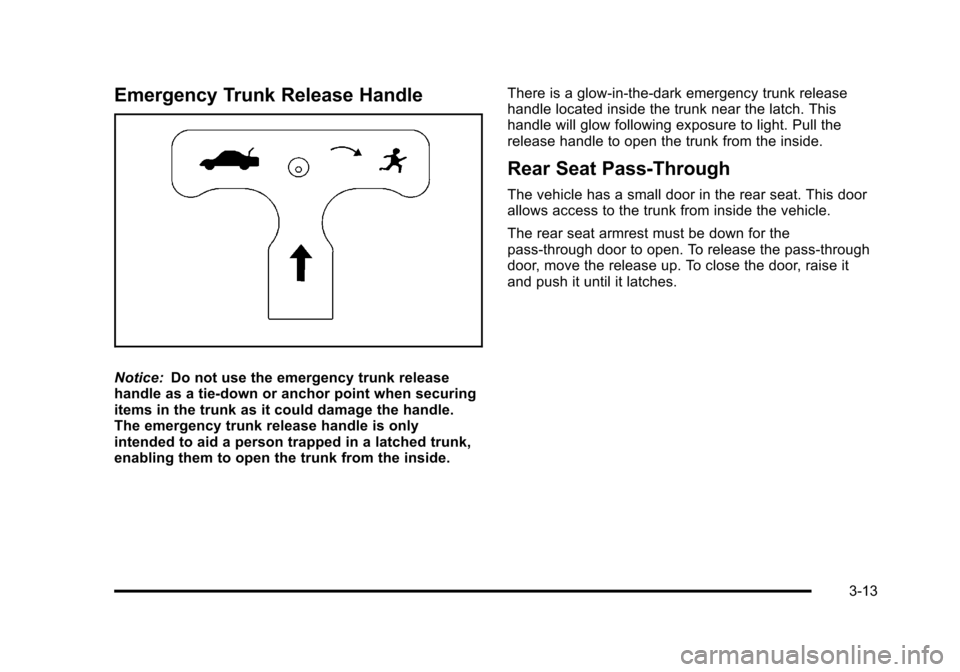
Emergency Trunk Release Handle
Notice:Do not use the emergency trunk release
handle as a tie-down or anchor point when securing
items in the trunk as it could damage the handle.
The emergency trunk release handle is only
intended to aid a person trapped in a latched trunk,
enabling them to open the trunk from the inside. There is a glow-in-the-dark emergency trunk release
handle located inside the trunk near the latch. This
handle will glow following exposure to light. Pull the
release handle to open the trunk from the inside.
Rear Seat Pass‐Through
The vehicle has a small door in the rear seat. This door
allows access to the trunk from inside the vehicle.
The rear seat armrest must be down for the
pass-through door to open. To release the pass-through
door, move the release up. To close the door, raise it
and push it until it latches.
3-13