seats CADILLAC DTS 2011 1.G User Guide
[x] Cancel search | Manufacturer: CADILLAC, Model Year: 2011, Model line: DTS, Model: CADILLAC DTS 2011 1.GPages: 470, PDF Size: 4.72 MB
Page 40 of 470

Black plate (8,1)Cadillac DTS Owner Manual - 2011
Power Reclining Seatbacks
{WARNING:
You can lose control of the vehicle if you try to
adjust the seat while the vehicle is moving. The
sudden movement could startle and confuse you,
or make you push a pedal when you do not want
to. Adjust the driver seat only when the vehicle is
not moving.
The seats have power
reclining seatbacks. Use
the vertical power seat
control located on the
outboard side of the seat.
.Press the control toward the rear of the vehicle to
recline the seatback.
.Press the control toward the front of the vehicle to
raise the seatback.
{WARNING:
Sitting in a reclined position when the vehicle is in
motion can be dangerous. Even when buckled up,
the safety belts cannot do their job when reclined
like this.
The shoulder belt cannot do its job because it will
not be against your body. Instead, it will be in front
of you. In a crash, you could go into it, receiving
neck or other injuries.
The lap belt cannot do its job either. In a crash,
the belt could go up over your abdomen. The belt
forces would be there, not at your pelvic bones.
This could cause serious internal injuries.
For proper protection when the vehicle is in
motion, have the seatback upright. Then sit well
back in the seat and wear the safety belt properly.
2-8
Page 42 of 470
Black plate (10,1)Cadillac DTS Owner Manual - 2011
Rear Seats
Heated Seats
{WARNING:
If you cannot feel temperature change or pain to
the skin, the seat heater may cause burns even at
low temperatures. See the Warning underHeated
and Ventilated Seats on page 2‑5.
Your vehicle may have heated rear seats.
To operate the rear heated seats, the ignition must
be on.
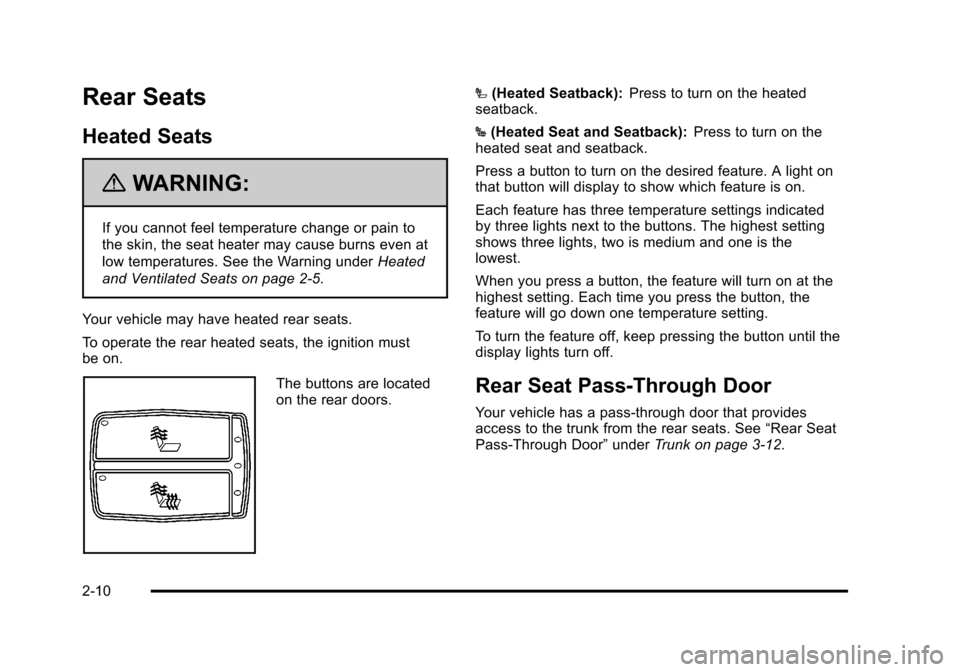
The buttons are located
on the rear doors. I
(Heated Seatback): Press to turn on the heated
seatback.
J (Heated Seat and Seatback): Press to turn on the
heated seat and seatback.
Press a button to turn on the desired feature. A light on
that button will display to show which feature is on.
Each feature has three temperature settings indicated
by three lights next to the buttons. The highest setting
shows three lights, two is medium and one is the
lowest.
When you press a button, the feature will turn on at the
highest setting. Each time you press the button, the
feature will go down one temperature setting.
To turn the feature off, keep pressing the button until the
display lights turn off.Rear Seat Pass-Through Door
Your vehicle has a pass‐through door that provides
access to the trunk from the rear seats. See “Rear Seat
Pass‐Through Door” underTrunk on page 3‑12.
2-10
Page 43 of 470
Black plate (11,1)Cadillac DTS Owner Manual - 2011
Safety Belts
Safety Belts: They Are for Everyone
This section of the manual describes how to use safety
belts properly. It also describes some things not to do
with safety belts.
{WARNING:
Do not let anyone ride where a safety belt cannot
be worn properly. In a crash, if you or your
passenger(s) are not wearing safety belts, the
injuries can be much worse. You can hit things
inside the vehicle harder or be ejected from the
vehicle. You and your passenger(s) can be
seriously injured or killed. In the same crash, you
might not be, if you are buckled up. Always fasten
your safety belt, and check that your passenger(s)
are restrained properly too.
{WARNING:
It is extremely dangerous to ride in a cargo
area, inside or outside of a vehicle. In a collision,
people riding in these areas are more likely to
be seriously injured or killed. Do not allow people
to ride in any area of your vehicle that is not
equipped with seats and safety belts. Be sure
everyone in your vehicle is in a seat and using a
safety belt properly.
This vehicle has indicators as a reminder to buckle the
safety belts. See Safety Belt Reminders
on page 4‑47for additional information.
In most states and in all Canadian provinces, the law
requires wearing safety belts. Here is why:
You never know if you will be in a crash. If you do have
a crash, you do not know if it will be a serious one.
A few crashes are mild, and some crashes can be
so serious that even buckled up, a person would not
survive. But most crashes are in between. In many of
them, people who buckle up can survive and sometimes
walk away. Without safety belts, they could have been
badly hurt or killed.
2-11
Page 56 of 470
Black plate (24,1)Cadillac DTS Owner Manual - 2011
Lap-Shoulder Belt
All seating positions in the vehicle have a lap-shoulder
except for the center front passenger position
(if equipped), which has a lap belt. SeeLap Belt
on
page 2‑29for more information.
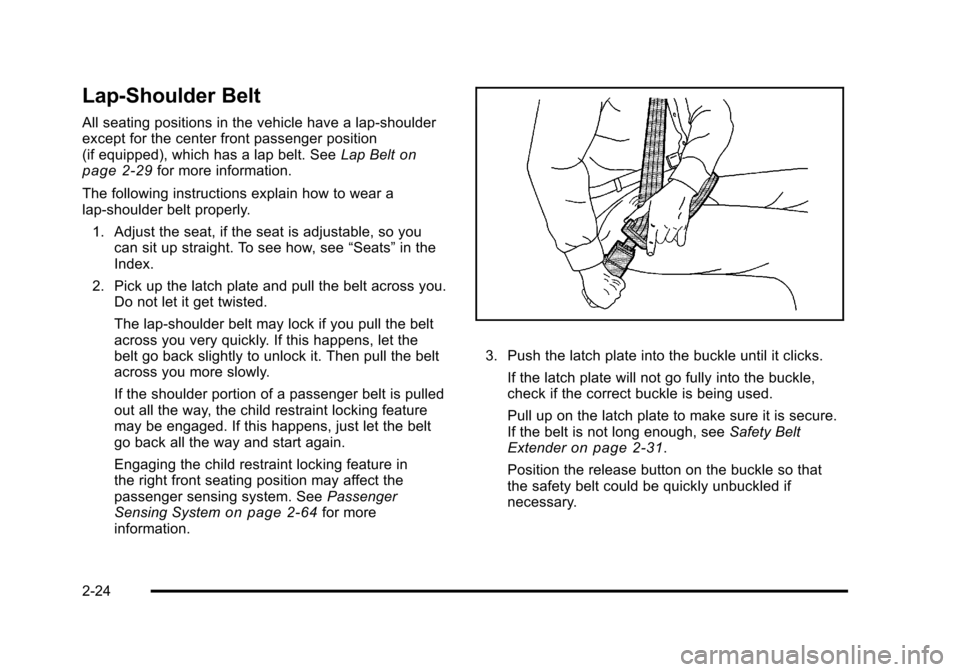
The following instructions explain how to wear a
lap-shoulder belt properly. 1. Adjust the seat, if the seat is adjustable, so you can sit up straight. To see how, see “Seats”in the
Index.
2. Pick up the latch plate and pull the belt across you. Do not let it get twisted.
The lap-shoulder belt may lock if you pull the belt
across you very quickly. If this happens, let the
belt go back slightly to unlock it. Then pull the belt
across you more slowly.
If the shoulder portion of a passenger belt is pulled
out all the way, the child restraint locking feature
may be engaged. If this happens, just let the belt
go back all the way and start again.
Engaging the child restraint locking feature in
the right front seating position may affect the
passenger sensing system. See Passenger
Sensing System
on page 2‑64for more
information.
3. Push the latch plate into the buckle until it clicks.
If the latch plate will not go fully into the buckle,
check if the correct buckle is being used.
Pull up on the latch plate to make sure it is secure.
If the belt is not long enough, see Safety Belt
Extender
on page 2‑31.
Position the release button on the buckle so that
the safety belt could be quickly unbuckled if
necessary.
2-24
Page 59 of 470
Black plate (27,1)Cadillac DTS Owner Manual - 2011
Rear Safety Belt Comfort Guides
This vehicle may have rear shoulder belt comfort guides
for each outside passenger position in the rear seat.
If not, they are available through your dealer. The
guides may provide added safety belt comfort for older
children who have outgrown booster seats and for some
adults. When installed the comfort guide positions the
shoulder belt away from the neck and head.
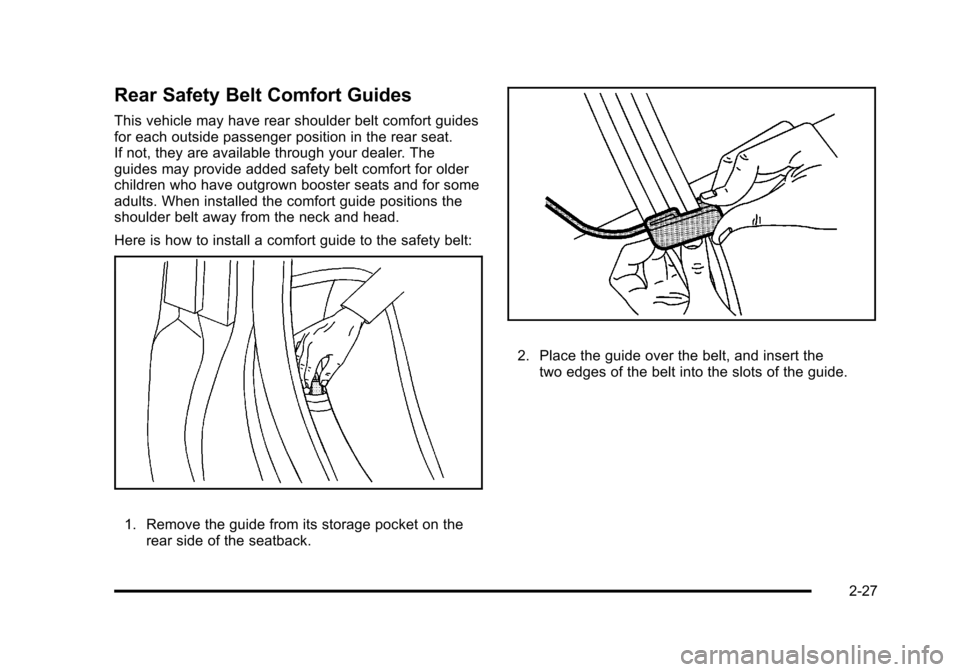
Here is how to install a comfort guide to the safety belt:
1. Remove the guide from its storage pocket on therear side of the seatback.
2. Place the guide over the belt, and insert thetwo edges of the belt into the slots of the guide.
2-27
Page 63 of 470
Black plate (31,1)Cadillac DTS Owner Manual - 2011
If you find that the latch plate will not go fully into the
buckle, see if you are using the correct buckle. Be sure
that the latch plate clicks when inserted into the buckle.
Safety Belt Extender
If the vehicle's safety belt will fasten around you, you
should use it.
But if a safety belt is not long enough, your dealer will
order you an extender. When you go in to order it, take
the heaviest coat you will wear, so the extender will be
long enough for you. To help avoid personal injury, do
not let someone else use it, and use it only for the seat
it is made to fit. The extender has been designed for
adults. Never use it for securing child seats. To wear it,
attach it to the regular safety belt. For more information,
see the instruction sheet that comes with the extender.
Child Restraints
Older Children
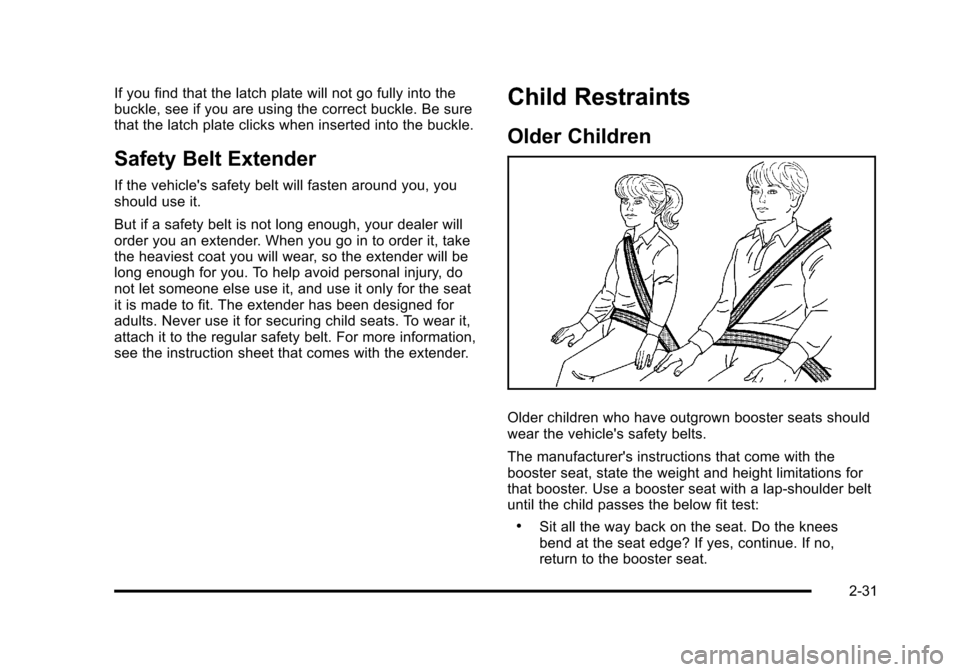
Older children who have outgrown booster seats should
wear the vehicle's safety belts.
The manufacturer's instructions that come with the
booster seat, state the weight and height limitations for
that booster. Use a booster seat with a lap-shoulder belt
until the child passes the below fit test:
.Sit all the way back on the seat. Do the knees
bend at the seat edge? If yes, continue. If no,
return to the booster seat.
2-31
Page 70 of 470
Black plate (38,1)Cadillac DTS Owner Manual - 2011
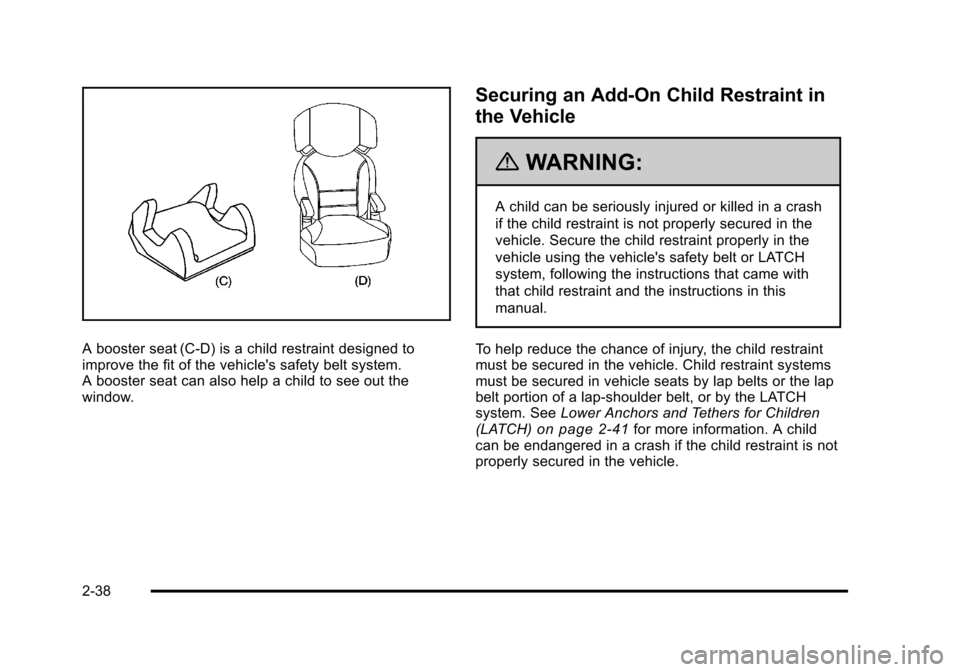
A booster seat (C-D) is a child restraint designed to
improve the fit of the vehicle's safety belt system.
A booster seat can also help a child to see out the
window.
Securing an Add-On Child Restraint in
the Vehicle
{WARNING:
A child can be seriously injured or killed in a crash
if the child restraint is not properly secured in the
vehicle. Secure the child restraint properly in the
vehicle using the vehicle's safety belt or LATCH
system, following the instructions that came with
that child restraint and the instructions in this
manual.
To help reduce the chance of injury, the child restraint
must be secured in the vehicle. Child restraint systems
must be secured in vehicle seats by lap belts or the lap
belt portion of a lap-shoulder belt, or by the LATCH
system. See Lower Anchors and Tethers for Children
(LATCH)
on page 2‑41for more information. A child
can be endangered in a crash if the child restraint is not
properly secured in the vehicle.
2-38
Page 73 of 470
Black plate (41,1)Cadillac DTS Owner Manual - 2011
Do not use child restraints in the center front seat
position.
When securing a child restraint in a rear seating
position, study the instructions that came with your child
restraint to make sure it is compatible with this vehicle.
Child restraints and booster seats vary considerably in
size, and some may fit in certain seating positions
better than others. Always make sure the child restraint
is properly secured.
Depending on where you place the child restraint and
the size of the child restraint, you may not be able to
access adjacent safety belt assemblies or LATCH
anchors for additional passengers or child restraints.
Adjacent seating positions should not be used if the
child restraint prevents access to or interferes with the
routing of the safety belt.
Wherever a child restraint is installed, be sure to secure
the child restraint properly.
Keep in mind that an unsecured child restraint can
move around in a collision or sudden stop and injure
people in the vehicle. Be sure to properly secure any
child restraint in your vehicle—even when no child is
in it.Lower Anchors and Tethers for
Children (LATCH)
The LATCH system holds a child restraint during
driving or in a crash. This system is designed to make
installation of a child restraint easier. The LATCH
system uses anchors in the vehicle and attachments on
the child restraint that are made for use with the LATCH
system.
Make sure that a LATCH-compatible child restraint
is properly installed using the anchors, or use the
vehicle's safety belts to secure the restraint, following
the instructions that came with that restraint, and also
the instructions in this manual. When installing a child
restraint with a top tether, you must also use either the
lower anchors or the safety belts to properly secure the
child restraint. A child restraint must never be installed
using only the top tether and anchor.
In order to use the LATCH system in your vehicle, you
need a child restraint that has LATCH attachments.
The child restraint manufacturer will provide you with
instructions on how to use the child restraint and its
attachments. The following explains how to attach a
child restraint with these attachments in your vehicle.
Not all vehicle seating positions or child restraints have
lower anchors and attachments or top tether anchors
and attachments.
2-41
Page 101 of 470

Black plate (69,1)Cadillac DTS Owner Manual - 2011
Adding Equipment to Your
Airbag-Equipped Vehicle
Q: Is there anything I might add to or change aboutthe vehicle that could keep the airbags from
working properly?
A: Yes. If you add things that change your vehicle's
frame, bumper system, height, front end or side
sheet metal, they may keep the airbag system from
working properly. Changing or moving any parts of
the front seats, safety belts, the airbag sensing and
diagnostic module, steering wheel, instrument panel,
roof-rail airbag modules, ceiling headliner or pillar
garnish trim, overhead console, front sensors, side
impact sensors, or airbag wiring can affect the
operation of the airbag system.
In addition, your vehicle has a passenger sensing
system for the right front passenger's position, which
includes sensors that are part of the passenger's
seat. The passenger sensing system may not
operate properly if the original seat trim is replaced
with non-GM covers, upholstery or trim, or with GM
covers, upholstery or trim designed for a different
vehicle. Any object, such as an aftermarket seat
heater or a comfort enhancing pad or device, installed under or on top of the seat fabric, could
also interfere with the operation of the passenger
sensing system. This could either prevent proper
deployment of the passenger airbag(s) or prevent
the passenger sensing system from properly turning
off the passenger airbag(s). See
Passenger Sensing
System on page 2‑64.
If you have any questions about this, you should
contact Customer Assistance before you modify
your vehicle. The phone numbers and addresses
for Customer Assistance are in Step Two of the
Customer Satisfaction Procedure in this manual.
See Customer Satisfaction Procedure on page 8‑2.
Q: Because I have a disability, I have to get my vehicle modified. How can I find out whether this
will affect my airbag system?
A: If you have questions, call Customer Assistance.
The phone numbers and addresses for Customer
Assistance are in Step Two of the Customer
Satisfaction Procedure in this manual. See
Customer Satisfaction Procedure on page 8‑2.
In addition, your dealer and the service manual have
information about the location of the airbag sensors,
sensing and diagnostic module and airbag wiring.
2-69
Page 111 of 470

Black plate (7,1)Cadillac DTS Owner Manual - 2011
Remote Vehicle Start
The remote vehicle starting feature allows you to start
the engine from outside of the vehicle. It also starts up
the vehicle's automatic climate control system. When
the remote start system is active, the climate control
system will heat and cool the inside of the vehicle
according to the previous settings of the system before
turning the vehicle off. The rear window defogger will
be turned on by the climate control system when it is
cold outside. If the vehicle has heated seats, they
will also turn on when it is cold outside. SeeHeated
and Ventilated Seats
on page 2‑5for additional
information. Cooled seats are not activated during a
remote start. Normal operation of the climate control
system will return after the key is turned to ON/RUN.
See Dual Climate Control System on page 4‑34.
Laws in some communities may restrict the use of
remote starters. For example, some laws may require a
person using remote start to have the vehicle in view
when doing so. Check local regulations for any
requirements on remote starting of vehicles.
Do not use the remote start feature if your vehicle is low
on fuel. Your vehicle may run out of fuel.
If your vehicle has the remote start feature, the RKE
transmitter functions will have an increased range of
operation. However, the range may be less while the
vehicle is running. There are other conditions which can affect the
performance of the transmitter, see
Remote Keyless
Entry (RKE) System Operation
on page 3‑4for
additional information.
/ (Remote Start): This button will be on the RKE
transmitter if you have remote start.
To start the vehicle using the remote start feature:
1. Aim the transmitter at the vehicle.
2. Press and release the transmitter's lock button, then immediately press and hold the transmitter's
remote start button until the turn signal lights
flash or if the vehicle's lights are not visible, press
and hold the remote start button for at least
four seconds. Pressing the remote start button
again after the vehicle has started will turn off the
ignition.
When the vehicle starts, the parking lamps will turn
on and remain on while the vehicle is running. The
vehicle's doors will be locked.
3. If it is the first remote start since the vehicle has been driven, repeat these steps, while the engine
is still running, to extend the engine running time
by 10 minutes. Remote start can be extended
one time.
After entering the vehicle during a remote start, insert
and turn the key to ON/RUN to drive the vehicle.
3-7