automatic transmission CADILLAC DTS 2011 1.G Owners Manual
[x] Cancel search | Manufacturer: CADILLAC, Model Year: 2011, Model line: DTS, Model: CADILLAC DTS 2011 1.GPages: 470, PDF Size: 4.72 MB
Page 9 of 470

Black plate (3,1)Cadillac DTS Owner Manual - 2011
A.Outlet Adjustment on page 4‑40.
B. Driver Information Center (DIC) Buttons. See Driver Information Center (DIC) on page 4‑59.
C. Exterior Lamps on page 4‑25.
D. Instrument Panel Cluster on page 4‑45.
E. Horn on page 4‑3.
F. Audio Steering Wheel Controls on page 4‑114.
G. Ultrasonic Front and Rear Parking Assist (UFRPA)
on page 3‑38.
Adaptive Cruise Control
on page 4‑14(If Equipped).
H. Analog Clock on page 4‑34.
I. Hazard Warning Flashers on page 4‑3.
J. Audio System(s) on page 4‑86.
K. Trunk Release Button. See Trunk on page 3‑12.
L. Instrument Panel Brightness on page 4‑30.
M. Lane Departure Warning (LDW) on page 3‑45.
N. Turn Signal/Multifunction Lever on page 4‑5.
Windshield Wipers on page 4‑10. O.
Hood Release on page 6‑13.
P. Parking Brake on page 3‑29.
Q. Data Link Connector (DLC). See Malfunction
Indicator Lamp on page 4‑54.
R. Heated Steering Wheel
on page 4‑4(If Equipped).
S. Cruise Control
on page 4‑12(If Equipped).
Adaptive Cruise Control
on page 4‑14(If Equipped).
T. Tilt Wheel
on page 4‑3.
Power Tilt Wheel and Telescopic Steering Column
on page 4‑4(If Equipped).
U. Dual Climate Control System on page 4‑34.
V. Traction Control System Button (Console-Shift Vehicles). See Traction Control System (TCS)
on
page 5‑6.
W. Shift Lever. See Automatic Transmission Operation
on page 3‑26.
X. Accessory Power Outlet(s) on page 4‑33.
Y. Glove Box
on page 3‑54.
Valet Lockout Switch on page 3‑18.
1-3
Page 105 of 470

Black plate (1,1)Cadillac DTS Owner Manual - 2011
Section 3 Features and Controls
Keys. . . . . . . . . . . . . . . . . . . . . . . . . . . . . . . . . . . . . . . . . . . . . . . . 3-3
Remote Keyless Entry (RKE) System . . . . . . . . . . . 3-4
Remote Keyless Entry (RKE) System Operation . . . . . . . . . . . . . . . . . . . . . . . . . . . . . . . . . . . . . 3-4
Remote Vehicle Start . . . . . . . . . . . . . . . . . . . . . . . . . . . 3-7
Doors and Locks . . . . . . . . . . . . . . . . . . . . . . . . . . . . . . . . . . 3-9
Door Locks . . . . . . . . . . . . . . . . . . . . . . . . . . . . . . . . . . . . . 3-9
Central Door Unlocking System . . . . . . . . . . . . . . . . 3-10
Power Door Locks . . . . . . . . . . . . . . . . . . . . . . . . . . . . . 3-10
Programmable Automatic Door Locks . . . . . . . . . . 3-10
Rear Door Security Locks . . . . . . . . . . . . . . . . . . . . . 3-10
Lockout Protection . . . . . . . . . . . . . . . . . . . . . . . . . . . . . 3-11
Trunk . . . . . . . . . . . . . . . . . . . . . . . . . . . . . . . . . . . . . . . . . . 3-12
Windows . . . . . . . . . . . . . . . . . . . . . . . . . . . . . . . . . . . . . . . . . . 3-14
Power Windows . . . . . . . . . . . . . . . . . . . . . . . . . . . . . . . 3-15
Sun Visors . . . . . . . . . . . . . . . . . . . . . . . . . . . . . . . . . . . . . 3-17
Theft-Deterrent Systems . . . . . . . . . . . . . . . . . . . . . . . . .3-18
Valet Lockout Switch . . . . . . . . . . . . . . . . . . . . . . . . . . . 3-18
Content Theft-Deterrent . . . . . . . . . . . . . . . . . . . . . . . . 3-19
PASS-Key
®III+ Electronic Immobilizer . . . . . . . . . 3-20
PASS-Key®III+ Electronic Immobilizer
Operation . . . . . . . . . . . . . . . . . . . . . . . . . . . . . . . . . . . . 3-20 Starting and Operating Your Vehicle
. . . . . . . . . . . .3-22
New Vehicle Break-In . . . . . . . . . . . . . . . . . . . . . . . . . . 3-22
Ignition Positions . . . . . . . . . . . . . . . . . . . . . . . . . . . . . . 3-22
Retained Accessory Power (RAP) . . . . . . . . . . . . . 3-24
Starting the Engine . . . . . . . . . . . . . . . . . . . . . . . . . . . . 3-24
Engine Coolant Heater . . . . . . . . . . . . . . . . . . . . . . . . . 3-25
Automatic Transmission Operation . . . . . . . . . . . . . 3-26
Performance Shifting . . . . . . . . . . . . . . . . . . . . . . . . . . 3-29
Parking Brake . . . . . . . . . . . . . . . . . . . . . . . . . . . . . . . . . 3-29
Shifting Into Park . . . . . . . . . . . . . . . . . . . . . . . . . . . . . . 3-30
Shifting Out of Park . . . . . . . . . . . . . . . . . . . . . . . . . . . . 3-32
Parking Over Things That Burn . . . . . . . . . . . . . . . . 3-33
Engine Exhaust . . . . . . . . . . . . . . . . . . . . . . . . . . . . . . . . 3-33
Running the Vehicle While Parked . . . . . . . . . . . . . 3-34
Mirrors . . . . . . . . . . . . . . . . . . . . . . . . . . . . . . . . . . . . . . . . . . . . 3-35
Automatic Dimming Rearview Mirror . . . . . . . . . . . 3-35
Compass . . . . . . . . . . . . . . . . . . . . . . . . . . . . . . . . . . . . . . 3-35
Outside Power Foldaway Mirrors . . . . . . . . . . . . . . 3-36
Outside Automatic Dimming Mirror . . . . . . . . . . . . . 3-37
Park Tilt Mirrors . . . . . . . . . . . . . . . . . . . . . . . . . . . . . . . . 3-37
Outside Convex Mirror . . . . . . . . . . . . . . . . . . . . . . . . . 3-38
Outside Heated Mirrors . . . . . . . . . . . . . . . . . . . . . . . . 3-38
3-1
Page 127 of 470

Black plate (23,1)Cadillac DTS Owner Manual - 2011
A (STOPPING THE ENGINE/LOCK/OFF):When the
vehicle is stopped, turn the ignition switch to LOCK/OFF
to turn the engine off. Retained Accessory Power (RAP)
will remain active. See Retained Accessory Power
(RAP) on page 3‑24.
This is the only position in which the ignition key can be
inserted or removed. This position locks the ignition and
transmission and steering column.
Do not turn the engine off when the vehicle is moving.
This will cause a loss of power assist in the brake and
steering systems and disable the airbags.
In an emergency:
1. Brake using a firm and steady pressure. Do not pump the brakes repeatedly. This may deplete
power assist, requiring increased brake pedal
force.
2. Shift the vehicle to neutral. This can be done while the vehicle is moving. After shifting to neutral,
firmly apply the brakes and steer the vehicle to a
safe location.
3. Come to a complete stop, shift to P (Park), and turn the ignition to LOCK/OFF. On vehicles with
an automatic transmission, the shift lever must
be in P (Park) to turn the ignition switch to the
LOCK/OFF position.
4. Set the parking brake. See Parking Brake
on
page 3‑29. The steering can bind with the wheels turned off center.
If this happens, move the steering wheel from right to
left while turning the key to ACC/ACCESSORY. If this
doesn't work, the vehicle needs service.
B (ACC/ACCESSORY):
This position lets the radio
and windshield wipers operate while the engine is off.
To use ACC/ACCESSORY, turn the key clockwise.
C (ON/RUN): This position is where the key returns to
after the vehicle is started. This position displays some
of the warning and indicator lights.
The battery could be drained if you leave the key in
the ACC/ACCESSORY or ON/RUN position with the
engine off. You may not be able to start the vehicle if
the battery is allowed to drain for an extended period
of time.
D (START): This position starts the engine.
A warning chime will sound and the Driver Information
Center (DIC) will display DRIVER DOOR OPEN when
the driver door is opened if the ignition is in LOCK/OFF,
ACC/ACCESSORY and the key is in the ignition. See
DIC Warnings and Messages
on page 4‑65for more
information.
3-23
Page 130 of 470
Black plate (26,1)Cadillac DTS Owner Manual - 2011
To Use the Engine Coolant Heater
1. Turn off the engine.
2. Open the hood and unwrap the electrical cord.The electrical cord is located on the driver side of
the engine, behind the transmission dipstick/fluid
fill location and next to the engine.
3. Plug it into a normal, grounded 110-volt AC outlet.
{WARNING:
Plugging the cord into an ungrounded outlet could
cause an electrical shock. Also, the wrong kind of
extension cord could overheat and cause a fire.
You could be seriously injured. Plug the cord into
a properly grounded three-prong 110-volt AC
outlet. If the cord will not reach, use a heavy-duty
three-prong extension cord rated for at least
15 amps.
4. Before starting the engine, be sure to unplug and store the cord as it was before to keep it away from
moving engine parts and prevent damage. The length of time the heater should remain plugged in
depends on several factors. Ask a dealer in the area
where you will be parking the vehicle for the best advice
on this.
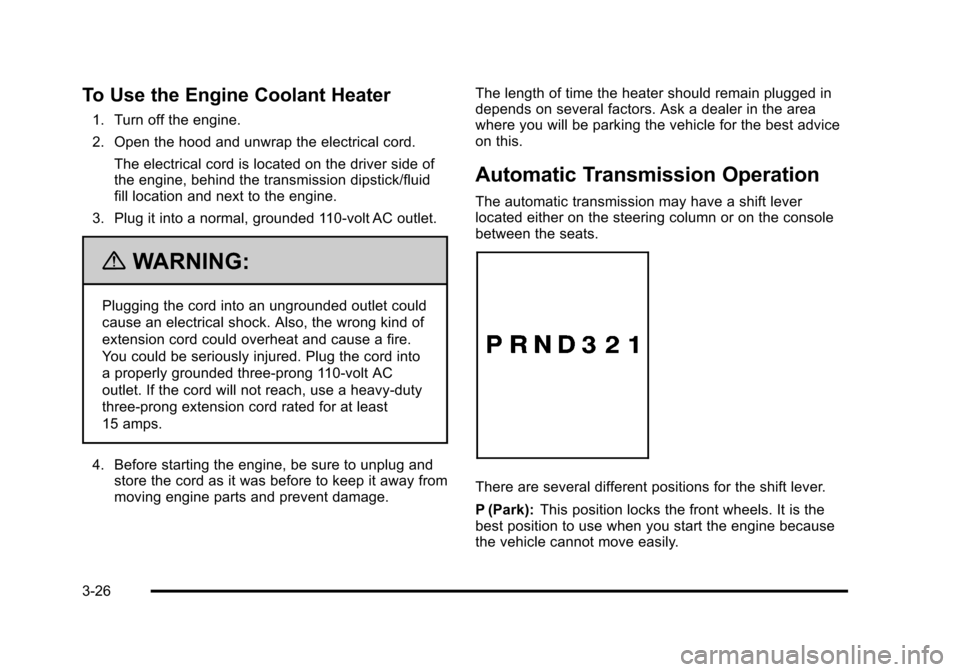
Automatic Transmission Operation
The automatic transmission may have a shift lever
located either on the steering column or on the console
between the seats.
There are several different positions for the shift lever.
P (Park):
This position locks the front wheels. It is the
best position to use when you start the engine because
the vehicle cannot move easily.
3-26
Page 131 of 470

Black plate (27,1)Cadillac DTS Owner Manual - 2011
{WARNING:
It is dangerous to get out of the vehicle if the shift
lever is not fully in P (Park) with the parking brake
firmly set. The vehicle can roll.
Do not leave the vehicle when the engine is
running unless you have to. If you have left the
engine running, the vehicle can move suddenly.
You or others could be injured. To be sure the
vehicle will not move, even when you are on fairly
level ground, always set the parking brake and
move the shift lever to P (Park). SeeShifting Into
Park
on page 3‑30. If you are pulling a trailer,
see Towing a Trailer on page 5‑26. Make sure the shift lever is fully in P (Park) before
starting the engine. The vehicle has an automatic
transmission shift lock control system. You have to
fully apply the regular brakes before you can shift from
P (Park) while the ignition key is in ON/RUN. If you
cannot shift out of P (Park), ease pressure on the shift
lever. Push the shift lever all the way into P (Park) as
you maintain brake application. Then move the shift
lever into another gear. See
Shifting Out of Park
on
page 3‑32.
R (Reverse): Use this gear to back up.
Notice: Shifting to R (Reverse) while the vehicle is
moving forward could damage the transmission.
The repairs would not be covered by the vehicle
warranty. Shift to R (Reverse) only after the vehicle
is stopped.
Also use this gear to rock the vehicle back and forth
to get out of snow, ice or sand without damaging the
transmission. See If Your Vehicle is Stuck in Sand,
Mud, Ice, or Snow
on page 5‑17for additional
information.
3-27
Page 133 of 470

Black plate (29,1)Cadillac DTS Owner Manual - 2011
3 (Third):This position is also used for normal driving.
However, it reduces vehicle speed more than D (Drive)
without using the brakes. You might choose 3 (Third)
instead of D (Drive) when driving on hilly, winding roads,
when towing a trailer, so there is less shifting between
gears and when going down a steep hill.
2 (Second): This position reduces vehicle speed more
than 3 (Third) without using the brakes. You can use
2 (Second) on hills. It can help control vehicle speed as
you go down steep mountain roads, but then you would
also want to use the brakes off and on.
Notice: Do not shift into 2 (Second) unless you are
going slower than 65 mph (105 km/h), or you can
damage the engine and/or transmission.
1 (First): This position reduces vehicle speed even
more than 2 (Second) without using the brakes. You can
use it on very steep hills, or in deep snow or mud. If the
shift lever is put in 1 (First) while the vehicle is moving
forward, the transmission will not shift into first gear until
the vehicle is going slowly enough.
Notice: Spinning the tires or holding the vehicle in
one place on a hill using only the accelerator pedal
may damage the transmission. The repair will not be
covered by the vehicle warranty. If you are stuck, do
not spin the tires. When stopping on a hill, use the
brakes to hold the vehicle in place.Performance Shifting
If the vehicle has this feature, it can detect a change in
driving patterns. If you make an aggressive driving
maneuver, the vehicle's transmission automatically
shifts to the lowest possible gear to maximize vehicle
performance. The vehicle will automatically return to
normal operation when you return to normal driving
patterns.
Parking Brake
The parking brake pedal
is located to the left of the
regular brake pedal, near
the driver door.
To set the parking brake, hold the regular brake pedal
down, then push the parking brake pedal down.
If the ignition is on, the brake system warning light on
the instrument panel cluster should come on. If it does
not, you need to have the vehicle serviced.
3-29
Page 136 of 470

Black plate (32,1)Cadillac DTS Owner Manual - 2011
Torque Lock
Torque lock is when the weight of the vehicle puts too
much force on the parking pawl in the transmission.
This happens when parking on a hill and shifting the
transmission into P (Park) is not done properly and then
it is difficult to shift out of P (Park). To prevent torque
lock, set the parking brake and then shift into P (Park).
To find out how, see“Shifting Into Park”in this section.
If torque lock does occur, your vehicle may need to be
pushed uphill by another vehicle to relieve the parking
pawl pressure, so you can shift out of P (Park).
Shifting Out of Park
Automatic Transmission Shift Lock
This vehicle has an electronic shift lock release system.
The shift lock release is designed to:
.Prevent ignition key removal unless the shift lever
is in P (Park)
.Prevent movement of the shift lever out of P (Park),
unless the ignition is in ON/RUN or ACC/
ACCESSORY and the regular brake pedal is
applied.
The shift lock is always functional except in the case of
a an uncharged or low voltage (less than 9 volt) battery. If the vehicle has an uncharged battery or a battery with
low voltage, try charging or jump starting the battery.
See
Jump Starting on page 6‑38.
Console Shift
If the console shift cannot be moved out of P (Park)
1. Apply the regular brakes.
2. Turn the ignition to ON/RUN or ACC/ACCESSORY position. See Ignition Positions
on page 3‑22for
more information.
3. Push the shift lever all the way into P (Park).
4. Then, shift into the desired gear.
If you still cannot move the shift lever from P (Park),
consult your dealer or a professional towing service.
Column Shift
If the column shift cannot be moved out of P (Park) 1. Apply the regular brakes.
2. Turn the ignition key to the ON/RUN or ACC/ACCESSORY position. See Ignition
Positions
on page 3‑22for more information.
3. Shift out of the P (Park) position to the N (Neutral) position.
4. Move the column shift to the desired gear.
If you still cannot move the shift lever from P (Park),
consult your dealer or a professional towing service.
3-32
Page 138 of 470

Black plate (34,1)Cadillac DTS Owner Manual - 2011
Running the Vehicle While Parked
It is better not to park with the engine running. But if you
ever have to, here are some things to know.
{WARNING:
Idling a vehicle in an enclosed area with poor
ventilation is dangerous. Engine exhaust may
enter the vehicle. Engine exhaust contains
Carbon Monoxide (CO) which cannot be seen or
smelled. It can cause unconsciousness and even
death. Never run the engine in an enclosed area
that has no fresh air ventilation. For more
information, seeEngine Exhaust on page 3‑33.
{WARNING:
It can be dangerous to get out of the vehicle if the
automatic transmission shift lever is not fully in
P (Park) with the parking brake firmly set. The
vehicle can roll. Do not leave the vehicle when the
engine is running unless you have to. If you have
left the engine running, the vehicle can move
suddenly. You or others could be injured. To be
sure the vehicle will not move, even when you are
on fairly level ground, always set the parking
brake after you move the shift lever to P (Park).
Follow the proper steps to be sure the vehicle will not
move. See Shifting Into Park on page 3‑30.
If parking on a hill and pulling a trailer, see Towing a
Trailer on page 5‑26.
3-34
Page 190 of 470

Black plate (28,1)Cadillac DTS Owner Manual - 2011
Cleaning the IntelliBeam Light Sensor
The light sensor is located
on the inside of the
vehicle in front of the
inside rearview mirror.
Clean the light sensor window, periodically, using glass
cleaner on a soft cloth. Gently wipe the sensor window.
Do not spray glass cleaner directly on the surface of the
sensor window.
Wiper Activated Headlamps
This feature activates the headlamps and parking lamps
after the windshield wipers are turned on and have
completed eight wipe cycles within four minutes.
When the ignition is turned to LOCK/OFF, the
wiper-activated headlamps immediately turn off. The
wiper-activated headlamps also turn off if the windshield
wipers are turned off.
Headlamps on Reminder
A warning chime will sound if the exterior lamp control
is left on in either the headlamp or parking lamp position
and the driver's door is opened with the ignition off.
Daytime Running Lamps (DRL)
Daytime Running Lamps (DRL) can make it easier for
others to see the front of your vehicle during the day.
Fully functional daytime running lamps are required on
all vehicles first sold in Canada.
The DRL system makes the turn signal lamps come on
when the following conditions are met:
.It is still daylight and the ignition is on.
.The exterior lamp control is in the off position.
.The transmission is not in P (Park) (United
States only).
.The light sensor is covered or not detecting light.
See “Sensors” underDual Climate Control System
on page 4‑34.
When DRL are on, no other exterior lamps such as the
parking lamps, taillamps, etc. will be on when the DRL
are being used. The instrument panel will not be lit up
either.
When automatic lighting is on and it is dark enough
outside, the turn signal lamps turn off and normal
low-beam headlamp operation occurs.
4-28
Page 191 of 470

Black plate (29,1)Cadillac DTS Owner Manual - 2011
When automatic lighting is on and it is bright enough
outside, the regular lamps go off, and the DRL takes
over. If the vehicle is started in a dark garage, the
automatic headlamp system comes on immediately.
Once you leave the garage, it will take approximately
one minute for the automatic headlamp system to
change to DRL if there is light outside. During that
delay, the instrument panel cluster may not be as bright
as usual. Make sure the instrument panel brightness
knob is in the full bright position. SeeInstrument Panel
Brightness on page 4‑30.
Turning on automatic lighting or the headlamps will
deactivate the DRL. If the parking lamps or the fog
lamps were turned on instead, the DRL will still
deactivate.
To idle the vehicle with the DRL off at night, turn off
automatic lighting and shift the transmission into
P (Park). Placing the vehicle in P (Park) disables the
DRL. The DRL will stay off until the vehicle is shifted
out of P (Park).
To drive the vehicle with the DRL off, turn off automatic
lighting and manually turn on the parking lamps or fog
lamps, if the vehicle has them.
The regular headlamp system should be turned on
when needed.Fog Lamps
The fog lamps button is on the exterior lamps control to
the left of the steering column.
#(Fog Lamps): Press to turn the fog lamps on or off.
A light comes on in the instrument panel cluster when
the fog lamps are in use. See Instrument Panel Cluster
on page 4‑45. The ignition must be in the ON/RUN
position for the fog lamps to work.
The fog lamps will go off when the headlamps are
changed to high-beam.
Some localities have laws that require the headlamps to
be on along with the fog lamps.
Cornering Lamps
The cornering lamps come on when the headlamps or
parking lamps are on and you signal a turn with the
multifunction lever. They provide more light for
cornering.
4-29