stop start CADILLAC ELDORADO 1993 10.G User Guide
[x] Cancel search | Manufacturer: CADILLAC, Model Year: 1993, Model line: ELDORADO, Model: CADILLAC ELDORADO 1993 10.GPages: 398, PDF Size: 20.66 MB
Page 193 of 398
Downloaded from www.Manualslib.com manuals search engine If you keep pace with the traffic and allow realistic following distances,
you
will eliminate a lot of unnecessary braking. That means better
braking and longer brake life.
If your engine ever stops while you’re driving, brake normally but
don’t pump your brakes.
If you do, the pedal may get harder to push
down.
If your engine. stops, you will still have some power brake assist.
But you
will use it when you brake. Once the power assist is used up, it
may take longer to stop and the brake pedal will be harder to push.
Anti-Lock Brakes (ABS)
Your Cadillac has an advanced electronic braking system that will help
prevent skidding.
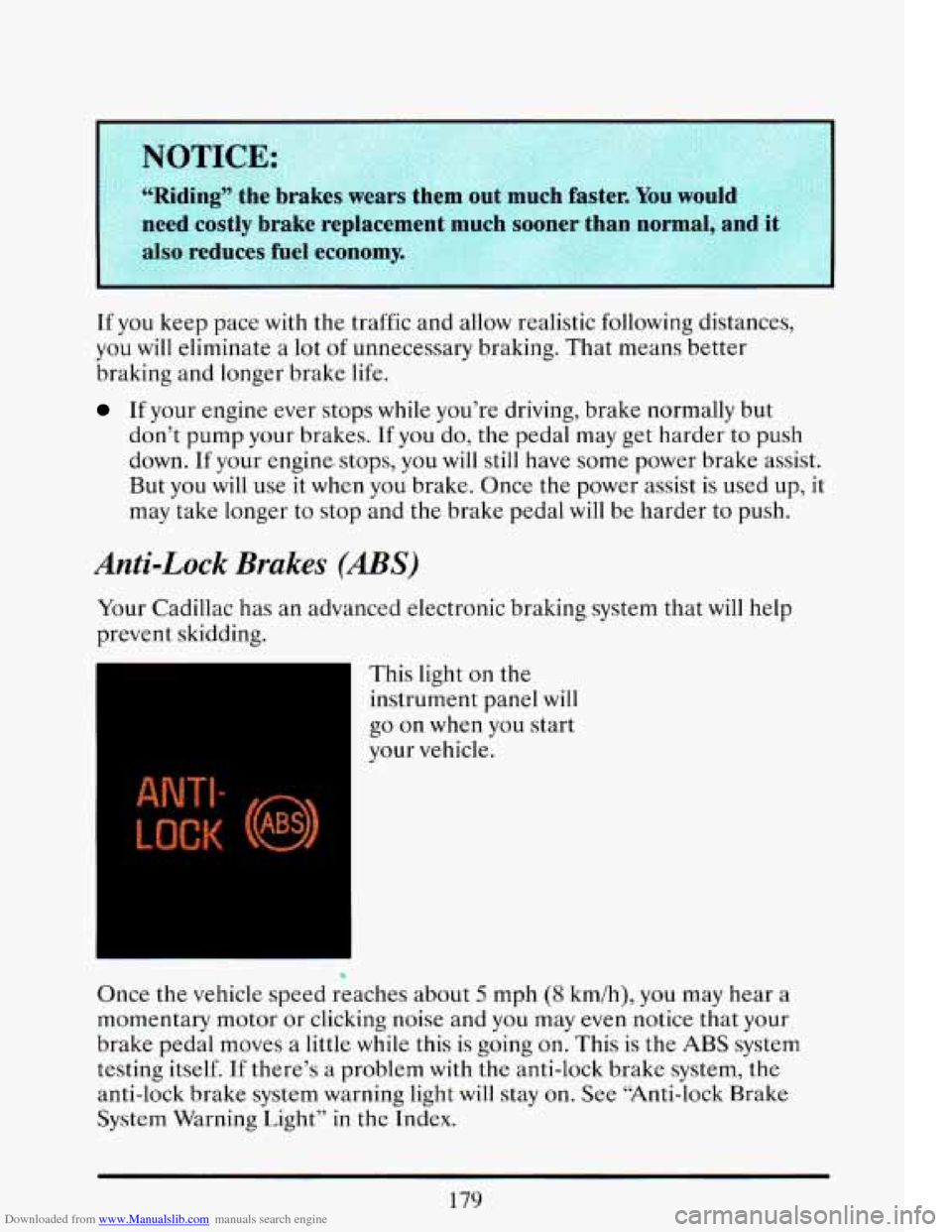
This light on the
instrument panel
will
go on when you start
your vehicle.
hear a
Once the vehicle speed reaches about
5 mph (8 km/h), you may
momentary motor or c1,icking noise and you may
even notice that your
brake pedal moves a little
while this is going on. This is the ABS system
testing itself.
If there’s a problem with the anti-lock brake system, the
anti-lock brake system warning light will stay on. See “Anti-lock Brake
System Warning Light” in the Index.
179
Page 200 of 398
Downloaded from www.Manualslib.com manuals search engine PASSING
The driver of a vehicle about to pass another on a two-lane highway waits
for just the right moment, accelerates, moves around the vehicle ahead,
then goes back into the right lane again.
A simple maneuver?
Not necessarily! Passing another vehicle on a two-lane highway is a
potentially dangerous move, since the passing vehicle occupies the same
lane as oncoming traffic
for several seconds. A miscalculation, an error in
judgment, or a brief surrender to frustration or anger can suddenly put
the passing driver face to face with the worst
of all traffic accidents -- the
head-on collision.
So here are some tips for passing:
“Drive ahead.” Look down the road, to the sides, and to crossroads
for situations that might affect your passing patterns.
If you have any
doubt whatsoever about making
a successful pass, wait for a better
time.
Watch for traffic signs, pavement markings, and lines. If you can see a
sign up ahead that might indicate a turn or an intersection, delay your
pass.
A broken center line usually indicates it’s all right to pass
(providing the road ahead is clear). Never cross
a solid line on your
side
of the lane or a double solid line, even if the road seems empty of
approaching traffic.
If you suspect that the driver of the vehicle you want to pass isn’t
Do not get too close to the vehicle you want to pass while you’re
aware
of your presence, tap the horn
a couple of times before passing.
awaiting an opportunity. For one thing, following
too closely reduces
your area
of vision, especially if you’re following a larger vehicle. Also,
you won’t have adequate space
if the vehicle ahead suddenly slows or
stops. Keep back
a reasonable distance.
When it looks like a chance to pass is coming up, start to accelerate
but stay
in the right lane and don’t get too close. Time your move so
you will be increasing speed as the time comes to move into the other
lane. If the way is clear
to pass, you will have a “running start” that
more than makes up for the distance you would lose by dropping back.
And
if something happens to cause you to cancel your pass, you need
only slow down and drop back again and wait
for another opportunity.
186
Page 202 of 398
Downloaded from www.Manualslib.com manuals search engine A cornering skid and an acceleration skid are best handled by easing your
foot
off the accelerator pedal.
If your vehicle starts to slide (as when you turn a corner on a wet, snow-
or ice-covered road), ease your foot off the accelerator pedal as soon as
you
feel the vehicle start to slide. Quickly steer the way you want the
vehicle to go.
If you start steering quickly enough, your vehicle will
straighten out. As it does, straighten the front wheels.
Of course, traction is reduced when water, snow, ice, gravel, or other
material is on the road. For safety, you’ll want to slow down and adjust
your driving to these conditions. It is important to slow down on slippery
surfaces because stopping distance will be longer and vehicle control
more limited.
While driving on a surface with reduced traction, try your best to avoid
sudden steering, acceleration,
or braking (including engine braking by
shifting to
a lower gear). Any sudden changes could cause the tires to
slide. You may not realize the surface is slippery until your vehicle is
skidding. Learn to recognize warning clues
-- such as enough water, ice or
packed snow
on the road to make a “mirrored surface” -- and slow down
when you have any doubt.
Remember: Any anti-lock braking system
(ABS) helps avoid only the
braking skid. Steer the way you want to go.
DIWTNG AT NIGHT
188
Page 205 of 398
Downloaded from www.Manualslib.com manuals search engine Just as your headlights should be checked regularly for proper aim, so
should your eyes be examined regularly. Some drivers suffer from night
blindness
-- the inability to see in dim light -- and aren’t even aware of it.
DRn/lNG IN THE RAIN
Rain and wet roads can mean driving trouble. On a wet road you can’t
stop, accelerate or turn as well because your tire-to-road traction isn’t as
good
as on dry roads. And, if your tires don’t have much tread left, you’ll
get even less traction.
It’s always wise to go slower and be cautious if rain starts to fall while you
are driving. The surface may get wet suddenly when your reflexes are
tuned for driving on dry pavement.
The heavier the rain, the harder it is to see. Even if your windshield wiper
blades are
in good shape, a heavy rain can makc it harder to see road
signs and traffic signals, pavement markings, the edge
of the road, and
even people walking. Road spray can often be worse for vision than rain,
especially
if it comes from a dirty road.
So it is wise to keep your wiping equipment in good shape and keep your
windshield washer tank filled. Replace your windshield wiper inserts
when they show signs of streaking or missing areas on the windshield,
or
when strips of rubber start to separate from the inserts.
191
Page 209 of 398
Downloaded from www.Manualslib.com manuals search engine Start your windshield wipers and washer, to help clear accumulated road
dirt. Slow down carefully.
Tips on Driving in Fog
If you get caught in fog, turn your headlights on low beam: (en In
daytime. You’ll see -- and be seen -- better. Use your fog lignts if your
vehicle has them.
Don’t use your high beams.
The light will bounce off the water droplets
that make up fog and reflect back at
you.
Use your defogger. In high humidity, even a light buildup of moisture on
the inside
of the glass will cut down on your already limited visibility. Run
your windshield wipers and washer occasionally. Moisture can build up
on the outside glass, and what seems to be fog may actually be moisture
on the outside of your windshield.
Treat dense fog as an emergency. Try to find a place to pull off the road,
Of course you want to respect another’s property, but you might need to
put something between you and moving vehicles
-- space, trees, telephone
poles,
a private driveway, anything that removes you from other traffic.
If visibility is near zero and you must stop but are unsure whether you are.
away from the road, turn your lights
on, start your hazard warning
flashers, and sound your horn at intervals or when you hear approaching
traffic.
Pass other vehicles
in fog only if you can see far enough ahead to pass
safely.
Even then, be preparcd to delay your pass if you suspect the fog is
worse up ahead. If other vehicles try to pass you, make it easy for them.
195
Page 212 of 398
Downloaded from www.Manualslib.com manuals search engine Switch on your turn signal, check your rearview mirrors as you move
along, and glance over your shoulder as often as necessary.
Try to blend
smoothly with the traffic flow.
Driving on the Freeway
Once you are on the freeway, adjust your speed to the posted limit or to
the prevailing rate
if it’s slower. Stay in the right lane unless you want to
pass.
If you are on a two-lane freeway, treat the right lane as the slow lane
and the left lane as the passing lane.
If you are on
a three-lane freeway, treat the right lane as the slower-speed
through lane, the middle lane as the higher-speed through lane,\
and the left lane as the passing lane.
Before changing lanes, check your rearview mirrors. Then use your turn
signal.
Just before you leave the lane, glance quicklyover your shoulder to make
sure there isn’t another vehicle in your “blind” spot.
If you are moving from an outside to a center lane on a freeway having
more than two lanes, make sure another vehicle isn’t about to move into
the same spot. Look at the vehicles two lanes over and watch for telltale
signs: turn signals flashing, an increase
in speed, or moving toward the
edge
of the lane. Be prepared to delay your move.
Once you are moving on the freeway, make certain you allow
a
reasonable following distance. Expect to move slightly slower at night.
Leaving the Freeway
When you want to leave the freeway, move to the proper lane well in
advance. Dashing across lanes at the last minute
is dangerous. If you miss
your exit do not, under any circumstances, stop and back up. Drive on to
the next
exit.
At each exit point is a deceleration lane. Ideally it should be long enough
for you to enter it at freeway speed (after signaling,
of course) and then
do your braking before moving onto the exit ramp. Unfortunately, not all
deceleration lanes
are long enough -- some are too short for all the
braking. Decide when to start braking.
If you must brake on the through
lane, and if there is traffic close behind you, you can allow a little extra
Page 229 of 398
Downloaded from www.Manualslib.com manuals search engine Passing
You’ll need more passing distance up ahead when you’re towing a trailer.
And, because you’re a good deal longer, you’ll need
to go much farther
beyond the passed vehicle before you can return to your lane.
Backing Up
Hold the bottom of the steering wheel with one hand. Then, to move the
trailer to the left, just move that hand to the left.
To move the trailer to
the right, move your hand to
the right. Always back up slowly and, if
possible, have someone guide you.
Making Turns
When you’re turning with a trailer, make wider turns than normal. Do
this so your trailer won’t strike soft shoulders, curbs, road signs, trees, or
other objects. Avoid jerky or sudden maneuvers. Signal well
in advance.
Turn Signals When Towing a Trailer
When you tow a trailer, your vehicle has to have a different turn signal
flasher and extra wiring. The green arrows on your instrument panel will
flash whenever
you signal a turn or lane change. Properly hooked up, the
trailer lights will also flash, telling other drivers you’re about to turn,
change lanes or stop.
When towing a trailer, the green arrows on your instrument panel will
flash for turns
even if the bulbs on the trailer are burned out. Thus, you
may think drivers behind you are seeing your signal when they are not.
It’s important to check occasionally to be sure the trailer bulbs are still
working.
Driving On Grades
Reduce speed and shift to a lower gear before you start down a long or
steep downgrade.
If you don’t shift down, you might have to use your
brakes
so much that they would get hot and no longer work well.
On a long uphill grade, shift down and reduce your speed to around
45
mph (70 km/h) or less to reduce the possibility of engine and transaxle
overheating.
215
Page 230 of 398
Downloaded from www.Manualslib.com manuals search engine If your trailer weighs more than 1,000 pounds (450 Kg) and you have an
automatic transaxle with Overdrive, you may want to drive
in “3” instead
of Overdrive (or, as you need to, a lower gear). This will help your
transmission.
Parking on Hills
You really should not park your vehicle, with a trailer attached, on a hill.
If something goes wrong, your rig could start to move. People can be
injured, and both your vehicle and the trailer can be damaged.
But
if you ever have to park your rig on a hill, here’s how to do it:
1. Apply your regular brakes, but don’t shift into “P” (Park) yet.
2. Have someone place chocks under the trailer wheels.
3. When the wheel chocks are in place, release the regular brakes until
4. Reapply the regular brakes. Then shift into “P” (Park) firmly and
apply your parking brake.
5. Release the regular brakes.
the
chocks absorb the load.
When You Are Ready to Leave Afier Parking on a Hill
1. Apply your regular brakes and hold the pedal down while you:
Start your engine;
Shift into a gear; and
Be sure the parking brake has released.
2. Let up on the brake pedal.
3. Drive slowly until the trailer is clear of the chocks.
4. Stop and have someone pick up and store the chocks.
216
Page 260 of 398
Downloaded from www.Manualslib.com manuals search engine 4. Put the cap back on
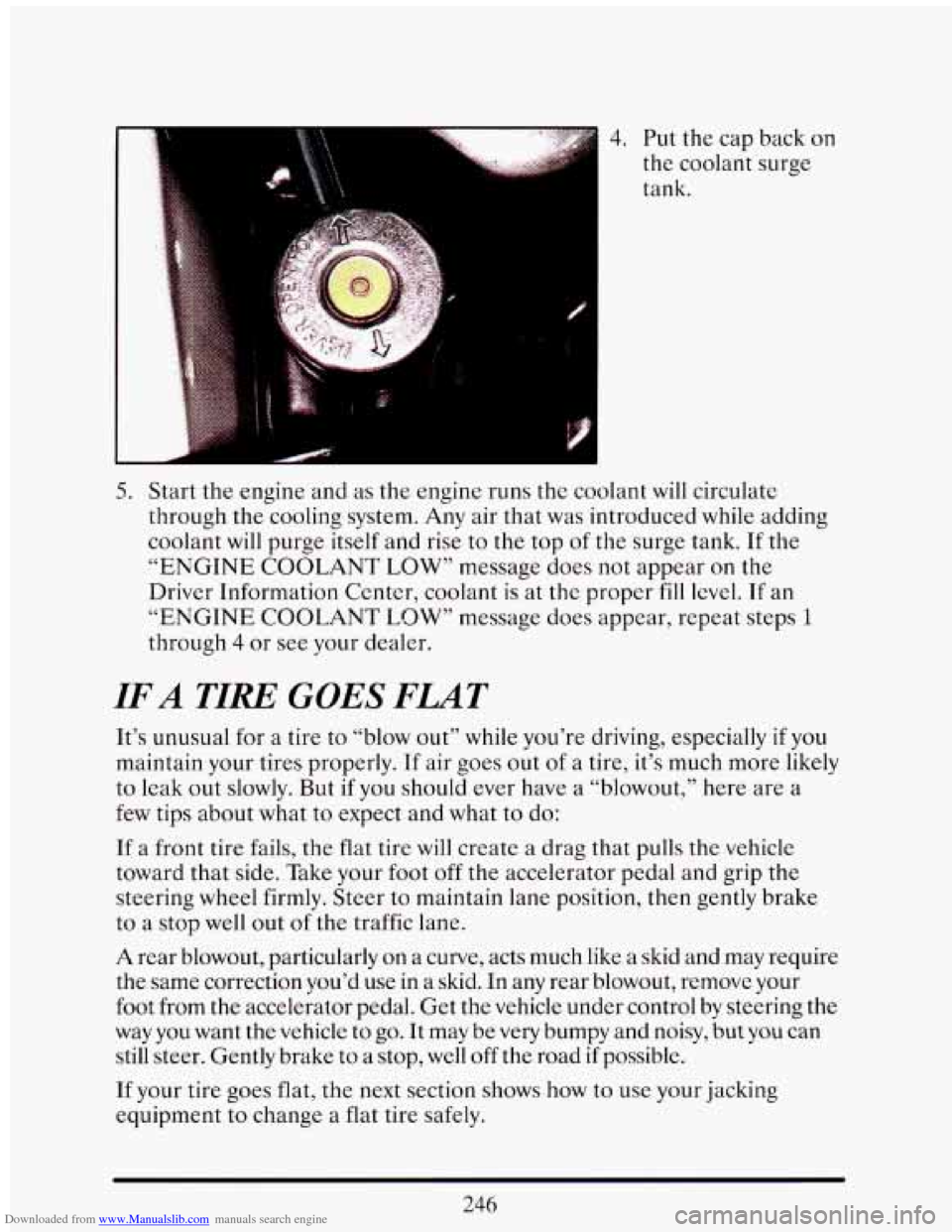
the coolant surge
tank.
5. Start the engine and as the engine runs the coolant will circulate
through the cooling system. Any air that was introduced while adding
coolant will purge itself and rise to the top of the surge tank.
If the
“ENGINE COOLANT LOW” message does not appear on the
Driver Information Center, coolant is at the proper
fill level. If an
“ENGINE COOLANT LOW” message does appear, repeat steps
1
through 4 or see your dealer.
IFA TIRE GOES FLAT
It’s unusual for a tire to “blow out7’ while you’re driving, especially if you
maintain
your tires properly. If air goes out of a tire, it’s much more likely
to leak out slowly. But if you should ever have a “blowout,” here are a
few tips about what to expect and what to do:
If a front tire fails, the flat tire
will create a drag that pulls the vehicle
toward that side. Take your foot off the accelerator pedal and grip the
steering wheel firmly. Steer to maintain lane position, then gently brake
to
a stop well out of the traffic lane.
A rear blowout, particularly on a curve, acts much like
a skid and may require
the same correction you’d use in a skid. In any rear blowout, remove your
foot from the accelerator pedal. Get the vehicle under control by steering the
way you want the vehicle
to go. It may be very bumpy and noisy, but you can
still steer. Gently brake to
a stop, well off the road if possible.
If your tire goes flat, the next section shows how to use your jacking
equipment to change a flat tire safely.
246
Page 344 of 398
Downloaded from www.Manualslib.com manuals search engine 5
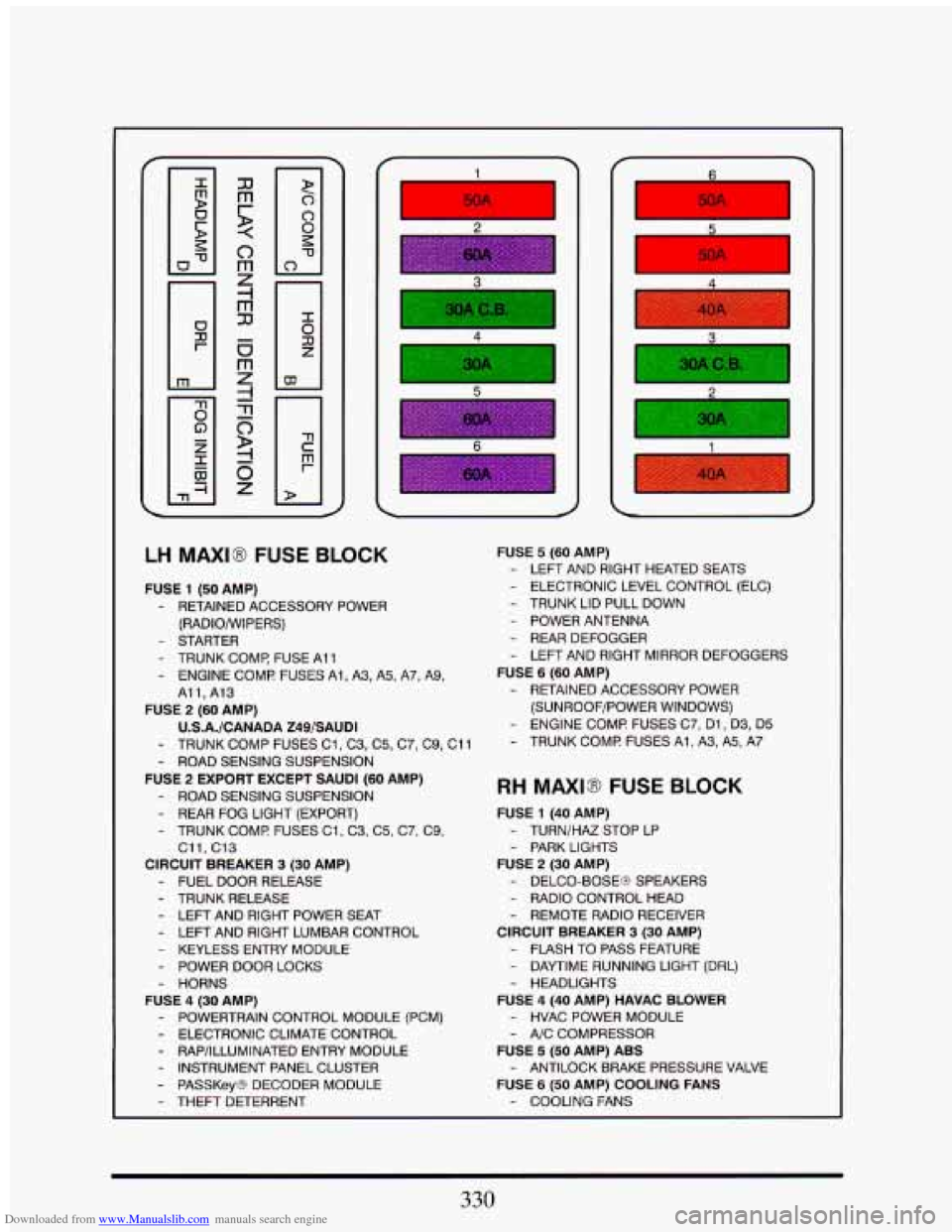
LH MAXI8 FUSE BLOCK
FUSE 1 (50 AMP)
- RETAINED ACCESSORY POWER
(RADIO/WIPERS)
- STARTER
- TRUNK COMR FUSE Ai 1
- ENGINE COMF! FUSES Ai, A3, A5, A7, A9,
All,A13
FUSE 2 (60 AMP)
U.S.A./CANADA Z49/SAUDI
- TRUNK COMP FUSES C1, C3, C5, C7, C9, Cil
- ROAD SENSING SUSPENSION
FUSE 2 EXPORT EXCEPT SAUDI (60 AMP)
- ROAD SENSING SUSPENSION
- REAR FOG LIGHT (EXPORT)
- TRUNK COMP FUSES C1, C3, C5, C7, C9,
C11, C13
CIRCUIT BREAKER 3 (30 AMP)
- FUEL DOOR RELEASE
- TRUNK RELEASE
- LEFT AND RIGHT POWER SEAT
- LEFT AND RIGHT LUMBAR CONTROL
- KEYLESS ENTRY MODULE
- POWER DOOR LOCKS
- HORNS
FUSE 4 (30 AMP)
- POWERTRAIN CONTROL MODULE (PCM)
- ELECTRONIC CLIMATE CONTROL - RAP/ILLUMINATED ENTRY MODULE
- INSTRUMENT PANEL CLUSTER
- PASSKeyB DECODER MODULE
- THEFT DETERRENT
I 50A I m 5
FUSE 5 (60 AMP)
- LEFT AND RIGHT HEATED SEATS
- ELECTRONIC LEVEL CONTROL (ELC)
- TRUNK LID PULL DOWN
- POWER ANTENNA
- REAR DEFOGGER
- LEFT AND RIGHT MIRROR DEFOGGERS
FUSE 6 (60 AMP)
- RETAINED ACCESSORY POWER
(SUNROOF/POWER WINDOWS)
- ENGINE COMF! FUSES C7, Dl, D3, D5
- TRUNK COMF! FUSES Al, A3, A5, A7
RH MAXIB FUSE BLOCK
FUSE 1 (40 AMP)
- TURN/HAZ STOP LP - PARK LIGHTS
FUSE 2 (30 AMP)
- DELCO-BOSEG SPEAKERS
- RADIO CONTROL HEAD
- REMOTE RADIO RECEIVER
CIRCUIT BREAKER 3 (30 AMP)
- FLASH TO PASS FEATURE
- DAYTIME RUNNING LIGHT (DRL)
- HEADLIGHTS
FUSE 4 (40 AMP) HAVAC BLOWER
- HVAC POWER MODULE
- AJC COMPRESSOR
FUSE 5 (50 AMP) ABS
FUSE
6 (50 AMP) COOLING FANS
- ANTILOCK BRAKE PRESSURE VALVE
- COOLING FANS
330