fuel CADILLAC ELDORADO 1993 10.G Owner's Manual
[x] Cancel search | Manufacturer: CADILLAC, Model Year: 1993, Model line: ELDORADO, Model: CADILLAC ELDORADO 1993 10.GPages: 398, PDF Size: 20.66 MB
Page 272 of 398
Downloaded from www.Manualslib.com manuals search engine rd
SERVICE AND APPEARANCE CARE
Here you will find information about the care of your Cadillac. This
section begins
with service and fuel information, and then it shows how to
check important fluid and lubricant levels. There is also technical
information about your vehicle, and a section devoted to its appearance
care.
SERWCE
Your Cadillac dealer knows your vehicle best and wants you to be happy
with it.
Wc hopc you’ll go to your dealer for all your service needs. You’ll
get genuine GM parts and GM-trained and supported service people.
We hope you’ll want to keep your GM vehicle all GM. Genuine GM parts
have one
of these marks:
Doing Your Own Service Work
If you want to do some of your own service work, you’ll want to get the
proper Cadillac Service Manual. It tells you much more about
how to
service your Cadillac than this manual can.
To order the proper service
manual, see “Service Publications’’ in the Index.
You should keep a record
with all parts receipts and list the mileage and
the date of any service work you perform. See “Maintenance Record” in
the Index.
258
Page 273 of 398
Downloaded from www.Manualslib.com manuals search engine r
P
A CAUTION
You can be iqjnred if you try to do service work on a vehicle
without knowing enough about it.
Be sure you have sdlicient knowledge, experience, and the
proper replacement parts and tools before you attempt any
vehicle maintenance task,
@ Be sure to use the proper nuts, bolts and other fasteners.
“k@sh” and ccmetricm fasteners can be easily eonffrsed. If
you use the mng fasteners, parts can later break or fall off.
You could be hurt.
1_ FUEL
!-
Use premium unleaded gasoline rated at 91 octane or higher. It should
meet specifications
ASTM D4814 in the US. and CGSB 3.5-92 in
Canada. These fuels should have the proper additives,
so you should not
have to add anything to the fuel.
In the U.S. and Canada, it’s easy to be sure you get the right kind of
only unleaded nozzles will fit into your vehicle’s filler neck.
T- gasoline (unleaded). You’ll see “UNLEADED” right on the pump. And
Be sure the posted octane is at least 91.
If the octane is less than 91, you
may get a heavy knocking noise when you drive. (In an emergency, you
may be able to use lower octane
-- as low as 87 -- if heavy knocking does
not occur.)
If you’re using 91 or higher octane unleaded gas and you still
get heavy knocking, your engine needs service.
I
259
Page 274 of 398
Downloaded from www.Manualslib.com manuals search engine What about gasoline with blending materials that contain oxygen, such as
MTBE or alcohol?
MTBE is “methyl tertiary-butyl ether.” Fuel that is no more than
15%
MTBE is fine for your car.
Ethanol is ethyl or grain alcohol. Properly-blended fuel that is no more
than
10% ethanol is fine for your car.
Methanol
is methyl or wood alcohol.
r 1
NOTICE:
Fuel that is more than 5% methanol is bad for your vehicle.
Don’t use it. It can corrode metal parts in your fuel system and
also damage plastic and rubber parts. That damage wouldn’t be
covered under your warranty. And even at
5% or less, there must
be 6Ccosolvents” and corrosion preventers in this fuel to help
avoid these Droblems.
Gasolines for Cleaner Air
Your use
of gasoline with detergent additives will help prevent deposits
from forming in your engine and fuel system. That helps keep your
engine
in tune and your emission control system working properly. It’s
good for your vehicle, and you’ll be doing your part for cleaner air.
Many gasolines are now blended with materials called oxygenates.
General Motors recommends that you use gasolines
with these blending
materials, such as
MTBE and ethanol. By doing so, you can help clean
the air, especially in those parts
of the country that have high carbon
monoxide levels.
In addition, some gasoline suppliers are now producing reformulated
gasolines. These gasolines are specially designed to reduce vehicle
emissions. General Motors recommends that you use reformulated
gasoline. By doing
so, you can help clean the air, especially in those parts
of the country that have high ozone levels.
You should ask your service station operators if their gasolines contain
detergents and oxygenates, and
if they have been reformulated to reduce
vehicle emissions.
260
Page 275 of 398
Downloaded from www.Manualslib.com manuals search engine FUELS IN FOREIGN COUNTNES
If you plan on driving in another country outside the U.S. or Canada,
unleaded fuel may be hard to find.
Do not use leaded gasoline. If you use
even one tankful, your emission controls won't work well or at all. With
continuous use, spark plugs can get fouled, the exhaust system can
corrode, and your engine
oil can deteriorate quickly. Your vehicle's
oxygen sensor will be damaged. All of that means costly repairs that
wouldn't be covered by your warranty.
To check on fuel availability, ask an auto club, or contact a major oil
company that does business in the country where you'll be driving.
You can also write us at the following address
for advice. Just tell us
where you're going and give your Vehicle Identification Number (VIN).
General Motors of Canada Ltd.
International Export Sales
EO. Box 828
Oshawa, Ontario L1H 7N1, Canada
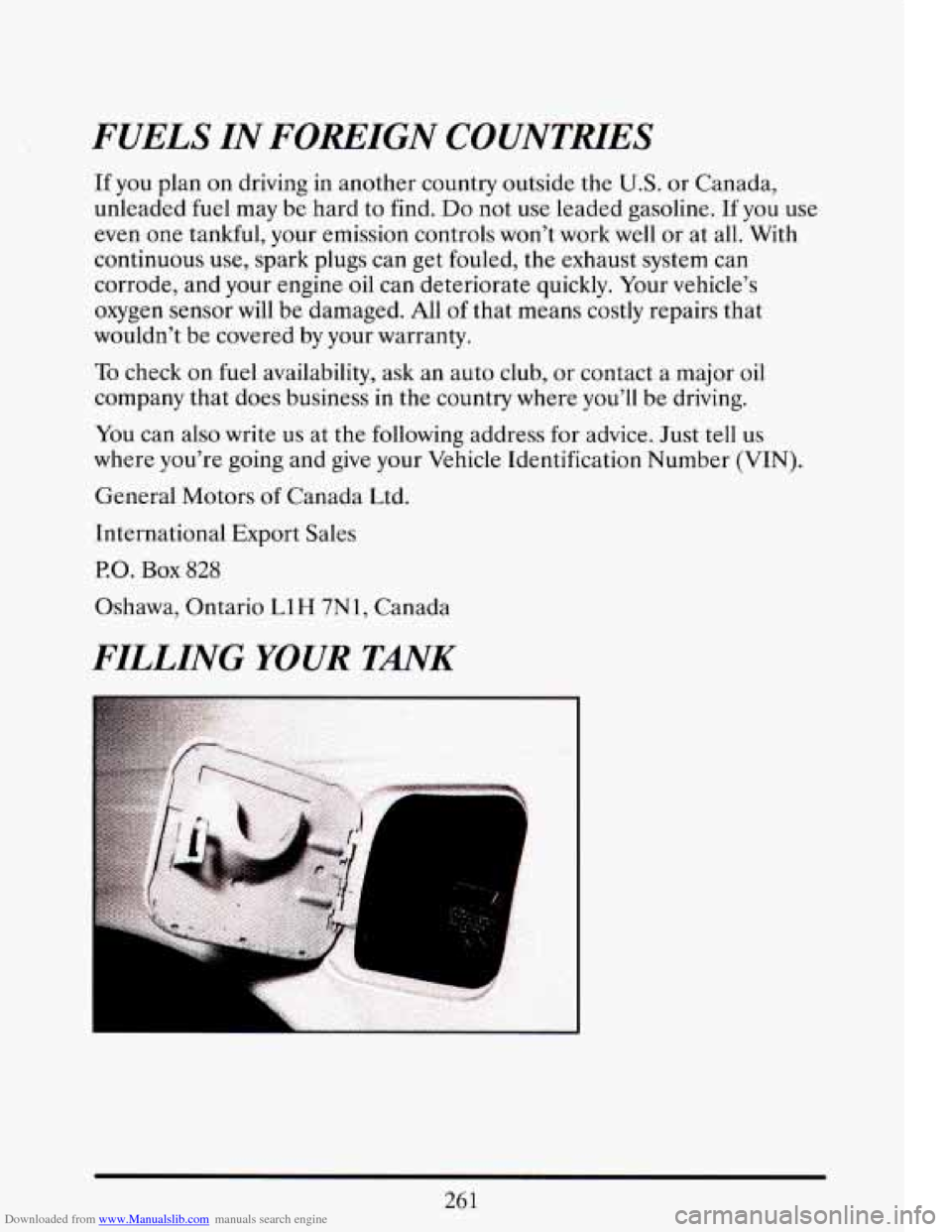
FILLING YOUR TANK
261
Page 276 of 398
Downloaded from www.Manualslib.com manuals search engine A CAUTION:
Gasoline vapor is highly flammable. It burns violently, and that
can cause very bad injuries. Don't smoke if you're near gasoline
pr refueling your vehicle. Keep sparks, flames, and smoking
;materials away from gasoline.
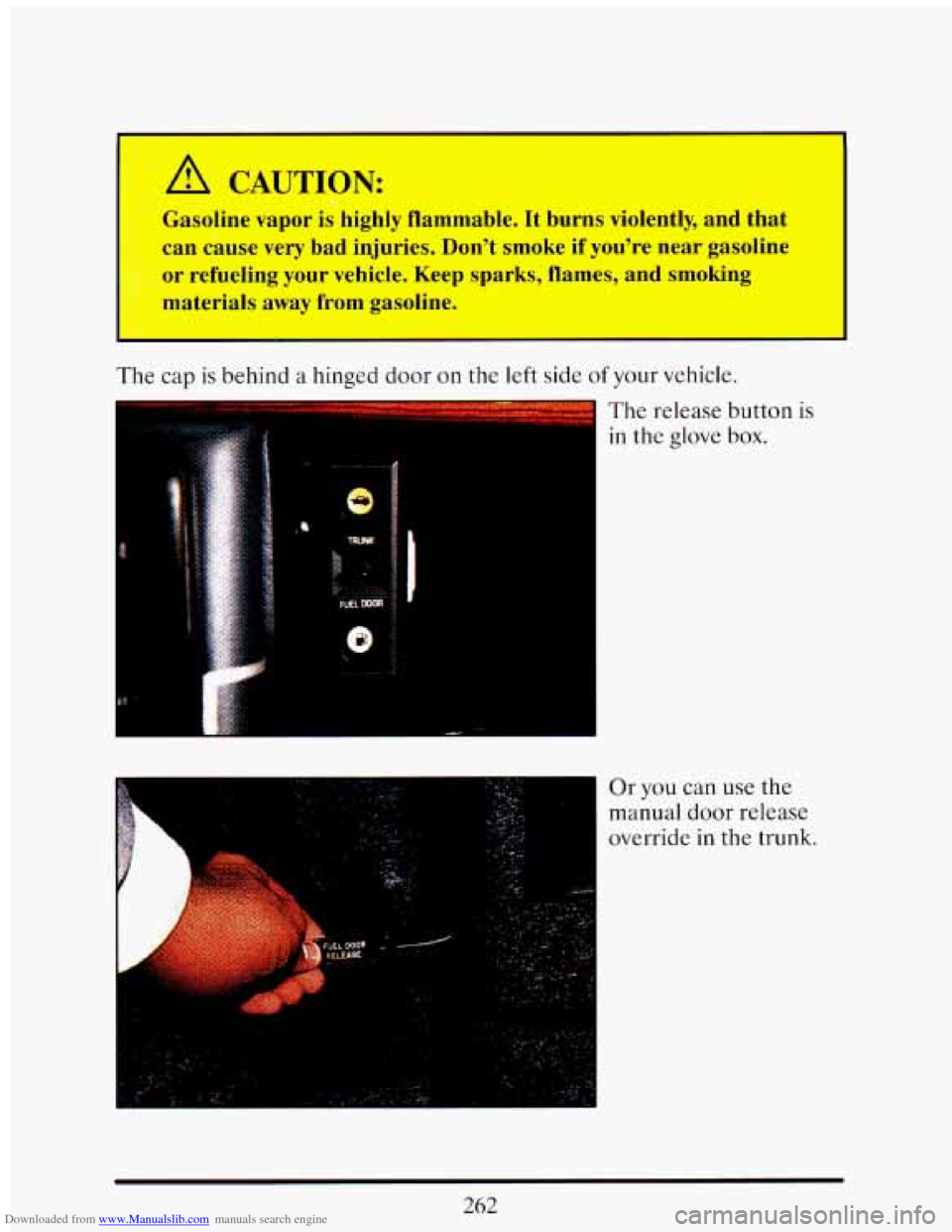
The cap is behind a hinged door on the left side of your vehicle.
The release button is
in the glove
box.
Or you can use the
manual
door release
override in the trunk.
262
Page 277 of 398
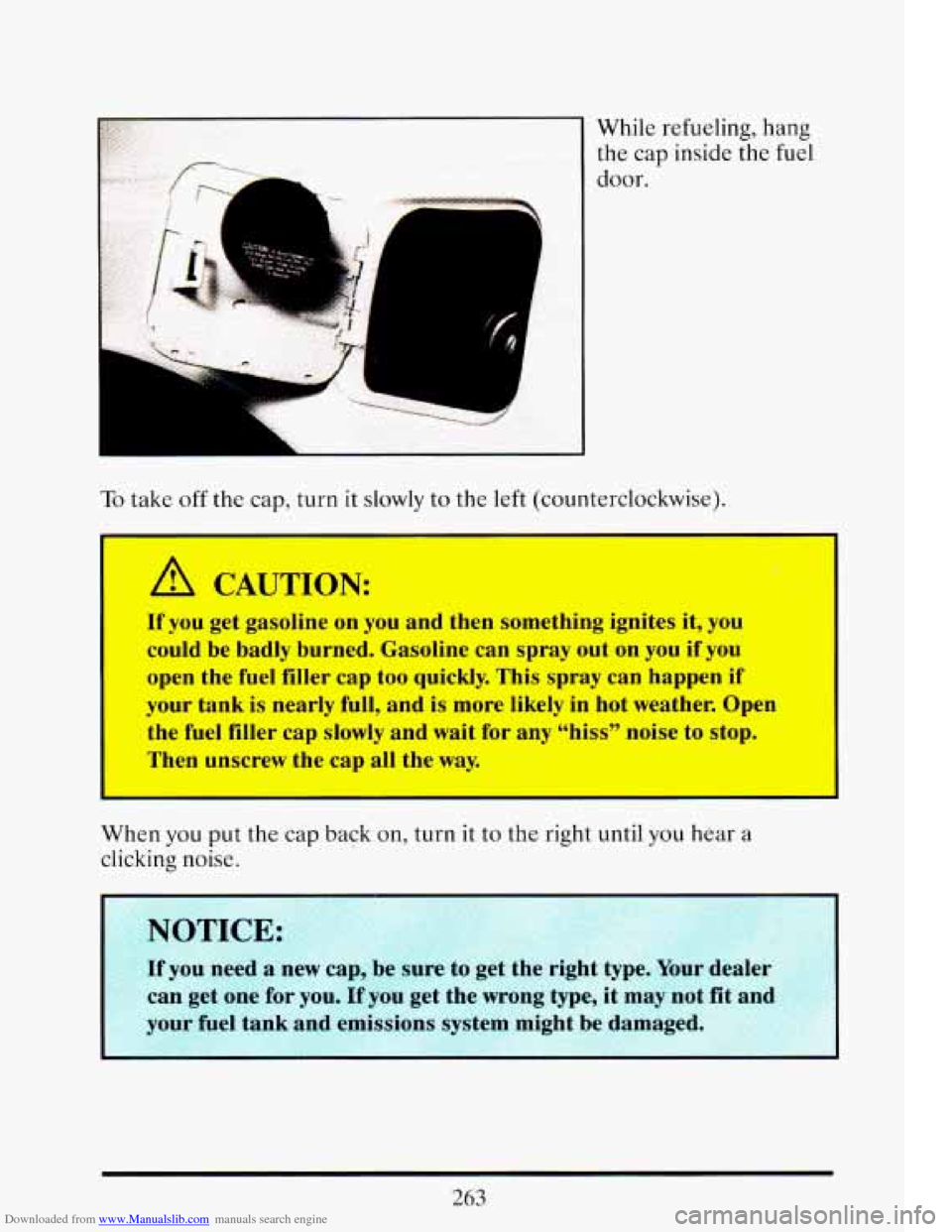
Downloaded from www.Manualslib.com manuals search engine While refueling, hang
the cap inside the fuel
door.
To take off the cap, turn it slowly to the left (counterclockwise).
I
A CAUTION:
If you get gasoline on you and then something ignites it, you
could be badly burned. Gasoline can spray out
on you if you
open the fuel filler cap too quickly. This spray can happen if
your tank is nearly full, and
is more likely in hot weather. Open
the fuel filler cap slowly and wait for any “hiss” noise to stop.
Then unscrew tht ap all the
1 y.
When you put the cap back on, turn it to the right until you hear a
clicking noise.
263
Page 280 of 398
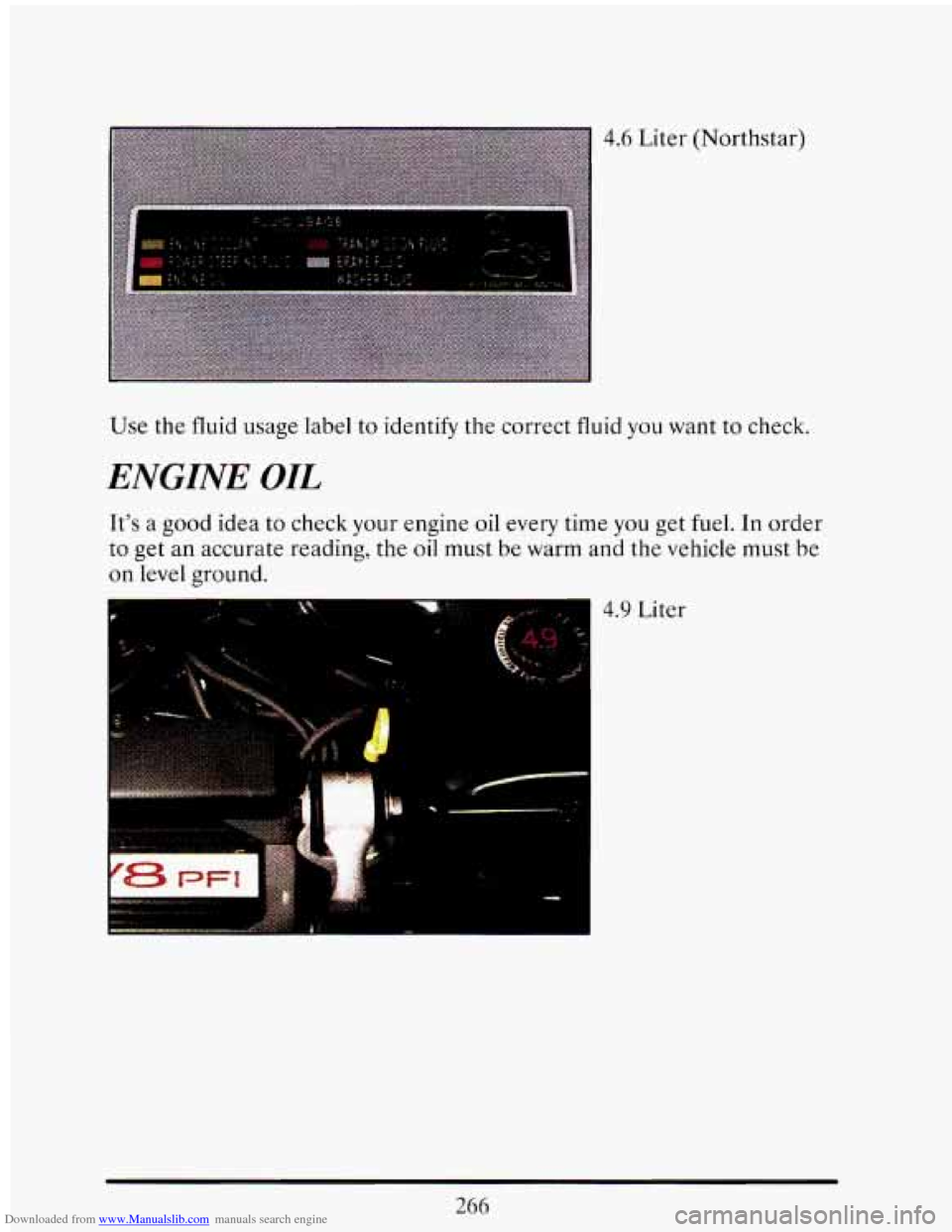
Downloaded from www.Manualslib.com manuals search engine 4.6 Liter (Northstar)
Use the fluid usage label to identify the correct fluid
you want to check.
ENGINE OIL
It's a good idea to check your engine oil every time you get fuel. In order
to get an accurate reading, the
oil must be warm and the vehicle must be
on
level ground.
c -,
266
Page 286 of 398
Downloaded from www.Manualslib.com manuals search engine RECOMMENDED SAE VISCOSITY GRADE ENGIHE OILS
FOR BEST FUEL Er-m7Y AND COLD STARTING, SELECT THE LOWEST
SAE VISCOSITY GLmwL
wll FOR THE EXPECTED TEMPERATURE RANGE.
vmim
HOT
OF "C
+loo - - +38
+80 - - +27
+60 - - +16
+40 - -+4
+20 - -7
0 3 --la
0
COLD
WEATHER
SAE 5W-30
-- [--I
-I
SAE low-30
PREFERRED
DO NOT USE SAE 1OW-40 GRADE OIL OR ANY OTHER GRADE NOT RECOMMENDED
SAE 1OW-30
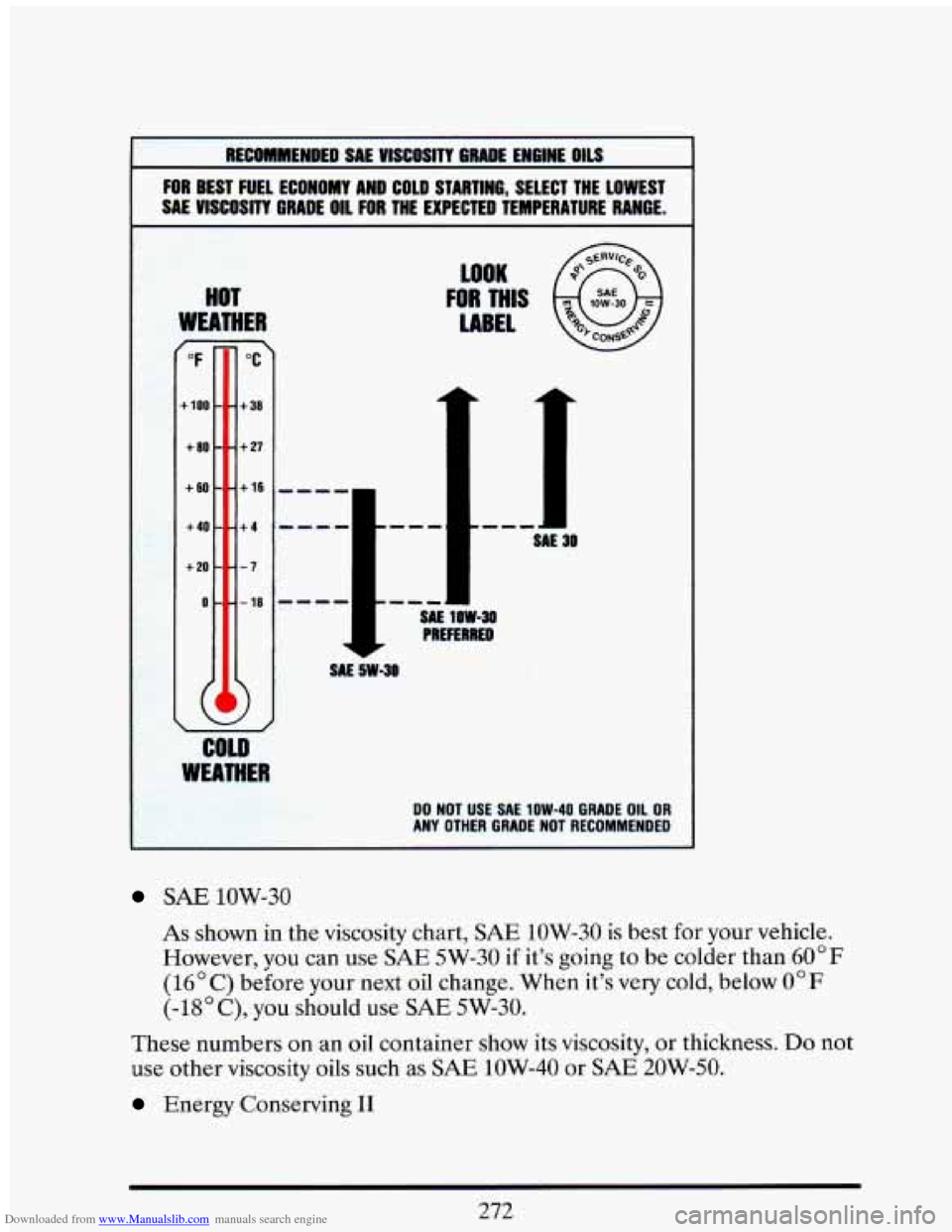
As shown in the viscosity chart, SAE low-30 is best for your vehicle.
However, you can use
SAE 5W-30 if it's going to be colder than 60°F
(16"
C) before your next oil change. When it's very cold, below 0°F
(-18OC), you should use SAE 5W-30.
These numbers on an
oil container show its viscosity, or thickness. Do not
use other viscosity oils such as
SAE 1OW-40 or SAE 20W-50.
Energy Conserving I1
272
Page 287 of 398
Downloaded from www.Manualslib.com manuals search engine Oils with these words on the container will help you save fuel.
This doughnut-shaped logo (symbol) is used on most oil containers
to
help you select the correct oil.
You should look for this on the oil container, and use only those oils that
display the logo.
GM Goodwrench@ oil (in Canada, GM Engine Oil) meets all the
requirements for your vehicle.
Engine Oil Additives: Don’t add anything to your oil. Your Cadillac
dealer is ready to advise
if you think something should be added.
When to Change Engine Oil: Your vehicle is equipped with an engine oil
life index (EOLI) feature as part
of the Driver Information Center
display (DIC). Oil change intervals are determined by the EOLI and will
usually fall at, or between, the
two recommended alternative intervals of
3,000 miles (5,000 kilometers) and 7,500 miles (12,500 kilometers), but
could be shorter than
3,000 miles (5,000 kilometers) under some very
severe driving conditions shown in Schedule I. The system will also
indicate the need for an oil change if
7,500 miles (12,500 kilometers) or
one year has passed.
Engine
oil life remaining is displayed through engine data as the ‘OIL
LIFE INDEX’ and as a ‘CHANGE ENGINE OIC message. The
‘OIL
LIFE INDEX’ display includes a number between 0 and 100. This is the
percentage
of oil life REMAINING based on driving conditions and
mileage driven since the last time of the oil life indicator was reset. When
the remaining oil life is less than
lo%, a ‘CHANGE OIL SOON’ message
will appear. This is a reminder to schedule an engine oil change. When
the oil life index reaches
0, the ‘CHANGE ENGINE OIC message will
appear. This indicates that no oil life remains and the oil should be
changed
as soon as possible, but certainly within the next 200 miles (320
km).
The EOLI will not detect excessively dusty conditions or engine
malfunctions which may effect the
oil. If you drive in dusty areas, change
the engine oil after every
3,000 miles (5,000 kilometers) or 3 months
(whichever comes first), unless instructed to do
so sooner by the DIC.
xu -
On Northstar 4.6 Liter engine equipped vehicles a ‘CHECK OIL LEVEE
message will appear whenever the oil level’s approximately one quart low.
273
Page 318 of 398
Downloaded from www.Manualslib.com manuals search engine you can carry. This weight is called the Vehicle Capacity Weight and
includes the weight
of all occupants, cargo, and all nonfactory-installed
options.
MFD BY GENERAL MOTORS CORP
DATE GVWR GAWR FRT GAWR
RR
THIS VEHICLE CONFORMS TO ALL APPLI-
CABLE
U.S. FEDERAL MOTOR VEHICLE
TION STANDARDS IN EFFECT ON THE
DATE OF MANUFACTURE SHOWN ABOVE.
SAFETY, BUMPER,
AND THEFT PREVEN-
GEN GME I
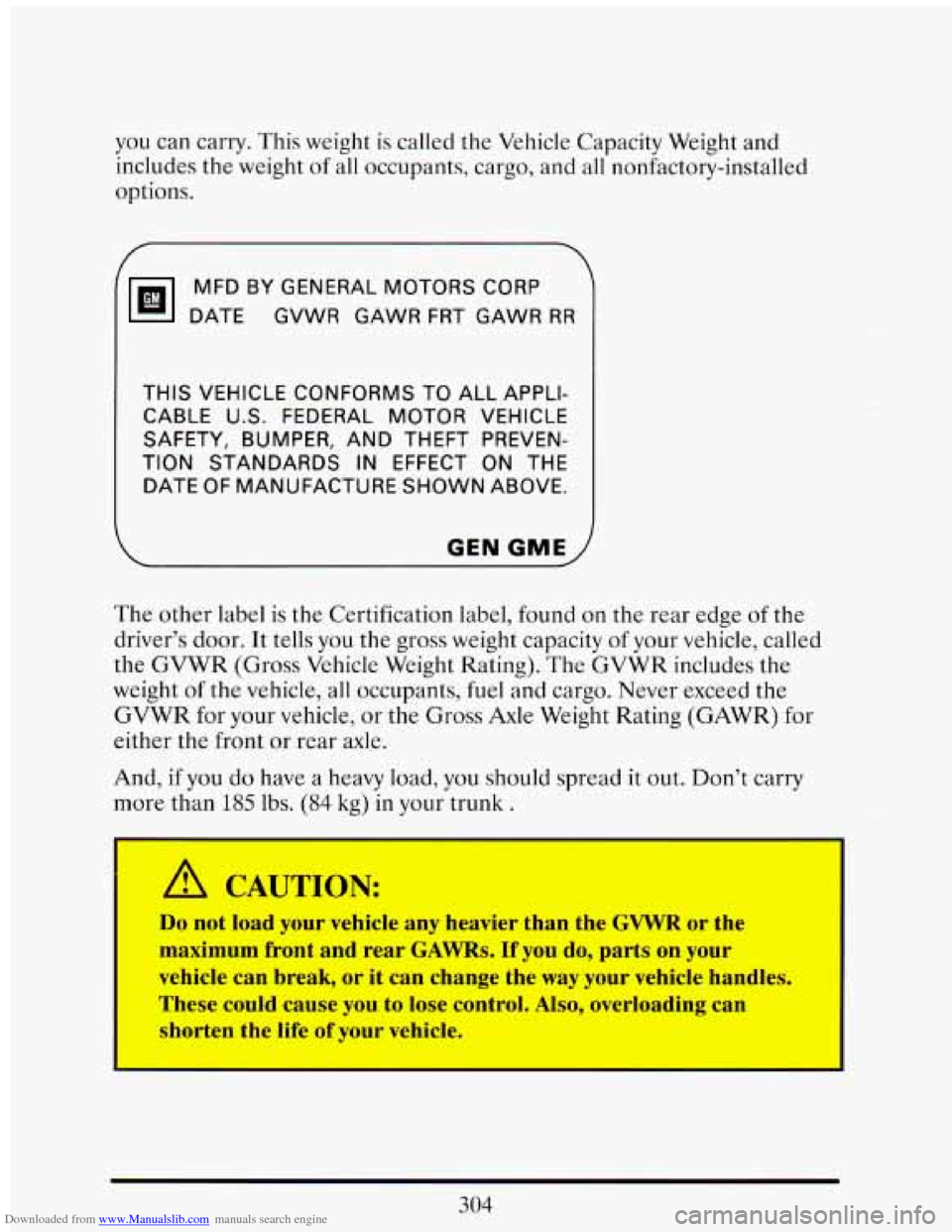
The other label is the Certification label, found on the rear edge of the
driver’s door. It tells you the gross weight capacity of your vehicle, called
the GVWR
(Gross Vehicle Weight Rating). The GVWR includes the
weight of the vehicle, all occupants, fuel and cargo. Never exceed the
GVWR
for your vehicle, or the Gross Axle Weight Rating (GAWR) for
either the front or rear axle.
And, if you do have a heavy load, you should spread it out. Don’t carry
more than
185 lbs. (84 kg) in your trunk.
A CAUTION:
Do not load your vehicle any heavier than the GVVVR or the
maximum front and rear GAWRs. If
you do, parts on your
vehicle can break, or it can change the way your vehicle handles.
These could cause
you to lose control. Also, overloading can
shorten the life of your vehicle.
304