wheel CADILLAC ELDORADO 1993 10.G Owner's Guide
[x] Cancel search | Manufacturer: CADILLAC, Model Year: 1993, Model line: ELDORADO, Model: CADILLAC ELDORADO 1993 10.GPages: 398, PDF Size: 20.66 MB
Page 229 of 398
Downloaded from www.Manualslib.com manuals search engine Passing
You’ll need more passing distance up ahead when you’re towing a trailer.
And, because you’re a good deal longer, you’ll need
to go much farther
beyond the passed vehicle before you can return to your lane.
Backing Up
Hold the bottom of the steering wheel with one hand. Then, to move the
trailer to the left, just move that hand to the left.
To move the trailer to
the right, move your hand to
the right. Always back up slowly and, if
possible, have someone guide you.
Making Turns
When you’re turning with a trailer, make wider turns than normal. Do
this so your trailer won’t strike soft shoulders, curbs, road signs, trees, or
other objects. Avoid jerky or sudden maneuvers. Signal well
in advance.
Turn Signals When Towing a Trailer
When you tow a trailer, your vehicle has to have a different turn signal
flasher and extra wiring. The green arrows on your instrument panel will
flash whenever
you signal a turn or lane change. Properly hooked up, the
trailer lights will also flash, telling other drivers you’re about to turn,
change lanes or stop.
When towing a trailer, the green arrows on your instrument panel will
flash for turns
even if the bulbs on the trailer are burned out. Thus, you
may think drivers behind you are seeing your signal when they are not.
It’s important to check occasionally to be sure the trailer bulbs are still
working.
Driving On Grades
Reduce speed and shift to a lower gear before you start down a long or
steep downgrade.
If you don’t shift down, you might have to use your
brakes
so much that they would get hot and no longer work well.
On a long uphill grade, shift down and reduce your speed to around
45
mph (70 km/h) or less to reduce the possibility of engine and transaxle
overheating.
215
Page 230 of 398
Downloaded from www.Manualslib.com manuals search engine If your trailer weighs more than 1,000 pounds (450 Kg) and you have an
automatic transaxle with Overdrive, you may want to drive
in “3” instead
of Overdrive (or, as you need to, a lower gear). This will help your
transmission.
Parking on Hills
You really should not park your vehicle, with a trailer attached, on a hill.
If something goes wrong, your rig could start to move. People can be
injured, and both your vehicle and the trailer can be damaged.
But
if you ever have to park your rig on a hill, here’s how to do it:
1. Apply your regular brakes, but don’t shift into “P” (Park) yet.
2. Have someone place chocks under the trailer wheels.
3. When the wheel chocks are in place, release the regular brakes until
4. Reapply the regular brakes. Then shift into “P” (Park) firmly and
apply your parking brake.
5. Release the regular brakes.
the
chocks absorb the load.
When You Are Ready to Leave Afier Parking on a Hill
1. Apply your regular brakes and hold the pedal down while you:
Start your engine;
Shift into a gear; and
Be sure the parking brake has released.
2. Let up on the brake pedal.
3. Drive slowly until the trailer is clear of the chocks.
4. Stop and have someone pick up and store the chocks.
216
Page 241 of 398
Downloaded from www.Manualslib.com manuals search engine If it won’t start after a few tries, it probably neeas service.
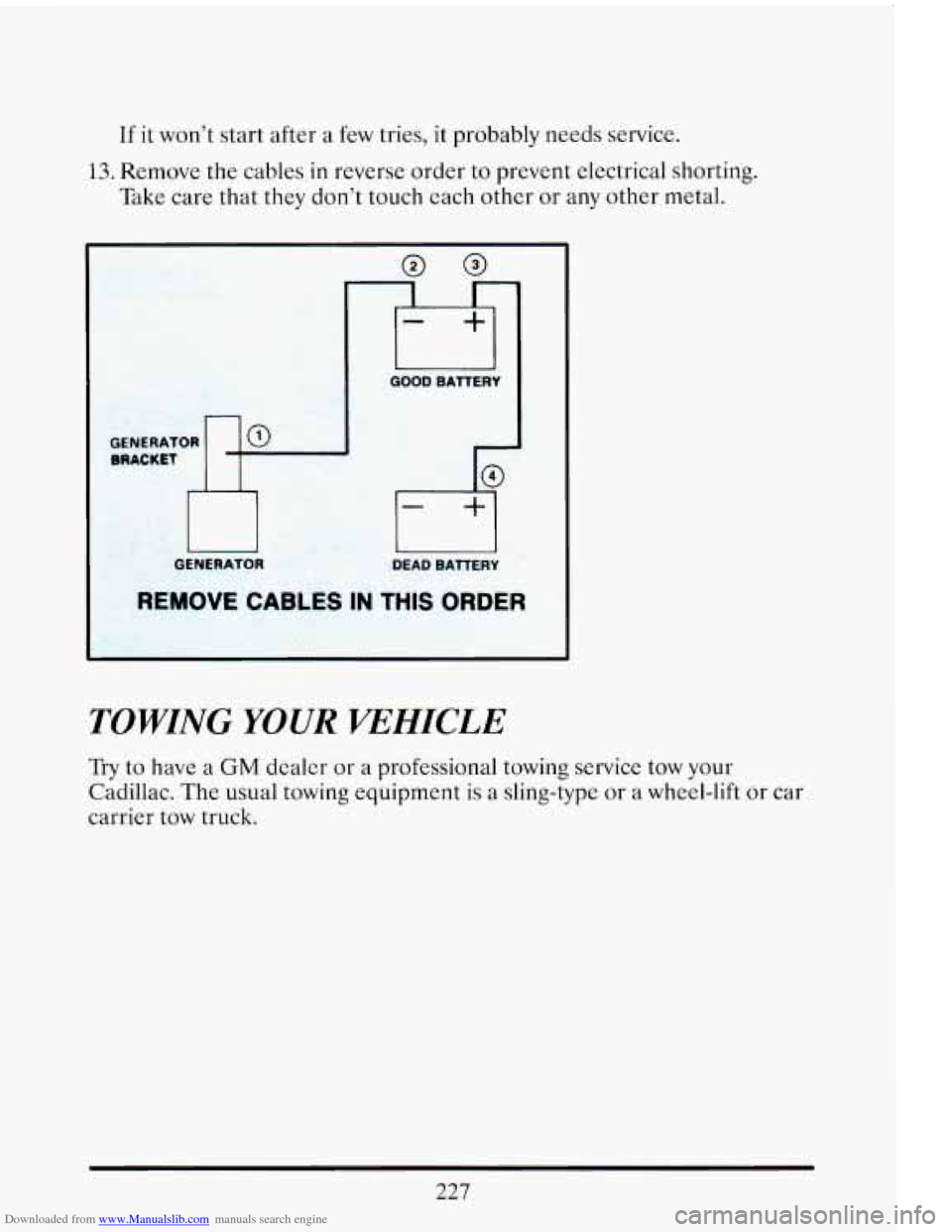
13. Remove the cables in reverse order to prevent electrical shorting.
%ke care that they don’t touch each other or any other metal.
GENERATOE
BRACKET
GENERATOR
I r
-+
GOOD BATTERY
@
- +
DEAD BATTERY
LMOVE CABLES IN THIS ORDER
TOWING YOUR VEHICLE
Try to have a GM dcalcr or a professional towing service tow your
Cadillac. The
usual towing equipment is a sling-type or a wheel-lift or car
carrier tow truck.
227
Page 242 of 398
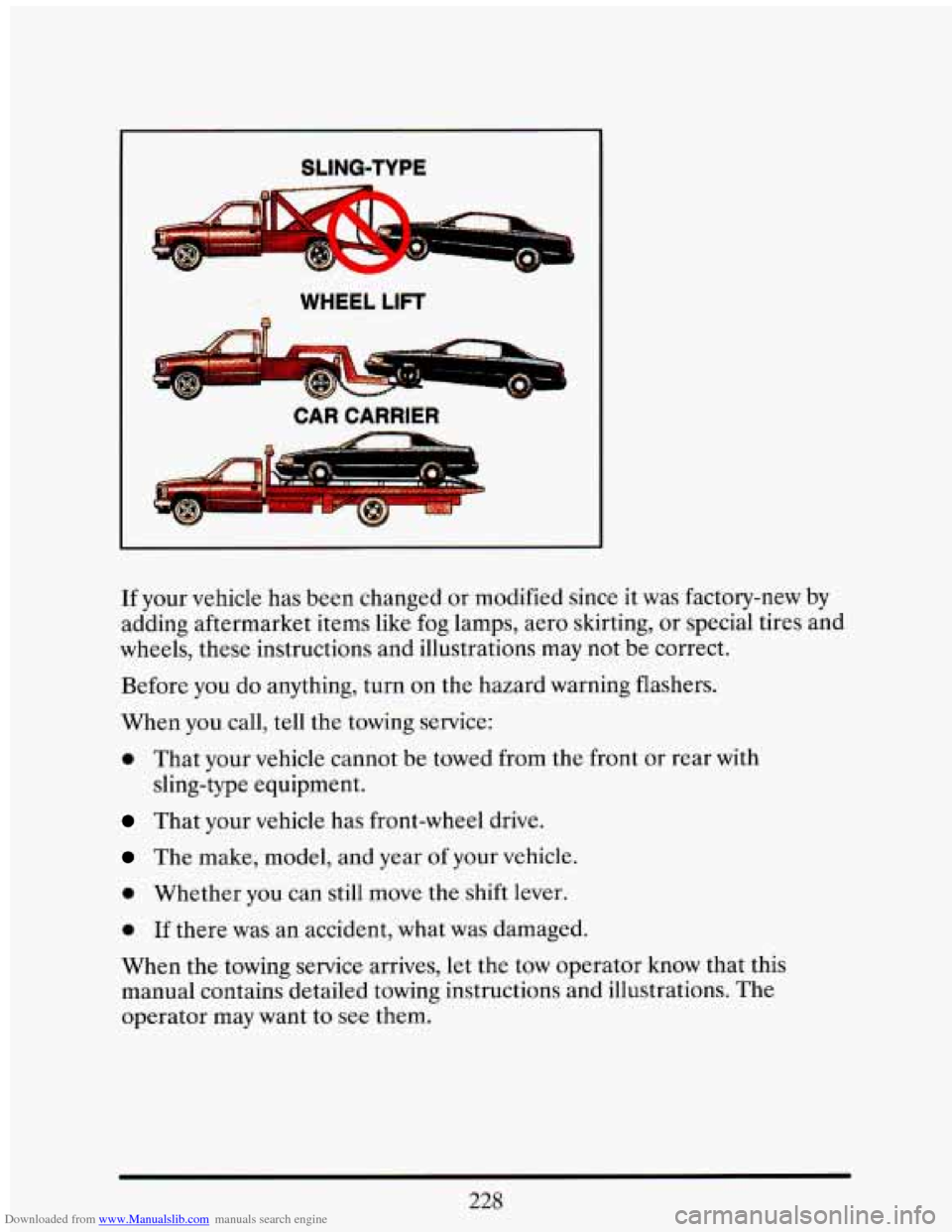
Downloaded from www.Manualslib.com manuals search engine I SLING-TYPE
WHEEL LIFT
If your vehicle has been changed or modified since it was factory-new by
adding aftermarket items like fog lamps, aero skirting, or spec\
ial tires and
wheels, these instructions and illustrations may not be correct.
Before
you do anything, turn on the hazard warning flashers.
When
you call, tell the towing service:
0 That your vehicle cannot be towed from the front or rear with
That your vehicle has front-wheel drive.
The make, model, and year of your vehicle.
0 Whether you can still move the shift lever.
sling-type equipment,
0 If there
was an accident, what was damaged.
When the towing service arrives, let the
tow operator know that this
manual contains detailed towing instructions and illustrations. The
operator may want
to see them.
228
Page 243 of 398
Downloaded from www.Manualslib.com manuals search engine r
I
I
r- 1-
i-
i-
1
A CAUTION:
To help avoid injury to you or others:
0
0
0
0
0
0
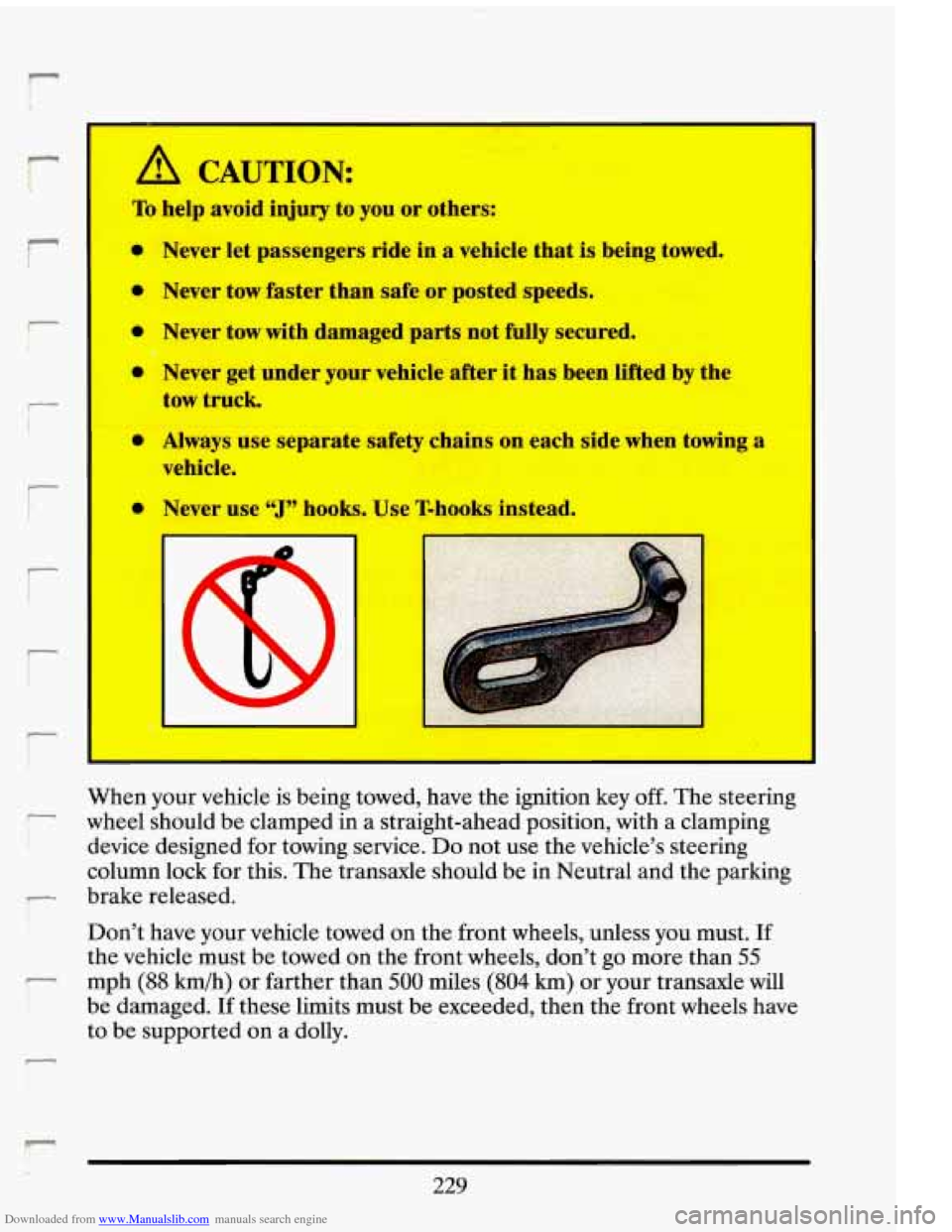
Never let passengers ride in a vehicle that is being towed.
Never tow faster than safe or posted speeds.
Never tow with damaged parts not fully secured.
Never get under your vehicle after it has been lifted by the
tow truck.
Always use separate safety chains on each side when towing a
vehicle.
Never use
“J” hooks. Use T-hooks instead.
When your vehicle is being towed, have the ignition key off. The steering
wheel should be clamped in
a straight-ahead position, with a clamping
device designed for towing service.
Do not use the vehicle’s steering
column lock for this. The transaxle should be in Neutral and the parking
-
F brake released.
Don’t have your vehicle towed on the front wheels, unless you must.
If
the vehicle must be towed on the front wheels, don’t go more than 55
mph (88 km/h) or farther than 500 miles (804 lun) or your transaxle will
be damaged.
If these limits must be exceeded, then the front wheels have
to. be supported on a dolly.
c
m
IC
229
Page 260 of 398
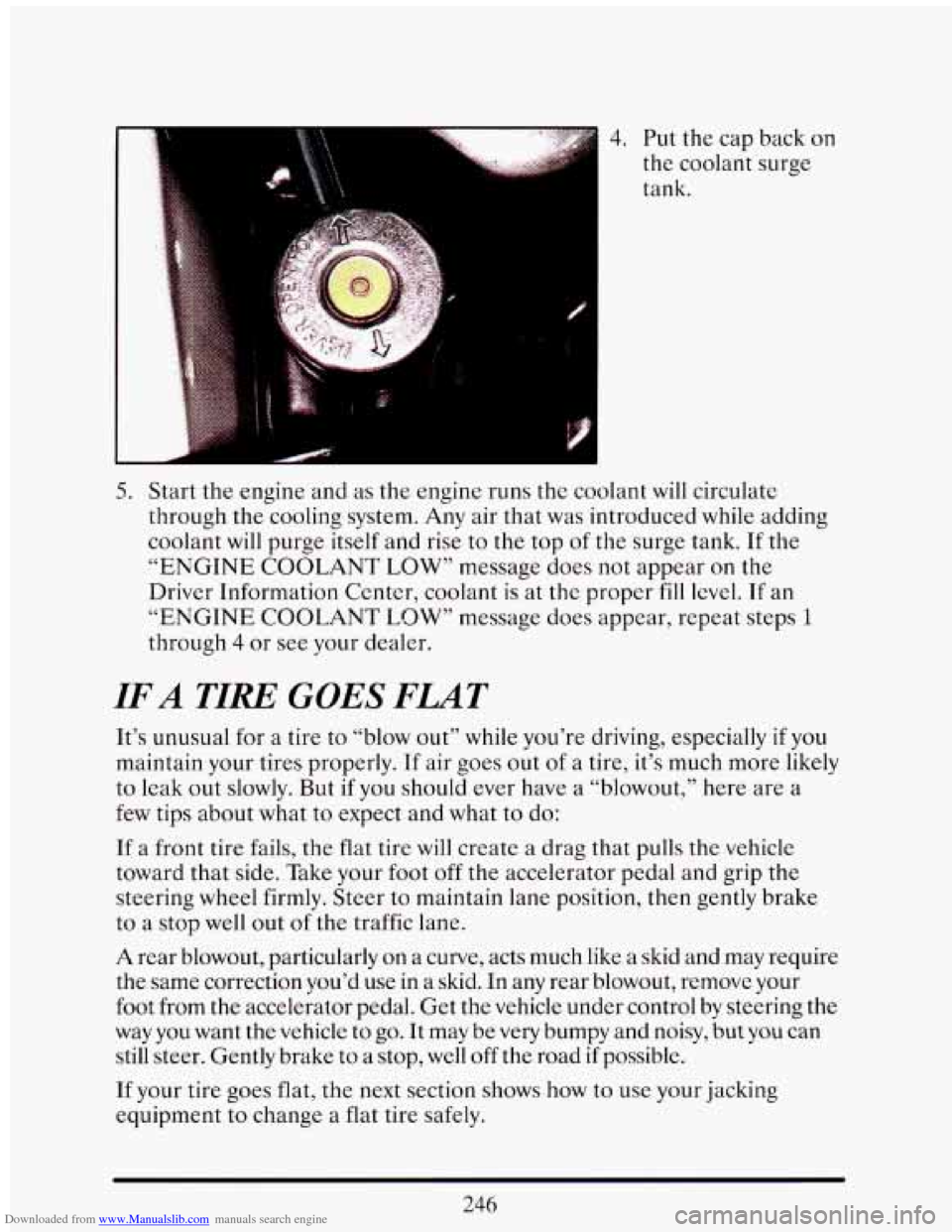
Downloaded from www.Manualslib.com manuals search engine 4. Put the cap back on
the coolant surge
tank.
5. Start the engine and as the engine runs the coolant will circulate
through the cooling system. Any air that was introduced while adding
coolant will purge itself and rise to the top of the surge tank.
If the
“ENGINE COOLANT LOW” message does not appear on the
Driver Information Center, coolant is at the proper
fill level. If an
“ENGINE COOLANT LOW” message does appear, repeat steps
1
through 4 or see your dealer.
IFA TIRE GOES FLAT
It’s unusual for a tire to “blow out7’ while you’re driving, especially if you
maintain
your tires properly. If air goes out of a tire, it’s much more likely
to leak out slowly. But if you should ever have a “blowout,” here are a
few tips about what to expect and what to do:
If a front tire fails, the flat tire
will create a drag that pulls the vehicle
toward that side. Take your foot off the accelerator pedal and grip the
steering wheel firmly. Steer to maintain lane position, then gently brake
to
a stop well out of the traffic lane.
A rear blowout, particularly on a curve, acts much like
a skid and may require
the same correction you’d use in a skid. In any rear blowout, remove your
foot from the accelerator pedal. Get the vehicle under control by steering the
way you want the vehicle
to go. It may be very bumpy and noisy, but you can
still steer. Gently brake to
a stop, well off the road if possible.
If your tire goes flat, the next section shows how to use your jacking
equipment to change a flat tire safely.
246
Page 261 of 398
Downloaded from www.Manualslib.com manuals search engine CMGING A FLAT TIRE
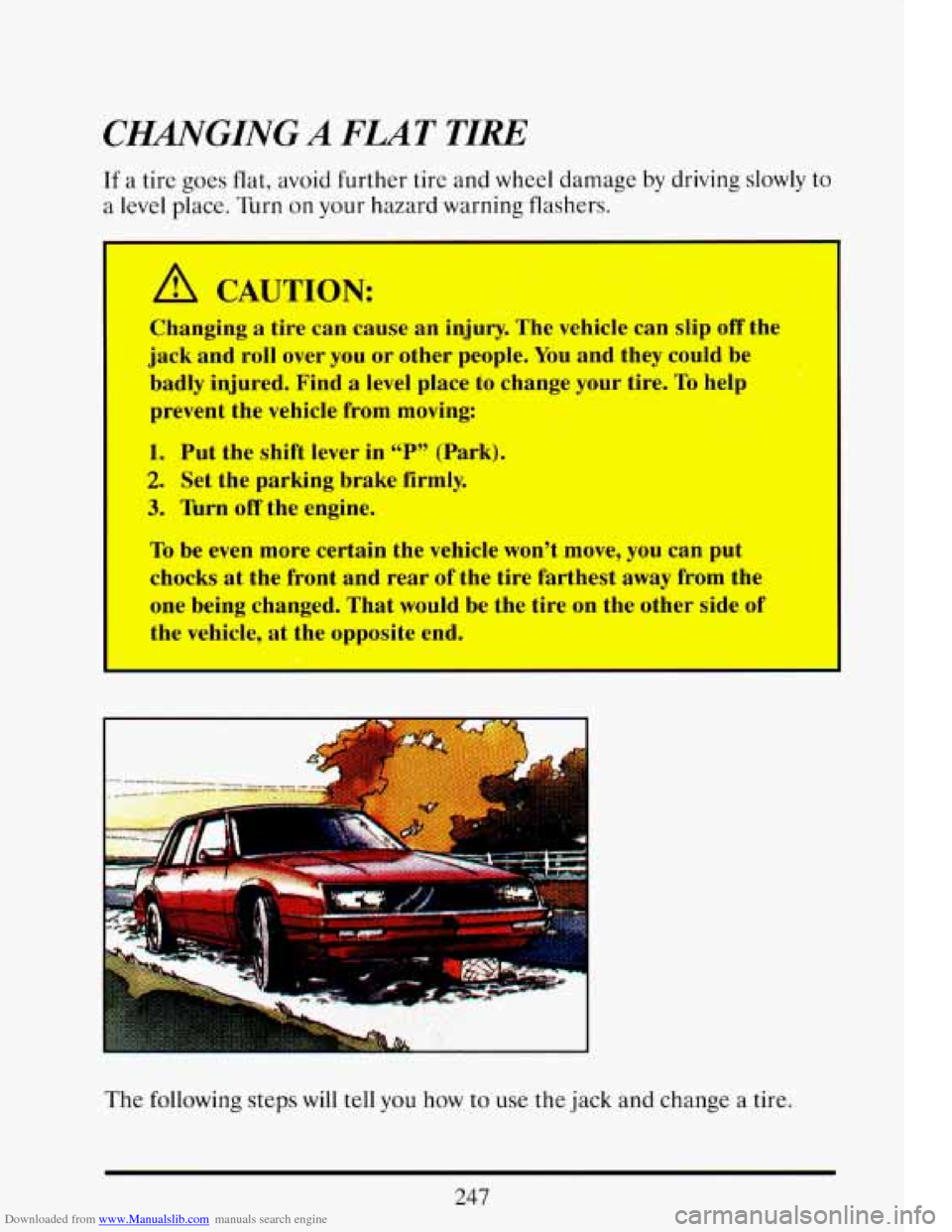
If a tire goes flat, avoid further tire and wheel damage by driving slowly to
a level place. Turn on your hazard warning flashers.
I
A CAUTION:
Changing a tire can cause an injury. The vehicle can slip off the
jack and roll over you or other people.
You and they could be
badly injured. Find
a level place to change your tire. To help
prevent the vehicle from moving:
1. Put the shift lever in "P" (Park).
2. Set the parking brake firmly.
3. Turn off the engine.
To be even more certain the vehicle won't move, you can put
chocks at the front and rear of the tire farthest
away from the
one being changed. That would be the tire on the other side of
the vehicle, at the opposite end.
The following steps will tell you how to use the jack and change a tire.
247
Page 263 of 398
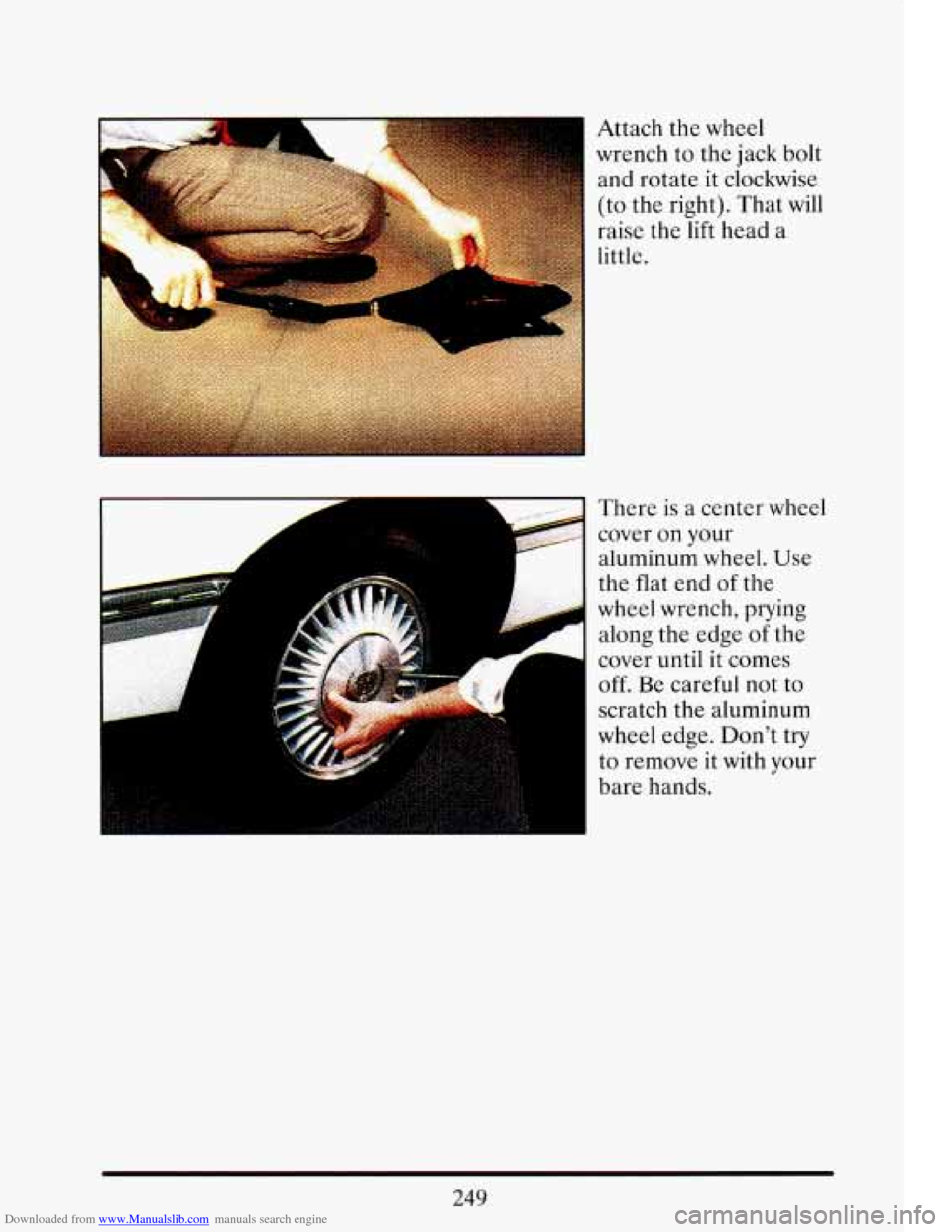
Downloaded from www.Manualslib.com manuals search engine Attach the wheel
wrench to
the jack bolt
and rotate it clockwise
(to the right). That
will
raise the lift head a
k.-....--."- -- There is a center wheel
*+ W cover on your
aluminum wheel.
Use
the flat end of the
wheel wrench, prying
along the edge
of the
cover until
it comes
off. Be careful not to
scratch the aluminum
wheel edge. Don't try
to remove it with
your
bare hands.
249
Page 264 of 398
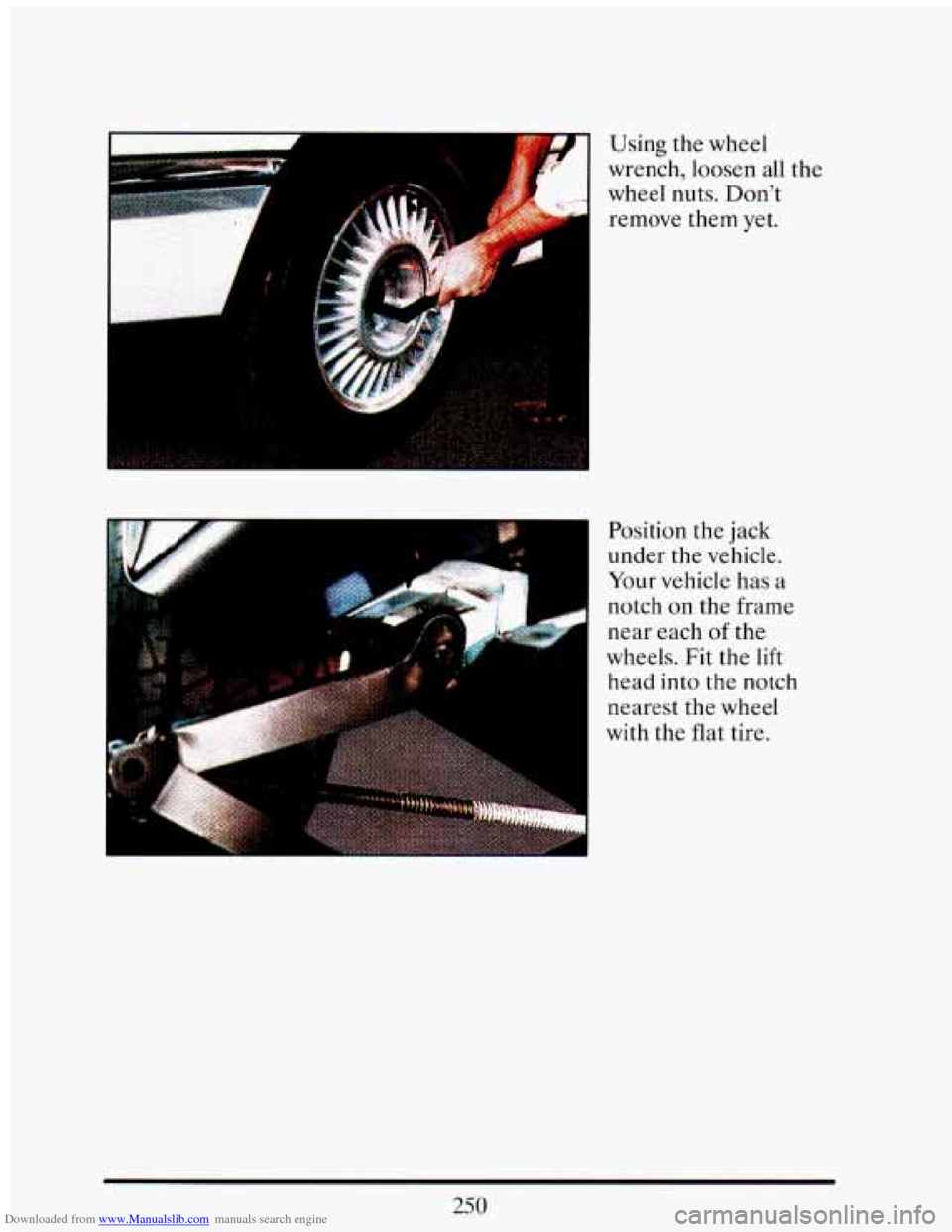
Downloaded from www.Manualslib.com manuals search engine .. Using the wheel
wrench, loosen all the
wheel nuts.
Don't
remove them yet.
Position
the jack
under the vehicle.
Your vehicle has a
notch on the frame
near each
of the
wheels. Fit the lift
head
into the notch
nearest the wheel
with the flat tire.
250
Page 265 of 398
Downloaded from www.Manualslib.com manuals search engine A CAUTION:
Getting under a vehicle when it is jacked up is dangerous., If the
vehicle slips
off the jack, you could be badly injured or killed.
Never get under
a vehicle when it is supported only by a iack.
I
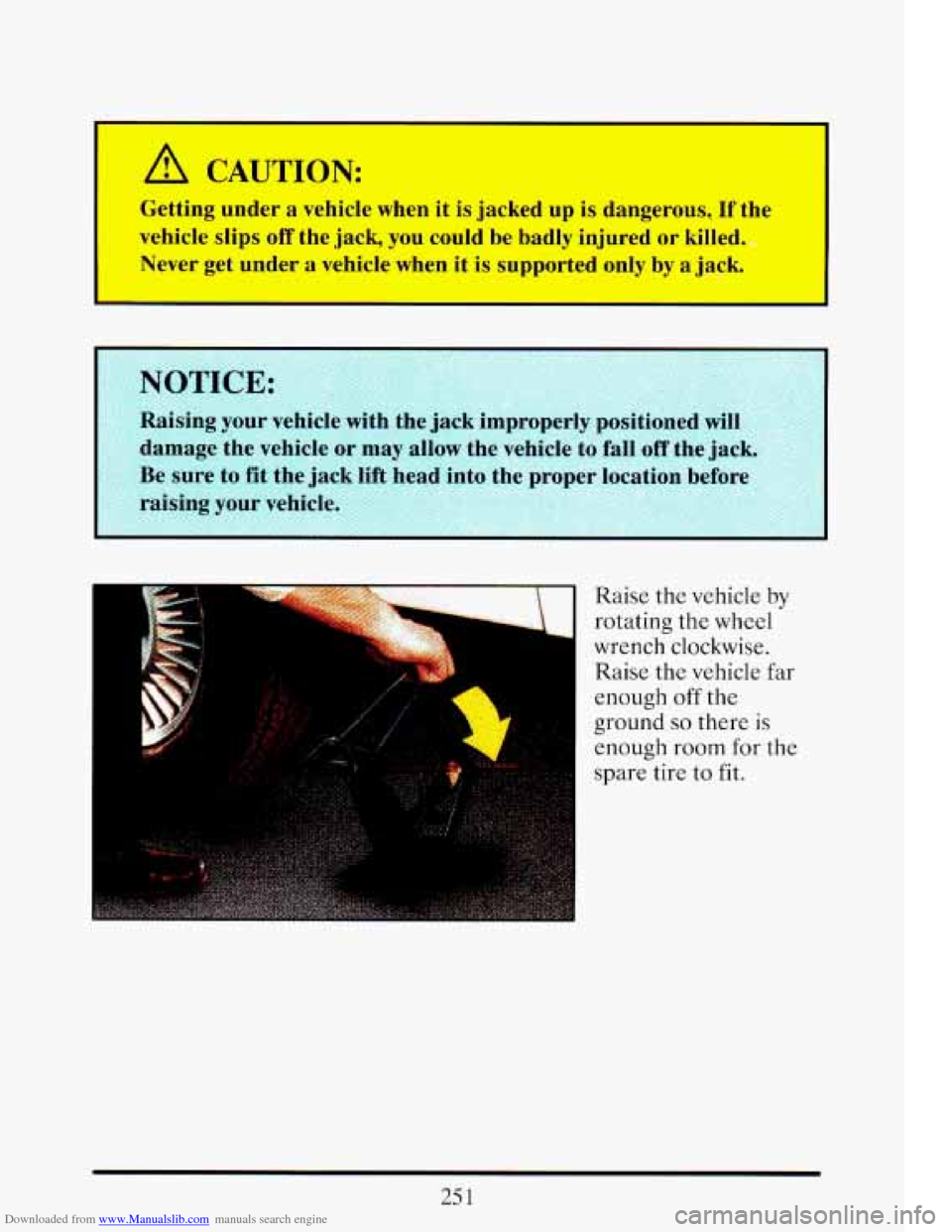
Raise the vehicle by
rotating the wheel
wrench clockwise.
Raise the vehicle far
enough
off the
ground
so there is
enough room for the
spare tire to fit.
25 1