wheel CADILLAC ELDORADO 1993 10.G User Guide
[x] Cancel search | Manufacturer: CADILLAC, Model Year: 1993, Model line: ELDORADO, Model: CADILLAC ELDORADO 1993 10.GPages: 398, PDF Size: 20.66 MB
Page 100 of 398
Downloaded from www.Manualslib.com manuals search engine If you are on a hill: See “Parking on Hills” in thc Index. That section
shows how to turn your front wheels.
If vou are towing a trailer and are parking; on anv hill: See “Towing a
Trailer” in the Index. That section shows what to do first to keep the
trailer from moving.
SHIFTING INTO ‘CPn (PARK)
I
A CAUTION:
It can be dangerous to get out of your vehicle if the shift lever is
not fully.in “P” (Park) with the parking brake firmly set. Your
vehicle can roll.
If you have left the engine running, the vehicle can move
suddenly.
You or others could be injured. To be sure your vehicle
won’t move, when you’re on fairly level ground, use the
steps
that follow. If you are parking on a hill, or if you’re pulling a
trailer, also see “Parking On Hills” or “Towing a Wailer” in the
Index.
-.
Steering Column Shifl Lever
1. Hold the brake pedal down with your right foot.
86
Page 107 of 398
Downloaded from www.Manualslib.com manuals search engine POWER WINDOWS
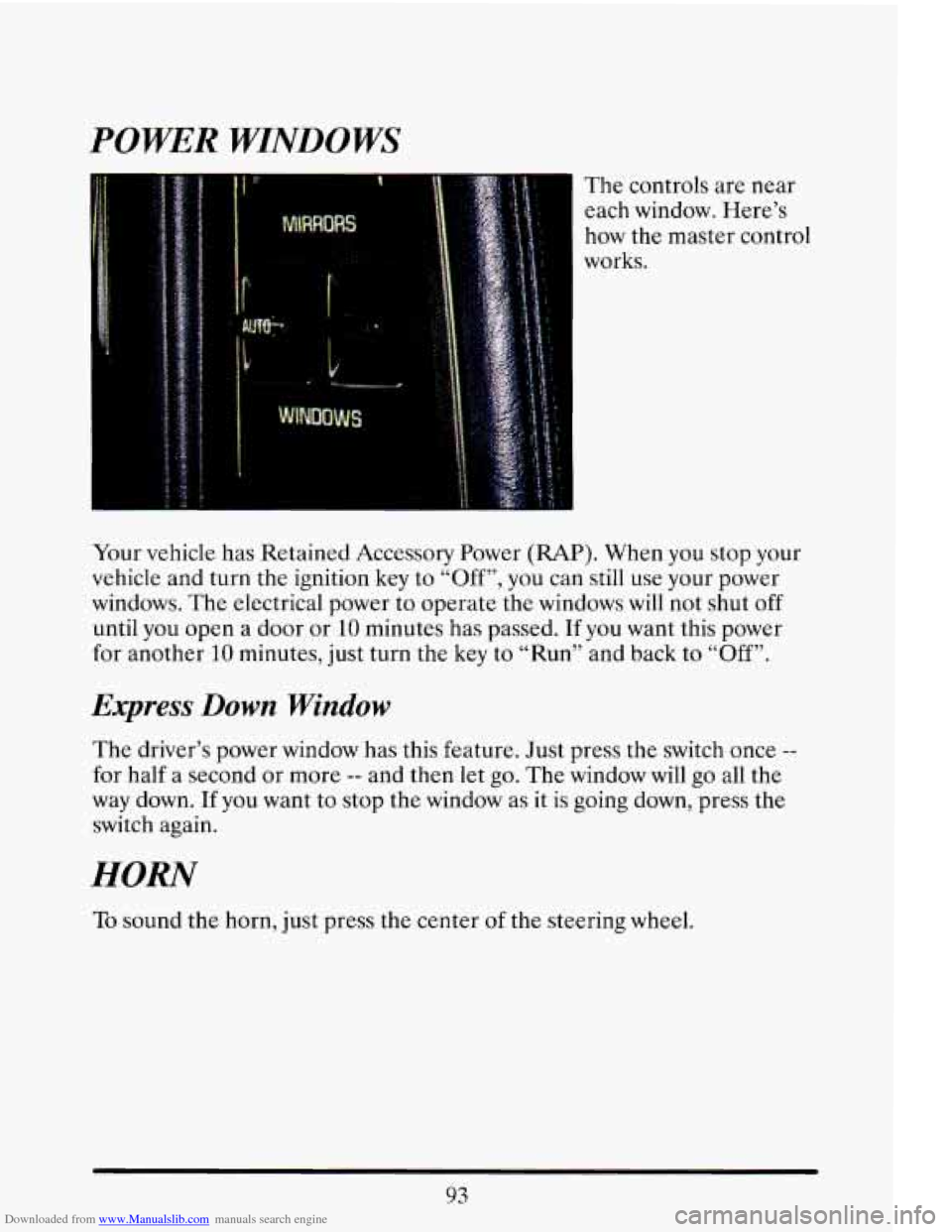
The controls are near each window. Here’s
how the master control
I works.
Your vehicle has Retained Accessory Power
(RAP). When you stop your
vehicle and turn the ignition key to “Off”, you can still use your power
windows. The electrical power to operate the windows will not shut
off
until you open a door or 10 minutes has passed. If you want this power
for another
10 minutes, just turn the key to “Run” and back to “Off”.
Express Down Window
The driver’s power window has this feature. Just press the switch once --
for half a second or more -- and then let go. The window will go all the
way down. If you want to stop the window as it is going down, press the
switch again.
HORN
To sound the horn, just press the center of the steering wheel.
93
Page 108 of 398
Downloaded from www.Manualslib.com manuals search engine TILT WHEEL
1
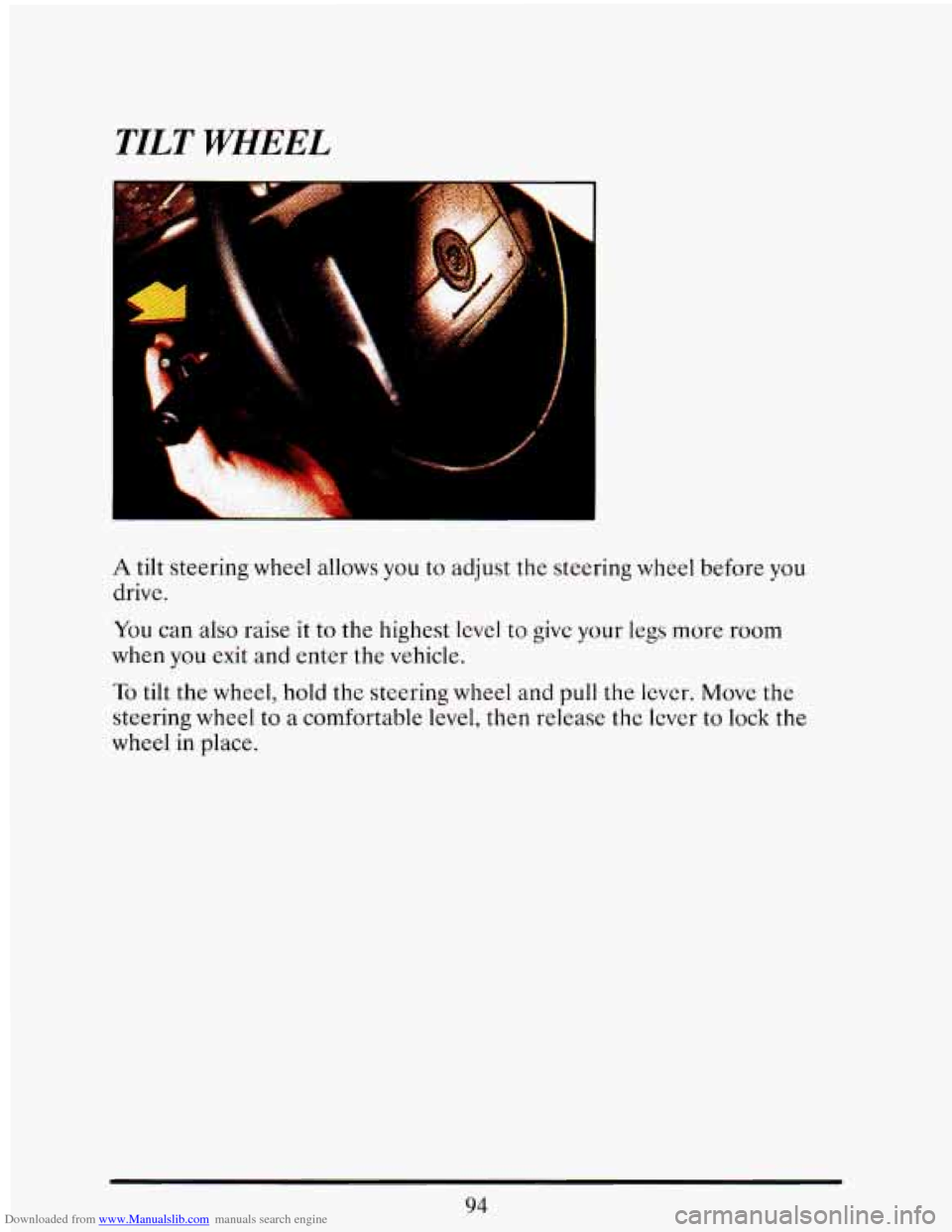
A tilt steering wheel allows you to adjust the steering wheel before you
drive.
You can also raise it to the highest level to give your legs more room
when you exit and enter the vehicle.
To tilt the wheel, hold the steering wheel and pull the levcr. Move the
steering wheel to a comfortable level, then release the lcver to lock the
wheel
in place.
94
Page 115 of 398
Downloaded from www.Manualslib.com manuals search engine CRUISE CONTROL
With Cruise Control, you can maintain a speed of about 25 mph (40
kmih) or more without keeping your foot on the accelerator. This can
really help on long trips. Cruise Control does not work at speeds below
about
25 mph (40 km/h).
When you apply your brakes, the Cruise Control shuts off.
Cruise Control can be dangerous where you can’t drive safely
at a steady speed.
So, don’t use your Cruise Control on
winding roads or in heavy traffic.
Cruise Control can be dangerous on slippery roads. On such
roads, fast changes in tire traction can cause needless wheel
spinning, and
you could lose control. Don’t use Cruise
Control on slippery roads.
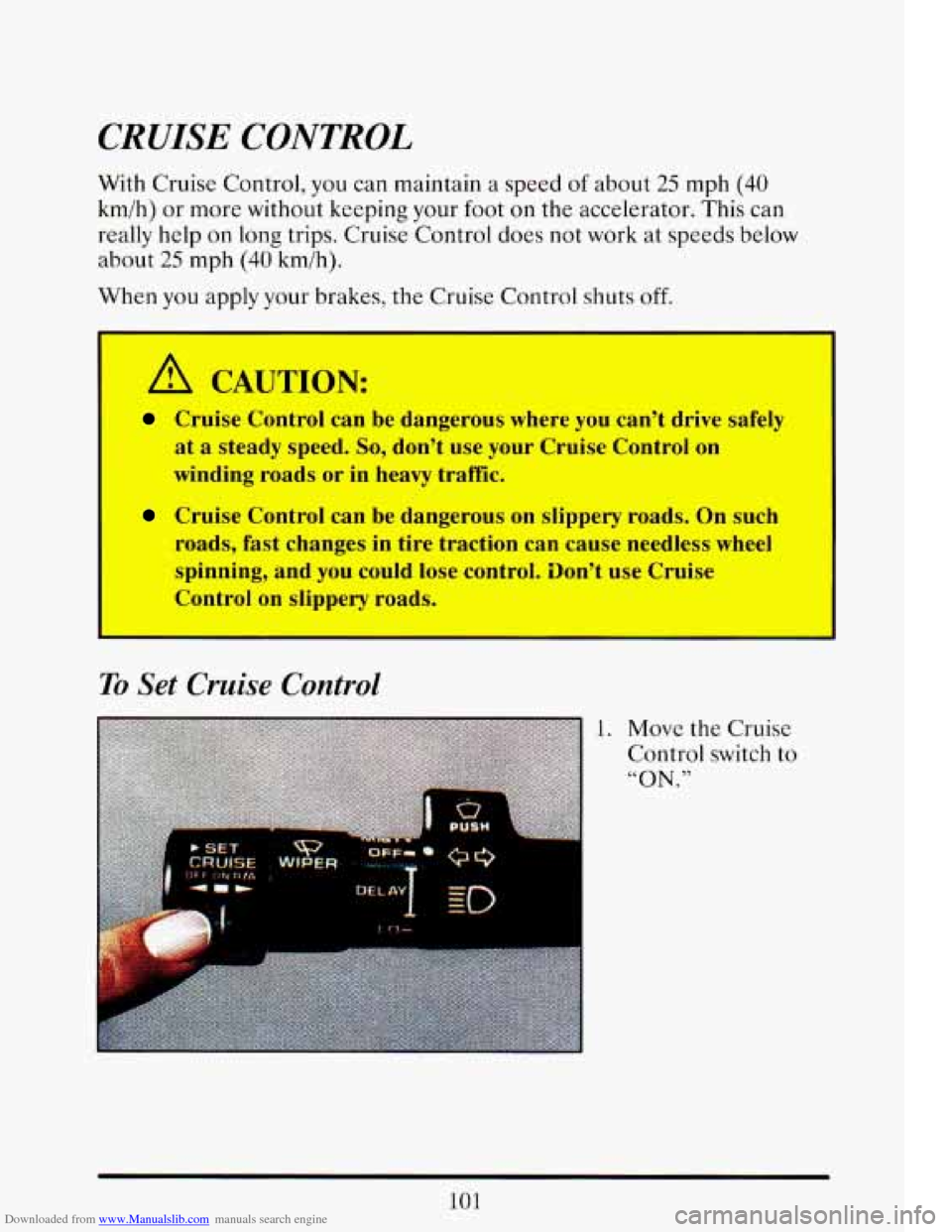
To Set Crucse Control
1. Move the Cruise
Control switch
to
“ON ”
101
Page 133 of 398
Downloaded from www.Manualslib.com manuals search engine GARAGE DOOR OPENER (OPTION)
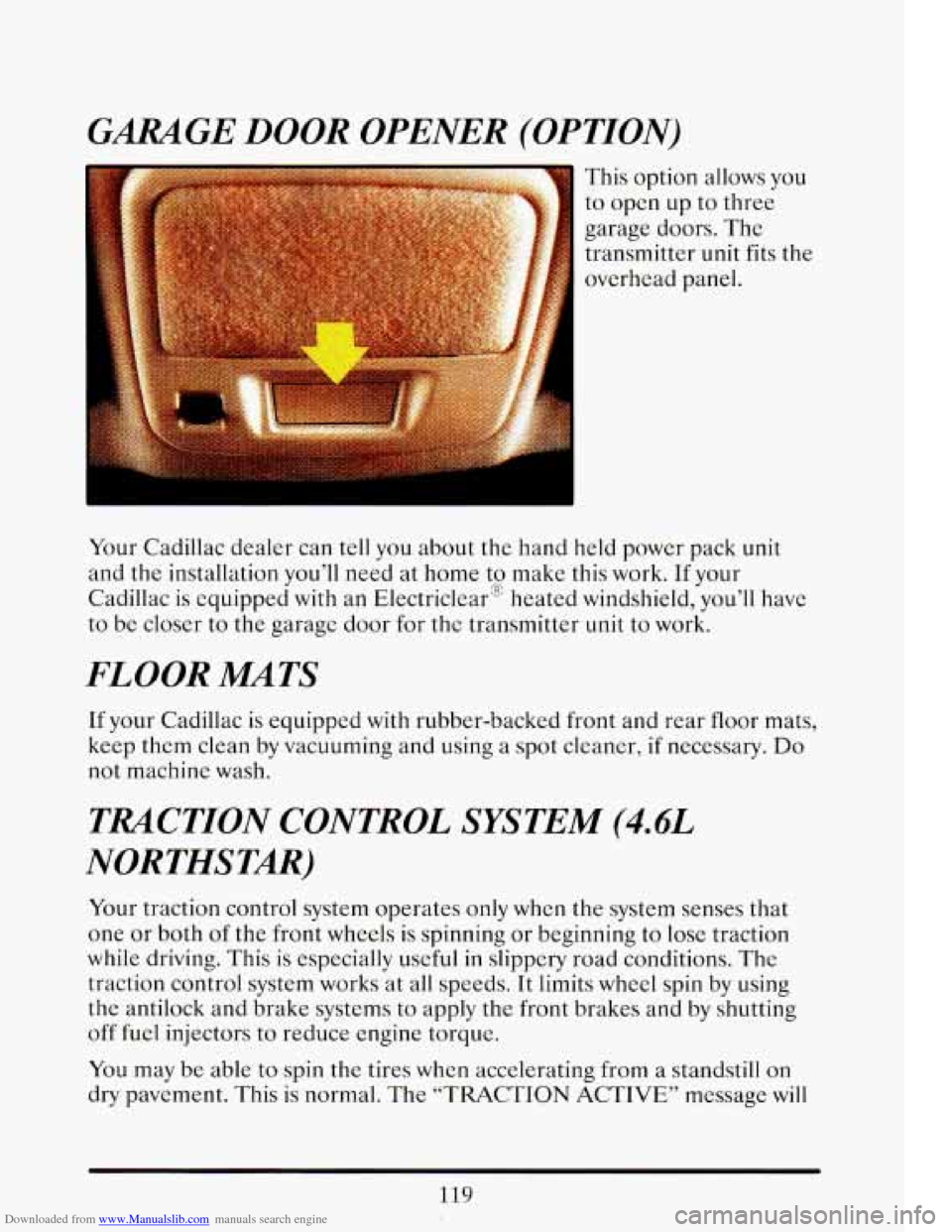
This option allows you
to open up to three
garage doors. The transmitter unit fits the
overhead panel.
Your Cadillac dealer can tell you about the hand held power pack unit
and the installation you’ll need at home to make this work.
If your
CadilIac
is equipped with an Electriclear” heated windshield, you’ll have
to be closer to the garage door for the transmitter unit
to work.
FLOOR MATS
If your Cadillac is equipped with rubber-backed front and rear floor mats,
keep them clean by vacuuming and using a spot cleaner,
if necessary. Do
not machine wash.
TRACTION CONTROL SYSTEM (4.4L
NORTHSTAR)
Your traction control system operates only when the system senses that
one or both of the front wheels
is spinning or beginning to lose traction
while driving. This is especially useful
in slippery road conditions. The
traction control system works at all speeds.
It limits wheel spin by using
the antilock and brake systems to apply the front brakes and by shutting
off
fuel injectors to reduce engine torque.
You may be able to spin the tires when accelerating from a standstill on
dry pavement. This is normal. The “TRACTION ACTIVE” message will
119
Page 152 of 398
Downloaded from www.Manualslib.com manuals search engine STOP ENGINE LOW OIL PRESSURE
If this message appears while the engine is running, stop the engine and
do not operate it until the cause of low oil pressure is corrected. Severe
damage to the engine can result.
SERVICE SUPPLEMENTAL INFLATABLE RESTRAINT
If this message appears, there is a problem with your Supplemental
Inflatable Restraint (Air Bag) system. Let only a qualified technician
work on your vehicle. See your Cadillac dealer for service at once.
THEFT SYSTEM PROBLEM/CAR MAY NOT RESTART
This message means there is atroblem in the Personalized Automotive
Security System (PASS Key
I1 ). PASS Key I1 TM will prevent the vehicle
from restarting if it is turned off,
so you should take the vehicle to a
proper service center before turning the engine off. Never leave an
unattended vehicle with the engine running. Once you are where you can
get service, turn the engine
off and then try to restart it. If the vehicle
does not restart, the PASS Key
I1 TM system will need servicing.
TRACTION ACTIVE
If your vehicle is equipped with Traction Control, this message will be
displayed if Traction Control is being used to reduce wheel slippage.
TRACTION DISABLED
If your vehicle is equipped with Traction Control, this message will be
displayed if
a problem is noted in the Traction Control System. Have your
vehicle serviced as soon as possible.
TRANS FLUID RESET (Northstar Only)
With the engine not running and the ignition ON, press and hold the
OFF and REAR DEFOG buttons until the TRANS FLUID RESET
message appears in the Information Center (between 5 and 20 seconds).
TRANS OVERHEATED (Northstar Only)
This message indicates that your transaxle is running too hot. You should
stop and turn your engine
off as soon as possible. Let the engine and
transaxle cool and have the problem corrected. Severe transaxle damage
can result from an overheated transaxle
138
Page 153 of 398
Downloaded from www.Manualslib.com manuals search engine TURN SIGNAL ON
This message is a reminder, after driving about a mile that you have your
turn
signal on.
TRUNK OPEN
This message indicates that your trunk is opcn when the Ignition is ON.
VERY LOW REFRIGERANT
This message means that the Air Conditioning system detects a
refrigerant level that is low enough to cause damage to the A/C
compressor.
To avoid damage, the A/C compressor automatically turns
off and the Electronic Climate Control will automatically switch from
“AUTO” to “ECON” and remain there. Have your
A/C system serviced if
this message appears.
Speed Sensitive Steering (SSS)
This system varies the amount of steering effort proportionate to your
vehicle speed. Steering is easier at
a lower speed for increased
maneuverability and parking ease.
As your vehicle speed increases, the
steering effort
is also increased proportionately. At highway speeds the
amount
of steering effort is greatly increased to provide a manual like
steering feel for maximum control
an enhanced vehicle stability.
Road Sensing Suspension (Northstar Only)
The Road Sensing Suspension automatically controls the ride of your
vehicle.
The system controls damping forces in the shock absorbers and
struts in response to various road and driving conditions. The system is
capable
of making these changes within milli-seconds.
The
Road Sensing Suspension controller is a computer used to control
and monitor the system. The computer receives inputs from vertical
acceleration sensors, wheel
to body position sensors, vehicle speed
sensor, lift and dive signals, and determines optimum strut valving or
(suspension stiffness) for your current operating conditions.
The
computer also receives feedback from the various components to
determine proper system operation. If the computer receives an incorrect
feedback from the system, an error code will be
set in memory and a
“SERVICE RIDE CONTROC’ message will display on the Driver
139
Page 194 of 398
Downloaded from www.Manualslib.com manuals search engine C I I
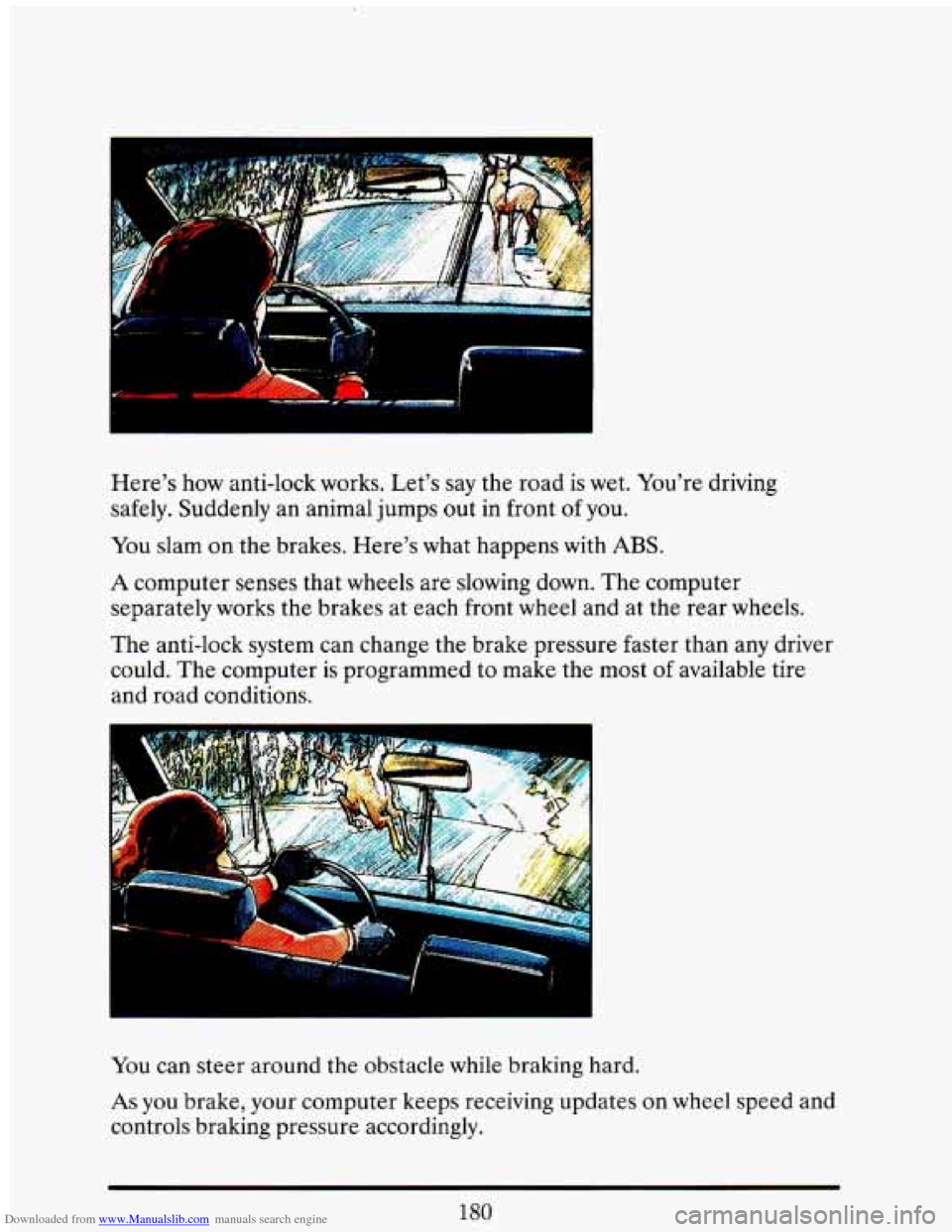
Here’s how anti-lock works. Let’s say the road is wet. You’re driving
safely. Suddenly an animal jumps out in front
of you.
You slam on the brakes. Here’s what happens with
ABS.
A computer senses that wheels are slowing down. The computer
separately works the brakes at each front wheel and at the re\
ar wheels.
The anti-lock system can change the brake pressure faster than any driver
could. The computer is programmed to make the most of available tire
and road conditions.
You can steer around the obstacle while braking hard.
As you brake, your computer keeps receiving updates on wheel speed and
controls braking pressure accordingly.
180
Page 195 of 398
Downloaded from www.Manualslib.com manuals search engine I
A CAUTION:
Anti-lock doesn’t change the time you need to get your foot up to
the brake pedal. If you get too close
to the vehicle in front of
you, you won’t have time to apply your brakes
if that vehicle
suddenly slows or stops.
Always leave enough room up ahead to
stop, even though you have anti-lock brakes.
I
To Use Anti-Lock:
Don’t pump the brakes. Just hold the brake pedal down and let anti-lock
work for you.
You may hear the anti-lock pump or motor operate. and
feel the brake pedal pulsate, but this is normal.
Disc Brake Wear Indicators
Your Cadillac has four-wheel disc brakes.
Disc brake pads have built-in wear indicators that make a high-pitched
warning sound when the brake pads are worn and new pads are needed.
The sound may come and
go or be heard all the time your vehicle is
moving (except when you
are pushing on the brake pedal firmly).
UJTION:
The brake wear warning sound means that sooner or later YL-,
brakes won’t work well. That could lead to an accident. When
you hear the brake wear warning sound, have your vehicle
serviced.
NOTICE:
181
Page 197 of 398
Downloaded from www.Manualslib.com manuals search engine Steering Tips
Driving on Curves
It’s important to take curves at a reasonable speed.
A lot of the “driver lost control” accidents mentioned on the news
happen on curves. Here’s why:
Experienced driver or beginner, each of
us is subject to the same laws of
physics when driving on curves. The traction
of the tires against the road
surface makes it possible for the vehicle to change its path
when you turn
the front wheels. If there’s
no traction, inertia will keep the vehicle going
in the same direction.
If you’ve ever tried to steer a vehicle on wet ice,
you’ll understand this.
The traction you can get in a curve depends on the condition
of your tires
and the road surface,
the angle at which the curve is banked, and your
speed. While you’re in a curve, speed is the one factor you can control.
Suppose you’re steering through
a sharp curve. Then you suddenly
accelerate.
Those two control systems -- steering and acceleration -- can overwhelm
those places where the tires meet the road and make you lose control.
What should you do if this ever happens? Let up on the accelerator
pedal, steer the vehicle the way
you want it to go, and slow down.
Speed limit signs near curves warn that you should adjust your speed.
Of
course, the posted speeds are based on good weather and road
conditions. Under less favorable conditions you’ll want to go slower.
If you need to reduce your speed as you approach
a curve, do it before
you enter the curve, while your front wheels are straight ahead.
Try to adjust your speed so you can “drive” through the curve. Maintain a
reasonable, steady speed. Wait to accelerate until you are out
of the
curve, and then accelerate gently into the straightaway.
When you drive into a curve at night, it’s harder to see the road ahead of
you because it bends away from the straight beams of your lights. This is
one good reason
to drive slower.
183