steering CADILLAC ELDORADO 1995 10.G Owner's Manual
[x] Cancel search | Manufacturer: CADILLAC, Model Year: 1995, Model line: ELDORADO, Model: CADILLAC ELDORADO 1995 10.GPages: 395, PDF Size: 20.17 MB
Page 224 of 395
Downloaded from www.Manualslib.com manuals search engine Driving with a Trailer
n Towing a trailer requires a certain amount of experience. Before setting
out for the open road, you’ll want to get to
know your rig. Acquaint
yourself with the feel
of handling and braking with the added weight of
the trailer. And always keep in mind that the vehicle you are driving is
now a good deal longer and not nearly as responsive as your vehicle is by
itself.
Before you start, check the trailer hitch and platform (and attachments),
safety chains, electrical connector, lamps, tires and mirror adjustment. If
the trailer has electric brakes, start your vehicle and trailer moving and
then apply the trailer brake controller by hand to be sure the brakes are
working. This lets you check your electrical connection at the same time.
. During your trip, check occasionally to be sure that the load is secure, and
that the lights and any trailer brakes are still working.
Following Distance
Stay at least twice as far behind the vehicle ahead as you would when
driving your vehicle without a trailer. This can help you avoid situations
that require heavy braking and sudden turns.
Passing
You’ll need more passing distance up ahead when you’re towing a trailer.
And, because you’re a good deal longer, you’ll need to
go much farther
beyond the passed vehicle before you can return to your lane.
Backing Up
Hold the bottom of the steering wheel with one hand. Then, to move the
trailer to the left, just move that hand to the left.
To move the trailer to
the right, move your hand to the right. Always back up slowly and,
if
possible, have someone guide you.
4-37
Page 238 of 395
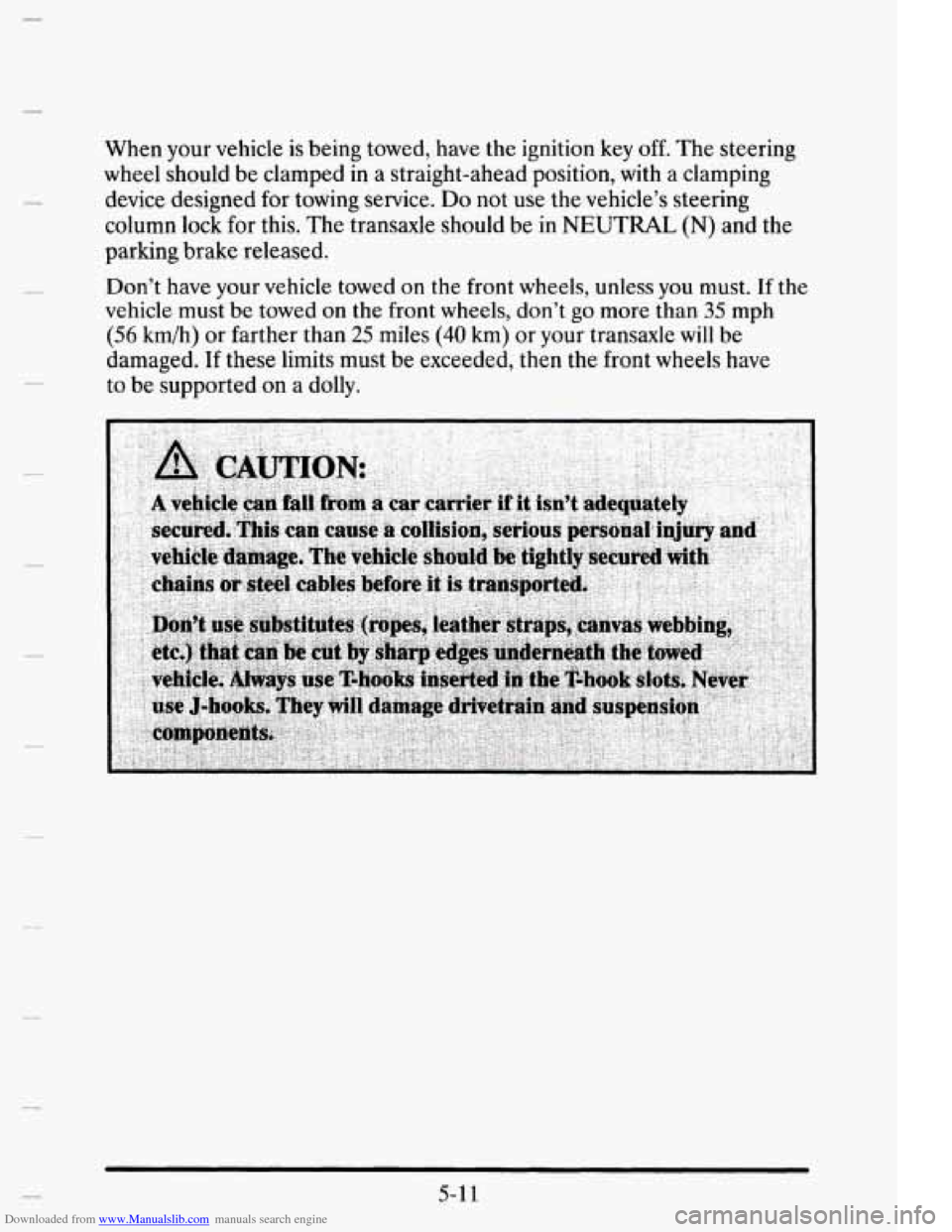
Downloaded from www.Manualslib.com manuals search engine When your vehicle is being towed, have the ignition key off. The steering
wheel should
be clamped in a straight-ahead position, with a clamping
device designed for towing service.
Do not use the vehicle’s steering
column lock
for this. The transaxle should be in NEUTRAL (N) and the
parking brake released.
Don’t have your vehicle towed
on the front wheels, unless you must. If the
vehicle must
be towed on the front wheels, don’t go more than 35 mph
(56 km/h) or farther than 25 miles (40 km) or your transaxle will be
damaged. If these limits must be exceeded, then the front wheels have
to be supported on a dolly.
5-1 1
Page 248 of 395
Downloaded from www.Manualslib.com manuals search engine .. i
k
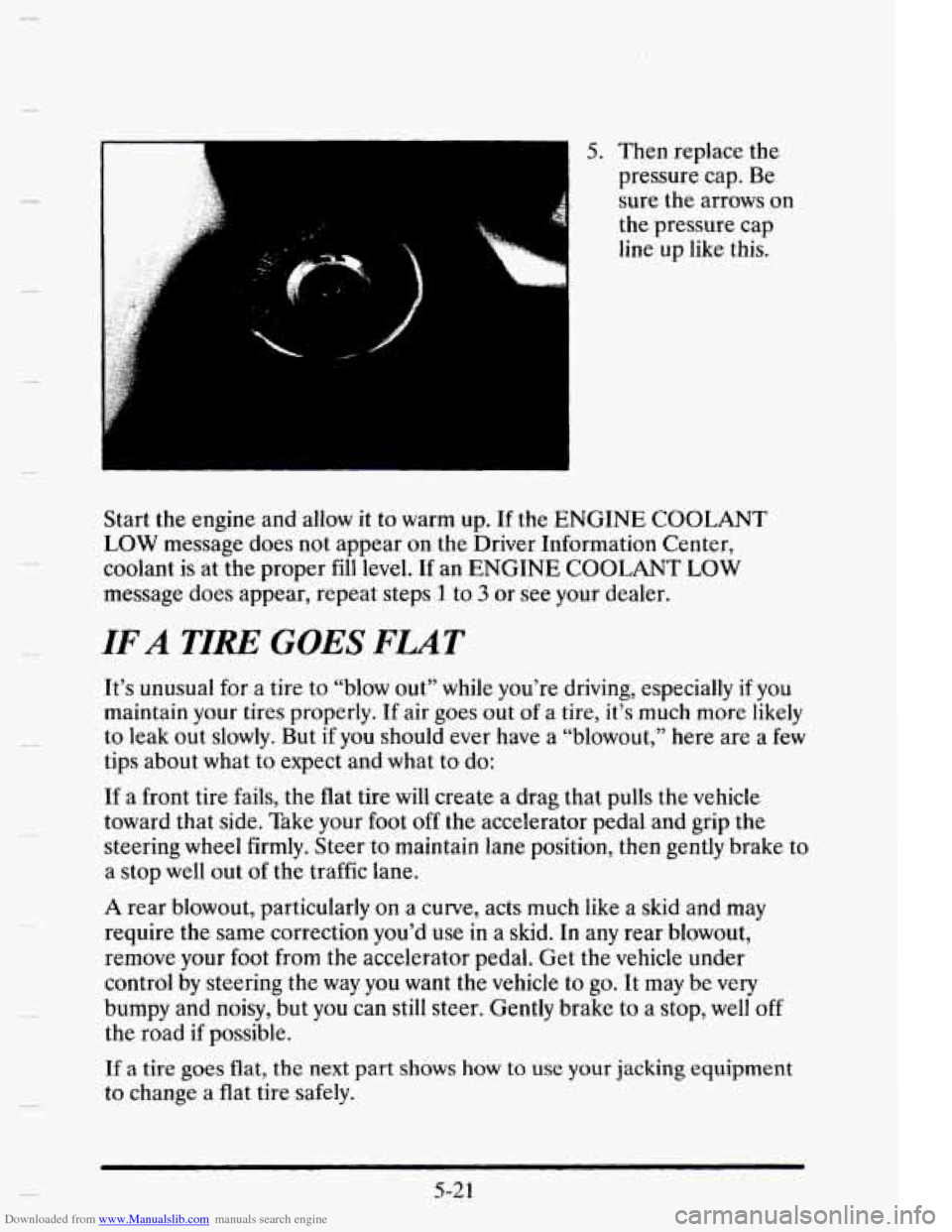
5. Then replace the
pressure cap. Be
sure
the arrows on
the pressure cap
line up
like this.
Start the engine and allow
it to warm up. If the ENGINE COOLANT
LOW message does not appear on the Driver Information Center,
coolant
is at the proper fill level. If an ENGINE COOLANT LOW
message does appear, repeat steps 1 to 3 or see your dealer.
IF A TIRE GOES FLAT
It’s unusual for a tire to “blow out” while you’re driving, especially if you
maintain your tires properly.
If air goes out of a tire, it’s much more likely
to leak out slowly. But
if you should ever have a “blowout,” here are a few
tips about what to expect and what to do:
If a front tire fails, the flat tire will create a drag that pulls the vehicle
toward that side. Take your foot
off the accelerator pedal and grip the
steering
wheel firmly. Steer to maintain lane position, then gently brake to
a stop well out of
the traffic lane.
A rear blowout, particularly on a curve, acts much like a skid and may
require the same correction you’d use
in a skid. In any rear blowout,
remove your foot from the accelerator pedal. Get the vehicle under
control by steering
the way you want the vehicle to go. It may be very
bumpy and noisy, but you can still steer. Gently brake to a stop, well off
the road if possible.
If a tire goes flat, the next part shows how to use your jacking equipment
to change a flat tire safely.
5-2 1
Page 259 of 395
Downloaded from www.Manualslib.com manuals search engine NOTICE:
Spinning your wheels can destroy parts of your vehicle as well
as the tires. If you spin the wheels too fast while shifting your
transaxle back and forth, you
can destroy your transaxle.
For information about using tire chains on your vehicle, see “Tire Chains”
in the Index.
Rocking your vehicle to get it out:
First, turn your steering wheel left and right. That will clear the area around
your front wheels. Then shift back and forth between
REVERSE (R)
and a forward gear, spinning the wheels as little as possible. Release the
accelerator pedal while
you shift, and press lightly on the accelerator pedal
when the transaxle
is in gear. If that doesn’t get you out after a few tries, you
may need
to be towed out. If you do need to be towed out, see “Towing Your
Vehicle”
in the Index.
Page 268 of 395
Downloaded from www.Manualslib.com manuals search engine Fluid Usage Label
LI
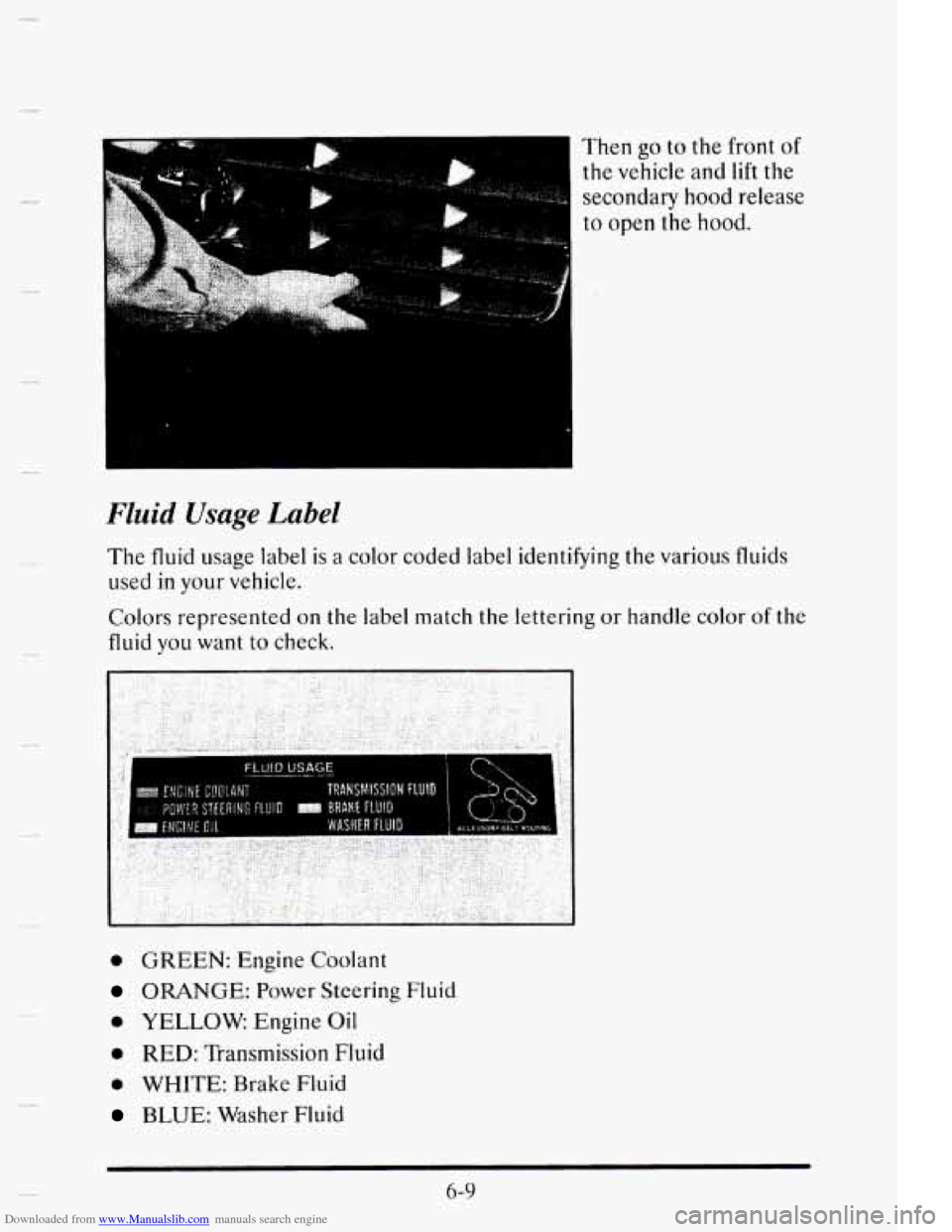
Then go to the front of
the vehicle and lift the
secondary hood release
to open the hood.
The fluid usage label is a color coded label identifying the various fluids
used in your vehicle.
Colors represented on the label match the lettering or handle color
of the
fluid you want
to check.
0 GREEN: Engine Coolant
ORANGE: Power Steering Fluid
0 YELLOW: Engine Oil
0 RED: Transmission Fluid
0 WHITE: Brake Fluid
BLUE: Washer Fluid
6-9
Page 285 of 395
Downloaded from www.Manualslib.com manuals search engine THERMOSTAT
Engine coolant temperature is controlled by a thermostat in the engine
coolant system. Thc thcrrnostat stops
the flow of coolant through the
radiator until the coolant reaches a preset temperature.
If your thermostat needs to be replaced an AC@ thermostat is
recommended.
POWER STEERING FLUID
a
How to Check Power Steering Fluid
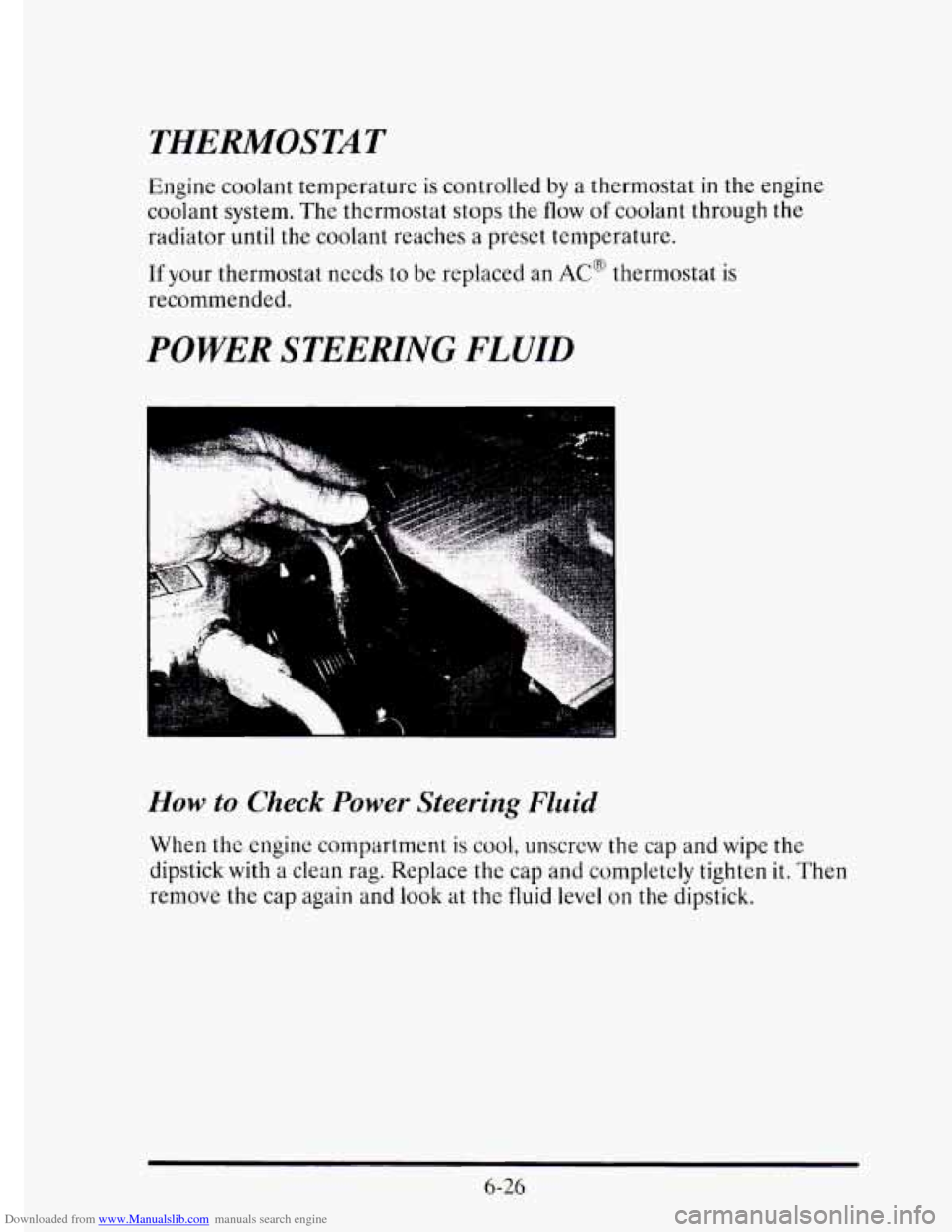
When the engine compartment is cool, unscrew the cap and wipe the
dipstick with a clean rag. Replace the cap and completely tighten it.
Then
remove the cap again and look at the fluid level on the dipstick.
6-26
Page 286 of 395
Downloaded from www.Manualslib.com manuals search engine c
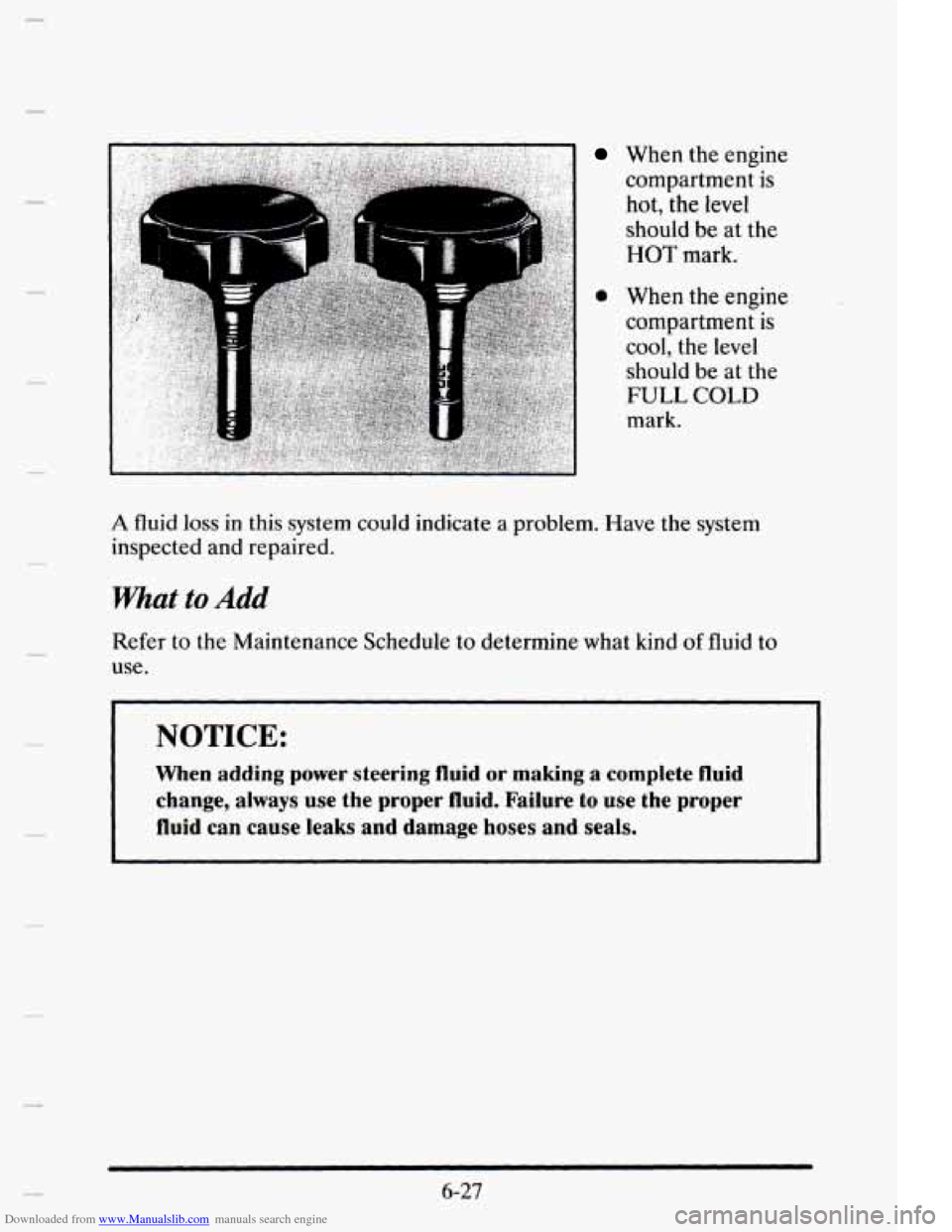
When the engine compartment is
hot,
the level
should be at the
HOT mark.
cool, the level
should be at the
FULL COLD
mark.
A fluid loss in this system could indicate a problem. Have the system
inspected and repaired.
What to Add
Refer to the Maintenance Schedule to determine what kind of fluid to
use.
I NOTICE:
When adding power steering fluid or making a complete fluid
change, always use the proper
fluid. Failure to use the proper
fluid can cause leaks and damage hoses and seals.
6-27
Page 324 of 395
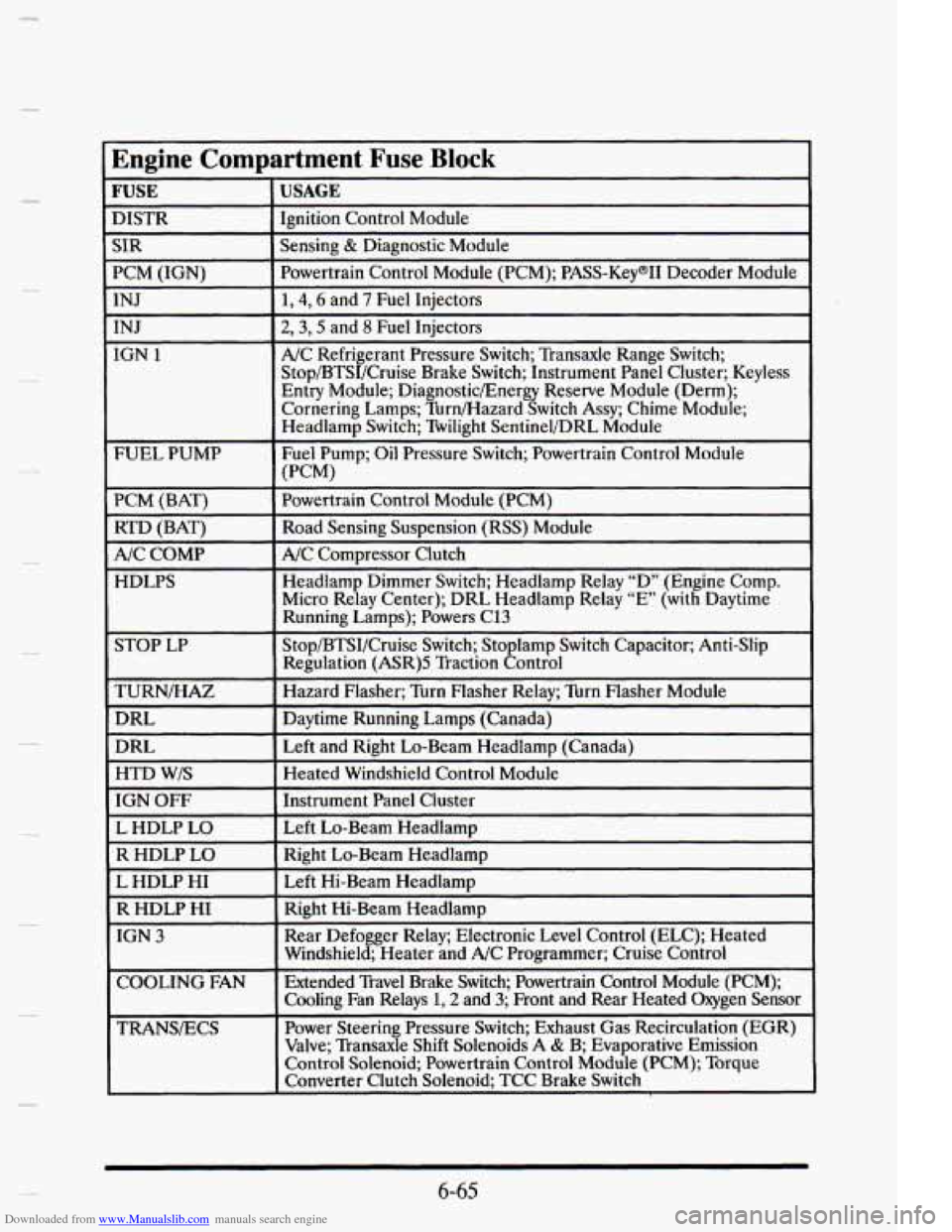
Downloaded from www.Manualslib.com manuals search engine [Engine Compartment Fuse Block
~~~
E DISTR
USAGE I
INJ
IGN 1
FUEL PUMP
PCM (BAT) RTD (BAT)
F
A/C COMP
HDLPS
TURN/HAZ
DRL
DRL
HTD W/S
IGN OFF
L HDLP
LO
I R HDLP LO Ignition
Control Module
I
L HDLP HI
R HDLP HI
I
I
TRANSECS Sensing
& Diagnostic Module
Powertrain Control Module (PCM); PASS-KeymII Decode llodule
1,4,6 and 7 Fuel Injectors
2,3,5 and 8 Fuel Injectors
A/C Refrigerant Pressure Switch; Transaxle Range Switch;
Stop/BTSI/Cruise Brake Switch; Instrument Panel Cluster; Keyless
Entry Module; DiagnosticEnergy Reserve Module (Derm);
Cornering Lamps; Tbrn/Hazard Switch Assy; Chime Module;
Headlamp Switch; Twilight Sentinel/DRL Module
Fuel Pump; Oil Pressure Switch; Powertrain Control Module
Powertrain Control Module (PCM)
Road Sensing Suspension (RSS) Module
NC Compressor Clutch
Headlamp Dimmer Switch; Headlamp Relay “D” (Engine Comp.
Micro Relay Center); DRL Headlamp Relay
“E’ (with Daytime
Running Lamps); Powers C13
Stop/BTSI/Cruise Switch; Sto lamp Switch Capacitor; Anti-Slip
Regulation (ASR)S Traction 8ontrol
Hazard Flasher; Turn Flasher Relay; Turn Flasher Module
Daytime Running Lamps (Canada)
Left and Right Lo-Beam Headlamp (Canada)
Heated Windshield Control Module
Instrument Panel Cluster
Left Lo-Beam Headlamu
(PCM)
Right Lo-Beam Headlamp
Left Hi-Beam Headlamp
Right Hi-Beam Headlamp
Rear Defogger Relay; Electronic Level Control (ELC); Heated
Windshield; Heater and A/C Programmer; Cruise Control
Extended Travel Brake Switch; Powertrain Control Module (PCM); \
Cooling Fan Relays
1,2 and 3; Front and Rear Heated Oxygen Sensor
Power Steering Pressure Switch; Exhaust Gas Recirculation (EGR)
Valve; Transaxle Shift Solenoids A
& B; Evaporative Emission
Control Solenoid; Powertrain Control Module (PCM); Torque
Converter Clutch Solenoid; TCC Brake Switch
6-65
Page 332 of 395
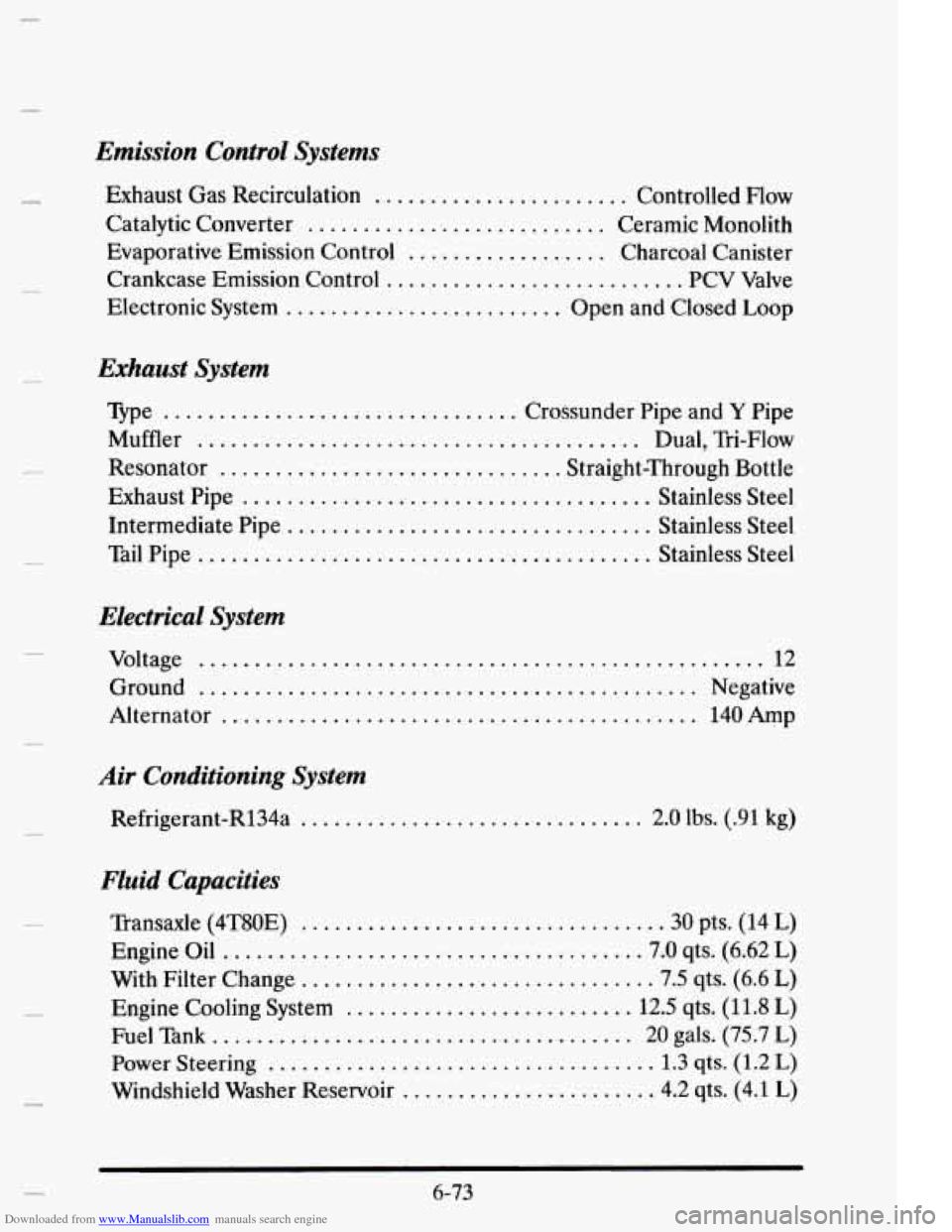
Downloaded from www.Manualslib.com manuals search engine Emission Control Systems
Exhaust Gas Recirculation ....................... Controlled Flow
Catalytic Converter
........................... Ceramic Monolith
Evaporative Emission Control
.................. Charcoal Canister
Crankcase Emission Control
........................... PCV Valve
Electronic System
......................... Open and Closed Loop
Exhaust System
Type ................................ Crossunder Pipe and Y Pipe
Muffler
........................................ Dual, Tri-Flow
Resonator
............................... Straight-Through Bottle
Exhaust Pipe
..................................... Stainless Steel
Intermediate Pipe
................................. Stainless Steel
Tail Pipe
......................................... Stainless Steel
Electrical System
Voltage ................................................... 12
Alternator
........................................... 140Amp
Ground
............................................. Negative
Air
Conditioning System
Refrigerant-R134a ............................... 2.0 lbs. (.91 kg)
Fluid Capacities
Transaxle (4T80E) ................................ .30 pts. (14 L)
Engine Oil ...................................... 7.0 qts. (6.62 L)
With Filter Change ................................ 7.5 qts. (6.6 L)
Engine Cooling System .......................... 12.5 qts. (1 1.8 L)
Fuel Tank ...................................... 20 gals. (75.7 L)
Power Steering ................................... 1.3 qts. (1.2 L)
Windshield Washer Reservoir ....................... 4.2 qts. (4.1 L)
6-73
Page 380 of 395
Downloaded from www.Manualslib.com manuals search engine C
.
.
.
.
.
c
.
.
.
.
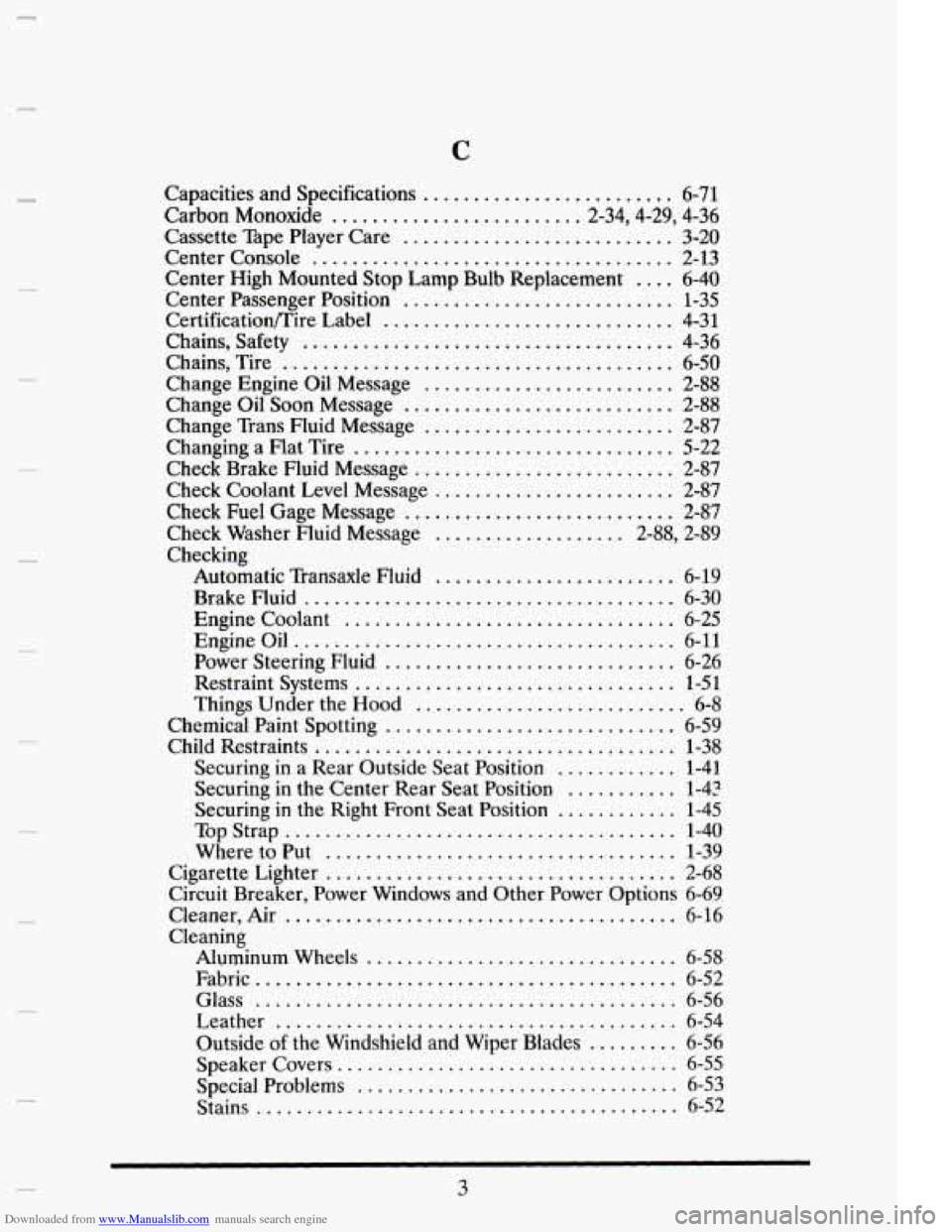
Capacities and Specifications ......................... 6-71
Carbon Monoxide ......................... 2.34.4.29. 4.36
Cassette Tape Player Care ........................... 3-20
Center Console .................................... 2-13
Center High Mounted Stop Lamp Bulb Replacement .... 6-40
Center Passenger Position ........................... 1-35
Certificationmire Label ............................. 4-31
Chains. Safety ..................................... 4-36
Chains. Tire ....................................... 6-50
Change Engine Oil Message ......................... 2-88
Change Oil Soon Message ........................... 2-88
Change Trans Fluid Message ......................... 2-87
Changing a Flat Tire ................................ 5-22
Check Brake Fluid Message .......................... 2-87
Check Coolant Level Message ........................ 2-87
Check Fuel Gage Message ........................... 2-87
Check Washer Fluid Message ................... 2.88, 2.89
Checking
Automatic Transaxle Fluid
........................ 6-19
Brake Fluid ..................................... 6-30
Engine Coolant ................................. 6-25
Engineoil ...................................... 6-11
Power Steering Fluid ............................. 6-26
Restraint Systems ................................ 1-51
Things Under the Hood ........................... 6-8
Chemical Paint Spotting ............................. 6-59
Child Restraints .................................... 1-38
Securing in a Rear Outside Seat Position ............ 1-41
Securing in the Center Rear Seat Position ........... 1-42
Securing in the Right Front Seat Position ............ 1-45
Top Strap ....................................... 1-40
Where to Put ................................... 1-39
Cigarette Lighter ................................... 2-68
Circuit Breaker. Power Windows and Other Power Options 6-69
Cleaner, Air ....................................... 6-16
Cleaning
Aluminum Wheels
............................... 6-58
Fabric .......................................... 6-52
Glass .......................................... 6-56
Leather ........................................ 6-54
Outside of the Windshield and Wiper Blades ......... 6-56
Speaker Covers .................................. 6-55
Special Problems ................................ 6-53
Stains ........................................... 6-52
.
.