wheel CADILLAC ELDORADO 1995 10.G Owner's Manual
[x] Cancel search | Manufacturer: CADILLAC, Model Year: 1995, Model line: ELDORADO, Model: CADILLAC ELDORADO 1995 10.GPages: 395, PDF Size: 20.17 MB
Page 201 of 395
Downloaded from www.Manualslib.com manuals search engine LOSS OF CONTROL
Let’s review what driving experts say about what happens when the three
control systems (brakes, steering and acceleration) don’t have enough
friction where the tires meet
the road to do what the driver has asked.
In any emergency, don’t give up. Keep trying to steer and constantly seek
an escape route or area
of less danger.
Skidding
In a skid, a driver can lose control of the vehicle. Defensive drivers avoid
most skids by taking reasonable care suited to existing conditions, and by
not “overdriving” those conditions. But skids are always possible.
The three types
of skids correspond to your Cadillac’s three control
systems. In the braking skid your wheels aren’t rolling.
In the steering or
cornering skid, too much
speed or steering in a curve causes tires to slip
and
lose cornering force. And in the acceleration skid too much throttle
causes the driving wheels
to spin.
A cornering skid is best handled by casing your foot off the accelerator
pedal.
Remember: Any traction control system helps avoid only the acceleration
skid.
If your vehicle starts
to slide, ease your foot off the accelerator pedal and
quickly steer the way
you want the vehicle to go. If you start steering
quickly
enough, your vehicle may straighten out. Always be ready for a
second skid
if it occurs.
Of course, traction is reduced when water, snow, ice, gravel, or other
material is on
the road. For safety, you’ll want to slow down and adjust your
driving to these conditions.
It is important to slow down on slippery surfaces
because stopping distance
will be longer and vehicle control more limited.
While driving on a surface with reduced traction,
try your best to avoid
sudden steering, acceleration,
or braking (including engine braking by
shifting to a lower gear). Any sudden changes could cause
the tires to
slide. You may not realize the surface is slippery until your vehicle is
skidding. Learn
to recognize warning clues -- such as enough water, ice or
packed snow
on the road to make a “mirrored surface” -- and slow down
when
you have any doubt.
Remember:
Any anti-lock brake system (ABS) helps avoid only the
braking skid.
4- 14
Page 210 of 395
Downloaded from www.Manualslib.com manuals search engine 0 Weather Forecasts: What’s the weather outlook along your route?
0 Maps: Do you have up-to-date maps?
Should you delay your
trip a short time
to avoid a major storm system?
HIGWAY HITNOSIS
Is there actually such a condition as “highway hypnosis”? Or is it just plain
falling asleep at the wheel? Call it highway hypnosis, lack of awareness, or
whatever.
c
There is something about an easy stretch of road with the same scenery,
along with the
hum of the tires on the road, the drone of the engine, and
the rush
of the wind against the vehicle that can make you sleepy. Don’t
let it happen to you! If it does, your vehicle can leave the road in less than
a second, and you could crash and be injured.
What can
you do about highway hypnosis? First, be aware that it can
happen.
Then here are some tips:
0 Make sure your vehicle is well ventilated, with a comfortably cool
interior.
Keep your eyes moving. Scan the road ahead and to the sides. Check
your rearview mirrors
and your instruments frequently.
If you get sleepy, pull off the road into a rest, service, or parking area
and take a nap, get some exercise, or both. For safety, treat drowsiness
on the highway as an emergency.
4-23
Page 220 of 395
Downloaded from www.Manualslib.com manuals search engine NOTICE:
Pulling a trailer improperly can damage your vehicle and result
in costly repairs not covered by your warranty. To pull a trailer
correctly, follow the advice in this part, and see your Cadillac
dealer for important information about towing a trailer with
your vehicle.
Your vehicle can tow a trailer if it is equipped with the Northstar 4.6L
engine and proper trailer towing equipment. To identify what the vehicle
trailering capacity
is for your vehicle, you should read the information in
“Weight of the Trailer” that appears later in this section. But trailering is
different than just driving your vehicle by itself. Trailering means changes
in handling, durability, and fuel economy. Successful, safe trailering takes
correct equipment, and it has to be used properly.
That’s the reason for this part. In it are many time-tested, important
trailering tips and safety rules. Many
of these are important for your
safety and that
of your passengers. So please read this section carefully
before you pull
a trailer.
Load-pulling components such as the engine, transaxle, wheel assemblies,
and tires are forced to work harder against the drag
of the added weight.
The engine is required
to operate at relatively higher speeds and under
greater loads, generating extra heat. What’s more, the trailer adds
considerably
to wind resistance, increasing the pulling requirements.
If You Do Decide To Pull A nailer
If you do, here are some important points.
e There are many different laws, including speed limit restrictions,
having to do with trailering. Make sure your rig will
be legal, not only
where you live but
also where you’ll be driving. A good source for this
information can be state or provincial police.
Consider using a sway control.
4-33
Page 224 of 395
Downloaded from www.Manualslib.com manuals search engine Driving with a Trailer
n Towing a trailer requires a certain amount of experience. Before setting
out for the open road, you’ll want to get to
know your rig. Acquaint
yourself with the feel
of handling and braking with the added weight of
the trailer. And always keep in mind that the vehicle you are driving is
now a good deal longer and not nearly as responsive as your vehicle is by
itself.
Before you start, check the trailer hitch and platform (and attachments),
safety chains, electrical connector, lamps, tires and mirror adjustment. If
the trailer has electric brakes, start your vehicle and trailer moving and
then apply the trailer brake controller by hand to be sure the brakes are
working. This lets you check your electrical connection at the same time.
. During your trip, check occasionally to be sure that the load is secure, and
that the lights and any trailer brakes are still working.
Following Distance
Stay at least twice as far behind the vehicle ahead as you would when
driving your vehicle without a trailer. This can help you avoid situations
that require heavy braking and sudden turns.
Passing
You’ll need more passing distance up ahead when you’re towing a trailer.
And, because you’re a good deal longer, you’ll need to
go much farther
beyond the passed vehicle before you can return to your lane.
Backing Up
Hold the bottom of the steering wheel with one hand. Then, to move the
trailer to the left, just move that hand to the left.
To move the trailer to
the right, move your hand to the right. Always back up slowly and,
if
possible, have someone guide you.
4-37
Page 226 of 395
Downloaded from www.Manualslib.com manuals search engine Parking on Hills
c
You really should not park your vehicle, with a trailer attached, on a hill.
If something goes wrong, your rig could start to move. People can be
injured, and both your vehicle and the trailer can be damaged.
But
if you ever have to park your rig on a hill, here’s how to do it:
1. Apply your regular brakes, but do not shift into PARK (P).
2. Have someone place chocks under the trailer wheels.
3. When the wheel chocks are in place, release the regular brakes until
the chocks absorb the load.
4. Reapply the regular brakes. Then shift into PARK (P) firmly and apply
5. Release the regular brakes.
your parking
brake.
When You Are Ready to Leave Afier Parking on a Hill
1. Apply your regular brakes and hold the pedal down while you:
Start your engine;
Shift into a gear; and
Be sure the parking brake has released.
2. Let up on the brake pedal.
3. Drive slowly until the trailer is clear of the chocks.
4. Stop and have someone pick up and store the chocks.
Maintenance When Trailer Towing
Your vehicle will need service more often when you’re pulling a trailer.
See the Maintenance Schedule
for more on this. Things that are especially
important in trailer operation are automatic transaxle fluid (don’t
overfill), engine oil, belt, cooling system, and brake adjustment. Each
of
these is covered in this manual, and the Index will help you find them
quickly.
If you’re trailering, it’s a good idea to review these sections before
you start your trip.
Check periodically to see that all hitch nuts and bolts are tight.
4-39
Page 236 of 395
Downloaded from www.Manualslib.com manuals search engine n
c
TOWING YOUR VEHICLE
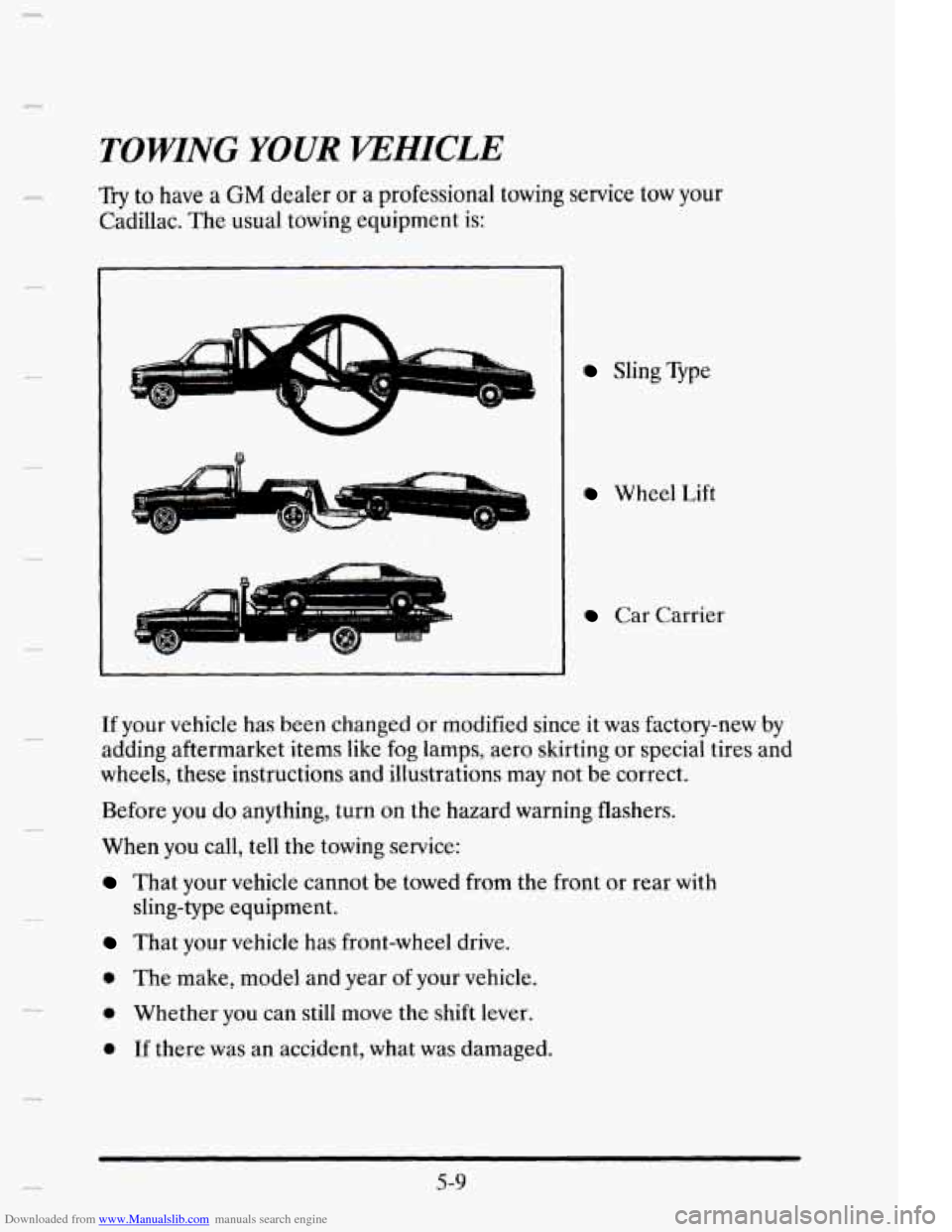
Try to have a GM dealer or a professional towing service tow your
Cadillac. The usual towing equipment is:
W
W
W
W W
Sling Type
Wheel Lift
Car Carrier
If your vehicle has been changed or modified since it was factory-new by
adding aftermarket items Iike fog lamps, aero skirting
or special tires and
wheels, these instructions and illustrations may not be correct.
Before you do anything, turn on the hazard warning flashers.
When you call, tell the towing service:
That your vehicle cannot be towed from the front or rear with
That your vehicle has front-wheel drive.
0 The make, model and year of your vehicle.
0 Whether you can still move the shift lever.
0 If there was an accident, what was damaged.
sling-type
equipment.
5-9
Page 238 of 395
Downloaded from www.Manualslib.com manuals search engine When your vehicle is being towed, have the ignition key off. The steering
wheel should
be clamped in a straight-ahead position, with a clamping
device designed for towing service.
Do not use the vehicle’s steering
column lock
for this. The transaxle should be in NEUTRAL (N) and the
parking brake released.
Don’t have your vehicle towed
on the front wheels, unless you must. If the
vehicle must
be towed on the front wheels, don’t go more than 35 mph
(56 km/h) or farther than 25 miles (40 km) or your transaxle will be
damaged. If these limits must be exceeded, then the front wheels have
to be supported on a dolly.
5-1 1
Page 248 of 395
Downloaded from www.Manualslib.com manuals search engine .. i
k
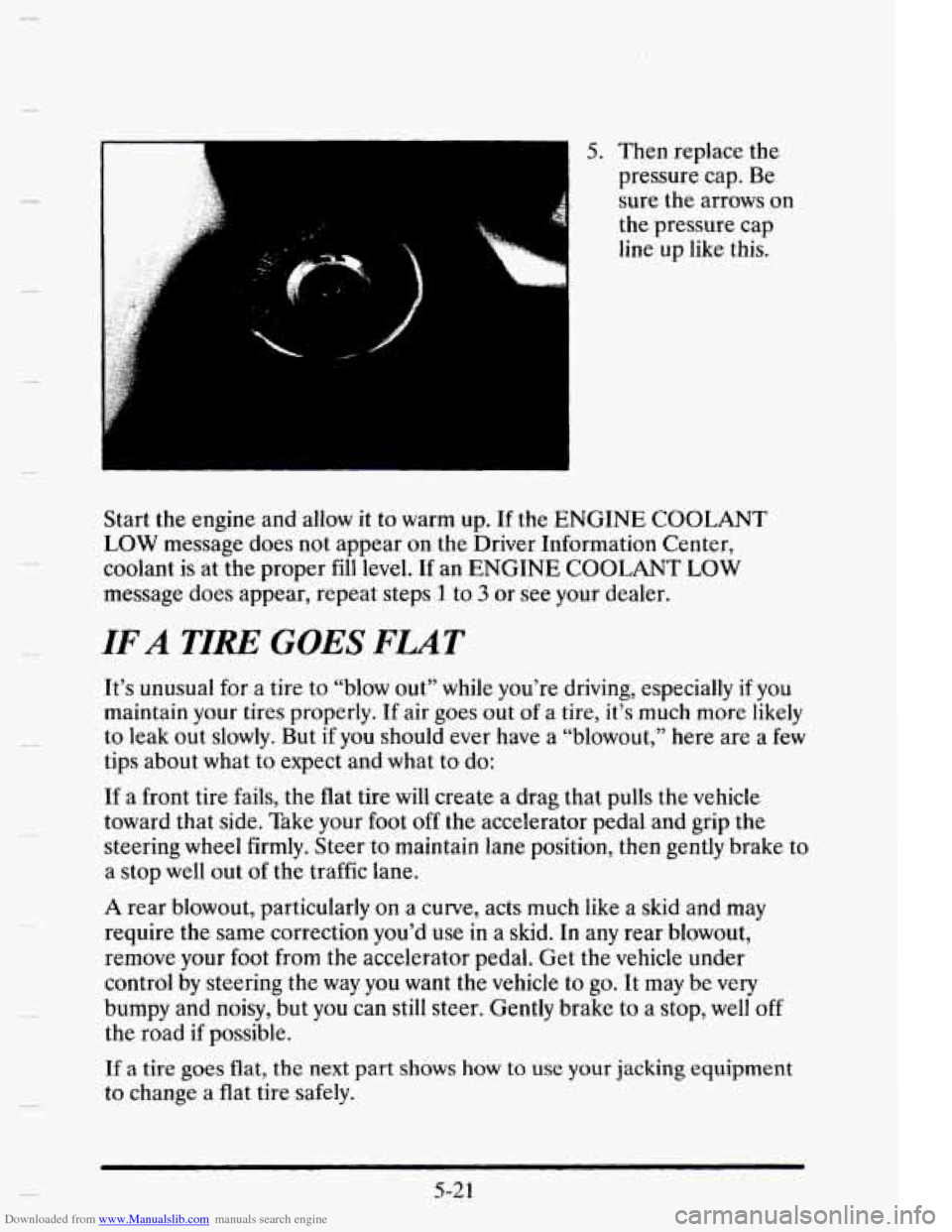
5. Then replace the
pressure cap. Be
sure
the arrows on
the pressure cap
line up
like this.
Start the engine and allow
it to warm up. If the ENGINE COOLANT
LOW message does not appear on the Driver Information Center,
coolant
is at the proper fill level. If an ENGINE COOLANT LOW
message does appear, repeat steps 1 to 3 or see your dealer.
IF A TIRE GOES FLAT
It’s unusual for a tire to “blow out” while you’re driving, especially if you
maintain your tires properly.
If air goes out of a tire, it’s much more likely
to leak out slowly. But
if you should ever have a “blowout,” here are a few
tips about what to expect and what to do:
If a front tire fails, the flat tire will create a drag that pulls the vehicle
toward that side. Take your foot
off the accelerator pedal and grip the
steering
wheel firmly. Steer to maintain lane position, then gently brake to
a stop well out of
the traffic lane.
A rear blowout, particularly on a curve, acts much like a skid and may
require the same correction you’d use
in a skid. In any rear blowout,
remove your foot from the accelerator pedal. Get the vehicle under
control by steering
the way you want the vehicle to go. It may be very
bumpy and noisy, but you can still steer. Gently brake to a stop, well off
the road if possible.
If a tire goes flat, the next part shows how to use your jacking equipment
to change a flat tire safely.
5-2 1
Page 249 of 395
Downloaded from www.Manualslib.com manuals search engine CHANGING A FLAT TIRE
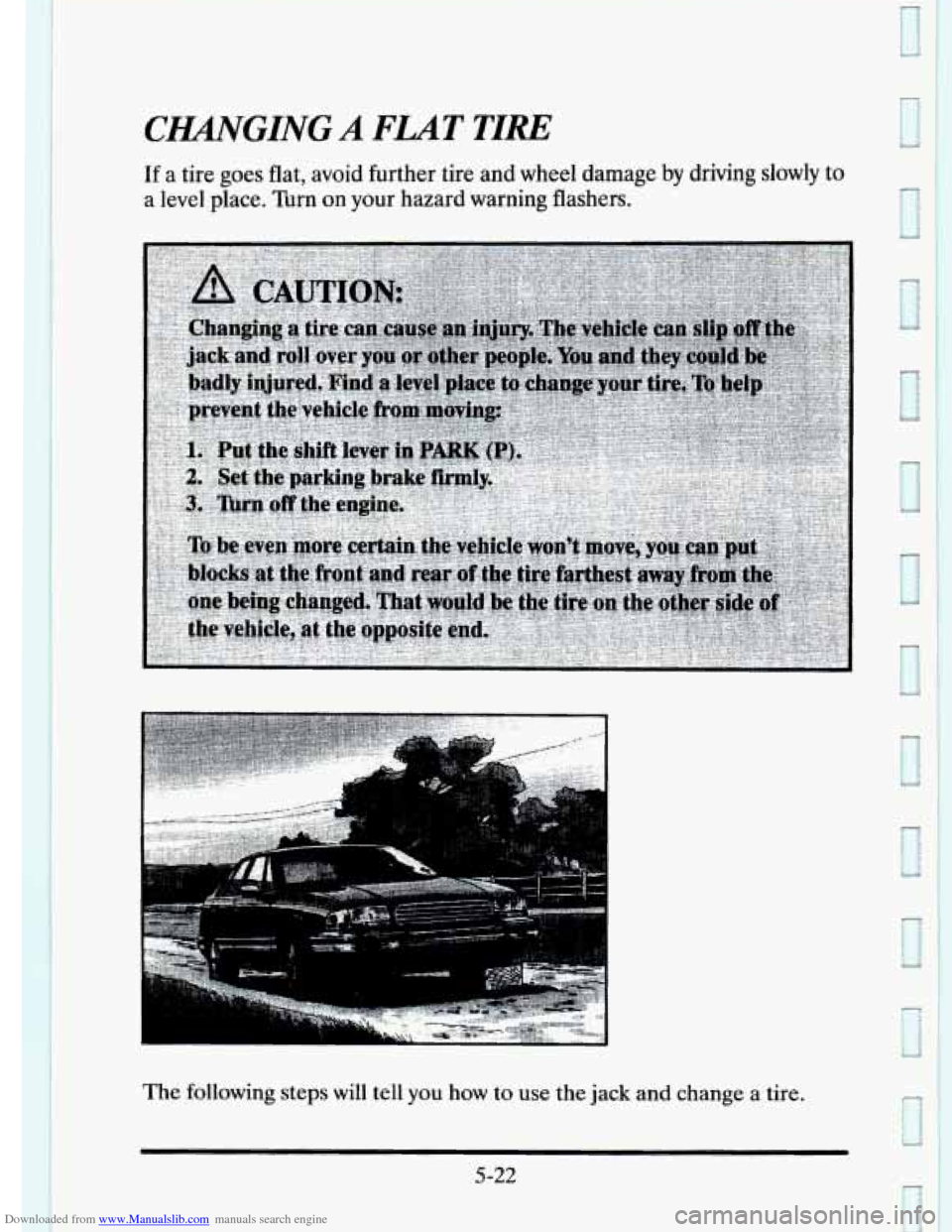
If a tire goes flat, avoid further tire and wheel damage by driving slowly to
a level place. Turn on your hazard warning flashers.
p.
The following steps will tell you how to use the jack and change a tire.
5-22
Page 250 of 395
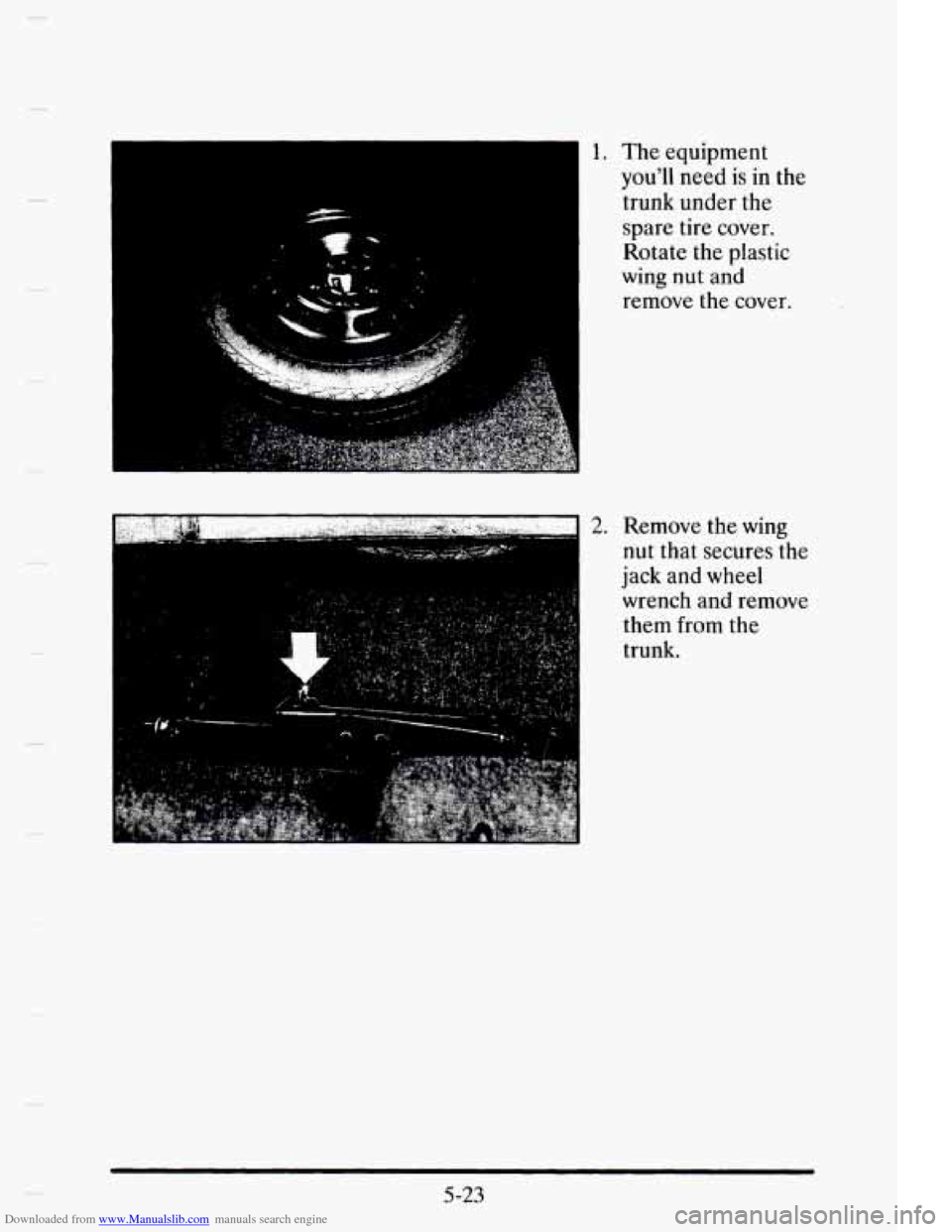
Downloaded from www.Manualslib.com manuals search engine 1. The equipment
you'll need is in the
trunk under the
spare tire cover.
Rotate the plastic
wing
nut and
remove the cover.
2. Remove the wing
nut that secures the
jack and wheel wrench and remove
them
from the
trunk.
5-23