lights CADILLAC ELDORADO 1995 10.G Owners Manual
[x] Cancel search | Manufacturer: CADILLAC, Model Year: 1995, Model line: ELDORADO, Model: CADILLAC ELDORADO 1995 10.GPages: 395, PDF Size: 20.17 MB
Page 17 of 395
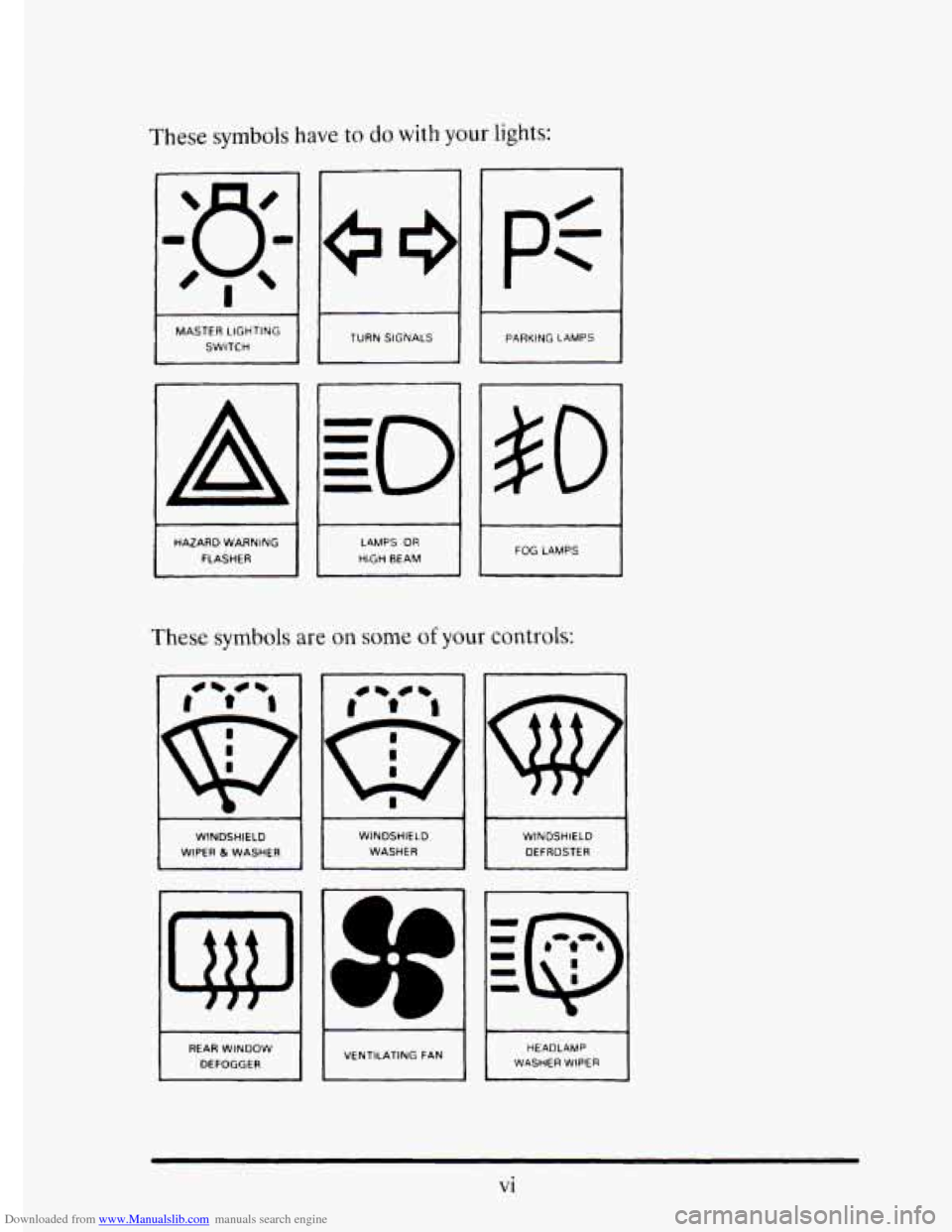
Downloaded from www.Manualslib.com manuals search engine These symbols have to do with your lights:
a
MASTER LIGHTING SWITCH
A
HAZARD WARNING
FLASHER TURN
SIGNALS
LAMPS OR
HIGH BEAM
pt
~~
PARKING LAMPS
#O
1 FOG LAMPS
These symbols are on some of your controls:
WINDSHIELD
WIPER 81 WASHER
REAR WINDOW
DEFOGGER WINDSHIELD
WASHER
dp
I VENTILATING FAN WINDSHIELD
DEFROSTER
HEADLAMP
WASHER WIPER
vi
Page 18 of 395
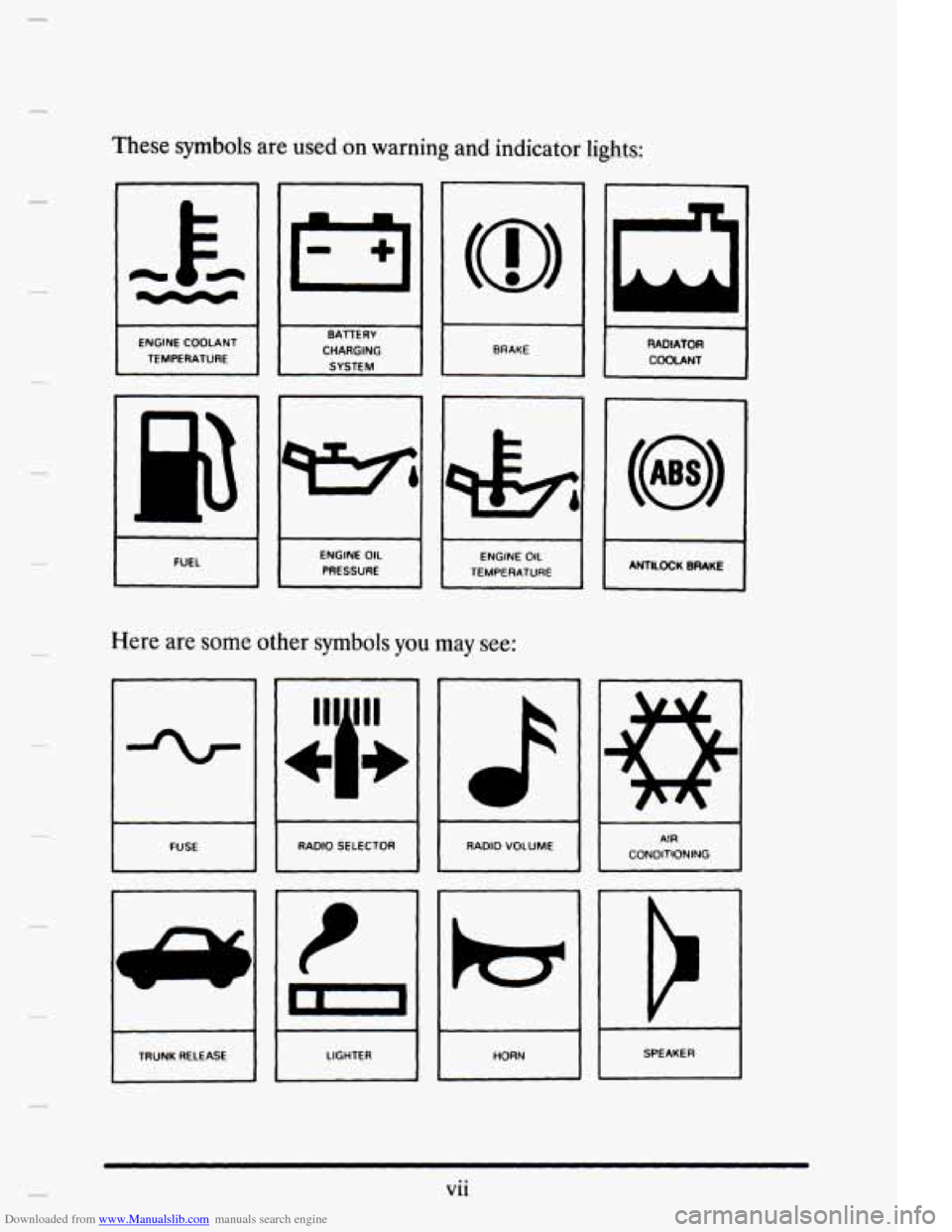
Downloaded from www.Manualslib.com manuals search engine These symbols are used on warning and indicator lights:
1- I
I -1 BRAKE I I
ENGINE COOLANT
TEMPERATURE RADIATOR
COOLANT
1 CHARGING
93
I
ENGINE OIL
TEMPERATURE I ANTILOCK BRAKE
ENGINE
OIL
PRESSURE
Here are some other symbols you may see:
-
-
RADIO VOLUME
A
i
U
RADIO SELECTOR FUSE A! R CONDITIONING I
E’ u -
SPEAKER I LIGHTER
TRUNK RELEASE HORN
I
Vii
Page 87 of 395
Downloaded from www.Manualslib.com manuals search engine If a door or the trunk is opened without the key or Keyless Entry System,
the alarm will
go off. It will also go off if the trunk lock is damaged. Your
vehicle’s lights will flash and the horn will sound
for three minutes and
then the alarm will
go off to save battery power.
Remember, the theft deterrent system won’t arm
if you lock the doors
with
a key or use the manual door lock. It arms only if you use a power
door lock switch or the Keyless Entry System.
Here’s how to avoid setting
off the alarm by accident:
If you don’t want to arm the theft deterrent system, the vehicle should
Always unlock a door with a key, or use the Keyless Entry System.
be locked with the door key after the doors are closed.
Unlocking
a door any other way will set off the alarm.
If you set off the alarm by accident, unlock any door with your key. You
can also turn
off the alarm by using the Keyless Entry System. The alarm
won’t stop
if you try to unlock a door any other way.
How to Test the Alarm
e From inside the vehicle roll down your window, then get out of your
vehicle, keeping the door open.
0 From outside the vehicle with the door open, lock the vehicle using the
Reach in and unlock the door using the manual lock and open the
power
door lock or the Keyless Entry System and close the door.
door. The horn will sound and your headlamps will flash.
If the alarm does not sound when it should, check to see if the horn
works. The horn fuse may be blown.
To replace the fuse, see “Fuses and
Circuit Breakers” in the Index.
If the fuse does not need to be replaced
you may need to have
your Cadillac serviced.
To reduce the possibility of theft, always arm the theft deterrent system
when leaving your vehicle.
2-16
Page 111 of 395
Downloaded from www.Manualslib.com manuals search engine As you signal a turn or a lane change, if the arrows don’t flash but just stay on
a signal bulb may be burned
out and other drivers won’t see your turn signal.
If
a bulb is burned out, rcplacc it to help avoid an accident. If the green
arrows don’t go on at all when you signal
a turn, check the fuse (see
“Fuses’’ in
the Index) and for burned-out bulbs.
Wiper Activated Headlumps
This feature activates the headlamps and parking lamps after the
windshield wipers have been in use
for approximately 23 seconds.
In order
to operate the wiper activated headlamps, the twilight sentinel
must
be in the ON position. This feature lights the way in poor weather
and
it also makes your vehicle more visible to other drivers. If the wiper
activated headlamps are
on, and the ignition switch is turned off, the
wiper activated headlamps
will immediately turn off.
The wiper activated headlamps will deactivate if you turn off the twilight
sentinel
or if the windshield wipers have been turned off for a period of
one or two seconds.
Headlamp High-Low Beam
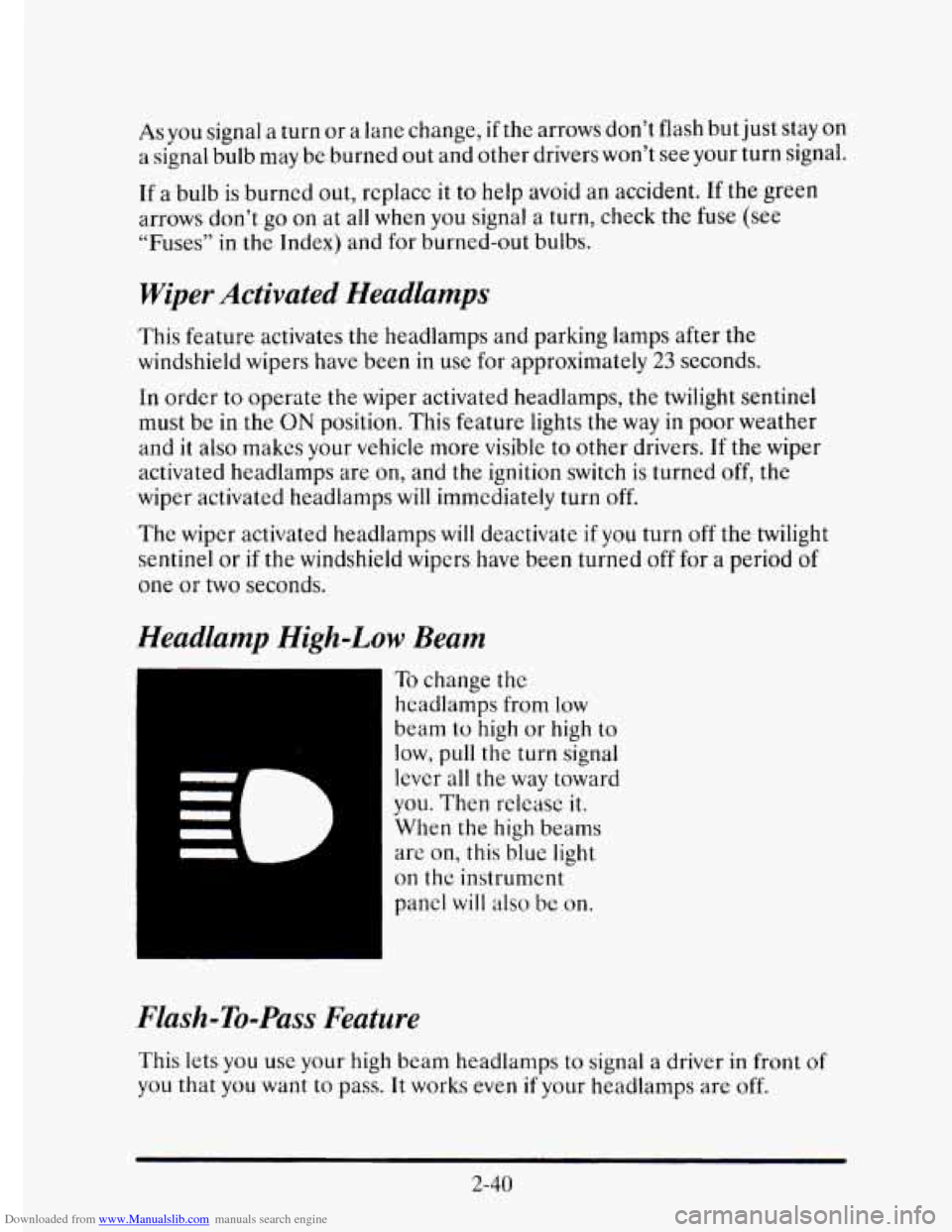
To change the
headlamps from low
beam
to high or high to
low, pull the turn signal
lever all
the way toward
you. Then releasc it.
When the high beams
are on, this blue
light
on thc instrument
panel
will also be on.
Flash-To-Pass Feature
This lets you use your high beam headlamps to signal a driver in front of
you that you want to pass. It works even if your headlamps are off.
2-40
Page 143 of 395
Downloaded from www.Manualslib.com manuals search engine Trip Odometer
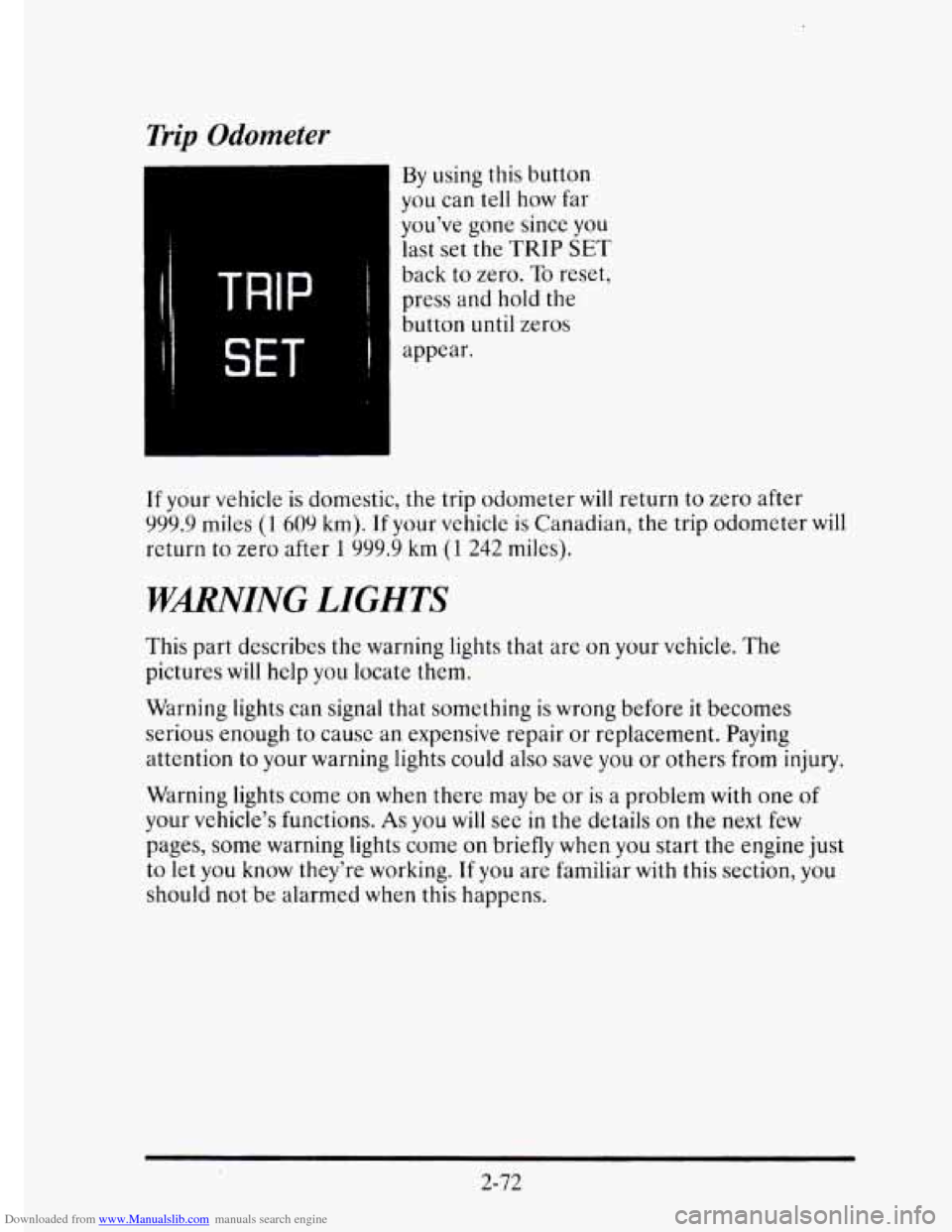
By using this button
you can tell how far
you’ve gone since you
last set
the TRIP SET
back to zero. To reset,
press and hold
the
button until zeros
appear.
If your vehicle
is domestic, the trip odometer will return to zero after
999.9 miles (1 609 km). If your vehicle is Canadian, the trip odometer will
return
to zero after 1 999.9 km (1 242 miles).
WMING LIGHTS
This part describes the warning lights that are on your vehicle. The
pictures will help you locate them.
Warning lights can signal that something
is wrong before it becomes
serious enough to cause an expensive repair or replacement. Paying
attention
to your warning lights could also save you or others from injury.
Warning lights come on when
there may be or is a problem with one of
your vehicle’s functions. As you will see in the details on the next few
pages, some warning lights come on briefly when you start the engine just
to let you know they’re working. If you are familiar with this section, you
should not
be alarmed when this happens.
2-72
Page 144 of 395
Downloaded from www.Manualslib.com manuals search engine When one of the warning lights comes on and stays on when you are
driving, check the section that tells you what to do about it. Please follow
this manual’s advice. Waiting to
do repairs can be costly -- and even
dangerous.
So please get to know your warning lights. They’re a big help.
Your vehicle may also have a Driver Information Center that works along
with the warning lights. See “Driver Information Center’’ in the Index.
Safety Belt Reminder Light
c
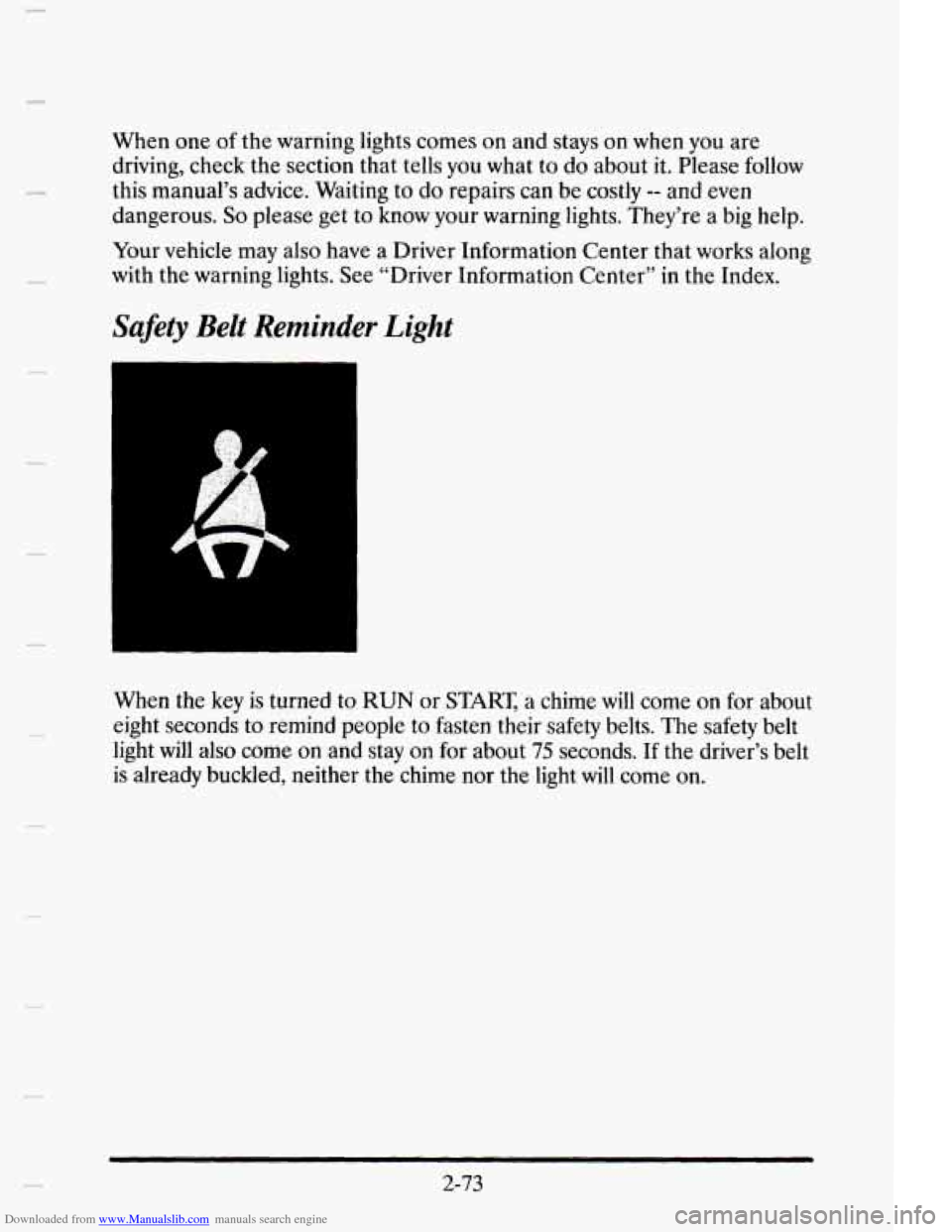
When the key is turned to RUN or START, a chime will come on for about
eight seconds to remind people to fasten their safety belts. The safety belt
light
will also come on and stay on for about 75 seconds. If the driver’s belt
is already buckled, neither the chime nor the light
will come on.
2-73
Page 146 of 395
Downloaded from www.Manualslib.com manuals search engine Battery Charge Light (Canadian Only)
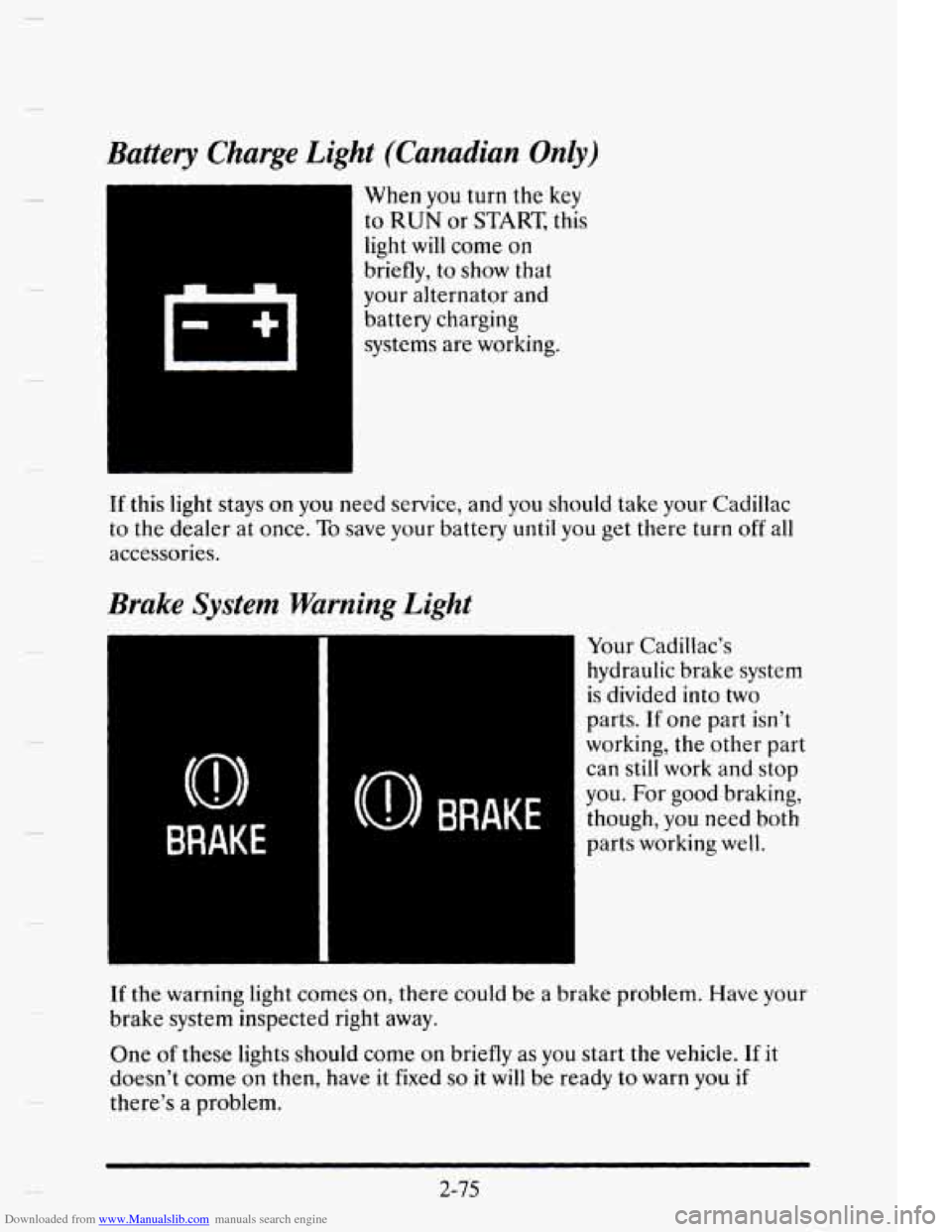
When you turn the key
to
RUN or START, this
light will come on
briefly, to show that
your alternator and
battery charging
systems are working.
(0) BRAKE
1)
BRAKE
If this light stays on you need service, and you should take your Cadillac
to the dealer at once.
To save your battery until you get there turn off all
accessories.
Brake System Warning Light
1 Your Cadillac’s
hydraulic brake system
is divided into two
parts.
If one part isn’t
working, the other part
can still work
and stop
you. For
good braking,
though,
you need both
parts working well.
If the warning light comes on, there could be a brake problem. Have your
brake system inspected right away.
One
of these lights should come on briefly as you start the vehicle. If it
doesn’t come on then, have it fixed so it will be ready to warn you if
there’s a problem.
2-75
Page 149 of 395
Downloaded from www.Manualslib.com manuals search engine Engine Temperature Warning Light (Canadian Only)
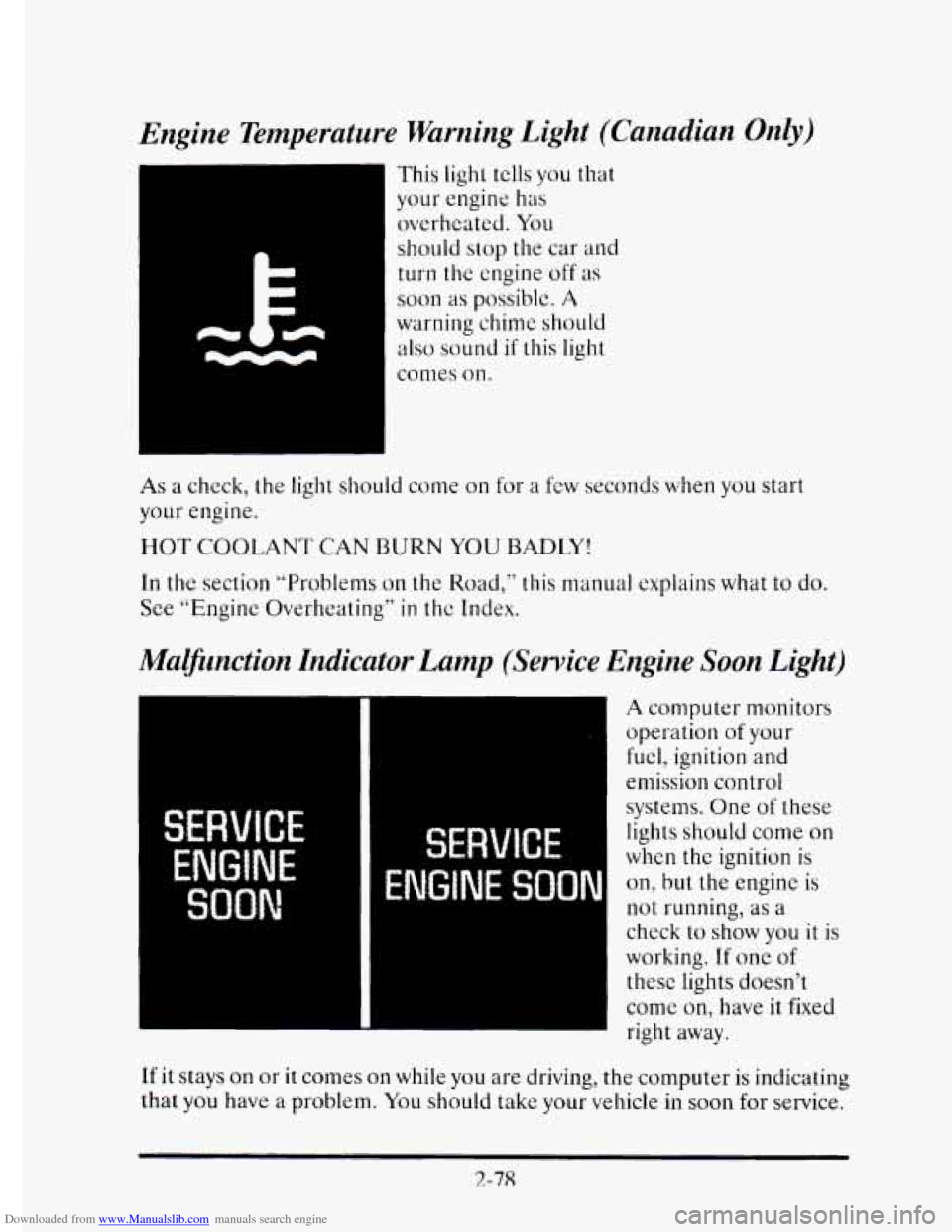
This light tclls you that
your engine has
overheated. You
should stop the car
and
turn the engine off as
soon as possible. A
warning chime should
also sound if this light
comes on.
As a check, the light should come on for a few seconds when you start
your engine.
HOT COOLANT CAN BURN YOU BADLl’!
In the section “Problems on the Road,” this manual explains what to do.
See “Engine Overheating”
in thc Index.
Mammction Indicator Lamp (Service Engine Soon Light)
I
w
A computer monitors
operation
of your
fuel, ignition and
emission control
systems. One
of these
lights should come
on
when the ignition is
on, but the engine is
not running, as a
check to show you it is
working.
If one of
these lights doesn’t
come
on, have it fixed
right away.
If it stays on or it comes on while you are driving, the computer is indicating
that you have a problem. You should take your vehicle in
soon for service.
2-78
Page 200 of 395
Downloaded from www.Manualslib.com manuals search engine 0
0
c
0
0
0
0
0 0
0
“Drive ahead.” Look down the road, to the sides, and to crossroads for
situations that might affect your passing patterns.
If you have any doubt
whatsoever about making a successful pass, wait for a better time.
Watch for traffic signs, pavement markings, and lines. If you can see a
sign up ahead that might indicate a turn or an intersection, delay your
pass.
A broken center line usually indicates it’s all right to pass
(providing the road ahead is clear). Never cross a solid line
on your
side of the lane or a double solid line, even
if the road seems empty of
approaching traffic.
Do not get too close to the vehicle
you want to pass while you’re
awaiting an opportunity.
For one thing, following too closely reduces
your area of vision, especially
if you’re following a larger vehicle. Also,
you won’t have adequate space if the vehicle ahead suddenly slows or
stops. Keep back a reasonable distance.
When it looks like a chance to pass
is coming up, start to accelerate
but stay in the right lane and don’t get too close. Time your move
so
you will be increasing speed as the time comes to move into the other
lane.
If the way is clear to pass, you will have a “running start” that
more than makes up for the distance you would lose
by dropping back.
And
if something happens to cause you to cancel your pass, you need
only slow down and drop back again and wait for another opportunity.
If other cars are lined up to pass a slow vehicle, wait your turn. But
take care that someone isn’t trying to pass
you as you pull out to pass
the
slow vehicle. Remember to glance over your shoulder and check
the blind spot.
Check your mirrors, glance over your shoulder, and start your left lane
change signal before moving out
of the right lane to pass. When you
are far enough ahead
of the passed vehicle to see its front in your
inside mirror, activate your right lane change signal and move back
into the right lane. (Remember that your right outside mirror is
convex. The vehicle
you just passed may seem to be farther away from
you than it really is.)
Try not to pass more than one vehicle at a time on two-lane roads.
Reconsider before passing the next vehicle.
Don’t overtake a slowly moving vehicle too rapidly. Even though the
brake lights are not flashing, it may be slowing down or starting to turn.
If you’re being passed, make it easy for the following driver to get
ahead
of you. Perhaps you can ease a little to the right.
4-13
Page 203 of 395
Downloaded from www.Manualslib.com manuals search engine Night Vision
No one can see as well at night as in the daytime. But as we get older
these differences increase.
A SO-year-old driver may require at least twice
as much light to see the same thing at night as a 20-year-old.
What you do
in the daytime can also affect your night vision. For example,
if you spend the day in bright sunshine you are wise to wear sunglasses.
Your eyes will have less trouble adjusting to night. But
if you’re driving,
don’t wear sunglasses at night. They may cut down
on glare from
headlamps, but
they also make a lot of things invisible.
You can be temporarily blinded by approaching lights. It can take a
second or
two, or even several seconds, for your eyes to readjust to the
dark. When you are faced with severe glare
(as from a driver who doesn’t
lower the high beams,
or a vehicle with misaimed headlamps), slow down
a little. Avoid staring directly into the approaching lights.
Keep your windshield and all the glass on your vehicle clean
-- inside and
out. Glare at night is made much worse by dirt on the glass. Even the
inside
of the glass can build up a film caused by dust. Dirty glass makes
lights dazzle and flash more than clean glass would, making the pupils
of
your eyes contract repeatedly.
Remember that your headlamps light up
far less of a roadway when you
are
in a turn or curve. Keep your cyes moving; that way, it’s easier to pick
out dimly lighted objects. Just as your headlamps should be checked
regularly for proper aim,
so should your eyes be examined regularly.
Some drivers suffer from night blindness
-- the inability to see in dim
light
-- and aren’t even aware of it.