wheel CADILLAC ELDORADO 1996 10.G Workshop Manual
[x] Cancel search | Manufacturer: CADILLAC, Model Year: 1996, Model line: ELDORADO, Model: CADILLAC ELDORADO 1996 10.GPages: 354, PDF Size: 19.33 MB
Page 297 of 354
Downloaded from www.Manualslib.com manuals search engine When to Check
Check your tires once a month or more.
Don’t forget your compact spare tire. It should
be at
60 psi (420 Wa).
How to Check
Use a good quality pocket-type gage to check tire
pressure.
You can’t tell if your tires are properly inflated
simply by looking at them. Radial tires may look
properly inflated even when they’re underinflated.
Be sure to put the valve caps back on the valve stems.
They help prevent
le:.& by keeping out dirt and
moisture.
Tire Inspection and Rotation
Tires should be inspected every 6,000 to 8,000 miles
(10 000 to 13 000 km) for any signs of unusual wear.
If unusual wear is present, rotate your tires as soon as
possible and check wheel alignment. Also check for
damaged tires or wheels. See “When It’s Time for
New
Tires” and “Wheel Replacement” later in this section for
more information. The
purpose
of regular rotation is to achieve more
uniform wear for all tires on
the vehicle. The first
rotation
is the most important. See “Scheduled
Maintenance Services”
in the Maintenance Schedule
booklet for scheduled rotation intervals.
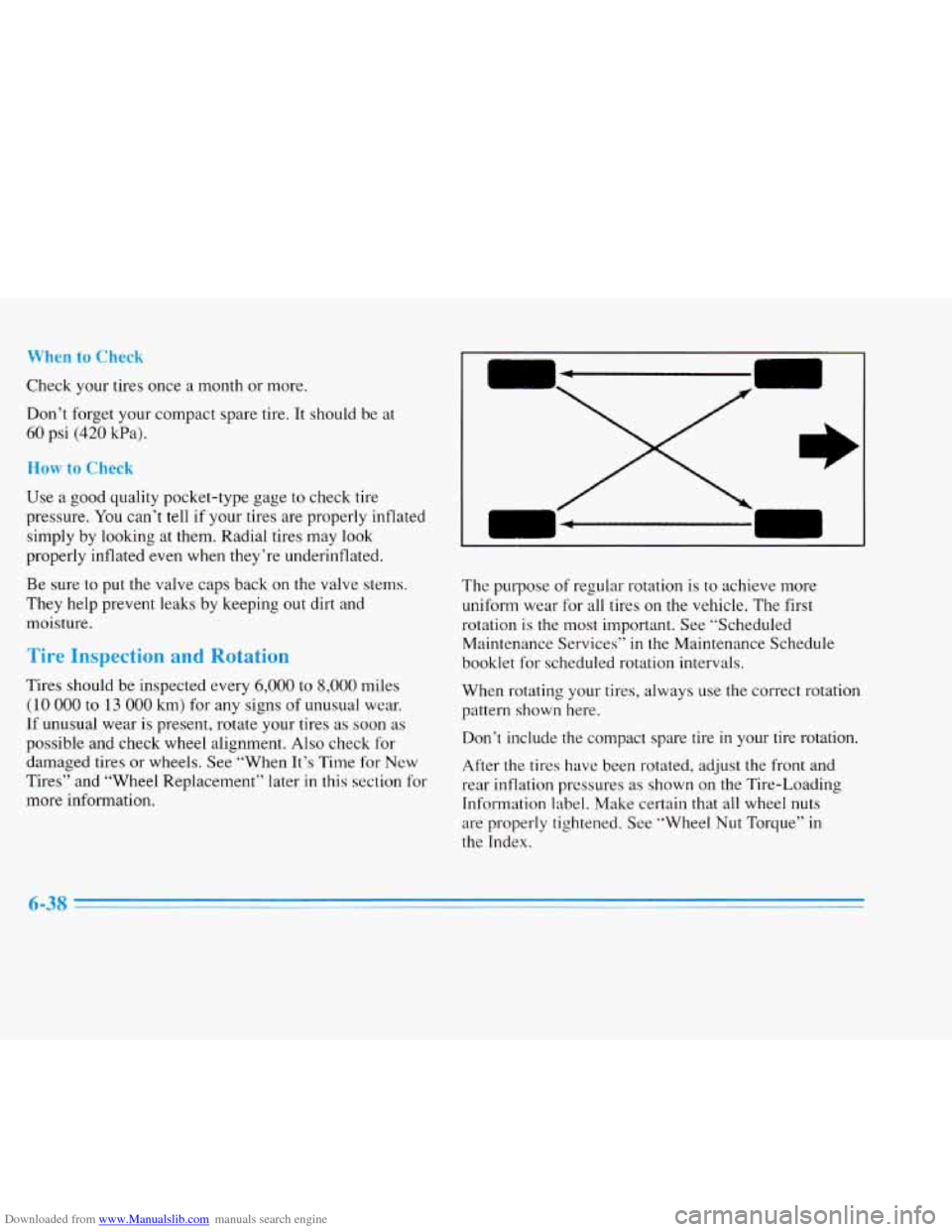
When rotating your tires, always use the correct rotation
pattern shown here.
Don’t include the compact spare tire
in your tire rotation.
After the tires have been rotated, adjust the front and
rear
inflation pressures as shown on the Tire-Loading
Information label. Make certain that all wheel nuts
are properly tightened. See ”Wheel Nut Torque” in
the Index.
6-38
Page 298 of 354
Downloaded from www.Manualslib.com manuals search engine I A CAUTION:
I
Rust or dirt on a wheel, or on the parts to which
it is fastened, can make wheel nuts become loose
after
a time. The wheel could come off and cause
an accident. When you change
a wheel, remove
any rust or dirt from places where the wheel
attaches to the vehicle. In an emergency,
you can
use
a cloth or a paper towel to do this; but be
sure to use a scraper or wire brush later, if you
need to, to get
all the rust or dirt off. (See
“Changing
a Flat Tire” in the Index.)
,
When It’s Time for New Tires
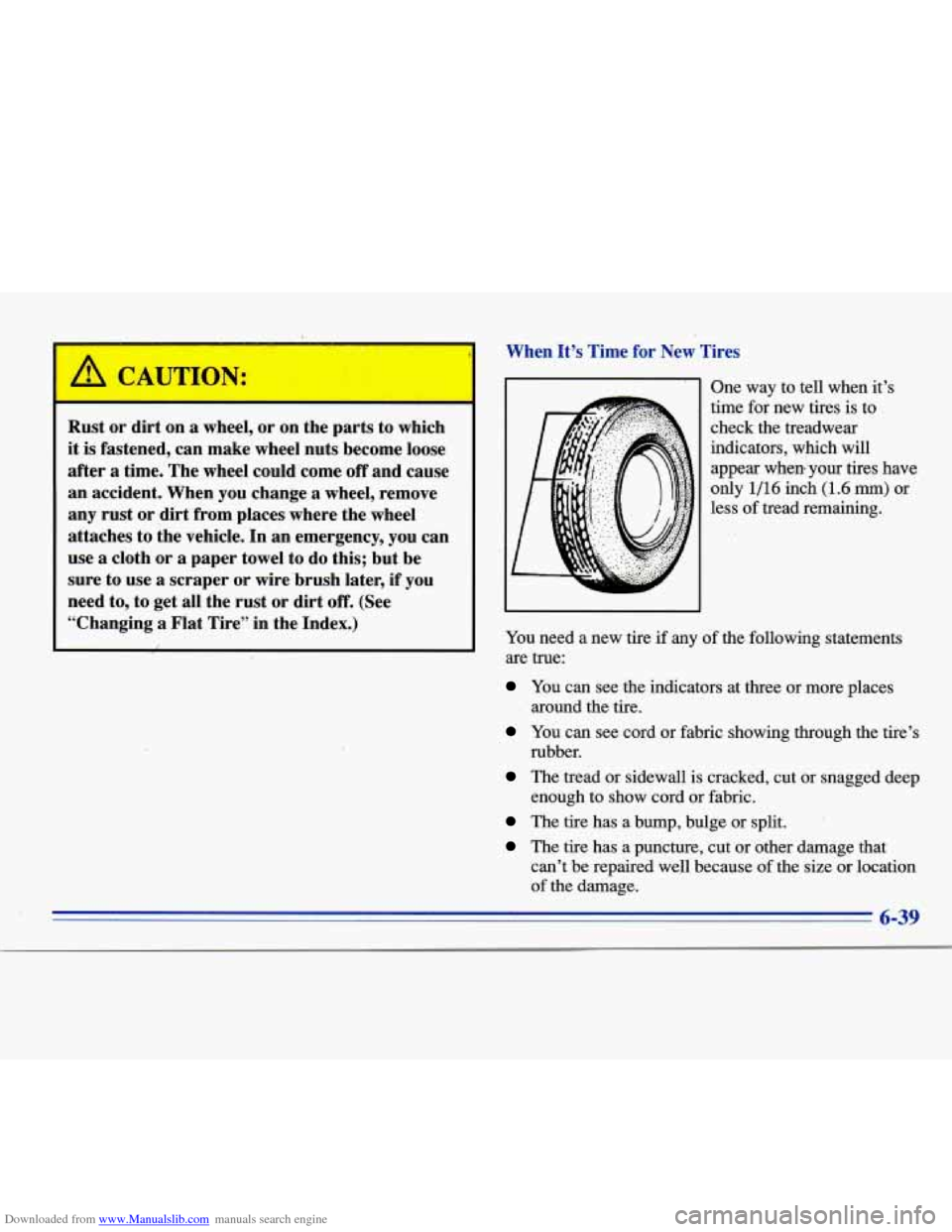
One way to tell when it’s
time for new tires is to check the treadwear
indicators, which
will
appear whenb’,your tires have
only
1/16 inch (1.6 mm) or
less of tread remaining.
You need a new tire if any of the following statements
are true:
You can see the indicators at three or more places
around the tire.
You can see cord or fabric showing through the tire’s
rubber.
The tread or sidewall is cracked, cut or snagged deep enough to show cord or fabric.
The tire has a bump, bulge or split.
The tire has a puncture, cut or other damage that can’t be repaired well because of the size or location
of the damage.
6-39
Page 299 of 354
Downloaded from www.Manualslib.com manuals search engine To find out what kind and size of tires you need, look at
the Tire-Loading Information label.
The tires installed on your vehicle when it
was new had
a Tire Performance Criteria Specification (TPC Spec)
number on each tire’s sidewall. When
you get new tires,
get ones with that same TPC Spec number. That way
your vehicle will continue to have tires that are designed
to give proper endurance, handling, speed rating,
traction, ride and other things during normal service on
your vehicle. If your tires have an all-season tread
design, the TPC number will be followed by an
“MS”
(for mud and snow).
If you ever replace your tires with those not having a
TPC Spec number, make sure they are the same size,
load range,
speed rating and construction type (bias,
bias-belted or radial) as your original tires.
Mixing tires could cause you to lose control while
driving.
If you mix tires of different sizes or types
(radial and bias-belted tires), the vehicle may not
handle properly, and you could have
a crash.
Using tires of different sizes may also cause
damage to your vehicle. Be sure
to use the same
size and type tires on all four wheels.
It’s
all right to drive with your compact spare,
though.
It was developed for use on your vehicle.
Page 301 of 354
Downloaded from www.Manualslib.com manuals search engine pttraturt: -
The temperature grades are A (the highest), B and C,
representing the tire's resistance to the generation of
heat and its ability to dissipate heat when t.ested under
controlled conditions on a specified indoor laboratory
test wheel. Sustained high temperature can cause the
material
of the tire to degenerate and reduce tire life, and
excessive temperature can lead
to sudden tire failure.
The grade
C corresponds to a level of performance
which all passenger car tires must meet under the
Federal Motor Vehicle Safety Standard
No. 109. Grades
A and B represent higher levels of perfolmance on the
laboratory test wheel than the minimum required by law.
Warning: The temperature grade for
this tire is
established for a tire that is properly inflated and not
overloaded. Excessive speed, underinflation, or
excessive loading, either separately or
in combination,
can cause heat buildup and possible tire failure.
I'ire Bala.--
The wheels on your vehicle were aligned and balanced
carefully at the factory to give you the longest tire life
and best overall performance. In
most cases, you will not need to have your wheels
aligned again. However,
if you notice unusual tire wear
or your vehicle pulling one way or the other, the
alignment may need to be reset. If you notice your
vehicle vibrating when driving on a smooth road, your
wheels may need to be rebalanced.
11 c
Replace any wheel that is bent, cracked, or badly rusted
or corroded.
If wheel nuts keep coming loose, the wheel,
wheel bolts and wheel nuts should be replaced. If the
wheel leaks air, replace
it (except some aluminum
wheels, which can sometimes be repaired). See your
Cadillac dealer if any of these conditions exist.
Your dealer will know the kind
of wheel you need.
Each new wheel should have the same load carrying
capacity, diameter, width, offset and be mounted the
same way as the one it replaces.
If you need to replace any of your wheels, wheel bolts
or wheel nuts, replace them only
with new GM original
equipment parts. This way, you will
be sure to have the
right wheel, wheel bolts and wheel nuts for your
Cadillac model.
Page 302 of 354
Downloaded from www.Manualslib.com manuals search engine -
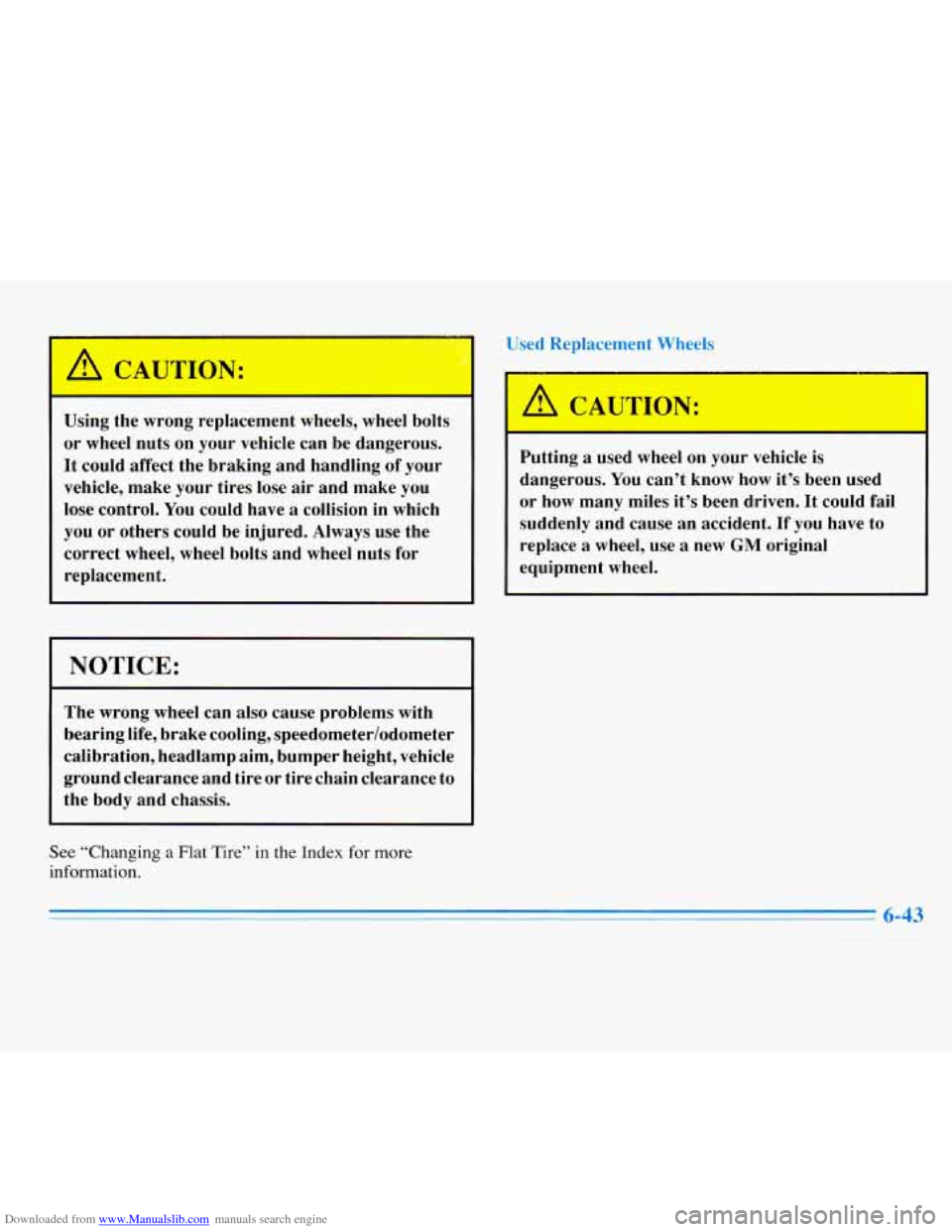
Using the wrong replacement wheels, wheel bolts
or wheel nuts on your vehicle can be dangerous.
It could affect the braking and handling of your
vehicle, make your tires lose air and make you
lose control.
You could have a collision in which
you or others could be injured. Always use the
correct wheel, wheel bolts and wheel nuts for
replacement.
NOTICE:
The wrong wheel can also cause problems with
bearing life, brake cooling, speedometer/odometer
calibration, headlamp aim, bumper height, vehicle
ground clearance and tire or tire chain clearance to
the body and chassis.
See “Changing a Flat Tire” in the Index for more
information.
Used Replacement Wheels
-
CAUTION:
Putting a used wheel on your vehicle is
dangerous. You can’t know how it’s been used
or how many miles it’s been driven. It could fail
suddenly and cause an accident.
If you have to
replace a wheel, use
a new GM original
equipment wheel.
6-43
Page 303 of 354
Downloaded from www.Manualslib.com manuals search engine Tire Chains
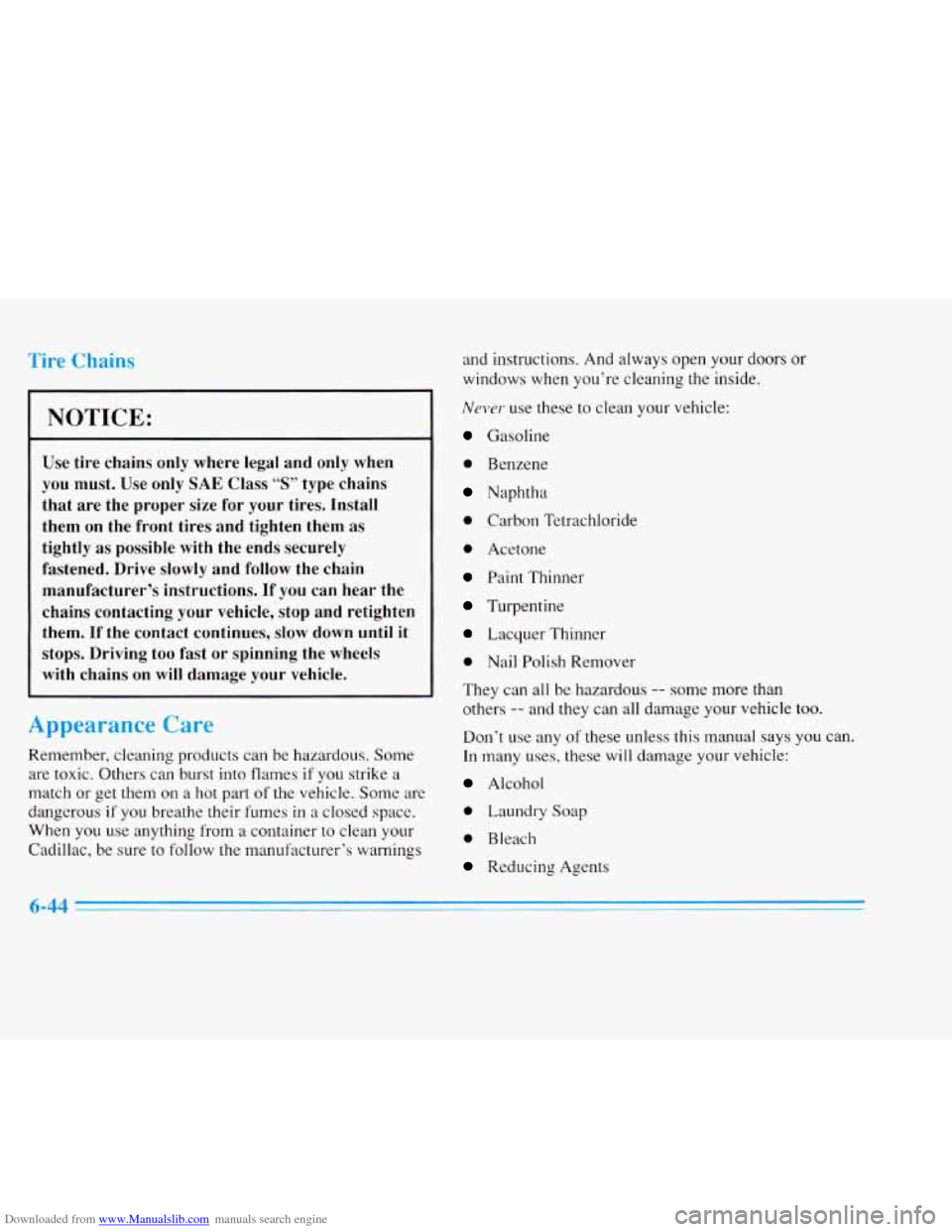
NOTICE:
Use tire chains only where legal and only when
you must. Use only
SAE Class “S” type chains
that are the proper size for your tires. Install
them on the front tires and tighten them
as
tightly as possible with the ends securely
fastened. Drive slowly and follow the chain
manufacturer’s instructions.
If you can hear the
chains contacting your vehicle, stop and retighten
them.
If the contact continues, slow down until it
stops. Driving too fast or spinning the wheels
with chains on will damage your vehicle.
Appearance Care
Remember, cleaning products can be hazardous. Some
are toxic. Others can burst into flames
if you strike a
match or get them on
a hot part of the vehicle. Some are
dangerous
if you breathe their fumes in a closed space.
When you use anything from
a container to clean your
Cadillac, be sure to follow
the manufxturer’s warnings and
instructions. And always open your doors
or
windows when you’re cleaning the inside.
Never use these to clean your vehicle:
Gasoline
0 Benzene
Naphtha
0 Carbon Tetrachloride
0 Acetone
Paint Thinner
Turpentine
Lacquer Thinner
0 Nail Polish Remover
They can
all be hazardous -- some more than
others
-- and they can all damage your vehicle too.
Don’t use any
of these unless this manual says you can.
In many uses, these will damage
your vehicle:
Alcohol
0 Laundry Soap
0 Bleach
Reducing Agents
6-44
Page 309 of 354
Downloaded from www.Manualslib.com manuals search engine vvn,,
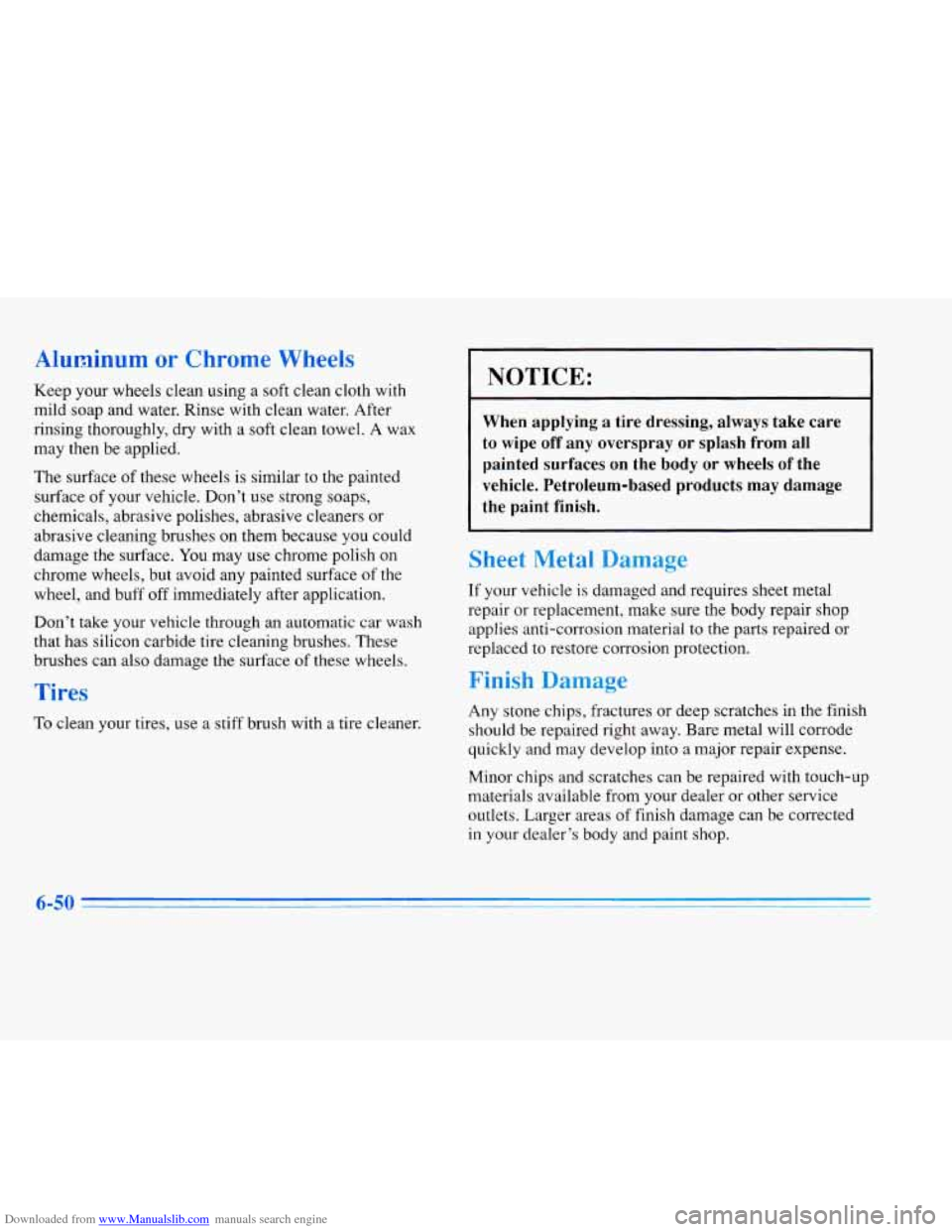
Keep your wheels clean using a soft clean cloth with
mild soap and water. Rinse with clean water. After
rinsing thoroughly, dry with a soft clean towel. A wax
may then be applied.
The surface of these wheels is similar to the painted
surface
of your vehicle. Don’t use strong soaps,
chemicals, abrasive polishes, abrasive cleaners
or
abrasive cleaning brushes on them because you could
damage the surface.
You may use chrome polish on
chrome wheels, but avoid any painted surface of the
wheel, and buff off immediately after application.
Don’t take your vehicle through an automatic car wash
that has silicon carbide tire cleaning brushes. These
brushes can also damage the surface of these wheels.
Til
To clean your tires, use a stiff brush with a tire cleaner.
’ NOTICE:
When applying a tire dressing, always take care
to wipe
off any overspray or splash from all
, painted surfaces on the body or wheels of the ’ vehicle. Petroleum-based products may damage
the paint finish.
IV 31 Dal Y
[f your vehicle is damaged and requires sheet metal
repair or replacement, make sure the body repair shop
spplies anti-corrosion material
to the parts repaired or
replaced to restore corrosion protection.
ish Dama; !
Any stone chips, fractures or deep scratches in the finish
should be repaired right away. Bare metal will corrode
quickly and may develop into a major repair expense.
Minor chips and scratches can be repaired with touch-up
materials available from your dealer or other service
outlets. Larger areas of finish damage can be corrected
in your dealer’s body and paint shop.
Page 320 of 354
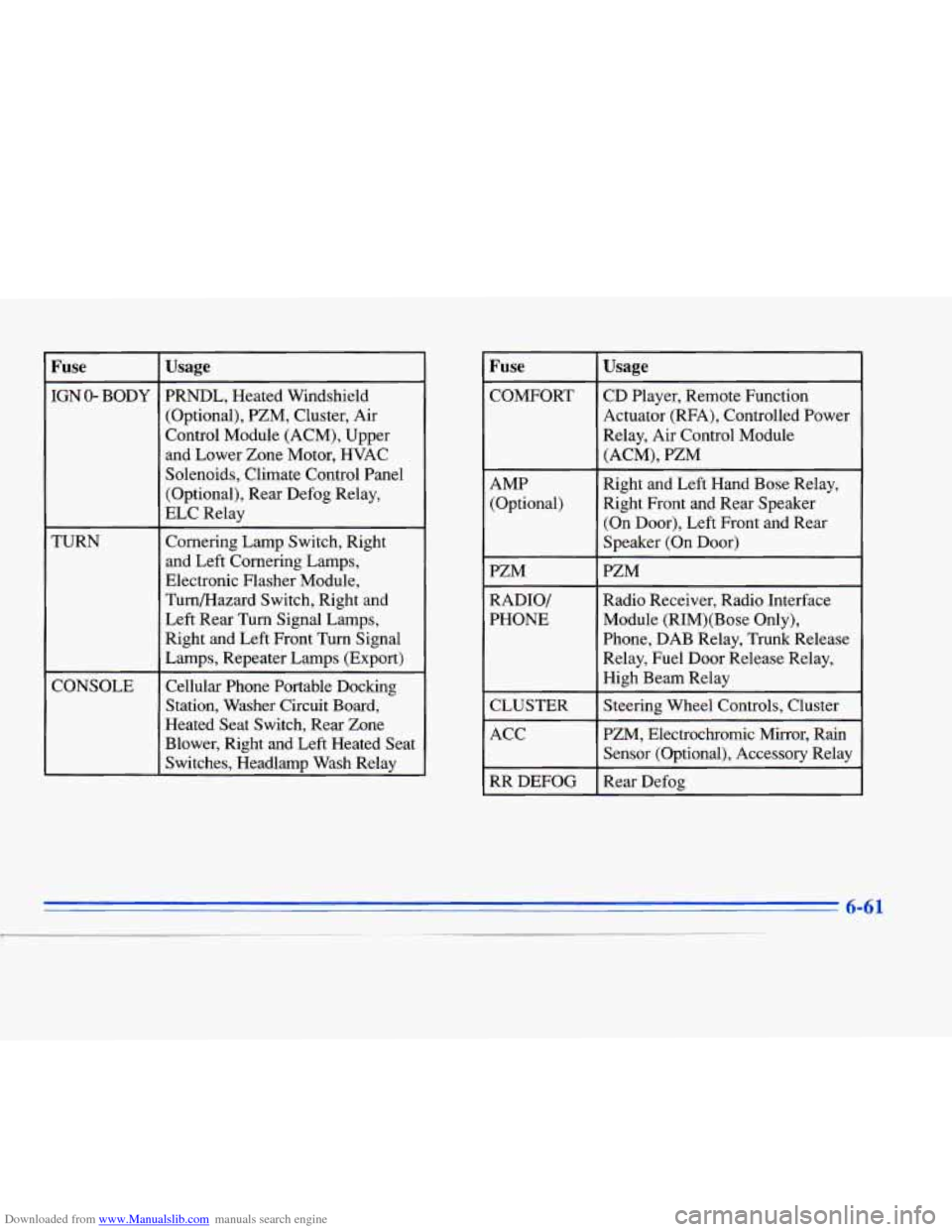
Downloaded from www.Manualslib.com manuals search engine Fuse
IGN 0- BODY
TURN CONSOLE
Usage
PRNDL, Heated Windshield (Optional), PZM, Cluster, Air
Control Module (ACM), Upper and Lower Zone Motor, HVAC
Solenoids, Climate Control Panel
(Optional), Rear Defog Relay,
ELC Relay
Cornering Lamp Switch, Right
and Left Cornering Lamps,
Electronic Flasher Module,
Turn/Hazard Switch, Right and Left Rear Turn Signal Lamps,
Right and Left Front
Turn Signal
Lamps, Repeater Lamps (Export)
Cellular Phone Portable Docking
Station, Washer Circuit Board,
Heated Seat Switch, Rear Zone
Blower, Right and Left Heated Seat Switches, Headlamp Wash Relay
Fuse
COMFORT
AMP
(Optional)
PZM
RADIO/ PHONE
CLUSTER
ACC
RR DEFOG
Usage
CD Player, Remote Function
Actuator (RFA), Controlled Power
Relay, Air Control Module (ACM), PZM
Right and Left Hand Bose Relay,
Right Front and Rear Speaker
(On Door), Left Front and Rear
Speaker (On Door)
PZM
Radio Receiver, Radio Interface Module (RIM)(Bose Only),
Phone, DAB Relay, Trunk Release
Relay, Fuel Door Release Relay,
High Beam Relay
Steering Wheel Controls, Cluster
PZM, Electrochromic Mirror, Rain
Sensor (Optional), Accessory Relay
Rear Defog
6-
-I
Page 324 of 354
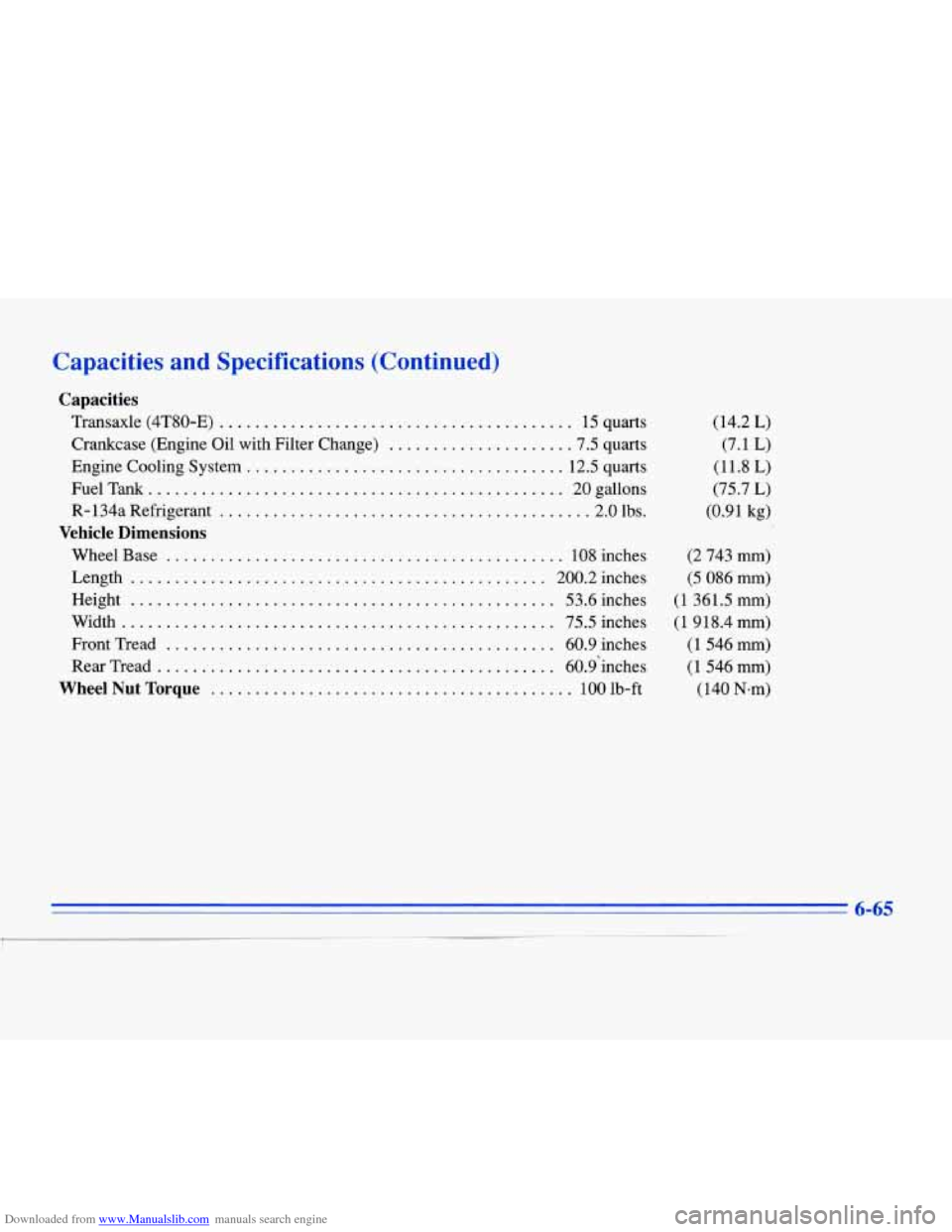
Downloaded from www.Manualslib.com manuals search engine Capacities and
Capacities
Transaxle (4T80-E)
Specifications (Continued)
........................................ 15quarts
Crankcase (Engine Oil with Filter Change)
..................... 7.5 quarts
Engine Cooling System
.................................... 12.5 quarts
Fuel Tank
............................................ rr ‘i 20 gallons
R- 134a Refrigerant
......................................... .2.0 lbs.
Wheel Base
............................................. 108 inches
Length
............................................... 200.2inches
Height
................................................ 53.6 inches
Width
................................................. 75.5inches
Front Tread
............................................ 60.9 inches
Rear Tread
............................................. 60.9-inches
WheelNutTorque ......................................... 1OOlb-ft
Vehicle Dimensions
(14.2 L)
(7.1 L)
(11.8 L)
(75.7 L)
(0.91
kg)
(2 743 mm)
(5 086
mm)
(1 361.5 mm)
(1 918.4 mm)
(1 546 mm)
(1 546 mm) (140 N-m)
6-65
I
Page 342 of 354
Downloaded from www.Manualslib.com manuals search engine ........
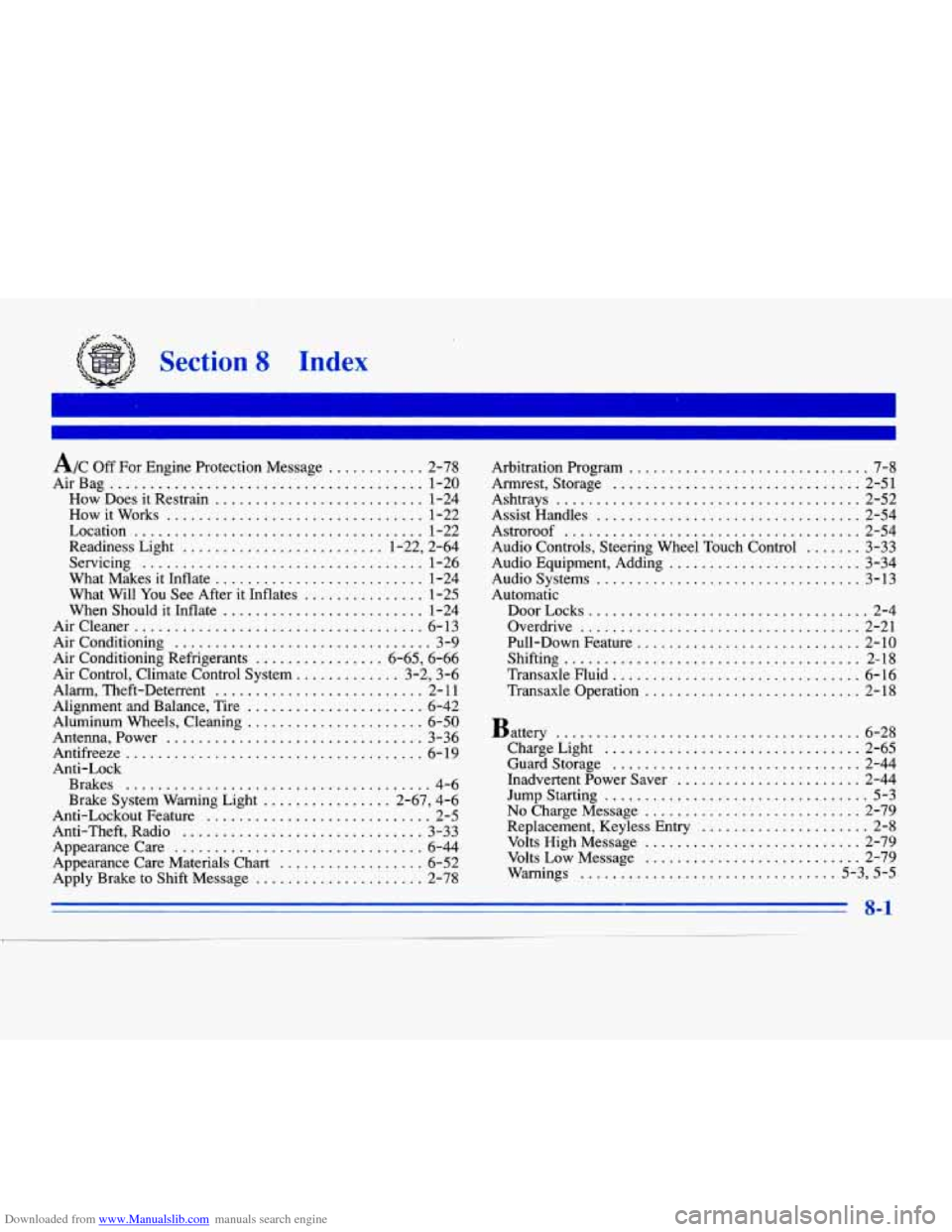
Section 8 Index
. .
.
A/C Off For Engine Protection Message ............ 2-78
AirBag
....................................... 1-20
How Does it Restrain
.......................... 1-24
How it Works
................................ 1-22
Location
.................................... 1-22
Readiness Light
......................... 1.22. 2.64
Servicing
................................... 1-26
What Makes
it Inflate .......................... 1-24
What Will You See After it Inflates
............... 1-25
When Should it Inflate
......................... 1-24
Air Cleaner
.................................... 6- 13
Air Conditioning
................................ 3-9
Air Conditioning Refrigerants
................ 6.65. 6.66
Air Control. Climate Control System
............. 3.2. 3.6
Alarm. Theft-Deterrent
.......................... 2- 11
Alignment and Balance. Tire
...................... 6-42
Aluminum Wheels. Cleaning
...................... 6-50
Antenna. Power
................................ 3-36
Antifreeze
..................................... 6- 19
Anti-Lock
Brakes
...................................... 4-6
Brake System Warning Light
................ 2.67. 4.6
Anti-Lockout Feature
............................ 2-5
Anti.Theft. Radio
.............................. 3-33
Appearance Care
............................... 6-44
Appearance Care Materials Chart
.................. 6-52
Apply Brake to Shift Message
..................... 2-78 Arbitration Program
.............................. 7-8
Armrest. Storage ............................... 2-51
Ashtrays
...................................... 2-52
Assist Handles
................................. 2-54
Astroroof
..................................... 2-54
Audio Controls. Steering Wheel Touch Control
....... 3-33
Audio Equipment. Adding
........................ 3-34
Audio Systems
................................. 3-13
Automatic
DoorLocks
................................... 2-4
Overdrive
................................... 2-21
Pull-Down Feature
............................ 2-10
Shifting
..................................... 2-18
Transaxle Fluid
............................... 6-16
Transaxle Operation
........................... 2-18
Battery
...................................... 6-28
ChargeLight
................................ 2-65
Guard Storage
............................... 2-44
Inadvertent Power Saver
....................... 2-44
Jump Starting
................................. 5-3
Replacement. Keyless Entry
..................... 2-8
Volts High Message
........................... 2-79
Volts Low Message
........................... 2-79
Warnings
................................ 5-3. 5-5
No Charge Message ........................... 2-79
8-1
I