light CADILLAC ELDORADO 1996 10.G Repair Manual
[x] Cancel search | Manufacturer: CADILLAC, Model Year: 1996, Model line: ELDORADO, Model: CADILLAC ELDORADO 1996 10.GPages: 354, PDF Size: 19.33 MB
Page 208 of 354
Downloaded from www.Manualslib.com manuals search engine Winter n rivil
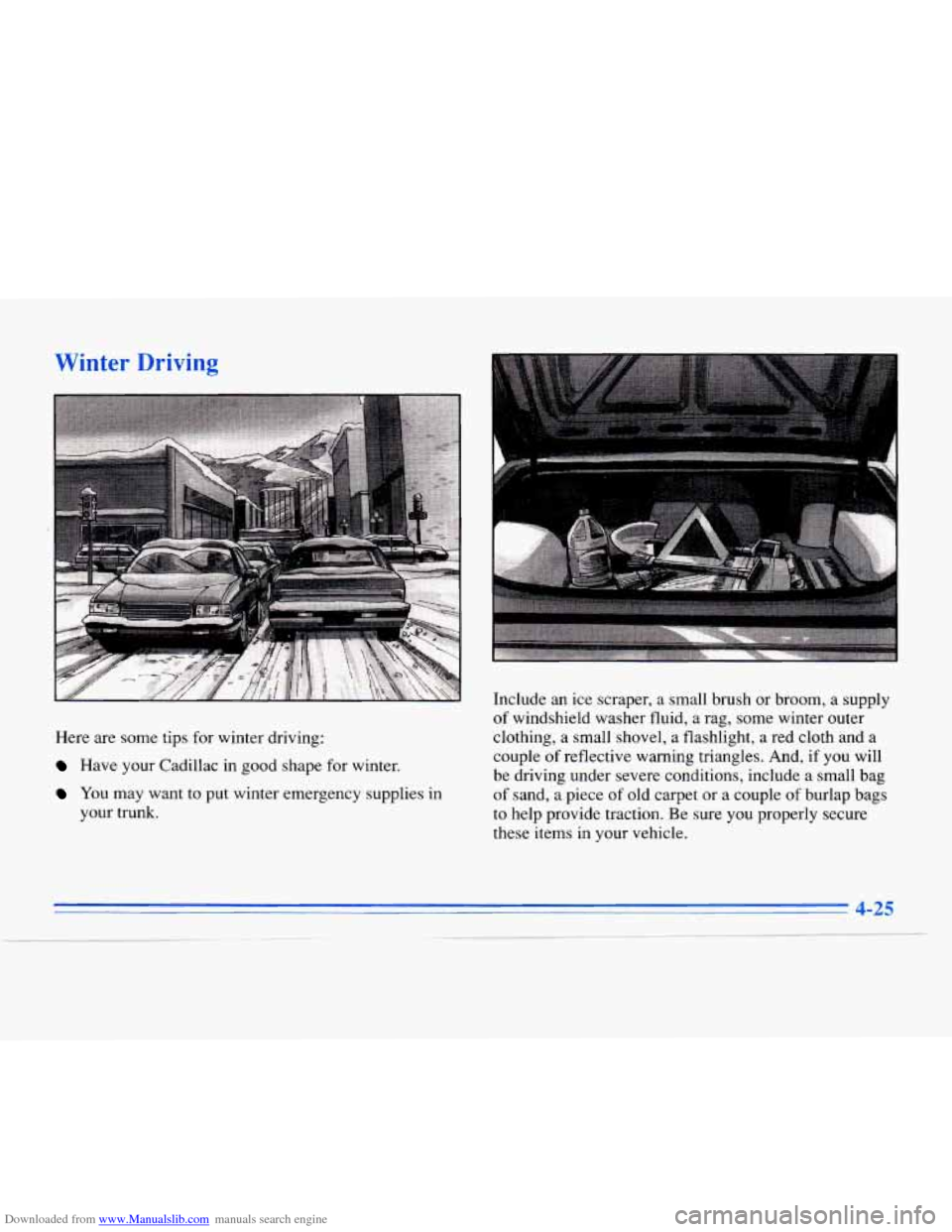
Here are some tips for winter driving:
Have your Cadillac in good shape for winter.
YOU may want to put winter emergency supplies in
your trunk. Include
an ice scraper, a small brush or broom, a supply
of windshield washer fluid, a rag, some winter outer
clothing, a small shovel, a flashlight, a red cloth and
a
couple of reflective warning triangles. And, if you will
be driving under severe conditions, include a small bag
of sand, a piece of old carpet or a couple of burlap bags
to help provide traction. Be sure you properly secure
these items in your vehicle.
Page 212 of 354
Downloaded from www.Manualslib.com manuals search engine Run your engine only as long as you must. This saves
fuel. When you run the engine, make it go a little faster
than just idle. That
is, push the accelerator slightly. This
uses less fuel for the heat that you get and it keeps the
battery charged. You will need a well-charged battery to
restart the vehicle, and possibly for signaling later on
with your headlamps. Let the heater run for awhile.
Then, shut the engine off and close the window almost
all the way to preserve the heat. Start the engine again
and repeat this only when you feel really uncomfortable
from the cold. But do it as little as possible. Preserve the
fuel as long
as you can. To help keep warm, you can get
out of the vehicle and do some fairly vigorous exercises
every half hour or
so until help comes.
Loading Your Vehicle
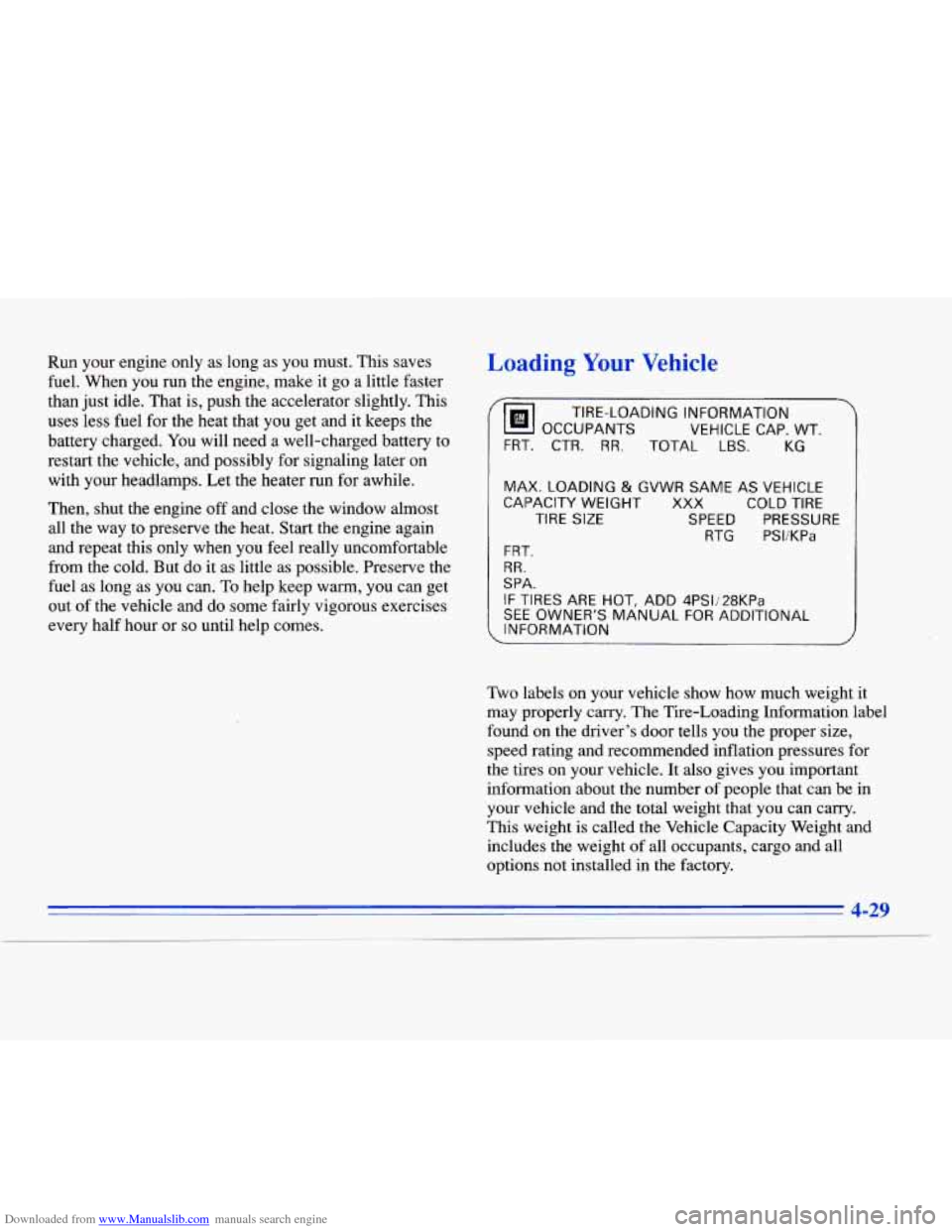
‘ OCCUPANTS
VEHICLE CAP. WT.
TIRE-LOADING INFORMATION
FRT. CTR.
RR. TOTAL LBS. KG
MAX. LOADING & GVWR SAME AS VEHICLE
CAPACITY WEIGHT
XXX COLD TIRE
TIRE SIZE SPEED PRESSURE
RTG PSI/KPa
FRT.
RR.
SPA.
IF TIRES ARE HOT. ADD 4PS1/28KPa
SEE OWNER’S MANUAL FOR ADDITIONAL
INFORMATION
Two labels on your vehicle show how much weight it
may properly carry. The Tire-Loading Information label
found on the driver’s door tells you the proper size,
speed rating and recommended inflation pressures for
the tires on your vehicle. It also gives you important
information about the number of people that can be in
your vehicle and the total weight that you can carry.
This weight is called the Vehicle Capacity Weight and
includes the weight of all occupants, cargo and all
options not installed in the factory.
I
4-29
Page 223 of 354
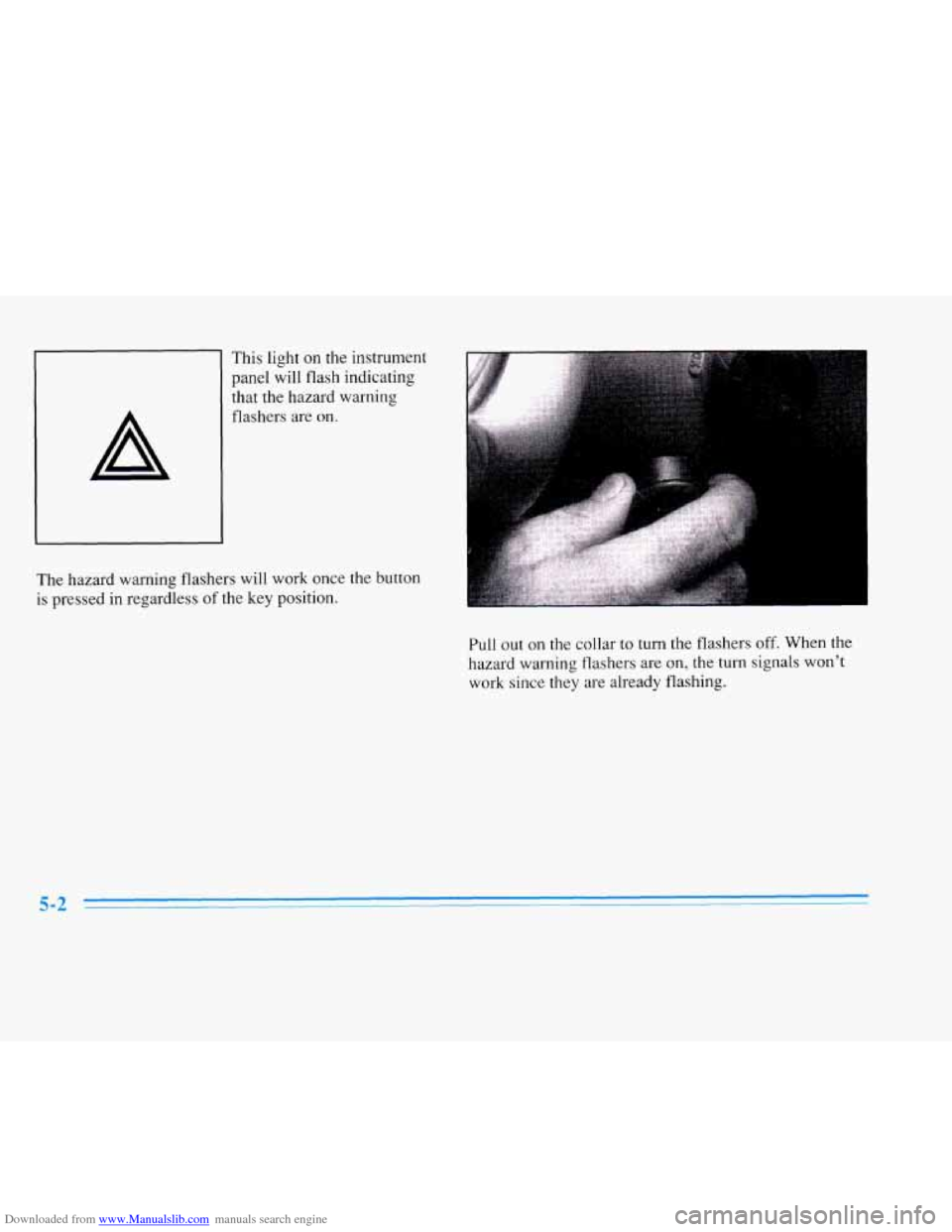
Downloaded from www.Manualslib.com manuals search engine This light on the instrument
panel will flash indicating
that the hazard warning
A
The hazard warning flashers will work once the button
is pressed in regardless of the key position.
. ..
Pull out on the collar to turn the flashers off. When the
hazard warning flashers are on, the
turn signals won’t
work since they are already flashing.
5-2
Page 225 of 354
Downloaded from www.Manualslib.com manuals search engine 2.
3.
4.
Get the vehicles close enough so the jumper cables
can reach, but be sure
the vehicles aren’t touching
each other.
If they are, it could cause a ground
connection you don’t want. You wouldn’t be able to
start your Cadillac and the bad grounding could
damage the electrical systems.
Tum off the ignition on both vehicles. Unplug
unnecessary accessories plugged
into the cigarette
lighter.
Turn off all lamps that aren’t needed as well
as radios.
This will avoid sparks and help save both
batteries. In addition,
it could save your radio!
Open the hoods
and locate the batteries. Find the
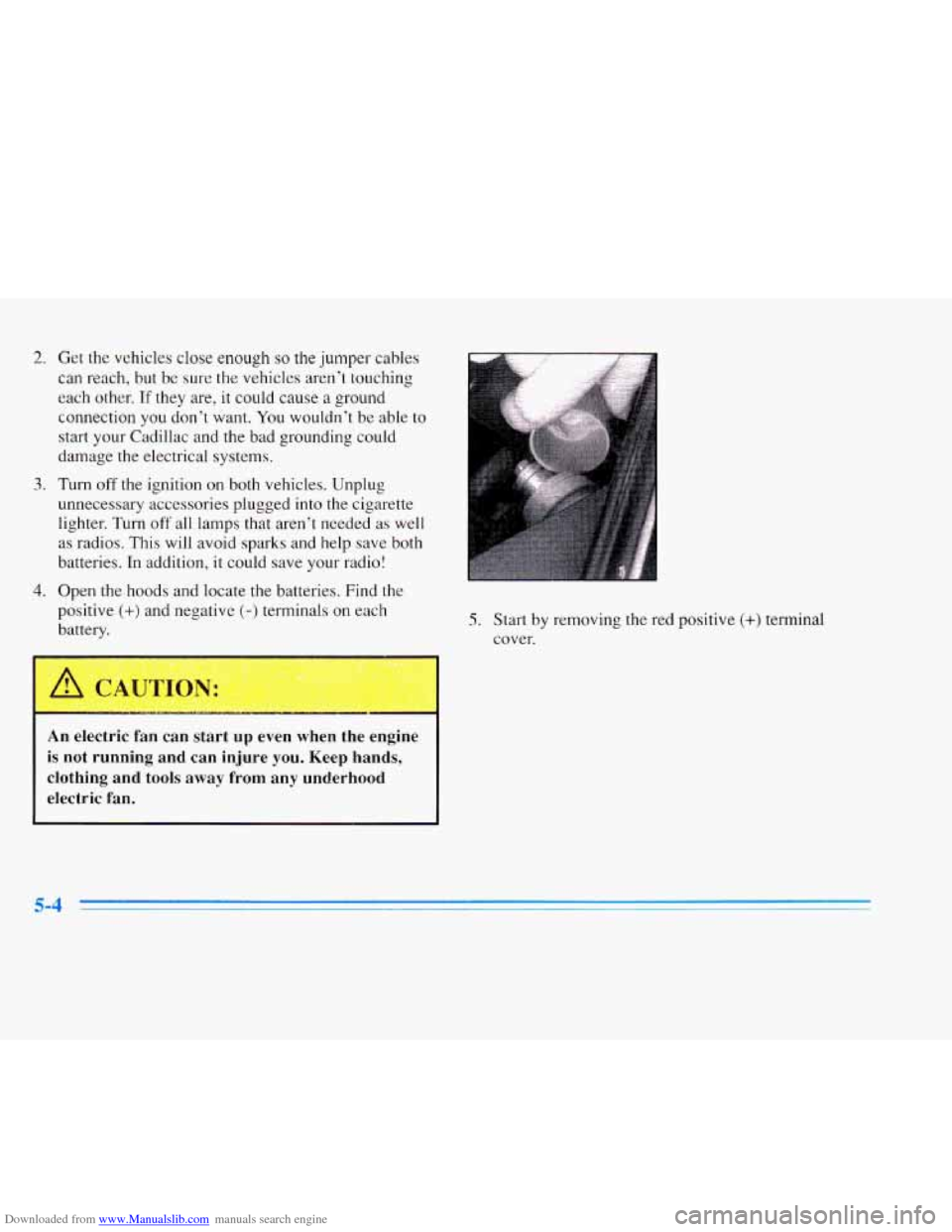
positive
(+) and negative (-) terminals on each
battery. 5. Start by removing the red positive (+) terminal
cover.
I
An electric fan can start up even when the engine
is not running a.nd can injure you. Keep hands,
clothing and tools away from any underhood
electric fan.
Page 226 of 354
Downloaded from www.Manualslib.com manuals search engine 6. Check that the jumper cables don’t have loose or
missing insulation.
If they do, you could get a shock.
The vehicles could also be damaged.
Before you connect the cables, here are some things
you should know. Positive
(+) will go to positive (+)
and negative (-) will go to negative (-) or a metal
engine part. Don’t connect positive
(+) to negative (-)
or you’ll get a short that would damage the battery and
maybe other parts, too.
Using a match near a battery can cause battery
gas to explode. People have been hurt doing this,
and some have been blinded. Use
a flashlight if
you need more light.
Be sure the battery has enough water. You don’t
need to add water to the Delco Freedom@ battery
installed in every new
GM vehicle. But if a
battery has filler caps, be sure the right amount
of fluid is there. If it is low,
add water to take care
of that first.
If you don’t, explosive gas could be
present.
Battery fluid contains acid that can burn you.
Don’t get it on you. If you accidentally get it in
your eyes
or on your skin, flush the place with
water and get medical help immediately.
Fans or other moving engine parts can injure you
badly. Keep your hands away from moving parts
once the engines are running.
5-5
Page 236 of 354
Downloaded from www.Manualslib.com manuals search engine Engine Overheating
You will find an ENGINE COOLANT HOT-IDLE
ENGINE message or a
STOP ENGINE ENGINE
OVERHEATED message
on the DIC. There is also an
engine temperature warning light on the instrument
panel. See “Engine Temperature Warning Light”
in the
Index.
Overhe 1 Engine Ootection Operating
Mode
Should a low coolant condition exist and the message
STOP ENGINE ENGINE OVERHEATED is displayed,
an overheat protection mode which alternates firing
groups
of four cylinders helps prevent engine damage.
This operating mode allows your vehicle to be driven
to a safe place in
an emergency; you may drive up to
50 miles (80 km). Towing a trailer in the overheat
protection mode should be avoided.
NOTICE:
After driving in the Overheated Engine
Protection Operating
Mode, to avoid engine
damage, allow the engine to cool before
attempting any repair. The engine oil may be
severely degraded. Change the oil and reset the
oil life indicator. See “Engine Oil, When to Change” in the Index.
5-15
Page 258 of 354
Downloaded from www.Manualslib.com manuals search engine NOTICE:
Spinning your wheels can destroy parts of your
vehicle as well as the tires. If you spin the wheels
too fast while shifting your transaxle back and
forth, you can destroy your transaxle.
~
For information about using tire chains on your vehicie,
see “Tire Chains” in the Index.
Rocking your vehicle to get it out:
First, turn your steering wheel left and right. That will
clear the area around your front wheels. You should turn
your traction control system off. (See “Traction Control
System” in the Index.) Then shift back and forth
between REVERSE
(R) and a forward gear, spinning the
wheels as little as possible. Release the accelerator pedal
while you shift, and press lightly on the accelerator
pedal when the transaxle is in gear. If that doesn’t get
you out after
a few tries, you may need to be towed out.
If you do need to be towed out,
see “Towing Your
Vehicle’’ in the Index.
5-37
1
Page 278 of 354
Downloaded from www.Manualslib.com manuals search engine Engine Coolant
The cooling system in your vehicle is filled with new
DEX-COOL TM (orange-colored, silicate-free) engine
coolant. This coolant is designed to remain in your
vehicle for
5 years or 100,000 miles (166 000 km),
whichever occurs first.
The following explains your cooling system and how
to add coolant when it is low. If you have a problem
with engine overheating, see “Engine Overheating”
in the Index.
A 50/50 mixture of water and the proper coolant for
your Cadillac will:
Give freezing protection down to -34°F (-37°C).
Give boiling protection up to 265°F (129°C).
Protect against rust and corrosion.
Help keep the proper engine temperature.
Let the warning lights and gages work as they
should.
NOTICE:
When adding coolant it is important that you use
DEX-COOL (orange-colored, silicate-free)
coolant meeting
GM Specification 6277M.
If silicated coolant is added to the system,
premature engine, heater core or radiator
corrosion may result. In addition, the engine
coolant will require change sooner
-- at
30,000 miles (50 000 km) or 24 months,
whichever occurs first.
What to Use
Use a mixture of one-half clean water (preferably
distilled) and one-half
DEX-COOL (orange-colored,
silicate-free) antifreeze that meets GM Specification
6277M, which won’t damage aluminum parts. Use
GM Engine Coolant Supplement (sealer) (GM Part
No. 3634621) with any complete coolant change. If you
use this mixture, you don’t need to add anything else.
A special procedure is required for adding sealer; see the
Cadillac service manual.
(To order a service manual, see
“Service and Owner Publications” in the Index.)
6-19
Page 280 of 354
Downloaded from www.Manualslib.com manuals search engine Checking Coolant
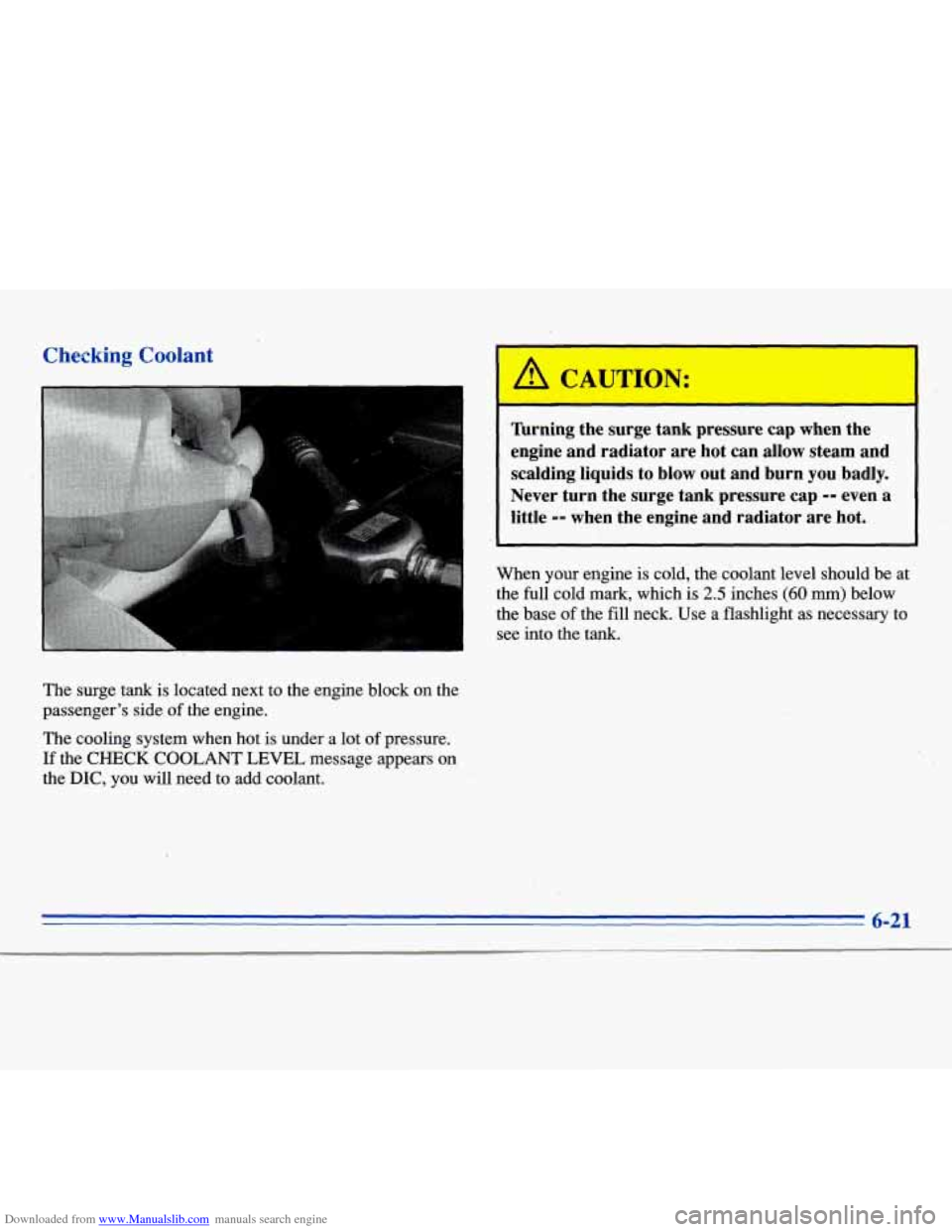
The surge tank is located next to the engine block on the
passenger’s side of the engine.
The cooling system when hot is under
a lot of pressure.
If the CHECK COOLANT LEVEL message appears on
the
DIC, you will need to add coolant.
A CAUTION:
I
I
lhrning the surge tank pressure cap when the
engine and radiator are hot can allow steam and
scalding liquids
to blow out and burn you badly.
Never turn the surge tank pressure cap
-- even a
little
-- when the engine and radiator are hot.
When your engine is cold, the coolant level should be at
the full cold mark, which is
2.5 inches (60 mm) below
the base
of the fill neck. Use a flashlight as necessary to
see into the tank..
6-21
Page 284 of 354
Downloaded from www.Manualslib.com manuals search engine Brakes
Brake Fluid
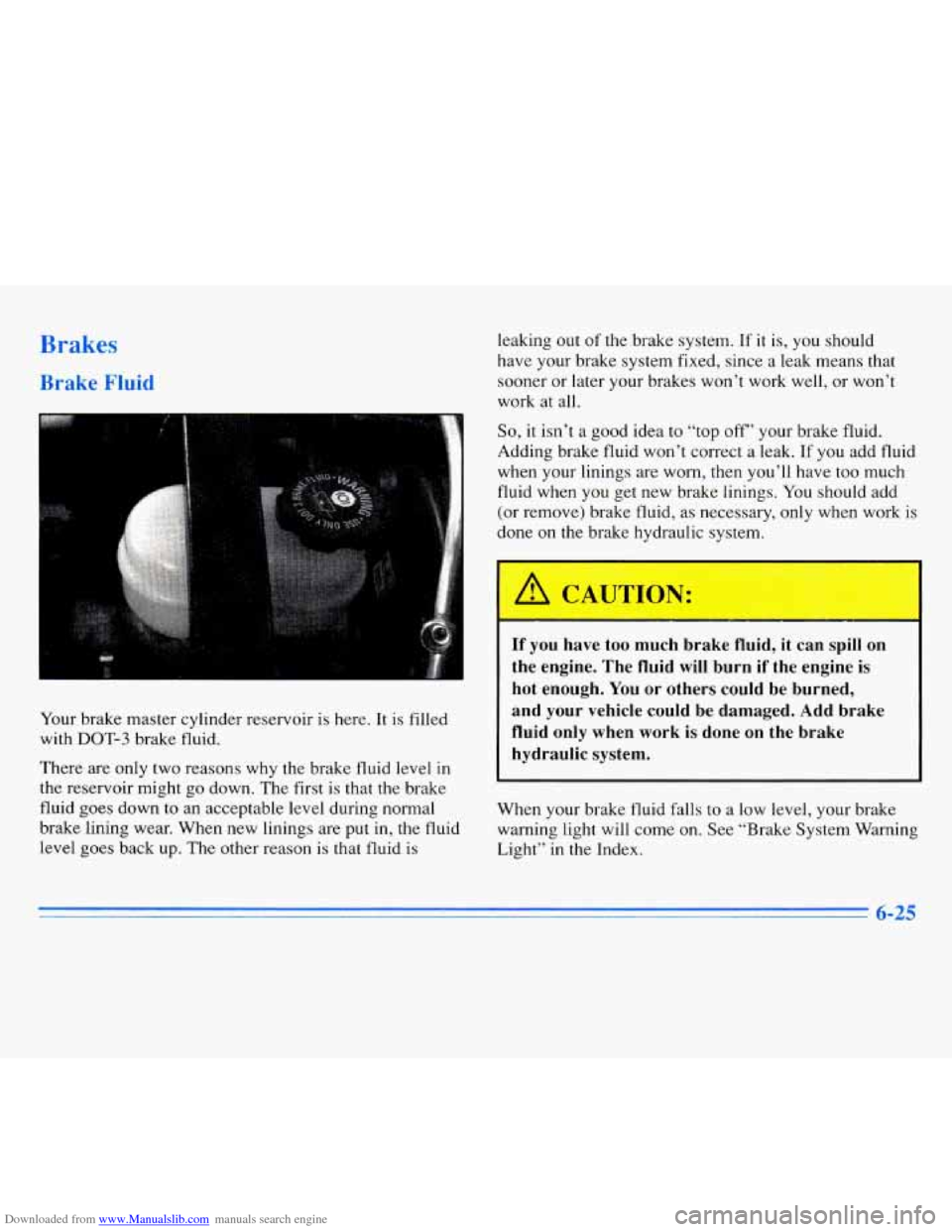
Your brake master cylinder reservoir is here. It is filled
with
DOT-3 brake fluid.
There are only two reasons why the brake fluid level
in
the reservoir might go down. The first is that the brake
fluid goes down to an acceptable level during normal
brake lining wear. When new linings are put in, the fluid
level goes back up. The other reason is that fluid
is
leaking out of the brake system. If it is, you should
have your brake system fixed, since a leak means that
sooner or later your brakes won’t work well, or won’t
work at all.
So, it isn’t a good idea to “top off’ your brake fluid.
Adding brake fluid won’t correct a leak.
If you add fluid
when your linings are
worn, then you’ll have too much
fluid when you get new brake linings. You should add
(or remove) brake fluid, as necessary, only when work is
done on the brake hydraulic system.
I
If you have too much brake fluid, it can spill on
the engine. The fluid will burn if the engine is
hot enough.
You or others could be burned,
and your vehicle could be damaged. Add brake
fluid only when work
is done on the brake
hydraulic system.
When your brake fluid falls to a low level, your brake
warning light will come
on. See “Brake System Warning
Light” in the Index.
6-25