wheel CADILLAC ELDORADO 1997 10.G User Guide
[x] Cancel search | Manufacturer: CADILLAC, Model Year: 1997, Model line: ELDORADO, Model: CADILLAC ELDORADO 1997 10.GPages: 361, PDF Size: 22.85 MB
Page 87 of 361
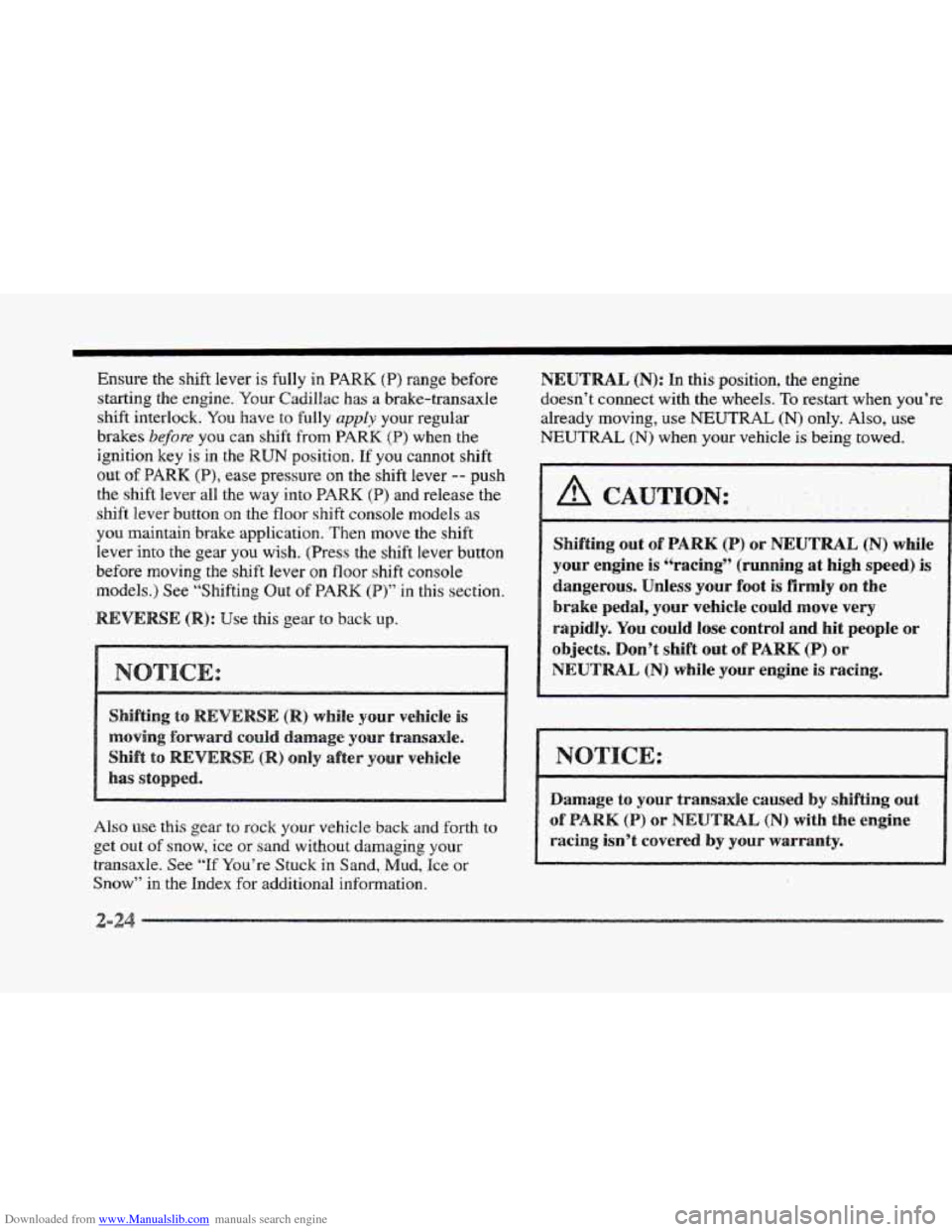
Downloaded from www.Manualslib.com manuals search engine Ensure the shift lever is fully in PARK (P) range before
starting the engine.
Your Cadillac has a brake-transaxle
shift interlock.
You have to fully apply your regular
brakes
before you can shift from PARK (P) when the
ignition key is in the RUN position. If you cannot shift
out
of PARK (P), ease pressure on the shift lever -- push
the shift lever all the way
into PARK (P) and release the
shift lever button
QII the floor shift console models as
you maintain brake application. Then move the shift
lever into the gear
you wish. (Press the shift lever button
before moving the shift lever on floor shift console
models.) See “Shifting Out
of PARK (P)” in this section.
EVERSE (It): Use this gear to back up.
Also use this gear to J-QC~ your vehicle back and forth to
get out of snow, ice or sand without damaging your
transaxle. See “If You’re Stuck in Sand, Mud, Ice or
Snow” in the Index for additional information.
NEUTRAL (N): In this position, the engine
doesn’t connect with
the wheels. To restart when you’re
already moving, use
NEUTRAL (N) only. Also, use
NEUTRAL (N) when your vehicle is being towed.
Shifting out of PARK (P) or NEUTWAL (N) while
your engine
is “racing” (running at high speed) is
dangerous. Unless your foot is firmly on the
brake pedal, your vehicle coulld move very
rapidly.
You could lose control and hit people or
objects. Don’t shift
out of PARK (P) or
NEUTRAL (N) while your engine is racing.
Damage to your transaxle caused by shifting out
of PARK (P) or NEWTML (N) with the engine
racing isn’t covered by your warranty.
Page 89 of 361
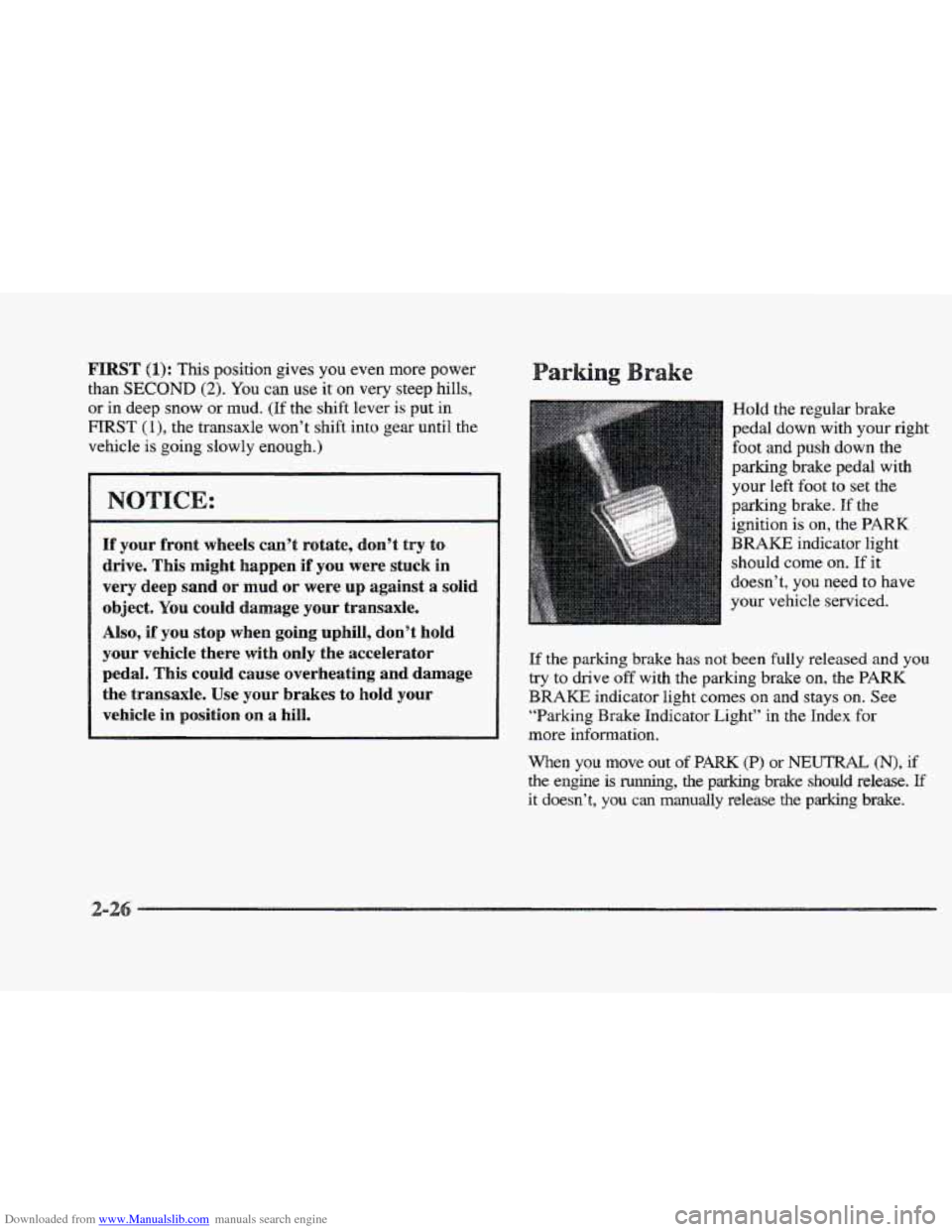
Downloaded from www.Manualslib.com manuals search engine FIRST (I): This position gives you even more power
than
SECOND (2). You can use it on very steep hills,
or in deep snow or mud. (If the shift lever is put in
FIRST (I), the transaxle won’t shift into gear until the
vehicle
is going slowly enough.)
If your front wheels can’t rotate, don’t try to
drive. This might happen if you were stuck in
very deep
sand OF mud or were up against a solid
object. You codd damage your transaxle.
Also, if you stop when going uphill, don’t hold
your vehicle there with only the accelerator
pedal. This could cause overheating and damage
the transaxle. Use
your brakes to hold your
vehicle in position on a hill.
1 ar e
Hold the regular brake
pedal down with your
right
foot and push down the
parking brake pedal with
your
left foot to set the
parking brake. If the
ignition is
on, the PARK
BRAKE indicator light
should come
on. If it
doesn’t, you need to have
your vehicle serviced.
If the
parking brake has not been fully released and you
try to drive off with the parking brake on, the PARK
BRAKE indicator light comes on and stays on. See
“Barking Brake Indicator Light” in the Index for
more information.
When you move out of PARK (P) or NEUTRAL (N), if
the engine is running, the parking brake should release. If
it doesn’t, you can manually release the parking brake.
Page 97 of 361
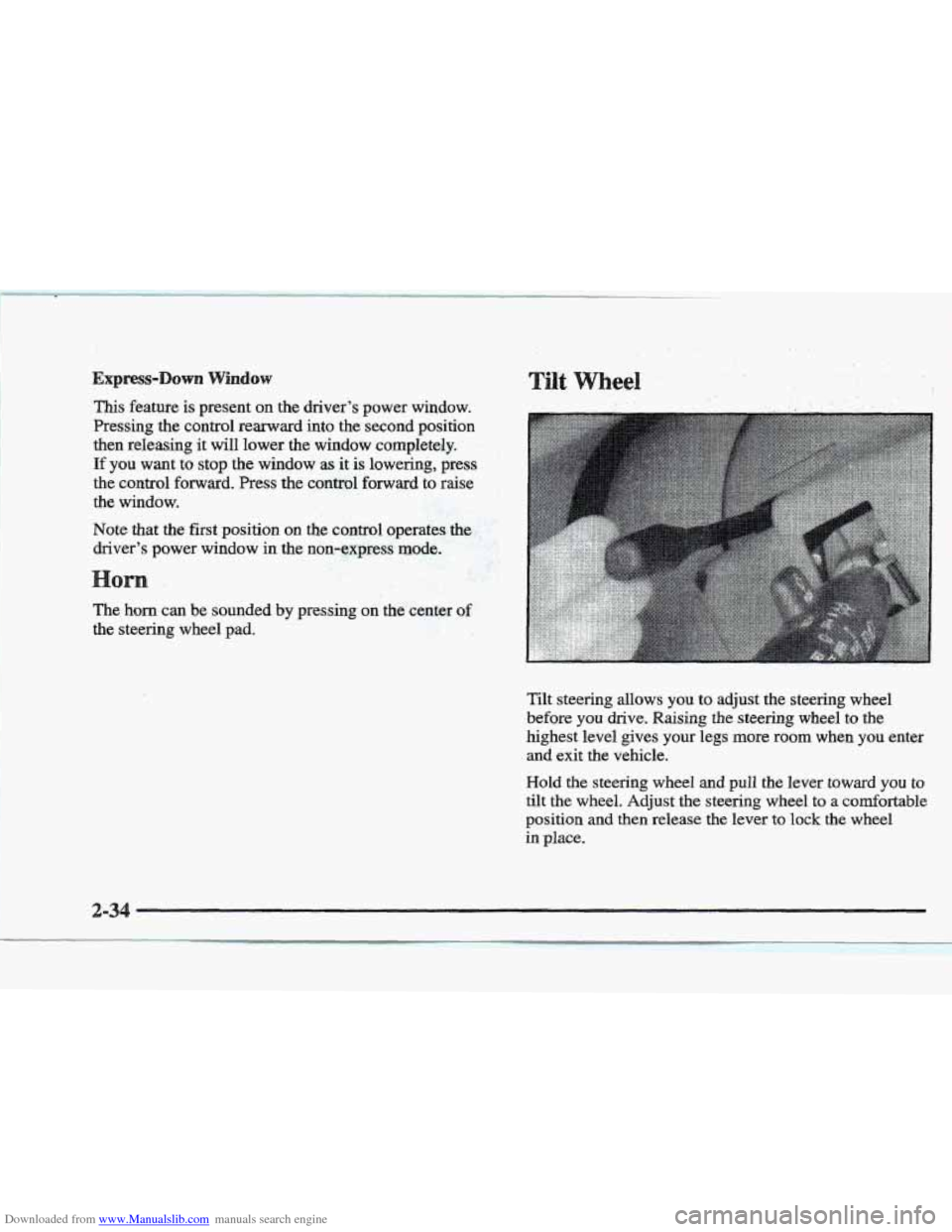
Downloaded from www.Manualslib.com manuals search engine EX~ESS-DOWR Whdow
This feature is present on the driver’s power window.
Pressing the control rearward into the second
position
then releasing it will lower the window completely.
If you want to stop the window as it is lowering, press
the control forward. Press the control, .. forward to raise
the window.
Note that
the first position on the control operates the
driver’s power window in the non-express mode.
The
horn can be sounded by pressing on the center of
the steering wheel pad.
Tilt steering allows you to adjust the steering wheel
before
you drive. Raising the steering wheel to the
highest level gives your legs more room when you enter
and exit the vehicle.
Hold the steering wheel and pull the lever toward you to
tilt the wheel. Adjust the steering wheel to a comfortable
position
and then release the lever to lock the wheel
in place.
2-34
I
Page 102 of 361
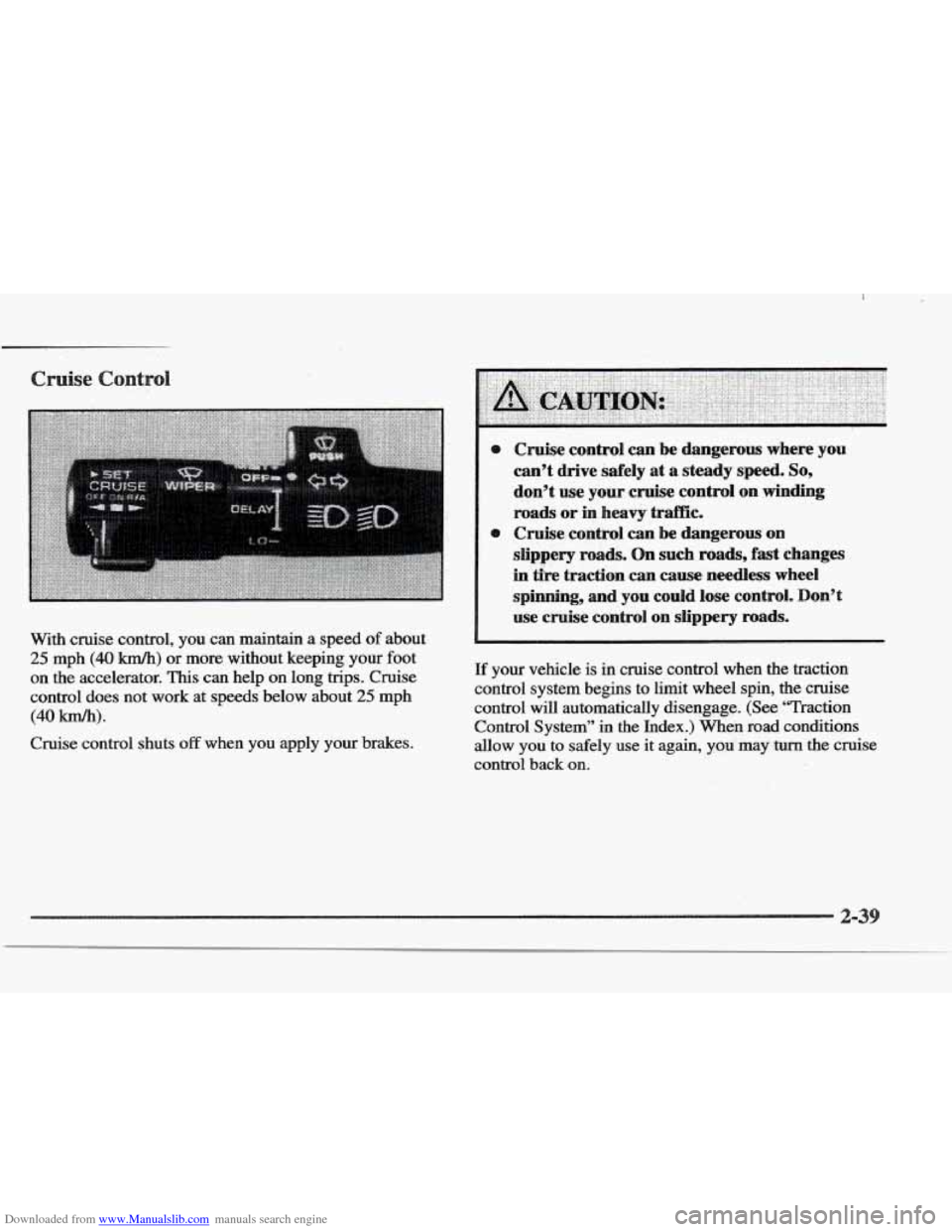
Downloaded from www.Manualslib.com manuals search engine With cruise control, you can maintain a speed of about
25 mph (40 km/h) or more, without keeping your foot
on the accelerator. This can help on long trips. Cruise
control does not
work at speeds below about 25 mph
(40 lun/h).
Cruise control shuts off when you apply your brakes.
I use cruise control on slippery roads.
If your vehicle is in cruise control when the traction
control system begins to limit wheel spin,
the cruise
control will automatically disengage.
(See ‘Traction
Control System” in the Index.)
When road conditions
allow you to safely use it again,
yoti may turn the cruise
control back on.
Page 121 of 361
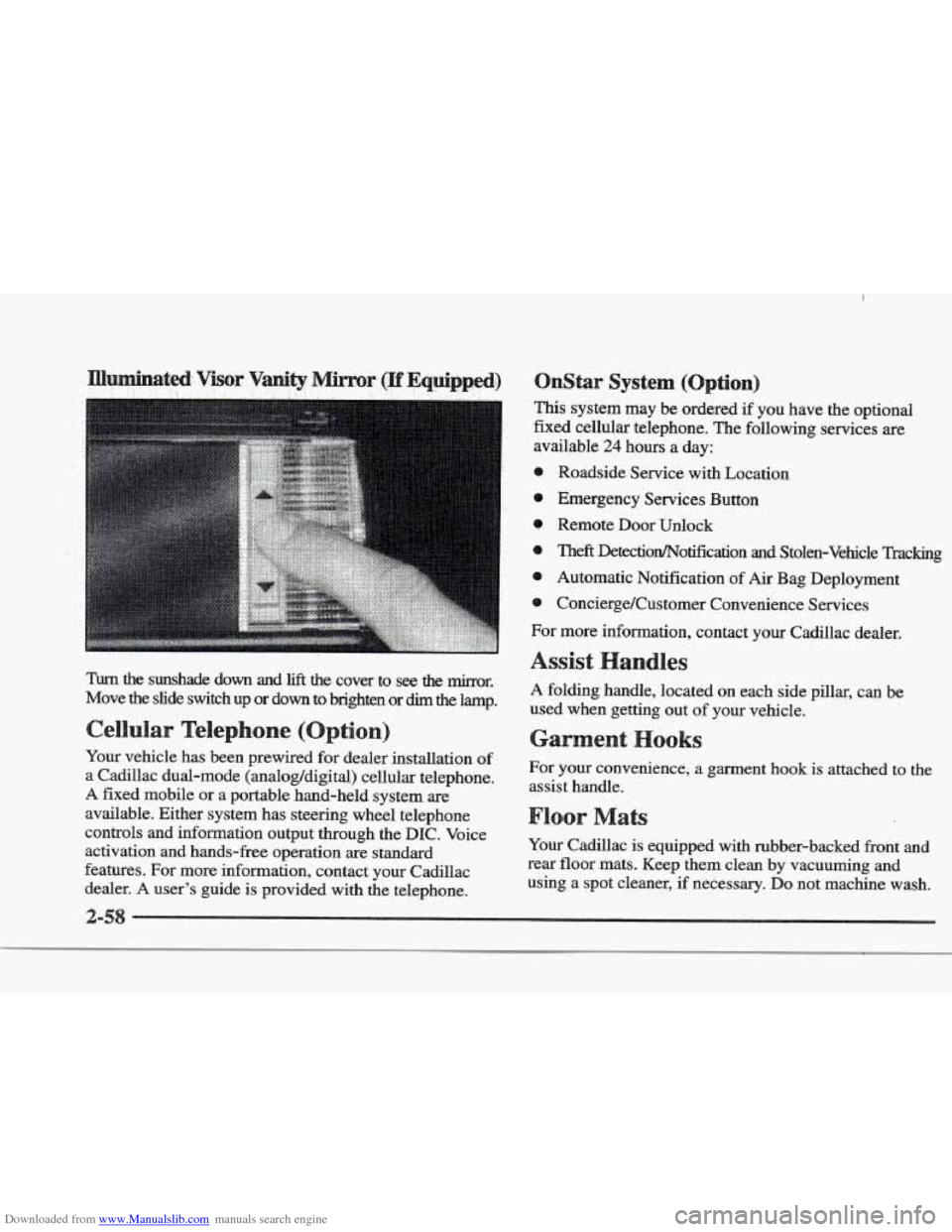
Downloaded from www.Manualslib.com manuals search engine Turn the sunshade down and lift the cover to see the nirror.
Move the slide switch up or down to brighten or
dim the lamp.
Your vehicle has been prewired for dealer installation of
a Cadillac dual-mode (analog/digital) cellular telephone.
A fixed mobile or a portable hand-held system are
available. Either system has steering wheel telephone
controls and infomation output through the DIC. Voice
activation and hands-free operation are standard
features. For more information, contact your Cadillac
dealer.
A user’s guide is provided with the telephone.
nStar System (
This system may be ordered if you have the optional
fixed cellular telephone. The following services
are
available 24 hours a day:
@ Roadside Service with Location
Emergency Services Button
@ Remote Door Unlock
ta Theft Detectioflotification and Stolen-Vehicle Tracking
@ Automatic Notification of Air Bag Deployment
Concierge/Customer Convenience Services
For more information, contact your Cadillac dealer.
A folding handle, located on each side pillar, can be
used when getting out of your vehicle.
For your convenience, a garment hook is attached to the
assist handle.
ts
Your Cadillac is equipped with rubber-backed front and
rear floor mats. Keep them clean by vacuuming and
using a spot cleaner, if necessary.
Do not machine wash.
Page 128 of 361
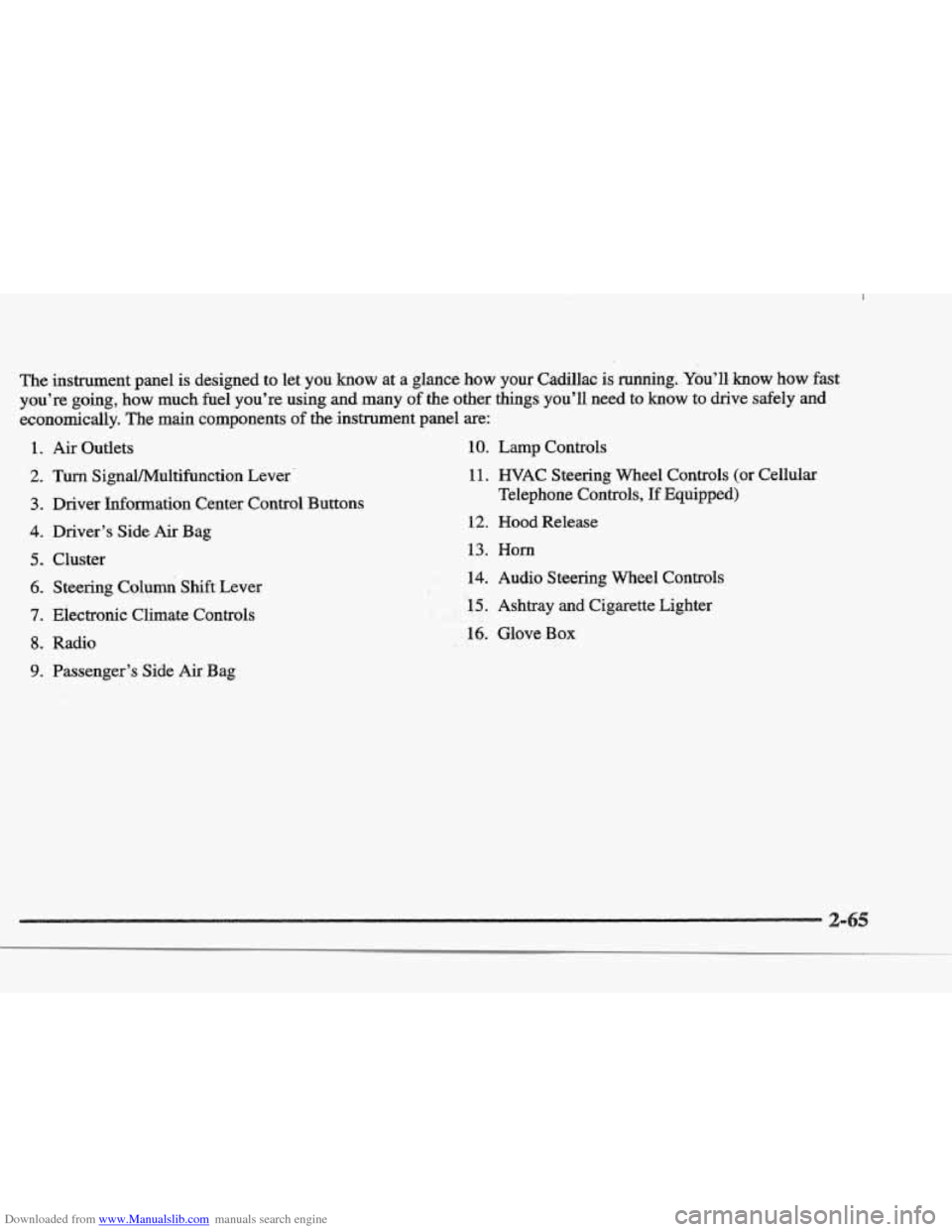
Downloaded from www.Manualslib.com manuals search engine The insbrument.pane1 is designed to let you know at a glance how your Cadillac is running. You’ll, know how fast
you’re going, how
much fuel you’re using and many of the other things you’ll need to know to drive safely and
economically. The main components of the instrument panel are:
1.
2.
3.
4.
5.
6.
7.
8.
9.
Air Outlets
Turn SignaVMultifbnction Lever.
Driver Information Center Control Buttons
Driver’s Side
Air Bag
Cluster Steering Columi Shift Lever
Electronic Climate Controls
Radio
Passenger’s Side
Air Bag
10. Lamp Controls
11. WAC Steering Wheel Controls (or Cellular
Telephone Controls,
If Equipped)
12. Hood Release
13. Horn
.#k. 14. Audio Steering Wheel Controls
F. , LI
- , .r 15. Ashtray and Cigarette Lighter I !i&&
16. Glove Box
Page 137 of 361
Downloaded from www.Manualslib.com manuals search engine If the regular brake system warning light is also on, you
don’t have anti-lock brakes and there’s a problem with
your regular brakes. See “Brake System Warning Light”
earlier in this section.
The anti-lock brake system warning light should come
on briefly when you
turn the ignition key to RUN. If the
light doesn’t come on then, have
it fixed so it will be
ready to warn you
if there is a problem.
TRACTION
CONTROL
This warning light should
come on briefly as you start
the engine. If the warning
i light doesn’t come on then,
have it fixed so it will be
ready to warn you if there’s
a problem.
If it stays on, or comes on when you’re driving, there
may be a problem with your traction control system and
your vehicle may need service. When this warning light
is on, the system will not limit wheel spin. Adjust your
driving accordingly.
The traction control system warning light may come
on
for the following reasons:
9 If there’s a brake system problem that is specifically
related to traction control, the traction control system
will
turn off and the warning light will come on.
If the traction control system is affected by an engine
related problem, the system will turn
off and the
warning light will come on.
If the traction control system warning light comes on
and stays on for an extended period of time when the
system is turned
on, your vehicle needs service.
Page 150 of 361
Downloaded from www.Manualslib.com manuals search engine ENGINE COOLANT HOT-IDLE ENGINE - 44:
This message will appear when the engine coolant
temperature is over
248 OF (1 26 O C). To avoid added
strain
on a hot engine, turn off the climate control system.
Stop and allow your vehcle to idle until it cools down or
the message is removed. If it does not cool down, turn
off
the engine and have it serviced before driving it again.
Severe engine damage can result
from an overheated
engine. See “Engine Overheating”
in the Index.
ENGINE MISFIRE -- EASE OFF GAS
PEDAL - 1114: An engine misfire has occurred.
You’ll need to ease
off the gas pedal.
FUEL LEVEE LOW - 11: This message serves as a
warning that the
fuel level in the tank is critically low.
Stop for fuel soon.
ICE POSSIBLE - 13: This message appears when
the outside air temperature
is cold enough to create icy
road conditions.
HEADLAMBS SUGGESTED - 23: If it’s dark enough
outside and the twilight sentinel control is
off, a
FEADLAMPS SUGGESTED message will display on the
DIC. This message informs the driver that turning on the
exterior
lamps is recommended even though the DRL are
still illuminated. (It has become dark enough outside to
require the headlamps and/or other exterior lamps.)
MONITORED SYSTEMS OK - I: This message only
appears
in the “recall” mode by pressing the RESET
button. It lets you know that no other messages are
stored or currently active.
FASS KEY NOT PROGRAMMED - 31: This
warning message displays when the PASS-Key pellet
information has not been programmed into your vehicle.
See your Cadillac dealership for service.
PCM FAULT - 110: The circuit in the Powertrain
Control Module (PCM) has shorted or
is loose when this
message appears. Have your Cadillac serviced by your
dealership at once.
REDUCED ENGINE POWER - 41: This message
informs the driver, that due to wheel slippage, your
vehicle is reducing engine power to compensate for
the loss of traction. Accelerating too fast, causing the
tires to spin, is an example of when this message
would display.
IREMOVE KEY - 70: This message will appear when
the Personalized Automotive Security System
(PASS-Key 11) is unable to read the pellet on the
ignition key or an improper key pellet has been inserted.
Wait for the
DIC to display STARTING DISABLED
DUE TO THEFT
SYSTEM REMOVE IGNITION
KEY. The instrument panel cluster will then run a timer
and change the messages
to WAIT 3 MINUTES, WAIT
Page 153 of 361
Downloaded from www.Manualslib.com manuals search engine 1 MINUTE and then START CAR. When the START
CAR message is displayed, try again to start the engine.
message will appear when the engine
has overheated. Stop
and
turn the engine off immediately to avoid severe engine
damage. See “Engine Overheating”
in the Index. A multiple
chime
will also sound when this message is displayed.
STOP ENGINE LOW OIL PRESSURE - 35: If this
message appears while
the engine is running, stop the
engine and do not operate it until the cause
of low oil
pressure is corrected. Severe damage to the engine can
result. A multiple chime will also sound when this
message is displayed.
THEFT SYSTEM PROBLEWCAR MAY NOT
RESTART - 34: Tbs message means there is a problem
in the Personalized Automotive Security System
(PASS-Key
11). A fault has been detected in the system
which means that
the PASS-Key I1 system is disabled
and is not protecting the vehicle. The vehicle usually
restarts, however, you may want to take your vehicle to
a proper service center before turning off the engine.
TOP SPEED FUEL CUT-OFF - Ill: This message
will appear when the PCM senses that
the maximum speed
for your Cadillac has been reached. The speed
of your
vehicle will decrease several mph as
the fuel supply is
STOP ENGINE ENGINE OVERHEATED - 42: This
cutoff. This allows your vehicle to stay in a stable
operating range.
TRACTION ENGAGED - 91: When your traction
control system
is limiting wheel spin, the TRACTION
ENGAGED message will be displayed. Slippery road
conditions may exist if
this message is displayed, so
adjust your dnving accordingly. This message will stay
on for a few seconds after the traction control system
stops limiting wheel spin.
TRACTHQN OFF - 89: Ths message wilI be displayed
after the traction control has
been turned off.
TRACTION READY - 91: This message informs the
driver that
the traction control system is available. This
occurs when the traction
ordoff button in the glove box
has been returned to an on position (pressing the button
once turns
the traction control system off pressing the
button again turns
the system back on). This message
also self cancels after five seconds.
TRACTION SUSPENDED - 56: This message
displays when
the traction control system has been
temporarily shut
off because your vehicle’s brakes have
overheated. This message
does not indicate a problem
with your vehicle’s traction control system. After a few
minutes, the traction control system
will be available
again and the
TRACTION READY message
will appear.
Page 156 of 361
Downloaded from www.Manualslib.com manuals search engine 3-2
3-2
3-6
3-6
3-6
3-7
3-8 3-8
3-9
3-9
3 -9
3-9
3-10
3-13
Comfort Controls
Climate Control Panel
Electronic Solar Sensor
Air Conditioning
Heating
Ventilation System
Defrosting
Rear Window Defogger
HVAC Steering Wheel Controls
Climate Control Personalization
Audio Systems
Setting the Clock
AM-FM Stereo with Cassette Tape Player and
Optional Compact Disc Player
Bose
TM AM-FM Stereo with Cassette Tape
and Compact Disc Player
In this section, you’ll find out how to operate the comfort control and audio systems offered with your Cadillac. Be
sure to read about the particular systems supplied with your vehicle.
3- 17
3-2 1
3-24
3-24
3-25
3-25
3-25
3-26
3-27
3-27
Bose TM AM-FM Stereo with Cassette
Tape and Compact Disc Player with Digital
Signal Processing
Trunk Mounted CD Changer
Radio Personalization
Theft-Deterrent Feature
Audio Steering Wheel
Controls
Understanding Radio Reception
Tips About Your Audio System
Care
of Your Cassette Tape Player
Care of Your Compact Discs
Power Antenna Mast Care